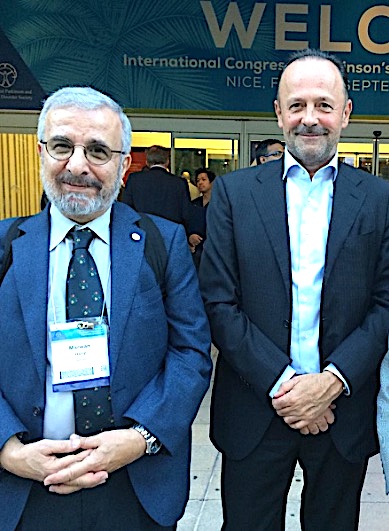
Marwan Hariz (left) and Joachim Krauss (right) together at the MDS meeting in Nice, 2019
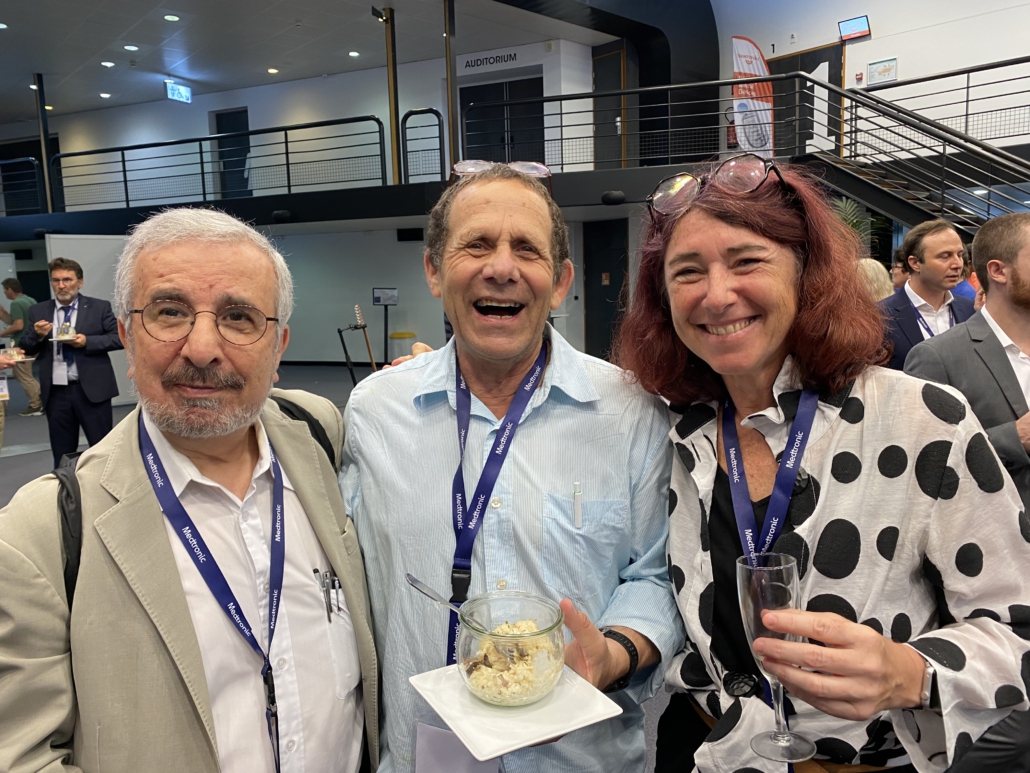
Marwan Hariz (left) together with Hagai Bergman (center, episode #17) and Christelle Baunez (right, episode #41) at the 30th year anniversary of STN-DBS held in Grenoble, 2023 by the DBS Society.
#47: Marwan Hariz & Joachim Krauss – Toward a third wave of pallidotomies?
Marwan Hariz and Joachim Krauss need no introduction. First, because they are famous, and second, because they have been on the show, before. In fact, Marwan Hariz is the first to have been on the podcast three times, first, as an early adopter and trustee in episode 3, second, together with Joachim Krauss and Christian Moll in episode 33, and now again with Joachim in the present episode. I met Joachim in Grenoble at a meeting celebrating the 30th year anniversary of STN-DBS. He mentioned that the last episode had been fun, and that it could be great to do an episode on the history of pallidotomies. Needless to say, I would always spend as much time as I can get to speaking with these legends in the field, so of course we went ahead with the idea. I think there are few people that know as much about the history of stereotactic surgery as Joachim and Marwan. In fact, recently, they have been designated as the Historians of the ESSFN and also of the WSSFN (the latter together with Rees Cosgrove).
In this conversation, I learned that pallidotomies came in two waves throughout history, and we may be witnessing the beginning of the third wave now with the growing popularity of focused ultrasound surgery. So sit back and enjoy while Marwan and Joachim take us on a ride through the centuries to shed light on the convoluted historical path of the surgical procedure we call pallidotomy.
Marwan Hariz & Joachim Krauss 00:00Gamma Knife is more comfortable because the couch of Electra is more comfortable than lying on the MRI couch. Actually, Fritz Mundinger and Richard, they did not like Cooper. So whenever I mentioned Cooper, they said, ah, Cooper, and we did it before, or something like this. And I think maybe it's true, yeah. Richard was a good friend of Spiegel, and Spiegel visited Freiburg, and Richard visited Spiegel. What they said is that they did the first thalamotomy years before Cooper, by an act of serendipity, used the thalamus as a target by himself in 1957. And also, polyglotomies were done already in the late 40s, and they spread all over the world already in the early 50s. So when Cooper had had this happening during the surgery for a protomotomy, where he severed the anterior corrhedral artery, and he observed lesion in the polydome, 01:02the attacking polyglotomies were already routine, or were in place in several other instances.
Andreas Horn He was attacked in a letter to the editor by Spiegel and Weiss. They attacked him in a letter that I will send to you later. I don't know if Joachim has the letter, published letter. He was attacked by Spiegel and Weiss for plagiarism. They attacked him. They claimed that he had plagiatized their brain. Welcome to Stimulating Brains. Marwan Hariz and Joachim Kraus need no introduction. First, because they are famous, and second, because they have built a lot of history. They have been on the show before. In fact, Marwan Hariz is the first to have been on the podcast three times. 02:03First, as an early adopter and trustee in episode 3. Second, together with Joachim Kraus and Christian Moll in episode 33. And now again with Joachim in the present episode. I met Joachim in Grenoble at a meeting celebrating the 30th year anniversary of STN DBS. He mentioned that the last episode had been fun, and that it could be great to do an episode on the history of polydotomies. Needless to say, I would like to thank Joachim for his time. I would always spend as much time as I can get speaking with these legends in the field. So of course we went ahead with the idea. But to demonstrate just how busy both of them are, we planned this in summer 2023 and only now got to it. I think there are few people around that know as much about the history of stereotactic surgery as Joachim and Marwan. And in fact, recently they have been designated as the historians of the ESSFN and also of the WSSFN, the latter together with the WSSFN. And I think that's a really good thing. I think that's a really good thing. I think that's a really good thing. In this conversation, I learned that polydotomies came in two waves throughout history, 03:02and we may be witnessing the third wave now with the growing popularity of MR-guided focused ultrasound surgery. So sit back and enjoy while Marwan and Joachim take us on a ride through the centuries to shed light on the convoluted historical path of the surgical procedure we call polydotomy. So thank you so much, Joachim and Marwan, for joining again. This is, of course, a big honor to be able to talk to you again as two of the most knowledgeable people, not only as surgeons, but also about the history of neurosurgery and neuroscience. And I think we thought about, together this came up to do an episode about polydotomies,
Marwan Hariz & Joachim Krauss which makes me think that there are a lot of people out there who are not sure about the history of surgery. There may have been a forgotten art, but seem to come back 04:00and have already had several comebacks in the history, or one comeback in the history, which we'll cover. And so this is obviously not a topic where I'm very familiar, but you are. So I hope we can learn a lot from you guys. You just wrote me in an email that you both are the official historians now of the WSSFN.
Andreas Horn Is that correct? Yeah. What does that involve? As a job?
Marwan Hariz & Joachim Krauss Correcting the mistakes of other people. And sometimes seeking out old manuscripts and see that several issues have already been raised decades ago and sometimes being solved also.
Andreas Horn Yeah.
Marwan Hariz & Joachim Krauss Great.
Andreas Horn Yeah, I read your fantastic chapter on polydotomies that you sent around, Joachim, and there you write the same thing, right?
Marwan Hariz & Joachim Krauss That when it came... When it came back, there were a lot of things that had already been considered back in the day. 05:01And I think we often have that now with focused ultrasound as well. But even in almost everything, even Haggai Bergman in his book wrote that he later discovered that 30 years ago, there had been another person that had already talked about the role of histamine in the basal ganglia and so on. So there's always these rediscoveries, and it's really worthwhile to study history for that reason. I totally agree. So I think we've both been on the show before. Usually I ask about hobbies, but we've covered that before, so we can jump directly into the science. And Marwan, in your 2022 Serendipity article, which we had also talked about before in Stereotactic and Functional Neurosurgery, you recount the tale that one of the six patients originally described by James Parkinson had a stroke, which led then to the alleviation of tremor. And... In the early 1900s, this, among many other reasons, led to surgeons aiming to mimic 06:03stroke using ablative surgery, mainly to treat tremor, I think, but also ototosis and dystonia. And surgical procedures for this paralysis, agitans, or Parkinson's disease, they did consist in most part in creation of lesions of the entire corticospinal system. You also write beautifully about that, Joachim, in your... chapter. So the motor cortex, the spinal cord, anything in between had been lesioned and tried. I think, Joachim, you even wrote that for balism, there was even the idea to amputate limbs, right, as a recommendation, which is, of course, very drastic as well. And I think all of these procedures, rhizotomies, anterolateral chordotomies, perimedotomies, pedunculotomies... and so on, they usually went into improving the symptom, but also losing function with 07:04paralysis of the limb. I think Paul Busse even ablated areas four and six in individual cases, which also led, of course, to paralysis.
Andreas Horn So we want to focus on paludotomies today, but before we go into that, could you maybe summarize a bit about these very early days of ablative neurosurgery? Is it possible to derive an executive summary of this earlier area?
Marwan Hariz & Joachim Krauss Okay, I can start a little bit. The first operation for Parkinson's disease was done in 1912 and published by René Leriche. René Leriche is a famous general surgeon who also trained Pierre Wertheimer, who is the neurosurgeon in Lyon, who gave the name. He went to the hospital. The hospital in Lyon is by the name of a neurosurgeon. 08:00Anyway, René Leriche is on a stamp, postal stamp of the French postal stamp. So what he did is a posterior rhizotomy of C2 to C8, C2 to C8, to cure tremor. Well, it didn't work well, and that was the first operation ever published for Parkinson's disease. Then you jump many years, and then it's operations on the motor cortex. And I think it was Broder who started, and he wrote a paper where he said, it is impossible to cure tremor without provoking paralysis. That was his conclusion. And then it is told by Blaine Nashold, who is a grand old man of American. functional neurosurgery, that at that time they were doing mostly functional neurosurgery for psychiatric illness, as you know. And during leukotomy or lobotomy, Browder went very far medial, so he cut the head of the caudate. And the patient had the psychosis, but also Parkinson or tremor. And the tremor was cured. And this probably is why Riechert 09:26thought, aha, maybe we should start curing Parkinson's by taking away the head of the nucleus caudatus. And it started from this, and then he went more deeper and deeper and deeper. So, Marwan, sorry to interrupt. Let's go into that in the next question.
Andreas Horn But how about maybe can we summarize also the pyramidal system lesions that were before Maya's time?
Marwan Hariz & Joachim Krauss Maybe I can add something on the dystonic movement disorder. So, as far as I found out, I think the first cortical lesion for atritosis, or it was called at that time, was actually made by Sir Victor Horsley. 10:12And maybe that was in 1890. Because there are two sources. One is a publication. From Horsley, which is called Remarks on the Surgery of the Central Nervous System, published in the British Medical Journal in 1890. And the other one is a clinical lecture on the function of the so-called motor area of the brain. At that time, it was so-called motor area. And this report reports a talk about a patient with atritosis. And. They thought the atritosis started after some peripheral surgery and he went ablation of the cortex. 11:03So that was the first source I could find of cortical ablation. Before it was applied to PD or Parkinson's disease. And Joachim, you're also a neurologist. I think that's not widely known.
Andreas Horn But is atritosis really the same thing as modern dystonia?
Marwan Hariz & Joachim Krauss I always, I don't know that myself. I always wonder. It seems similar. But. Because now we use atritosis for specific symptoms.
Andreas Horn Yeah. But at the time, you never find the word dystonia in these early reports. And my feeling is that they, when they speak about atritosis, they mean dystonia. Is that correct?
Marwan Hariz & Joachim Krauss Or. Well, I would say they mean basic dystonia, mobile form of dystonia, but not really regarding the posture. On the other hand, we have some early photographs where they show core atritosis. The hands also. And you can clearly see the dystonic process of the finger cell. But I think atritosis, especially the term core atritosis, was coined to describe more the mobile part of the disorder.
Andreas Horn Okay.
Marwan Hariz & Joachim Krauss Great. So, so, so, so again, many, many systems of the pyramidal system from, from motor cortex down were lesions.
Andreas Horn 12:00And that had been done for how many years before we touched or, you know, touched the heart?
Marwan Hariz & Joachim Krauss basal ganglia, was it at least decades, right? Where before, because my understanding is that the basal ganglia were considered, for example, were considered the seat of consciousness. So, lesioning them for a long time was a no-go. I think they were called Noli Metangere, as you write, Marwan. So, a structure not to be touched. And then, essentially, it came about as an accident. And you were just about to describe that, Marwan. Maybe you can continue there then. 13:03It was Walter Dandy, the neurosurgeon who invented the ventriculography in 1918, who
Andreas Horn said that you should not touch the basal ganglia. Why he said that? Well, because he thought it was the center of consciousness. And that was one of the reasons why Spiegel, in the beginning,
Marwan Hariz & Joachim Krauss and he described that, was very keen on or very fearful to do the paludotomy, especially on both sides because it was a very dangerous thing. And he said, well, you know, you can't touch the basal ganglia. And he said, well, you can't touch the basal ganglia. And he said, well, you can't touch the basal ganglia. And he said, well, you can't touch the basal ganglia. And he said, well, you can't he said, well, you can't touch the basal ganglia. And he said, well, you can't touch to these And as you know in carbon monoxide intoxication you have affection of both globus pallidae, the whole, and the patient is in coma. I think Joachim knows more about this.
Andreas Horn Joachim Rasmussen Yeah, it was one actually of my early manuscripts was on Eastulfiram
Marwan Hariz & Joachim Krauss 14:00introducing pallidal lesion with subsequent Parkinson's and dystonia.
Andreas Horn Dr. So did those, these also played a role in the surgical history, right?
Marwan Hariz & Joachim Krauss That these findings post-mortem that after intoxication you had lesions in the pallidum that led to Parkinson's disease.
Andreas Horn Is that correct? Did that play a real reason to better understand things?
Marwan Hariz & Joachim Krauss Dr. Yeah. Remember that the open surgery of... Dr. Yeah. Dr. Russell Meyer, Guillaume, Fenelon with different approaches, transventricular, sub-temporal, or trans-cortical, were aimed at the unsalenticularis expressively. It was not pallidotomy, open pallidotomy, it was unsalenticularis. How they found it, you know, without frame, without radiology, without open eye, I have a big admiration. 15:00It's a hard time to find it now with MRI and tractography and everything. But that's what they aimed at. So they didn't aim at the pallidom. They aimed at the outflow of the answer.
Andreas Horn Right, Joachim?
Marwan Hariz & Joachim Krauss Dr. Yeah. And there was some report in one of Meyer's manuscripts from 1949. And they used kind of a transventricular approach with an angulated probe. And what they say is they went to the answer. I think it was in the early 20th century. Dr. Yeah. And they also tried to extirpate the oral code of the proboscopiditis. So they did not really go to what we now call the sensory motor area, but they were definitely more anterior and in the anterior part lower, more ventral initially. Dr. Great. So again, to summarize, the first incident to touch the basal ganglia was probably Jefferson Browder's case. That excised the caudate that you just mentioned before. 16:02And then likely following that, Russell Myers, I think in 1939, operated on a 26-year-old patient with a likely diagnosis of post-encephalitic Parkinsonism. And he used a transquarticle transventricular approach. Beautiful picture of, I think, that approach in your book chapter, you know, coming from medially through the ventricles, I think.
Andreas Horn Right?
Marwan Hariz & Joachim Krauss Meyers resected the anterior two-thirds of the head of the caudate nucleus. Reading that now, my feeling is, you know, head of the caudate, I always think of the potamen of being the motor part of the striatum
Andreas Horn and head of the caudate more cognitive or so, but it seemed to have helped, right? Striking
Marwan Hariz & Joachim Krauss improvement with complete cessation of tremor, except when the patient was emotionally excited, that the patient was emotionally excited. Sorry, there was still tremor when the patient was 17:00emotionally excited. And this established for the first time that it was possible to improve
Andreas Horn Parkinson's symptoms with a surgical procedure that did not produce paralysis, right? So that
Marwan Hariz & Joachim Krauss was a real breakthrough, I think. And then, you know, this went through the roof with a case series of more patients. Maybe you can tell the story of Russell Myers a bit more, if possible. No, no, you do it.
Andreas Horn Yeah, well, I was,
Marwan Hariz & Joachim Krauss I was, I must say I was fascinated to read these papers by Russell Myers. And I read many of his articles. I never met him. And he actually was a little bit ignored in the function that's a tactic you certainly seen initially. And I think he was only discovered later. But he never had a firm position in history for a function that's a tactic you're 18:05searching only until later when they really discovered his pioneer work. And as far as I understand, he also abandoned functional surgery at a relatively young age, in his 40s or so. And I think later, he did not engage any longer in these types of surgery. Also, especially the early functional surgery, the open approaches somehow followed his targets, but with different techniques. You know, the concept of functional neurosurgery was coined by Pierre Wertheimer from Lyon again, in a book in 1952 or 56. That's where the first time functional neurosurgery is, is coined as a category. But remember, Andy, that all almost all neurosurgery in the 20s 30s 40s. We're psychically, 19:03I think surgery. So it was not an every in the beginning, it was not, you know, the attempt, of course, and every surgery pituitary surgery with Harvey Cushing, but most of this early neurosurgery was either traumatic for after World War, World War One, down to World War Two, and lobotomies, different kinds of of the economies. So that was, and they didn't call themselves functional neurosurgery. They were general neurosurgery operate anything that could be operated. So that's, I agree with Joachim, he was not a functional neurosurgeon, Russell Meyers. Got it. And I think that's a very important point that both of you highlight every every now and then in your papers that that the entire stereotactic surgery field comes from psychosurgery,
Andreas Horn 20:00essentially, right? We discussed that in the last episode as well.
Marwan Hariz & Joachim Krauss I think it is still true that a lot of cases or maybe not a lot, but there were early cases with Huntington's as well, right? I think Huntington's was a what seemed to be a prominent diagnosis to do surgery in these days, but then also, of course, as we mentioned, Parkinson's and atatosis as well. I think I also learned this from from you, Marwan that that the first DBS for the first DBS, maybe ever, the first DBS, maybe ever, was the one that was the most popular surgery in the world. And I think that's a very important point. And I think that's a very important point. And I think that's a very important point. And I think that's a very important point. And I think that's a very important point. And I think that's a very important point. And I think that's a very important point. So the example that you mentioned in 48 by pool was, I think it was for psychiatric symptoms. But it was a lady with Parkinson's. Well, the day it was several the but the first lady had had some psychosis. And funny enough, the target was the head of the caudate. Yes. Yes. Interesting. Okay. So I think one one issue in Myers approach, and also in the 58 cases 21:01that he operated between the two areas.
Andreas Horn between 39 and 49 from your excellent work was the high complication rate, right?
Marwan Hariz & Joachim Krauss Because of the open transventricular surgery, I think up to 40% mortality rate, as you write.
Andreas Horn What followed in the attempt to improve that? Shall I say something about Phenolone? No one? Yeah, yeah, yeah.
Marwan Hariz & Joachim Krauss All right. So in the late 40s, the French neurosurgeons, I think, were inspired also by the work of Myers and Crowder. And they started to target the basal ganglia and also the pallidum and pallidophageal pathways by different approaches, not transventricular. So Phenolone had two approaches. One, a temporal approach. 22:01To go to the basal ganglia, and he also later applied a transfrontal approach. So trying to avoid some of the early complications. And I think two or three years later, Guillaume and Brion, two other French neurosurgeons, they modified the technique, having a subfrontal approach and a transilvan approach. And they started to have... open approaches for placing the lesion in the head. But that was in parallel to the development of cirotactic surgery already.
Andreas Horn Okay.
Marwan Hariz & Joachim Krauss The aim was all the time to decrease the morbidity. I mean, all efforts, in my historical opinion, were concentrated on... 23:01more and more pointing to the target while avoiding the side effect. In any... You can start with lobotomy, which is different kinds. And then for movement disorder. And then all this converged until stereotaxis was invented. Which was the ultimate tool to avoid the... the...
Andreas Horn harming the rest of the brain, right?
Marwan Hariz & Joachim Krauss So this is how it came about. And all these different techniques that Joachim mentioned, is how to get to the area of interest without harming the rest of the brain. This is the essence of neurosurgery. And even more the essence of functional neurosurgery. But also the essence of general neurosurgery. 24:00How to get to the... the aneurysm without opening half the head. How to get to the tumor. You know. It's the essence of neurosurgery.
Andreas Horn In that line, maybe focused ultrasound or gamma knife could be seen as another way to do that, right?
Marwan Hariz & Joachim Krauss In the same line where you try to spare an open approach. Of course, with all the downsides, and I know that's a bigger topic, but at least it's an attempt in the same direction. Yes, we can discuss that later. It's... I'm not sure it's better than...
Andreas Horn Yeah, yeah, yeah.
Marwan Hariz & Joachim Krauss I get the point. So I think around that time we should mention Cooper performing the pedunculotomy and then the accidental lesioning of the anterior coroidal artery.
Andreas Horn Can you maybe talk about that Joachim or Marwan?
Marwan Hariz & Joachim Krauss Joachim, he better to talk. He doesn't like Cooper. Well... It's... 25:00It's... That's not completely true. I mean, I was raised, so to say, by Fritz Mundinger in my functional neurosurgery childhood. And actually, Fritz Mundinger and Richard, they did not like Cooper. And so whenever I mentioned Cooper, they said, ah, Cooper. And we did it before or something like this.
Andreas Horn Okay.
Marwan Hariz & Joachim Krauss And I think maybe it's true, yeah. And so Richard was a good friend of... Of Spiegel. And Spiegel visited Freiburg and Richard visited Spiegel. And so what they said is that they, I think, that is a historical fact, that they did the first thalamotomy in 1952.
Andreas Horn Okay.
Marwan Hariz & Joachim Krauss Years before Cooper, by an act of serendipity.
Andreas Horn Okay.
Marwan Hariz & Joachim Krauss By an act of serendipity. By an act of serendipity, introduced thalamus or used the thalamus as a target by himself in 1957. 26:07And also, polyglotomies were done already in the late 40s. And they spread all over the world already in the early 50s. So when Cooper had this... This happening during the surgery for... For... For... For... For a polyglotomy, where he severed the anterior corrhedral artery and he observed a lesion in the pallidum, pallidotomies, the attack of pallidotomies were already routine, were in place in several other instances.
Andreas Horn That's very interesting to know. Yeah, because it's often really the good marketing, right, that may write the history. Absolutely. Absolutely. Yeah.
Marwan Hariz & Joachim Krauss It's not only that. 27:00It's also the fact that, as Joachim wrote, the papers from Germany were written in German.
Andreas Horn Yes.
Marwan Hariz & Joachim Krauss The papers from France were written in French. And the papers of Cooper were written in English, of course. But the advantage of writing in English and coming from the United States mirrors the influence of that country. The United States of America growing up between World War I and World War II. And of course after that. So what is... What is coming from the States until to this day weighs more than what is coming from Germany and France. Although the big pioneers of the United States, like Pat Kelly, Gildenberry and others, they visited Europe. They visited Europe. They visited Europe. They visited Europe. And they learned from Europe. 28:00Jules Hardy from Canada who went to Albert Fessard and Guillaume. Pat Kelly who went to Tallerac. Gildenberry who went to Freiburg. They...
Andreas Horn Penfield was with Foerster, right? Yeah. Yeah. Yes. Yes.
Marwan Hariz & Joachim Krauss So they come here to Europe. They learn from Europeans and they... Well, Cooper didn't come here. But the point is what is published from where you live now carries heavy weight. It's heavy weight internationally more than what is published from Germany or France or Kandahar in Afghanistan. Although the latter may be more correct, but this is another story.
Andreas Horn So this is one of the reason why Cooper is credited to be the inventor of thalamotomy, which is wrong, of course.
Marwan Hariz & Joachim Krauss And by the way, I was very sad to learn. You, Joachim, that the first paper on thalamotomy from Freiburg, the operation was done by Munninger, but he was not on the paper. 29:06Yes, absolutely. This is this is unexcusable.
Andreas Horn What happened? Well, that's another interesting story, Mawwan.
Marwan Hariz & Joachim Krauss So I found the operative report. I still have to publish it.
Andreas Horn Yeah.
Marwan Hariz & Joachim Krauss And it's clear that. So it's stuck. It's stuck. It's stuck. It's stuck. It's stuck. It's stuck. The idea started from Hasler because Hasler had his theory of the thalamus, the motor thalamus and so on. And so Hasler came up with the idea to target the thalamus for treatment of trauma. And Munninger was a young resident. I think he was in his second year of residency or third year. And he was searching to do this thalamotomy. And in Freiburg at that time, they already had a series of paludotomies. So they switched to thalamotomy for treatment of Parkinson's in trauma. 30:00And when the paper was published, residents at that time had no right to appear as co-authors on a manuscript. And I must say he was very frustrated about the fact and he was frustrated even 50 years later.
Andreas Horn Well, yeah, understandably. Yeah. How much older was he to you? Like how when you trained with him or with the Freiburg team, what was it? Was it a generation between you and them?
Marwan Hariz & Joachim Krauss Absolutely big generation. So Professor Munninger was born in 1924. So when I joined him in 1987, I was a very young guy. And Professor Munninger was a big senior figure. And. And it was very impressive for me. And still angry about the fact. 31:01I could understand that.
Andreas Horn Yeah, it's a good. Yeah. It's fascinating to me also in general, the story of Rolf Hasler, because he was not a clinician, right?
Marwan Hariz & Joachim Krauss He trained with the folks. He was a pathologist, as I understand. But he did not treat patients. But he still seemed to be very seem to have been very influential on the team.
Andreas Horn Yeah. Is that correct?
Marwan Hariz & Joachim Krauss So. So he was not a neurologist and not a neurosurgeon, but he seemed to have played a key role. No. No. No. You're right.
Andreas Horn I mean, they had a fantastic team in Freiburg.
Marwan Hariz & Joachim Krauss And I had an interview with Professor Munninger in 1998 about the history. And he told all of the history that is actually lost in the meantime. And it was a big problem because Freiburg was completely destroyed. And so all of the incidents were gone. 32:00And they built it up very slowly. And there was a psychiatrist. And he built up a team of neurologists, neurosurgeons. So with Richard Jung and he had Hasler on board. And so later Richard came and Munninger came. And so Hasler had a big influence with his anatomical studies. Hmm. And he laid the grounds for much of the basic gang and network, which we understood only later. Network, I think, really. Because first, of course, it was for holidry and some connectivity. And I think, I mean, when you look at it, his nomenclature for the thalamus is still being used today, although it's outdated.
Andreas Horn Yeah.
Marwan Hariz & Joachim Krauss It's in the Schaltenbrand Waren Atlas, right, as well.
Andreas Horn Yeah.
Marwan Hariz & Joachim Krauss So. So. So quite remarkably. Maybe as an anecdote that goes into the same line of what you just said, Marwan, with the 33:02carrying weight of the US and so on. I had the big honor that Maelon de Long visited me here at the Brigham recently. And we talked about earlier times. And I also showed him these quite early studies of the Vogts and Hasler from the straddle system, I think from 1920, where a lot of the loops were already anatomically at least identified.
Andreas Horn Yeah.
Marwan Hariz & Joachim Krauss And then, you know, which is another way of, you know, similarly, I think these publications were in German at the time. Right. So just hard to find as an American. And then I also found it quite remarkable that he told me that he met Rolf Hassler at some point at conferences and he seemed like a very dominant figure. I don't know if that matches your... He was extremely dominant. I mean, the two German most dominant figures are Rolf Hassler and Schaltembrand. 34:04OK. One from Würzburg, right, who was succeeded by Volkmann now, in a way, and then Hassler. And remember, Hassler is connected so much with Freiburg, but Hassler published also with Gerd Diekmann on psychosurgery from Homburg-Saar. I don't read German, unfortunately, not so much.
Andreas Horn But I have followed the German school, and it's fascinating how this man was like the center of all stereotactic and functional neurosurgery in Germany, and not only in Germany. So maybe, I don't know if he published also with people from Göttingen, but at least with Gerd Diekmann, he has papers on Tourette and on psychiatric surgery. Right, Joachim?
Marwan Hariz & Joachim Krauss You're right, Mama. 35:00And he actually, he moved from Freiburg then later to Frankfurt and had his own institute in Frankfurt. And I tried to contact his daughter, who was taking care of the remains of the institute to get a brain of a patient with hemibalism. But actually, I don't know what happened to this institute in the end. It's kind of a museum, if you can go there. He was very influential on many other people.
Andreas Horn Okay.
Marwan Hariz & Joachim Krauss So I think we've diverged a bit, of course, to go back to paludotomies and the history. I think we had been talking about Cooper. I learned that he did not invent thalamotomies. I think in parallel, stereotactic procedures were developed, I think, as a consequence of the 1936 Nobel Prize winning work of Agas Moniz with leucotomies and the treatment of mental illness. That were original. Originally, I think, celebrated, but then, you know, had a lot of side effects, were very extensive. 36:07So we have already talked in the last episode about Spiegel and Weiss's, and you've mentioned Spiegel before, who I think in 1947 carried out the first stereotactic procedure. One year later, in 1948, they performed a paludotomy in a patient with chorea Huntington with the rationale, and I'm quoting again, of course, Marwan's great papers here. With the rationale to tackle the output structure of the extrapyramidal system. And then following these reports, I think several frames were designed by Tyler in Paris, Lexell in Lund, and Richard in Freiburg. So that was the dawn of stereotaxy. I think before, maybe to briefly mention it, I think three decades earlier, Horsley in Britain had already created a frame, but only used it in animals, just to give credit to that. But the first human application of. Stereotactic frames was by Spiegel and Weiss's.
Andreas Horn 37:01So can you talk about this time a bit? What were the developments? Who are the key players?
Marwan Hariz & Joachim Krauss And maybe I think that was also when paludotomy started, right?
Andreas Horn Yeah, yeah.
Marwan Hariz & Joachim Krauss So at that time, every neurosurgeon who respected himself created his own frame. I have a list of all kinds of frame, you know, with all kinds of. Of the one with the bar hole, the one like this. So they created the. So I am quoted by Blaine Nashold in one of my papers where I said the history of stereotactic surgery is to a great deal the history of its stereotactic frame. Because they publish a lot of the frame. And they use the. Of course, ventriculography or pneumoencephalography. 38:04And all of these were shifting towards the movement disorder. Because already at that time, lobotomy and and psychiatric surgery was declining, not disappearing, not disappearing, but declining because of other things. And and and so and also every neurosurgeon of with self-respect. Had his own target in the paludon. I have a map of the paludon showing the targets of about 20 neurosurgeons and 20 different. I have forgotten few of them. For example, lighten and paludotomy that is like cell that we will talk about later was roughly the same target as water and Orton. In in in getting. Which way I published together with the. With the Wolfgang Hamel and and more in and Paul crack in in a paper and it was that that discovery because they have seen the autopsy of the patient. 39:09It was almost the same target as one Borsaco in in in Spain that Joaquim mentioned in his. So and and you have everything from the most anterior dorsal paludon, which was Cooper and Narabayashi to Lexell and Burrussi. And. And. And the Borsaco, which is and everything in between. Now it's little bit like today's DBS because the lesion was so big that they could take everywhere. And it's it's a it's a question of. Of who has the best the best of the tactic frame because the aim was to also to manufacture. To manufacture. To manufacture and to sell these frames. I mean there was there was an an economic incentive. 40:03Right. So you have the. Entrepreneurs.
Andreas Horn Okay.
Marwan Hariz & Joachim Krauss I did not realize that.
Andreas Horn Yeah.
Marwan Hariz & Joachim Krauss And then. And then. And then. And then. And then. And then. And then. And then. And then. And then. And then. And then. And then. And then. And then. And then. This was also in the picture. Maybe I can add something on target choice in the early years. So as you said, everyone had his own target. And there was one analysis by Levy, published in 1959. And he came to Freiburg also and he looked at the different targets. 41:01And he very nicely depicted the targets of different neurosurgeons on anatomical sketches. And so there was another neurosurgeon, French neurosurgeon, Raymond. And he actually, Raymond, had postural ventral lateral GPI as a target. I think he had been completely forgotten and neglected as well. And he was very good at that. At that time, many people went more to the anterior polydom. And of course, it's not because we now tend to glorify some ancient times. Sometimes we say, well, this was a big period of polytotomy and everything worked. But that was not the case in every place because some neurosurgeons had better results and some had worse results. And those who were targeting the anterior polydom in general had less favorable results. So, yeah. In your book chapter, Joachim, you show also the map by Hasler with the homunculi in the thalamus and the pallidum.
Andreas Horn 42:06And to me, it looks like it starts in the posterior lateral part with the legs and then goes up to the very front head of the pallidum as the head of the homunculus.
Marwan Hariz & Joachim Krauss And I think that doesn't make too much sense anymore with modern days, right? No. The motor part of the pallidum should be smaller.
Andreas Horn Yeah.
Marwan Hariz & Joachim Krauss And the front is psychiatric, you know, limbic and associative. Well, absolutely. I've seen dozens of maps of somatotopy in the pallidum. They all look different, yeah. Upside down.
Andreas Horn And, well, I mean, you should know better. What is the somatotopy now of the TBI?
Marwan Hariz & Joachim Krauss I agree with you.
Andreas Horn I mean, there are not so many good maps, right?
Marwan Hariz & Joachim Krauss I've seen probably three or so, at least in my research.
Andreas Horn Yeah.
Marwan Hariz & Joachim Krauss But I think in more modern times, and yeah, I think there is an organization. 43:00Sorry, Marwan, you have something. There is an organization because when we did a lot of pallidotomies with lightening and after lightening, when you go with the probe down and you stimulate, you can provoke dyskinesia, which is a very good sign, as you yourself have heard from Rhys Koskeroff with your discussion.
Andreas Horn Yeah.
Marwan Hariz & Joachim Krauss The first dyskinesia appear in the leg. And then you go down and down. So the homunculus, according to macrostimulation, is leg up and then arm and the head most down. So this has been repeated times and times again just by provoking dyskinesia in the off-medication patient on the table, which is a very good sign for the prognostic.
Andreas Horn Yeah. So the map of Hussler is upside down. And it's also, his is a bit more in the AP plane, right? Yeah.
Marwan Hariz & Joachim Krauss So, yeah.
Andreas Horn Okay.
Marwan Hariz & Joachim Krauss Okay, great. So, so, so in, you mentioned Narabayashi, and I think we should also mention him. 44:03You write that he was somewhat isolated from the Western world, but developed very similar concepts.
Andreas Horn Shall we maybe briefly talk about Japan?
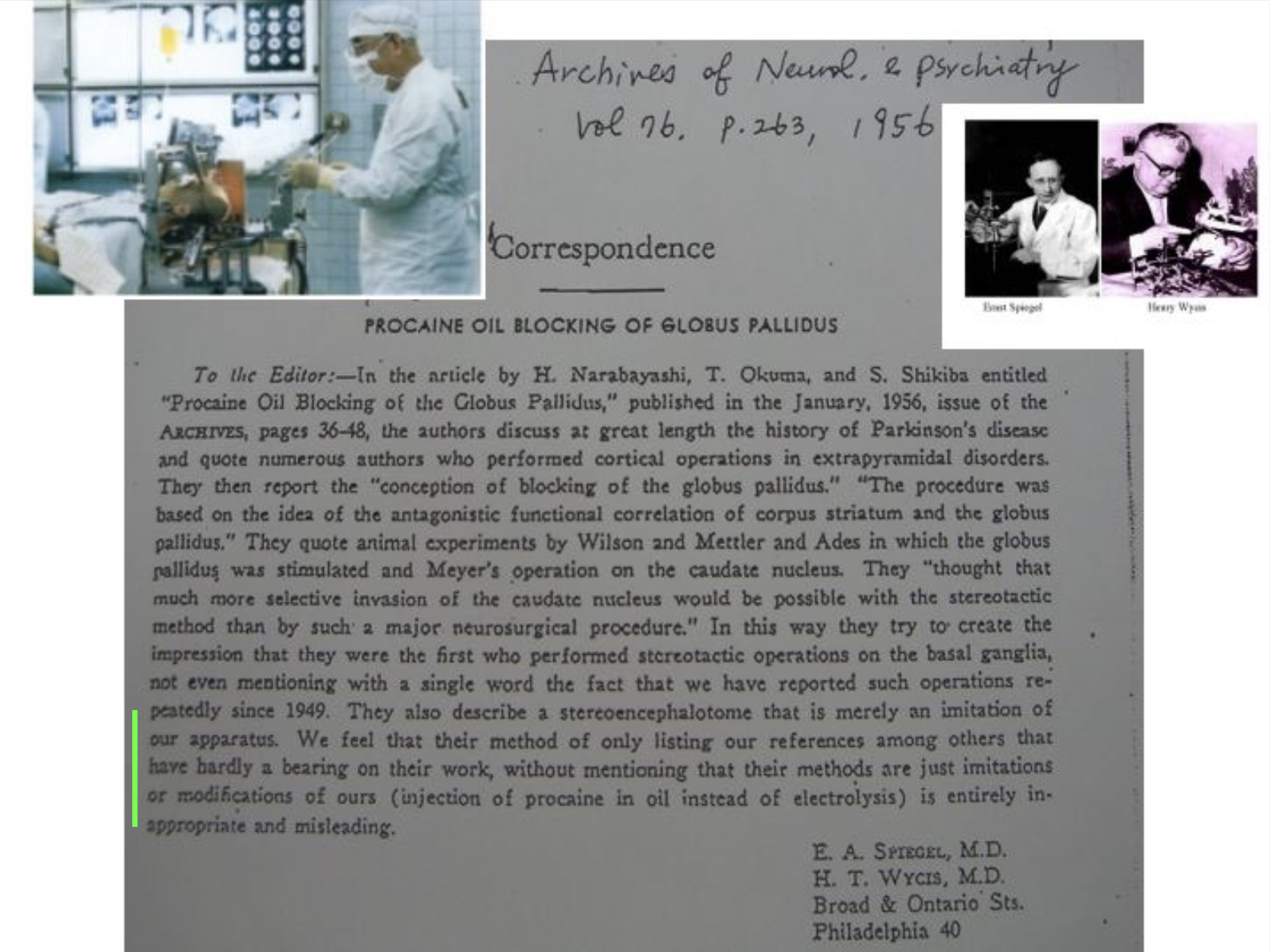
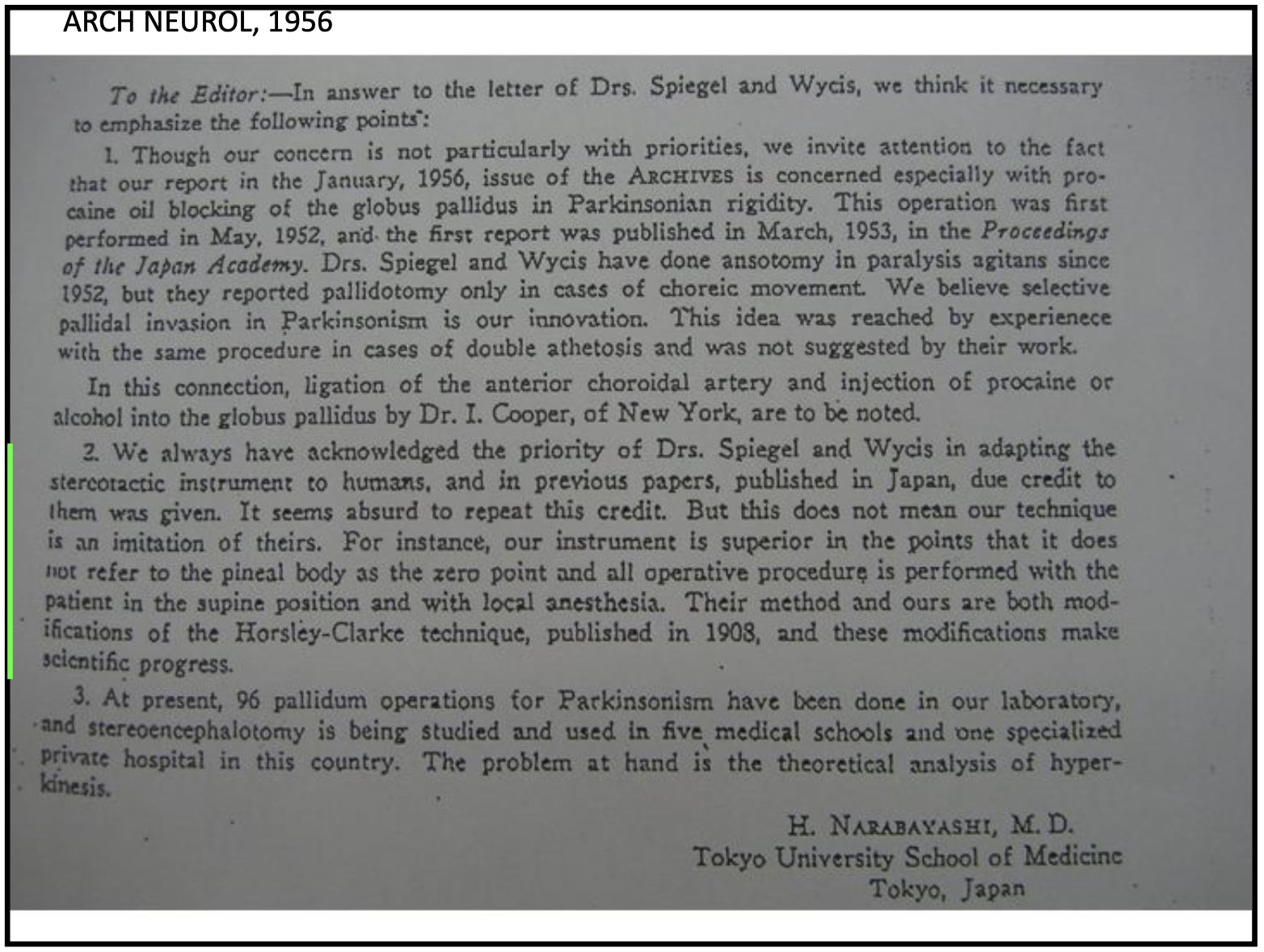
Marwan Hariz & Joachim Krauss And he is, he was attacked in a letter to the editor by Spiegel and Weiss. They attacked him in a letter that I would send to you later. I don't know if Joachim has the letter, published letter. He was attacked by Spiegel and Weiss for plagiarism. They attacked him that he has plagiarized their frame. Oh, wow. And he answered the letter with another published letter where he said he's not plagiarizing anybody and he respects their work. And it was very nice Japanese honest and polite reply. And also he mentioned, I think, that you know, he was isolated. It was after two atomic bombs on Japan, you know, in the early 50s. And he had, there was no PubMed, no connection. 45:01He saw, so, but he was still aware of their work in a way.
Andreas Horn But it was not plagiarism. And these two gentlemen, Spiegel and Weiss, attacked the man for plagiarism. Can you imagine that? Yeah. Do you have any other questions?
Marwan Hariz & Joachim Krauss No.
Andreas Horn Okay. Do you have this letter, Joachim?
Marwan Hariz & Joachim Krauss No, I don't have it.
Andreas Horn When was it published? When was it?
Marwan Hariz & Joachim Krauss It was published long time ago, in the 50s. But I will find it. I will try to find it. Well, I had the opportunity to talk to Nagabayashi. And he, I asked him about the origins of polydotomy. And he also. The first indication. The first indications for him were atatosis again. So we come back to atatosis. And Nagabayashi was not, initially, he did not start as a neurosurgeon also. 46:021956. I found the letter. 1956. 1956. So according to his personal account, he started in 1950, 1951.
Andreas Horn Yes.
Marwan Hariz & Joachim Krauss And at that time, I think he had really very little access to the world.
Andreas Horn Yes.
Marwan Hariz & Joachim Krauss And he did not have access to medical literature. I mean, not like me today. We can go to PubMed and we see everything that has been published last week. And I think they couldn't see what had been published last year.
Andreas Horn Yeah. Yeah.
Marwan Hariz & Joachim Krauss You also wrote that Nagabayashi injected prokaine hydrochloride to obtain a reversible predictive effect of palatal blocking. And then, I think, a mixture of oil, prokaine, and wax to create permanent lesions.
Andreas Horn Maybe we can talk in general a little bit about chemo lesioning, chemical lesioning. Who did it? How?
Marwan Hariz & Joachim Krauss Was it sometimes reversible, sometimes... Because I don't know anything about that topic, to be honest.
Andreas Horn 47:01Was that something Nagabayashi pioneered, in your opinion? Or was it used worldwide in multiple centers to use chemical agents?
Marwan Hariz & Joachim Krauss I don't know. I don't know. Joachim, you know better. Well, I think, as we said before, there were different tachyframes. I think also many neurosurgeons had their own lesioning methods.
Andreas Horn Yeah.
Marwan Hariz & Joachim Krauss So... Sure. Some used balloons. Some used cryosurgery. Some used electrolytic lesions, thermo-controlled lesioning, ultrasound, mechanical lesions, small knives.
Andreas Horn Yeah.
Marwan Hariz & Joachim Krauss Rotating knives.
Andreas Horn Yes.
Marwan Hariz & Joachim Krauss I think there was... Cooper, for example, used a substance called ethylpolyne, which was mainly alcohol, 95% alcohol. And I think especially in the early years, in the early 50s to the mid-1950s, there was such an abundant way of using types. When we look at what we have nowadays, this is extremely rare. And I think it's a very important thing. 48:02I think it's a very important thing. I think it's a very important thing. I think it's a very important thing. I think it's a very important thing.
Andreas Horn Yeah.
Marwan Hariz & Joachim Krauss And to these standards nowadays, this is extremely limited.
Andreas Horn Yeah. And of course, the problem was with many of these techniques, the size of these lesion was only poorly controlled. Do you agree, Marwan? Yeah. Yeah. Yeah.
Marwan Hariz & Joachim Krauss It was only on autopsy that you can see. And Marion Smith also published a very nice paper in Journal of Neurosurgery about autopsy. She was a pathologist at уд Square. And she showed autopsy of patient who eventually dies. and showed the lesion all over the place. And she even writes that she put into question when the surgeon said the excellent results when the patient died two weeks later. She published that in Journal of Neurosurgery.
Andreas Horn Okay.
Marwan Hariz & Joachim Krauss 49:00Right, so in 1958, Spiegel and Weiss then published a series of 100 palidoansotomies. I think you mentioned this before, the unsalenticularis was targeted by many. I think we had terms for ansotomy,
Andreas Horn but also forel-aged otomy, right, by others. Is it the same idea?
Marwan Hariz & Joachim Krauss Always the palidal outflow tracts. And then I think their approach had evolved to the use of intraventricular rather than bony landmarks. And apparently in 77% of their patients, it was possible to either abolish the tremor
Andreas Horn or to reduce it considerably. So was that a landmark publication or was it just a generalization? With the 100 cases, do you think?
Marwan Hariz & Joachim Krauss The issue, I think, that this is a landmark in a way that they published this palidoansoc. But at the same time, some people did even lesion attacking the fasciculus lenticularis across the internal capsule. Even Cooper has published that, 50:00claiming that you can do lesion in the internal capsule if you can target that fasciculus without provoking paresis, which is... It can be questionable. And then after the palidotomy of the cases of Spiegel, I think, I don't know if it's after or in parallel, they did what you call campotomy, campus forelli.
Andreas Horn Yeah.
Marwan Hariz & Joachim Krauss So the forels... So what is the issue and the concept at that time, which we think today that we have discovered, is it was a circuitry surgery. And this is, I tried to say in my meeting and in my... publication that the concept of targeting a circuitry is not new because of the tractography. People knew the circuitry. Of course. Even since Vogt in Germany, you know, the pathologist Vogt and others, they knew the circuitry between the cerebellum and the thalamus and the palidom and the thalamus. And they knew it. 51:00They couldn't see it like you can see it today, probably. But they knew that there is a pathway, a circuitry. The same goes for psychosurgery.
Andreas Horn Why?
Marwan Hariz & Joachim Krauss Because the whole cell did capsulotomy, anterior capsulotomy. You know, from the prefrontal cortex or the limbic cortex. Of course. It's too... This concept was existing. And again, the aim point was where to target to have the best effect with the least side effect. Sure. And then it went to zona inserta area, what the colon called the DRTT, which is actually a cerebellotalamic, DTT, and this is in the funnel, in the funnel between the STN and the nucleus ruber, going up to the thalamus, VIM, VOP, VOA, or VO, where you have many things. You have extremely many things, 52:01which is amazing that people can target that area without so many other side effects, because you have the medial forebrain bundle go there, the lemniscus go there, more anterior, the motor from the paludon go there, from the cerebellum go there. So this concept of circuitry is nothing new. I know, yeah. The new is that we can see it, or part of it, or we think we can see it. We think we can see it.
Andreas Horn Yes, exactly. Yeah, no, I very much agree.
Marwan Hariz & Joachim Krauss And in my papers, so I had to learn that. I, you know, my early papers would not mention that, but in the beginning, I did. In the newer ones, I usually add that too. So 100%. And in your book, too.
Andreas Horn Yeah, yeah.
Marwan Hariz & Joachim Krauss So I think even, you know, in the very early days, in 1800, people already tried to segregate systems
Andreas Horn in psychosurgery, right?
Marwan Hariz & Joachim Krauss And you mentioned, of course, Lexel in the 50s 53:02with capsulotomy to also cut connections in the brain. That was, I totally agree. So then I think I just mentioned Lexel, and he's, you know, next on the list. Again, this is very inspired by your great paper. So variable results led the team of Lars Lexel then to compare optimal lesioning sites within the nucleus in 81 cases. The optimal site was the posterior medial aspect of the GP internus, or GPI, anterior to the internal capsule and 16 to 24, medial. So the body was 6 mm from the midline. This led to Lexel's posteroventral paludotomy.
Andreas Horn Do you still agree with these coordinates in general, by the way? The two of you?
Marwan Hariz & Joachim Krauss I think Joachim has published a lot about that, not only in the paper that he sent, 54:01but he also has a paper not a long time ago about Sven Nilsson, the paper of Lexel Sven Nilsson, which has been...
Andreas Horn Yeah.
Marwan Hariz & Joachim Krauss been really reproduced again in movement disorder clinical practice although it
Andreas Horn was published in 1960 in the in a psychiatric journal but the interesting
Marwan Hariz & Joachim Krauss thing with this is that click cell has moved his target he started anteromedial and he went back and down and back and down and back and down and it is stated in that paper that the best results were where the lesion were most
Andreas Horn posterior and most ventral ventral the other interesting thing with that paper
Marwan Hariz & Joachim Krauss is that there was no you PDRs and a cohort of patient before and a cohort of patient after there was individual cases 81 individual in a figure with the rating of tremor and rigidity before and after and you could see how many got better how much better how many did not get better how many got worse which today you have no idea when you have mean value here and a mean value there 55:05yeah you cannot tell the patient anything I can't tell the patient anything I can't tell the patient anything I can't tell the patient that it experienced 10% of patient did not get good results based on individual cases but you cannot tell that in when you have this mean before and mean after and not only that in that's venus on paper they have also quality of life they have go back to work or not go back to work for those who had work it's extremely many details that thanks to you Joaquin was discussed in in a in a paper specifically about this right to you are keeping well I I
Andreas Horn was I always wondered why I was commissioned to write this paper and I
Marwan Hariz & Joachim Krauss thought maybe you should better have written it so but they asked me the entities asked me to reflect on spend as a series so I wrote this manuscript and I must say this is really a landmark paper was published in 1960 and at that 56:06time it was not very well distributed I think and I think the most fantastic issue with this management is that they were the first to explicitly describe the improvement of Pranikha Nusha not because they clearly talk about mobility they talk about precision movements speed and so on because before the main symptom for polydotomy in Parkinsonism was rigidity and the rigidity was clearly the dominant target symptom of polydotomy trauma also improved but the best improvement of course was seen for rigidity and then many people saw that the slowness of movement
Andreas Horn also improved and I when I prepared now for this podcast today I've looked at the old
Marwan Hariz & Joachim Krauss 57:03doctoral thesis from wounding and I found something which is really amazing the thesis now that I found published by Ryan Hill the brass um now 1964 and uh she says so she says the apparent improvement of akinesia 1964 we have to be very skeptical about and then she says because akinesia is negative symptom and um this is related to improvement of rigidity so when the rigidity gets better the movement is quite easy but they always thought a negative symptom like practical nature cannot be improved by knocking out the third area of the brain but they had no idea that there was over activity in 58:00GBI or other yeah basically and so and uh they excelled they really noted and they published it that there was a clear improvement of radical Asia but as with many things nobody else really took notice of it and the concept I think was buried until we had the new studies on the basic gang in myophysiology by the long and and uh
Andreas Horn makes sense and and so in does does it match your impression that around 1960 on a global scale um
Marwan Hariz & Joachim Krauss the paludium then became abandoned again and the thalamus became the new main Target before then 59:06later being
Andreas Horn discovered first of all is that correct and then second why do you think there was a shift to the
Marwan Hariz & Joachim Krauss thalamus around that time it's I think if I may answer uh the paper of flexel was published in 1960. in a journal that nobody reads so number one number two already in 1960 the thalamotomy by hustler and later by Cooper was was gaining momentum because it is extremely efficient for tremor and not only that the thalamotomy when I say thalamotomy I say thalamotomy and subthalamotomy because don't forget many many authors like Wertheimer and the hudar also moniger also 01:00:01included the subthalamic area not the subthermic nucleus the subthermic area so total amortumisap to me were almost almost the same and they were very effective for them for the symptom that you can see on videos at that time or camera uh you know in patients not like today on on internet but still there was motion motion pictures and this was a very uh striking uh uh striking uh appearance that pushed neurosurgeons including Lexa later on including Lexa and and lighting and other Lexel and Leitner and others to go for the thalamus. The patients had tremor and also not only that, don't forget essential tremor, post-traumatic tremor, MS tremor, Holmes tremor, all the kind of tremor. So it was a universal target that could help tremor and also in a way rigidity. And it helped rigidity not by making the patient normotomic, hypotonic.
Andreas Horn 01:01:01That's why after thalamotomy you have like a flat tire.
Marwan Hariz & Joachim Krauss The patient has some going to the thalamotomy side, flat tire, I call it, which was described by Albrecht Strupler in Munich.
Andreas Horn You know Albrecht Strupler in Munich?
Marwan Hariz & Joachim Krauss He died some years ago. Joachim knows him. He was a new guy performing seotactic neurosurgery.
Andreas Horn Yes.
Marwan Hariz & Joachim Krauss You can comment. So it was described despite the deviation to the thalamotomy side. It was so striking.
Andreas Horn Exactly many years later, like when Benabid and others show a patient with STN-DBS dancing
Marwan Hariz & Joachim Krauss and rotating, you know, going around and this impressed people. So that is, in my opinion, the reason because compared with the inconsistent effect of pallidotomy. So we neurosurgeons are like sheep. You know, one sheep go there, everybody go there. 01:02:00Now one sheep go to focus ultrasound, everybody go to focus ultrasound. One sheep go. We know that. So that's the reason. Until Leitner reintroduced it many years later.
Andreas Horn Joachim, can you comment?
Marwan Hariz & Joachim Krauss No, it's true. It's true. I think that thalamotomy and fruit thalamotomy in many centers partially replaced pallidotomy. And of course, pallidotomy has some effect on tremor in Parkinsonism. No. No. No. No. No. No. No. No. No. No. with thalamotomy is so striking i mean the tremor is gone within a second or so or two seconds and polydotomy took a longer time than it required earlier i think when when people showed their videos videos there were no videos at that films international conferences showing the movement of
Andreas Horn tremor this was a fantastic movement and it was much better than that seemed much more spectacular
Marwan Hariz & Joachim Krauss 01:03:05it just reminds me it just the last podcast episode with with todd langovine who was with metronic when when you know they introduced he led the team to essentially introduce dbs to metronic and and marketed and he said it was easy to raise money because of the same thing
Andreas Horn you you showed the video with the tremor stop right it just remains a fantastic
Marwan Hariz & Joachim Krauss story um to see that and and i think uh we are all still always amazed when we see see that or at least me i am speaking for myself um so i can understand that so so then according quoting from a article by the team of andres lozano they wrote in 1992 laurie lighten and rediscovered lexell's poster eventual paludotomy target after a period of 30 years during which the procedure was almost forgotten and marvin you are the last author on that 1992 paper um which i think reported on 38 patients 01:04:03with parkinson's that underwent paludotomy could you summarize also what your role was you you were still junior at the time or first first first a small correction to the history paper of
Andreas Horn fantastic history paper of yuakim where he writes that the rediscovery of paludotomy uh was initiated
Marwan Hariz & Joachim Krauss by laurie lighten and neurosurgery at the sophia hemmet hospital in stockholm no it was in emu the first the first 13 patients you were working well done in emu when i was a resident at that time and and the funny thing here is that lexell and lighten had a meeting in stockholm i think or somewhere i was not there and they discussed paludotomy and they discussed the the svennison I was not at that meeting, and Leksell died in '86. On January 30, 1985, January 30, 1985, was the first pallidotomy done, and I was there and I have video of the patient and pictures. And I said to Laitinen, why are you doing this? He said, you know, because this patient has tremor and dyskinesia, and we will try it. And I said, why do you try it?
Andreas Horn 01:05:25Based on what?
Marwan Hariz & Joachim Krauss She said, on the paper that I gave to you last week, the Sven Nilsson paper.
Andreas Horn Well, at that time, there was no L-DOPA, right?
Marwan Hariz & Joachim Krauss At the time, so we had no idea about what the effect would be on the dyskinesia of the patient. And furthermore, the neurologist who referred the patient, they referred them for thalamotomy. That was the usual referral. They referred patients for thalamotomy. All these patients had also tremor.
Andreas Horn That's why they were referred for thalamotomy.
Marwan Hariz & Joachim Krauss So Leighton said, let's try this and see what happened. 01:06:01And what happened, and I remember the first patient, no flat tire. The patient don't deviate to the, like thalamotomy. The dyskinesia were gone. The tremor was better, but not gone. The patient was happy. The speech was okay.
Andreas Horn You know, so it was really fantastic.
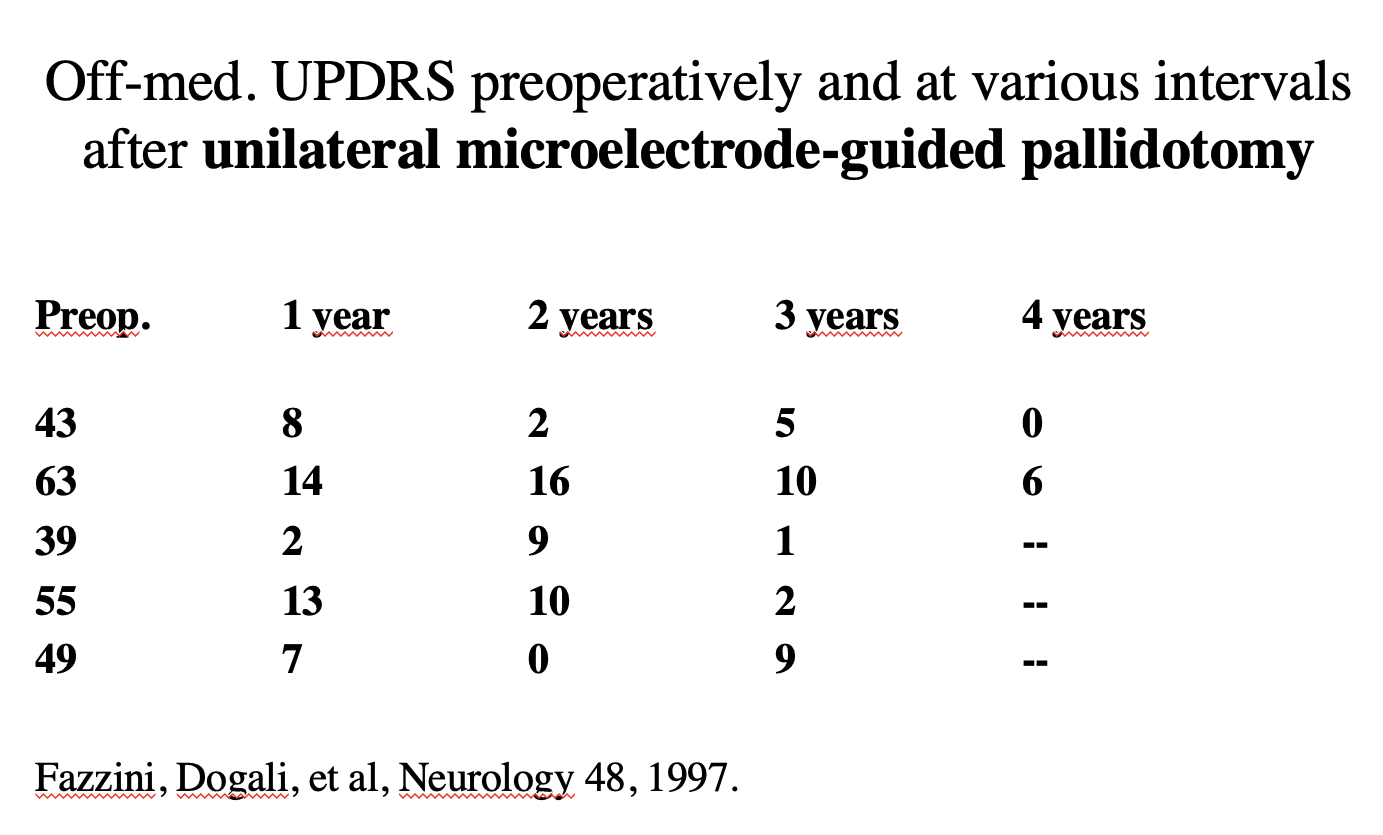
Marwan Hariz & Joachim Krauss So that was patient number one. Later that week, we had patient number two. And then three said, and then up to 13 patients before Leighton and moved to Stockholm, left Umeå, left me alone there, and went back. And we studied these patients later on, me and Tommy Bergenheim, who has a second name on the paper, with a 10-year follow-up of the same patient. We visited them at home, at the nursing home. We visited, and we submitted this. And we sent a very nice paper, detailed, patient by patient, to a neurology. It was rejected because we didn't have UPDRS. 01:07:02UPDRS did not exist in 85. There was no UPDRS in 85.
Andreas Horn So we told them, how can you use UPDRS?
Marwan Hariz & Joachim Krauss You could use it post-operatively. Well, we don't have pre-operative UPDRS. It was rejected by neurology. The same neurology who published the same year Fazzini's paper with zero UPDRS that I sent you. This is the same neurology journal. Anyway, we published then that in Journal of Neurosurgery. 10-year follow-up. Including one patient with bilateral telomotomy who went back to work as bus driver in northern Sweden. So, the story was that the dyskinesia, which was abolished completely by paludotomy, was a new thing because we didn't know that. And the second thing is that this was done before the model of Alexander DeLong. 01:08:00Leighton had no idea about the model of Alexander DeLong. Lexer even less. DeLong was not born in 1940 or 50. So, almost. So this, it was completely serendipity, completely observation. And it was not based on the circuitry of Alexander DeLong. And it was extremely nice for... And then we operated, I think, a couple of patients with dystonia. I have one patient who did not publish. And the same thing there. The dystonia was gone, but the effect was not immediate. It took some time for the patient to improve.
Andreas Horn Joachim, you can comment more? You mean on the paludum, the revival of the paludum? Yeah.
Marwan Hariz & Joachim Krauss Yeah, I think it had several reasons, as you said, Maman. But also, of course, what people became aware were the limitations of levodopa replacement therapy. 01:09:03Because initially, of course, in the late 60s,
Andreas Horn when dopaminergic therapy became popular, it was absolutely fantastic. Yeah.
Marwan Hariz & Joachim Krauss And then there was the film awakenings, like it showed. But later, people became aware that levodopa, also long-term treatment, can have side effects, like fluctuations, dyskinesias, and so on. And I think that was also one of the big things. It was for rediscovering surgical therapies in general. I mean, not only polypneumonia, thalamotomy also came back in the way. But also, another, I think, event. One thing we must account for is the re-acceptance of surgical therapies in general. Because in 1987, Madrazo started with autologous transplantation of adrenal-vascular tissue to the striatum. Then later, shortly thereafter, we had a big public attention for implantation of fetal mesencephalic tissue for Parkinsonism. 01:10:09And I think that really also paid off. And that also paved the way, because we soon realized that it doesn't work like people thought so. And there were problems with it. And that also paved the way to rediscover surgical therapies for immune disorders. And of course, I think your paper, Marwan, just was placed at the right time in the biggest, I must say, new research journal. The most widely read research journal. So I think everyone who was interested in movement disorder was reading this manuscript and got the idea that we are back on track with functional surgery and this nation. I must add here two things.
Andreas Horn One, why was the paper published in 1992 when the first patient was operated in 1985?
Marwan Hariz & Joachim Krauss 01:11:04Well, the reason is that this paper was rejected. First, from the Swedish Medical Journal. Second, from the Swedish Medical Journal. Who now regretted very much to this rejection. And then rejected a couple of times from the Journal of Neurosurgery. And I remember when I went to meeting, for example, I went to France. I speak French to show the results. Before the publication of the paper in the late 80s, I was destroyed by Serge Blanc and John Siegfried.
Andreas Horn And I was told, what is this?
Marwan Hariz & Joachim Krauss It's obsolete.
Andreas Horn What are you coming here talking about this rubbish, palaeontotomy?
Marwan Hariz & Joachim Krauss And I never forget that because I was a young, you know, still resident at that time. And being attacked by Serge Blanc from Lille and John Siegfried for something very obsolete. 01:12:01It doesn't work, what you're talking about, etc. Anyway. So then Laurie Leiten and wrote to Toralf Sand. Toralf Sand was the director. Toralf Sand was the great man who was the editor of Journal of Neurosurgery. And asked that he review the paper. Not the other reviewers. And Toralf Sand reviewed the paper and then published it. And it was published in 1992. Which is about seven years after the first patient was operated. Number two I want to say is that this gained a big popularity, palaeontotomy, in the United States and Canada. And in UK. But not in France. Not in Germany. Because at that time, Monsieur Joachim was in Houston. And published from Houston the palaeontotomy. But nobody did it in France. I helped in France with three palaeontotomy with colleagues later on. 01:13:00Because they couldn't have DBS. So I went there to help with that. But. Because in 1987 Benabid has started DBS for VIM.
Andreas Horn Right?
Marwan Hariz & Joachim Krauss And 93 for STN. But already in 1987 when VIM DBS came. That was what French people did. Germany I don't know.
Andreas Horn Maybe there are other reasons why in Germany lesions were not accepted.
Marwan Hariz & Joachim Krauss Maybe Joachim can comment on that. It's like you say, Marwan. So. The renaissance of palaeontotomy really was starting on a bigger scale in the United States. Not America. Canada. United States. And Syria. I mean it was initiated in Northern Europe. And I think you continue to do palaeontotomies. But it was not well received in France and Germany. And I must say Germany neurologists were very, very skeptical about it. 01:14:02Even about palaeontotomy at that time. It was really not an acceptable treatment to have a lesion. And this goes like destructive surgery. I mean when you ask a patient do you want to have neuromotivation or do you want to have destructive surgery in your brain. It's clear what people would say. And in the United States the renaissance of palaeontotomy was very, very important. And the renaissance started in I would say 1991. I can tell about that also. The first modern palaeontotomy in the United States in New York. And then only after that, after four, five, six, seven years the waves swept over to Germany. And then of course we had palaeontotomies in Germany by Holger Sturm. And I think also in France we had a wave of palaeontotomy. But the waves were very, very strong. The waves were much smaller than the big renaissance waves in Canada and the United States. 01:15:05So Emory was one big center, right, that also did a lot of palaeontotomies with Malon. At least he said that.
Andreas Horn Or who else were? Absolutely.
Marwan Hariz & Joachim Krauss Well, maybe I can tell a little bit about the first modern palaeontotomy in the United States. And when I was in Houston in 1995, 1996, I had a possibility to meet a friend of mine. It was Dohali Berridge. Berridge was a neurophysiologist. Dohali was the neurosurgeon. And according to his account, he was working together with Rantzhoff, a famous American neurosurgeon. And he discussed with Rantzhoff about looking for different targets than the thalamus. Because the thalamus was the main target at the time.
Andreas Horn And according to Dohali's account, he said, why don't we move to the subthalamic nucleus?
Marwan Hariz & Joachim Krauss 01:16:04And Rantzhoff answered him, well, it's impossible because we know this will invariably cause emigralism. So maybe you think about another target. And then Dohali heard presentations by, I don't know, by you or by Leitinen at Congress about the revival of the thalamus. pallidotomy, Leksell's pallidotomy, Laitinen's pallidotomy, and said that Professor Laitinen should do this procedure in New York. And he then talked to Laitinen, and Laitinen came to New York along with Ron Tasker from Canada, and the first modern pallidotomy was done in December 1991 at the Department of Neurosurgery surgery in the hospital for joint diseases in New York University. And then it very rapidly 01:17:06caught fire all over the United States. As you said, the major center, the next major center, I would say was Atlanta. And Atlanta, they were the one that really made microelectrode recording a routine technique. Jeremy Witek, Mail on the Long, Roy Duque, and also other centers in California, Loma Linda, Irvine. Houston started in 1995. There were a lot of applications that came out of Toronto, of course, and Houston. But at that time, polyglotomy was already quite popular.
Andreas Horn Who was the surgeon in Toronto? Was that already Andres Lozano at the time, I assume? Yeah, but Ron Tasco also.
Marwan Hariz & Joachim Krauss Okay. Great. So we should maybe just for the listeners also mention, I forgot to add that
Andreas Horn 01:18:06that Marwan sits currently in UMEA again, right? So where it all started, and we see you in your
Marwan Hariz & Joachim Krauss home office there. Because I think maybe some people still think you're in London, that may not know you as well.
Andreas Horn Yeah, yeah. So you moved back a while ago, right, to UMEA? Yeah, yeah.
Marwan Hariz & Joachim Krauss And so I think here, the story I wanted to tell about that Rhys Cosgrove told me would fit in really nicely. And I'm apologizing that's a bit longer, but I really think it's a great story. So Rhys Cosgrove is the surgeon here at the Brigham and together with you two apparently is now also a historian of the WSSFN.
Andreas Horn Yeah, yeah. Yeah.
Marwan Hariz & Joachim Krauss And so he told that soon after he landed in Boston, as the young attending surgeon at the Mass General Hospital that was around 1990, a patient knocked on his door in need for help 01:19:01regarding severe dyskinesias, and a paludotomy should be done. The patient was an electrician,
Andreas Horn and apparently very nice guy. And his wife, they sat in Rhys's office and they asked, how many of these procedures have you done, doctor? And Rhys said, three. So Okay. Okay. Okay. Okay. Okay. Okay. Okay. Okay. Okay. Okay. Okay. Okay. Okay. Okay. Okay. Okay. Okay. Okay. Okay. Okay. Okay. Okay. Okay. Okay. Okay. Okay. Okay. Okay. Okay. Okay. Okay. Okay. Okay. Okay. Okay. Okay. Okay. Okay. Okay. Okay. Okay.
Marwan Hariz & Joachim Krauss Cosgrove did not see the patient again. And then in 1992, the 10th Congress of the European Society for Stereotactic and Functional Neurosurgery happened in Stockholm, and Dr. Cosgrove was eager to attend his favorite conference. And he also said that Europeans always showed a creative
Andreas Horn thing, but phrased them in ways that were hard to understand. Interesting quote there too. And it was
Marwan Hariz & Joachim Krauss 01:20:02the beginning of email, and he wrote one email to Professor Leitinen, could he maybe be able to
Andreas Horn combine the conference with a brief visit to his surgical theater? And it was exactly that the time
Marwan Hariz & Joachim Krauss where Professor Leitinen had figured out how to accept international patients, so the day of his visit, Rhys Cosgrove enters the operation room and finds his electrician patient on the operation table, by coincidence. And he says, apparently this was not, you know, set up. And I think you can't make this up, the surgery went well, and both Dr. Cosgrove and the patient made it back to Boston a while later where the dyskinesia started again. So Rhys took an MRI and finds the lesions Leitinen made were apparently a bit too anterior in the internal pallidum, and covering the more associative and rather than sensorimotor functional zone. 01:21:01So he sends a ! picture to Leitinen who agrees and a revision surgery is planned. Then Dr. Cosgrove finds a way to make Leitinen apparently visiting Professor in Boston. And both doctors do the revision together once more, but this time in Boston. And this time Dr. Cosgrove is operating and the electrode is entered, a high frequency test stimulus is applied under which the dyskinesia suddenly go wild. And that's the main drive home here. So apparently, under stimulation high frequency to stimulation to work to 01:22:00Marvin, your successor, Ludwig Srinzo, who was visiting to see focused ultrasound,
Andreas Horn and fellow neurosurgeon Marie Kruger, whom I interviewed in episode 28. So, and we discussed this case exactly because it showed some proof that a lesion is not the same as stimulation, right?
Marwan Hariz & Joachim Krauss Stimulation led to dyskinesia getting worse. The lesion later helped.
Andreas Horn And do you share this general experience, or do you have ideas of, or experiences you've made, where high-frequency test simulations would be very different from a lesion later on? And does it match your experience? Do you have something like that?
Marwan Hariz & Joachim Krauss And I think, Marvin, you mentioned even before that under-stimulation dyskinesias can get worse,
Andreas Horn but then a lesion will help them. Is that true? Yeah, the case that Rhys Kosgrove,
Marwan Hariz & Joachim Krauss mentioned to you, is published. I have the paper in front of me. 01:23:00I will send you the paper with the MRI of the old lesion and the new lesion. And lightening lesion was probably slightly anterior, but especially two lateral.
Andreas Horn Okay.
Marwan Hariz & Joachim Krauss And the new lesion that you see in MRI is medial, more medial in the GPI to the one. So this case is published by Rhys and with MRI. It's... It's... It's also... It's also... If you... If you can turn a patient during surgery by stimulation, from being off medication, off, you know, off patient, into not being on, but being on with dyskinesia in the leg or in the hand. This is, we have learned, a predictive good sign. In the same way as during STN-DBS, you stimulate or you enter the STN,
Andreas Horn and you stimulate, and the patient who is off medication get dyskinetic. What... What does this mean?
Marwan Hariz & Joachim Krauss 01:24:01It means that the inhibition is gone. And it's even too much gone. So this was considered a big sign because that was the same thing we experienced in Umeo. That, oh, the patient is getting like this, you know, and happy and talking and, you know, his face is... His mimic is better. And so this is a... This is a predictive good sign for a future improvement in the pallidome and in the STN. I mean, it's the same thing going. Of course.
Andreas Horn But then the lesion would not produce dyskinesias anymore, right?
Marwan Hariz & Joachim Krauss No. The funny thing is that the lesion sometimes does not... Well, often does not produce... No, no. Dyskinesia are gone. They are so much gone, the dyskinesia, that sometimes the patient has to increase DOPA to get better. It blocks... In some patients I've seen and it's described, it blocks not only the dyskinesia, it blocks the kinesia. 01:25:02So it's so efficient that it may block... I don't know why, but I don't know if the lesion is too big or what happened.
Andreas Horn So this is what allows patients with pallidotomy to increase their medication when needed without getting dyskinesia. You understand?
Marwan Hariz & Joachim Krauss It's too much... It's very powerful in some patients. Not all patients. But in some patients. So this is one of the problems that have been seen with pallidotomy, that you block the dyskinesia, but also you can block the effect of normal DOPA on the kinesia. Which, by the way, reminds me of a very nice paper of, among others, Leitinen from the thalamotomy era. When they did thalamotomy on one side and L-DOPA was introduced. The dexterity was better in the non-operated hand than in the thalamotomy hand. The finger dexterity.
Andreas Horn 01:26:01So even in thalamotomy, and we can see it even today in thalamotomy, that the tremor is gone, but the patient's dexterity is not as good as it was before. Like fine motor skills, you mean? Yeah. Yeah.
Marwan Hariz & Joachim Krauss Fine motor skills are not bad, but less good than when the non... non thalamotomy era.
Andreas Horn Yeah.
Marwan Hariz & Joachim Krauss And that showed that the GPI is a very peculiar target and it's unlike other targets because, I mean, especially with Pratikinesia, you can induce Pratikinesia and you can improve Pratikinesia post. And it's not always that it's different locations in the thalamotomy. In the same location where you can improve Pratikinesia as in the pallidotomy.
Andreas Horn But you can induce Pratikinesia as in Chorea and Dystonia. And with DBS or with lesioning or both?
Marwan Hariz & Joachim Krauss 01:27:03Actually both. But I think lesioning is more efficient than DBS. I mean, if you look at patients who have, for example, status dystonicus, the reports were to cure the status dystonia, they can kill the patient. You do a pallidotomy. In some Italy, in other places, they have published that. And in general, a lesion is more... a well-placed lesion is more efficient than DBS in general. The problem are the side effects, bilaterality, etc. And it reminds me of an exchange I had with a letter to the editor, to Anthony Lang. Anthony Lang wrote a paper that we need evidence-based to see if... if pallidotomy works for dyskinesia, etc. And I wrote a letter. I said, you don't need evidence-based. You need to look at the patient, compare the pallidotomy side with the other side. 01:28:02The patient comes to your office with dyskinesia on the non-operated side. And I think I sent him even a video about that. The patient is his own control.
Andreas Horn Yeah, yeah, yeah.
Marwan Hariz & Joachim Krauss Sure, sure.
Andreas Horn So, but maybe I find this very interesting, right? How do lesions compare to high-frequency stimulation? Because as a first approximation, it's the same thing, right?
Marwan Hariz & Joachim Krauss First approximation. I don't say it's the same thing. But, you know, we have, as we all know, you know, lesions to the same target as DBS would usually generally lead to the same effect or similar effects. But this case now with that that Rhys described and you have observed yourself, there it seems different. Where high-frequency stimulation leads to exacerbation of the dyskinesias. But then a lesion to the same site would stop it. So, there might be something to learn here, you know, where, as we know, it's not the same thing, but often they're similar, the effects, but here they seem to diverge. 01:29:06So, I would love to hear more because I think we're not experienced with lesions, but also in general, lesions are not performed that often anymore. So, you have all these, this knowledge and this, you know, experience here. This is one of the issues that made Maillan delong. Little bit, not sad, but thinking about his model. I remember because the model would not predict that these two opposite effects, right? So, the model did not predict that dyskinesia will get better. So, they introduced some variability to the model. Jose Obeso has written about that paradox of, I am not neurophysiologist. I don't know. Maybe Joaquim who is the neurologist. Maybe. I don't know. Well, I think it's, like it has been said initially, deep brain stimulation is like mimicking a lesion, functional lesion. 01:30:06I think it's not the right concept. And that's, I think, everyone except in the meantime that we have such a lot of antithrombic, autotromic stimulation effects and so on. So, it's really, if worse in many ways, it's not the right concept. If worse in many different ways, yeah.
Andreas Horn Yeah.
Marwan Hariz & Joachim Krauss And I think probably nobody really understands, but I just meant other, like does it match your experience or do you have other examples where in the operation room high frequency stimulation led to a different effect than the lesion later on?
Andreas Horn But it seems that at least you have seen similar stories in the OR as well, right? Where stimulation led to more dyskinesias. Is that correct? Yeah. Absolutely.
Marwan Hariz & Joachim Krauss Of course. It depends on the, I would say, functional state of the basal ganglia.
Andreas Horn Yeah. Yeah. Makes sense. Okay.
Marwan Hariz & Joachim Krauss Even, Andy, when it comes to lesion and stimulation, even Benabid in his first paper on DBS for VIM, you know, for the paper from 1987, he writes, and I quote, these patients had telomotomy on one side and he did DBS on the other side. 01:31:18That was the first paper.
Andreas Horn You remember? Yeah. Yeah.
Marwan Hariz & Joachim Krauss I do. But he writes already, I think, in the abstract that the stimulation was effective but not as effective as the lesion on the, previous lesion on the other side. Benabid writes that in the telomotomy. The concept that lesion, or stimulation, high frequency stimulation equals lesion actually applies to many targets.
Andreas Horn Yeah.
Marwan Hariz & Joachim Krauss It is the capsule.
Andreas Horn Yeah.
Marwan Hariz & Joachim Krauss It is in the pallidome. It's in the STN. It's in the VOP, VOA, VIM. It's in the pallidothalamic tractotomy or tract. 01:32:01It does not apply, of course, and should not apply in the PPN or in the fornix. You lesion the fornix, the patient is demented. The lesion PPN, the patient cannot walk.
Andreas Horn So, this is not exactly the same.
Marwan Hariz & Joachim Krauss At least in the PPN.
Andreas Horn At least PPN, though, was low frequency, mostly low frequency stimulation, right? Yes.
Marwan Hariz & Joachim Krauss Driving, driving the PPN, not high frequency. The fornix, I don't know what frequency they use, but it's a high frequency.
Andreas Horn High, yeah, it was high, 130, yeah. So, in all other targets, actually, it mimics. Now, there is anti-grad and retrograd and, you know, anti-grad and retrograd, what is this? Even after lesion, you have a valerian degeneration, right?
Marwan Hariz & Joachim Krauss You have a retrograd. That's why. That's how the dorsomedial thalamus was used by Spiegel for psychiatry, because it was published in 1947 by no less than Walter Freeman, the valerian degeneration after leucotomy going 01:33:02back to the thalamus, to the dorsomedial nucleus.
Andreas Horn Yeah.
Marwan Hariz & Joachim Krauss Again, circuitry.
Andreas Horn Yeah, yeah, of course. No, no, that makes sense. Yeah. Fantastic. Okay.
Marwan Hariz & Joachim Krauss So, in episode 22 of the podcast, I interviewed Maelon DeLong, who mentioned that his team with Roy Bakai and Jerry Vitek had good experience with palaeoedotomies and carried out the procedure frequently until subthalamic DBS came out. And then Kelly Foote, who I also interviewed in episode 25, told Mike Fox in episode 29 that apparently Alim Louie Benabid attempted to carry out palaeoedotal DBS after his successful VIM series. So, not, you know, palaeodome first, apparently. This is apparently not well known. The palaeoedotal did not work as well, and the results were never published, according to Kelly. And once then the Bergman and Benazus papers came out, he rapidly pivoted to the STN. 01:34:04Again, this is hearsay. I'm not sure if this is true, but that's what I heard. And, of course, we know that then the STN DBS became history. So, Joachim, I think you were among the first surgeons to implant DBS electrodes into the palaeodome. And if I know correctly, the first to do so for dystonia, as outlined in your famous 1999 Lancet article that we talked about the last time.
Andreas Horn Do you see a difference in maybe risk profile and efficacy or other factors between palaeoedotomies and then palaeoedotal DBS?
Marwan Hariz & Joachim Krauss In 1995, I must say. I had two. I attended a conference in Irvine, a three-day meeting.
Andreas Horn And this was on the title was called Palaeoedotomy, Where Are We? And I did a lecture on STN DBS, and many people were in a shock-like state, like, how can 01:35:02you do this? How can you dare to do this? How can you go to the STN?
Marwan Hariz & Joachim Krauss Because everyone was focused on the palaeodome. And I remember I even stood up and asked him, when I was still young, I said, I'm going to do this. I was still young at the time.
Andreas Horn How can you dare to do this? Don't you have a few prominent hemipalism?
Marwan Hariz & Joachim Krauss So, of course, this was an early sign, what Benedict showed, that the second wave of palaeoedotomy would decline in hindsight, of course.
Andreas Horn Okay.
Marwan Hariz & Joachim Krauss Now talking about what you asked me about. DBS versus reasoning. Palaeoedotomy versus reasoning. I think it's a good question. I think it's a good question. First of all, to get to these standards to get to these standards to get to these standards to get to these standards to get to these standards to get to these standards to get to these standards to get to these standards to get to these standards to get to these standards to get to these standards to get to these standards to get to these standards 01:36:00to get to these standards to get to these standards to get to these standards to get to these standards to get to these standards to get to these standards to get to these standards to get to these standards to get to these standards to get to these standards to get to these standards to get to these standards to get to these standards to get to these standards to get to these standards to get to these standards to get to these standards to get to these standards to get to these standards to get to these standards to get to these standards I'm not sure if we have improved methods really being confined to the palidome and have no spread to the capsule, posterior limb or knee of the capsule, if that would have the same safety profile. But unilateral palliative dot knee, of course, is much easier than bilateral patients. And with that regard, of course, bilateral stimulation is much more forgiving because you can take care of regulating the intensity for stimulation. Sure. So that is a great point. And I had one question that I have skipped. And it started with Irving Cooper was a giant of lesional neurosurgery. And now that I know that you don't like him or your mentors don't like him, I should have maybe changed it. But I think he carried out 8000 procedures. And he was quoted by Kreienbühl to have said that I hesitate to sacrifice the same structure bilaterally, no matter what structure that may be. 01:37:15And I think also Haslein-Richert became lightly disappointed with palliative lesions for rigidity and tremor and mentioned that the risks to damage nerve. neighboring targets. And then they sought for alternate targets, and the thalamus came about. And I think in the Hassler 1960 Brain article, they mentioned that experience from 560 operations between 1950 and 1958. They often recommended asymmetric lesioning. So maybe on the left side, pallidotomy, the right side thalamotomy, to avoid side effects. Do you think such asymmetric choices could be a good choice even today let's say in the you
Andreas Horn 01:38:01know with focused ultrasound or so to exactly avoid sacrificing the same
Marwan Hariz & Joachim Krauss structure on both sides good I don't know can you talk to that my one can I can I just comment there is a paper recently from Ukraine Ukraina from Kostiuk about asymmetric lesions what asymmetric lesions meant at that time was on one side maybe the thalamus VIM or motor thalamus on the
Andreas Horn other side the paludon that was what was meant by asymmetric lesions today and
Marwan Hariz & Joachim Krauss this is what Kostiuk from Ukraine published just two months ago in stereotactic and functional neurosurgery paludar lesion on one side subtile thalamic on the other side what the focus ultrasound people are doing now or trying to publish is thalamotomy with little asymmetric and this I don't understand if you have one side thalamotomy right in the target with 01:39:00tremor gone how can it help in being elsewhere than in that target on the other side but this is maybe a kind of justification to use focus ultrasound avoiding side effect and having sub optimal effect this is an
Andreas Horn discussion. The asymmetry concerns different structures of the circuitry. And Cooper, I admire this guy. I mean, you should read his book The Vital Probe, where he writes that that was at the end of his professional life when he married, remarried with a Norwegian beautiful woman called Cecile. Yes, yes.
Marwan Hariz & Joachim Krauss And he writes in that paper how he was so devoted to patients that sometimes when the surgery didn't go well, he slept in the hospital next to the patient during night, you know, monitoring himself, the patient, 01:40:00how many of us sleep with the patients the night after surgery. And he was very keen on really avoiding side effects. And the asymmetric lesion of his was in different structures around this circuitry. If I may just comment on Kelly Foote and Benabid. Benabid has done palatal stimulation, and they have published, they have several papers on cognition. They have paper about DBS up and down in the palatum, how you can increase echinacea down and up by Paul Crack. So they have several papers. They have several papers on palatal stimulation. And the reason they abandoned is because, of course, STN in their hands were much more powerful. You could decrease medication, etc. Another reason is that John Siegfried introduced DBS in the palatum in 1994.
Andreas Horn And John Siegfried and Benabid were not exactly very friends for many reasons.
Marwan Hariz & Joachim Krauss 01:41:01And Joachim, he knows that better than me. We should not talk too much. One is dead, one is not dead. But they are not very keen. They are not very keen friends. This is another story. Okay, I must say something about my relationship to Cooper.
Andreas Horn Okay?
Marwan Hariz & Joachim Krauss Because it's not that I do not like Cooper. This is not true. It's that my old boss did not like Cooper.
Andreas Horn Yeah, yeah, yeah.
Marwan Hariz & Joachim Krauss Sorry, you clarified that before.
Andreas Horn Yeah, if you could see here what I show in the camera, you cannot see.
Marwan Hariz & Joachim Krauss So Joachim just pulled out a book of... of... of... of Cooper. It's called The Victim is Always the Same. It's the title. The Victim is Always the Same. It has a dedication to money from Sony inside.
Andreas Horn Yeah.
Marwan Hariz & Joachim Krauss And it's written by Cooper. So...
Andreas Horn Fantastic.
Marwan Hariz & Joachim Krauss Wow. I just wanted to... I wanted to...
Andreas Horn Okay. 01:42:00Can you send me a picture of that book so I can order it?
Marwan Hariz & Joachim Krauss Of course. Of course I can do so.
Andreas Horn Okay.
Marwan Hariz & Joachim Krauss And let me say also something about asymmetry. I think asymmetry is important with many different regards because a couple of years ago we had the concept of dominant basal ganglia. One side would be more dominant than the other. I think this concept has not been followed further. Maybe it's not useful. I don't know. But also when you think about... For example, you have STN DBS in Parkinson's disease. And... Many of these patients will have problems later. And asymmetric stimulation, for example, is a great concept to improve or ameliorate the disorder. So I think we should still have an eye on asymmetry regarding to stimulation within 01:43:02the same target, maybe using different targets. It's a little bit difficult to really... The success is embedded in the same destination. But I think we should keep it always in mind and maybe come back to it.
Andreas Horn When I read it in the Hasler paper, it feels odd to me, right?
Marwan Hariz & Joachim Krauss If I were a patient to know that my brain is now being asymmetrically targeted, one thalami, one pallidum, but it may make a lot of sense. And of course, you could also... If there's more tremor on the right side, you could also have a more ! 01:44:07who is the inventor of MRI-guided focused ultrasound. So not focused ultrasound, there's a long history before him, but he really, I think, pioneered the MRI guidance, which has now become very popular. And due to modern day FUS, pallidotomies have become center stage of attention again. And the New England Journal article first authored by Vibhor Krishna describes a first trial of FUS-based pallidotomies. 30% of the participants improved by less than three points on the motor UPDOS. So that, in the light of the historical success, seems a bit disappointing, I think.
Andreas Horn What do you think of this development? First of all, is it a good idea to use FAS4 palaeontotomies? And maybe why wasn't it so successful?
Marwan Hariz & Joachim Krauss 01:45:00I wrote a letter to the editor published about this paper because I find this, in a way, dishonest. Because, you know, number one, this is an InsightTech-driven finance trial. And it's said there. So, number two, the threshold for improvement is put at three points of UPDOS per side. This is barely clinically significant.
Andreas Horn Yes.
Marwan Hariz & Joachim Krauss No medication would be approved for Parkinson's with three points. So, by starting that, you show the kind of dishonesty, in my opinion, of this trial. The patients were much less sick in the preoperatively than the palaeontotomy, the radiofrequency palaeontotomy patients. 32% improved on placebo. Placebo, as you said. 01:46:01And the improvement of about 25%. 25% mean that the report is by one side. So, they split the UPDOS. They take away the axial, the speech, you know. And so, this whole thing is kind of promoting this tool, focus ultrasound, to do palaeontotomy. And one of the authors of the paper, I won't mention who it is, but you know him well. One of the authors of this paper, who contributed patients, say, he will never do a... focus ultrasound palaeontotomy again. This is way below what radiofrequency palaeontotomy. And this push of focus ultrasound, it may have its place for some patients with too much atrophy, etc.
Andreas Horn But in general, it says that you avoid penetrating the brain with a probe. When was penetrating the brain with a probe a problem?
Marwan Hariz & Joachim Krauss It was not a problem during radiofrequency. 01:47:02It was even less during DBS. Well, you... You penetrate on both sides. Mm-hmm. So, penetrating the brain was not a problem. The problem was making a lesion.
Andreas Horn Why people adopted DBS?
Marwan Hariz & Joachim Krauss It's because you don't make a lesion, and you do it bilateral. So, you penetrate the brain on both sides. No problem. Never been an issue. The issue was the lesion. Now, suddenly, the issue is penetrating the brain. Mm-hmm. Suddenly, there is a shift in the mind of many people. This is a big issue. You don't penetrate the brain, but you do a lesion. Well, wait a minute. The lesion was bad. It's non-invasive. It's rubbish. I very much agree with you. Also, the marketing to call it non-invasive is very silly. Completely. Completely. And I was one of those who said to Insight Tech when I met them in London many years ago when they wanted to put a machine in my hospital, don't call it non-invasive. I used to burn paper with a magnifier when I was a child with the sun, you know. 01:48:03Mm-hmm. The same. Like a gamma knife. They don't call it non-invasive. You know, people are still dying in Hiroshima and Nagasaki. So...
Andreas Horn Yeah. So, I mean, one point, though, so that, you know, maybe it's not the penetration, but for some patients, elderly patients with unilateral tremor, they often go home the same day, right? Yeah.
Marwan Hariz & Joachim Krauss And it seems in the good hands, in the right hands, like with Rhys, he did 400 cases here already. I think it can be a fantastic method. It has.
Andreas Horn Right?
Marwan Hariz & Joachim Krauss For some patients. It has.
Andreas Horn Exactly.
Marwan Hariz & Joachim Krauss It has its place.
Andreas Horn Yeah.
Marwan Hariz & Joachim Krauss It has. I don't say it doesn't have its place. But the inflation is that downloading the side effects, how many paresthesias permanent or balance problem or other issues. I never had paresthesia with telomotomy. And the reason they have paresthesia is because they target, like they target DBS, two posterior, where you can avoid paresthesia by activating contacts higher up and more anterior. 01:49:02So... Mm-hmm. So... Mm-hmm. Mm-hmm. Mm-hmm. Mm-hmm. Mm-hmm. Mm-hmm. Mm-hmm. Mm-hmm. Mm-hmm. Mm-hmm. Mm-hmm. Mm-hmm. Mm-hmm. Mm-hmm. Mm-hmm. Mm-hmm. Mm-hmm. Mm-hmm. Mm-hmm. Mm-hmm. Mm-hmm. Mm-hmm. Mm-hmm. Mm-hmm. Mm-hmm. Mm-hmm. Mm-hmm. Mm-hmm. Mm-hmm. Mm-hmm. Mm-hmm. Mm-hmm. Mm-hmm. Mm-hmm. Mm-hmm. Mm-hmm. Mm-hmm. Mm-hmm. Mm-hmm. Mm-hmm. Mm-hmm. Mm-hmm. Mm-hmm. Mm-hmm. Mm-hmm.
Andreas Horn what DBS people did. They denigrated paludotomy. You remember Joachim? They denigrated paludotomy
Marwan Hariz & Joachim Krauss in the 90s. Absolutely, yes, but still I'm not that negative about these new studies, to be true. I think this is a chance and we see pioneer work. So we're seeing now the third wave of paludotomy and I would say you can see it from different angles. I could also say this is very honest 01:50:02how they report it because they are honest in reporting. They have not such a high efficacy and in a way it's also, I mean you can show your results of course in different ways like you have the total UBDS or you look at some of the special part of it but I would say this is good that people start again to accept on a wider scale lesion in the second year but that was not the case for many years. And focused ultrasound to my opinion opened now the mind of many people to accept lesioning therapies on a much wider level. Of course it's wrong to market it like you say I've seen patients
Andreas Horn coming here to Hannover and they ask me what can you do with it. We can do BBS, we can do radiofrequency lesion. They said oh my god but then you need to open the skull and you why don't you do this
Marwan Hariz & Joachim Krauss 01:51:02incisionless method which is not invasive. Of course this is dishonest but I would say reporting these results and exploring the field offers some opportunity for the future and we do not know whether it will end if it will become routine or not. Maybe you can improve methods for example one of my visions would be you can easier repeat lesions. So maybe you can have focused ultrasound I don't know one three four times in the given patient depending on the progression of the disorder and so on. I think it's just at the very beginning so I'm looking forward quite hopefully. I must say here that the first time I met Monsieur Joachim Kurt Kraus was in October 2000 in London at the ESSFN meeting. I was moderating a session and he was talking and what he was talking about 01:52:02is his experience. He was talking about his experience in radiofrequency paludotomy from Houston and I asked him a question if you remember Joachim. I didn't know him. I was very scared. I mean how you have these excellent results. I mean he had a I still have the abstract very nice results of radiofrequency paludotomy of patients much more stick than what we see now in focus ultrasound. Hmm. And he said that he had better results in terms of UPDRS of medication after. So that was the first time I met you Joachim.
Andreas Horn Yes.
Marwan Hariz & Joachim Krauss And you remember but what I want to say is that the funny thing is that those people who are most enthusiastic about ultrasound are those people who were most enthusiastic about you cannot do anything in the brain without micro recording. Hmm. Lozano, Obezo, Rumia, etc. 01:53:00Hmm. And my one of my first question to Andres at a meeting a public meeting in Berlin was what he was talking about focus ultrasound
Andreas Horn paludotomy. I said Andres what did the micro recording show? He was angry at me.
Marwan Hariz & Joachim Krauss He was angry at me. I can understand that. And not only that not only that the only target they chose for non-micro recording focus ultrasound was the only target in the brain that you cannot see. Hmm. I understand.
Andreas Horn Yeah.
Marwan Hariz & Joachim Krauss I understand STN ultrasound capsule ultrasound you name it. The VIM is the only thing you cannot see. You cannot even see it. I mean now probably with FGATIR you know. No but it's a good point.
Andreas Horn It's exactly there where you where micro electrode recordings even in your in your view might make
Marwan Hariz & Joachim Krauss sense right where because yeah. So these are the same people who insisted on micro recording now they lose no recording nothing. And just burn a hole.
Andreas Horn Yeah.
Marwan Hariz & Joachim Krauss 01:54:00Got it. And. So in my opinion this is kind of sheep you know fashion. Fashion. Don't forget fashion is very important in the decision making today fashion and yesterday is very important. And we are sheep. I want to have a focus ultrasound. Patrick Bloom said my boss is looking to financing a focus ultrasound because that's what the patient wants because that's what they see on. And then you hear them saying that oh we offer the patient anything. We have gamma knife. We have this. We have this. We have that. Well take a patient. Tell him or her. We have two like this penetrating the brain down and we have one we don't touch the brain. What would you choose. Sure.
Andreas Horn Yeah.
Marwan Hariz & Joachim Krauss I mean come on. So I want to also maybe add to what Joachim said when I read the New England Journal paper I was not impressed by the results. So I think it was maybe more honest reporting. So but the question was. 01:55:00And maybe the question was. Maybe that goes to both of you.
Andreas Horn Why was it not as good.
Marwan Hariz & Joachim Krauss Is it because it's hard to focus the field. I think it's you know in the center of the brain of course we can focus much better. Is it because the targeting was off. But because in the end it is a lesion. Right. So it should work.
Andreas Horn Why do you think it did not work as well.
Marwan Hariz & Joachim Krauss The temperature need to be higher.
Andreas Horn Okay.
Marwan Hariz & Joachim Krauss Because when we do radio frequency telematomy we use 70 degrees. When we use radio frequency pallidotomy. We use 70 degrees. When we use radio frequency telematomy we use 80, 82 degrees. And the temperature in the focus ultrasound cannot get too high.
Andreas Horn Okay.
Marwan Hariz & Joachim Krauss I think they were also cautious which is okay. So they could have burned bigger lesions you think. Takes longer time. Takes longer time. Longer time maybe repeat it.
Andreas Horn Why not.
Marwan Hariz & Joachim Krauss But anyway I think it's good when you start with a new concept better be cautious. Because when you're not cautious the whole concept will be killed. 01:56:00Of course.
Andreas Horn Yeah.
Marwan Hariz & Joachim Krauss That's a good point. How does focus ultrasound compare to in your opinion to gamma knife which was pioneered by Lexell and or maybe LID or other forms of lesioning that are you know not radio frequency. Any opinion there. Joachim opinion. Well it depends on what you have at hand also. Hmm. I'm not sure. I think there's nobody who has a machine part like having gamma knife focus ultrasound radio frequency just everything at hand. And so I think it's not that one method is definitely better or worse than the other but it depends on your health system on your insurance system financing. Sure. And so on. This is very multifaceted problem. And. Uh. I think. I think. I think. I think. I think. I think you know that the time is fortunately over when we had this debate like 20 years 01:57:03ago. EPS or lesioning one is a good guy the other bad guy. And I think we should just allow to have more instruments available and maybe you have something you could use it with this or that but depending on your location where you are and what you have. I mean focus ultrasound you have immediate results. Gamma knife. You have to wait six months. Uh. Focus ultrasound you have immediate uh uh MR MR verification gamma knife. Gamma knife is more comfortable because the couch of electa is more comfortable than lying on the MRI couch. So. Probably this but I want to insist and maybe Joachim will agree or not today and still for the foreseeable future. The gold standard of leadership. Leasing is radio frequency lesion.
Andreas Horn 01:58:00Yeah.
Marwan Hariz & Joachim Krauss Because this has the most expansive extensive documentation all over the place and all over targets. And when you learn how to do a leisure I mean I know people today I have heard that in the US you have neurologists buying a machine radiologists buying a machine people who have never done a lesion buying machines to do focus ultrasound. Uh. So. I mean it's it's it's uh it's not like it should be. And they all use DTI to guide them without maybe having ever worked with tractography either.
Andreas Horn Yeah.
Marwan Hariz & Joachim Krauss And which tractography what kind you have different kinds of I learned from her.
Andreas Horn Exactly.
Marwan Hariz & Joachim Krauss You don't have only the the deterministic and the probabilistic you have and you have tracks that look as thick as two fingers like this.
Andreas Horn Yes.
Marwan Hariz & Joachim Krauss You know. Look at the me the DRTT of course. Turn in or the media for rem bundle it's like half the brain. What do you target there.
Andreas Horn 01:59:01Exactly. Yeah.
Marwan Hariz & Joachim Krauss It's scary. I think it's scary too. I think it has to be in the in the right hands. You know with Reese is a perfect example because he has a long history of also doing radio frequency ablations and he has now done again 400 cases. That is great. I think. But I totally agree you need to optimally have experience with conventional lesioning to do it right. I think so. I think so. I think you can monitor the patient much better during radio frequency than the patient lying with the frame on the head fixed in the MRI. You the intraoperative monitoring not micro recording the clinical monitoring is much easier. I would add micro recording.
Andreas Horn Yeah.
Marwan Hariz & Joachim Krauss You can add if you want but but the monitoring of the clinical result during surgery prior to radio frequency lesioning when you stimulate the patient count backward. You see if the tremor is enhanced. Many things you can monitor everything except walking. 02:00:03That's a good point. Right. You can test stimulate and they attempt that at and fast too. But I think if you test simulate too often in fast then you you lose the opportunity right because something in the skull changes. So I think you cannot test as long as you want and some even don't test at all because of that reason. Right. Because then you know the.
Andreas Horn Yeah.
Marwan Hariz & Joachim Krauss So so that's a that's a clear advantage of radio frequency relation. So so this year last year we postponed the podcast last year I co-authored an article in in brain with you who you'd sign your lips man and Reese Cosgrove and Mama. Well, you and Mike Fox. Sorry. And my one you you did email us about it too. And it was entitled the return of the lesion for localization and therapy. And. You know, it was Mike Fox's idea to make the point that both in neuroscience where you 02:01:01know you have early lesions like Paul Broca and Wernick and so on. They were very important. They lost some some sort of interest when fMRI came around. But now they are back with you know lesion network mapping and so on and lesions are still the most causal way of informing us in neuroscience. But then also in therapy the same kind of happened maybe where where where lesions were of course the beginning of of of of of a stereotactic surgery but then may have declined a little bit and then now have a comeback with M. R. guided focus ultrasound and DBS maybe was a stepping stone in between and the way we kind of see it is that lesions might surpass DBS again.
Andreas Horn And in order to do that we need to know better exactly the target and also be able to identify
Marwan Hariz & Joachim Krauss the target in the individual. But. And then of course have techniques that really hit that spot precisely because one of of course one of the big advantages of DBS is that we can change it right we can adapt it 02:02:05if we kind of miss the target we still have a lot of wiggle room but with the lesion it's it's permanent but maybe as soon as we have better imaging you know better ways to identify the sweet spot in individual patients maybe then lesions again surpass DBS and so. So I think you you at least you agree that the decline of lesioning was not a good development and maybe you can comment on the future of ablative neurosurgery both of you if you want as a final question. The introduction of the new tool without opening the head to make lesion will make for the foreseeable future. This to be the future of surgery. Partly at the expenses of DBS but you know like with all new discoveries you have this QRS 02:03:09curve. Now it's a big enthusiast and then it will be people will start to having thoughts about the side effect etc. But as long as there is an economic incentive financial incentive. Promoting. Meeting you know it's like with DBS I couldn't afford to go to meetings during during the the paludotomy era. There was no incentive and then DBS came and you get invited here and invited there and they pay your trip and I had to say no sometimes to trip to Las Vegas because of the the neuromodulation society and this I said no no no no to metronic I don't want to go to Las Vegas. I will be it will be disaster for me.
Andreas Horn Okay.
Marwan Hariz & Joachim Krauss So now depending on on how this promotion of of meetings and and travels and this and I'm not 02:04:04saying that this is something bad I mean we need also the the industry to but don't neglect this issue there is no money in radio frequency lesion there is money in deep brain stimulation and there is money in in focus ultrasound and this will be something that will make the difference. Good point. That will make the difference. Good point. So I think that maybe move the field more towards lesion with the latest machine together with the so-called non-invasive or incision-less together with but this and I insist will be at the expense of less efficiency more side effect. Read my word less efficiency more side effect than with radio frequency or with the and already we see permanent paresthesia permanent this permanent that. So I think that's the point. So I think that's the point. I think that's the point. In few but still some patients. This is my Joachim your opinion. Okay well we all don't know what the future will really bring and of course it would be better if 02:05:04we have disorders actually to prevent them or to treat them in easier medical way but that is a dream of every kind of disorder brain tumors whatever and for the time being I do not see this development in movement disorders. It's also we know much more about genetics. But I do. I think. What would be ten or twenty years when surgery be gone. I don't think so. And. The time of acceptance of leaching has already begun since five or ten years. And we are already in the middle of that. And I think it will become bigger. We will see more. Lesion surgery. Maybe we will have more. Maybe we will have more. Maybe we will have more radio frequency. Again places where you don't have the machinery. But also I do not think that the brain stimulation will go down completely because there's many 02:06:06indications especially for bilateral surgery. I'm still I must say more skeptic of course when I look at bilateral surgery or any movement disorders like dystonia with fast machinery.
Andreas Horn Yeah.
Marwan Hariz & Joachim Krauss So. So I think. I think that case is still on the safer side. We see it in brain stimulation also. And that has become an accepted treatment. So for the next ten or twenty years I would see we have I would say we have parallel developments. We will have a lot of discussion what is better or worse. We will always have heated minds sometimes who think this is right or this is wrong. But I would say we've been long enough in this. So I think that the more you look at the business that you've seen 30 40 years what has been going on and going down you should also look at it in a more relaxed way. 02:07:00Hmm. So what you just said one I think key advantage of DBS that is not often talked about is also the disease progression right. Often the first symptoms are more on the tremor side in Parkinson's for example. Maybe then a dorsal contact is the best choice. But then maybe over time axial symptoms and free ! So. So. So. So. So. So. So. So. So. So. So. So. So. So. So. So. So. So. So. So. So. So. So. So. So. So. So. So. So. So. So. So. So. So. So. So. So. So. So. So. So. So. So. So. So. So. still mitigate it that's one advantage but also the the time domain right where lesion you cannot change the lesion you could do another one but um maybe that's another key advantage of these more adjustable systems like dbs yes and there's also very little flexibility switching from one message to another method as you say as a disorder progresses uh you have different symptoms at 02:08:05different points of time and maybe for some of these symptoms that usually would be better later earlier but usually we don't think in these categories we usually think it's either translation or it's even lesion but there's very little exploration in combining concepts although that as my one said that's that's how it started in 87 right with the um first report where the one side was lesioned and one side had dbs that's true that's how it started yeah yeah and we we shouldn't forget also the the financial issues focus ultrasound is expensive dbs is even more expensive radio frequency is the same electrode you can use hundreds of times it's not expensive so think about the population in the world that cannot afford that may need surgery but cannot afford to have these very sophisticated tools and 02:09:05there is a risk for loss of skills i mean the generation of people who know how to do lesions with radio frequency is either retired or demented or dying with few exceptions right thank you so so we i i we don't train we don't train uh young colleagues in doing radio frequency leisure that's how i trained that's how you are trained and and risk trained and andres tozzano etc but who who is coming then who who how how will they do this i mean it's like with anevrys you know if you coil everybody nobody will know how to to clip an aneurism anymore right joaquin yeah it will be rediscovered so um we have a harith acram right that that you trained and i think he's young and does reasoning with rf in london yeah i trained 02:10:03Ludwig and and the party Harris and they are doing lesions both with radio frequency Ludwig does it in Malta Malta and even in London publishing that using new uh methods to target with the the tractography ala Harris not ala Conan ala Harris which is different uh and and uh yeah but but uh they know how to do it and they are young but they are they're exceptions the exceptions yeah yeah I agree and they have many in Germany how many in Germany in charity or or Hannover or even other places how many can do radio frequency leisure and feel confident with that yeah good question I think I think there's some rf no okay no I'm training residents here to do so I have two um 02:11:00two new researchers now besides me who can do thalamotivism great I I agree it's it's great to keep that knowledge around absolutely that's um yeah very important okay so I I want to be mindful of your time we already spent I think over two hours now um sorry to go over time um any uh any maybe thoughts about the future or also questions we did not cover before we wrap up um anything we should do or missed opportunities in this field or final words that you wanted to say to end the conversation i i want just to say that it's very courageous of you to spend time with these supports that you have done now about 50 right and almost and we learn a lot and you probably learn some something a lot yeah yeah that's the main 02:12:02reason i do it yes and this is a great honor for me to have this is second time i was one of the first uh the interviewed i was quite angry at that time because i had the tyriotoxicosis uh if you remember on on cortison and was uh but it was a great episode though yeah thank you thanks for joining and thank you for associating me with the great man you know joachim former president of the society here and society there and big big colleague and and a big friend yeah well i must say this has been a pleasure again uh and i think it's great what you're doing with this podcast because this is kind of a open history and now with having this uh on the internet gives it a completely different aspect because it will stay there for much longer time 02:13:02like the video forms we had earlier and i hope to keep on going with this format there are more people to come later and this today it was again a pleasure to uh talk with marvin and uh i i know i didn't notice how time goes by yeah we could talk about this for hours i think and uh you always discover something new and uh as we said before it's very important to have a look on history because otherwise you will cover the music yeah no absolutely but but sorry congratulations to your very successful students oh thank you thank you but thanks again also maybe i can share that um you know how busy you are um it uh you know
Andreas Horn and then taking two hours or even more than two hours is really fantastic and um i know how busy
Marwan Hariz & Joachim Krauss you are not just because you're so famous and everything but we we had to find a um an appointment twice and it was always i think planned for three months or so something uh um planned to 02:14:02be done in september and then had to postpone and then you know um that just shows how how hard it is to find um such a slot with you and so so thank you even more to for taking so much time to do
Andreas Horn this i learned a lot and it was fantastic to talk to you big honor thank you thanks a lot bye-bye
Marwan Hariz & Joachim Krauss you
Click any highlighted text passage to jump the Spotify player to that point. The transcript text is present directly in the page HTML for search engines and accessibility.
Additional resources mentioned in the conversation:
- Paper by Laura Cif & Marwan Hariz on the history of pallidotomies: Cif L, Hariz M. Seventy years of pallidotomy for movement disorders. Movement Disorders. 2017;32(7):972-982. doi:10.1002/mds.27054
- Case report of re-pallidotomy carried out by Rees Cosgrove and Lauri Laitinen: Eskandar EN, Cosgrove GR, Shinobu LA, Penney JB. The importance of accurate lesion placement in posteroventral pallidotomy: Report of two cases. Journal of Neurosurgery. 1998;89(4):630-634. doi:10.3171/jns.1998.89.4.0630
- Paper by Dogali et al. about Pallidotomies: Dogali M, Fazzini E, Kolodny E, Eidelberg D, Sterio D, Devinsky O, Beric A. Stereotactic ventral pallidotomy for Parkinson’s disease. Neurology. 1995;45(4):753-761. doi:10.1212/WNL.45.4.753
- 10-year follow up data on posteroventral pallidotomy: Hariz MI, Bergenheim AT. A 10-year follow-up review of patients who underwent Leksell’s posteroventral pallidotomy for Parkinson disease. J Neurosurg. 2001;94(4):552-558. doi:10.3171/jns.2001.94.4.0552