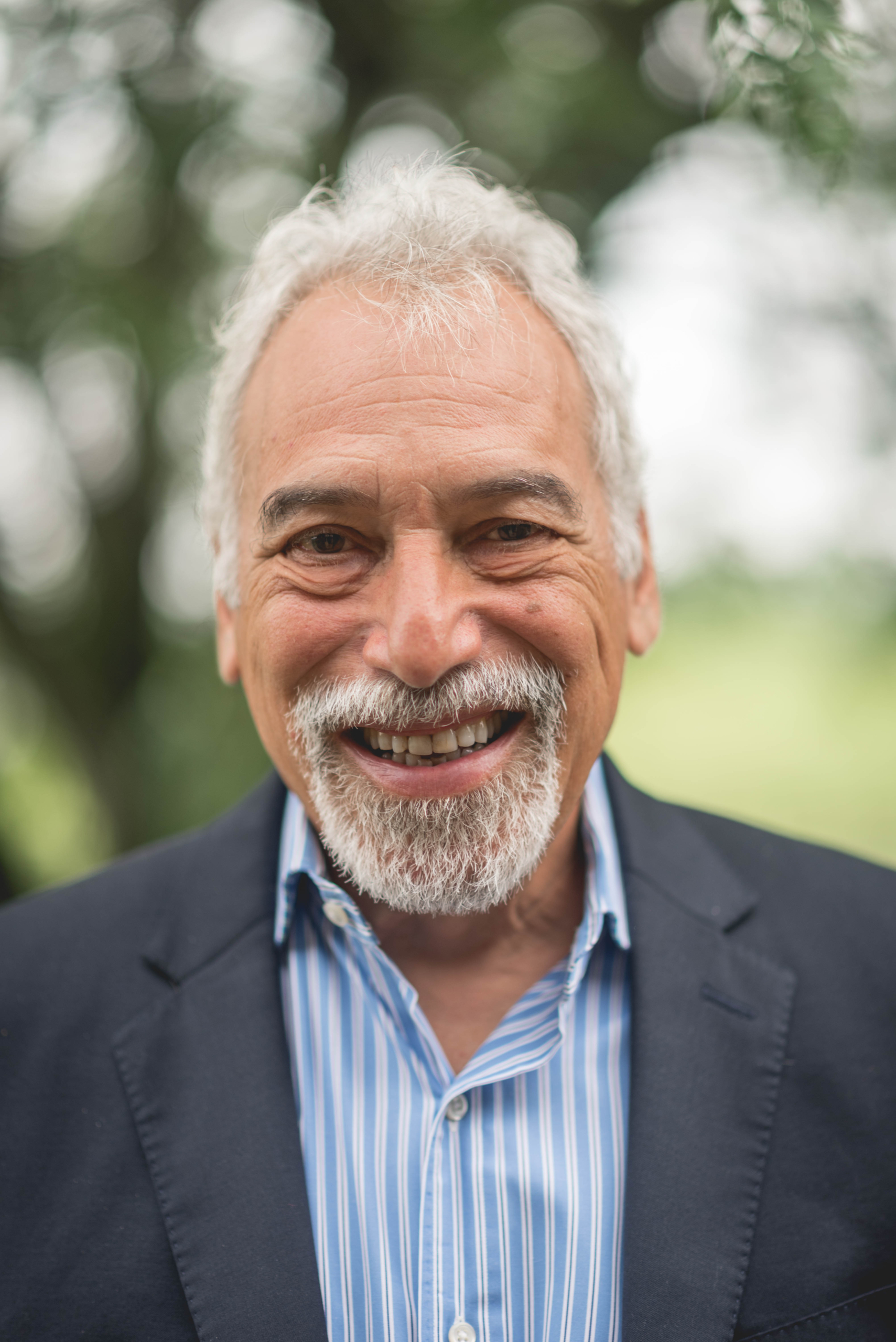
Dr. Sackeim is a Professor in Department of Psychiatry at Medical University of South Carolina.
#71: Harold Sackeim – The founding editor of Brain Stimulation and a founding figure in modern electroconvulsive therapy
Today we had the privilege of speaking with a true pioneer in the field of neuropsychiatry and brain stimulation— Dr. Harold Sackeim.
Dr. Sackeim is perhaps best known for his extensive research on electroconvulsive therapy (ECT), but his contributions span a wide range of topics from treatment-resistant depression to the placebo effect in neurostimulation. As a founding figure in modern ECT research, he has played a central role in shaping both the science and the clinical practice of brain stimulation therapies.
In this episode, we explored the history and future of ECT, the controversies surrounding it, and Dr. Sackeim’s insights on the direction of neuromodulation. He explains how ECT has long been the most effective treatment for severe, treatment-resistant depression. While once overlooked in favor of medication, we now know that both the placement and intensity of stimulation are key—challenging the old belief that seizures alone drive its effects.
Harold Sackeim 00:00And nowadays, the vast majority of patients will say if there was any price they paid, it was trivial compared to the relief that they got. And what was clear is that the impersonal is more vulnerable than the personal. It's probably rehearsed more of the personal, has more affective laden, but people care much more about the person. But what was extraordinary is you could come in every day for an hour, sit in the chair, you know, get all this attention and go nowhere that the placebo response was so little in that context. And what I was going to say is, now compare that to the RECOVER trial in these people who are far more resistant, who have been killed for far, far longer. 01:00Welcome to Stimulating Brains.
Andreas Horn Welcome back to another episode of Stimulating Brains, the podcast where we explore the frontiers of neuromodulation and brain stimulation by speaking with you. Some of the most fascinating minds in neuroscience. Today, I had the huge privilege of speaking with a true pioneer in the field of neuropsychiatry and brain stimulation, none else than Dr. Harold Sackheim. Harold is perhaps best known for his extensive research on electroconvulsive therapy, but his contributions span a wide range of topics from treatment-resistant depression to the placebo effect and other forms and many forms in neuromodulation. As the founding editor of the journal Brain Stimulation and a founding figure in modern ECT research, Harold Sackheim is a professor of neuroimpedimental medicine at the University 02:00of New York. He has played a central role in shaping both the science and the clinical practice of brain stimulation therapies. In today's episode, we'll talk about the history and future of ECT and other forms of brain stimulation and his thoughts on where the future of neuromodulation is headed. Thank you so much for tuning in, Stimulating Brains. Dear Dr. Sackheim, Dear Harold, I will have already introduced you formally, so we can directly dive in. First of all, thank you so much for taking part in this. I know your schedule is very busy, so it's a great honor to be able to talk to you about your career and about brain stimulation. And as I think you know, by now, we always start with an icebreaker question, asking about hobbies. Sure. Sure. Sure. Sure. Sure. Sure. Sure. Sure. Sure. Sure. Sure. Sure. you do if not stimulating brains? 03:04Well, I live on a horse farm in Mennonite Amish country in Pennsylvania. So many of the farms around me, ironically, have no electricity. There are people that live in the 1700s. So when I'm not doing academic work, as I just was this morning, I was feeding the horses and the chickens and the pigs and on and on. Well, I'm sure that gives you busy. Yeah, fantastic. So so diving into your work, can you tell us a bit about your academic journey? What drew you to neuropsychiatry and then ultimately to brain stimulation in the first place?
Harold Sackeim I have a unusual background. I'm trained as a clinical psychologist. 04:02I trained at Columbia, Oxford and Penn and and joined the faculty at Columbia in 1977 at the age of 25. I was a professor there. And by 30, I was essentially head of biological psychiatry, chief of biological psychiatry at Columbia and did that for over 25 years. So I'm sorry for that. Let me. The so running the most invasive psychiatry group in the world, essentially for a long time, we were the people that was involved in Vegas, neuro stimulation, first use and depression. I developed MS. MST magnetic seizure therapy. 05:00Lots of I was the first in the world to administer ECT to people in status epilepticus as a method of terminating status. So we did not hesitate in terms of the invasiveness of the procedures we were involved in.
Andreas Horn Yeah. Did you ever overlap?
Harold Sackeim Probably not pretty overlap with Delgado there. No, not Delgado. One of my early mentors was Norm Gashwin from. Oh, yeah. From, you know, the father of behavioral neurology.
Andreas Horn Yes.
Harold Sackeim And and in terms of academic journeys in 1978, I had a paper in science on the asymmetry of the human face and in its expression of emotion. And that is something that has now been replicated hundreds of times in multiple societies. 06:00And that was part of work that I was doing on the nature of lateralization, the nervous system with regard to affective processes. And I was inspired to start that work by my mentors at Penn, Ruben and Raquel Gore, who at the time were heavily involved in laterality research. And they also. Were among the first and really in the world to do neuroimaging to look at behavioral phenomena. And that's all I introduced functional imaging to Columbia in 1980 when we brought the first lab to measure absolute regional cerebral blood flow using Xenon 133 inhalation and then later SPECT and then that. So, you know, it's sort of with that background with Gashwin, what I was doing, was work on lesion locations in the brain, people who had pathological laughing and crying.
Andreas Horn 07:02Yeah.
Harold Sackeim And and then where the foci was in people with elastic epilepsy, outbursts of laughter during their prodrome for a seizure or decrystic epilepsy, crying attacks during seizures and
Andreas Horn and that work, which was sort of what was the impetus for the Davidson work and all the work on
Harold Sackeim affective processes and linked to the left and right hemisphere and so on. That led to the interest in ECT. Ruben Gore and I were writing a book called Brain Thought and Emotion for McGraw-Hill, which we never wrote. OK. But one of the areas that I was looking in was ECT because ECT clearly was the most effective treatment we had in psychiatry for very, very serious depression. Without doubt. It was also a treatment that you could administer without any drugs. 08:00The recommendation to the fact of the American Psychiatric Association was to withdraw people from antidepressants when you were giving them ECT. Our work later showed that that was a mistake. So you had people who were in many ways the sickest in terms of their affective illness, who got the most well, who didn't have the confounded drugs. And then on top of it, you had an intervention. That you could give in a spatially focused way. So that bilateral versus unilateral, to give you an example, at the time, Liz Warrington in London, neuropsychologist, had showed that left and right ECT were as good as the WADA procedure and identifying the site of the brain subserving language. That if you did language testing right after the treatment, you were as good as injecting sody mametol into the internal carotid artery. And then on top of all of that, it was a laboratory for learning and memory. 09:01Because in an example, Larry Squire, one of our greats in terms of neuroscience and memory, the distinctions he drew between declarative and non declarative memory, propositional memory versus episodic memory, largely came from ECT samples. I didn't know that. Wow. That you could produce an anterior grade or retrograde amnesia for propositional information. But if you had patients learn mirror writing, you know, sort of a more basal ganglia based procedure, there was no amnesia for that sort of thing. And that was among the things that got Larry to advance those aspects of memory. So this was, and the research in ECT was horrible. It really was a field that, did not have very rigorous, it had, and essentially what had happened is with the introduction of the medications in the 50s and 60s, 10:02a whole generation of individuals in biological psychiatry became interested in pharmacology. And ECT was left behind. So it was an unresearched, but extraordinarily important intervention for many, many reasons. Can you brief, very briefly talk about its origins, when it was invented,
Andreas Horn who were the key players in the very early days, and maybe why it was never researched well before you came in?
Harold Sackeim Well, I wouldn't say before I, but ECT was around in a pre-scientific era. It was first used in 1934 as convulsive therapy by von Meduna in Hungary, who later became an American. Von Meduna claimed that the induction of seizures, he first used camphor and oil, 11:01which is very painful, injecting it into your muscles. And then metrazole, essentially a GABA antagonist, which also had issues. But von Meduna claimed that 50% of the patients he treated with schizophrenia had profound remission after a series of these seizures. And he was fired from his position in Hungary because he dared to claim that he had discovered something that was of therapeutic value. Because the universal view in biological psychiatry was that the major mental illnesses were degenerative or congenital. There was nothing that you could do of a therapeutic nature. There was a nihilism with respect to therapeutics. And it was ECT when tens and tens of thousands of people, tens of thousands of patients, were discharged after decades in state institutions. 12:00And when it was discovered that it was even better in mood disorders, it just changed the whole zeitgeist. And that's what ushered in the pharmacologic era. And what people don't know, so in 1938 in Rome, Triletti and Beeney, Italian neuropsychiatrists, realized that it was safer and much more efficient to induce the seizures electrically than to induce them chemically. I would sometimes comment with my colleague Don Klein, who largely considered the father of pharmacology at Columbia, that we would typically see with metrazole, with chemical induction, panic attacks before people would see. They were terrified of the treatment because this anti-GABA treatment was provoking this massive anxiety attack 13:03before the seizure occurred. And the replacement of it with electricity was something that you could ensure that you only had one seizure as opposed to because of recirculation issues and so on. So it was a much more efficient approach. But again, this was in a pre-scientific era. The person who spread ECT around much of the world was a fellow by the name of Lothar Kalinowski. Kalinowski was a German half-Jewish, German half-Jewish, who escaped Germany in 1930s, late 1930s, and attended the second treatment in Rome of ECT. Going to Italy was not a smart idea. At the time. He had to leave again. And he went to St. Anne's Hospital in Paris, which is where chlorpromazine was later discovered, 14:00and the term neuroleptic in psychopharmacology was coined. I was just there this past summer to help start a national study in France of one of the newest forms of ECT, something called FEAST, that maybe we'll talk about in a bit, spatial targeting of this. But he seeded ECT in France, and then went to Holland, and then to England, seeded it there, and then got on a boat and went to New York City. And this fellow at Columbia, at the New York State Psychiatric Institute, who had my job, Paul Hoke, one of the greats in psychiatry, met Kalinowski at the boat and offered him the job right away at the Psychiatric Institute, where the ECT device was built, based on the plans of Truletti and Beeney, and ECT was promulgated across America. And Kalinowski was very influential because, among other things, he really noted that the mood disorders was an area where you had this profound effect. 15:08So all of that occurs before the revolution in medicine of the RCT, the placebo-controlled trial, those findings that everything that we would do to evaluate an intervention happened afterwards. And in fact, much of our methodology in medicine generally was stimulated by the introduction of the psychiatric drugs in the 50s and 60s. That's where our standard methodology for trial evaluation was really, really improved.
Andreas Horn Interesting. Was that because effects were harder to measure, more subjective? Or like, why did psychiatry...
Harold Sackeim It's also because NIMH started a unit for evaluation of the efficacy of these drugs in an empirical way. It was, let's get away from the doctor thinks it works, 16:00and it was a total revolution. And it was applied pharmacologically, as opposed to being applied to treatment in psychiatry as applied to drugs.
Andreas Horn Very interesting. That's fantastic. So, okay, what happened after that? Was it then that you...
Harold Sackeim ECT went down in its use somewhat. It stabilized to some extent in the 70s and 80s. And in terms of my work, when I entered the field, the fundamental belief in the field of ECT was that the seizure provided the necessary and sufficient conditions for efficacy. It didn't matter how you produce a seizure, whether you did it chemically, electrically, or now magnetically, that the generalized seizure was the essential ingredient, 17:04and that the electricity only contributed to the cognitive effects of the treatment.
Andreas Horn Now, what was odd was that even though this was by far the fundamental view,
Harold Sackeim John Otto Watteson in Sweden, his work in 1960, had really promoted this as the worldview of ECT, nobody had really adopted in practice. Because if you ask, well, if the electricity is what's contributing to the side effects
Andreas Horn and the seizure is what's therapeutic, why don't we give the least amount of electricity possible, but ensure that they have an adequate seizure? That would seem to be what...
Harold Sackeim Nobody had ever done that. And when I went to the leaders of ECT at the time, people like Max Fink or Dick Abrams, and asked them,
Andreas Horn where do you set a dial on this machine? There was not a coherent answer.
Harold Sackeim 18:00Essentially, the way the field was treating everyone was at the top of the device,
Andreas Horn the maximal electrical output of each device. And what was unknown was what was the variability
Harold Sackeim in patients in terms of their electrical needs. As a consequence of this work, I'll sort of tell you part of what happened and then the science behind it. At the time in 19... I wrote my first ECT protocol in 1979. The average time it took at that time somebody to know their name, where they were, the day of the week, following a single treatment was eight hours for bilateral ECT. And six hours for unilateral ECT. Now, with standard treatment in the field of ECT, it's down to 10 minutes. And with the newest forms, the experimental forms, it's a third quicker as well. We're down to just the anesthetic, essentially, in terms of recovery of radiation. 19:04And we've done a... And what's beautiful about that is the acute disorientation is highly predictive of the long-term effects on retrograde. It's the only persistent. So you have a biomarker in your treatment room that's telling you essentially what the likelihood is of there being a more adverse outcome. And part of the reason for this is that, one, the electrical waveform that was being used was incredibly inefficient. In all of the... ECT, the field of ECT in many ways pioneered a lot of our knowledge about the fundamentals of electrical stimulation of the brain.
Andreas Horn What is the optimal waveform for electrical stimulus? How do you dose it?
Harold Sackeim And to illustrate, the sine wave, which was what Celletti and Beeney had originally used, 20:04which is, you know, a wave with positive-going and negative-going waveforms, because the sine wave is slow to reach peak, it takes, in the U.S., with 60 hertz electrical output, that's what we have in the United States, 50 hertz in Europe, so that we can have 60 positive-going, 60 negative-going waves. Each wave or period is 8.33 milliseconds. So it takes about 4 milliseconds to reach peak and 4 milliseconds to offset, and then you can have a wave going in the opposite direction. The width of that... Because it's slow to reach peak, as opposed to, for instance, a rectangular or a square wave, it actually raises the threshold of the neuron to fire through the principle of accommodation. It makes it harder to produce a seizure because of the nature of the slowness of its increase. 21:06Moreover, because with a brief pulse, the optimal width of a pulse to get neuronal depolarization in all mammals is between 0.03 of a millisecond and 0.2 of a millisecond in that brain. We were giving 8.33 milliseconds. Oh, wow. Okay. Yeah. And so the wave... So we were stimulating the neuron well after it had already fired, and we were transmitting this refractory and relative refractory period. We were depositing almost all of the energy we were transmitting to the brain in a way that was highly inefficient. And from my point of view, stimulating a neuron after it's already fired is not going to either be effective in producing the physiologic event you want and probably is contributing to the side effects.
Andreas Horn 22:03Interesting.
Harold Sackeim So there was a big change. There was a change, and that change has not stopped. We just published last month the first comparison in the world of a 0.15 millisecond stimulus to a 0.3 millisecond stimulus and showed almost patient for patient that you had a lower seizure threshold at 0.15 than at 0.3, that we could further improve the efficiency of the electrical stimulus. So that was one thing, is changing the nature of the electricity. The other thing was titrating. So we were trying to do a lot of things in the world of the electrical stimulus and the way we did it was to give the individual a threshold for the individual. And what we introduced was the idea of giving deliberately electrical simulations that were below the threshold for a seizure and using ascending method of limits, the standard in psychophysics, to trigger the seizure at the least electrical dose possible. 23:03And what we found is, conservatively speaking, that the thresholds are much higher than the thresholds for pediatric patients and their seizure thresholds. Some thresholds are far higher than others, and that's largely due to skull anatomy. Only a small proportion of the current actually enters the brain. It essentially goes between the electrodes because the skull is a massive insulator. Its resistance impedance is on the order of 17,000 ohms per centimeter, while the skin scalp is about 200 to 300 ohms per centimeter. So you have a massive insulator that's deflecting the stimulus and only allowing a portion of it to get in, and you're producing these massive individual differences. So what the field had been doing was treating everyone at 20, 30, 40, 50, yes, because in order to get seizures in the people with high threshold, they were treating... And for instance, women have a lower threshold than men. 24:02There is a literature demonstrating more common side effects in them. Age is threshold related, and where you place electrodes is threshold. So we were able, for the first time in history, to measure seizure threshold in the human reliably. And among the other things that happened when we did that is we also, in our first work, two major discoveries. One was in the first study, we randomized people to unilateral and bilateral ECT under double-blind conditions. And we had about a 10% remission rate with low-dose unilateral ECT and about a 70% remission rate with low-dose bilateral ECT. We managed to make ECT not work despite the fact that everybody had, by the most conservative criteria, adequate seizures. 25:02So that blew out the fundamental theory about ECT. It's clearly not sufficient, the generalized seizure, for efficacy. And what our work later went on to show, and it's been replicated, it's now widely adopted across the world, is that the efficacy of the treatment is contingent on both the current path and the dosage within that path. That there's specificity in where in the brain we need to stimulate with what intensity. And so that moved ECT in a whole different place than the original framework. What we also showed is that seizure threshold goes way up, particularly in people who get well, during the course of ECT. It's dynamic. That you need 60% to 70% more electricity, greater charge, at the end of the course than you did at the beginning of the course.
Andreas Horn 26:00Sorry, end of course means after several days? Or how long is a course, Amelie?
Harold Sackeim The American Psychiatric Association would say 6 to 12 treatments is typical in America. It's actually a little bit longer. That is something that has changed with time. There's been a secular change in how much ECT you need. But typically it's a matter of you get treated three times a week. So three times a week. At three times a week, let's say you need 12 treatments of four weeks is your question. And nowadays, most patients are outpatients. This is being done as an outpatient procedure.
Andreas Horn Yeah.
Harold Sackeim So you needed, let's say, 60%, 70% more electricity at the end of your course than you did at the beginning. Seizures get shorter. EEG expression gets weaker as ECT goes on. 27:06And you're getting a massive, essentially, with the treatments, you're getting large reductions in cerebral blood flow and glucose metabolism. We did ECT in the pet suite with A-lines in our patients. And fully quantified both CBF and FDG before 20 minutes, 40 minutes after treatment, an hour later, and then over time. And so we have very clear understanding. Jerome Engel was the first to report in science the inhibitory effects of spontaneity, where you get essentially surround inhibition. And we were essentially applying the same model in the ECT. 28:00ECT was a place where we could pick where the seizure started from. It mattered a lot more, in my mind, what the site of initiation was. So for instance, an hour after unilateral ECT, all the EEG changes, all of the blood flow and metabolism changes were on the site of stimulation, even though you got a generalized seizure.
Andreas Horn Okay.
Harold Sackeim That what ECT was doing is screening. And what ECT was doing is fooling the brain into thinking you had a focal secondary generalized seizure. And that you're getting the surround inhibition at where the seizure started from, as opposed to necessarily where you're propagating it.
Andreas Horn Makes sense.
Harold Sackeim And so that then turned into two directions. One was ECT is an anticonvulsive. It's now demonstrated results in massive release of GABA. And that's where we were the first to use it. I spent a couple of years following with the head of epilepsy, outpatient epilepsy, 29:03in Columbia following epileptic patients. And I felt it important. This is in the early 80s. If you're going to be doing this deliberately, people, you should know what the spontaneous effects are. And so we established relationships. And when it became clear that ECT was a powerful anticonvulsant, we then used it to treat. And trackable seizure disorders and patients with status.
Andreas Horn Fantastic. Yeah.
Harold Sackeim And that is now become a standard for some places. It's a standard procedure is less resort to for status. And but at the mechanistic level, my belief has been that major depression. There's nothing abnormal about being in the depressed state. What is abnormal is that it doesn't stop. That when your wife says she's going to leave you or you get fired from your job. 30:05To feel, you know, we're built so that abstract concepts are going to impact on our mood. It makes us quite vulnerable. And but there's a resilience that most people have.
Andreas Horn It's the same type of question as to why do 25% of people develop PTSD.
Harold Sackeim After trauma 75% down. That my view is that the pressure we are wired to be depressed. And that what's abnormal is that these are disinhibitory states. That it's a failure of breaks. And that the beautiful effect of ECT is that you can, you know, they're quite literally enhance inhibitory town in particular networks. And so that was the, at my convulsion theory that we had proposed. Years and years ago.
Andreas Horn Fantastic. Thanks so much for this great overview that already, you know,
Harold Sackeim answers quite a few questions that I had lined up. 31:02And, and so, so I think you said a lot here to, to unpack maybe. A few points.
Andreas Horn One that I found particularly interesting and did not know is that.
Harold Sackeim You know, I think that. I think that there's a lot of. I think that there's a lot of. I think that there's a lot of. I think that there's a lot of. I think that there's a lot of. I think that there's a lot of. I think that there's a lot of
Andreas Horn better, right? So essentially where to put the focus. And then
Harold Sackeim also, if it's not just about seizing generally, in a generalized fashion, I mean, what else is it like, how does the electricity, you know, change neurons change the reward
Andreas Horn 32:03system? Or do you have other thoughts that followed after this that are from, you know, your work or other work? Yeah, the well, the one of the direct consequences of this is
Harold Sackeim that magnetic seizure therapy and focal electrically administered seizure therapy feast are the two techniques being investigated there in international trials to enhance spatial targeting, to take advantage of this type of
Andreas Horn thinking and say, okay, where do we really need to go? I was the
Harold Sackeim inventor of both of those. And I think it's a very important thing. And I think we're going to do a lot of work on both of them. And I spent 10 years with maxed and building the first magnetic stimulator that was capable of a deliberate seizure doctor. And when we built that first stimulator, we thought we would need to complete electrical supply of New York 33:00City. 16 capacitors, quite blowing up and, and so on. But
Andreas Horn then we were sort of like, okay, how do we do it? And then we how do we do it? And then we were sort of like, how do we do it? And then we were sort of like, how do we do it? And then we
Harold Sackeim over intracerebral dosing with a magnetic stimulus than you did with an electrical one because you didn't have the skull effect smearing the spatial distribution. And the weakness of magnetic stimulation, I don't personally, I don't think it's panning out, is because of insufficient dosing. I just gave some lectures where I showed a slide of what a typical ECT stimulus looks like inside the brain of a monkey. And what, at the same site, the same electrode recording, with in-depth electrodes, what a magnetic stimulus looks like. 34:02They're not in any way comparable in terms of the electric fields that they're inducing. And so that's the weakness of the magnetic, it's so inefficient, you're going from current in a coil to a current in brain that you don't have anywhere near the control that you have electrically. Beast is something that I developed around the time that I was working with Mark George, Mark and I were the PI's of the optimization ATMS trial. I had been the senior director, sort of director, sort of director of optimization ATMS, sort of director of optimization ATMS, sort of director of optimization ATMS, sort of director of optimization ATMS, sort of director of optimization ATMS, sort of director of optimization ATMS, author on the O'Riordan study that got TMS approved with the FDA that neuronetics originally did. And I had worked closely on that. And for OptiMS, Mark was coming up. We wrote that protocol at my house in Westchester. 35:00And we wanted to improve the methodology in TMS and have an active sham. And to have an active sham, you needed to, under the coil that was not discharging, it was not producing any stimulation of the brain, you had to have the physical sensation of what it would be like to discharge. So we put electrodes under it. And we had the ECT company, Magda, at the time, turn down their device markedly down to milliamps, you know, like 1 to 10 milliamps.
Andreas Horn So that we could be triggered that device by the magnetic coil, the neuronetics device. And we had to learn, how do you throw an electrical stimulus to a spot? And we were, that's exactly what we were working on with Vahi Amasian, who is one of the gods
Harold Sackeim of brain stimulation, really a wonderful man who passed away a while ago. Vahi had been the chair of neurophysiology in the Bronx. 36:06At Montefiore, and then later in Brooklyn at Downstate.
Andreas Horn And he had done the basic work on what is the optimal form of stimulation to get a neuron to depolarize magnetically and electrically? Where is the depolarization occurring? How do you shape the stimulus of the used amendment?
Harold Sackeim And so we were working with those ideas. And that's where we came up with the idea that we would change ECT from a bidirectional electrical stimulus. To a uni directional current flowing only in one direction with a different geometry of electrodes, where there would be cathode and a large cathode small anode essentially. That would give us a capacity to do targeting. And now, just recently another modeling paper came out our work recording in monkeys with 37:04feast and traditional. And the human trials we've done all indicate that we're getting much more focal stimulation with that technique. The question you asked about the electricity, largely the way I've thought about it in the ECT is what the electricity does is it changes the seizure. Because you have to have a large enough population of neurons. Whenever I've shrunk the population of neurons, and you can shrink it by shrinking a pulse width. Because of the duration functions, you will have a more, the shorter your pulse width, the more focal it will be. And so there are a bunch of ways of impacting on the size of the population and how often they're discharging, which will be electrically mediated. I do think that independent of that, we as a field have not gotten up and said, boy, between TDCS. 38:04Which is in the two milliamp to four milliamp range in ECT, which is about an amp. 800, 900 milliamps. We have nothing. The field of neuromodulation has nothing in between. And I know, for instance, I can produce dopamine release profoundly with an intense electrical stimulus. This is microdialysis work that Anatoly Zis, who used to be chair at British Columbia, he did. Microdialysis. Microdialysis in rodents, where if you turn up the dial, you get more dopamine release. And if you block the seizure with the barbiturate, you get the same dopamine. And I've used that clinically. Stan Fon used to send us maybe 20, 30 patients a year, Parkinson's disease, who were psychotic because of their anti-Parkinson medication. 39:02And at the time. Before they were using Clozapine a lot, they were using ECT. Because ECT is both anti-Parkinsonian and anti-psychotic. It's very unusual in that respect. But I saw quite clearly that when I turned up the dial, patients would say, how come my Parkinson's symptoms were so much better and lasted so much longer than the time. So I think ultimately we will need as a field. A type of stimulation induced pharmacology. That has nothing to do with seizures.
Andreas Horn Interesting.
Harold Sackeim So something in between TDCS and ECT. And remind me, you know the history much better. It was before my time. But I heard from Mark Hallett that before TMS was invented, there was electrical brain stimulation. That was just painful.
Andreas Horn And that's why it never took off. 40:00Is that without inducing seizures? Is that right? Yeah.
Harold Sackeim Well, yes, it was largely Marsden and Rothwell and people like that, the neurologists, because the only way they could get twitches was electrically. And it hurt like hell to do that. And and there had been electric sleep. There had been attempts at electric anesthesia. You know, so that was how they were overcoming this by putting you to sleep.
Andreas Horn And that was largely Russian. But the reality was that there was no therapeutics, no therapeutics. And and we're in this wonderful year to give you a sense. Who knows how it hold up? But I helped a group in Lisbon at the.
Harold Sackeim At the International Brain Simulation Conference in Lisbon, the one before last, I was invited to help this group that had given three subjects. 41:01Subconvulsive stimulations in a row to patients and manic episode five patients and manic episode. And all of them became euthymic within a day compared to drugs. It was 20 something days to get an effect. And I also think that that'll probably work in catatonia. Catatonia. I've never seen a catatonic patient who did not show more clinical benefit after a single treatment. There is quite clear. I think it works whenever benzodiazepine. It's that GABAergic effect, I think that. But I think you can get that inhibitory response without seizures as well. That if if we stimulate in the right way, I think that we will probably be able to treat the catatonic without the seizure. Those are just some.
Andreas Horn Yeah, no. So so many so many already opened up so many interesting strands.
Harold Sackeim 42:00Maybe. We can circle back a little bit about like your career broadly. Like, I always like to ask about mentors and also mentees.
Andreas Horn Who were the key people that that maybe influenced your thinking on your long and illustrious way in in neuroscience? Maybe in the beginning, who trained you and you know, what?
Harold Sackeim Well, a couple. A couple of things that mattered was. My goal when I was completing my training was to be a full time psychotherapist and to have an office on Park Avenue in New York City and do psychodynamic psychotherapy for the rest of my life. I thought talk was all you need. And that's that's an ambition of how wrong one can be. 43:00And how little you know oneself. But along the way, I did my undergraduate degree at Columbia and then I received the Kellett Fellowship to go to Oxford and Oxford. My two I read PPP, a degree that doesn't exist anymore. Psychology, philosophy and physiology. And and my psychology tutor was Dick Passingham, who who's illustrious in his in his work. And the first paper I had to write for him. He wrote 80 papers in 40 weeks.
Andreas Horn Was. Is that is that intense? The first paper was how do lesions of the hippocampus and animals support or not support the distinction between short and long term memory and man?
Harold Sackeim OK. That blew me away that that that. I had to go and read original journal articles. And. And, you know, Brenda Milner's work and and and and this stuff that is a Columbia undergraduate. 44:06You never approached anything at that level. And and this was undergraduate work at Oxford. And I had a lab with Edmund Rolls. Edmund Rolls, a young. I just wrote to Edmund and in my lab there, he taught us how to put an electrode through Bregma in the rat brain. And and ultimately into the nucleus accumbens and to do self stimulation of the of the rat, which was a. Subliminal impact, I guess, because that was essentially my first experience with brain simulation was in the Rose's lab. And Larry Weiss Krantz was also a mentor at the time. Larry had was a discoverer of blindsight that if you have lesions in the area 18. Visual cortex. 45:00My first grant from NIMH in nineteen seventy seven. Was to produce total blindness in people with hypnosis and to essentially do the blind sight studies.
Andreas Horn And and so you could see that there was that progression. And then I went to Penn. And how did you end up in Oxford? Why?
Harold Sackeim England. Columbia had a fellowship that that they, you know, if you did OK, Columbia, and they liked you. They sent you there. And then Dick Dick Passingham was was anatomically focused. Right. So it was probably a lot of anatomy there as well.
Andreas Horn Is that right? Well, yeah, but you're you're he he was my tutor for learning and memory.
Harold Sackeim That each subject. And in philosophy, philosophy of mind or logic. 46:01You know, so each area had I saw my first psychiatric patients at the Warnford and and so on. So and then I went to Penn. Marty Sullivan at Penn was the reason I went there. We I happened to meet him and we really hit it off and spoke for hours and so on. And so they invited me to come to Penn. And and I. I. But I worked with the. Gores who were Rubin was a first year assistant professor and Raquel wasn't wasn't part of the faculty at the time. And they were very physiologically oriented. And and that had an impact. But to tell you the truth, the research that I did at Oxford and largely for my dissertation at Penn was on empirically demonstrating. So. So. So. Self deception, providing a laboratory demonstration that people can truly lie to themselves. 47:05And and that was because I thought that was fundamental to psychodynamic thinking at the time. And at the time, half the world was saying there's no such thing as an unconscious sort of sort of silly. So I was still on that track and. And an ECT. And that particular. That particular avenue was simply a hobby. It was a number of different studies. And to tell you in terms of happenstance, I was offering a graduate seminar in psychology at Columbia on psychopathology. I was a first year assistant professor, just out very green. And I invited Rochelle Goodleman Klein, who was Donald Klein's wife. And she was the she was a psychologist. 48:00I offered to. Teach a seminar to teach in my class, and Rochelle, she was she was the first to study ADHD.
Andreas Horn It's what happens to them 20 years later if you're on drugs or not on drugs, is there a few that showed that you're likely to go to jail as part of function of whether or not you're getting medication?
Harold Sackeim So. And she asked me what I was doing. I said, well, right now, I'm interested in this ECT thing. I have this project. I was going to do a trial. At Mount Sinai, the sign was totally the old way and so on. And she says, there's this guy at Columbia who really needs somebody to help him do research. He's now head of the Alumni Association. He had been the. At Columbia. He's now the head of the Alumni Association. He had been the. Acting director of the department, acting chair of Psychiatry, Columbia's largest department in the world in psychiatry. 49:05And he had been marginalized because it was a new chair. Ed Sacker, young guy who came from Montefiore in the Bronx. He Sacker was the first to show a biological abnormality and depression ever. He did the first 24 hour cortisol measurements, urinary cortisol, and show that there was a phase advance.
Andreas Horn And they were cleaning out the place. And all of the old analysts and so on, making it into a high powered neuroscience institute. And so a lot of the ogard was like, they fired Otto Karmberg, the father of borderline personality, people of that stature. And so Rachel said, do you mind if I introduce you to Sid Malice, the guy that needs some help, that he wants to do ECT itself?
Harold Sackeim ECT. And so we met, I wrote a grant. I had never seen ECT in my life before I wrote this NIH grant. 50:05There was a site visit. She had left the site visit after five minutes, said, Harold, we'll answer all your questions. And we got funded. It would never happen. And I wouldn't have the judgment today, probably to fund me in 79. And what happened was Ed Sacker, tragically, he was a type A. I would see him in the hallways banging on the elevator doors because they were too slow. And he had a stroke. And it left him aphasic. And ultimately, yeah. And ultimately, he died. He killed himself. And the faculty at Columbia could not decide on who would become interim. 51:02And so they ultimately, they chose Sid Mallitz again. So the guy, right. And so now he, so this revered department, biological psychiatry, which had nobody in it anymore, they gave that to me. And I built it back up. That group also ran the memory disorders program. Richard Mayhew and Devon and my deputy ran the Alzheimer's program at Columbia. A late life depression and a bunch of other directions. So that was happenstance that that happened. And then after, after Sid in 1944, 1984, Herb Pardes came, having been director of the NIMH, and Herb and I were very close. And we did things like be charged with reorganizing the intramural program of NIMH. 52:06So we did that together.
Andreas Horn Fantastic. Thanks so much.
Harold Sackeim So, you know, lots of turning points and key figures in your career. Then maybe diving again more into the scientific questions, you talk about cognitive side effects already quite a bit. And I think, you know, your research really explored exactly that. Do you, maybe can you summarize and potentially also looking towards the future, the, you know, effects of ECT on depression, but then also the side effect profile. So. So I, my current way of thinking and it's not well informed, I must admit, is that ECT is still the, probably still the most effective thing we have towards treatment resistant depression.
Andreas Horn 53:01But one key downside might exactly be these cognitive side effects.
Harold Sackeim And I'm saying this because that might be the maybe uninformed word on the street, where probably a lot of that, like based on what you said before, a lot of that might be still.
Andreas Horn But one key downside might exactly be these cognitive side effects.
Harold Sackeim on trials that were run with these sine wave high intensity types of stimulation.
Andreas Horn So do you do you think the view on side effects should have changed already or should has changed already on ECT?
Harold Sackeim And or might change more in the future with with better. Better ways to get there's no doubt ECT has a PR problem and which often has little to do with the reality of the treatment. Here is how I would put it. There's been incredible progress in not just reducing, but in most 54:06instances, eliminating the cognitive impact of the treatment. And nowadays, the vast majority of patients will say if there was any price they paid, it was trivial compared to the relief that they got from the patient's point of view if you inquire. But it is also the case that because there is variability among people, for instance, pre-existing cognitive deficit is one of the predictors of the vulnerability to cognitive effects. People who are coming in impaired are going to be the people you worry about more than the elderly. We did a study that was published in 2007 called the service study, and I made paid for NIH where we. 55:04Quick assistance at seven different hospitals in New York City. Before and we and we very closely monitor these patients 54:56before we put them in the hospital. 55:14Before, during and after their treatment and six months later. And what we were able to demonstrate is that these hospitals did not differ in the efficacy of their treatment. But what hospitals differed in is the side effects they produced six months after the treatment and if things don't get better by six months, typically, I don't think they're going to get better. And so that was sort of, you know, you know, sort of bottom line gut. Healing is, you know, how can we as as the field of medicine, be in a position where depending on what hospital you go, you know, you're going to have different amounts of amnesia for events in your own life. And so that was part of the challenge to the field is is how it goes. Again, this is largely in terms of control over the nature 56:02of the electrical stimulus and the dose where you're putting it. Well, that's the technical factors. So, for instance, when we control for the technical factors, all the hospital differences disappeared. And so there's a lot of differences in technique. So it's one thing to say, you know, so it's going to end. And the variability in practice is not not not only substantial in the US, but it's much greater across the world. Sure. So, for instance, almost all of the West is moving away from bilateral ECT. You're seeing a lot more high dose unilateral or bi-frontal, whatever. But China is all I see. At least all of these papers that come to brain stimulation and they're all bilateral in China. So. So the promulgation of knowledge hasn't hasn't been anywhere near as 57:00helpful. I don't know if that's unusual, but it's certainly something that I see in the field of ECT. The other thing that people. Often don't appreciate is that mood disorders are cognitively impairing. That what's typically the case is that there's a double dissociation between the impact of the mood disorder on your learning and memory and ECT. Typically, with a mood disorder, you have an attentional deficit such that you have a hard time taking information in. Yeah. And and so that what gets in tends to stay in. There's no rapid loss of no anterior grade amnesia. At the beginning. But there's less information that's learned. So, you know, so the end product is you learn less with ECT. What often happens is during the course of treatment, as you get better, your attentional impairment goes away and you can take more in. 58:02But for a very brief period of time, you can't hold it. Right. And that anterior grade amnesia cannot be demonstrated more than a week or two after the. Treatment, at least with modern techniques that that and that has practical implications because of of decision making, going out, driving that sort of thing. You don't want a patient to be impaired. And, you know, the more intense, the more treatments you give, the higher the dosage, the these are all dose related effects. But it's trivial because it's gone very rapidly. And more than a week or two after ECT, there's only one persistent effect on the cognition that's ever been demonstrated. And that is memory for events in the past. Largely episodic memory for events. We did the only trial ever where we did a match task paradigm in ECT patients. 59:01I did this with Holly Lizard, the first author on this. Yeah. And what we did was we asked people to reduce from memory. Tell me about all of the natural disasters. Remember. Remember in the last couple of years, all of the major court cases, just tell me as many details as you can about these things, as well as your trips out of town, your illnesses in your family, you know, Princess Diana versus, you know, your cousin's wedding.
Andreas Horn And what was clear is that the impersonal is more vulnerable than the person.
Harold Sackeim It's probably rehearse more of the person has more affect. But people care much more about the person. So, in fact, we were the only people to originally it was found in ECT that if you have people to rate their own memory on things like the Squire memory questionnaire, Larry Squire or Broadbent's Cognitive Failure's questionnaire, 01:00:07patients after ECT say their memory is better than it was before. And it doesn't. And those scales don't correlate at all with objective neuropsychological tests, but they correlate with the Hamilton and the back. And we showed that everybody showed that we replicated all those effects, for instance, in the services that in those multiple hospitals in their own sample, multi-centers, but showed that if you ask patients a simple,
Andreas Horn much simpler question, did ECT help or hurt your memory?
Harold Sackeim I know, you know, minus five to plus five scale. And I think that the majority of patients say it hurt. They say six months later and the degree to which it hurt correlates with how much amnesia they have for events in their own lives that we could show it that with objective neuropsychological 01:01:01data that the patient's perception is very.
Andreas Horn So that changed our it. We it's a really interesting phenomenon. Why is it that when you atomistically go and ask, do you have trouble following road directions, can you lose yourself when you're reading a book?
Harold Sackeim That's the broadband type of question that people say they're much, much better. But if you ask them, just speak forward what you want to know. They say, no, I'm impaired. And and objectively, it's so. That is a lasting effect of ECT. I believe that what you lose, if at six months you're not able to read, you're not able to read. And that's and it can be it can be deaths in. Oh, a couple of decades ago, I asked a wonderful former ECT patient who was, I think, is still in the Vermont legislature, 01:02:01a woman who had been treated at Dartmouth Hitchcock, Dartmouth, and was switched from unilateral to bilateral ECT with her consent. That being reconsidered. And developed a retrograde amnesia where she was writing checks on a bank account. She had closed years earlier.
Andreas Horn Regularly, she was asking her family members, how is my uncle doing? Who had died earlier?
Harold Sackeim So and and she and when there's a bad ECT outcome, it can be dense and it can go back for a year. That's we're trying. That's the thing we're trying to truly avoid. She sued Dartmouth Hitchcock. And the only thing she asked her as a suit is that she thought ECT saved her life. And that is that Dartmouth Hitchcock produced a video that was much better informative for patients of what it's like to go through ECT and what the risks and benefits were and the Meta Corporation provided that video to every provider. 01:03:04It was a win win for everybody. And when the Vermont legislature was considering banning ECT. She had me come up and give a two hour lecture to the Vermont legislature. Benefits. So when people like that, this is just a sort of a clinical. But. I embraced her and asked her to write an autobiographical account of what it was like to go through this and and but people are so afraid of people who are saying that treatment hurt them. And they're typically pushed away and isolated. And that is not friends with. In our field, of course.
Andreas Horn Yeah, that makes sense.
Harold Sackeim That's very enlightening. It's still like, you know, one key question is still like if. 01:04:02If everybody would do it the proper way, right, with the newest and latest, most minimal electrical field. So so maybe, you know, I just heard a talk by. uh see the ding um speak at anpa in montreal and he um i'm sure you know his work um and he uses uh also you know uh does a lot on ect and e-field modeling his talk was very similar in scope of what you said in the introduction about all these things with you know people will just use the highest voltage that the device um produces and then you know they they don't like he also talked a lot about skulls very varying and so on so it sort of reminded me on all the all the groundwork you you were doing um now you know maybe with e-field modeling and so on but it seems like this as you as you alluded to too that this has not this knowledge has not translated to the mainstream 01:05:00caregivers you mentioned hospital hospital hospital variants so do you think that could hurt analysis going forward right if people if some sites do it the old way with you know too much voltage do you think if everybody were doing it the proper way would um you know how strong would the adversified still be this is probably what i would love to hear your opinion on well i think we are far better informed as to uh how to do it and as having incredible um penetration um the the more recent guidelines from australia ultra brief right unilateral is the way that that should be your default treatment uh i gave the note um to uh japan the japanese psychiatrists and they asked me to be polite 01:06:02ahead of time we negotiated for a year about this keynote because they knew that their practices were needed to be updated and and uh we just taught a course at the brain simulation kobe uh where the leadership in japan attended the course um uh that that i i think that the uh great deal of progress was being made uh but i think that it's like anything else if i have somebody that's going to die uh i've had card i've had cardiologists beg me to give them ect 01:07:04um um my son's best friends who got a psychotic depression a couple of years ago. And fortunately ended up in a private hospital in New York, did not respond to medications in the first week or two and went right to ultra brief, right. Unilateral ECT, six treatments. And now it's been three years completely well, you know, and you know, that's, that's sort of, so one thing I would want to,
Andreas Horn and this is, it will be a little bit conservative, but I've been thinking and lecturing fair amount on the question of are people born treatment resistant or do we make them that way? And,
Harold Sackeim and I believe we make them. I believe that, that, that just like there's an antibiotic resistance, which is a function of ineffective exposure to ineffective treatment, the exposure to ineffective treatment in psychiatry in particular, 01:08:04uh, results in the next treatment being less likely to produce a benefit. So the example I give is for instance, when you're not smoking, it takes seven months for your nicotine receptors to regenerate and, uh, in your brain and you're clouded, confused for that period of time. When you come off the necessary, you you've put your brain in a place that it's never been in nature. And, uh, and you've, you've down-regulated a whole bunch of five HT receptors. And you, you flooded the synapse with serotonin and so on. And I think it's not, um, unlikely that, that, that, uh, experience of ineffective treatments promotes, um, uh, resistance.
Andreas Horn And so John Rush and I have been writing a lot about difficulty to treat depression and treatment resistance, right? But a good example is in the,
Harold Sackeim 01:09:00in the VNS trial, the recovery trial that we're doing right now, uh, I are on the steering committee for this, the average length of episode for these people in this trial that made you impressive is 18 years in a depression. Wow. Okay. The number of failed treatments is 13. Now in epilepsy, if you fail two anticonvulsants, you're a candidate for surgery. That's what it's looking like in a depression as well. That the likelihood of responding to the next one is so low. That, you know, so going on for 13 of them is sort of like, I think putting pillars into the, into the sand. And unlike ontology and other fields where we start with the most potent treatment, uh, what we often do in psychiatry is start with the least potent treatment and build up, but that assumes that there's no residue. 01:10:00And, uh, uh, and so it's, it's, And so that's these, and I'm actually more iconoclastic than that. I lectured on this once in Germany to the German Psychiatric Association. And I argue that many of our antidepressants keep you sick. That what they do is they prevent the resolution of the episode. They freeze you. So that your brain is frozen in a place that has never been, that you're half well, you can't get off the drug because the drug is helping you. To some extent, it's providing some relief. And if you take it away, you get worse. But when I first started in this field, you know, in the 70s, the last patient was a patient who had had ECT in their 20s or 30s, had a great life afterwards. And then in their 60s, 70s, had another episode. The patients you're seeing now are chronic. And the model that we've switched from was, 01:11:02depression was taught to be an episodic illness with a natural history, typically of an episode of two years. That was pre-ECT, pre-drugs. That's what the average length of stay in Europe was for serious depressions, for hospitalization. Now we've switched to a diabetes model. And we've switched our models of these illnesses without asking why. And so, yes, I think the neuro stimulation treatments, not just ECT, but TMS and some of the others, because of they're working through a very different mechanism, and they don't have this glue that they're putting in the brain, may have the possibility of both being more effective and not resulting 01:12:01higher level of resistance. So, yeah, I think that's a very interesting.
Andreas Horn Yeah.
Harold Sackeim That's very insightful. A lot of food for thought. So, so, yeah. Thank you for sharing that. That makes a lot of sense intuitively to me.
Andreas Horn Yeah, absolutely.
Harold Sackeim So maybe switching gears a little bit. You did mention Parkinson's disease. I knew about animal studies around ECT and models with Parkinson's disease that are ongoing and suggest, you know, that there could be a great effect of ECT and PD, potentially even disease modifying, which in, you know, a degenerative disorder such as Parkinson's is a magic word, right, of key impact.
Andreas Horn Do you see value in, you know, going into humans or going back into humans with ECT? Is this being done? And, you know, if so, why? And if not, why not?
Harold Sackeim I don't see that it's going to have much potential. 01:13:02Honestly, the Parkinson patient has was studied quite well, typically in Sweden, with sham. There's been a couple of sham control trials, just anesthesia alone versus ECT with seizures and so on Parkinson's. There's no doubt ECT is anti-Parkinsonian. And there's no doubt that it is a liberator of dopamine.
Andreas Horn Yeah.
Harold Sackeim And if you're pushing your foot on the dopamine pedal and the and its clinical role was largely in the patient who couldn't tolerate the doses of L-Dopa or dopamine agonist because of the psychotic genetic effects of those drugs. They were just going too crazy. And so here you had an intervention that was both anti-Parkinson and anti-psychotic. So that was one way of managing.
Andreas Horn 01:14:01And that's why people like Stan Fons group would send us regularly so many patients.
Harold Sackeim But but now they're being managed pharmacologically largely with with and particularly clozapine seems to be a favorite agent for for dealing with that. And what happened with the as I said, preexisting cognitive impairment, preexisting brain damage is a real vulnerability factor to the cognitive. And so we're going to have to do a lot of research to see if we can get a better understanding of the effects of ECT. And no matter how soft you do it, you're going to you're going to worry about that impact on the Parkinson's patient. I remember a classic patient, a private patient with Parkinson's disease that was sent to us, who is at the Milstein Pavilion at Columbia, who was free and dancing and euphoric and so on. 01:15:01But completely disoriented and trying to get out of the hospital. And, you know, you know that we had we had improved the mood, improved the Parkinson's disease, but the guy needed one to one because of the confusion.
Andreas Horn Yeah. Okay.
Harold Sackeim So that is going to be a limiting factor. But again, if I'm right and who knows if you could do it, if you could do a targeted in terms of wearing the brain. And two, without seizures, because it's if it's being mediated in part, at least the product Parkinson's effect by this dopamine release. That is totally an area that we've not explored.
Andreas Horn Okay. So you would see value in exploring that essentially ECT without seizures. So sub-seizure ECT, that could be valuable to pursue, you think?
Harold Sackeim 01:16:00Right.
Andreas Horn Exactly. Absolutely.
Harold Sackeim And I think in neurologic and in psychiatric disorders, I mean, if you could get a GABAergic effect, a dopaminergic effect, depending on where and with what intensity. You know, my son is a emergency room physician at Stanford, San Francisco, but he's also CEO of a neuromodulation company. And they're stimulating the splenic nerve. And they're also stimulating the splenic nerve with developing an at-home ultrasound device to downregulate cytokines and TNFN, and for the treatment of rheumatoid arthritis. And that's all mediated by the release of norepinephrine and acetylcholine. That, you know, we know that pathway and so on. So the idea that we could do neuromodulation to produce these specific neurochemical changes that may be a benefit. in people with neurochemical lesions is, I think, extremely prominent. 01:17:08And you don't see much of that. But another illustration of that is we gave a year ago one of the awards at Brain Stimulation, I think a travel award, to people that were getting raclopride displacement in the basal ganglia with TMS to the dorsolateral prefrontal cortex. So they were changing receptor density patterns with dopamine multisynaptically. One more question about ECT maybe before we move on to, you know, the brain simulation journal work as well. You also discussed placebo responses and worked on that.
Andreas Horn Can you talk a bit about that a little bit in neuromodulation in general? 01:18:00Can you talk a bit about that?
Harold Sackeim That's a tough nut. One of the things that shocked me was that in the development of TMS, TMS was a toy for a long time. And my group and I did the first meta-analysis of TMS's antidepressant effects. And what we concluded was that there's no doubt that it seemed to have antidepressant properties in the early work, but that they were not clinically meaningful.
Andreas Horn And what was impressive was how some of that early work,
Harold Sackeim how low it was. And it was a little of a placebo effect people were getting. 01:19:00And this is when they were doing, you know, five sessions, 10 sessions and so on. And then I did with neuronetics, I was essentially their senior depression advisor, the ARIERDEN trial. And that was barely successful, but essentially had a 15% remission rate at six weeks versus 5% placebo, with sham at six weeks. Their primary outcome was actually at four weeks, but they didn't hit the primary outcome, but got the FDA anyway. Then Mark and I did the OPT-TMS trial. And we essentially replicated. We had a 15% remission rate at the key endpoint and a 5% with sham. And as I wrote at the time, I wrote an editorial on biological psychiatry. You know, it's significant statistically different, 01:20:01but I'm not so sure that a 15% remission rate where you're taking weeks and weeks of daily treatment is compared to 70% I could get with the ECT.
Andreas Horn But what was extraordinary is you could come in every day
Harold Sackeim for an hour, sit in a chair, you know, get all this attention and go nowhere. And that the placebo response was so little in that context. And what I was gonna say is, now compare that to the RECOVER trial in these people who are far more resistant, who have been ill for far, far longer. The sham effect that they're having is much, much greater.
Andreas Horn Interesting. And yeah, no, it's why.
Harold Sackeim And one of the differences is that this is a treatment 01:21:03as usual trial. So you're getting VNS on top or sham on top of changes in your treatment and it could be that. But the point I was making is that I was not impressed so much by TMS's efficacy at the time as by the lack of efficacy of the shams. And that my opinion has totally changed. I chair the medical advisory board for, for neuromatics and the registry, 175,000 TMS patients. And the efficacy there is very impressive. And I think it's a moving target. I think it will get better and better. But I don't think we have a good handle on sham. In ECT, there were in the sixties and seventies, 01:22:01a series of eight studies, I think it was in England, that they were obsessive repeating sham trials, ECT versus anesthesia alone. And what I took away from the sham trials was yes, acutely ECT giving electricity and seizure works better than sham, but it's also the case that the dose of the, the anesthetic agent you're using correlated with the efficacy with their sham efficacy. These are ganderergic agents that, that, I mean, we used to treat depression by putting people to sleep with barbiturate. And so I don't think these were neutral interventions. I think there was a dose response relationship there. Yeah. Very complex and very important work too. Sorry. I'll give you an example of Columbia. Actually, we were talking about him before he, I believe they were the first people in neurosurgery to do 01:23:00a placebo controlled trial. And these were in Parkinson patients where the idea was to put burr holes in the skull and drop in fetal tissue into the ventricular system, hoping that it would adhere to the walls of the ventricles
Andreas Horn so that you would then have a dopamine growing neurons into the, right?
Harold Sackeim That was the rationale for this trial.
Andreas Horn And they had a sham group where they did the burr holes and they didn't put the tissue in. And both groups got better. Interesting. They were, right?
Harold Sackeim It was, it was a failed trial because of the, because there was a placebo response in the Parkinson patients to having holes put in your head. So sham responses can occur in the most, in the most unexpected places. Yeah. Yeah. No, totally agree.
Andreas Horn And is there a clear correlation between invasivity and sham response? Probably, right? How invasive the treatment is?
Harold Sackeim 01:24:00I don't know. That's a good question. I don't know. I don't know. I don't know if anybody, I haven't looked at it. If anybody has ever tried to manipulate the sham response by increasing it. I know clinically, I always, you know, you want to take advantage of any placebo response that you get. You're very encouraged. But this may be helpful in ECT. We did a couple of studies where I told you about the global impression of the patient regarding their memory. We also asked them afterwards,
Andreas Horn did ECT help or hurt your mood? But we asked the same questions. What do you expect to happen before? And will ECT help or hurt your memory? Will ECT help or hurt your mood?
Harold Sackeim There is no relationship between the cognitive effects and the expectations. If there was a relationship between the ECT and the sham, there was no relationship between the therapeutic, the mood effects and expectation. It was negative. People who thought that they were not going to ever get 01:25:00better were the people who did the best.
Andreas Horn Interesting.
Harold Sackeim Right, right. That's a condition where, you know, it's true blue. Yeah. Wow.
Andreas Horn Okay.
Harold Sackeim Right. So as the founding editor of the journal Brain Stimulation, you've overseen the journal's development since its inception. 01:24:55I'm very proud of that. 01:25:20I'm very proud of that.
Andreas Horn And what were the primary challenges you faced in establishing this journal?
Harold Sackeim And have you seen the influence of the journal, you know, influence the trajectory
Andreas Horn of brain stimulation research? And then maybe how did you even come up with creating a journal in the first place?
Harold Sackeim Oh, those are a bunch of questions. The, at the time, I had a couple of fellows who were training 01:26:02under me from neurology, an epileptologist and a movement disorder person, as well as, and my work has always been across, I was a consultant to neuropaths. And I had a lot of experience with neuropaths. And I had a lot of experience with the development of response stimulation and so on, had a deep interest in DBS. I had given a keynote, a plenary lecture at the international epilepsy meetings in The Hague in the 90s, when I first heard on the question,
Andreas Horn what does seizures do to cognition, actually?
Harold Sackeim And when I first heard about VNS in that context, and I had a lot of experience with the ! was part of the group that convinced the company at the time to start looking at that in mood disorders. So we were doing a ton of work with TMS and developing MST. 01:27:08So we were covering a lot of the waterfront in terms of brain stimulation, at least technologies at the time. And it was a no brainer. It was obvious that this was going to be an emerging field. I knew that this field had incredible future and that what is obvious now in hindsight, but I think it was a sense of it then, is that the technology was just going to get better and better. When I did my first science experiment at Oxford, there were no computers. I had to use a correlation machine. Which was... It was like an adding machine where you put two arrays in and it spits out a Pearson R. That's all it does. And then I graduated to mainframes. 01:28:01And that now we're in a position where a person who's totally mute, we can develop a vocabulary of 150,000 words for them by reading their thoughts with a chip. And so it was that trajectory that I felt was going to revolutionize. And I think that's what I learned from this psychiatry. And I had a good fortune, actually, when I was charged with helping to reorganize the intramural program. I met this young fellow there by the name of Mark George, who is working for Bob Post and got exposed to TMS through Mark. We became friends while he was a fellow at NIMH. And so that was clear that that would be a benefit to the field. 01:29:01And I approached Elsevier with a sort of an unusual request. This was at a meeting in Toronto in the, I don't know, around 2007, something like that, 2008. With the idea of starting a new journal when journals were dying. And I was sort of like, how do I sort of were going out of business and not having a society. That the way journals stay in business is that you have a society around them which charges dues, and as part of your dues, you subscribe to the society's journal, the New DBS Society and the DBS Journal, the TMS Society and the TMS Journal, the ECT Society and the ECT Journal. And I thought that the politics of that, and I had been president of the Society of Biological Psychiatry. I was the only PhD in the first, whatever, 60 years to be president. 01:30:03And I thought that that is not for a new field of medicine, that we didn't have to be encumbered by all of that. That if you could... If you could... It could be done with just a good heart and, you know, getting together a group of people who were invested in this field moving forward and seeing the best science presented. And so when we wrote the mission statement, it was,
Andreas Horn this journal is going to be agnostic to any particular intervention,
Harold Sackeim that interventions are going to come and go. That's not the point. The point is advancing knowledge and helping to treat people. And so I was not... I was physically ill at the time the journal was going to start. And so I... And one of the smartest decisions I ever made was I asked Mark George if he would be willing to serve as editor-in-chief. 01:31:03So Mark... Mark spends two to three hours a day, seven days a week, literally. We are now getting, I'd say, about 1,300 manuscripts a year.
Andreas Horn Right? Right?
Harold Sackeim So that's four or five a day. And he reads every one. And he and a deputy editor act on every manuscript. And he is much more disciplined than I am. And so he has great judgment. So I am so glad that it worked out that way. Sure. And for the field, in terms of what it's done, I think, the idea of, you know, like the original mission statement, 01:32:05the idea of incorporating neurosurgeons, neurology, psychiatry, modelers, engineers, cognitive scientists, the whole gamut of people that are involved, and then the idea of the role of the brain in neuromodulation, as in one group, you know, treated equally, is... And there is a deep fundamental knowledge. It's, you know, our understanding of how to best stimulate the brain
Andreas Horn is getting better and better. But it's shared across these technologies. And we're seeing so, I mean, questions we were asking, why is it that virtually every technology titrates into the current domain? But ECT titrates in terms of number of pulses and frequency of pulses?
Harold Sackeim That's the question was asked. And we can ask those questions, you know, because we know enough about these other technology.
Andreas Horn 01:33:04Or I asked, I said, you know, why in the world did Medtronic make a deep brain stimulator that was a constant voltage device?
Harold Sackeim It makes no sense at all from the physics of it. It should be a constant current device.
Andreas Horn You know?
Harold Sackeim And so for, yeah.
Andreas Horn Interesting. Yeah, I know.
Harold Sackeim I mean, I guess they've changed that back.
Andreas Horn Yeah.
Harold Sackeim So by now.
Andreas Horn So interesting. So yeah, no, I totally agree.
Harold Sackeim As a forum, you know, across disciplines, across brain simulation modalities, you know, there's tremendous value of the journal. So congratulations and thank you on behalf of many people, I think, to setting this up. The editors of Brain Simulation, also you mentioned there's no society, the editors also organize an international meeting,
Andreas Horn which has grown to a major happening over the years. What were some of the most rewarding moments you may have had in the context of these meetings? 01:34:01Can you share some anecdotes or insights?
Harold Sackeim Well, you know, those meetings to me are very moving. You know, the, They're personally, and in part because it's sort of like your child is now, you know, having their bar mitzvah, is how I put it in Lisbon, not in Lisbon, in Kobe. We started out in Singapore, you know, five, six hundred people came to the meeting and we had, you know, a decade later, 1,700 in Japan. And by all, we unfortunately, an example of the growth of this meeting and how they're going to struggle with it in the future is we had requests from, 01:35:04you know, about 500 people to give, be part of symposia.
Andreas Horn 500 speakers, right?
Harold Sackeim So you divide that by four, that's, you know, 125 symposia. We had 30 slots. So we expanded the slots to 40, but, you know, 40 times four is still 160. And so, you know, so what we did for Kobe is we cut every speak, every talk in half and doubled up. So that instead of 160, we had 120. And then we moved others into what we called on-demand symposia, putting posters together. It's too many. And these are good stuff. I mean, Mark and I, our approach has been as long as it's in the field and it's science and it's reputable science, then it should be presented at the meeting, that there should be a forum for it in some way. And we had 900 posters. 01:36:02That's a lot. Right. And so the beating has grown enormously. There's no doubt about it. As with the journal, the journal is my, in terms of personal anecdotes, I'm a member of the ACMP, the fellow of the ACMP, the American College of Neuropsychopharmacology, which is sort of the nudie organization for pharmacology. And they have their own journal, of course. They're a society. They have neuropsychopharmacology. Right. But brain stimulation has a higher impact factor than the premier pharmacology journal. So in that race, we seem to be doing.
Andreas Horn Yeah. No, fantastic.
Harold Sackeim No. And I mean, do I remember correctly that you also said that you had to say no to industry sponsors as well because there were too many that wanted to.
Andreas Horn Yeah.
Harold Sackeim This year we didn't have enough spots.
Andreas Horn Yeah.
Harold Sackeim It's grown too big. 01:37:00And what you see. Are you know, like in the TMS world, there's like 24, 25 TMS manufacturers. Russia is manufacturing TMS devices. There'll be a winning wing out. There'll be, you know, some growing and some, you know, that field is moving fast. But there are going to be lots and lots of new industry. industry. We'll see what happens with ultrasound.
Andreas Horn Yeah, so much happening these days in the space.
Harold Sackeim Totally agree. And probably everybody wants a booth at your conference. So that's nice. So you at the COVID meeting...
Andreas Horn You had a fantastic talk. I really enjoyed your talk. Oh, thanks so much for saying that.
Harold Sackeim It was one of the highlights of the meeting. It really was very
Andreas Horn 01:38:00compelling. Oh, that's too much. But thank you so much. I'm of course very...
Harold Sackeim I felt very honored to be there and bought the prize as well. So thank you on that end as well. So at that COBE meeting 2025, together with Mark George, you also handed over the meeting duties to Maren Bixson
Andreas Horn and Charlotte Stack, who are senior editors at the Journal. So how did it feel to maybe hand off that to the next generation? Just relief?
Harold Sackeim No, no, it was bittersweet. Absolutely bittersweet because it was... Mark and I are slightly different places. I'm a little bit older than Mark, but it's certainly a statement of, you know, you're closer to finishing and to starting.
Andreas Horn And, you know, so there's, you know, some regret about that. 01:39:00And you also, you worry about, you know, is it going to do as well?
Harold Sackeim What I really worry about is, is if this field continues, does this want to become a, you know, sort of a junior form of the Society of Neuroscience, where it's like Grand Central
Andreas Horn Station and it's very impersonal? Is the meeting getting too big for it to be to have the same type of level of interaction that you had in the past?
Harold Sackeim Yes. An example, I, at All6, I held the expert workshop. I chaired it on ECT. And this was an opportunity for anybody in the world who is attending the meeting to come and ask whatever questions they want. And so there was a discussion, a world discussion about ECT and what the challenges to it were and what people felt the needs were for this field. And so on. And so it's very personal. 01:40:02And I don't know what's going to happen in the future. Yeah. Yeah. Sounds good. Reflecting on your work alongside with the journal and the decades you've been in the field,
Andreas Horn are there any new neuromodulation techniques today that you find particularly exciting or do you think promising for the future? You mentioned FAS, but yeah. What do you think is the most? The biggest new kid on the block?
Harold Sackeim Well, there's no doubt. I mean, in terms of. I lecture a fair amount on my views on where I think neuromodulation is going to go. And where it needs to go. Independent of technology. So I'll reverse it. I think there are. There are three main issues.
Andreas Horn 01:41:01One is who we treat and why we're treating them.
Harold Sackeim And I think all of our interventions are disease modifying interventions. Nobody ever got depressed because they lacked a seizure. Nobody ever got Parkinson's disease because they needed to be stimulated in the subthalamic nucleus. That's two subway stops down from the lesion. And I argue that at least in psychiatry, the last time we did anything fundamental in terms of disease processing was when a discovery at Columbia and Rockefeller of the spirochete for syphilis emptied half the beds in the world. Right. And whether depression is a great example, we've now made it into a lifelong illness. And which is in our illnesses are remarkably. 01:42:00Whether it's schizophrenia, OCD, anxiety disorders, depression, obviously, PTSD. These are all extremely stress, stress sensitive illnesses. I think we can fix that with neuromodulation. I lecture about that a bit. One of the people's work that I point to is who and who in China, who is. Essentially, in rodent models, been able to demonstrate that stimulation of medial dorsal prefrontal cortex. She can take a wimp of a mouse who always loses against another mouse in a tube test where you put two mice in a tube and has to push the other one out. She recorded single units from the winners, identified the cells that were firing when they were winning, transfected those with. A virus so that she could shut them off chemically. And she immediately made winners into losers. 01:43:01And then she did the inverse. She used optogenetics to. Instantly make a loser into winner. And then she showed that was six. Experiences brain simulation induced winning half the mice became winners for life. And she worked out what the pathway was on the brain. That was altered. But if the Limey you write the same week, this came out in science. Um, I was having dinner with Marty Seligman at Penn and neuroscience people who would essentially studied what is the basis in the brain of learned helplessness.
Andreas Horn And that whole thinking in the essentially had the major theoretical paper where they went like Steve Hawkins. They went 180 degrees around and said, you know what?
Harold Sackeim Helplessness is the default state. We're born helpless. What we do is learn control or what I call resilience. Um, And there's a, there's a neurobiology behind it and there's a brain center behind it. And so on. 01:44:00Um, And so, uh, I think that one of the big challenges for our field is, is to essentially do preventative medicine. To do, uh, uh, to develop, uh, interventions where it's no longer fixing what's broken, but not letting it break. And, uh, uh, uh, uh, and the problem with that is every military in the world now is, uh, is, uh, banking on this. Uh, DARPA gave me my group lots and lots of money years ago to see if we could have pilots flying for 24 hours with a brain simulation reversal of, of sleep deprivation. Uh, but this is even more, if you can make a socially dominant mouse, imagine what you could do for a soldier or get your kid into Harvard.
Andreas Horn Yeah.
Harold Sackeim So, so, uh, that's one, uh, issue that I, I think a lot about is, is, uh, we, we think this, 01:45:00we think disorder or disease based as function based in terms of, of, of our interventions, as opposed to the more fundamental question in terms of technology. It's quite clear that, uh, uh, there are two, I think main goals of the field. The one is, uh, not invasive focal pharmacology and the other is non-invasive emulation. Uh, of a deep structure without impacting on the surround. Um, I think the non-invasive focal pharmacology will be easier to achieve. Um, whether it's through uncaging techniques or designer drugs, um, that is going to revolutionize in the next decade, uh, neurology and psychiatry that once we can send the drug to a spot. And I did, by the way, I did some work, um, uh, with, uh, I don't know if you know, Dan Abrams, he was chair of neurosurgery at children's hospital Denver, a consultant to this work. 01:46:01And, uh, he was so invested in the focal pharmacology. He, he, his specialty was removing glioblastomas from kids and he started losing his eyesight. He was a chairman of neurosurgery. And so he humbled himself and did a new residency in psychiatry. And while he's a resident, a fellow resident says it wouldn't be great if we could chew Clozapine straight away. chew clozapine straight into the brain. He says, I can do that. And what Dan did, what I've helped him with is he put a pump in the abdomen under the skin, tunneled a catheter to the ventricular system, put a shunt in the ventricular and under MRI guidance, guided the shunt to the floor of the lateral ventricle, which is the hippocampus and the amygdala. And what we did is we took patients with medial temporal lobe epilepsy who had failed pharmacology, had them all fail sodium valproate in mega oral doses, and then pumped in sodium valproate at one-tenth the dose 01:47:05that they had failed orally, 70% seizure control, no side effects. Three out of five becoming seizure free. And I wrote the protocol for Dan's group company, which is called Cerebral Therapeutics. To do that for the DOD, to do that for PTSD, for intractable, because what other area of the brain you want to shut down but the hippocampus and the amygdala and PTSD, and what better way of doing it with an anti-convulsant? And so he had raised, I think, 50 million for that venture, but Biogen bought the hardware for how to do that. So that's an example of the hard way of doing focal pharmacology. If we could do that noninvasive, wow, that's going to be huge. And that's why, by the way, when I wrote the original vision statement for brain simulation, 01:48:01it included focal pharmacology as part of brainstem. I figured we'd have to use some type of stimulation-based technology to get there. And so at the technology end, yes, ultrasound obviously looks like it's the way. Very excited about it. We'll see. The last thing, the third avenue, and this is some stuff that I'm doing with Abrams now, and many other people are doing it, is obviously the reading the brain, that it makes no sense to simulate it without reading it. And here I think we have a pretty smart idea. Obviously, this was an important space. But it's a very important space. And it's a very important space. And it's a very important space. And it's a very important space. And it's a very important space. And it's inspired by all the work that's being done in rehabilitation, like bringing speech to the mute. But what Abrams wants to do is there are 30,000 Americans who have a shunt put in their brain 01:49:04every year for hydrocephalus. And those shunts are dumb. The only thing they do is remove CSF.
Andreas Horn Why don't we put sensors on those shunts? These people have sleep disturbance, they get panic
Harold Sackeim attacks, they have a lot of anxiety, they have a lot of anxiety. And they're not going to be able to read their thoughts. They have PTSD, they have traumatic brain injury often, and they hallucinate. And if we can read somebody's thoughts so that we could detect a word, it should be far easier to detect a hallucination or to detect a panic attack. We're not asking what
Andreas Horn the content of the hallucinations are asking, are they hallucinating? And there, the idea is
Harold Sackeim to use external sensors at the same time as you have the internal so that you can at least validate some biomarkers on the outside while you're picking up the real signal inside the brain. So it's leveraging that, is we need better signals in terms of our stimulation paradigms. 01:50:07And let's take every advantage we can of what we're putting in the brain. And so that's the sort of stuff I think about.
Andreas Horn Love the idea. Yeah, very interesting. So use the ventricular system to, you know,
Harold Sackeim and we're going there anyways to get more insight. I want to be mindful of your time. I know how busy you are. I can imagine how busy you are and want to ask one last question, which is, you know, you said you shared your CV with me and I've rarely seen, I've probably never seen a CV that's as impressive than this one. You have, I think if you count patterns and case reports and everything, you've authored almost 500 articles. If you had to pick just one, could be a pattern, could be a scientific article, could be anything,
Andreas Horn 01:51:03which one are you most proud about and what is it about? Sure, that's hard, right? From 500 things you've put out. Yeah, yeah.
Harold Sackeim No, I, I think the thing that jumps to mind is the 93 paper in New England Journal of Medicine, because that was the paper that both disproved the theory of mechanisms of ECT and at the same time gave a whole new direction in terms of how to treat people. And so that's, you can see in my work that's sort of the balance I've tried, is to get to fundamental questions, but at the same time, be very critical.
Andreas Horn Yeah, yeah. Yeah.
Harold Sackeim Very clinical.
Andreas Horn And. Yeah, love it. Okay, fantastic. Is there anything I should have asked that you would have loved to talk about more, but that I failed to address? 01:52:05Yes.
Harold Sackeim I should say a little bit about my thoughts about TMS. I think it's a very, very important topic.
Andreas Horn Who would have known? I mentioned what the remission rates were with TMS in the controlled trials that got FDA approval. It tells you how much FDA approval means.
Harold Sackeim It's now, it's remarkably lawful. We're averaging in literally tens and tens of thousands of people, about 70% response rate, a 30, 35% remission rate. So it's as good as any drug and probably better in that. 01:53:02And the first trials of fail-to drugs, do you get TMS or do you get the next drug, have come out. They're coming out and they're favoring TMS. That, I argue, a couple of things. One is that we stopped giving TMS while people are still getting better. That I've been able to track the clinical progress. And it's remarkably lawful. And people had no appreciation for this. There's a 3% improvement per session over the first 10 sessions. In some cases, it might be over the first five. Then it drops to 1% per session. So there's a third decrease, two-thirds decrease in its potency. But it keeps at that level until you stop giving it. It's not that people have plateaued. It's that we stopped the treatment. And so you have the improvement. 01:54:00And so you have the improvement. And so you have the opportunity to convert those responders who are not remitters into remitters. Simply because insurance has run out. So obviously, because it's so impractical, you're giving it now. If you're giving 36 sessions as the typical number, if you went five times a week, that would be over seven weeks. We know we can accelerate it. I was the one that wrote the view. God knows whether it's really true or not. That the quicker you get well in depression, the quicker you lose it. That the neuro-plexicity is such that treatments that TMS right now in standard TMS, daily TMS, I think has a better protection against relapse than ECT. Certainly better than ketamine. Far better than ketamine. And I think it's with those other interventions, it's in part is they work too quick. So you need it. 01:55:01So that's the sort of thing I'm thinking about is we can fashion a form of TMS, which has the same type of remission rates as you get with ECT. Not necessarily the same people. It may only work in somewhat less resistant. It may not work in the deep resistant patients. Still may need ECT. But we can improve the outcomes with TMS. And I think we can speed it up. I know we can speed it up. What Nolan Williams did, Nolan is one of my grandkids, academic grandkids.
Andreas Horn Yeah.
Harold Sackeim And he stays here at our farm and stuff. So I love Nolan's work. But he threw the kitchen sink at accelerating TMS, doing everything possible. And we tried to deconstruct it a little bit. Just with neuro-plexicity. With neuro-plex With neuro-plex 01:56:01I did a little work with a group in Minneapolis, clinically, instead of giving 50 TMS sessions in 5 days, they gave 36 because that's what patients got insured for. Instead of giving three times the number of pulses of DBS, they got standard 600 pulses of ITBS instead of 1800. And they had no neuro-navigation. They did not use fMRI to identify the anti-correlated region, which I'm doubtful about its utility.
Andreas Horn And they got the same clinical effects that, who knows?
Harold Sackeim I mean, they may have been less resistant and so on. There may be some advantage to it and all that. But basically, you can accelerate it in a routine way, which is huge. So we have that power. So now we have to mix it, make the cake in a way which preserves durability, is practical, and maximizes remission. This is a totally different type of TMS than what we had 10, 15 years ago. 01:57:06It really is.
Andreas Horn Yeah, it's remarkable.
Harold Sackeim I mean, you could even potentially counter your argument that bumping people out, if it just takes a week, in theory, you could do it more often if it doesn't last that long.
Andreas Horn But it's a very interesting thought that it lasts longer if it takes longer to work. Do you think that is based on plasticity or more on life changes that essentially becoming non-depressed too quickly, your environment won't adapt to that? Why do you think it lasts longer?
Harold Sackeim I'm glad you asked that. The opposite of what I told you as wanting to be a psychotherapist from the beginning. I think it's biological.
Andreas Horn But who knows?
Harold Sackeim 01:58:01I'm also one that thought it was bizarre that you could take people who are so profoundly sick, you know, who had tried repeatedly to kill themselves and whose family life had fallen apart, get them all with ECT within, you know, two weeks. And they're, you know, and not give them psychotherapy. It did not make sense to me. But that's the society we are in.
Andreas Horn Yeah, so there may be some component to that.
Harold Sackeim But I think it is some type of neuroplasticity. The psychotherapy takes the longest to get well. And often lasts long.
Andreas Horn Exactly.
Harold Sackeim The pharmacotherapy comes next. Traditionally, the four to six week, as opposed to the ketamine.
Andreas Horn Ketamine, you lose it within days, right?
Harold Sackeim Sleep deprivation, half of TRD will get better in one night if you provide them with sleep, 01:59:04but you can't keep them without REM. And so they all relapse. And all of the, not all, but 80% of the relapse solving ECT for a year occurs within the first two months. And then you fall off. You know, so if you look at that big picture, it's again, something that may suggest that taking it slow makes it last longer. I've just I haven't written it up. I don't have time. But during X, I'm going to have a conversation tomorrow about it. We have a couple thousand people that got treated twice with TMS. And you don't need less. You need to. You need to go the full. You know, if you have a full relapse a year later, you need another full. That's the treatments in order to achieve the same benefit. 02:00:00So much, so much still to learn. And, you know, so insightful and inspiring. I want to thank you one more time for carving out two full hours of your busy schedule. Harold, this was truly illuminating.
Andreas Horn And I want to tip my hat in front of your fantastic career.
Harold Sackeim And thank you to all the amazing things you've done and are doing. Really, really, really amazing.
Andreas Horn Thank you so much.
Harold Sackeim My pleasure. And thank you for doing this. I look forward to being more of your work in the future.
Andreas Horn When are you going back to Germany?
Harold Sackeim In May, actually.
Andreas Horn Yes.
Harold Sackeim Very soon. Very soon.
Andreas Horn Yeah.
Harold Sackeim Very soon. Very soon. Well, for what it's worth, this is a wonderful time to be leaving America.
Andreas Horn Yeah, that's a big topic.
Harold Sackeim But yeah. It did not influence my decision, these recent events. But it is.
Andreas Horn Yeah. Yeah. Yeah.
Harold Sackeim No, I can imagine. Anyway, good talking with you.
Andreas Horn Thank you so much.
Harold Sackeim One more time. 02:01:00All right.
Andreas Horn Okay.
Harold Sackeim Be well. Bye-bye. Bye-bye. Bye-bye. Bye-bye. Bye-bye. Bye-bye. Bye-bye. Bye-bye. Bye-bye. Bye-bye. Bye-bye. Bye-bye. Bye-bye. Bye-bye. Bye-bye. Bye-bye. Bye-bye. Bye-bye.
Click any highlighted text passage to jump the Spotify player to that point. The transcript text is present directly in the page HTML for search engines and accessibility.