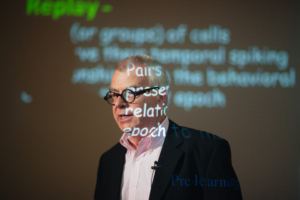
György Buzsáki is a neuroscientist at New York University whose work focuses on brain rhythms and hippocampal circuit activity.
#76: György Buzsáki — Action, the ultimate source of knowledge
In this episode of Stimulating Brains, we are honored to sit down with György Buzsáki, Professor of Neuroscience at New York University and one of the most influential thinkers in modern neuroscience.
Dr. Buzsaki trained as a physician in Hungary, completed his PhD in neuroscience at the Hungarian Academy of Sciences, and went on to postdoctoral training in North America before building a decades-long academic career spanning UC San Diego, Rutgers University, and now NYU.
In this conversation, we explore the ideas behind his work on hippocampal oscillations, sharp-wave ripples, and the organization of neural activity across states such as sleep and wakefulness. Dr. Buzsáki reflects on how his early life experiences, technological innovation, and persistent questioning of dominant frameworks shaped a scientific philosophy centered on internal dynamics rather than task-based explanations.
Tune in for a rare opportunity to hear one of neuroscience’s most original voices reflect on the past, present, and future of understanding the brain.
György Buzsáki 00:00Science doesn't prove anything. Science just rejects the null hypothesis. Failures are a very good part of a scientist's life. Resilience to failure is the most important ingredient for a scientist. The thought is a delayed action. The thought is a deferred action. The thought is only as useful as its utility in the future. The brain does not represent the world. What it does, its internal dynamic and its equipment is able to allow the organism to explore the world and live and survive. Welcome to Stimulating Brains.
Andreas Horn 01:19Hi, this is Ruoyu, one of the producers of the podcast. In this episode of Stimulating Brains, we're honored to sit down with György Buzsáki, professor of neuroscience at New York University and one of the most influential thinkers in modern neuroscience. Dr. Buzsáki trained as a physician in Hungary, completed his PhD in neuroscience at the Hungarian Academy of Sciences, and went on to postdoctoral training in North America before building a decades-long academic career in the field of neuroscience. Dr. Buzsáki went on to postdoctoral training in North America before building a decades-long academic career spanning UC San Diego, Rutgers University, and now NYU. In this conversation, we explore the ideas behind his work on hippocampal oscillations, 02:04sharp wave ripples, and the organization of neural activity across states such as sleep and wakefulness. Dr. Buzsáki reflects on how his early life experiences, technological innovation, and persistent questioning of dominant framework shaped a Thank you very much, Dr. Buzsaki, for taking part in this interview. It's a big honor to be able to talk to you in depth. As you may have heard before, we sometimes start with an icebreaker question about hobbies. 03:06Do you have hobbies? Do you have any free time? What do you do? I have no free time. I'm always in the lab. I used to have many hobbies. Now the only hobby that is left probably is the love of contemporary architecture. I often say that in my next life I will be an architect. I also do some sailing whenever I have the time. Great. And my family lives in Florida, so I often go to Florida. I'm actually going this weekend as well. Oh, fantastic. Great. Which type of buildings would you buy? Build as an architect houses, bridges, parks. So I love theoretical architecture, which is an interesting discipline.
György Buzsáki The thing closest to brain science is scalability.
Andreas Horn 04:04How you make big structures, how you can make a geodesic dome that will cover New York City. Okay, like the buckyballs, right? Yeah.
György Buzsáki I'm sure. I'm sure you know Buckminster Fuller.
Andreas Horn Yeah.
György Buzsáki Buckminster Fuller, of course, is highlighted in my first book extensively.
Andreas Horn It is. Yeah, it's been a while that I read that one.
György Buzsáki The 10-Security Structure. And of course, people will not see, but you see this is on my desk. This is Rem Koolhaas's Bible. Rem Koolhaas is supposed to be the granddaddy of all architectural theory. And if you're interested in the history of the staircases, walls, windows, buildings, and so on, you can go to his bookshop, which is on the right. And you can see the walls, windows, balconies, fireplaces, bathrooms. It's all in here.
Andreas Horn Fantastic.
György Buzsáki That's really, really great. Didn't know that. Glad to hear. So another icebreaker question. I also build a house.
Andreas Horn You build a house? 05:00Yeah. Your own?
György Buzsáki Well, it's an exaggeration that I build, but I put a lot of effort. I built my furniture and I co-designed it. It was fun. You do seem to have some time.
Andreas Horn Yeah. Working with interesting people is always a good thing. So the person who did my staircase was actually a master degree person in philosophy from Princeton. But he changed profession and he's a carpenter. That's fantastic. And that house is in New York, I assume, or in that territory?
György Buzsáki It's in New Jersey. The sad thing is that we had to sell it. So it's no longer in New York. So it's in New Jersey.
Andreas Horn Yeah.
György Buzsáki So it's no longer in our property. Got it. All right. Another quick icebreaker.
Andreas Horn Is the brain becoming clearer or just more complicated?
György Buzsáki The brain doesn't change very much in the last hundred years. I mean, you're over time while you learn things. 06:02Well, this is the nature of science. The more you know, the more you ask. Science doesn't prove anything. Science just rejects the null hypothesis. So you have to buy into this. You have to buy into this frustration at the very end of your career. If you think as a graduate student that in my next five years I will figure out the brain, then you are in the wrong profession. Yeah, I think that's even in the beginning of your career the same thing, right? Probably.
Andreas Horn Exactly. Will we understand the universe? What is understanding? What is the level? Yeah.
György Buzsáki You know, you can say that understanding means that I can explain it to my mother-in-law. No. So we understand the brain in the same way how I can describe the Heller loop of the kidney. That would be cool.
Andreas Horn Yeah, it would be cool.
György Buzsáki Unlikely. Okay, great. So you grew up, so a bit about your personal history. You grew up in communist Hungary, got into serious trouble as a rebellious youth and then crossed the Iron Curtain twice, I read.
Andreas Horn 07:02How did that shape your relationship with authority? Is it possible to summarize this part of your life somehow? Yeah.
György Buzsáki Wherever you grew up, that bringing is part of your history.
Andreas Horn Yeah.
György Buzsáki I'm grateful that I had that history.
Andreas Horn Many people say in our business that the reason why there are so many people in neuroscience who are working with interneurons coming from Hungary is because we were under a suppressed regime and inhibition is one of those mechanisms. Yeah.
György Buzsáki That may be there. Also, I was exposed to very different philosophies, very different world views. The Hungarian language is a funny language. So, you know, your brain is shaped differently.
Andreas Horn And when you are transported or teleported into a different environment, all of a sudden you face interesting things and your uncertainties increase.
György Buzsáki 08:06But with time, you start viewing things from multiple views. And looking at anything from multiple views is always more advantageous than from a simple view. So one of my favorite entertainment in the US is that I look at some of my colleagues and I will say, oh, this would be a good party leader in old communist Hungary.
Andreas Horn Interesting.
György Buzsáki All right. So I have in the light of this, you know, different views. I have one dear friend my age that also grew up in Hungary. She's called Lilla Horvath. Lilla Horvath also was in neuroscience once.
Andreas Horn And I asked her for a guest question. And she asked, growing up in early years of post socialist Hungary, I often felt that independent and critical thinking were not actively encouraged in school. When I later moved to Germany and then to the United States, one of my biggest challenges was allowing myself to ask questions without limitations. 09:01And perhaps even greater challenge was learning to tackle those questions fearlessly. Is this an experience you can relate to? And if so, how did you become fearless in your research? What were the biggest challenges you faced after leaving Hungary and entering the American academic system?
György Buzsáki Wow, that's a long question. You know, memories are reconstructions. So they are not faithful. It's very easy to interpret what happened. But when it's happening, you don't interpret. In retrospect, I'm very grateful to be here. Thank you. I'm very grateful to this communist system because it offered opportunities that I wouldn't have otherwise, such as I learned the Morse code. I became obsessed with information transmission early on because of that. I learned about feedback feed forward inhibition because I built radios and antennas and so on. 10:01So many, many of the. My obsession in neuroscience actually can be tied back to my early days when I was part of this radio club. And this radio club where I belong to was a young pioneers organization initially. And that was a paramilitary club. So, you know, it was you could fly an airplane for free. You could learn how to parachute for free. You could go and build the markets of little houses and so on for free. This doesn't exist today. So that's that was a positive thing. Now, when you come to the United States, of course, you know, it depends where you come. New York is an easy place to start. But I went to Texas. And then all of a sudden you are lost, you know, in the European city. You want to buy. You go for your shopping ground and you have to buy milk. Newspaper, pencils and so on. 11:00Then you find it in one area. In Texas, you have to find the 50 miles one way, 50 miles another way. You go to this big store and then you are given something that you were never exposed before, which is choice. Choice is a good thing for people who don't want to use it.
Andreas Horn So when you were looking for for, let's say, sugar, there is 10 different type of 15 different types of sugar. Which one? Which one should I choose?
György Buzsáki And so these are ridiculous things in the rest of the world. 12:01you know in a bank you can be fired at any moment or that you are in academia you have to earn your
Andreas Horn salary i know but maybe one of the reasons why i just moved back um but but yes uh you're right
György Buzsáki you have the luxury of moving back to comfortable germany and you're right i mean this is it's an
Andreas Horn interesting topic right where in the us i feel that is a key part of the success or the key
György Buzsáki ingredient of the success for the system right but it that that people are essentially you know earn their own um salary to work and essentially are in a constant drive and the academic system
Andreas Horn which is fantastic very good for the system it's a it's a it's a best science for the box for sure
György Buzsáki yes but for him for being one of those you know players of neuroscience who have uncertainty when you have a small child and you know you don't even know what will going what you're going next year whether you can pay the rent and 13:02so on this is a this very exciting times i'm sure you mean in your life right when you arrive of course you know you wake you know we go in the morning and you look at your daughter and said my god what kind of father you are you know you can't even pay the rent perhaps in the next month and no that is certainly certainly too much more challenging to the individual but probably better
Andreas Horn for the system yeah interesting um
György Buzsáki um it reminds me of the brain and uh you know how how community communities of neurons may interact as well so um moving on maybe a bit more to the neuroscience uh realm i've also talked to a few of your trainees or ex trainees and um one thing they said is that you've always been seem to have been one step ahead of the curve um so for example your ex-trainee anna maslarova um asked how do you develop new probes and requirements for the neural network and how do you develop new probes and recording techniques because she seemed that you were really one step ahead with disruptive 14:03experimental ideas you've done in her words crazy brain graft surgeries um quote unquote in the 80s and 90s pioneered high density probes and continued to drive adapt and develop the most
Andreas Horn advanced technologies how and why uh well you know when you are a good formula one driver
György Buzsáki then you get a silver medal that's a pretty good thing but in science if you discover something the second time it's totally useless so so you you have to be first you have to get there and the technology is one of those things you know many people realize i don't want to say seriously what i say because it's not quite true but you know the science moves much forward forward faster and you have new methods new ways of looking at things so methods in a sense drive the the the 15:04the science it's not true you know the short run is true so uh back in in in my days uh you know there was eeg scalp recording that was 16 channels you know that was the standard and there was single cell recording or one lfp and we had ridiculous technology back in the day then but you knew already because physics told you that the local field potentials for example are understandable that's the simplest thing there is no limit of understanding there because it's simple biophysics but in order to make it uh presentable you have to do the measurements and how do you do measurement it has to be simultaneous we call it depth profiles and things like that so you were looking for options and you made ridiculous electrodes you you know, with multiple sides. But then the problem was it was a small animal. 16:02And the higher the impedance of the electrode was, the bigger the noise was. Field defect transistors came about only in the late 70s, 60s, 70s. So again, back in communist Hungary, getting a FET was almost impossible. So I'm very grateful to many of my current and old friends who came from the West and brought me stuff that I could use. I met an extraordinarily nice guy by the name of Otto Prohaska, who was a postdoc in University of Michigan. And he founded Otto Sensors in Vienna. He married an American woman who wanted to become an opera singer.
Andreas Horn So that was the reason why they moved there.
György Buzsáki And then I got a glass electrode with eight sides. That was revolutionary.
Andreas Horn Fantastic.
György Buzsáki Eight sides. And that was the first simultaneously measured local field potential convergence called current source density analysis. 17:03And so when I came to the US, I had the good fortune to meet Ken Wise at University of Michigan, who came from Stanford and he already got infected a little bit by neuroscience. So he was very much motivated of making tools for neuroscientists. But he didn't get buyers, according to him. I was the buyer. And I was ready. You know, before I came to the US, I have done current source density analysis in a ridiculous way that I had a reference electrode, a movable electrode, and the animal had to run 500 times in the same direction. And then every single legend, you did successive measurements and pretended that those successively measured field potential were simultaneous. Of course, not very high precision. But so the tools were there, the ideas were there. You just needed technology. So that was an extraordinarily nice collaboration that is still going on, not with him, but he retired and so on. 18:01But he's a student who is now the leader of the MEMS technology center there. So having a good partner is a great thing.
Andreas Horn Who were other key mentors or turning points in your career?
György Buzsáki and my postdoctoral mentor in Canada, Kees Vandervolff. One of my closest friends is Rusty Gage, who is a, you know, our trajectories went in totally different directions, but back in the early days when I met him in Texas and then we worked together in Sweden in the Björkund laboratory.
Andreas Horn Those were interesting times
György Buzsáki because we were addressing the brain from multiple directions,
Andreas Horn asking interesting questions.
György Buzsáki And indeed, you know, I had a detour as many neuroscientists back then to do brain tissue transplantations 19:01and learn that without neuromodulators, everything is just burst and pause, burst and pause. And there's a lot of lessons from those experiments for today's human organoids. You know, there's a lot of noise about organoids, which is good. You know, there is no method that doesn't teach you. There's no way to do something. But what happens with pyramidal cells in isolation
Andreas Horn is an interesting thing.
György Buzsáki And, you know, funny thing is that last year there were two meetings, or ethical meetings of human organoids discussing how a collection of human brain cells or neurons perhaps will give rise to consciousness, which is the most ridiculous thing you can ever imagine. But if you are not, you don't have the right level of understanding, you think you are doing some service to humankind, 20:00and you're not. I agree with you.
Andreas Horn Yeah.
György Buzsáki What came out of from this is friendship, connections, and then recognizing that, that's not a good direction. Let's do something else. Failures are a very good part of, of a scientist's life. You know, resilience to failure is the most important ingredient for a scientist. So when you realize we wanted to stop seizures, obviously. And so that was my goal. And I transplanted anything where I thought there was a lot of GABA neurons, such as the cerebellum striatum and so on. Of course, back then we had no clue about the median eminence, where the GABA cells are born and migrate from and so on. I wish I had that knowledge. So, but I learned that the cerebellum is a different beast. Packinger cells hate pyramidal cells. They never, ever make contact. So I transplanted the cerebellar neurons into the hippocampus 21:04and nothing happens except seizures.
Andreas Horn Okay.
György Buzsáki So anyway, so, you know, it was, it was a lot of fun. Very, very, very cool. And you, Anna, Anna mentioned you were, you were a scientist.
Andreas Horn Yeah. And you were always ahead of the curve, but then, you know, was there always, was there sometimes also the problem of being too early?
György Buzsáki So according to your postdoc, Thomas Heinmüller, in your lab, you stopped calcium imaging and also stopped work on ANNs, so artificial neural networks, decades before most labs started doing that.
Andreas Horn Can it be sometimes that you were just too early for your time?
György Buzsáki Too early is always a, it's a postdoc decision. It's easy to be a smart postdoc. It was more rational, I would say. So when I was at Rutgers and that was the time then two photon imaging emerged, 22:00I was a frequent visitor and I worked with the group at Bell Labs where David Tank and Winfried DeWink and all these extraordinary smart people were there. So that was the highlight of my week that I went there for lunch and talked to them. And I said, oh, I'm going to do experiments with two photon imaging with Carol Svoboda and so on. So I said, oh, this is the new technology. I need one too. But by the time we were ready, and of course I was always interested in vivo. And the only way how it worked back then is that you filled a single neuron. So what we wanted to do is have a bunch of neurons. And then we did a lot of things with a postdoctoral fellow named Hajime Hirase. And we failed to label neurons. But we found ways to label parasites. So we did the first two photon imaging of parasites in vivo. Then we did the first two photon imaging of astrocytes. 23:01And that became his career. So he went in this direction. But then by the time we, well, others, Arthur Kornert was a pioneer from Germany who managed to do much more. And he was a very good scientist. And he was very good at studying the ! And he was very good at studying the speed of muscles. Everything is that we need to have, at least in my world, how to interpret neural interactions. So it coincided also with the possibility 24:00that silicon probes were much better. You can record from much higher areas. Computers were, computer storage became realistic. You could have not only megabytes, but 500 megabytes and then many more terabytes. So I put my bet on the development of technology that I can record from multiple sites at a very high speed, as well as high resolution. So, you know, this is always the case. This is what we discussed in the lab also, that during your postdoctoral years, you have to calibrate yourself against your fellows.
Andreas Horn Where are your strengths and where are your weaknesses?
György Buzsáki And, you know, it's a great idea to say that I want to figure out something. Something that has emotions.
Andreas Horn But what tools do I use?
György Buzsáki And how will I move forward most effectively, given my talent, given my knowledge,
Andreas Horn given my expertise, given my manual skills and so on?
György Buzsáki 25:01And this is where it determines which direction you have to go, because the rest of your life would be miserable or entertaining. Because if you do something you really like, you enjoy every day.
Andreas Horn Yeah.
György Buzsáki If you do something just because you want to have a paper published, your life is miserable. That is very much true. Wisely said.
Andreas Horn Yeah.
György Buzsáki It's still sometimes frustrating. So for me as a more imaging person, neuroimaging person in humans, I can look at the where question, but I can rarely look at the how or when question. And it's fine because that's what we do and we specialize in it. But it still is sometimes, you know, there's an itch of, you know, I envy people that could look into it. I envy people that could look into these questions more. And so, but you're right. It's sometimes the most pragmatic way to work with the tools you have and know and the talents you have and so on. Very much agree. So let's move on to your inside out brain book. 26:00So you wrote two books so far or two popular science books at least. One is the Rhythms of the Brain and then the Brain from the Inside Out book.
Andreas Horn Is there a third one coming or?
György Buzsáki I don't know about it. But nothing in concrete works. No.
Andreas Horn Okay. So if you had to summarize the brain from the inside out in one sentence or in a few sentences, what problem was the book trying to fix?
György Buzsáki It has basically two aspects. One is how we got to where we are now in terms of thinking.
Andreas Horn How do we create the current neuroscience framework?
György Buzsáki And the second, the third part, which is connected to it, what is the best, not the best way, what is a, for me,
Andreas Horn comfortable way of asking questions in neuroscience? Where do I start and how you address the question?
György Buzsáki Because the way you address the question will almost guarantee you how you will interpret what you find. 27:03And that's a very important thing because the way how we do experiments is the way we should. And that's the way we should. Which is we test the hypothesis. Namely, I test my hypothesis. And if I test my hypothesis, almost guaranteed that I will get an answer.
Andreas Horn Yeah.
György Buzsáki And it's always favorable to be. So the good experiment is that in the same experiment, I'm testing my hypothesis and your hypothesis. Preferably many more simultaneously. And if you can design that experiment that way, you can confront a lot of different views at the expense of the hypothesis itself.
Andreas Horn Yeah.
György Buzsáki And then you can sort of sort of 28:13In our case, it was a very simple situation that was a sound, it's a changing sound that the hippocampal neurons tracked.
Andreas Horn And we thought, oh, just like in other laboratories, in David Tank's lab, for example, these are sound cells or sound landscape cells. And then we showed it has absolutely nothing to do with sound. But with change?
György Buzsáki No. So the experiment works like this. This animal is the agent of its own feedback, which is running at a, or moving around in an alley where the sound changes as the animal changes its position. And then the goal is that produce 20 kilohertz. 29:02And wherever there is 20 kilohertz, just look to the right and there will be water. And there are many stops you can do that. It's like this game that you play. It's like in middle school or elementary school, you know, that cold, cold, cold, warm, warm, and so on. And then when it's warm, you look around and said, okay, found it. So this is applied to the rodent. And then you see a surely perfect correlation with sound.
Andreas Horn Makes sense.
György Buzsáki But then you can terminate the sound at four kilohertz instead of going up and nothing happened in the hippocampus.
Andreas Horn Okay. So they. This, the neurons change as if the sound went on because the animal was moving, right? Yeah. Okay.
György Buzsáki So, so it encodes space rather than sound. No, no, no space at all. That was wrong. Stop guessing. Now it was the animals action.
Andreas Horn Okay.
György Buzsáki It was the animals planned action. 30:00And we also showed that, you know, it's not a, a reward per se, because we had six sports and that it was more the movements. The licking.
Andreas Horn It was exactly the same in all the one, but in one case, the probability of finding water was a hundred percent.
György Buzsáki The others was lower and lower and lower.
Andreas Horn And that probability or that uncertainty or expectancy is what was driving the neurons rather than the water per se. So very interesting.
György Buzsáki So that, but this became clear only because we have done multiple experiments and multiple exposures, multiple. Controls. So this, I think this is what I, I advertise in the inside out.
Andreas Horn Yeah.
György Buzsáki That you have to ground your knowledge with something. Maybe the one paragraph summary of this is that what we do is you observe brain activity, whether it's your favorite ball signal or, or, or unit firing or whatever. 31:11And then you present something to the brain.
Andreas Horn Yeah.
György Buzsáki And then you, and only you, the observer is looking the relationship between the two.
Andreas Horn Yeah.
György Buzsáki But that requires an external observer interpreter who is already biased. But the brain has no clue whatsoever about this correlation.
Andreas Horn Yeah. And, and then how do you know?
György Buzsáki In other words, how do neurons see, how do you. Plan and so on. And you were looking for something else and that's something else that is available for the brain with besides sensation is only action. And the brain always compares the, there's terms like relational brains and so on. 32:02And that's the main theme of my laboratory. You know, everything is a relationship in the brain and, and there is no. Absolute things. Absolute things are all arbitrary in physics and everywhere. There are no units are made up by humans. There aren't.
Andreas Horn And no, but the relationships is, is natural. And this is what we have to strive for in neuroscience that we have to know when you find a neuron that is, is responding to a rabbit outside or a sound of a rabbit or whatever, then you can say, well, is this change relevant for the brain? Yeah.
György Buzsáki So you know, yeah. So you have to, you have to ask a downstream neuron, an interpreter, so to speak better. It's important for the rest of the brain.
Andreas Horn It there's the brain is so, so the book is so interesting and so multilayered, right?
György Buzsáki I think you've started answering the question of summarizing the book in a, in a way I hadn't heard before, which is essentially contrasting hypothesis driven research, right? 33:05Which is favored by NIH and others and then journals. Maybe. William James and so on, very old concepts that we have in psychology of perception or behavior, decision making, all these things, terms that may not even have a representation in the brain. And then I think there's also this big theme in the book about the primacy of action that you just related to. And all of these are interweaved with each other, but it's really rich in so many concepts.
Andreas Horn 34:07And I would say it's not even easy to summarize it, which makes sense.
György Buzsáki It's a whole book.
Andreas Horn But what I take from you now rather to go forward would be listen to neurons or brain activity by itself and from that try to infer meaning of the signal, right?
György Buzsáki Not by just correlating it to a task.
Andreas Horn Or would that fit the bill?
György Buzsáki Kind of. So the question. The word meaning is the most difficult thing in philosophy.
Andreas Horn Yeah.
György Buzsáki And it's a good word. It says that I know that meaning to whom.
Andreas Horn Yeah.
György Buzsáki Many of the things in the world have to, and the only way things make sense is that you have a classifier. Now, whenever we, an observer and the observer is always a classifier.
Andreas Horn 35:00You know, what is the difference between a dog and a cat, a small dog and the big cat?
György Buzsáki You know, the only way you know is that. That if you have an interest in differentiating because it makes a difference for your life, but otherwise you just lumped them together. So the naive approach I would say is that you present the signal and the brain is ever ready in a way how a computer is ready to respond to your commands and and everybody subconsciously knew that it's not the case. But still, we designed experiments according to this. You know, you can say tabula rasa. Calculated.
Andreas Horn Yeah.
György Buzsáki That's the kind of approach and they interpret the results accordingly.
Andreas Horn Now, this is brings us to the interesting part is that the brain is a self organized system.
György Buzsáki We just had we have a paper now that we asked very seriously about, you know, how much energy, how much energy budget is devoted to maintaining the brain's dynamic. 36:00And I'm asking you, give me a guess. 10%, 5%. order to give life because otherwise these are just connections and so on and in order to give life you have to put a lot of noise in and then it lives for five seconds and it dies you know but to maintain this spontaneous activity forever uh the way we ask the question is that we went back to shannon and say what is information yeah and and we'll get to this 37:00perhaps a little bit later and how you define the communication and so on and uh he basically defined that the a bit is not in information the information is between at least two bits so the intervals are there and of course the intervals then have to be read something so now you go into the brain said do we have a mechanism to read out a burst of neurons burst of spikes yes do we have a mechanism to read 200 millisecond yes do we have a a mechanism to read out one second two second three second intervals and the answer is maybe but we don't know about it probably doesn't even exist so now you look at every neuron in the brain 10 areas from thalamus to neocortex and you ask hmm what fraction of the spikes in each neuron have a long interval several second intervals yeah and and then you 38:00quantify 10 000 neurons and you find that half in every structure of the spikes are devoted to this sporadic activity which is not coordinated across neurons in order to do neural cross coordination the neurons have to fire at the uh not physiological it's in the communication regime which just starts around one hertz or so and when you have gamma oscillation theories that they have 39:00dynamic forever. And so good to patients, such as learning about politics, learning about discoveries or whatever, it doesn't change much in the brain. Even if your entire life learns and you don't learn anything, the brain dynamic doesn't differ in maybe a tiny bit measurably. So that means that the brain decides the relationships. So this is in contrast to the philosophy and practice that we inherited
Andreas Horn because people are talking about signals. Yeah, people are talking
György Buzsáki about stimuli. People are talking about reinforcers. There is no such a thing as a reinforcer or signal in the physical world. The signal it already assumes that somebody interprets it.
Andreas Horn Yes.
György Buzsáki 40:00But you know, if somebody knocks on my door now, I probably won't even notice it, because I'm focusing on you. So this is the beauty of the brain that it has extraordinary resilience to ignore pain and everything. At the same time, it's extraordinarily sensitive. So where does this extraordinary dynamic come from, if not from self organization, it would be absolutely not impossible. Nothing is impossible of course in technology, but it would be very expensive energy budget wise to have a brain that is always super, super sensitive and it senses everything around us. And it may not be very useful either. So these are the questions that you know, it occurred to you, it occurs to everybody, you just have to
Andreas Horn think about it. There's no why people think this way. And then
György Buzsáki you go back to William James, you go back beyond William James to British MP. Sure, I was sort of like, sort of like, sort of like sort of 41:28you know your hindu grandmother have no idea what you are talking about what is what is decision making and so many of these things are culturally biased and then it they got codified and then we do research and you know and we take it for granted that those words that we repeat enough are real and then we are trying to find homes in the brains and mechanisms in the brains and we start fighting each other yeah so you just mentioned it would 42:04be impossible or like what way to not unsustainable if the if the brain was always very sensitive to everything right wouldn't wouldn't really work the opposite could be that you know you could even imagine and not that but you know no activity neural network that just based on the sensory stimuli coming in it fires up and does stuff right so that maybe would have this standard arc of sensation some processing and then an action that that we sometimes see in textbooks and um first of all you know that's certainly not how the brain works right we all agree maybe the idea is rather that it's a a bit like a boxer player that tipples around all the time and keeps active may that maybe that's even a image you had in your book or i heard it somewhere else but that is always active and tipples around and then may deliver a lot of the same kind of information and then it's not like it's like a punch at the right moment but also might be tippling in the wrong way and then may not be able to do so right so so it has to there's a ground activity there to respond 43:05um first of all am i getting that right and then second maybe as an analogy you know if you open up chat gpt and ask for a prompt so these artificial neural networks they are really dead while nothing happens and then the stimulus is right in it's dust processing and it produces output so that seems to maintain such a system where you don't need at least in the current implementations need some ground activity any thoughts on these points yeah so we are attempting to always make parallels with technology and we say oh well this mechanism is like and then you can be brave enough like uh conrad lawrence you know the ethologist to say oh i can explain you motivation by the toilet flush you know you build up energy you pull and it comes out and so on 44:03this is how you know aggression works it's a nice analogy and then we always say what it is and the computers were analogy of the brain and now ai is the analogy of the brain and the ai is trying to be in brain inspired most of it is at the moment i would say lip service because it on the wrong brain model, I would say, the right brain model would be the one that is having its own dynamic and maintaining, but such AI model doesn't exist. And you're absolutely right that the current work is responding only
Andreas Horn when there is an input. Now, is nothing wrong with that?
György Buzsáki Sure, it works. You can do so many things so much better than you and I.
Andreas Horn So why do we want to strive to build a brain when we have 7 billion of them already?
György Buzsáki I agree with you. No, no, it was more like an example of how we know that it could work like that. 45:01So I think we were inspired by birds and we built airplanes, but they are not birds.
Andreas Horn Yes.
György Buzsáki The locomotive was introduced to compete with horses.
Andreas Horn And of course, yeah, it out-competed,
György Buzsáki but we never made a horse. We just made something that served humankind in a good way. And along the way, of course, we interpreted it. I have a couple of pictures when I'm talking to AI people where the early locomotives actually had a face of a horse. Oh, wow.
Andreas Horn Interesting.
György Buzsáki Just to make it, to drive home the point that these are strong horses.
Andreas Horn Yeah.
György Buzsáki So we do it all the time. We always have analogies.
Andreas Horn Yes.
György Buzsáki You know, in the, in our European thinking, there are not too many ways how you can define the world. You can use Aristotelian logic, which is you start with a general proximum that is the next possible, next closest group. 46:03So this is, this is, this is, this, you know, you call it an iPhone, but you can say, this is a communication device. Now you know the communication device. And then you have the differential specifics is that this is the one that I can hold in my hand, The other way is metaphors.
Andreas Horn Yeah.
György Buzsáki And, and that's, that's the repertoire. There is nothing, nothing really else. So you use metaphors when you got stuck with the Aristotelian logic, such as when you are defining difficult things in physics or difficult things in neuroscience, such as consciousness, because there is no more general category. So you cannot say where it is. Then you say, oh, consciousness is like a flow of the river. or some nice metaphor.
Andreas Horn Yeah, interesting.
György Buzsáki That might really be the reason
Andreas Horn why there were so many analogies for the brain over the years, right?
György Buzsáki With telegraphs and with telephones and everything. So because it is so complicated and because there's probably no superior category,
Andreas Horn 47:02that makes sense.
György Buzsáki Because the human mind and every mind of every animal works by, as I said, relationship. The only way you can ground the unknown is to ground it to the known.
Andreas Horn Yes.
György Buzsáki So this is how evolution gives you already a level of knowledge and you are born with that pre-configured knowledge and then you ground it. Now when you know what a telegraph is, then you kind of get what the neurons could do. Of course, this is always bad because the analogy is understandable on one part and not the other part. But you walk home by saying, oh, the brain is like a telegraph or a vision is like a TV screen. And things like that. And there is nothing wrong with that. May it for some things be helpful. It's a good point.
Andreas Horn So the grounding is a very important word in your book, right?
György Buzsáki That relationship to known things. And I think also in that vein, 48:02there's this primacy of action. And I told you, I think, in the email that I have a quote of yours on my door and have it since years. But I didn't tell you which quote. And the quote on my door to my office says, action, the ultimate source of knowledge. Also to motivate myself. But in a deeper sense, the primacy of action,
Andreas Horn what do you mean by that?
György Buzsáki And I think it also ties into this idea that the brain invented, as you say,
Andreas Horn the collaterals to the sensory system, right?
György Buzsáki So whenever there's an action, it seems like the sensory systems are informed by that.
Andreas Horn Could you speak about that idea? Yeah.
György Buzsáki You can. You can. I have again two approaches, like in everything. One is the big framework thinking, how these ideas come about. The other one is mechanisms. So let's start with the more complicated one. And this is just, you can say, philosophy is that there is absolutely no utility 49:02of perception. Zero. Unless you can act upon it. There would be no need to develop sensors, because they are useless.
Andreas Horn Yes, makes sense.
György Buzsáki On the other hand, that is not true for action.
Andreas Horn So you go back and say, well, how would animals evolve?
György Buzsáki And the animals evolved because they had to eat. They had to eat plants. And you can go back into the simple things that you have to provide energy for yourself.
Andreas Horn Yeah.
György Buzsáki And if you just do a random walk, chances of survival are higher. But even if you have the best laser technology or cameras, everything on you and it tells you where the food is,
Andreas Horn but you can't walk, it's totally useless. 50:03Or how do I know that the tree is smaller than the moon?
György Buzsáki If I'm just sitting in my chair. You know. Hard to say yes. You're right.
Andreas Horn Yeah.
György Buzsáki The moment I start walking, it's clear.
Andreas Horn Yeah.
György Buzsáki So measuring is the action is the way of measuring.
Andreas Horn Yeah. And without measuring, there is no ground truth. This is the same idea of this active inference concept as well, right?
György Buzsáki Where you have to use the case, you have to move, you have to touch things.
Andreas Horn Exactly.
György Buzsáki So the most important, the brain, as I try to say all the time is prediction. But the way it predicts is that it predicts its own actions because that's the important thing. And the consequences of its actions. And of course, this goes hand in hand with memory. 51:00So because they have to register in order to make use of that experience, you have to have that experience stored one way or another. And and then this principle to me applies to every brain, including us.
Andreas Horn Yeah.
György Buzsáki then the allostasis mechanisms are much more complicated than homeostatic. And then you can perform this prediction in a much noisier environment and at a much longer timescale.
Andreas Horn Yeah.
György Buzsáki And the third step in this process is, takes us to the exciting part, is that the processing becomes so smart that you no longer need the world. 52:17You can, the brain can disengage. You can disengage from the world and you can disengage from the body. And then you can do it. And for only for one reason, which I. Mentioned in a second, you can do what if scenarios. In your thoughts without acting out.
Andreas Horn And the reason why you can do that is because of von Holst and Mr.
György Buzsáki Statt, two Germans.
Andreas Horn Yes.
György Buzsáki Who invented what in America we call corollary discharge. That was an extraordinary insight showing that it's not, as you rightly pointed out, that it's not input processing. It's an output.
Andreas Horn 53:00Yeah.
György Buzsáki But every single time the agent generates an output, it will send a return envelope to the rest of the brain.
Andreas Horn Yeah.
György Buzsáki To the sensory system and everywhere. Informing that whatever you see next is my action, the consequences of my action. This is an, you know, apart from the philosophy and everything, this is an extraordinary recognition. And what I did is I. I just. I. I just generalize it to higher levels. And if you read that, you know, the. Original publication of von Holst and Mr. Statt is 20 some pages. This is one of the most beautiful writing in neuroscience history. That is it. It's it. They thought about almost everything I'm preaching about because they thought how it could be used for many, many levels of brain organization. And it is used in many levels of brain organization. Now you can do this. This. 54:00Potential out. So it's fictive action. Because it is when I, when I do something in my mind, I'm doing an action without moving my muscles.
Andreas Horn And so to just to clarify, you mean a thought by that, right?
György Buzsáki A thought is an action without output in your book.
Andreas Horn Exactly.
György Buzsáki The thought is a delayed action. The thought is a deferred action. The thought is only as useful as its utility in the future.
Andreas Horn Yeah. Makes sense.
György Buzsáki If I have a thought that is bizarre, I will be treated by psychiatrist. But if it is something that is actually translatable and the important thing is that that the the evaluated choice of that action is better than the alternatives. That's what you can call thinking, you know.
Andreas Horn Yeah.
György Buzsáki And the foundation of all this is action. 55:00And if you if you look at just the brain anatomy. And say, oh, action part, sensory part, you know, front and back and so on. The motor cortex.
Andreas Horn Yeah.
György Buzsáki Inputs and outputs and its internal organization are so, so similar to the prefrontal cortex.
Andreas Horn Yes. Just the only down, right?
György Buzsáki They stop in the midbrain somewhere. Well, but they have the same. You're a modulator. They have the same kind of.
Andreas Horn Yeah.
György Buzsáki So so it is, you know, you ground your speculation also in anatomy. The only difference is that there are no bad cells. There are no no cortical cortical spinal tracks. But there are these spindle neurons that are large enough in large, large brain animals. And they are probably evolved. Similarly, they just don't send the accident all the way down.
Andreas Horn Yeah.
György Buzsáki Super cool. So this, you know, you talked a bit about two things. One was phylogenetic refinement or like the idea of, you know, studying, of course, simpler organisms and over time then seeing what came on top. 56:08The other point was that you talked about homostasis and allostasis. And it reminded me of something Paul Csikszentmihalyi said, who I also had on the show before, where, you know, he essentially. I think summarized theories of hypothalamus researchers where where essentially the homeostatic part of it was almost done pretty, pretty soon because it's comparably simple. But the allostatic part that tried to control the environment in, you know, about others where it controlled the environment, the external environment, essentially, in his words, grew mushroomed out a whole base of cells.
Andreas Horn Yeah.
György Buzsáki And the cortex. So his basis on on Puella's, I think, mainly Puella's ideas of the hypothalamus, where the entire thing that we now call, you know, pallium and basic ganglia and cortex came out of that piece of the hypothalamus that required so much compute. 57:14And it even he would even say that even something like language or maybe studying at the MIT and all these complex things we do are still a function of time.
Andreas Horn Yeah.
György Buzsáki I wouldn't say missing in neuroscience because there is Paul and Jean-Laurent and many preachers there who say that if you are interested in a particular problem, identify the 58:02smallest, not the smallest, but the simplest possible organism because everything else comes with noise. So for me, a good example would be sleep research. Sleep is such a fundamental thing that is probably organized down here. But we find sleep centers all over everywhere. The wake centers. Every part of the brain can be classified one way or another depending on some threshold. Now, the fundamental thing is in the evolutionary part, where is the
Andreas Horn initial REM, non-REM change? And you can find it in the Australian dragon.
György Buzsáki So if you have a non-REM change, then you don't think about the neocortex. But I know that my grant is rejected, my paper is rejected. I will not sleep the same way tonight than I did yesterday. 59:02So there is a, the loops are always serving and controlling what happens deeper. And that's why, you know, there are many people who are interested in the brain. There are many people, you may have good friends that, you know, you can tell them that, they tell themselves they have to catch a plane six o'clock in the morning, they have to wake up at four o'clock. And they wake up at four o'clock without an alarm clock.
Andreas Horn Yes. And so that's an interesting thing. What do you say to your endocrine system?
György Buzsáki You know, we wake up usually because of the cortisol level increases.
Andreas Horn How do you increase cortisol level at your will for hours?
György Buzsáki Mm-hm.
Andreas Horn Yeah.
György Buzsáki In advance. So this is where you need this allostatic complication that comes in.
Andreas Horn And of course it comes with very interesting questions,
György Buzsáki which is one of my favorite that I ask from students is that, okay, the pre-Betzinger nucleus, which is the breeding center, 01:00:04has a few hundred neurons in the mouse. But in a whale or in a human, it has tens of thousands. Mm-hm. But it controls the same number of neurons as a mouse.
Andreas Horn the same number of intercostal muscle the diaphragm and so on why do you need so many neurons or i can ask you know why locus serolus which provides norepinephrine to the brain and the spinal cord why there are why why why the numbers scale with the size of the brain and and you know if you ask
György Buzsáki molecular biologists colleagues then you say oh there is a gene that is the scaling gene and and so on and so on but it's not right the answer is that that you have choice either you make extremely large neurons that can pump norepinephrine to various places but that's not the key part the key part is that the new part of the brain that is added always wants to have 01:01:05access to the old part and in order to oh yeah access to the but there's only way is to control control control but there's only way is to control control control is to uh multiply neurons so it's no wonder for example we were surprised initially that we went to the vta and recorded from the vta dopaminergic neurons and they responded to smell they've placed fields of dopamine euros yeah they had all sorts of funny things, but they are the teacher or the critic of of the basal ganglia to some or to yeah um they they need they need to somehow have lots of input because they're key in deciding or like they don't decide but the system decides with them as the output function of of whether something was a good thing or maybe not so good thing right so they you're right they they must it wouldn't be the same number of neurons wouldn't work because of
Andreas Horn 01:02:00the inputs probably right um yeah well it's interesting you mentioned the basal ganglia
György Buzsáki because the basal ganglia are like the cerebellum you know with all my respect and all the beauty of the cerebellum and the basal ganglia they are dead you know they are dead in a sense that they don't do anything
Andreas Horn on their own and the reason why don't they have because they don't have recurrences and if they
György Buzsáki don't have recurrences uh recurrent excitation typically or some kind of maintenance of spontaneous activity then you don't have persistent activity which is the essence of of brain activity that you have to have a lot of activity and you have to have a lot of activity and you have to have a stimulus and the life of activity in the brain is much longer than it survives but the basal ganglia doesn't do a thing because it's all gaba without the neocortex they borrow it from
Andreas Horn yeah they borrow the life from the other systems yeah exactly together so that's the tabula rasa
György Buzsáki so the tabula rasa example would be the cerebellum extraordinary useful structure 01:03:02please don't protect me from saying this but it developed for a different purpose because if you don't protect me from saying this but it developed for a different purpose because if you yeah make sense so if action comes first what is perception really doing knowing that perception doesn't exist it it's it does enormous enrichment to our lives enormous enrichment but the perception is again utility based it so again we we had recently a paper and we managed to have a two centers at the end of the discussion that i'm still surprised that they you could gotta wave it down which is that that the brain does not represent the world uh what it does it the its internal dynamic and its equipment is able to allow the organism to explore 01:04:05the world and live and survive so in order to do what we do we need a few sensors and uh you know we we are not in the deep sea we are not in caves natural thing is his vision sound and so on but we don't have sensors for radioactivity yeah funny thing is that i don't know how useful it would be but we don't have sensors for uh for for the magnetic no and perhaps we don't need it because we have the sun so you know you you do all these things for a utility and no it is this is a different type and very simple but different type of
Andreas Horn thinking that say the reason why we were given five sensors is to learn about the beauty of the world created for us by god because that's the ultimate philosophy and so that's a interesting
György Buzsáki 01:05:08idea if it's if the framework exists yeah i mean if it doesn't if it doesn't then you have to think about differently but even then you you follow the the new new testament and you will find that you know help yourself you ! !
Andreas Horn 01:06:38in canada for two dollars two hundred dollars so that's an interesting thing that you can incorporate
György Buzsáki stuff like uh you know a phantom limb and so on automatically yeah in a very short time we learn very quickly it's the same with the reversal like the goggles you have but reverse only the truth the truth comes through action right yes the moment you said oh is it my limb because your 01:07:05sense is stimulating me i'm not so sure after a while i fool myself but the moment you i move an inch you know it's trivial to know it's a good point yeah i mean the the the you know the the compass sensor might even be a really good example for that because there's no the body like or the brain would not know anything about but it will sense and then incorporate it as a natural signal
Andreas Horn and then i found it super interesting when i had like my my babies
György Buzsáki at home and they would start moving their hands and at some time you realize they now see something moving in in front of them right so they had to really make sense of this trivial signal and patch these things together right that that they were the actors here at all i think they did not know that in the very beginning they would move things and then they would also maybe perceive motion but grounding that together was a learning thing i i think i mean couldn't of course 01:08:05you just observe them from the outside but it didn't feel like they had to really learn that from scratch i felt right well i i mentioned these are mostly anecdotes but they are good anecdotes from mostly surgeons in the old days you know when you the baby was sitting in a wrong position in the womb they had forceps and they pulled out the baby and often not oftentimes occasionally they broke a leg or something so then they put a cast on the baby's leg and i i had family members that were panicking and so on because they had positive babinski reflex and and the baby didn't feel they didn't feel the touch and they were panicking and then they went to talk to the surgeon who did the casting and he said it's ridiculous we will remove it and
Andreas Horn everything will be normal and that's exactly what happened the moment the limb started to move
György Buzsáki 01:09:00sensation return not return sensation emerged yeah so this is a very striking example in humans in human babies and indeed sensation is secondary reaction
Andreas Horn you mentioned the tabula rasa view and you reject the tabula rasa view what is that and what exactly
György Buzsáki is pre-configured in the brain so it's not me everybody i don't know any serious neuroscientist or even a novice who would say tabula rasa is the brain can you briefly mention what it even means okay just for the listeners blank slate or a piece of paper as uh many people said before is that it's a white paper and you have to draw something on it and that will be information but initially it's empty we we arrive with an empty mind yeah and then this mind can be enriched by whatever we learn and so nobody 01:10:05believes in that but what i observed and demonstrated through a couple of paragraphs in my book that even the most serious experiments are designed by this idea and the interpretation of the experiments
Andreas Horn the experimental findings are within this scope so this is why i attacked it and i have good examples
György Buzsáki in my talks you know that i take giants such as ellen turing hopfield yeah you know they said everything is similar similar similar similar and that's so 01:11:05far from the truth everything is different different different in the brain the distribution can you clarify what do you mean by that similar similar similar so the whole field network which
Andreas Horn of course is highly praised and it's fantastic but the idea is that you can do magic with
György Buzsáki a large number of similar elements with similar connectivity okay and the ai is a perfect example of that yeah but the brain seemed to figure out that even in the simplest brain yeah diversity or different it's called component diversity the component diversity is the primary drive i i remember i had talks with the iv mara and others you know kind of jokingly said you know we can't figure out the gastric ganglion control with eight neurons and you're trying to explain the human brain or mammalian brain but in reality it's not a huge leap because what happened in the 01:12:08human brain is that yeah maybe about 20 different types of cells maybe 100 different types of cells depending on how you classify them but the big thing is that some of them multiplied by the billions or millions but that's a not a a exponential increase of complexity because the diversity the component diversity was already
Andreas Horn present in a very simple brain and that's why it is so difficult to understand even a simple brain yeah so that's what i meant by saying that yes you can build fantastic devices and and
György Buzsáki performance from similar elements but the brain is not like that no the picture that you see behind you is that well i look at the brain and i see that it's not like that you know you know you know i look at the distribution of axon called axon calabit calibers it has a wide four orders of magnitude distribution from tiny tiny fibers to giant 10 micro fibers in the human corpus callosum
Andreas Horn 01:13:07so why is that there's a lot of just function already ingrained by the structure right so
György Buzsáki it's not just a mush of squishy neurons that are randomly wired together right it already has a lot of organization just how it's wired up that must imply function and a lot of constraints but a lot of readiness and a lot of bias and a lot of abilities and uh you know this is something that we are beginning to understand and there are extraordinary good programs and because people realize that this is this is very important uh now when it comes to understanding then you start perturbing but when you perturb such a complex system that's called perturbation some people call it causal neuroscience which is ridiculous in my mind okay because finding causes in the in a complex system is uh is is much more hopeless than finding 01:14:00a a needle in a heat stack hey it's like good point yeah i i when i studied medicine i found it a very crazy idea but it is true that our immune system essentially builds structures against anything that could arise right so the um antibodies that are essentially pre-configured to think of not think of you know but it will build anything that's not that could potentially come as a foreign component to get into our um into our body and it's an unintuitive way of doing that right i felt like there should be rather a detection system that knows everything that the body has and then anything that's not that would maybe get attacked but but it actually implements it by building millions and millions of antibodies that could you know for things like millions and millions of antibodies that could you know for things that could arise right and that also has of course implications for autoimmune systems allergies and so on and i think that analogy is a bit similar to what you come up with pre-configured things that like
Andreas Horn 01:15:07states of the brain that exactly are there from the beginning and then are grounded to things
György Buzsáki that happen um so maybe brain stays network activity could you could you talk a bit about that idea oh very well said and it's not by chance that immunologists like jerry edelman we're on the right track so i was a member of jerry edelman's club you know he had a club in san diego and uh he discussed it a lot he had this high level of thinking but he really thought about the darwinian selection which is what you know gave him a nobel prize but he said oh yeah maybe something analogous happens in the in the brain and that's where the pre-configured idea comes from so you know the way i think about pre-configuration is at the dynamic level that that just a tiny 10 millimeter long hippocampus
Andreas Horn 01:16:02in the rodent can generate so many patterns spontaneously why do we want to add another
György Buzsáki 10 000 when there is already a lot so in in my world we are not making patterns by sensory stimulation and the hippocampus has no idea about senses anyway when it's already available any choice is available so for me learning is not a synthesis but it's a matching so it there is a pre-existing pattern and it is matches and of course you can it's like a lego system and this is much easier to 01:17:13But the ultimate proof for that is that optogenetically, you can turn off the entorhinal input.
Andreas Horn And then the number of place cells in the hippocampus remains exactly the same. Okay.
György Buzsáki The sequences remain the same. So it shows that it's not that there is an imposition of a pattern coming from an upstream region. The entorhinal input, it just selects the most probable ongoing pattern from the many, many possibilities. So, for example, when I come to my workplace, my mindset and the probabilities of my patterns immediately biased that this is a research facility, I will see colleagues and 01:18:05so on. And I look at my calendar that already biases my. I'm thinking, so Andreas, aha, 930 a meeting and so on. So there is no surprise that I see your face. Sure. But if you meet, let's say in Tahiti on the beach, that would be a total.
Andreas Horn Yeah, you wouldn't recognize me. That makes sense.
György Buzsáki So this is how the way the brain always brings up the highest probability.
Andreas Horn So this is why I say that there's nothing.
György Buzsáki I can show you to the brain that the brain would say that doesn't exist. You always say it is like you anchor it to something that you know, you make the connection immediately. The brain always makes it always interprets.
Andreas Horn Could there be an alien signal that's from a very different physics planet that is so 01:19:03different than that really couldn't be matched by the brain?
György Buzsáki Probably not. Right. Because it's still based on the physics. If you don't sense it, if you don't translate, it doesn't exist. The moment you prescribe it by equations. That's already something you can sense. You make it sound or you make it possible to touch. Then we are back to our realm of possibilities.
Andreas Horn Yeah, yeah. Makes sense. Okay, fantastic.
György Buzsáki So so so essentially there is a there's probability and in the developing brains, I think your example when you came into the office.
Andreas Horn That's a fully trained brain, right?
György Buzsáki So but what about in the beginning when it's a baby or so you would still think there that there are these states essentially randomly browse around through the brain activity and then maybe there's a sensory input coming in that matches something that's already there
Andreas Horn and then it's ground to that thing or to that action probably mainly. 01:20:01Is that how it starts?
György Buzsáki And you build it up. You already have our phylogenetic knowledge, which is enormous. Right.
Andreas Horn Yeah.
György Buzsáki So every animal then but then then we can go back to Piaget. But many, many developmental psychologists that said, well, the way how humans babies learn is. Not the way we learn German as an adult, but they learn through action. This is my translation. Namely, they bubble and they say they every baby has a little bit of different repertoire. So they have a lot of different cultures. So they have a lot of different cultures. But yet different. And they say, uh, uh, and then the father says Apple. And then they point out the Apple and the devil will become Apple. So it's a matching process of the world outside initially.
Andreas Horn And then, of course, we have the interesting advantage through language that no other species
György Buzsáki 01:21:05said that a lot of the semantic information that we learn is not the language. That is the language. learn is not through our own experience but is given to us by a cultural background and that's a that's a beautiful wonderful advantage and at the same time it's a dangerous curse because you are given knowledge that you don't question you know the authorities will tell you that this is how you have to behave yeah or you know if you say what is this this is a uh this is an iphone or this is a this is a mouse i have no or usb i don't even know what the heck the usb is but i know the utility and so on and i don't ask it anymore oh but you said god and they comes from an authority and explain me what it is then i start believing in it without questioning it or 01:22:01uh you know republicans are bad democrats are good and you know if it's if it if i if i'm told by an authority then i don't question it i forget if i accept it the same thing when i say there is stimulus there is a signal there is a choice there is free will and all these things this is because we have language and language allows us to learn semantic knowledge without grounding though
Andreas Horn 01:23:00Richard, so how does that tie into that primacy of action for you?
György Buzsáki Silly action of the parents, probably.
Andreas Horn So understanding is an interesting problem. What is understanding?
György Buzsáki Responding is easy.
Andreas Horn Yeah. Right?
György Buzsáki But understanding is a deep word. Well, example is you can ask a baby that wouldn't yet speak.
Andreas Horn You could say, where's the lamp? And it would point to it. Right?
György Buzsáki So you have some proof it at least has the semantic knowledge of a lamp. So here the experiments are lacking, obviously. But my experiment is that if the baby could never move, if his eyes were frozen.
Andreas Horn Yeah.
György Buzsáki The muscles wouldn't move. So the reafferentation wouldn't really exist. That brain. It would be dumb forever. 01:24:02It would never understand anything. There would be no, no, nothing. So this experiment hasn't been done the way it should be. But I already mentioned you the broken leg. This is a little bit closer to that. So there is no sensation without action. If there is no knowledge without action, it just appears that verb from very early on.
Andreas Horn First of all, you know what?
György Buzsáki Babies do in the womb. First they move. The babies understand the big, the mothers understand the big kick because that's what they feel. But they move thousands of times a day. Sometimes only the gastrocnemius contracts. Sometimes they're always a isolated muscle and they have whole body startle responses.
Andreas Horn And we studied this many years ago. Uh, we asked the question, what is the first organized pattern in the brain? It's a legitimate question, right?
György Buzsáki 01:25:01And it turned out to be a spindle. It's a time of article because you're on the brain is organized vertically. The spine, the thalamic neurons, uh, axons are there. The thalamo cortical fibers are there. There's no feedback yet. There are no horizontal connections, the association connection. There are no new more neuro modulators yet. But every time there was a pattern, which is this, we call it early spindle. It was. Initiated by one type of movement. And so it, it could occur spontaneously because we cut the spinal cord and we, you know, did this, but it's like the relaxation oscillators that can be perturbed very effectively early on stake.
Andreas Horn It speed rules would be generated internally by the interesting cortical thalamo cortical organization.
György Buzsáki But when there is a. Input. From a muscle. 01:26:01Which is a stochastic pattern. It's, it just responds to the stochastic release of, I said, the call it. Then there is an early triggering of the spindle. So this is how we build the body scheme because how would the, how would I know that my, my body is the way it is. It's not a ball, a snake and so on. And I'm growing, you know, last week, the distance from my finger to my nose was different. So I have to. Update that, that knowledge every day. And that can be done only through actions. Totally agree.
Andreas Horn Yeah. Very interesting. This, this, this podcast is about brain stimulation and a lot of people that listen to deep brain stimulation, um, aficionados, so human researchers.
György Buzsáki Um, and I want to tie that back to something that, uh, keeps me awake at night sometimes. Um, if we put a deep brain stimulation electrode into. Your sensory nerves or mine, um, or the media limb, this goes and activate this typical 130 Hertz pulse. 01:27:06It could be a hundred Hertz could be, you know, high frequency. We call it right. So buff, maybe 80 Hertz or so you would feel tingling or pain. Um, but if we put it. You know, in, uh, if we put it into the optic track, we would see, uh, phosphine.
Andreas Horn So we see something if we touch, um, the corticospinal tract, uh, your muscles. The muscles will oscillate at roughly exactly that 130 Hertz, not roughly, but exactly that 130 Hertz or a one-to-one transmission to, to the muscles. And you can see that in the EMG. However, if we stimulate more central parts of the brain, um, the stimulus is not perceived in any way in some areas, right?
György Buzsáki Um, rather it feels, or there's evidence in some, some regions that this 130 Hertz pulse will act disruptive and, um, maybe rather act as. information flow disruption and you know it will have behaviorally at least will have lesion-like 01:28:06effects and we know this because for example carrying out an actual lesion will to lead to similar changes examples would be deep brain stimulation to the pallidum internus and pallidotomies where we actually burn a small hole in in parkinson's or anterior limb of the internal capsule deep brain stimulation and capsulotomies and ocd so there seems to be at least two parts of the brain one maybe these inputs and outputs where uh that that may act a bit more like analog cables that transmit the incoming physical information or you know go out to the world again that don't seem highly organized but have to be analog because they have to carry the physical world's information and the second maybe more central regions they act more like a the second maybe more central regions they act more like a the second maybe more central regions they act more like digital cables that transmit maybe coded signals and you've said you know transmission is an agreement between 01:29:03receiver and sender so you know in the analogy we can't tell the sun how to send that signal so we have to kind of use the analog information it uses but we have to adapt the receiving end somehow so i talked about tool systems but of course it could be many more it could be a gradient between these systems that it gets coded and coded higher and higher um but i wonder where's the switch in the brain that translates from this maybe more analog transmission to the maybe more digital or coded um transmission is it already happening very early in the spinal cord you know or is it where does that happen or is it more a gradual thing um have you ever thought about these ideas and have you any thoughts on that not in this way because i don't see the distinction between analog and and digital uh if you stimulate any nerve yeah it will become digital because there are spikes so by 01:30:03definition there is only spike it becomes analogous when the chemical transmission kicks in and it is there in motor sensory higher everywhere this is the same foundational idea the rest could be an illusion
Andreas Horn i don't understand that you know why is it you say that the sensory would be
György Buzsáki digital sorry maybe the word is wrong here so this is more an analogy um and i'm thinking of telephone lines right where you do have you know a telephone you you speak to the the microphone you could and then at some point there's a analog digital converter that will send the signal differently off right many of the sensors and so the analog the analog piece you know if you put on the analog piece you know if you put on the analog piece you know if you put on 01:31:22Yes, sometimes you can get sensation.
Andreas Horn Yeah.
György Buzsáki And sometimes you've got disruption. But you said, oh, when you are going inside the brain, if you stimulate the hippocampus, you don't feel it. It doesn't mean it doesn't have the same exact effect, physiologically speaking, than when you stimulate the spinal cord. But I guarantee you, because I did this experiment, you put the electrodes in a dentate gyrus, and it could be used, the stimulation, it was 80 hertz.
Andreas Horn Yeah.
György Buzsáki That the animal can use it as a discriminative signal. 01:32:03Or, alternatively, if you do the test right, they said, oh, we have a memory test, for example. And you do it with stimulation and without stimulation, and the patient has no clue that you did anything. Nevertheless, you can demonstrate. You can demonstrate that there is a disruption.
Andreas Horn So, in this case, the effect is the same. The question is, why the brain cannot interpret?
György Buzsáki The brain can interpret if it is asked the right way. Or if you say, oh, I changed my emotions. I stimulated the amygdala. I don't feel anything. But maybe you expose the person to an emotional signal. So, the same stimulation can have an impact that you can measure.
Andreas Horn Yeah. So, I mean, it's interesting that you picked the two examples that I sometimes see as exceptions. It's exactly the cerebellum, which also projects feedforward type to the thalamus that would then go to the more apical dendrites in the neocortex. And then the hippocampus is also one, like you call it the librarian of the brain, right?
György Buzsáki 01:33:05You can actually induce sometimes flashbacks with the brain stimulation in that system, where all of a sudden, a distant memory will, you know, be lost.
Andreas Horn Yeah.
György Buzsáki highest order uh you know associative cortices if we stimulate in these regions we typically don't induce anything that's meaningful or or that that can be perceived but probably we'd rather act lesion like we disrupt the information flow because I think um but that's what I'm asking right my hypothesis would be that the the code is complex are there there's the single simple pulse does does is essentially rather filtered out or or disrupts things rather than being interpreted by the receiver in a meaningful way while the same could not be said for the spinal cord you 01:34:05know sensory nerves that maybe I used to interpret any signal that comes in and feel any signal comes um I begin to understand the problem I would say is there is nothing to do with the nature of the stimulation and it's nothing to do with the immediate effect but it has something to do with the embedding yes where that thing is embedded and if it's embedded in a complicated structure let's say prefrontal cortex or hippocampus then my answer is that the hippocampus is has no clue about modality yeah I just gave you an example about where the information came from all it knows that if something comes up in it has to interpret whether it's novel or not the world and so on so maybe it's the answer that hippocampus is not made to 01:35:06feel anything yeah or interpret anything except that oh is it known or not known uh but it's not these frequency of the stimulation it's not a pattern of simulation it is it is the the nature of the computation that the hippocampus does or the nature of the computation of the cerebellum does plus the what is the interpreter of the cerebellum you know the cerebellum is a
Andreas Horn fantastic structure together with with the basic ganglia they do a lot of computation and it's
György Buzsáki totally useless unless it is interpreted by the vim in humans the va vl area yeah where all this convergence comes in and there are humans there are only 200 000 of those neurons so this is a huge huge bottleneck you know you've got billions and billions of neurons and of course this is the computation in the cerebellum is is 01:36:03local so it's not all the billions are involved in everything nevertheless the only thing that comes out is is has to go through this bottleneck yes and now that's where you can say oh this is where the digital this is important because there is no other way I can think of how this complicated thing can be translated in a short period of time other than by some multiplexing mechanism so maybe the goal of this computation is a little bit different than let's say the prefrontal cortex and and that's because the nature of the computation is different this
Andreas Horn is why the experimental to produced in perturbations will be differently perturbed
György Buzsáki yeah so I mean it's just it seems like a pattern to me that this more stimulatory quote-unquote effects of high frequency stimulation are typically in the inputs and outputs with maybe 01:37:03some exceptions like hippocampus you know also outputs because you can also stimulate of course the motor neurons and then you have muscle activity that directly matches it but the more lesion-like effects where really behaviorally it is the same thing as doing an actual lesion for example subthalamic nucleus deep brain stimulation or a lesion to the same structure will help Parkinson's it seems to be a very similar effect behaviorally that doesn't mean it's the same effect you know but in in the brain but but it seems like a disruptive effect that stops information or disrupts information flow meaningful information flow through these structures and if they're dysfunctional that can be a good thing right if they're somehow you know
Andreas Horn um but but why is the effect of high frequency stimulation in these structures so different and where exactly does the change occur I don't know but but I mean the answer you gave is very interesting with the bottleneck of the
György Buzsáki 01:38:03vam I have to think about that some more that's um I I don't want to pretend that I'm an expert in in this area and I'd rather not give an answer I can speculate but it will be as good speculation as anybody's got it I mean I I thought to ask you because there's a quote by you where you said this is the measurement between sender and receiver right um and and you have even as a kid as you mentioned thought a lot about communication and and you know radio um and so on and so so I felt like okay you you you I'm sure you have thought a lot about this how do they know how to communicate and then how would that tie to the very inputs of and outputs of the brain right so you would not be able to you know find a system with the muscle for example by oscillation or synchrony because the muscle is passive but the neuron up the upstream neuron will still have to figure out how how to talk to it 01:39:07right and it it is a pretty analog quote unquote right analog code because it essentially has to activate or not activate right it's not there's not an encoded message there that the muscle has but it is pretty raw signal right and and it but it's not raw everywhere in the brain and somewhere I think these things have to be translated or have to you know shift in in how they are encoded uh you see we have problems with words you know your row and my row probably means something different yeah probably and then that's a problem with the with with language but what I said is that indeed there is a communication is an agreement between the sender and receiver this is a not my idea of course this is the fundamental of any communication there has to be a cipher without the cipher there is no understanding or no message can be sent now 01:40:03the most important thing of of any communication system there that stuff such as action potential should be packaged into short and long messages and you have to know not you but the interpreter or the receiver has to know where is the beginning and end of the message code the most difficult thing to learn is where the silence is and what is the difference between and and and now in human communication it's a little bit easier because we've got many sounds and we've got 30 letters or so in 30 some letters in in many cultures and that's a large repertoire already but if our our interview have been one long word without full stops and without punctuations, it would be very 01:41:01difficult to comprehend. Now think about just bits rather than different sounds, then it would be impossible. So now one way to think about it is that the sender has to have at least a minimal knowledge of where is the beginning and where is the end. And here's the problem of current neuroscience is that when it is happening from here to there in time, that happens in the brain from here to there in space. These are traveling waves.
Andreas Horn So just imagine that we have an alien who is looking at activity of humans with a fantastic
György Buzsáki sense of, let's say, noise, but he cannot see the world. It just has the sensors. And he puts a bunch of sensors. And if everything is lumped together, then they no sense will be there because humans are overall active 24 hours a day somewhere.
Andreas Horn But then if the person says that, oh, one sensor, actually the activity happens earlier, 01:42:05the other one is later, then that's already an embarrassment because said, why is that things happen here?
György Buzsáki But the moment it will be discovered that the world rotates.
Andreas Horn Then it said, oh, it makes sense.
György Buzsáki You know, in Germany, you already had your lunchtime and I have to wait a few more hours to get there.
Andreas Horn That is exactly what happens in, for example, in the hippocampus that in 70 millisecond,
György Buzsáki the activity travels from the dorsal to the ventral hippocampus that is terminated by an increase of inhibition. That's the full stop.
Andreas Horn Yeah.
György Buzsáki And and so it's like in human language, unless you wait to the end of this last word of the centers, the meaning of the centers can be. Changed dramatically.
Andreas Horn Yes.
György Buzsáki 01:43:00So applies also to the reader. In this case, let's say the hippocampus, the neocortex, that neocortex reader has to be informed about the length of the package, whether it's a gamma oscillation or theta oscillation and so on. And the only way to do it is to coordinate. And typically happens through. That we another show that indeed the hippocampus data is not prominent in the neocortex, but the inter neurons are timed very effectively by it. So indeed, that's the kind of communication that is a prerequisite of any kind of thing that you call meaning, understanding and so on, or even sensory information. Same thing when it goes out. You know, this you I think it's what is his name? Peter Bensa is the fastest piano player in the Guinness Book of Records. He's the fastest piano player in the Guinness Book of Records. And he's the fastest piano player in the Guinness Book of Records. And he's the fastest piano player in the Guinness Book of Records. And he's the fastest piano player in the Guinness Book of Records. And it is 11 hertz. But though maybe 12, I don't know, but it cannot be faster than the cerebral rhythm. You cannot see. 01:44:00You cannot see the cerebral rhythm.
Andreas Horn So what would you have the prerequisite, right? The stop codons and start codons, they have to be known, right?
György Buzsáki But the muscle would not have that information. The muscle is stupid, quote unquote.
Andreas Horn Yeah.
György Buzsáki No, the muscle cares all about acetylcholine. Then the acetylcholine is released, of course, in quanta, but it's smooth. But you know, when you have 12 hertz, because of the refractories of this lousy myosin and actin, the 12 hertz is smooth. So when you move something like this, you don't see the oscillation, even though the output from the cerebellum is like that.
Andreas Horn Okay.
György Buzsáki So you learn this early on in physiology class, which I taught, you know, that you stimulate the muscle of a frog at one hertz, two hertz, three hertz, and you see the tetanus. We call it the tetanus. 01:45:00Remember, the tetanus is when the things are becoming smooth because the interpreter, the translator, the actuator cannot follow that frequency. And when it doesn't follow the frequency, it becomes smooth.
Andreas Horn Yeah.
György Buzsáki So digital to analog maybe has something to do is whether the reader is capable of resolving things at 50 hertz, 100 hertz, 200 hertz. No neural mechanism is known to read out more than 600 hertz.
Andreas Horn Very interesting. Do sensory nerves oscillate too? Do sensory nerves oscillate too? Do they send the information in oscillatory form?
György Buzsáki I don't know whether, for example, the rods or cones would have their own life. I wouldn't be surprised, but it's certainly not very high frequency because it would probably 01:46:00be calcium. But I know that even isolated pieces of guts, they have the one minute, I used to call it ultra slow, but they renamed it for infraslow oscillation now.
Andreas Horn Yeah. So that happens everywhere. And that's automatic or autonomous for the muscle. But it happens in the autonomic nervous system everywhere. And you can say that the reafferentation is a sensor, but whether, I don't know. What is your guess?
György Buzsáki Maybe it's in the literature, which I didn't read that. I don't know. I mean, I thought, no. Right. The nerves themselves would probably not oscillate, but it's a very good question and you can probably find out.
Andreas Horn But yeah, to me, one idea of this might maybe switch could have been that things become
György Buzsáki more synchronous and oscillatory, like big neural populations in the higher order cortex 01:47:05seem to fire very synchronously. The alternative would be that it's more about confluence of information and timing you mentioned, that things have to co-align. are but um you're not using your office but prefer to sit in the lab right next to the workshop which is the noisiest part of the lab and where everybody can come and talk to you anytime um you are also available always to have lunch with the lab members how do you run the lab and what is important to you and your team um so when you come and visit i can show you my office where 01:48:05i'm sitting now and i can brag about the view and things like that but it is 50 steps away from the lab and that's a barrier you know in anatomy or molecular biology probably doesn't matter maybe in your business it doesn't but in physiology it does you know when you hear a interneuron or there is some pattern so the graduate students walks to your office and you are not there it tries it again but gives up the third time so again this is the issue about being ever ready for something and the receiver is there all the time or not so the simplest thing is that you are sitting next to them yeah so okay by choice i i i learned how to ignore my environment i can write and you know i can be perturbed anytime and i don't mind in fact that's what i like when they 01:49:05they they come to me and indeed i chose the noisiest part of the lab which is next to the workshop because other people don't want to be there except the rotating graduate students is always sitting next to me okay which is initially intimidating i was told but after two three days it turns out that you know it's a it's a way of uh communicating i find it very efficient and i've read a lot of social interaction books that you know what is the right distance of course it depends on professionals organized crime is done differently than uh than wall street and things like that but the distance is the right distance about six feet oh wow okay you could invite everybody into your office that might even bring every we sit closer sit around and believe me i'm not going to 01:50:09how I think the efficacy is much better because they can get immediate feedback. And I am the beneficiary of getting the immediate information of a new graph or new observation and so on. And then we have lunch breaks. And then we talk about the ice floating on the East River and things like that. 01:51:01And inevitably, we start talking about complicated things like we did today with you. But it's not about the everyday experiments. It's about how you put things in a bigger picture. There's no way that you can teach young people and say, oh, learn the philosophy first. Learn the big framework first and so on. That doesn't work that way. But through conversations, you start thinking about things. But you don't otherwise. Or you are scared to ask questions from your advisor because you think they are not scientific. And the rule is every question is legitimate. There is no ridiculous question. Of course. If you are interested in meditation, that's okay. We can discuss it and so on. And we can even design an experiment.
Andreas Horn Yeah. Fantastic. Fantastic. 01:52:01Why not?
György Buzsáki Anna. Sorry. Go ahead. Nothing. And it's good to have people like Anna because she's a neurosurgeon. It's good to have mathematicians and people who have different backgrounds. And they come together and enjoy talking to each other. Most of the knowledge that we learn is from each other by overhearing a conversation. And it can happen only if you are not sitting in isolation in an office.
Andreas Horn Yeah.
György Buzsáki Makes a lot of sense. Anna, as you mentioned, is a neurosurgeon.
Andreas Horn So her last question was, what would it take for neuromodulation to work for memory disorders in humans? What would it take?
György Buzsáki I leave this answer for you.
Andreas Horn Okay.
György Buzsáki A few more questions. If I knew the answer, I would be doing it. Of course.
Andreas Horn What's the most overrated idea in neuroscience?
György Buzsáki Most overrated idea. Ah. 01:53:01There's no overrated idea. Every idea is good.
Andreas Horn I would say there are interesting ideas.
György Buzsáki One of my favorite is the new term decision making, which is a substitute for free will.
Andreas Horn For what?
György Buzsáki It's for free will. Free will.
Andreas Horn Okay. Yeah.
György Buzsáki But it's a pedestrian version of that, but it's basically the same philosophical problem. And I wouldn't even know how to start. But there is a cotegion. There's a cotegion out there. And I think it has something to do with the capitalistic environment of the United States or some other frameworks. You wouldn't talk about decision making if it would be a neuroscience department in the Philippines.
Andreas Horn There's still choices there, right?
György Buzsáki Things we think of as choices. But you're totally right. It might not. It just could be an illusion. Right. Or it probably is an illusion. Right. But it is all like there will.
Andreas Horn 01:54:01Yeah.
György Buzsáki You want something, so you do that. But wanting something else is a choice. Anyways, this becomes philosophical. Not a quick question.
Andreas Horn What's the most underrated thing in neuroscience?
György Buzsáki The most underrated thing is what we haven't thought about yet. Okay, great. Think new things. The moment somebody discovers something, then we realize it's important. Everybody will go. After that. And it will be over, not overrated, but it will be legitimate. So please come up with any good ideas. I guarantee you people will listen.
Andreas Horn What's the biggest intellectual risk you took? What is the biggest intellectual risk you took?
György Buzsáki I don't remember. I would say that when I was a postdoc, I realized that, you know, there are a lot of things that I can do. I can do a lot of things. I can do a lot of things. I can do a lot of things. 01:55:00I can do a lot of things. So there are big waves in culture that the only way I could get a job is if I did in vitro experiments. Because that was the tactic of the day.
Andreas Horn And then fMRI came. And then now every department was hiring only fMRI people. Oh, really?
György Buzsáki I learned later on that I'm at systems neuroscience. That's because that term didn't exist. You know. Hi. that field but then I think that maybe the risk but I didn't feel it as it is that I did this well I felt comfortable I knew that slice doesn't provide me the answers I knew that there are difficulties in vivo because in vivo work was basically especially free moving animals was phenomenology which was play cells which was not so exciting to me until it came connected with
Andreas Horn time and data phase and things like that then became a legitimate interesting
György Buzsáki 01:56:01challenge so that was I think a risk to take that I persevered and say let's do let's continue maybe there will be some funding and some funding I actually first funding was about brain transplants that I got and then you use that money to do your hobby and then you pretend that you are doing the experiment but you are doing something else and so you know I didn't know how to do it but I didn't know how to do it but I didn't know how to do it That's a risk.
Andreas Horn Yeah, makes sense. Last question, what would be any advice for new people entering the field of neuroscience or, yeah, of your field? Who am I to give an advice to anybody? Who are you?
György Buzsáki Everybody is different. There are so many different things that have to be conceded. But I think the, you know, if I, I don't have an advice, but I just say that the difficult, the first difficult thing in a young person's life is to find something that is truly fascinates you. 01:57:10The second difficult thing is to make a living with that.
Andreas Horn Yeah.
György Buzsáki Whether it's the art or the sciences or anything. And the two can be, if it can be balanced one way or another at some level of compromise, then I think that's it. I had a choice in, let's say, 1982, either become a neurosurgeon or continue discovery on feedforward inhibition. And that was so much more exciting back then.
Andreas Horn But today, maybe it would be a different choice because neurosurgery is an extraordinarily interesting profession now.
György Buzsáki So there is no real advice. I think you have to figure out yourself.
Andreas Horn But, you know, joking aside. Interestingly, I say in the lab that, you know, when people ask me about decisions, I say, when do you come to a fork in the road?
György Buzsáki 01:58:03Take it.
Andreas Horn Take it and eat the cake? Or what do you mean by that? Or take one of them?
György Buzsáki I don't say that. It's your choice. Got it. But take it. Don't get, don't get, don't stop. Don't stop.
Andreas Horn Okay. Yeah, yeah.
György Buzsáki I get it.
Andreas Horn Okay.
György Buzsáki Never regret.
Andreas Horn Okay.
György Buzsáki but we will discuss it another time.
Andreas Horn Fantastic. Thank you so much once more, Dr. Buzsaki.
György Buzsáki This was really a big honor and a lot of time. My pleasure. Thank you. Take care. Bye. 01:59:14Thank you.
Click any highlighted text passage to jump the Spotify player to that point. The transcript text is present directly in the page HTML for search engines and accessibility.