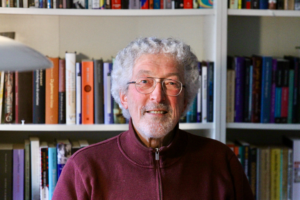
Dr. Frans Gielen served for over three decades at Medtronic, where he played a central role in the clinical and regulatory development of modern deep brain stimulation
#75: Frans Gielen – From Idea to Evidence: The Making of Modern DBS
In today’s episode of Stimulating Brains, we have the pleasure of speaking with Frans Gielen — a physicist and biomedical engineer who played a foundational role in shaping modern deep brain stimulation. Over more than three decades at Medtronic, Frans worked at the intersection of engineering, neurology, and surgery during the formative years of DBS, when stereotactic imaging protocols, targeting strategies, and surgical workflows were still being defined in real time.
He supported and trained teams in more than 2,000 DBS implantations worldwide, helping refine operative techniques and imaging standards long before they became routine. Beyond the operating room, Frans designed and managed several of the pivotal clinical trials that ultimately led to CE marks in Europe and FDA approvals in the United States — including landmark studies in VIM DBS for tremor, STN and GPi DBS for Parkinson’s disease, the first controlled trial of DBS for obsessive–compulsive disorder, and later the MORE trial in epilepsy.
In this conversation, we explore the practical, technical, and regulatory work required to transform DBS from a promising idea into a reliable, evidence-based therapy — and reflect on what it took to build the foundations that the field stands on today.
Frans Gielen 00:00And the doctor said STN stimulation is so fantastic for the patient that you must do something. So Medtronic was kind of forced to do something and we designed an extension of the original study. We asked the operator of the MRI to change the parameters. And he said, no, no, I have only tools provided by the manufacturer. And Peter and I looked at each other and said, okay, ask this guy to get a cup of coffee in the canteen of the hospital and come back in an hour. And what we did is we put the Medtronic salesperson who was there in the MRI machine. And Peter and I changed the parameters in the MRI machine. In half an hour, he had a beautiful T2. The next morning, the radiologist was absolutely flabbergasted. Wow. My machine can make a T2. So I designed. A protocol. And sent it to Medtronic. It's called the Quest. 01:01With capitals. Q-U-E-S-T. Quest Grant. And it is intended for activities that are crazy in their idea.
Andreas Horn Where the existing Medtronic business units were absolutely not interested. And so I got the money from the top of Medtronic. $50,000. I got $250,000. To design the brain stimulation for obsessive-controversial disorder. Welcome to Stimulating Brains. Hello and welcome to Stimulating Brains. I'm delighted to welcome Franz Gehlen, who is one of the quiet architects behind modern deep brain stimulation. 02:02Franz is a physicist and biomedical engineer by training who spent more than three decades at Medtronic. During the formative years when DBS evolved from an experimental idea into a globally accepted clinical therapy. During that time, he supported and trained teams while attending more than 2,000 DBS implantations worldwide. Often working hands-on in the operation room at a time when the brain was not yet fully developed. when stereotactic imaging, targeting, and surgical workflows were still being invented in real time. Crucially, Frans was not only involved at the technical level. It is little known that he designed and managed several of the pivotal clinical studies that ultimately led to CE marks in Europe and FDA approvals in the United States. These include the landmark VIM DBS trial for tremor, enrolling nearly 300 patients, as well as the advanced PD study, targeting STN and GPI, which helped establish DBS as a standard therapy in movement disorders, and was published in the New England Journal of Medicine. 03:02This was not enough for Franz, who next had the idea to apply DBS in psychiatry, and initiated and led the first clinical trial for DBS in obsessive-compulsive disorder, which again led to CE and FDA approval in form of a humanitarian device exemption. Finally, later, he designed the MORD trial, which was the first application of DBS for epilepsy, also resulting in CE mark and FDA approval. These two studies shaped how neuromodulation entered psychiatric and epilepsy care. Many of the DBS indications we now consider established were, at the time, high-risk ideas that required not only engineering solutions, but also regulatory strategy, clinical rigor, and persistence. And we have to thank Franz, most especially in the case of OCD, which was really originally his idea, that the therapy exists today.
Frans Gielen Throughout his career, Franz Bridges... ...invented a wide range of methods to improve the quality of the therapy, including the use of a 04:11! ! ...inventing studies on the connectivity of the antinucleus for DBS in epilepsy, where he collaborated with Jürgen May and Volker Köhnen, and thinking deeply about how brain networks process information, a question that continues to literally keep him awake at night. This episode is a rare opportunity to hear part of the untold history of DBS, which is often and conventionally told from a surgeon's or scientist's perspective, but this time focusing on the work of an engineer who helped make DBS work, technically, clinically, and scientifically. and regulatorily, across multiple indications. I would like to use the opportunity to thank Dr. Ali Sarim Aslani, 05:04who many of you may know, and who made the suggestion to interview Franz and put us into contact. When Günter Deuschel from episode number five heard about the endeavor to interview Franz, he endorsed it to the highest degree possible. And when I told Marwan Hariz from episodes three and 33, he became excited too, even contributing a guest quote. I must say that it is these interactions with dear colleagues in the field, be it academics or friends from industry, that keep me motivated recording these interviews, which, as you may imagine, do take quite some effort and time. I would like to thank you wholeheartedly for tuning in. If you like Simulating Brains, feel invited to tell your friends about it, or if you even would like to contribute to the project in any other form or way, please do not hesitate to reach out. I would also like to thank Dr. Ali Sarim for his time and his work, and for his work on the project. I would also like to thank Alaa Taha for producing this episode, and Niels Boceko and Rui Omar, who together with Alaa have volunteered to split the work 06:03of producing all episodes that we put out. Now I wish you much fun with Franz Gehlen, and thank you for tuning in to Simulating Brains.
Andreas Horn Franz, thank you so much for taking the time
Frans Gielen It was a pleasure. to sit down and talk about your job. You have done a great job, you have spent your entire life with Medtronic, and your entire life is full of Simulating Brains. I am super excited, I met you when I was entering the field, and it is great to see you again. You look almost the same, you have not aged so much, And we are here in your home in Ekerade, in the Netherlands, which is beautiful, and it is great to be here and talk together. As you may know, I often start by asking an icebreaker question about hobbies, hobbies. So maybe what would you do in, well, you were retired, but what,
Andreas Horn what did you do in your free time or do you do now as a hobby?
Frans Gielen 07:03Okay. Uh, my first hobby was biking. I biked my whole life, started biking at five years old going to school until I finished high school and in the university I entered the biking club. I must have biked at least twice around the whole world, so many kilometers. And I don't forget it because in the last two years I biked more than 11,000 kilometers in two years.
Andreas Horn Is that sport?
Frans Gielen No, no, no. Since I had Corona a couple of years ago, my, my legs are complaining and so the biking is now with an e-bike but still a hundred kilometer on a day or so.
Andreas Horn Fantastic. Yeah.
Frans Gielen Yeah. That is the biking this I did my whole life. And the second thing is sailing. Oh wow. I started sailing on the university and um, 08:01the sailing was on an old ship that we had as a student club, uh, an old cargo ship. And later we rented with a group of people, we rented a boat and there's a famous name of such old ships is called Scootje in the north of the Netherlands in Friesland. There is, the famous Scootje Schielen and we rent such a boat and sailed on the north of the Netherlands in German is the Baden Meer. Yeah. Yeah. We sailed all the way up to Denmark and crossed the Kieler canal, the North Oostzee canal and went up to, uh, to, uh, Copenhagen. Wow. Yeah. Great. So, and we also sailed in the, in the fall in Croatia. Okay. Because the water is nice and warm. Yes.
Andreas Horn And, uh, and more rough was sailing on the English channel. I'm sure. And the English channel islands. Uh, 09:01so the Croatian, the Croatian shore must be, it's wonderful, right?
Frans Gielen With all the islands.
Andreas Horn And yeah, it is, it is nice. You sail on the Adriatic sea.
Frans Gielen If the wind is too strong, it can be pretty uncomfortable. Okay. And, but in between the islands you could have strong winds, but no big waves. Yeah. And then go very tipped with the sailing boat. Yeah. Having a lot of fun. And, and we did that usually with, uh, two groups that rented identical boats and then men, they go and compete. Okay. Yeah. So that is, uh, that is the sailing that, uh, did I did. And in the back of my garden, you see honeybee colonies. Uh, I, I did when I was in the university, I, I, I thought I need to do something besides studying. Okay. And I have more than 50 years. I have honeybee colonies. 10:02And I do queen breeding. So making, trying to get them better, or making them more friendly that they sting less. And, uh, I, I, I have to deal with, uh, an invader. This is called the pharoah might be. And I, I test them and things like that. And lately, regarding the honeybees, the invasion of the Asian hornets. Yes. You told me about that. I see the book over there. Right. Um,
Andreas Horn and you're expecting a call from university about that, right? So you,
Frans Gielen you're deep into the topic.
Andreas Horn Yeah, we have, I've designed this year, um,
Frans Gielen the contrary to a clinical study, but, uh, a scientifically based study to, um, to look at, if you try to catch the Queens to avoid the Queens of the, as, as, you know, you, you try to reduce the number of nests that they make in the spring. And you do that with, uh, 11:00uh, a pop with a small, uh, spacing, but you get also other, uh, insect in this called bifunks. Additional catch.
Andreas Horn Yeah.
Frans Gielen By fun.
Andreas Horn Yeah. Yeah.
Frans Gielen And, and, uh, governments, uh, rely on that on a report made in the West of the Netherlands where the people did that. The report it's called the ice report. That's not negative information about ice, but there are many, many people who complain about the ice. It says that these Asian Hornets do not be a re are not a risk for people, but they have, they have an enormous impact on biodiversity. Of course.
Andreas Horn Yeah. Yeah.
Frans Gielen And, uh, finally breaking, breaking the ice gardening.
Andreas Horn Yeah.
Frans Gielen I, I used in between my metronic job, I used to grow vegetables for my family.
Andreas Horn Okay.
Frans Gielen Great. Um, biological, 12:00no fertilizer, no, no poison. And that was an hobby also.
Andreas Horn Fantastic. Okay.
Frans Gielen And so you worked, um, as an engineer, uh, who became embedded in surgical practice and clinical evidence generation, um, very early on and also at a critical time point when deep brain stimulation really was born. So, um, that is a very rare and valuable view viewpoint. Uh, how was it like to be exposed to and collaborate with pioneers such as, um, Alain, Louis Ben, Ben, a beat and Pierre Polak. And how, how was the landscape at the time in the field of PBS or in the birth, uh,
Andreas Horn birthing field of PBS?
Frans Gielen It, it, it is not strange because Ben a beats was first started first physics and got a PSD and physics. Mm-hmm. And then he decided that, uh, he wanted to do medicine and got a PSD in medicine. And I, besides the medicine, I have more or less the same thing. My, my study is also, 13:00and PSD is in physics.
Andreas Horn Yeah.
Frans Gielen And so we went very well on to together. So it was not strange that I did that. And, uh, so my master's degree in physics and biomedical engineering together, you may call it biophysics.
Andreas Horn Yeah. Yeah.
Frans Gielen Uh, was very much linked to what Ben, he did. So we were on speaking terms, so to say.
Andreas Horn Makes sense. Yeah. Maybe we can also start. How did you even get to Medtronic?
Frans Gielen And when that was 1991.
Andreas Horn Yeah.
Frans Gielen Uh, after my PSD in 1987, uh, uh, I, 1983, uh, I went two years to the United States as a postdoc and the research professor in Vanderbilt University.
Andreas Horn Ever heard? Yeah.
Frans Gielen That is one of the five most famous medical, uh, universities in the United States. That's right.
Andreas Horn Yeah.
Frans Gielen And there I, I, I did biophysics, biophysics that was tailored to measuring the magnetic, 14:01uh, the biomagnetic field of nerve fibers.
Andreas Horn And why the biomagnetic field of nerve fibers?
Frans Gielen Because just like in electric electricity where you have the, uh, epsilon, the, the, the, uh, relative conductivity. In, in, in, in, in magnetism, you have mu zero, which is for almost all, certainly biological materials, very close to one. So if you would be able to measure, uh, the biomagnetic signal from in our situation, uh, regenerating nerve fiber, you could objectively, because it was quantitative, very light. You could measure how many axons would regrow in a nerve fiber. For instance, in, okay, it was the biomagnetism with, uh, that I was involved in. So my, my career went from pure biophysics, University of, in Vanderbilt University to bi, 15:03pure physics in, in, in biomagnetism in Vanderbilt University to biophysics in Erasmus University in Rotterdam, five years. And then I thought maybe try commercial companies. Uh, commercial company. So that is the only time in my life that I solicited that applied for a job. And I got the job in the Metronic Bacca Research Center in here in Maastricht. I got the job and I think it's the only reason why I got it because I worked three years in the United States. That was considered to be, I, we are an American company and the guy knows, he knows how to behave in the United States. So that was, uh, how I went, uh, and I started in Metronic on the 1st of September, 1991. And I was hired to run a clinical study, a clinical study in spinal cord stimulation for pain.
Andreas Horn 16:01Yeah.
Frans Gielen And the electrodes are outside the durine spinal cord, which is a kind of a space because the durine is hanging a little bit dangling in a bit. And these electrodes had the tendency in some patients at least to move. And so this was a space. And so this was a study in so-called positive fixation, uh, techniques. And the study had tines on the tip of the electrode, plastic tines. And in my situation, I, I did a study and the first patient that was implanted was in Sweden. And thanks to the fact that physicians have the tendency to not read clinical study protocols.
Andreas Horn Yes.
Frans Gielen Which clearly said, once you are in, the patient, you cannot remove the stiff stylet in the middle. Now this doctor did. And because of the design of the electrode, the stylet poked out, went through the durine right in the spinal cord. That was the end of the clinical study. Oh,
Andreas Horn 17:00really? Yeah.
Frans Gielen So that's, that was a very, very severe adverse event. End of the study. And then Metronic didn't know what to do with me. And my boss, an American, by the way, Keith Mullet.
Andreas Horn Yeah.
Frans Gielen Keith Mullet, uh, told me, go to Grenoble, because the team over there is all the time asking attention from Metronic for the de-brain stimulation product. So I went to Grenoble in January, uh, 90, nine, 1992. Mm-hmm. And I learned from Benebit and from Pollack. I learned a lot. And we designed a clinical study. It, Benebit did at that time, he published in, in, in 1991. Mm-hmm. Study in the Lancet.
Andreas Horn Yeah.
Frans Gielen Of about 20 patients done in the VIM of the thalamus for tremor Parkinson patients. And that was all done with a, uh, custom device. That was the famous model three, 18:01three, eight, zero. The, the model with one bullet tip at the end.
Andreas Horn And that was the same as for spinal cord, right?
Frans Gielen Or no, no, the, the, the, the two, three, nine, eight, zero was an electrode that was contrary to spinal cord electrode. Mm-hmm. Not very flexible. Mm-hmm. Spinal cord electrodes, you must be going around the corner and then go in and bend the electrode steer with the stylet. Mm-hmm. Well, it was a custom electrode for that trial. For,
Andreas Horn oh yeah,
Frans Gielen for,
Andreas Horn yeah,
Frans Gielen Metron, Metronik made it in 80, 1987.
Andreas Horn Okay.
Frans Gielen For Benebit. And it is designed to go in a stereotactic freight straight to a target.
Andreas Horn Yeah.
Frans Gielen As straight as possible. Mm-hmm. That was that electrode. About 20 patients were done, published by Benebit. And he, he did that besides two all in Parkinson's tremor patients, because he tried also two essential tremor patients, but he considered that failures. Mm-hmm.
Andreas Horn Interesting.
Frans Gielen It is essential tremor is by the nature also more difficult. 19:00Mm-hmm. Than Parkinson's tremor. So, and then he, he came to me and said, I want to have, uh, an electrode with more contacts on it. Like the spinal cord electrode, electrodes that had four contacts already. And Metronik had an associated stimulator, the ITRO.
Andreas Horn Yeah.
Frans Gielen ITRO,
Andreas Horn yeah.
Frans Gielen ITRO2 that could run four contacts. And he said, we want to have one. So then we designed the Metronik designed the 3387. You may have heard about that. Of course. That was the initial DBS electrode.
Andreas Horn Yeah.
Frans Gielen And that was a study. The study was initiated in May 92. Mm-hmm. Uh, it was the classical, based, I didn't know anything about clinical studies as a physicist, you know.
Andreas Horn But you had one before, right? But yeah,
Frans Gielen but, but that, that was spinal cord.
Andreas Horn Yes.
Frans Gielen It's completely different than in the brain.
Andreas Horn Yeah.
Frans Gielen And the study, 20:02I designed a study, the brain stimulation, uh, study for, for tremor. And it was approved by 13 centers, 13, uh, professors. Mm-hmm. Most of the time in, in 13 centers in, in, in Europe in, in May 92. And it, it was based on, uh, the classical Metronik study in spinal cord stimulation at that time. 60 patients followed for a year. Mm-hmm. Six zero. The enrollment went so fast. Mm-hmm. That Met, Metronik in Minneapolis got interested. Mm-hmm. And first of all, I got a boss in Minneapolis above me. And he said, uh, your, your design of the study is not good because you need 300 patients in the study.
Andreas Horn And why was that?
Frans Gielen The so-called statistical rule, rule of thirds. Mm-hmm. Everything that you can imagine in your wildest thoughts that can go wrong in a clinical study, 21:03if that doesn't happen in 300 patients, it is not something of any relevance.
Andreas Horn Okay.
Frans Gielen Rule of thirds. So I needed to do, instead of 60, I needed to do 300 patients. Mm-hmm. Uh, the design was that in 1994, somewhere in 1994, the, all the patients were enrolled. And it was. In rather, rather 60, it was 300. Wow. Uh, in two studies. Because after I started the de-brain stimulation study, uh, after, maybe 10 implants or so, some doctors came to me and said, this protocol, the case report form, is way too thick and way too complicated. We cannot work with it. Mm-hmm. You have to design something else. And then we designed the so-called DBS basic study, which was only implanting in three targets, doesn't matter which target.
Andreas Horn Okay. But mostly for pain. And, and followed for three months. For pain?
Frans Gielen For, no, for, 22:00for, for tremor. For tremor.
Andreas Horn Okay.
Frans Gielen But free. Free. You could do, you, and, and there were, sorry for the say so, cowboys that, that, that had ideas to stimulate. Just like before the era of chronic DBS, as, as, as, as Marwan Haare said,
Andreas Horn yeah,
Frans Gielen before the chronic DBS stimulation, there were all kinds of studies.
Andreas Horn Yes.
Frans Gielen With a, with a few patients. Proof of concept, yes or no, but publication,
Andreas Horn yeah. Yeah.
Frans Gielen And, and that was, in my case, was a 300 patient study in 1994, somewhere in, in April or so. All patients were in, and then we needed 12 month follow up. Wow. For, for the DBS.
Andreas Horn Yeah.
Frans Gielen Study. And, and we, we, we got a CEMAC in somewhere April 2000, and 1995, which was S-planned, but five times as many patients. So,
Andreas Horn Yeah.
Frans Gielen It, it, it was an achievement that was not only for me, 23:00but it was such a dramatic success, and everyone could see it, that doctors for, also for commercial reasons went on.
Andreas Horn Absolutely.
Frans Gielen And, and, and did this, this study. That's a very fast time frame,
Andreas Horn right? Yeah.
Frans Gielen It's unbelievable fast.
Andreas Horn Was this the study that was then published in the New England Journal of Medicine?
Frans Gielen No, that was the, the DBS, the advanced DBS study.
Andreas Horn Yeah. Okay.
Frans Gielen I, I finished this for, for a moment. Please. Because we got a, a CEMAC.
Andreas Horn Yeah.
Frans Gielen And then, Metronach as a company, we have a so-called XCOM, that is the real top of the company. Hmm. They need to decide, whether they would give, give XCOM approval. And it came very, very close, despite of the dramatic good results, came very, very close, that XCOM said, no, we are not going to give that to the market, because at that time we had about $1 billion revenue annual for mainly cardiac stuff.
Andreas Horn 24:01Yeah.
Frans Gielen Cardiac pacing and so.
Andreas Horn Yeah.
Frans Gielen And they, they thought brain stimulation, risky. It, it, it brings the $1 billion pacing business, maybe, at a halt. I see.
Andreas Horn Yeah.
Frans Gielen So, but ultimately they decided to give, give XCOM approval. Hmm. But we started the study in, in May 1992. Hmm. And almost directly, in, in, in beginning of 1993, Benhabit got a French government study sponsoring. Hmm. Approved by the French government. The government for DBS in the SDN of the.
Andreas Horn Yes.
Frans Gielen For advanced Parkinson's disease.
Andreas Horn Yeah.
Frans Gielen And Benhabit did 10 patients in that government approved study. And the last patient, number 10, was an absolute disaster. Already on the table. 25:00Hmm. The patient got a bleeding. Oh no.
Andreas Horn Okay.
Frans Gielen Got in coma. And then two weeks later, the other side that was already in, started also to bleed. Hmm. It turned out that the patient had a, had a coagulation disease. Oh wow. Which was missed by the inclusion, but probably missed or not known or whatsoever.
Andreas Horn Yeah.
Frans Gielen But it turned out that the patient had a, a, a coagulation disease.
Andreas Horn Yeah.
Frans Gielen Coagulation was not good with this patient. Hmm. And then DBS came to almost complete standstill because the government said, you cannot do this.
Andreas Horn Okay.
Frans Gielen Anymore because of the risks. And, and, but ultimately Benhabit continued its approval from the, approval from the government in, in, in the STN. But then it was a Medtronic study. It's called the DBS, uh, the advanced DBS study.
Andreas Horn Yeah.
Frans Gielen Which was, uh, for DBS in STN. Hmm. For, for advanced Parkinson symptoms of DBS in the globus pallidus interna.
Andreas Horn 26:01Yeah. Yeah.
Frans Gielen The globus pallidus interna was the hobby from our US doctors and the STN because of the seed, of Benhabit.
Andreas Horn Yeah.
Frans Gielen Was mainly done in Europe.
Andreas Horn Yeah.
Frans Gielen And, uh, that study was also finished very fast, faster than Medtronic thought. And you had a, a 12 month follow up also.
Andreas Horn And you also designed that study or? Yeah,
Frans Gielen I designed the study.
Andreas Horn Yeah.
Frans Gielen In, in Europe together with a, a, a colleague.
Andreas Horn Yeah.
Frans Gielen That I got in the United States. The study in the United States was impossible because, I'm not going to say that that's too negative, but it was impossible. I, I, I skipped some of the follow ups a day long every hour following the patients.
Andreas Horn Okay. Can you imagine that from a doctor?
Frans Gielen That's a lot.
Andreas Horn Yeah.
Frans Gielen That's a lot of work.
Andreas Horn Yeah.
Frans Gielen And the study in the European study was finished 60 patients with the follow up of 12 months. 27:00That was not ready. Hmm. And the doctor said,
Andreas Horn STN stimulation is so fantastic for the patients that you must do something. Yeah.
Frans Gielen So Medtronic was kind of forced to do that.
Andreas Horn Yeah.
Frans Gielen So Medtronic was kind of forced to do something. And we designed an extension of the original study, which was kind of a, I think. You mean just,
Andreas Horn just to include more people? Yeah.
Frans Gielen Oh, wow.
Andreas Horn Yeah. Yes.
Frans Gielen But in, in a clinical study, Medtronic could give that clinical device, the electrode.
Andreas Horn Yeah.
Frans Gielen Could, could do that. So we did that and we got a CE mark, I think in 1998. And four years later, there was FDA approval. So it was also a very, it was also a very positive study that ran like, like hell.
Andreas Horn Yeah.
Frans Gielen Inclusion was enormous. Wow.
Andreas Horn That's fantastic.
Frans Gielen Very fast. One, one, one quick question, skipping back a little bit. I heard once, but I don't know if this is true, that before Benabid looked into the STN, 28:01he did try the Pallidum, but it didn't seem to work.
Andreas Horn Yeah. Did you know that?
Frans Gielen That was probably, probably initiated by Professor Siegfried in, in Zurich.
Andreas Horn Yeah.
Frans Gielen Clinique, Clinique AMC, who published in his way, a four patient study and said, based on a four patient study with hardly any follow up, uh, globus pallidus stimulation is successful for Parkinson's disease. And, and, and that was an official publication.
Andreas Horn Yeah. Okay.
Frans Gielen And Professor Benabid must have tried it, but came to the conclusion that globus pallidus stimulation is, and I consider that also, far more difficult than STN stimulation, although the STN is a whole lot smaller, but maybe because of the size of the globus pallidus internal, it is so difficult. Because you might miss the sweet spot or something.
Andreas Horn Yeah. Okay. Fantastic.
Frans Gielen Wow.
Andreas Horn Okay.
Frans Gielen That was a tour de force.
Andreas Horn So what happened next?
Frans Gielen Or maybe, um, before we go into, um, the trials as well,
Andreas Horn 29:01how was the landscape of Medtronic as a company?
Frans Gielen I assumed that DBS division at that time, was very small because it was a new thing.
Andreas Horn Yeah.
Frans Gielen Who were people that, uh, you know, formed that part.
Andreas Horn And then maybe how did it explode at some point?
Frans Gielen Maybe, you know, besides the salespeople that were responsible for selling devices, when the CE marked in the clinical study, every device one by one has to be assigned with all the paperwork. And that has to be done by me. I was the, at that time, the only person working in Europe. And that was almost a, not a daily job, but an enormous job to assign all these clinical products.
Andreas Horn Yeah.
Frans Gielen And I had a debate also with Medtronic because they said, okay, the system, the whole system is investigational, including the stimulator.
Andreas Horn Yeah.
Frans Gielen This ITRO2, which was used at that time pretty widely in spinal cord stimulation. 30:02And I thought it was not clever to do that, because suppose, and it happened at some point that, but not in the study luckily, that there is a flaw in an ITRO2. And if you call it clinical, you have to stop the whole clinical because the clinical product fails. Oh, wow.
Andreas Horn Yeah.
Frans Gielen And I said, you cannot do that. But I was, I was not successful. People simply hope that the ITRO2 had no problem. Now, a few years after, uh, that's, uh, they, uh, they, that study, it turned out there was a problem because someone made a cleaning mistake by welding, point welding the battery to the electronics in the ITRO. And when the battery is used, it swells a little bit. So it moves inside the housing and the, the contacts broke. Oh, wow.
Andreas Horn Okay.
Frans Gielen And so then the, the, the, the whole ITRO2 was coming on a standstill. 31:01If that happens in a clinical study, then it's all done.
Andreas Horn Yeah. Yeah.
Frans Gielen We are lucky that that didn't happen. Now, now it was a very, it was, in my opinion, the best, uh, stimulator that Medtronic ever had. I cannot really judge the percept at this moment. That is so new and so complex that we still do not know how it behaves under all kinds of situations. But the ITRO2 had the longest battery life.
Andreas Horn Yeah.
Frans Gielen Uh, you needed to have two ITRO2s in the bilateral simulation because you could only stimulate one, quite a bit of battery life. So, uh, you had to have two ITRO2s.
Andreas Horn Yeah.
Frans Gielen Uh, you needed to have two ITRO2s in the bilateral simulation because you could only stimulate one quadripoly electrode per ITRO. Uh, later we had the, uh, the, um, the, the, the Kinetra,
Andreas Horn right?
Frans Gielen The Kinetra.
Andreas Horn Yeah. Yeah.
Frans Gielen The Kinetra was even worse.
Andreas Horn Okay.
Frans Gielen Because of a battery life. It, it wasn't, no, it, it, it was not a well-designed product in terms of battery life. And, and the doctor saw that and started to complain.
Andreas Horn 32:01That was one of the reasons why they went over to other companies.
Frans Gielen Other companies like, uh, Boston Scientific and the predecessor of, uh, Abbott.
Andreas Horn Yeah.
Frans Gielen Because they hoped, they learned from the marketing that their batteries were better.
Andreas Horn Okay.
Frans Gielen So, they, then was, Medtronic lost a lot of battery, a lot of customers for DBS when these things are happening, were happening.
Andreas Horn Yeah.
Frans Gielen Hmm.
Andreas Horn Okay. What, what happened next?
Frans Gielen Um, the two successful trials, um, now for VAM and STM,
Andreas Horn Yeah.
Frans Gielen uh, for essential tremor and Parkinson's disease. Um, I did the field directly explode. So I, I had, um, Todd Langevin on the talk once,
Andreas Horn right?
Frans Gielen And he was at some point my boss.
Andreas Horn Okay.
Frans Gielen He was the manager for all the DBS in the whole world in Minneapolis. And, and he said, he said, uh, something that struck with me that, you know, inside Medtronic, the, it was somewhat easy to, uh, 33:00to, to, uh, to, to, uh, fight for DBS because it, you could just show a video and the tremor stopped. Right. So I could imagine maybe something similar happened also in the field where this was a new technology that didn't need maybe big statistics to show that it worked at least for tremor. Um,
Andreas Horn did it like, was there a lot of demand all of a sudden after the CE marks and FDA? Yeah. Yeah. Yeah.
Frans Gielen The, the, the, the, it went, it went off like a rocket.
Andreas Horn Yeah.
Frans Gielen Brain simulation mainly because it did its own magic.
Andreas Horn Yeah.
Frans Gielen It was so clear that the symptoms that it on off a tremor.
Andreas Horn Yeah.
Frans Gielen And with advanced Parkinson's disease, people that were kind of wheelchair bound suddenly could walk.
Andreas Horn Yeah. Yeah.
Frans Gielen You have seen these patients. Of course.
Andreas Horn Yeah.
Frans Gielen And so it's own marketing and still there were millions of dollars spent in marketing.
Andreas Horn Yeah. Okay.
Frans Gielen Uh, but we went on for a while. Uh, but we went on for a while. Uh, but we went on for a while. Uh, but we went on for a while. Uh, but we went on for a while. Uh, but we went on for a while. 34:00Uh, but we went on for a while. Uh, but we went on for a while with the Kinnitra and uh, with the Kinnitra and uh, with the Kinnitra and uh, with the Kinnitra and uh, with the Kinnitra and uh, with the Kinnitra and uh, with the Kinnitra and uh, with the Kinnitra and uh, with the Kinnitra and uh, with the Kinnitra and uh, with the Kinnitra and uh, with the Kinnitra and uh, with the Kinnitra and uh, with the Kinnitra and uh, with the Kinnitra and uh, with the Kinnitra and uh, still having complaints about battery life forever. Now, that is not necessarily a bad technology because these newer stimulators could do so much more, especially the Activa PC, run two. Sure. And they didn't want to have it too big, so they thought that the electronics were more power, less power using.
Andreas Horn Yeah.
Frans Gielen And so the battery in the Percept was not twice as big as in the iTroll 2.
Andreas Horn Yeah.
Frans Gielen And battery life was a concern for a long time.
Andreas Horn Okay.
Frans Gielen Got it.
Andreas Horn What happened for you after these trials concluded successfully?
Frans Gielen At some point, you sent me an email that you trained, or you attended 2,000 DBS surgeries yourself. 35:01You trained lots of people. You trained radiologists for the imaging.
Andreas Horn So was it all of a sudden more a field job where you traveled a lot and had to teach people how this works? Or what happened next in your life?
Frans Gielen At some point, the DBS manager in Europe, Pino Cabone is his name. Maybe you have heard the name. He's working for the Focus Ultra sound company. You know that. Insight Tech. Insight Tech, yeah. At some point, Pino approached me and said, DBS is not running well in Germany, way below the plan. So I'm a chronic. And he knew how my training was. And he proposed that I started working for the marketing division. And I thought, I'm going to work for the marketing division because if I do my job correct, I will also steal some money from them to do research.
Andreas Horn 36:02Yeah.
Frans Gielen And so I started working, supporting customers in Germany. And in one year, Germany went from below the financial target to way above the financial target. And then, well, my chronic manager in Minneapolis said, oh, that is apparently a very efficient way of making customers believing in somewhat difficult technology.
Andreas Horn And so I got immediately two colleagues. You know Peter Abnerod?
Frans Gielen No. Peter Abnerod lives in Bremen and was for a long period my colleague in the field.
Andreas Horn Okay.
Frans Gielen Training doctor. So I was training doctors initially in Europe. But for me, it started already very soon in Japan because I saw emails in Medtronic and a salesperson in Japan telling that she didn't get any support from Medtronic in Japan. And so I made contact with her. 37:02She invited me. And from then on time on, I trained many doctors in Japan, which is difficult because the hierarchy in Japan, doctors towards an engineer, is like me. It is not so easy.
Andreas Horn Okay.
Frans Gielen But once you have shown that you know your job, then it goes also there smoothly.
Andreas Horn Yeah.
Frans Gielen And from there on, I did this based on the cost. Marketing paid me. I did training in India and South Korea and Thailand. You name it, the countries.
Andreas Horn Yeah.
Frans Gielen I've seen the Excel file. It's very impressive.
Andreas Horn Yeah.
Frans Gielen The sites that you've trained.
Andreas Horn Yeah.
Frans Gielen And the training, it's very easy. It's very easy. It's very easy. It's very easy. It's very easy. It's very easy. It's very easy. It's very easy. It's very easy. It's very easy. It's very easy. It's very easy. It's very easy. I mean, I started always with the technology because neurosurgeons knew what a stereotactic frame was. At that time they made lesions.
Andreas Horn Yeah.
Frans Gielen And Banebiet said I'm not going to make lesions in an already sick brain, Parkinson brain. So he started the brain stimulation. 38:00And so for that, you need completely different imaging techniques.
Andreas Horn Yeah? Yeah.
Frans Gielen We started with Banebiet and also the Amsterdam Center with Banebiet, Banebiet, ventriculography now with how do you call it ac pc based targeting yeah two points in a three-dimensional brain yes and based on that if you had a white hat or a very tall head it was a kind of guessing to find the target and there were no tools so i learned to do completely manual uh target calculations based on the images from from from x-rays from the front and yeah wow okay yeah so no software no software yeah not no frame link no not software like you have no nothing like that yeah and initially it started with uh the x-ray plain x-rays front and lateral and then ct came in yeah and ct was not designed for deep brain stimulation imaging 39:05first of all if if you told a radiologist yeah i need one millimeter accuracy so at the very most two millimeter slice thickness our machine cannot make it and i do remember the period that the patient was with stereotactic frame in the ct in the ct and you could make a slab of a certain number of slices and then you had to stop the acquisition because the x-ray tube had to cool down oh wow and then you had to make a second slap cool down and the third slide yeah so you had to make a third slide and then you had a three-dimensional picture of the brain where you could not see anything besides the ventricles yes and the skull yeah yeah and still you you with a very good ct but that came later where you could see the internal capsule yeah the nice thing about ct was that you could also add contrast and in 3d you could see 40:07some of the blood vessels of course yeah yeah so that is the ct and then the MRI from 1995 on 1995 MRI became suitable for deep brain stimulation purposes yeah it was very late and you you're right yeah absolutely but it was probably a game changer because he saw soft tissue but probably in the beginning it wasn't great quality or no no no no the MRI was made by the manufacturer for diagnostic purposes yeah and for a lot of diagnostic purposes uh thick slices five millimeter were very standard and uh distortions yeah are not important if you have a disease in your brain if the brain is looking more crooked than it really is yeah but making an MRI uh 41:02initially without frame because the frames were not considered to be safe in at that time in the MRI making an MRI with say maximum two millimeter slices yeah that was very difficult you had to teach the radiologist to do that because the MRI manufacturers
Andreas Horn did not train doctors to do that yes because it was commercially not interesting the brain
Frans Gielen stimulation, which was just a tiny niche in the whole business from using CT. Yeah, so I see.
Andreas Horn the you know manufacturers wouldn't see a reason why you would need to minimize for diagnostic reasons makes sense okay yeah and then you started collecting dicom headers and database right yeah
Frans Gielen because if the radiologists were not capable they they they hardly knew what the dichrom header was and if they ever saw that they the bulk of the radiologists didn't know what to do with it 42:01and they got all the standard diagnostic uh imaging technique with ct and mri from the manufacturer and that's it but if you needed to transfer the mris for instance to something suitable for dbs
Andreas Horn you i learned how to change the dichrom header and then at some point wow fantastic image that's what
Frans Gielen i want and a t1 was considered to be the least sensitive for for geometrical distortions yeah and then i started collecting dicom headers from mris the scenes that spit out beauty images and i wrote somewhere that i i have something like 176 uh dicom headers from all kind of mri machine in the world that i saw spitting out beautiful mris they're probably still valuable today i could imagine they are yeah but i wrote also somewhere that dicom headers were not a metronic product this metronic manages and legal people said 43:03franz guillen you cannot give that to the customers because it is it didn't pass a clinical study for dbs and then i remembered the beginning of custom devices i told to the sales people who begged me for this type of address i told to the to the to the the people tell me what kind of me the sales people tell me what kind of mri machine and model the doctor has and i gave them a dicom header from only that machine and i consider that a custom device yeah and i thought it was and it was never questioned but also because i was really careful i never promoted the dicom headers the whole database that i have as a metronic product of course that other people could use a bill it was always asking franz guillen
Andreas Horn to get something specific yeah yeah yeah makes sense or i i went to centers where
Frans Gielen we where we did it ourselves i had a story from a a center in in south america in colombia where the 44:06radiologist insisted that his a center in in south america in colombia where the radiologist insisted that his he had a modern MRI machine insisted that his machine could not make a t2 at that time there were no diagnostic tools for t2 okay certainly not with thin slices and uh i asked him whether we could get access to his MRI machine now that was not possible because they were doing the business but ultimately we got access to the machine at 10 o'clock in the evening including an operator for the MRI yeah and then peter and i we were with the two of us we asked the operator of the MRI to change the the the parameters yeah and he said no no i have only tools provided by the manufacturer and peter and i looked at each other and said okay ask this guy to get a cup of tea in the canteen of the hospital and come back in an hour and what we did is we put the metronach 45:02salesperson who was there in the MRI machine and peter and i changed the parameters in the MRI machine and in half an hour he had a beautiful t2 yes and the next morning and those uh yeah the next morning it was intended to do the imaging for a patient in in that hospital in colombia the next morning the radiologist was absolutely flabbergasted wow but i
Andreas Horn my machine can make a t2 oh that's fantastic i mean you it just shows this whole process how much
Frans Gielen the company and you as the executing person had to invest into yeah making this a thing right yeah it wasn't a how do you say um self self-love you know it wouldn't it didn't just go on its own you really had to put a lot of activating energy into this because it started with dbs in imaging within many other aspects from scratch it was absolutely new of course and so imaging all over the world that was about the first thing 46:04i did all over the world to go to the radiologist and say let me see what you image here show me an example of a t2 and a t1 image and very often they couldn't so i helped them to design with my database with dicom headers i helped them to design a t1 and a t2 that they could use yeah and they were almost always they were absolutely grateful
Andreas Horn because they learned something fantastic new it was an important tool for the for the uh the
Frans Gielen neurosurgeon and not even for dbs i'm sure they use the sequence for other things too right so
Andreas Horn that's yeah yeah that's fantastic and uh so it was basically in all centers where i went in the world
Frans Gielen uh was training radiologists to make images yeah and then later training radiologists to make mris with an implanted dbs system so that it is safe yes the safety was also uh something brand new yeah that 47:04was that was very early on that metronic was mr conditional right over there it was it was probably after 2000 that we did something like that okay okay conditional safe uh and with a 1.5 tesla machine where soon three teslas came in and five and seven teslas came in uh that was later later and radiologists because they were not physicists the bulk of them did not realize that the safety with an implanted dbs system went better and better and better the higher the b0 because the rf current that you use to excite the tissue is higher and higher frequency and if you know something about physics you know something about skin depth the current flows the higher the frequency the more the metal is a kind of a shielder and it's flows to a very thin layer on the outside of the DBS contact of DBS wires. 48:03So that was the physics behind to say that to claim that the higher the B0, the safer it was to use these systems with implanted system. The only patient that got, not the only, but the first patient that was published was from Jamie Anderson in Stanford University. And he published, so I can say it, he published big holes in the patient's head. But for whatever reason, they thought that 0.5 Tesla rather than 1.5 Tesla was safer. Oh, okay.
Andreas Horn Yeah. Yeah. Yeah.
Frans Gielen Now, I knew that I always thought it has to do with the resonance frequencies on the length of the cables that we just said.
Andreas Horn Yeah. Okay. Yeah. Yeah. Interesting.
Frans Gielen So the RF energy to stimulate the resonance.
Andreas Horn Yeah.
Frans Gielen And to stimulate the tissue with the Lama frequency.
Andreas Horn Yeah.
Frans Gielen The frequency. I have always a story from a child on a swing.
Andreas Horn 49:01Yeah. Yes.
Frans Gielen If you push that child on the wrong moment, you need as an adult man, you need all your force and the child doesn't fly.
Andreas Horn Yeah.
Frans Gielen If you push at the own frequency, one finger and the child flies all over the whole thing.
Andreas Horn Yeah. Yeah. Yeah.
Frans Gielen And that has something to do with the Lama frequency.
Andreas Horn Yeah. Yeah. So, did you also train surgeons or more the radiologists or was it like not surgical team as well?
Frans Gielen No. If I was invited in the center, then I first checked the radiologist, the images. And then I trained the physician, the neurosurgeon in use of ultimately the frame link and the planning system. Or I brought in many cases, I brought the frame link with me and we did together. I operated the system. Mm-hmm. And I looked at the images and said, I want to have the electrode there and so on. So that was training of the neurosurgeons.
Andreas Horn 50:00Yeah.
Frans Gielen In many, many cases because many actually you could say that very few neurosurgeons were actually in their medical education trained for stereotaxy. Mm-hmm. There were a couple of old guy, Professor Sturm.
Andreas Horn Yeah.
Frans Gielen And Professor Siegfried. They were the last of the Mohicans, you know.
Andreas Horn Yeah. Yeah.
Frans Gielen They were the last of the Mohicans who do stereotaxy. And then it started all over again. Mm-hmm. They had to learn again.
Andreas Horn Okay.
Frans Gielen They had to learn again. And then in a technique with deep brain stimulation that has the biophysics of stimulating what is the pulse rate and what is the frequency and all these things.
Andreas Horn Yeah. Interesting. Yeah.
Frans Gielen I've been trying to get Professor Sturm on the show as well, but it's been hard to contact him.
Andreas Horn It's been interesting to hear from him as well. Yeah. So it must have been a very exciting time. At some point, maybe are there any anecdotes that you can talk about?
Frans Gielen 51:01You told me that you would only talk about people if it's very positive.
Andreas Horn Yeah.
Frans Gielen But at the time training these teams, were there any encounters that you still remember or that were curious or that... In the beginning, I had to learn a lot. Mm-hmm. My teachers were Ben Abita and Paul Lack.
Andreas Horn Yeah.
Frans Gielen And in Amsterdam, Professor Dr. Speelman, but he was not a professor, and Professor Bos.
Andreas Horn Yeah.
Frans Gielen He was one of the people that never forgot how to DBS. Mm-hmm. But DBS with only AC and PC initially.
Andreas Horn Yeah.
Frans Gielen And then going on and going on. So I learned a lot of these things over there in Grenoble and Amsterdam. In Amsterdam, they were really willing to...
Andreas Horn Yeah.
Frans Gielen Teach me. Mm-hmm.
Andreas Horn Fantastic. So yeah, it's interesting that Amsterdam is still one of the really leading centers in
Frans Gielen terms of numbers and so on. 52:00They do a lot of surgeries, including osmotic psychiatry. So it seems the history there has started early into...
Andreas Horn Yeah.
Frans Gielen In 1993, they were the first implants in Amsterdam. So that was during the clinical study.
Andreas Horn Yeah. Yeah.
Frans Gielen And they do now...
Andreas Horn Yeah.
Frans Gielen And they do surgeries for about 40 weeks in a year, vacations as well.
Andreas Horn Yeah.
Frans Gielen They do three patients a week.
Andreas Horn Yeah.
Frans Gielen And so they are way over 2,000 patients now. And they did that in a correct way, because if you look at the publications in Amsterdam, there is a whole bunch of New England Journal of Medicine patients comparing thalamotomy versus DBS and things like that. So it was very systematic.
Andreas Horn Yeah.
Frans Gielen And now you have... the successor of Professor Bosch, Rick Schumann. Rick Schumann is now the professor in India.
Andreas Horn Yeah.
Frans Gielen And so I worked very much with him. I remember the very first time that Rick Schumann 53:01did his own DBS and with hands like this,
Andreas Horn Okay.
Frans Gielen inserting a cannula in the ventricle to add contrast in the ventricle to be able to see AC and PC in the third ventricle.
Andreas Horn Yeah, yeah.
Frans Gielen That was the very beginning when he was a resident. Okay, wow. You were there.
Andreas Horn Okay, fantastic.
Frans Gielen And I remember this might have been a bit later, but when we met earlier on, you also spoke very highly of Volker Köhnen because he was a pioneer with the DTI. As like pretty early on, you might have been even the first trying to combine tractography with DBS. Was that... Volker Köhnen was a resident in Aachen.
Andreas Horn Yeah.
Frans Gielen In RWTH hospital. And he became a good friend of mine.
Andreas Horn Yeah.
Frans Gielen Because we kind of fitted in thinking process. And he's a brilliant guy. Absolutely brilliant guy in my opinion. 54:02And I learned very much from him.
Andreas Horn Yeah.
Frans Gielen And then he went to Bonn from Aachen. Yes, correct.
Andreas Horn Yeah.
Frans Gielen And in Bonn, he could not become a professor because it was assigned to someone else who was there apparently. And then he got a full professor in Freiburg.
Andreas Horn Yeah.
Frans Gielen And he's still in Freiburg.
Andreas Horn Yeah.
Frans Gielen And Volker started deep brain stimulation for depression with his medial forebrain double target.
Andreas Horn Yeah.
Frans Gielen And it didn't fly stronger than I thought because his arguments were pretty good. Hmm. But I consider deep brain stimulation for depression one of the most difficult things that you can do with depression.
Andreas Horn Yeah.
Frans Gielen Because measuring the symptoms is one day this and one other day is that. And so Volker did that also partly funded by Medtronic. 55:01Mm-hmm. And I went there numerous times.
Andreas Horn Yeah.
Frans Gielen Learned things.
Andreas Horn Did you ever go to his room?
Frans Gielen I did not.
Andreas Horn In Freiburg?
Frans Gielen No, I studied in Freiburg, but it was before he was there. So I know him well, but I haven't seen his room. So no, I have yet to. I'm not going to tell what you can see over there. If you are going over there, you will see it.
Andreas Horn Okay. Fantastic.
Frans Gielen So back to the script. I think one other really breakthrough that you introduced, or at least were part of this, was to introduce micro electrode recording.
Andreas Horn Yeah. Was that really like, how did that come about? Was that your idea or how did that work? Yeah, how did that work? Initially with DBS, because of the unknown risk, perceived risk,
Frans Gielen patients were really end-of-the-line Parkinson patients that could hardly cooperate in the operating teams. Yeah, they were conscious, 56:04but they were asked to do all the testing of the symptoms. Hardly, some patients, it was impossible to do that. First of all, test stimulation, you needed to know what kind of parameters and things like that so it was not immediately that the symptoms were gone certainly not in STN not immediately and then I learned that Medtronic had a company in Denmark and it's called Dantec you know Dantec no the name is not known anymore it was a very famous Danish company in Copenhagen for neurophysiological equipment mainly EMG and so on and they had a machine to record single fiber signals single motor unit fiber signals from muscles and I realized that the cross-section of a muscle fiber cross-section is about the same as the cross-section of a neuron in the brain yeah 57:06and I immediately realized if you can measure single cells from this muscle fiber you can also measure single cells from the brain great yeah and the my point was if you can measure it then it can help the doctors a lot because you you don't you are not 100 relying on the cooperation of the patient you test stimulation you could already later with better beats technique but refined five simultaneous micro electrodes you've got the 3D impression where the nucleus was and if you knew the 3D impression where the nucleus was is in a patient you know also where the limbic and associative and the motor part is so you could try to avoid for instance the limbic part and by doing that the psychiatric side 58:02effects of STN stimulation went down and and that was based on micro electrode recording and actually over the whole world doctors accepted micro electrode recording I think that 80% of all DBS implanting neurosurgery used micro electrode recording yes nowadays it is getting a little bit less because people think that you can do it solely on imaging because the image is so much better but in Amsterdam they evolved to doing micro electrode recording under general anesthesia where you choose the right uh anesthesia yeah that was an order training aspect at some point we started to do micro electrode recording and I had to teach the neurologist that they could not give certain medications in the evening before partners on their patients and the anesthesiologist don't use benzodiazepines because then the STN is quiet and things like that yeah sure and and so that was 59:01another training aspect training anesthesiology training micro electrode recording and interpretation is not trivial I think right I've done that a bit myself and it's not yeah not very easy so I'm sure teaching people and uh you know getting experience in it yeah in STN I I think it is now we got to know easy the STN signal is pretty correct right and in the global spammers internist uh you need to do a whole bunch of negative elimination it's not that it's not that it's not that and it must be this yes yes and I remember that we started in Amsterdam doing micro anterior nucleus with thalamus in epilepsy patients and I saw the lamina yeah from coming from from up yeah and I saw the lamina and I recognized triplets quadruplets spikes firing very shortly behind each other and I realized that you can measure these things also in the thalamus 01:00:05and I thought hey this is that a landmark signal for me being in the appropriate part of the anterior nucleus of the thalamus for epilepsy so we started like that also we'll get to epilepsy in a bit so the the Ben gun um system that's I think really called after Ben and beat right Ben gun was that like were you part of the design or like how did that um like who then created the the the you know the device to record and how early did it start with microelectrode recording we didn't copy the Ben gun because Ben had uh electrodes that were 2.2 millimeters apart five and the cannulas were so thick that there was almost no space for tissue in between the cannulas okay but we learned from a company in the United States FHC ever heard about it FAC uh in in Maine in the United States who could make 01:01:01cannulas for research they made them yeah and they were stiff enough stainless steel and the microelectrode they made also and instead of being about uh 1.8 millimeter outer diameter likely benefit these were only 0.6 millimeter and inside was the microelectron yeah and that means that you did not get a massive microleash these things in the SDM okay yeah so that is the steps from FAC and FAC was a very reliable company making microelectrodes making cannulas yeah until electronic to make money out of it and that okay so you we had already covered that you designed and managed major pivotal study so the we talked about the DBS and the vim for tremor with 290 patients and the advanced PD clinical study which was STN and GPI both led to CE mark and FDA approval um and then you did mention to 01:02:04me that Medtronic had an internal fund which was apparently internally called the crazy money fund mm-hmm um got this grant and used it to run DBS for OCD uh trial and OCD which also led to CE Mark
Andreas Horn um why how did you come to that and uh yeah what was it we knew already Metronic knew already
Frans Gielen that the biggest cash cow for the pharmaceutical industry is psychiatric medication and especially persistent depression was where a lot of medications were made in billions of dollars were made by the pharmaceutical companies and I thought if you could that do that with DBS stimulates somewhere in the brain to treat depression uh that that was a nice opportunity for Medtronic but then when I started to talk about these things also in Germany I learned that at that time doing 01:03:02something in the brain of a psychiatric patient was absolutely not done in Germany because of the of the second drill form. And I still wanted to convince the psychiatrist that the brain stimulation could mean something for them. And then I learned about OCD, obsessive compulsive disorder, which you and I and people who are not trained can see the symptoms very, very well, objectively can see the symptoms. So I designed a protocol and sent it to Medtronic. It's called the Quest, with capitals, Q-U-E-S-T, Quest Grant. And it is intended for activities that are crazy in their idea, where the existing Medtronic business units were absolutely not interested. And so I got the money from the top of Medtronic, 01:04:00$50,000 I got to design the brain stimulation for OCD. And then I started to develop the process of obsessive compulsive disorder. We started with that in Leuven with Professor Luke Tang. And ultimately also with a couple of centers in the United States. And we collected the data and sent it to the CE-MAC authorities. And they said, yes, you can get a CE-MAC. And so that was how we got a CE-MAC for DBS for OCD, which is a technique which is a technique which is a technique which is a technique which is a technique which is a technique which is a technique which is a technique which is a technique which is a technique
Andreas Horn which is a technique which is a technique which is a technique which is a technique which is a technique which is a technique which is a technique which is a technique which is a technique which is a technique which is a technique which is a technique which is a technique which is a technique 01:05:01which is a technique which is a technique which is a technique which is a technique But the disease is so complex that measuring the symptoms in an objective way, it was way too early to do that.
Frans Gielen And so Professor Nutterman is now famous, I think, for being a big nucleus of striatum and I was talking about that.
Andreas Horn Back then it was the nucleus accumbens, correct? In your trial that you targeted? So my main question is, how did you define the target?
Frans Gielen Because it was a first inhuman attempt to do this. I think we always stimulated in the nucleus of the striatum, which is very close to the nucleus accumbens. And it is actually a fiber bundle. We know if we stimulate in the brain that the lowest thresholds are for axons and not cells to stimulate. And so I started to believe that one of the inputs and outputs, which is parallel, is the bad nucleus of striatum. 01:06:05But the fibers going in and out to the nucleus accumbens, among others, that was the choice to use it. And I trained doctors that wanted to do DBS for OCD also in all Europe and the world. I trained them how to go to the bad nucleus of the striatum. That was a very rigorous, systematic, step-by-step approach that I learned from Professor Nutterman.
Andreas Horn Okay, interesting. So it was probably you brought the idea and the funds, and then together the team would decide where to even go in the brain. I find that very fascinating because it hadn't been done before, right?
Frans Gielen Professor Nutterman, you know, the predecessor of Professor Nutterman, he was the predecessor and he did already some of these psychosurgery, lesioning. And Nutterman followed by DBS because he believed in DBS for this technique because it is reversible.
Andreas Horn 01:07:05Yeah. Yeah.
Frans Gielen And so I did email with Marwan Hariz just by accident last this week. And he did mention that I'm going to interview you. And he's been on the show a few times, too. And I asked if he has a few questions. And now I think one of his questions that I didn't share up front with you would fit really well.
Andreas Horn Yeah.
Frans Gielen 01:08:04two papers where you also are co-author.
Andreas Horn But since this OCD-DVS was your idea, why are you not co-author on the first paper, but only the long-term papers? And why were there even ethicists on the paper, but not the person that had the idea?
Frans Gielen Professor Nukten is a friend of mine. But that doesn't mean that others who participated, other doctors who participated, you mentioned, were not feeling happy that there was an engineer on that paper. From an industry background.
Andreas Horn Yeah, and industry background is very important
Frans Gielen because I will tell you with DBS for epilepsy what that means. 01:09:01Because doctors thought that the Lancet paper would be considered biased if there was an employee of Medtronic involved. And I had peace with it. You know that we got a patent also based on that. Nukten and myself, we got a patent on deep brain stimulation for OCD. Okay, so you are listed there. That's great.
Andreas Horn Yeah, yeah, yeah. And I imagine, you know, working for industry, maybe papers are not even that important, right?
Frans Gielen But patents, I'm sure, are more important than that. Patents are very much important. I learned that in the beginning when it was Medtronic, maybe the third year or so. Medtronic, they say, hallelujah, we won a patent suit from Siemens about the use of something in cardiac stimulation. Siemens is also pacemakers. And I learned that we got $3 billion over a period of 10 years. 01:10:01From Siemens, because they invaded our patent. But there are numbers that are way higher. So I learned that patents, even if you don't use the technology yourself, you can license them, can be very important financially for Medtronic. And so then I started to write patents. And maybe I have 60 ideas that I wrote down. And I have 35 international approved patents. Wow, that's impressive. And it became a kind of a sport.
Andreas Horn Yeah.
Frans Gielen I never did something that was linked to research
Andreas Horn where I didn't think, hey, is this brand new? Could it be brand new?
Frans Gielen No. Leave it to the patent lawyers in the United States to judge that.
Andreas Horn Yeah, okay. Fantastic. Did any of these patents become, I don't know, widely used or also personal? Is there a personal benefit if you have patents? 01:11:00The benefits?
Frans Gielen There could be millions and millions of billions of dollars for Medtronic. The inventor in Medtronic got first 750 euros tax-free. If the company decided that they were going to file the patent, and then when the patent lawyers, I was involved in patent lawyers and writing text. Imagine, it is unbelievable what you see there. And if you got officially a patent approved by the American government, you got a patent for the patent authorities, then you got another $750. So it was $1,500 for every patent times 35, you know. It's not nothing, but it's also not a lot. No, it's not a lot compared to, that was in the Medtronic labor agreement that anything that you learned over there is owned by Medtronic.
Andreas Horn Yeah, I guess it's probably normal for most industry.
Frans Gielen I'm going to, if you permit, I'm going to tell you a story. At that time, I had three sons. 01:12:01I had three small kids. I still have the kids, but they are not small anymore. And we went to one of the Waddenzee Islands, Terschelling, Waddenmeer Islands in the north of the Netherlands. And we went there 14 years or so. And at some point, I made, in the middle of the night, I made a walk along the beach to the very, very southwest of Terschelling, which is an enormous plate of sand with low tide. And when I walked back to the village, Terschelling is where the ferry is also. Every time that the beam of the lighthouse struck me, can you imagine you are in the middle, almost in the middle of the sea on land, you are totally blinded by the light. And then I thought, if we can steer currents in the brain stimulation, we may be able to be more selective in stimulation. So that was my patent windowed, DBS electrode, 01:13:01like if you see how a lighthouse works, rotating light or a windowed light, where the light turns around, and then you have a beam in a certain direction with a certain timing. And I got the patent approved in 2001. Wow, okay. Internationally approved. I can show you on my computer.
Andreas Horn And Medtronic was not interested. Really?
Frans Gielen Medtronic was not interested. No, no, no, no, no. And then other companies like Boston Scientific and St. Jude, they saw my patents, they see all these patents, and they kind of worked around it, and they got segmented DBS electrode. And it was all over. Medtronic business went down very, very much, because it is, sorry for the word, but it is a windowed, a segmented DBS electrode,
Andreas Horn yeah?
Frans Gielen That you can steer. That is pretty sexy. 01:14:00Of course.
Andreas Horn Yeah, yeah, yeah.
Frans Gielen And so customers bought en masse DBS electrodes from Medtronic.
Andreas Horn Yeah.
Frans Gielen From St. Jude and Boston Scientific. And then Medtronic decided in 2000, and I wrote it down somewhere, 2009, to do a clinical study in Kiel, because they were very good in relationship with Jens Volkmann. And it was not so much in planting the electrode, it was the same as a normal DBS electrode,
Andreas Horn but testing, yeah?
Frans Gielen Side effects and whether the segmented electrode could indeed evoke different symptoms.
Andreas Horn And that was a blatant failure. Why?
Frans Gielen Because it was done in Kiel. I was six hours driving from Kiel, but they chose a managing engineer in Minneapolis, who didn't know what he was doing, because he, he used the Medtronic CE Marked and Approved external stimulator that mimics the ITROD2, 01:15:05and it was Taylor 2, one kilo ohm load.
Andreas Horn Yeah.
Frans Gielen DBS electrode, one kilo ohm load. And then you could stimulate to 10 and a half volt, that came from spinal cord, that was internally technical.
Andreas Horn Yeah, 10 and a half volt.
Frans Gielen And then you could stimulate with a stimulation current, that was doing everywhere its job in DBS. Until we got the segmented lead, and they did a clinical study, and wanted to use the same stimulator, 10 and a half volt, on an electrode that is only, that is four kilo ohms.
Andreas Horn Yeah.
Frans Gielen And you could not stimulate more than five and a half to six milliamps, which was insufficient, and therefore they couldn't do what the study protocol required, looking at side effects in certain directions. And it was a dramatic failure.
Andreas Horn Interesting.
Frans Gielen So in that context, maybe it would be worth briefly touching upon the acquisition of Sapiens, 01:16:03where you talked about the windowed approach, there was a pattern, Medtronic wasn't maybe interested, and then I think they wanted to maybe even jump to the next, even better model with 30 contacts, but which was ultimately discarded.
Andreas Horn Yeah.
Frans Gielen The technique from Sapiens, was just like making integrated circuits, and integrated circuits, not ICs, but circuits that are on a flexible bearer.
Andreas Horn Yeah.
Frans Gielen And so they did that, they made with the same techniques as they made electronic circuits, they made contacts, and then they could roll it up, and then it looked like a DBS electrode, and you could inject it in the brain, or insert it in the brain through a cannula. All these things were well designed, but, biocompatibility is an issue. And if you have this plastic, 01:17:02that you use for flexible electronics, to make that biocompatible, when they did research that was, not going as quick as they wanted, not going as quick as Medtronic wanted, and things like that.
Andreas Horn Yeah.
Frans Gielen And so after, within two years, after Medtronic bought, and Medtronic also pulled the plug.
Andreas Horn Yeah. Yeah.
Frans Gielen They fired all the people.
Andreas Horn Very interesting.
Frans Gielen We had talked about all your clinical trials, that all led to CE marks, including OCD. Anything you learned from the OCD study,
Andreas Horn that was maybe interesting, or any anecdote you want to share, before we move to the next disorder?
Frans Gielen Medtronic was from the beginning, not really interested in DBS for OCD.
Andreas Horn Okay.
Frans Gielen They were kind of surprised that we got, on relatively few patients, a CE mark approval.
Andreas Horn Okay.
Frans Gielen 01:18:00And actually in about three years ago, Medtronic, you need to renew.
Andreas Horn Yes.
Frans Gielen And Medtronic. They lost it.
Andreas Horn Yeah.
Frans Gielen They lost it.
Andreas Horn Yeah. Yeah.
Frans Gielen They were, so they were so little interested that, a CE mark that they could use, whatever in the future, they simply let it go. That means that you now have to do a clinical study, according to, according to new rules.
Andreas Horn Yeah.
Frans Gielen Far more expensive than at that time.
Andreas Horn Yeah. Interesting. Okay.
Frans Gielen And then you, also in 2010, you started and managed a clinical study in DBS for epilepsy.
Andreas Horn Yeah.
Frans Gielen Which also resulted in a CE mark. Study enrolled 196 patients in Europe.
Andreas Horn What were key outcomes? How did it even come to pass that you looked into epilepsy?
Frans Gielen As a physicist, I like networks. And I realized that epilepsy was a network disease where sometimes network fail, get the epileptic symptoms, 01:19:00and sometimes the brain is completely normal. And I found that enormously intriguing and especially the timing, the temporal and network features. And when Medtronic asked me whether I could do DBS for, for depression or DBS for epilepsy, I choose, all happily DBS for depression, for epilepsy. For epilepsy.
Andreas Horn Yeah. Yeah. Yeah.
Frans Gielen And then we did a clinical study in Europe, went relatively fast, 190 patients. And what I did for DBS in OCD, where manually I characterized the place from, from where the target was, in a brain that is big and small.
Andreas Horn Yeah.
Frans Gielen At that time, I was very happy with the technique that I used for OCD.
Andreas Horn And he asked me, can you do that for epilepsy also?
Frans Gielen It's basically manually locally stretching based on landmarks that you can see, and then ultimately decide, 01:20:01decide where the electrode is. It was pretty successful. I got for that all images, all the images that I had, all the images that I had, all the images that I had, all the images that I had, all the images that I had, I got for that all images that the doctors collected in the, I required it in the clinical protocol that they needed to give me a copy of all images, which is not, no brainer because there is patient privacy and so it involves, but I signed non-disclosure, whatever. And so I did that for epilepsy also, 196 patients or so, and Medtronic, Thomas Brien, my colleague, and also some colleagues in Minneapolis were, Minneapolis were really satisfied with it and then someone said yeah but you can never publish it because it is done by a electronic employee and the journals will say that strictly biased and then they said we need to let it be 01:21:01done again and then they asked me what I had to suggest suggestion and I proposed professor my initial daughter yes because I used professor mice brain atlas yes for my whole my work and so there was a contract with person my and electronic and I went there with my frame link because all images were on the frame link yeah it costs tremendous amount of time to get the images on an automatic from from from my so I was sitting there with professor my in his private house close to the University of this order I've been there actually
Andreas Horn yeah fantastic yeah you're treated with
Frans Gielen godly godly stuff is absolutely a gentleman he's precise and I went there initially together with my colleague Matt Eastburn who's now in Australia for my chronic and when we we started there at 10 o'clock in the morning and the whole day we were working with patient by patient by patient evaluating 01:22:03whether his naming of a target would be the same as what France needed okay and more than 80% of the patients were not patients were not patients were not patients were not patients were not patients we were understand that's a great and others were because he knew far more microstructures in the name I do not remember that I made somewhere and make mistake yeah and we started 10 o'clock in the morning we left my house at 10 o'clock in the evening yeah and we did half of the patient on the 96 not not not even and when we drove back Matt Eastburn I we said we both and I was really strong in it I had the impression that I was back in my student age and working together with a professor in my in my doctoral phase you know very intensely working together and that was the the feeling that I had working with Professor Mai very informal but strictly 01:23:02scientifically and Dr. Maitanek probably I think Maitanek I was working on his own stuff yeah I think I was working on his own stuff yeah I think I was working on his own stuff yeah I and at some point he he he wanted to show us something and I stayed with working with Professor Mai and Matt Eastburn who knows more about computers than me sat with Milan in the same house behind Milan stuff and that resulted in
Andreas Horn the publication that I said you yes yeah a network publication a fantastic paper
Frans Gielen for forty forty pieces or something like that pretty extensive paper a speaking speaking speaking speaking speaking speaking speaking speaking speaking speaking speaking ! speaking speaking speaking speaking speaking speaking speaking speaking extensive paper and that was what Milan Majtanek did for us.
Andreas Horn Fantastic. So maybe for the listeners this is the paper where your co-author Dr. Majtanek and
Frans Gielen Professor Mai, I think Volker Koehnen as well? Volker Koehnen also and a Swedish doctor, a Finnish doctor I think. And it is about the connectivity of the phthalomers and especially 01:24:01the ANT right, the ANT nucleus? Yeah. Where you I think applied a really cool approach to use anatomical knowledge but still put it into some sort of three-dimensional stereotactic space right to do that. Yeah. And yeah you wanted it. The MNI Atlas. Yeah. Yeah. Yeah. I was very intrigued and interested about it. I learned almost as much in the beginning of my studies. Yeah. You had some thoughts about you know a broader brain networks hypothesis. You know the brain as a stochastic system and that was also formulated in that article. Do you want to
Andreas Horn talk a bit about these ideas? I was struggling and dreaming often. I could not understand for myself
Frans Gielen that the brains of human beings did not grow noticeable bigger since basically the middle ages.
Andreas Horn 01:25:05Yes.
Frans Gielen But we realized that now our brains can cope with terabytes of extra information. Yeah. Yeah. And I could not understand that evolution would have created a brain that for everything that you learn there was a discrete storage point. Yeah. Despite of the huge number of brain cells. Yeah. And so then I thought and based on my thermodynamic studies
Andreas Horn Yeah.
Frans Gielen Um, that the brain
Andreas Horn Yeah.
Frans Gielen depending on the input. And the idea came from a baby crib. On top of that, you have a mobile. And now consider the brain as enormously more bigger mobile. But the essence is no matter where you pull or pull or push on the mobile, 01:26:00everything will move more or less depending on the gain factors. And that means, in my opinion, that that is what I dream about, that the brain, a certain structure in the brain, can sometimes, depending on where the equation is, can do a certain job. And in another moment when the inputs are different, can do the same brain structure, can do another job. And so this is what I... I think about and I consider... Sometimes I cannot sleep. I dream about it and I try to understand more and more about it. Very fascinating thought. I mean, for memory, I think these associative ways of storing data
Andreas Horn have been theoretically worked up in smaller systems, right?
Frans Gielen That seemed a bit like that, I think, where single neurons would... 01:27:02Again, depending on the network, the active network can play a... form part in different networks for different purposes.
Andreas Horn Yeah.
Frans Gielen Overlapping purposes. And I assume even the grid cells in the hippocampus that can always rewire and adapt to the new... Availability is rewiring or... Not rewiring, sorry. Re-functionally rewiring.
Andreas Horn Yeah. That seems to be like this, right?
Frans Gielen I totally agree with you. That it's not like one neuron is always the grandmother neuron or so. I don't believe. It's impossible. There could be not enough brain cells compared to the terabyte of extra information that...
Andreas Horn Evolution would have never created it, as you say, right?
Frans Gielen It would have never... Because there was no necessity for our modern... So evolution would never do something that had no benefit.
Andreas Horn Yeah.
Frans Gielen And it never had benefits. Maybe there are disadvantages that we know not so much information. So... 01:28:00So...
Andreas Horn Yeah, this is what I believe that the brain should kind of work.
Frans Gielen And you can only believe that if you also accept that the brain is not a discrete machine, but a stochastic machine, depending on millions or hundreds of thousands of inputs, it weighs it and it comes to work.
Andreas Horn Yeah.
Frans Gielen A certain outcome.
Andreas Horn Yeah.
Frans Gielen I think also like information is typically represented. By populations of neurons, not by individuals. Right. So that is a similar thought. Maybe that they're...
Andreas Horn Yeah.
Frans Gielen It's never a very discreet or deterministic. And what we underestimate is we make images, MRIs, CTs, whatever images.
Andreas Horn Yeah.
Frans Gielen What is missing with these things is time information at the speed of firing axons. Milliseconds speed.
Andreas Horn Yeah.
Frans Gielen Milliseconds. Milliseconds. Milliseconds. Milliseconds. Milliseconds. Milliseconds. Milliseconds. Milliseconds. Milliseconds. Milliseconds. Milliseconds. Milliseconds. Milliseconds. 01:29:00Milliseconds. Milliseconds. Milliseconds. Milliseconds. Milliseconds. Milliseconds. Milliseconds. Milliseconds. Milliseconds. Milliseconds. Milliseconds. Milliseconds. Milliseconds. Milliseconds. Milliseconds. Milliseconds. Milliseconds. Milliseconds. Milliseconds. Milliseconds. Milliseconds. Milliseconds. Milliseconds. Milliseconds. Milliseconds. Milliseconds. Milliseconds. Milliseconds. Milliseconds. So none of the models that we use and bring forward is using appropriate time constant, very small time constant, and integrating circuits like the cells that are feeding diocytes. Sorry for that. Okay, now I get it.
Andreas Horn Interesting. But isn't it fascinating, I mean, alone the fact that evolution could not have foreseen our modern lives, 01:30:01and it still works. Isn't that fascinating?
Frans Gielen That is absolutely fascinating. A small anecdote here. My father, unfortunately, already passed, but was very much a scientist in mind. He was an eye doctor, but he was very much interested in science, and he always had these thoughts also about the brain and these things. And he always told me, you know, nonetheless to what you just said, if you ever come to heaven, ask them for a bigger hard drive. Because he always tells, our brain is not, it's too capacitively limited. But that was probably based on the fact that we saw, we thought that we had discrete stories, and discrete circuits that did only one job.
Andreas Horn Yes.
Frans Gielen And I don't believe that that is the case. No, no, and he wouldn't have either, but it was more, of course. But I think still more storage would be even...
Andreas Horn desirable, right? So to be able to memorize even more would be great. Because we forget so much, don't you? Yeah, if you get older, you forget so much.
Frans Gielen 01:31:03But what I... There are wonders in Christian beliefs, yes. A sheep herder in somewhere in the Pyrenees goes to a grotto and sees Maria standing over there.
Andreas Horn Yeah. Why does the brain do that?
Frans Gielen Depending on the inputs and her relationship. So the brain is the one that believes, the religious, whatever believes, she sees, she creates an image of Maria.
Andreas Horn Yeah. Yeah.
Frans Gielen That is how I think a lot of wonders...
Andreas Horn Yes.
Frans Gielen ...are generated. I agree.
Andreas Horn Yeah.
Frans Gielen And then the brain is... It's unbelievable what the brain with different types of inputs can create, in my opinion. Yes, absolutely. So just a few more questions to close. How does the... In your opinion, how does the field of neuromotivation and functional neurosurgery...
Andreas Horn ...of the future look like?
Frans Gielen I wrote down here for myself...
Andreas Horn Okay.
Frans Gielen ...that the brain is essentially an electronic network. 01:32:01Mm-hmm. And therefore, I believe that this network, when you modulate it electronically, you can do unimaginable things.
Andreas Horn Yeah.
Frans Gielen Especially, and this is what I wrote explicitly, if you act with the brain in a similar stochastic behavior as the brain itself. Mm-hmm. And then it has a great future, in my opinion.
Andreas Horn Yeah. Okay. Any eureka moments that you had in your career? Yeah.
Frans Gielen The first time that I was recording in an epilepsy clinic here in a little bit north, specialized epilepsy clinic, we had the percepts in the patients. Mm-hmm. You could record from the electrode, and I had electronic tools that I could read life out. Mm-hmm.
Andreas Horn And the patient had the classical epilepsy... ...network, yeah?
Frans Gielen Mm-hmm. 64 electrodes.
Andreas Horn Yeah. Yeah. Okay.
Frans Gielen And I was sleeping on a stretcher in the room besides, but I got a beep when the patient got a seizure. 01:33:03Oh, wow.
Andreas Horn Okay.
Frans Gielen And I went and I read the information out, and it was unbelievable. That was an eureka moment, how well there was a coordination with what we registered with the DBS electrode and what the outside EEG said.
Andreas Horn Okay. Yeah.
Frans Gielen Wow. That was, for me... I'm sure.
Andreas Horn Yeah.
Frans Gielen Absolutely an eureka thing.
Andreas Horn Yeah.
Frans Gielen Great.
Andreas Horn Any time in your life where you thought, this was a waste of my time or it didn't go well?
Frans Gielen Trying to convince Medtronic that DBS in epilepsy is the technique, the disease to start the epilepsy. Mm-hmm. To start adaptive stimulation with percepts. Mm-hmm. Because epilepsy is an episodal...
Andreas Horn Yes.
Frans Gielen ...disease. Well, Medtronic decided, okay, we go in...we do this adaptive stimulation in Parkinson's disease. 01:34:04Mm-hmm. Well, never, ever, ever we saw dramatically better results than what we typically see in patients. And Parkinson's disease is a kind of a tonic disease.
Andreas Horn Yeah. So why don't you start in a disease that is very important...
Frans Gielen Paroxysmal. ...episodal epilepsy...
Andreas Horn Yeah.
Frans Gielen ...with a device that said, okay, now comes a seizure and now I know how to interact. That was... Got it.
Andreas Horn Yeah. Any advice for young people entering your industry field or the field in DBS? You asked for a neurosurgeon, yeah?
Frans Gielen But a doctor... I did, but I think for you more appropriate would be for industry jobs in the field.
Andreas Horn Yeah.
Frans Gielen So, whatever you find more... For a physician, I wrote down, team up with a physicist.
Andreas Horn Yeah.
Frans Gielen Because if you realize that almost every important improvement in medicine is there where physicians 01:35:04work together with physicists, MRI, whatever.
Andreas Horn Yeah.
Frans Gielen All examples like that. So, team up with a physicist if you want. That's smart. I like that.
Andreas Horn Yeah. Yeah.
Frans Gielen Because this is completely different but very much supporting...
Andreas Horn Yes.
Frans Gielen ...on medicine.
Andreas Horn Yeah. Where do you see the future of the field?
Frans Gielen I wrote down that if you stimulate the brain, you should do that more with a stochastic technique to accommodate the stochastic brain.
Andreas Horn Okay. And then any missed opportunities of the field?
Frans Gielen So, maybe...
Andreas Horn Yeah. Not in your life or anyone but what is the field not doing and should be doing?
Frans Gielen I like my job in Medtronic 30 years. Mm-hmm. I liked it so much. I was dedicated so much that now I realize more and more that when my children were small, I didn't see them enough to see them growing up. 01:36:01That is missed opportunities.
Andreas Horn Okay. Is there any topic you would have liked to discuss that I missed? I put emphasis on what you missed, yeah?
Frans Gielen And I wrote down I worked for 30 years in DBS, in Medtronic. And now in about an hour, you won't do it. So, you missed many, many things. But I kept you for a very long time.
Andreas Horn Yes. So, thank you so much for bringing up so much time, Franz.
Frans Gielen It's absolutely a pleasure.
Andreas Horn It was really fantastic. Okay.
Frans Gielen Good. Thank you. Take care.
Click any highlighted text passage to jump the Spotify player to that point. The transcript text is present directly in the page HTML for search engines and accessibility.