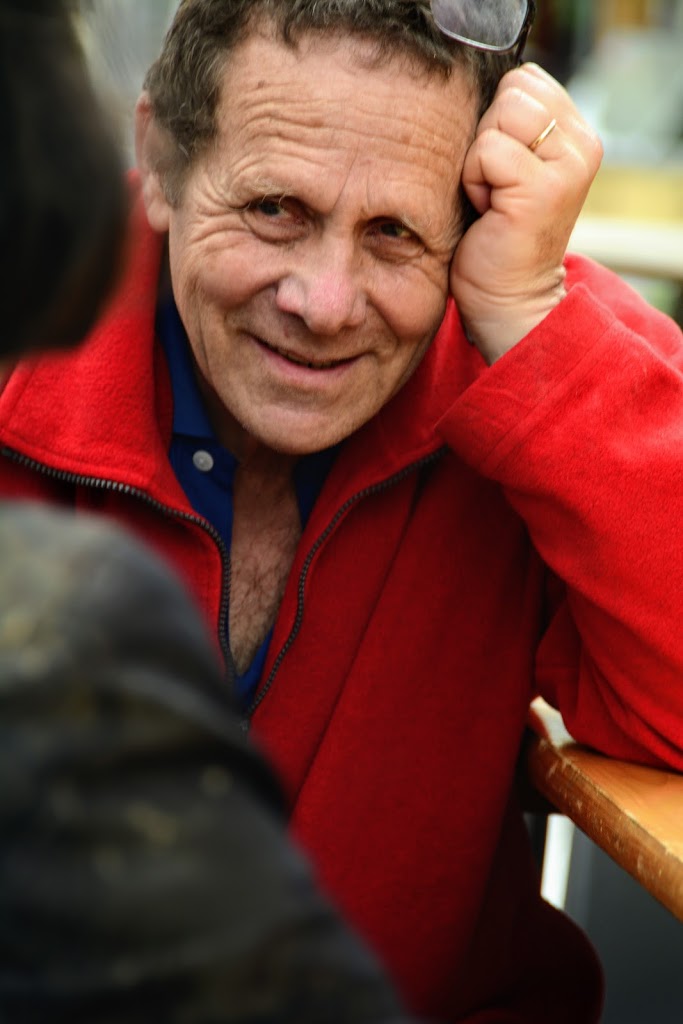
Hagai Bergman from the Edmond & Lily Safra Center for Brain Sciences at the Hebrew University of Jerusalem, where Hagai is the Simone and Bernard Guttman Chair in Brain Research
#17: Hagai Bergman – The Hidden Life of the Basal Ganglia: At the Base of the Brain and Mind
In this episode, Hagai Bergman and I talk about his new book, The Hidden Life of the Basal Ganglia: At the Base of Brain and Mind. We cover some of the many highlights of his life in basal ganglia and deep brain stimulation research. This includes his crucial discovery that paved the way to subthalamic deep brain stimulation during his work at John Hopkins together with Mahlon DeLong and Thomas Wichmann. We talk about his three-layer model of the basal ganglia, one of the first proof-of-principle demonstrations of closed-loop DBS, his work on the basal ganglia as a dimensionality reduction system and his newer interest in asleep DBS (and basal ganglia electrophysiology during sleep). We also talk about collaborations and friendships between academia and industry, as his research has found commercial applications such as in the HaGuide algorithm in the NeuroOmega system by AlphaOmega. Together with the surgeon of his center, Zvi Israel, Hagai has carried out over seven hundred DBS surgeries as a pair of two – and he has further studied DBS electrophysiology in numerous experiments in the macaque model. Likely, there are few if no people around that know the basal ganglia as well as Prof. Bergman. Hence, it was a true privilege to carry out this in-depth conversation about the key concepts of his research with him.
Hagai Bergman 00:00If you show me a chocolate, I would like to run to you to increase the vigor and next time to speak with you again to get one more chocolate. This is dopamine. Serotonin, on the other side, is that now you don't offer me chocolate but you actually you change yourself to a lion and you're attacking me. Again, I should increase my excitability and run away. But next time I will not come to speak with you. And what I do believe is that the subthalamic nucleus is the driving force. It changes very strongly the activity and or something like the pedal of the piano. And the striatum is the keyboard that gives the melody. Clearly for our clinical practice today, we cannot, we can affect only the the piano. And the striatum is the keyboard that gives the melody. Clearly for our clinical practice today, we cannot, we can affect only the piano. Seeing the major effects of the subthalamic nucleus. 01:01We are not sensitive enough. We are not able to be delicate enough in order to play with the keyboard.
Andreas Horn But the real melody of the basal ganglia is done in the striatum, is done by the dopamine system. We are now having very nice evidence of this. Welcome to Stimulating Brains. Hello and welcome back to stimulating brains episode number 17. Since the beginning of this podcast, I have wanted to get Hagai Bergman on the show. Since he is not only one of the kindest and most experienced people in the field, but also really has a story to tell. Hi. Hi. Guttman Chair in Brain Research within the Edmond and Lily Safra Center for 02:01Brain Sciences at the Hebrew University of Jerusalem. During his time with Mahlon DeLong at Johns Hopkins, he was instrumental in generating and validating the famous Albin-DeLong model and his 1990 Science publication about MPTP lesioning of the subthalamic nucleus in macaques more or less directly led to STN-DBS few years later in Grenoble. He has since done phenomenal work in the fields of closed-loop deep brain stimulation, electrophysiology and computational modeling of the basal ganglia and in more recent times asleep DBS and asleep electrophysiology. Some of you that actually spent time in the operation room may know his name already from a fruitful industry collaboration of Hagai's which led to the HaGuide algorithm co-developed with the company AlphaOmega. Recently Hagai wrote a phenomenal book called The Hidden Life of the Basal Ganglia: At the Base of Brain and Mind, which we talk about and I would dearly 03:01recommend very much to read. Finally we cover some outlook about DBS for schizophrenia and his thoughts about the future of our field. I think we're all very fortunate that Hagai spent so much of his time to talk about all these fascinating topics and hope that you will enjoy the conversation as much as I did. Thank you so much for tuning in stimulating brains episode number 17. So thank you so much Hagai for taking your time, valuable time, so valuable time to do this. To break the ice before we start I often ask about hobbies or anything you do or like to do when you're not working on the brain or the basal
Hagai Bergman ganglia. Thank you Andy. So one mistake we've already done and my time is not valuable. It is a pleasure to be with you and I'm really happy to do it. So 04:09speaking about the question what I'm doing outside of basal ganglia and brain I could divide it to two domains. First domain is family. So I was very very lucky in my life with Revital, my partner for many many years with four kids, all of them in medicine and six grandkids and it is a lot of pleasure and a lot of happiness and indeed whenever the family is ready to spend time with me I will do it okay and I will push aside everything. This is one aspect and the most for me the most lucky and important aspect 05:04outside of the basal ganglia, Parkinson and so on. The second aspect which I believe it's probably more common okay is that I'm running for many many years. I've done a few marathons including Berlin and Boston. Oh great. Oh yes. So yes. And I did not know that. Amazing. Yes. So I've done a few marathons all over the world and several in Israel and actually I can share is that I've done two marathons with Revital, my wife and three with the three of my kids but my daughter Marva has never done a marathon. She is a very good person. She is a very good person. has never done it. So she promised me that next year, we have a very nice marathon around the Sea of Galilee, and it will be my 70 years old birthday, she will do it. Oh, that's amazing. It's great. And again, just 06:25to give full disclaimer, and I think that this is also, it will be new for you. For many, many years, I'm doing a martial art training. Oh, wow. And I do believe, actually, coming to the first issue, basal ganglia and Parkinson's, is that both running and movement art and martial art, like dancing, are a kind of movement art, are something which are important in order to fight with the degeneration of your dopamine neuron. 07:05You should keep your cardiopulmonary system functioning, but then you should keep learning new movement techniques, tricks all over the life.
Andreas Horn Maybe it will keep your dopaminergic neuron alive a little bit longer. What kind of martial art is it?
Hagai Bergman Ninjutsu, which is an open Japanese martial art. So it is soft contact. I'm not involved in real fights, actually. Most of the time I'm training with Remi Tan now. And the main thing... The main trick is actually that it is everything. It's from judo, karate, jiu-jitsu. So you play all around, and this is coming back to what I believe is important, is to keep learning movement, 08:02and not just when you are at the age of 18, as most of us do. Amazing. So slowly circling to the professional life, you've been very successful, of course. But did you... And I'm sure... I'm sure you have had mentors that along in the career.
Andreas Horn Did you have somebody or a few people that clearly stuck out where you think they were really important in your career? And maybe relatedly, what were turning points in your career? Yeah.
Hagai Bergman So, you know, I started medical school. And when after three years in medical school in the European style, you go directly to medical school, which usually is for six years. But after three years in medical school, I decided that I need to know more about the brain. 09:03And I went... I started a master's thesis, and then came to PhD in parallel to my MD. And this master's thesis and PhD were done with professors, for Amir Hamimov and Yoram Palti, and were devoted to cellular neuromuscular junction and action potential conductance. At this stage, I was quite naive, and I knew that I'm interested in the system point of view of the brain, but I believed that I should start from the core element. And nevertheless, I learned a lot over there, but the two very influential mentors that I had were the two post-doctorate fellowship mentor that I was lucky to work with them, Professor Moshe Abeles in the Department of Physiology 10:03in the Hebrew University of Jerusalem. With Moshe, I learned the art of recording for more than one neuron, so multiple electrode recording, not only looking at the... activity of a single neuron, but looking at the interaction and understanding the importance of network, computational neuroscience. And then for my second post-doc, I went to Mahlon DeLong, where I've learned the physiology of the basal ganglia. And again, it is two different... Moshe Abeles and Mahlon DeLong have... complete opposite personality, one more open and one more, I would say, orthodox and Perseverance. But put it aside, for me, when I came back, 11:02the combination, when I was able to do multiple, to take the idea of doing multiple electrode recording in the basal ganglia, was a kind of a breakthrough that I'm very, very thankful to, to both of them for teaching me and giving me the ability to do this step in my future research. Great. Cleared turning points in your career. You've been to Emory.
Andreas Horn Was that important or something else?
Hagai Bergman So, so turning point in my career was indeed actually, it was to the work with Mahlon DeLong and Thomas Wichmann, is that we've done at Johns Hopkins. It was before, before Mahlon moved to Emory. And this was a turning point because I'm clearly one of these late bloomers. I spent the, everybody in Israel has to go to the army. 12:01So I spent the three years in the army. And then after there was the October war, so it took more time. And then medical school in parallel to master and PhD studies. And finally, I did two postdoc fellowship. So eventually I think that I came to Mahlon DeLong when I was already 36 years old.
Andreas Horn So not the typical American postdoc starting at the age of 24. And then. Is that a good thing maybe?
Hagai Bergman Or, you know, because you were already, you know, you could, I don't know.
Andreas Horn It's an interesting question. Was it, do you think in hindsight, it was even good to be a bit more wiser already or further down your career?
Hagai Bergman Well, I don't think I was wise. But I think that it was a kind of, 13:02that I was very lucky to explore all this field because it gave me, for example, when I was doing my PhD on a meal and today, a, I was going very deep into the issues of control, to which feedback to, and now that I'm trying to develop adaptive closed-loop DBS, I'm coming back to the, to the subject that I learned then in my earlier. So I do believe that we learn from exploration and from mistake.
Andreas Horn Okay.
Hagai Bergman So, for me, for me, it was very, very good at the end. It was successful.
Andreas Horn Okay.
Hagai Bergman So, as you hinted, and, you know, and I can even tell the story to make it even a little bit longer. And so when I came to Mahlon DeLong, 14:02and I came from Moshe Abeles, understanding that cross correlation is a very important tool that probably has not been used before in the basal Ganglia. So I came to Mahlon DeLong and I told him that we are actually looking at the very surprising results. Till 1987, when I came to Mahlon DeLong, the subthalamic nucleus was considered by everybody to be a GABAergic structure, like all structure of the basal ganglia. And then Yolande Smith and others have shown, Yolande Smith, Steve Kitai, have shown that the subthalamic nucleus, unlike all other structure in the basal ganglia, is glutamatergic.
Andreas Horn And this was interesting, but it was even more interesting because everybody that was doing before my time,
Hagai Bergman 15:04stimulation of the subthalamic nucleus and recording in the output structure, external segment of the globus pallidus, internal segment of the globus pallidus, have found inhibition by stimulation of the subthalamic nucleus.
Andreas Horn So how could it be that the subthalamic nucleus is glutamatergic and still inhibit its structure?
Hagai Bergman So I suggested to Mahlon to change, to modify all his setup and now to use two recording chambers, one oriented to the subthalamic nucleus, one oriented to the globus pallidus, put two electrodes,
Andreas Horn and do cross-correlation of the spontaneous activity. So it will not be confounded by antidromic activation of fibers and so on. Anyway, Mahlon, as I said, was open for everything, okay?
Hagai Bergman 16:02And if you'd like, if you are crazy enough, go for it. And they spent the first year doing this, trying to cross-correlate the subthalamic nucleus, the driving force of the basal ganglia. So I believe no matter where I put electrode in the subthalamic nucleus, I will find cross-correlation with pallidal activity. And all the cross-correlation, I believe in two or three monkey, more than close to 200 pairs, all the cross-correlation were flat. No functional interaction between one neuron, in the subthalamic nucleus and another unit in the globus pallidus. And when we stimulate, we found the same result as everybody else, inhibition. So today we understand it. And again, I probably in different stimulation, 17:02we are using this kind of mechanism, but at that time it was very, very frustrating. And I didn't know what I will do. But then it was the end. Since I came to Baltimore with my wife, Revital and two kids, already a lot of them in Nova. And the agreement between me and Revital was that she will take care of the kids for the first year. And on the second year, it will be my role at five to pick them from the kindergarten. So I was looking for a simple project. And luckily enough, Thomas Wichmann came. And together, we decided that we not do cross correlation in such very difficult task, but to inactivate the subthalamic nucleus to see if it ameliorate the symptoms of Parkinson's. Simple project. Okay, great. Simple project. 18:00But easier than doing cross correlation. And again, this was the turning point in my career. For those that don't know, we found that inactivation of the subthalamic nucleus in Parkinsonian monkey, either by chemical method, for example, Musimol, or by ablation with botanic acid, ameliorate all the motor symptoms of this MPTP induced Parkinsonism in the monkey. It was published in Science, and it was published in the National Institute of Medicine, in the National Institute of Medicine, and it was published in Science. I believe I got my tenor track position because of this paper. And I think that this is still my best paper. Great. So the simple project, that's a nice backstory there. Of course, 19:00we wanted also to talk about this paper, and maybe for the listeners again, to just mention, I think before that paper, people did think about that lesioning the subthalamic nucleus would lead to hemiballism or side effects. So in surgery, nobody dared to go there, if I understand the history correct. And your paper would really show it's the opposite, that STN lesions could ameliorate Parkinson's disease. So that is a true landmark paper that probably led to STN DBS.
Andreas Horn Yeah, yeah.
Hagai Bergman My best friend, Professor Benabid from Grenoble, actually said that he took this idea, and since he knew how to inactivate the brain by high frequency stimulation, so in 1993, Alim Benabid has done the first human surgery, just before it, Amit Benazuz already shows that even in the monkey, high frequency stimulation of the STN ameliorate Parkinson's. 20:03So this idea was indeed, indeed verified by our good friend from France. So I was just in Charleston at a conference where he got the prize, Benabid, and gave a lecture. And to me as a young student of DBS, it is, I even had the great honor to talk in a session with him, and he saw lead DBS, and I was really happy about that. And for me, I just thought, for someone like him who started this field, now seeing young people doing so many things with deep brain stimulation, must be feel really, really great. And I mean, he's also, I think partly retired, but for you, it's similar,
Andreas Horn right?
Hagai Bergman You essentially laid the groundwork and it's not only, of course, researchers now doing a lot,
Andreas Horn but so many patients benefiting from it. 21:00So how does that feel? You know?
Hagai Bergman Again, it is a great feeling. And for me, actually, and I think like for Ben, we call Lim Benabid, we short it for Ben. And what I think that we are very, very lucky is that we are, I'm still able to do it. And Ben, as you say, is partially retired, but I believe he's still going to the operating room. And I think that we are able to go to the, that for me every week, at least one day, sometime two or three, I'm in the operating room going to the subthalamic nucleus. And there is a human patient.
Andreas Horn Okay.
Hagai Bergman So many, many, again, I know that this surgery happened in many, many places all over the world, but in my place, in my small area, 22:00okay, I do see those patients, okay, that I'm going, I'm navigating to the subthalamic nucleus. And then it is,
Andreas Horn yeah,
Hagai Bergman I was very lucky in my life and I wish everybody else to be as lucky about this. Just maybe each time visiting an old friend, if you go back to the STN, right, in the surgery.
Andreas Horn Exactly.
Hagai Bergman And, you know, as I'm saying, for example, in Europe it is less, but in the United States, people are still debating if the STN or the internal segment of the globus pallidus are a better target for Parkinson's disease. For me, it is the STN because the STN is small and complex structure. And because it is glutamatergic and the driving force and so on and so on. And, but whenever I'm coming to this debate, 23:01who is better or who is better target, I'm saying, you know, I am biased. You know, I became a friend of the STN so many years ago. I will keep this friendship. And it's amazing that you are still so much in the surgery. I think at some point that was already a few years ago, you told me that you did together with the surgeon in your center, 900 surgeries. As a pair of tools that. So far in Jerusalem, in a doctor medical center in Jerusalem with the Swiss rail, that was the first neurosurgeon to do different stimulation in Israel. So we started it together and took it actually in Israel. DBS is covered by the national health insurance. So everybody can get it. So altogether we've done more than 700 cases in Jerusalem. Wow. In Jerusalem. 24:00And now we are very, very lucky. And we have many students around being the hospital in Tel Aviv, in Haifa. And I'm trying to go also over there. So it's keeping busy.
Andreas Horn Okay.
Hagai Bergman Amazing. Amazing. So I remember Renana. I turned one set. You were hard to replace in the surgical room. or forever there, for... It's keeping me busy. Okay, amazing, amazing. So, I remember Renana Eitan, once said you were hard to replace in the surgical room. Now that I think you are retiring or have retired officially, but not yet. For, I will be retired in, luckily enough, in my university, my next birthday is 70 years old, but in my university I can retire at the age of 71, but eventually it doesn't make a difference because you can continue as emeritus as far as my Lewy body dementia will not overcome. Okay. Amazing. So maybe circling back a bit to the time at Johns Hopkins with DeLong and 25:07also Thomas Wichmann, I think the Albin-DeLong model from 1989-1990, I think two or three papers led to it, is still the most famous model of the basal ganglia. So before going more into detail, could you maybe tell us a bit about the history that maybe you were involved in or you
Andreas Horn know about who were the main players at the time, how did it evolve this model?
Hagai Bergman So at that time, the time that let's say the 87 to 1990, there were two fields. There were a researcher of the basal ganglia that were doing the research on rodents and were oriented mainly to pharmacology and what we call at that time biochemistry and what we call 26:01today molecular biology. And there were electrophysiologists like Mahlon DeLong, Thomas Wichmann and me, that were more interested in the electrical activity of the brain. And the two groups were a complete disconnection. So the reason that we decided at Hopkins to go for inactivation of the subthalamic nucleus was the previous work of Bill Miller. Bill Miller was an MD-PhD student of Mahlon DeLong that eventually left the basal ganglia. And Bill was recording in the globus pallidus, external internal segment, before and after induction of Parkinson's by the 27:02MPTP neurotoxin. And indeed, the MPTP was discovered by William Langston at 1985, 1986. So Bill Miller and Mahlon DeLong were probably the first to record the pallidal activity of the subthalamic nucleus. And Bill Miller was the first to record the pallidal activity before and after MPTP treatment. And their main finding was that GPE, external segment of the globus pallidus firing, is decreasing and internal segment of the globus pallidus is increasing after MPTP. And moreover, Bill Miller was doing recording in one monkey subthalamic nucleus after MPTP induction and found that the discharge rate in the subthalamic 28:01nucleus of this MPTP-treated monkey is higher than previously reported cases in the normal subthalamic nucleus of monkey. So we decided... the first decision was... of Thomas Wichmann and me... was to continue the study... of Bill Miller, but now to record in the subthalamic nucleus, and to see if indeed, now that in the same monkey we compare before and after MPTP, do we see increase in discharge rate. So we've done it, first monkey, and it was nice, we found significant increase, and then came to us the question of the difference between correlation and causality. Because now we found correlation between the increased discharge rate in the subthalamic 29:01nucleus and the symptoms of Parkinson's disease, but the causality direction was not clear. It could be the increase in discharge rate caused the Parkinson's symptoms, on the other hand, it could be that the Parkinson's symptoms were not clear. The symptoms are causing the increase in the discharge rate. So in order to be able to answer the question of causality, so it was a kind of pure science question, we've done the inactivation of the subthalamic nucleus, reducing the discharge rate, and we're very happy to see that indeed the symptoms disappear.
Andreas Horn Okay.
Hagai Bergman And then actually we went one step back, we found the albin model, it was clearly in line with our results and the rest of history, okay, because we say, yes, this is the correct 30:06model of the basal ganglia, direct, indirect pathway, D1, dopamine receptor on the direct pathway, D2. Dopamine receptor on the indirect pathway, because of the excitatory effect of dopamine on D1 medium spiny neuron and inhibitory effect of D2, of dopamine on D2 medium spiny neuron, we are getting these changes in the striatum activity leading to decrease after MPTP, the generation of dopaminergic neuron. There will be decrease in the GPD.
Andreas Horn Okay.
Hagai Bergman And then we also found that the GPD activity that would lead to this inhibition of the subthalamic nucleus activity that would lead to increased activity in the GPi. And we verify this by inactivation of the subthalamic nucleus.
Andreas Horn 31:02Okay.
Hagai Bergman So your paper, the science paper was a very critical point in that model as well, apparently.
Andreas Horn Yeah, makes sense.
Hagai Bergman And at the time, at least... It was kind of the proof of the concept.
Andreas Horn Okay.
Hagai Bergman I would say, Albin, Penny and Young have shown correlation to this, but I think that this paper was the first one that they've shown causality that we can perturbate the system and get the expected result out of the model.
Andreas Horn Makes sense.
Hagai Bergman The model at the time, and probably still today was conceived to serve action selection
Andreas Horn or thought selection in the brain. What are your thoughts on that?
Hagai Bergman Is that still true or...
Andreas Horn Okay.
Hagai Bergman So, you know, since then it is certainly solved.
Andreas Horn Okay.
Hagai Bergman And we've learned a lot about the basal ganglia since then. I would say, first of all, we've learned that the anatomy of the connectome of the basal 32:06ganglia is much more complex than we knew at that day.
Andreas Horn Okay.
Hagai Bergman So, for example, this model completely...
Andreas Horn Okay.
Hagai Bergman Completely ignored what Atsushi Nambu later called the hyperdirect pathway, the direct cortical projection to the subthalamic nucleus. It was assuming that all the information is going from the striatum to the downstream structure without back projection from the subthalamic nucleus to the GPE, from the GPE to the striatum.
Andreas Horn Okay.
Hagai Bergman So, for example, we know today that the connectivity is much more complex, and I think that this dichotomic view of the basal ganglia as direct, indirect, go, no go, is oversimplistic. 33:03The brain is not working on a binary as a binary decision making. It is a network.
Andreas Horn Okay. Okay.
Hagai Bergman So, the connectivity of the whole network is important. So, today, I do see the basal ganglia as a kind of a critical app for the dimensionality reduction of all the information regarding the current state in order to provide information to the actor, to the motor system of the brain.
Andreas Horn Okay. Okay.
Hagai Bergman Thank you. Thank you. So, I'm curious to know, for example, if the brain were to do in the next step, and for this, we should do from time to time decision, but most of the time, we'll do integration of this information in order to provide, to select the best action, not out of two options, 34:04but out of very, very many options that we can do.
Andreas Horn Okay. Okay.
Hagai Bergman Certainly. Certainly. Certainly. Certainly. Certainly. Certainly. Certainly. Certainly. Certainly. Certainly. Certainly. Certainly. Certainly. Certainly. Certainly. Certainly. Certainly. Certainly. Certainly. Certainly. Certainly. Certainly. Certainly. Certainly. Certainly. Certainly. Certainly. Certainly. that dimensionality reduction. And I think the first paper that you worked on this was with Issa Barghad, which really tried to computationally explore this concept that the basal ganglia can be a dimensionality reduction system. And then maybe if you think about the classical loops, the thalamus would project back, right, and expand again in these very simplified loops. So, Andy, again, because this is a podcast and I think it is interesting,
Andreas Horn and maybe the history is even more interesting than the...
Hagai Bergman 35:00I would like to go one step before Issa Barghad, but I will come soon to Issa Barghad. And the story goes like this. So, as I told you, after coming back from Mahlon DeLong to my lab in Israel, I decided that as Moshe Abeles and many other people in Germany at that time were doing individual cortex, frontal cortex, multiple electrode recording, Wolfzinger, for example, I would like to do multiple electrode recording in the basal ganglia. And, of course, I selected to go to the globus pallidus because it is the easiest place to do that. It is the place to record from. And when... So, I was doing this kind of multiple electrode recording with my first master student, Asaf Nini, and then later with Yal Raz. 36:01And the bottom line of these studies and many, many others, we repeat it so many times in my lab, is that when we do cross-correlation of simultaneously record pallidal neurons, they are always independent of each other. So, you record the spiking activity of two pallidal neurons and you cross-correlate between them. The cross-correlation is flat. One is not exciting the other or inhibiting the other. They are not affected by common input as in many, many cases in the cortex. So, in the cortex, actually, when we do simulations, in terms of recording, we see a lot of correlated activity. So, this was, first of all, a kind of amazing fact. And, of course, the first paper that we wrote about it, 37:02I was sure, wow, this is something, black and white answer. We send it to Nature, rejected science, rejected... I've done all the way to Journal of Neurophysiology. And it was published in a journal, a journal, a journal, in 1995, still 700 citations. So, not bad. But then, actually, it was something that, on one side, I was very happy because it was black and white. It was very clear. On the other side, it was against my intuition. So, although I came from Mahlon DeLong, together with Gary Alexander and Peter Strick, wrote about the segregation of the 38:03in the basal ganglia, I was more... I did believe in integration following Gerard Percheron, a very smart anatomist from Paris that was speaking about the big disk of the pallidal dendrites that should... Actually, if you just look at the anatomy, the reduction is... the reduction in the number of neurons from the striatum to the globus pallidus, the shape of the dendritic field of the pallidal neuron, you clearly see that this is integrative structure. But integrative structure, I would expect to be correlated. And it was not clear to me. And then, we have, again, I was lucky again to be in Jerusalem. We have a very nice computational,
Andreas Horn very interesting computational center.
Hagai Bergman We used to have our retreat in near by the Dead Sea. There is a very nice kibbutz called En Gedi. And on the way back from this kibbutz En Gedi, 39:00from this retreat, I was sitting near by one of the PhD students of our computational neuroscience program. And we spoke about it. And I said that... I mentioned it that on one side, I am very happy that I have a PhD in neuroscience. And I said, I don't know if it's black and white, but it is against my intuition. And then Izar Bargat said, no, but probably I'm sure that you know that today in neural computation neuroscience, neural network, they are telling us that you can do PCA, principal component analysis with neural network. It was Chaim Szympolinski teaching to them. Of course, you know, I was not going to this lecture. I said, wow, so neural network can do dimension, because PCA, principal component analysis, is a kind of a method to do dimension reduction and to make the unit uncorrelated 40:01in order to maximize the information. So this was a second breakthrough because this took me to this idea. And then Izhar Bar-Gad was making all the computational neuroscience,
Andreas Horn and I said, yeah,
Hagai Bergman this really can work. And as I said, so I was very lucky. There is a saying, an old saying in the Jewish tradition is that I've learned a lot from my teacher, but I learned more from my friends and even more for my students.
Andreas Horn So this is exactly the case.
Hagai Bergman So the insights of a PhD student, that's amazing. And I am very, very proud of that. So maybe to rephrase or to, that I understand correctly, essentially dimensionality reduction with the outputs being completely uncorrelated,
Andreas Horn that's of course exactly what PCA does, right?
Hagai Bergman To have orthogonal components. 41:00So you're saying that that's what the GPi essentially does. So the neurons have the pallidal disc and there is some computation that would reduce, but keep uncorrelated. For most of the time, in order to maximize the information, and again, just to make one step forward, actually what I'm saying today is that it is not principal component analysis type dimensionality reduction, because PCA is trying to minimize the reconstruction error. In PCA, I'm trying to, that if I try to reconstruct the input, I will have minimal error, but this is the brain. The brain does not care about the past, the brain cares about the future. So the brain actually is doing the PCA in order to maximize the information for the next action that you will do. So for example, if you see me now, okay, you don't care that I'm now dressing, 42:04that I'm having the glasses on over here, or that I'm moving them because they are not important. Your dimension reduction system will just push you, push it away. You will do dimension reduction of a stream of words that I'm moving forward to you. What is relevant, it is what is kept in the system.
Andreas Horn That makes sense.
Hagai Bergman Great.
Andreas Horn Yeah.
Hagai Bergman So maybe one more question about the general model history.
Andreas Horn I recently interviewed Mike Humphries also on this podcast
Hagai Bergman who did his PhD with Kevin Gurney. I know, I know. A decade. So a decade after the Albin-DeLong model, I think Peter Redgrave, Tony Prescott and Kevin Gurney, you know that very well, but more for the listeners published the computational adaption of the model, which I think also became very influential 43:00in more in the computational neuroscience. So to me now, a young student looking back, they seem so similar.
Andreas Horn So what could you, do you think what was added or what is different between the two models?
Hagai Bergman So again, I think that one, another issue that was added in between is the issue of the reinforcement learning. And again, if we're going back to Wolfram Schultz, Peter Dayan and Montegro, okay, that actually we're looking at the, at that time, computational field of reinforcement learning, and shown us that dopamine neuron encode the prediction error. And by actually by adding this reinforcement, 44:00a prediction error learning into the basal ganglia and understanding that the basal ganglia are part of a continuous loop that is going from state to action. And then this, this action is changing the state of the world. And the loop is working continuously and how we can optimize our behavioral policy. If we don't have a all known teacher, and this is the role of the critic, the dopamine neuron in this structure, that the dopamine neuron actually provide you the mismatch between prediction and reality. And therefore, you can improve your behavioral policy by interaction and exploration with the world. I think this is the main addition, okay, at the time of Albin-DeLong, okay, it was dopamine was mainly in order to change it, 45:04the excitability of the striatum, and then finally the excitability of the motor cortex. So more dopamine, again, by changing D1, D2, MSN and all the way down, more dopamine lead to more excitability of the motor cortex and less dopamine lead to less excitability of the motor cortex and Parkinson's akinesia. This was dopamine in the time of Albin, Albin Tenney and Young and us and so on and so on. Later, I think, later, I think, later, I think, this is the big, the second big jump is that dopamine now is coming, okay, not only to change the excitability, but to enable learning and enable plasticity and modification of the behavioral policy. 46:00So I think this is the big difference. Okay, great. That helps a lot. So it's always a bit harder to see history looking back than if you read the history, than if you really experienced it.
Andreas Horn So thank you so much for clarifying that.
Hagai Bergman I think we already covered a few of your big achievements. One other that's a bit outside of the box now is in closed loop deep brain stimulation. So I just interviewed Julian Neumann in the last episode here, and we were talking about closed loop DBS. And he mentioned that the most important paper in his view that showed the first proof of principle in the non-human primate was from your group as well.
Andreas Horn Could you tell us a bit about that story or that paper?
Hagai Bergman So again, I was very lucky all over my life. And many of my students were smarter than me, clearly much better experimentalists. 47:00And this was the story of Boris Rosin, that was an MD-PhD student, is now a phdologist in Pittsburgh. But before moving to the battlefield of eye surgery, he was king of the basal ganglia. And at that time, we've been very much aware that our DBS patients are coming back and forth to the outpatient clinic in our hospital in order to adjust their stimulation parameter, or what we call programming. And being very, very, very aware of one, the limit of human being. Okay, so, you know, we have a human being trying to optimize something, but we do it in the office. And the office environment is very different from the patient, natural environment. 48:01And still, we are having our own limit of being distracted by so many other things. And finally, the fact that the medical system don't allow the patient to come in Israel, it is public system. Patient can come every three months and don't pay for it. But in Boston, probably it is much more expensive. And I'm not sure everybody can come every year. So this is a long time for the involvement of Parkinson's disease. So, you know, I think that's the thing. So we were dreaming on a system that will adapt automatically to the symptoms of the patient and will change from a minute to a minute. And by this one will provide optimal control of the Parkinson's symptoms. 49:00And moreover, will be, let's say, more beneficial or more cost effective for the medical system, because the the patient will need to come for programming only whenever the automatic system was not working. So we've done this experiment in the monkey. And indeed, the main message of this paper is that the basal ganglia system is observable and controllable. And this is a very important issue in control theory. You cannot control something that you cannot observe. I cannot control the patient. I can't control the temperature in this room if I don't know to measure it.
Andreas Horn Okay?
Hagai Bergman So this is the whole thermometer. But this is not enough. I can measure the temperature outside of the room. Still, I don't control it. So in order to have an effective control closed system, I have to show that the system that 50:07I'm speaking about it can be observed and can be controlled. And this was this paper in Neuron 2011 that we've shown that this proof of principle. And, unluckily, it is less easy than we believed at that time. It is already 10 years and we still don't have a patient outside with full independent closed ! ! So, in order to have an effective control system, there were huge steps done forward by the group of Peter Brown in Oxford, the group of Priory in Milano, Tim Dennison in Medtronic, and now in Oxford. I do believe that this is the system of the future. 51:03And moreover, I do believe that using closed-loop and sophisticated machine learning algorithms, will be able to cure more complex disorders than Parkinson's. So Parkinson's is a kind of simple disorder, but if we are moving to mental disorder, from depression to schizophrenia, maybe over there, this is where we need closed-loop systems. So I'm still putting all my money in this direction. There was just this Nature Medicine paper in depression, right, from Scangos et al., where they showed at least a proof of principle in depression as well.
Andreas Horn Yeah, yeah, yeah.
Hagai Bergman So, about speaking about measuring the basal ganglia, one question I did not prepare beforehand, but that I want to ask now is, you also worked with the company AlphaOmega, 52:05of course, and developed an algorithm for the NeuroOmega. So, you did a lot of research on the beta-power, and then you did some research on the beta-power for the operation room, where you could detect the beta-power, and then essentially have some medical guidance for where to place the electrode. And, funnily, I think the company called that system after you, it's called HaGuide. Many use it worldwide, we've used it in Berlin as well.
Andreas Horn So, what was that like, to work with the company, but also to develop this system?
Hagai Bergman Well, I think it was very, very natural for me to work with the company, because I was working in the hospital in my place, in my academy place, when I was working in the hospital. It is, even in my medical school, very few researchers are crossing the border between the academic place and the medical place. 53:00And I was very, very lucky to cross this boundary. I was very lucky to collaborate with this AlphaOmega company. And the major idea was, one, that everything that machine can do, it will be better than the average human. So, if we speak about driving a car, I'm sure that the best driver will be always human, or for many, many years.
Andreas Horn Yeah.
Hagai Bergman But for the average person like me and you, autonomous car will do better than we do. And clearly, they will do less mistake on this one. And I do believe that this is the same for physiological navigation to the subthalamic nucleus. It will take a lot of time, apology for speaking about myself, for the system to beat me. 54:03So, for the system to do better than me, that I am living in the subthalamic nucleus area for more than 30 years. But for newcomers and for people who is less experienced, then the support of automatic system can really help in the decision making during the surgery. And therefore, we develop this system that move alone.
Andreas Horn Okay.
Hagai Bergman So, again, it is the same idea that the surgeon is only pushing the green button, allowing the system to move forward. The system moves, records, and makes decisions and tells the neurosurgeon, this is the subthalamic nucleus, this is the motor domain of the subthalamic nucleus. I recommend you, the decision is always of the neurosurgeon. I recommend you to put the stimulating lead in this point. 55:01So, it was fun because it is three different cultures. The first one is the academy, which is completely open and so on and so on. Medicine, with this huge amount of responsibility and still you are quite alone. And then you are coming to a company and there is a team and there is a project manager and you set your line. But the bottom line, which is very nice with industry, is that industry success is when you realize that you plug and play, don't play. So, you plug, you don't need a lot of explanation, and the system work all the time. And indeed, this is the major difficulty because the common places or the common event are 56:02well treated by the system. But you have to think about all the activities. And to be clear to these people to these people to these people to these people to these people to end of it, you cannot allow a mistake even in one human patient. So it is very different from academy where we say, okay, we are correcting 95% of the cases. This is more than enough. Industry, it should be simple and it should work all the time.
Andreas Horn So I really enjoy learning, you know, moving between all these three cultures. And as I said, I'm very lucky to... And you have worked with them over 30 years or known the CEO as well, right?
Hagai Bergman So it is very nice. I can tell you a story. So, and again, it is coming probably most of, we didn't say, but I'm living in Israel, in Jerusalem.
Andreas Horn Okay.
Hagai Bergman And as you know, Israel for many, many years and still now, 57:05I'm living in Israel for many, many years and still now, there is an ongoing conflict with the Arabic world and still with the Arabic people inside Israel that are Israeli citizens. And many, many years ago when I was doing my PhD, Ahmad Younes, who came from Nazareth, was the electrical engineer in my department. And then... And then we've been working together. We've tried to develop a closed loop voltage clamp system. Part of 30 years ago. But then after I came to Ahmad and I didn't use the word intellectual property because they didn't exist yet. But I told him we have intellectual property. 58:01But at that time we built... We built... We built... We built our electronic devices by ourselves. So take our intellectual property, build the device for us and make your money by selling it to other people. And this was the beginning of a very big friendship. And again, it is just because of the time. So we are speaking a little bit before Christmas. The first device that we developed was a hardware spike sorter. Spike sorter is the... It's a device that can detect the different shape of action potential of different neurons recorded by the same electrode. And I remember I wrote to my good friend, Jerry Witek. Jerry Witek that is now in Minnesota. And Jerry Witek was also with us at Hopkins and then moved to Emory. So I told him, look, Jerry. 59:01We have great device for... For spike sorting. I really recommend him.
Andreas Horn And again, keep in mind, this is the time before email and so on. So I say, okay, tell me what is the name of the company?
Hagai Bergman So I tell him that this is Emma Dunes. You're still walking at the basement of his mother, St. Mary's Square, 1, Nazareth, Israel. And Jerry Witek wrote back to me and said, I don't believe you. There is nothing. Nothing like St. Mary's Square 1 in Nazareth, the company located over there. So since then, AlphaOmega became a big company, very successful company. And I'm very happy playing with it. Very cool. Nice. A bit like the Steve Jobs garage or, you know, at the computers and so on. Sounds like that. 01:00:00Really cool. So you wrote a book and we want to talk about the book, but maybe one more question before that, that I think is a major, there are so many major contributions you had, but one I really enjoy personally as well is your eLife paper where you showed a three-layer model of the basal ganglia. And I think that also is very important in the book, in which the subthalamic nucleus now serves as an input nucleus together with the striatum, essentially being on the same rank or in the same hierarchy.
Andreas Horn So can you summarize how you got to that and what it means?
Hagai Bergman So what happened to me, and I started with the D1, D2, direct, indirect model. And then I was still listening to my friends that are doing anatomy, mainly anatomy, Susan Haber and other people that are doing anatomy. You also, but it can... No, no, no. 01:01:04And it was clear to me. That the connectivity of the basal ganglia is much, much more complex than this direct, indirect model that we have in mind. And indeed, if you look at the paper that were coming, let's say around 2000, there were more and more box and more and more arrow into the circuits of the basal ganglia, eventually making it a kind of a jungle, a kind of that look like the... the underground of London, rather than something that anyone can remember. And I was thinking what could be done. And then it came to me that I can highly simplify the system by moving the subthalamic nucleus from its position as a relay nucleus in the indirect pathway 01:02:04into the input tier of the basal ganglia. So we have the striatum and the subthalamic nucleus as the input tier of the basal ganglia, getting information from all cortex and from intralaminar nuclei of the thalamus. Both project to the GPE and so the external segment of the globus pallidus of the basal ganglia. And the external segment of the globus pallidus project back to both of them, to the subthalamic nucleus. And the striatum. And then the three structure, input tier and central tier, project to the output layer of the basal ganglia, the GPi and the SNr, the globus pallidus internal and the substantia nigra pars reticulata. And eventually we are getting a kind of, I say, I believe, a full description of the main pathway of the basal ganglia by having this. 01:03:07So there is one more addition that from the output structure, I'm speaking not only to the thalamus and frontal cortex, but also to the PPN, superior colliculus, so motor from brainstem motor, a nuclei in the brainstem or in the cortex. But coming back to the questions that you mentioned is that having both the striatum and the subthalamic nucleus, the subthalamic nucleus in the input tier, I'm not saying that they are equal. The striatum is GABAergic, the subthalamic nucleus is glutamatergic and driving force. And what I do believe is that the subthalamic nucleus is the driving force, changing very strongly the activity and or something like the pedal of the piano. 01:04:02And the striatum is the keyboard that gives the melody. So in the striatum, OK, and clearly for our clinical practice today, we cannot, we can affect only the pedal, seeing the major effect of the subthalamic nucleus. We are not sensitive enough. We are not able to be delicate enough in order to play with the keyboard. But the real melody of the basal ganglia is done in the striatum, is done by the dopamine system. We are now having the very nice evidence that during sleep spindle, there is increased correlation between the cortex and the striatum. Another work of Aviv Mizrachi that you know. So this is where the small science of a movement and behavior are learned. But when we have to run away, to explode, to freeze, this is done by the subthalamic nucleus. 01:05:04So I think, just to clarify, you mentioned STN as the driving force, but I think a lot of people would see it as a brake more. So I think maybe can you clarify it? Because there was... I clearly agree that it is that a increased activation of the subthalamic nucleus breaks the basal ganglia.
Andreas Horn What I mean by driving is that it has a very diffuse and strong effect all over the basal ganglia, where the striatum effect are local and minimal. Okay? So the STN is the brake, okay?
Hagai Bergman And we actually can stop all the activity of the basal ganglia. But when I'm saying the driving force, I'm coming to the fact that it is very broad and glutamatergic.
Andreas Horn 01:06:01You once mentioned that the brake can also be used to start a car, right?
Hagai Bergman If you... Press the gas pedal at the same time and release the brake.
Andreas Horn Yeah, okay. Exactly. So one should be careful not to use it at home, but a professional driver, when the... Or even if you can listen to your airplane in the times that you used to take airplane, okay?
Hagai Bergman You can see that actually what the pilot is doing is actually operating the engine in full power,
Andreas Horn but the plane is not moving because he's pushing the brake. And then in order to start move, he's releasing the brake. And the advantage over pushing the gas pedal is that now the engine is already in full movement, okay?
Hagai Bergman So if you release the brake, you go faster than if you push the gas pedal. That makes a lot of sense. So I think one last question before we go to the book. 01:07:04Recently, you shifted attention.
Andreas Horn You mentioned to sleep DBS as well. So looking at... Or not only DBS, but also recording during sleep. Why or what do you think is going to happen there?
Hagai Bergman Okay, so there are two levels. One level is sleep.
Andreas Horn I, like most people in my age and my generation, ignore sleep, okay?
Hagai Bergman For me, we have behavior, you know, reinforcement learning. We explore, we explore it. We seek for food, water, sex, run away from land. Sleep was a kind of non-important field for me. And indeed, actually, sleep was ignored by most people in the basal ganglia. 01:08:00So for example, when we decided to look for... For... For the activity of basal ganglia neurons during sleep with Aviv Mizrachi, the only abstract that I found about recording pallidal activity in the sleeping non-human primate was for Mahlon DeLong, that in 1969, because Mahlon DeLong came from Ed Evarts, and Ed Evarts came to the motor system. By the way, he was recording pyramidal neurons of the motor system because these are the best cells, the biggest cells in the primate brain, and this was his dream to record from them while the monkey is sleeping. But Evarts' move to the motor system, Mahlon DeLong's move to the motor system, is this 01:09:01only one-page abstract. And we have to look at the ! I think that we ignore sleep up to now, but I do believe that we understand more and more that sleep is critical for our health and for our normal behavior. And I will come later to it because I do believe right now that one major role of non-REM sleep, I will put aside REM sleep, is to clean the brain. And I think that's the most important thing. And I think that's the most important thing. So, we need to clean the waste product of the brain, and if we don't clean enough the waste product of the brain, like beta-amyloid, alpha-synuclein, and so on, so on, we are starting this positive feedback chain that leads to accumulation of misfolded protein and neurodegeneration. So, we started by recording in the basal ganglia of sleeping monkey, we found very significant 01:10:03changes in the basal ganglia. We debate with other people. We believe that these changes are due to changes in the thalamocortical activity rather than the neuromodulation of the basal ganglia, but I'll put this debate aside. Then it came to me that, unlike my friend from the anesthesiology department, I do believe that sedation and anesthesia are related to sleep. So, I think that's the most important thing. I think that the most important thing is to sleep. And, again, being in the operating room, we, as many big centers, do our DBS surgery while the patient is completely awake, using only local anesthesia, because we are afraid that if we sedate or anesthetize our patient, the activity of the basal ganglia will go down 01:11:02significantly.
Andreas Horn And we will not be able to recognize our target. But this is not fun. Okay?
Hagai Bergman It is not fun to be awake for six hours in the frame. And I was thinking maybe we can find a kind of, at least, sedation paradigm that would enable us to see the normal physiology of the basal ganglia while making the patient much more comfortable. And luckily enough, we found that if we use hypnotic sedation, like Propofol, Remifentiline, Dexmedetomidine, the activity in the basal ganglia is going down very much, and this hypnotic sedation masks the physiological marker of the subthalamic nucleus and basal ganglia target. But Propofol is very fast. So I can give Propofol. 01:12:01And the effect of Propofol...
Andreas Horn Okay. Okay. Okay. Okay. Okay. Okay. Okay. Okay. Okay.
Hagai Bergman will disappear by 10 minutes. And then came the big surprise, which is ketamine. Ketamine is very different from the hypnotic sedation agent. It is NMDA antagonist, by the way, like nitrous oxide. So you can go to the ether theater and see that before they use ether, they tried to use nitrous.
Andreas Horn Okay. So nitrous came to the world before ether. But anyway. The ether dome is here in Boston, right? Yeah.
Hagai Bergman It was invented here. Super.
Andreas Horn Yeah.
Hagai Bergman So let's speak about ketamine. Ketamine is NMDA antagonist that induce a dissociative state. And when we look at the activity of the basal ganglia and the cortex during either propofol or ketamine, we did see that propofol mimic non-REM flow 01:13:00or sleep. So very strong effect on the basal ganglia. But ketamine mimic the activity during REM, during paradoxical dream sleep, where the brain is actually awake, but we don't enact our dream because there is a glycinergic inhibition of the spinal apparatus. So if I give ketamine, the patient is happy because he's dissociated. He's not dissociated from the environment. And still I do see the normal activity of the basal ganglia. So we came with the idea of using a kind of propofol ketamine, propofol sedation protocol. When for the recording and for the assessment of the therapeutic window of the DBS, we are doing it under ketamine. We publish it in the monkey and it was working. 01:14:00And we've done already a retrospective study that we're trying to publish. And we are now in the middle of prospective study where patients are coming. They give their consent to participate in the study. The patient and me, the physiologist are blind. Of course, the surgeon and the anesthesiologist are aware, but the patient will get either a propofol ketamine propofol or propofol saline propofol. And so far so good.
Andreas Horn Okay.
Hagai Bergman So I do believe that sooner, more will not need to do DBS while the patient is awake and will be able to provide the patient this propofol ketamine propofol or like, okay. So you can replace ketamine with nitros, with Xenon, whatever. But we'll be able to provide it to our patients 01:15:03without paying the price of losing the reliability of electrophysiological navigation. Great. So this is great. And then just to complete the story, to come back to sleep. I do believe that what we should do now is actually to do different stimulation that will not only suppress the beta activation, but also help the patient to have better immune system. So we should do the beta activity, the beta oscillation during the night, but we'll enhance by phase specific stimulation, the good guys, the delta wave. And by this, we should restore normal sleep architecture to our patient. And maybe restoring normal sleep architecture to our Parkinson's patient will not only relieve the symptoms, but will slow the progress of the alpha-synuclein accumulation 01:16:01and the progress of the involvement of the symptoms of Parkinson's in our patient. I love the idea. So essentially trying to go to a more curative or disease modifying deep brain stimulation by modifying sleep of patients, better clearing up waste.
Andreas Horn So the glymphatic system plays a role there, right? Is that known to be malfunctioning in Parkinson's? Or it's still quite vague, right?
Hagai Bergman The science behind things, but. It is known that it is malfunctioning in Alzheimer's.
Andreas Horn Okay.
Hagai Bergman And we know that sleep apnea and other sleep disorder really increase the risk for Alzheimer's. And I do believe that, and I think this is well known. I do believe it will be the same story for alpha-synuclein.
Andreas Horn Makes sense.
Hagai Bergman Do you think DBS for, Alzheimer's in the few patients where it did work
Andreas Horn 01:17:01or did help had such an effect potentially or it's probably hard to speculate, right?
Hagai Bergman On that. It is still hard to speculate. You have to interview Andreas Luzano.
Andreas Horn Yes.
Hagai Bergman He took a rain check. I tried. So, okay. I will tell him to give you a Christmas gift. Great. Amazing. So two very important things that disease modifying, but the other would be to have a sleep DBS with electrophysiology, which is also, would be a great, we would need to ask Marwan Hariz or the London group what they think about that. They would probably still not approve and prefer the pure imaging based because of the, they always say it's a, there's a bleeding risk, but yeah. Again, you know, first of all, one can do some recording even from the lead. And I think that my point in DBS is, 01:18:02we're coming back to the issue. Should we do microelectrode recording during DBS procedure. And my point is that DBS is an elective procedure. So in elective procedure, we should be on target in 100% of the cases. We cannot allow ourselves to be correct only in 95% because the one patient out of 100 patients that we have done perfect, for him, he came to elective neurosurgery and we failed. Okay, so I'm speaking about this one out of 100 patients. I agree. And that's such an important point, because now that people do studies, you know, on a cohort basis and say sleep DBS is the same, because there's no significant difference. I think they missed these few patients in that, right? So it's not the right design to, you would, I totally agree with you. I think my, 01:19:02my own experience much, much less than yours, but from Berlin would be that we had changed targets based on electrophysiology and maybe one in 20 patients or two in 20 patients. So not many,
Andreas Horn but in these, you don't even know, was it a good choice or not, right? It's always,
Hagai Bergman so it's very hard to prove, but my gut feeling would be similar to yours. In most patients, it would be fine without, or in many, but then in a few, it is helpful to have electrophysiology. Yeah. And because it is elective, I should, I should consider this.
Andreas Horn Makes sense. Okay. So finally, let's go to the book. I also want to be mindful of your time,
Hagai Bergman but you published an amazing book with MIT press, which is called the hidden life of the basal ganglia at the base of the brain and mind. And essentially what we all talked about right now
Andreas Horn is in part, part of this book, right? So anybody who's interested in more learning about these
Hagai Bergman 01:20:00stories we already talked about now should, read the book and everybody else should read it as well, I think. But maybe can you summarize
Andreas Horn a bit what drove you to write the book in first place and also what it is about?
Hagai Bergman So again, I was very lucky over my life because at the end, now that I'm looking over my last 30 years, I was all the time walking in the same direction. So starting with the subthalamic nucleus, looking for the fissure, the physiology of the basal ganglia, DBS, the physiology in the human. Eventually I did feel that I have a big story that I would like to share with everybody else. And more important for me was the ability to speak about, so the first part of this book is kind of introduction to the anatomy, physiology. 01:21:02The second part is about the computational neuroscience of the basal ganglia. And here I'm trying to copy David Marr, who is also from Boston, that I was really inspired by his book, Vision, that was written many, many years ago. When he says that when we are trying to understand, to understand the function of the nervous system,
Andreas Horn we should speak on three level. The first level is what is the computational goal of the system? The second level is how to get to the computational algorithm. Okay. What is the algorithm that is used?
Hagai Bergman And the third level is what hardware the system is using in order to implement the algorithm and 01:22:03achieve its goal. And so the second part of this book is going over four generations of model of the basal ganglia. First generation is this that we already discussed, D1, D2, box and arrow, even the three-layer box and arrow is part of the first generation. Second generation is reinforcement learning. Now dopamine is coming and dopamine is modulating the plasticity of the main axis of the basal ganglia. But then in the third level, I'm coming and I'm asking myself how it could be. If I give apomorphine, which is a very fast dopamine agonist to the patient, or I give haloperidol, which is very fast dopamine antagonist, the effects are coming out within a few minutes. It is not plasticity. So I'm trying 01:23:03to go to a more complex model, which I call the multi-objective optimization, where dopamine play a role first on the excitability and like in the first generation and also on the plasticity of the learning in the basal ganglia. And finally, the fourth level that we already debated a lot, but I enjoy this debate, and I believe that now you may agree with my terminology, is that I'm saying, but the basal ganglia are not the only brain network that connects between state and action. There are other networks. And what I'm trying to claim, and now I'm a fact, and I'm interested already by you, is to say that the basal ganglia behave like system two of Daniel Kahneman. So I'm not saying that the basal ganglia are system two, but they are behaving 01:24:05like system one of Daniel Kahneman, namely the automatic default, the one that it is very prone to mistake and so on and so on. And then the second level is that the basal ganglia are behaving like system one of Daniel Kahneman. So I'm not saying that the basal ganglia are system two of Daniel Kahneman. So I'm not saying that the basal ganglia are system one of Daniel Kahneman. And the cortical network is behaving like system two. So whenever the automatic system is not working, it moves the control to system two, which is more deliberate, more careful and can provide solution. So basal ganglia behave more like system one. Cortex behave more like system two. And because basal ganglia are behave more like system one, it is a major part of our default automatic system. When the basal ganglia are not functioning, we are getting the symptoms of Parkinson's disease, which from my 01:25:04point of view is akinesia and bradykinesia, absence or slowness of automatic movement. So no, we don't move our arm when we are going. We have to wear a face mask, we are apathetic. This is because we are losing our major part of system one. So this is the second part of the book. The third part, I'm taking it to the what happened when the basal ganglia do not do, for example, in Parkinson's, but also in schizophrenia. And the fourth part, which is just one chapter, I'm really going outside of my pleasure zone. But I'm trying to ask myself the question, if all our neural system is state to action loop, system one, system two, and so on, so on. What about free will and
Andreas Horn 01:26:07the human responsibility? And I do believe I have some answer. But clearly, I'm not the first and not
Hagai Bergman the last. To go into this minefield of mind and body, free will and I really like that chapter. I mean, for me, you're one of the, you know, wisest people I had the pleasure to get to know a bit. So even just let's say humanitarian advice or thoughts in there are really great. So I really enjoyed that chapter as well. Thank you.
Andreas Horn So, so maybe briefly talking about so so and exactly, that's what I'm going to do. I'm going to
Hagai Bergman ask you a question.
Andreas Horn Yeah, absolutely. So what I love about the book, you know, these box and arrow models and the
Hagai Bergman all the models of the basal ganglia can be so confusing, especially for young people that have 01:27:00not lived through the history when they were developed. So it is an amazing overview about them. And then also then the application to the pathology and Parkinson's and schizophrenia. I think dopamine is very crucial as a neuromodulator, but you then also show that there are others in play doing similar things. Could you still summarize briefly what your your role of dopamine is according to what you believe or what it does in the brain. So again, the reason I'm moving, I mentioned one reason not to stay with the classical reinforcement learning, that took dopamine as the major critical, the only critic of the basal ganglia. But the second problem with this reinforcement learning model is that it assumes that the only goal of life is to maximize cumulative pleasure. Okay, so by looking by maximizing cumulative dopamine in our brain and so on, we are trying to maximize cumulative pleasure or 01:28:02we have to keep in mind that pleasure can be positive or negative. But I do believe that we complex human beings have more than one goal. Okay. And therefore, I would like to speak about the multi objective optimization, Pareto, and we're actually trying to optimize more than one item, not only pleasure, everybody can put in place. And in order to achieve this, what I'm putting, I'm adding to the circuit is the fact that not only dopamine is neuromodulator of the basal ganglia, or the striatum, if you are looking at the striatum, we see a huge amount of serotonin,
Andreas Horn acetylcholine, and histamine, not noradrenaline, by the way, interesting, noradrenaline is left
Hagai Bergman for the cortex and other place. But this, so in addition to dopamine with dopamine, serotonin, 01:29:08acetylcholine and histamine. Now, dopamine, I do believe, increase excitability of the motor system, increase the vigor, or the pseudo-temperature, and actually induce positive reinforcement, namely, if I've done, if you show me a chocolate, I would like to run to you to increase the vigor. And next time to speak with you again to get the one more chocolate, okay, this is dopamine. Okay. Serotonin on the other side, is that now you don't offer me chocolate, but you actually, you change yourself to a lion and you're attacking me. Okay. Again, I should increase my excitability and run away. But next time, 01:30:01I will not come to speak with you. Okay. So it also increases vigor as dopamine. It increases vigor, but induces negative reinforcement learning. Okay. Because I need to increase the vigor, okay, into two different situations, for chocolate and for a lion, but I have to do opposite learning for the chocolate and for the lion. And then again, just by theoretical reason, I'm having dopamine and serotonin in order to complete the four combinations of increased or decreased vigor, or increase, decrease plasticity. It is important, very important here to make the notion that I'm speaking about neuromodulation of the basal ganglia. So when I'm speaking about dopamine, 01:31:01I'm speaking about dopamine in the striatum. There is also dopamine in the cortex, in the frontal cortex. There is also dopamine in the A11, A11 nucleus projecting to the spinal cord related to RLS. So now that I'm speaking about this neuromodulation, I'm speaking about their role in the basal ganglia. For dopamine, it is easy because still most of the dopamine is in the basal ganglia. But for example, when I'm speaking about serotonin, I should keep in mind that it could be that serotonin role in the cortex are different than serotonin role in the basal ganglia. And if you will give me another 70 years to do research, it will be my field. Okay, great. I will, yeah, I can't. I'm sorry. I would love to. So you already answered quite a few questions that I had now with your brilliant explanation. So I think we can skip a few questions that I had, but now once you established 01:32:15a good understanding of how the basal ganglia work in health. As you said, the next part of the book
Andreas Horn is also to tear their function down again while talking about diseases like Parkinson's disease. So what can we learn from this silly question, but what can we learn from diseases when we
Hagai Bergman studied basal ganglia and which diseases are at play? So I think disease is the, I can share a story actually. This is very nice. So we publish our paper about the subthalamic nucleus, that inactivation of the subthalamic nucleus is ameliorating the symptoms of Parkinson's disease. And then a year later, I got an envelope from a French neurologist named Salon. And 01:33:10he wrote to me, Dear Professor Bergman, I'm writing to you to tell you that you have solved one of the big mysteries that I was seeing in my clinic. And the story that he was giving was that he had a patient with Parkinson's disease. And then this patient had a stroke in the subthalamic nucleus, developed hemiballismus. And following the hemiballismus, hemiballismus is usually very transient, he was cured of his Parkinson's. Wow.
Andreas Horn And this happened before our paper, okay? So nature has done already this experiment, okay? And later he published it in Neurology, okay? 01:34:00You can find the reference in my book, okay? And the story, okay?
Hagai Bergman And I still keep it, it's still, you know, it is untyped, no email, it's an envelope from France,
Andreas Horn so I was very, very happy to see it.
Hagai Bergman And I think that this is a disease, okay? On one side are an opening, there are messages that nature send us
Andreas Horn in order to understand itself, okay?
Hagai Bergman This is one place. The second place, for me, is that we, as responsible human, we should be aware of the suffering of the other. And therefore, it is so critical to use our knowledge, our resources that were given by our society, in order not only to understand the world, but also in order to provide cure to those people that need it. 01:35:03So this is my... Beautiful. I just saw a talk from Marwan Hariz, who recently got the Oliver Kroner Prize, and it was a beautiful talk about deep brain stimulation surgery history and so on. But he also talked about serendipity, you know, that a lot of things happen by, not by chance, but something happens, and then you find a discovery. And he then also quoted that serendipity would only happen to the prepared mind. So, you know, it could happen, and then you observe it, but you don't make a, you know, you don't follow up and so on. So potentially that story in France, that could have led to amazing discoveries. And it was, now it's still used to confirm what you found, but this is a great example of, you know, these single case reports, they have, I think, 01:36:02a great role in medicine. So we can, should take them seriously and learn and follow up, yeah. Really nice. So I think one of the later chapters in the book, and you already briefly mentioned this, you called dreams and delusions to treat schizophrenia by means of DBS.
Andreas Horn Can you summarize your thoughts about that?
Hagai Bergman So at my time in medical school, but I assume that also in your time, they told us that Parkinson's disease and schizophrenia are just two opposite, example of disease. So we treat dopamine, if we treat dopamine too much with dopaminergic therapy, we get schizophrenia. And if we treat schizophrenia patient too much with neuroleptic, we get Parkinson's symptoms. So they're completely different. But I think that they are, 01:37:02maybe we actually looking at two different spots of this. When we speak about schizophrenia, we mainly see the positive symptoms, the delusion, the hallucination, the psychosis. And therefore, when we treat it with neuroleptic, we are getting the negative sign of Parkinson's, the akinesia. And then when we treat akinesia with dopamine, okay, if we give too much dopamine, we see the hallucination. But for me, now that I'm aware of, you know, I'm aware of this, let's say, dichotomy of positive and negative symptoms, I can see them not only in schizophrenia, I can see them also in Parkinson's.
Andreas Horn So let's speak about positive symptoms. So we see delusion and hallucination in schizophrenia, okay?
Hagai Bergman But we see actually levodopa induced dyskinesia. 01:38:01And Mahlon DeLong actually once mentioned to me that maybe the psychosis, these schizophrenia psychosis is dyskinesia of the non-motor part of the basal ganglia. But even more important to really to going to the negative systems. It is just different language to describe these same symptoms. So they, in the psychiatry to call it abolition, lack of wanting to make a movement. And then Parkinson's to call it akinesia. And we are very careful to explain to teach our students that the patient, the akinetic patient, is not paralyzed. He can move.
Andreas Horn Okay?
Hagai Bergman And so on and so on. So I do believe that there is a lot of similarity. And I do believe that we have a very good control of system. This is the subthalamic nucleus. 01:39:00And therefore, and finally, we have today the tool of machine learning. So we can put electrode inside the brain into a very critical point and look at the clinical effect. And according to the clinical effect, adjust the stimulation for our patient. And schizophrenia is a terrible disease because it affects young patients, you know, about almost 1% of the population at the age of 25. Most of them in Europe. And at hostels or mental hospitals. And the United States has to improve and to take them from the street and not to leave them homeless. Apologies for preaching. But the point is that right now we as Western community don't have a real treatment. 01:40:04Even not for the symptoms. Because. We know that the patient will develop more and more severe negative symptoms. We'll be able to see all this, but not the negative symptoms. So this is for me my major delusion. And I'm aware that it is very risky. We are something like 70 years after the frontal lobotomy. And I hope that we would be very, very careful not to repeat the mistake of the frontal lobotomy. And again, the frontal lobotomy, if we read the history of Freeman, Walter Freeman was not a monster. He was really trying to help his patient. 01:41:01And we should be careful to clarify that. Right. done first for the benefit of the patient, not for the society. Second, with full consent of the patient and family and so on, with full coverage of ethical committee and move very, very slowly, not to make 20 lobotomies in a day. Yes, I totally agree. I think the beginning of that story was actually really good. The book is still very helpful that they wrote, I think. So I
Andreas Horn think it's called Psychosurgery. And yeah, it's maybe a similar story also with Robert Heath,
Hagai Bergman who also treated schizophrenic patients with DBS very early on. They probably, all of them were not monsters. You're totally right. But it was maybe, so actually Marvin also said that recently that 01:42:01they were, you know, driven or driven away by their excitement about things. And therefore for me, this is to learn from their mistake, not to be driven by your excitement. Start slowly, make sure that you have full, that you are able to convince the ethical committee, the association, the patient association, you know, convince many other people and be under their supervision. Okay. Because we need this. That even if we do mistake, okay, which probably will do mistake. Okay. But even if we do mistake, people will not blame us for, as you say, running out without control. Yeah, I think that's exactly what needs to happen. And that's great. So Günther Deuschl also mentioned that, you know, this downfall of psychosurgery that happened in that time in Germany, it was by a prominent Spiegel article, but there were, I think there were also the hearing 01:43:03to these things with the FDA and so on in the US that he once said this could happen anytime again.
Andreas Horn And the only weapon we have against it to be a hundred percent scientific and document
Hagai Bergman everything, you know? And I think that was also lacking back then that they did not, you know, it wasn't written up in a, you know, very scientific way. It was often case reports and hard not hard to follow to some degree so I tried to read some papers by Robert Heath just to learn from that time and it's a very different style of writing the papers it's more anecdotical it's harder to see statistics and so on so there is a recent biography of Robert Heath okay did you see it okay so it is called The Pleasure Shock yes I read that that was my
Andreas Horn entry to the story and in fact I interviewed Lone Frank on this podcast so the author of that book
Hagai Bergman 01:44:05is about Heath as well so so I think it's a great book me too me too great so we have to stay tuned for your your work on that that's coming up now maybe just a few general questions to wrap up before we stop do you have any tips for young scientists entering the field well you know I'm afraid because I'm aware of Cajal's book about advice to young scientists and so the first advice don't listen to other people's advice you know find your way and again what I would like to say is that keep in mind that you learn more from your mistake than from from other things so allow yourself to explore move to the right move to the left 01:45:04fell down and learn to rise again this is the name of the game great do you what do you think the future will bring for deep brain stimulation maybe you said already schizophrenia but other things are the same thing schizophrenia and closed loop this is for me namely closed loop for every okay but for me again it is a good system of closed loop again phase specific so hopefully enabling to restore normal architecture of sleep and better treatment of accumulated accumulated misfolded protein and then actually also to increase the spectrum to other severe ! 01:46:00brain disorders that right now we are unable to treat
Andreas Horn great then what was your greatest eureka moment in science
Hagai Bergman wow the two two for me the subthalamic inactivation and the uncorrelated activity of the normal basal ganglia switching to synchronous oscillation in the parkinsonian in the Parkinsonian monkey. So it is not only rate and oscillation, it is also synchronicity in the basal ganglia that makes us Parkinsonian. Okay, great. And since we talked about the successes, was there ever been a moment where you thought this was a complete waste of my time, this did not work, this was a failure? No, no, again, because as Revital is always saying I'm just over-optimistic. 01:47:00I'm sure that all my mistakes will eventually happen to turn over to good things. And I was very, very lucky in my life. It is not that I have not done mistakes and rejected from when I submitted paper and so on and so on. But for me, again, I think the issue is to go to the arena. And when you go to the arena, I think it is Truman that was saying it, this is where you are tested. If you are ready to fall down, to be in the dirt and to accept some failure, but you know that you are doing your game. This is for me. I love it that you say there was never the moment. It was a waste of time because even failure. Failures can, or especially failures, you can learn a lot from. That's great.
Andreas Horn Anything else? We talked about so much and I took so much of your time, but anything else we did not cover that you would like to mention to the audience?
Hagai Bergman 01:48:05We spoke a lot about physiology, but I would like to speak about your field, anatomy. And I think that anatomy is critical. Physiology is shaped by anatomy. We cannot do anything outside of the anatomy. And what a physiologist like me would love to have from the anatomist is a quantitative anatomy. Namely, not only there is connection from A to B, because there is connection from A to B, any A to B in the brain. This is big. This is small. So we should start with anatomy.
Andreas Horn Okay.
Hagai Bergman And only then move to physiology. So. For me, the brain, understanding of the brain, I don't remember the name. It is very famous. 01:49:01Scientists say that everything starts with evolution and genetics. The Vujovsky or something like that. For me, everything in the brain starts with anatomy. And only on the base of this anatomy, I can do physiology. So keep doing your anatomy. Thank you. I mean, I'm more imaging. I wouldn't consider. I wouldn't consider. I'm more imaging myself doing real anatomy. So I'm always powerful. Imaging is the new method to do anatomy.
Andreas Horn Yeah, you might be right.
Hagai Bergman But, you know, maybe I can share that when I started and or from med school, I was, I would have thought that we know much more about anatomy that we know, or we have better methods that everything is known. That's how you started. Because there are these anatomy books. You think, oh, that's also old things, you know, that everything has been worked out. But I'm even now. I was still realizing how poorly we understand anatomy, you know, and even the gold standards. Especially of the subcortical system.
Andreas Horn 01:50:00Yeah. Okay.
Hagai Bergman So we know very well, I think that subcortical system, we really don't know. And even the gold standard methods, like you mentioned, Susan Haber with track tracing, they are off. They are, I think, very precise, but they have, of course, the selection bias where you put the dye. They also don't. They are not really quantified. They are not really quantitative, probably, or a bit, but, you know, there's no. So, so even these gold standard methods are very limited in what, you know, you see what you observe only, you can only slice up so many parts of the brain. So, and then there's entrograd, retrograd.
Andreas Horn So yeah, it's, and tractography doesn't solve it at all.
Hagai Bergman You know, that's terrible method. I use it, but because it's the best we have in vivo, but there are so many limitations of that. But I think that this is the fun of life. We will not understand the brain for clearly the rest of our life, but probably for the next 10,000 years. 01:51:01So, you know, like they say in the East, the way, the dough is the important. That's true.
Andreas Horn So I just talked with, asked our neurosurgeon here at MGH, Mark Richardson, about why did we choose an engineering problem where we know we will fail to understand it right.
Hagai Bergman We could have. Studied cars or something simpler, but we chose the brain.
Andreas Horn Why? This is an interesting question.
Hagai Bergman Yes, you're right. That's a great way to stop this.
Andreas Horn And so thank you so much for your time and for participating. Okay.
Hagai Bergman This was really cool. Thank you. And in the end, I hope to meet soon person to person. Great. Thanks a lot. Bye bye. Shabbat Shalom. Outro music plays.
Click any highlighted text passage to jump the Spotify player to that point. The transcript text is present directly in the page HTML for search engines and accessibility.