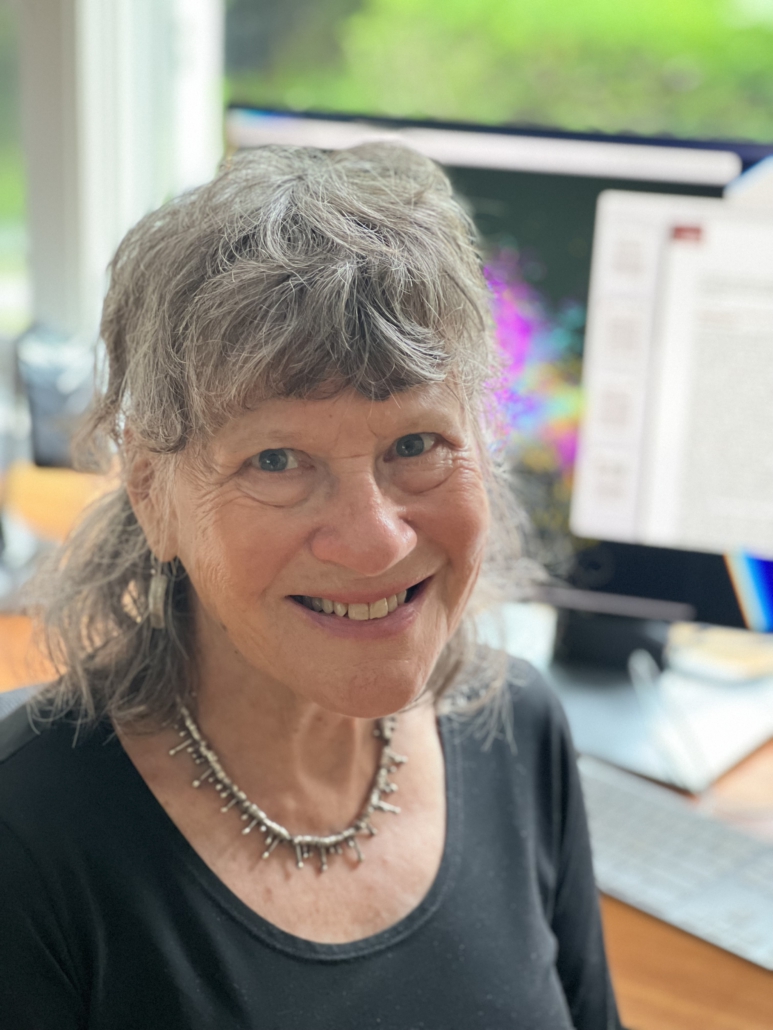
Suzanne Haber is Professor at the University of Rochester & runs a lab at McLean hospital at Harvard Medical School in Boston
#30: Suzanne Haber – Anatomists, an endangered species & their importance for DBS
It was my great honor to talk with Suzanne Haber about the importance of anatomy in neurosurgery and neuromodulation as a whole. Among many other topics, we discussed her seminal work on the subthalamic nucleus, the anterior limb of the internal capsule and briefly present work on the zona incerta, also in synopsis with earlier work from Mahlon DeLong (#22) and Anne Young (#23). Crucially, Suzanne is not only an anatomist but one with a particular interest in deep brain stimulation. She leads a Conte center with the NIMH focused on Obsessive Compulsive Disorders and has carried out seminal work about the striatal system. One key area Suzanne has worked on lately was the comparison between noninvasive imaging (diffusion-MRI based tractography) and tract tracing data. Together with Anastasía Yendiki (Martinos Center Boston), she runs the “iron tract challenge”, in which tractography methods folk competes to reconstruct tracts from diffusion data as best they can – which are then compared to the ground truth from tracing data. Together with Cameron McIntyre (#10), alongside three other anatomists, Suzanne recently created the basal ganglia pathway atlas which represents a unique dataset to study connectomic deep brain stimulation data.
Suzanne Haber 00:00and it was at a time where I was told to my face, but also that was the atmosphere, that we don't need anatomy anymore because we have imaging. And this was a very frustrating thing for me. And I went to, I was giving a talk at Oxford, and there's Tim Behrens and Matthew Rushworth in the front row, and they're asking all these questions about it, and the paper had like literally just come out while I was on the plane going over, right? Like it just literally came out. I didn't know this would be really too long. Thanks. Welcome to Stimulating Brains. Classically trained anatomists are an endangered species on the brink of extinction. In 1974, Paul Lauterbur changed history by publishing the first picture of a living animal, a clam, using a technique he called zeugmatography. The technique, which was later referred to as NMR, or MRI imaging, changed medical practice for the good.
Andreas Horn 01:29In many fields, such as functional neurosurgery, clinicians were soon after that able to see, without opening the skull, the anatomy of the patients they planned to treat. Before the advent of MR imaging in medicine, functional neurosurgery teams often comprised of an anatomist. For instance, as we discuss in the first episode of this podcast, the Freiburg school of stereotaxy consisted of Traugott Riechert and Fritz Mundinger, two neurosurgeons, who tightly collaborated with Rolf Hassler, the neuropathologist and anatomist. 02:29But when clinicians were able to see for themselves, they thought they did not need anatomists anymore. Suzanne Haber is one of the last classically trained anatomists and, as you have heard, was told that to her face. By now, it has become clear how limited imaging is when it comes to defining anatomy, and the need for anatomists is huge. But few are being trained, as Suzanne mentions, not many labs like hers exist anymore. There is much the imaging field needs to learn, and we should continue to collaborate with anatomists in our field. 03:29So to break the ice before we get into the science part, I often ask about hobbies or things that you would do if you're not invested in academia. Yeah, so it's summertime now, and one of the maybe August holidays is gardening.
Suzanne Haber And we have a very large garden, which I just love to kind of putter around in, big vegetable garden and some wonderful flowers and plants. And during the winter, when we don't have that, I have a rather large collection of orchids in the house, which I kind of pamper a little. 04:29But the hidden secret to orchids is, of course, that you shouldn't pamper them, you should ignore them. Everyone wants to know, how do you do so well with orchids? I keep blooming, blah, blah, blah, and I think, yeah, it's because I don't fuss over them, and they kind of like to dry out. So those are two things that I like a lot. I like to sew. I have a couple grandkids, so I enjoy making things for them and for others. Do they live close by, too? Yeah. So we're in Rochester, New York, as you know. 05:29One daughter lives in Cambridge, who I see quite a lot because of course I have an appointment at McLean. And then the other daughter lives in New York City in Washington Heights and I spend some time with her. So essentially you're between the two daughters then if you have the two appointments between Rochester and here. Yeah, sort of. It's a driving triangle. Okay, that's nice. Got it. So, okay, we are here at the McLean Hospital campus. The first time I've been here, really beautiful, so really cool to see you in person here in Boston, to pivot to the main topic, which is academia and your work in science. 06:29I often ask about key mentors in your career, also turning points that led to where you are now. Yeah, so key mentors, I'd have to go back to my graduate work with David Hamburg, who was an amazing man. He had a lot of insight and foresight into developing programs and helping people. He was a psychiatrist and a very well-known one. And he took me into this fold at Stanford. And I was very determined to study the low-dose effects of amphetamine on social behavior of monkeys. 07:29This was my thesis. I was always driven by the idea of why do people behave the way they do and abnormalities in behavior, etc. And so amphetamine at the time, and perhaps now still, was a model of schizophrenia because psychosis that developed in people who had overdosed would often be misdiagnosed as schizophrenia. That's a very, very long time ago, but it still produces behavioral effects that are interesting. And so I looked at the social environment, the low-dose effects in monkeys. In terms of a mentor, he was just supportive of really whatever you wanted to do. 08:29He was one of those people that allowed you to find your own way, and so that was fantastic. I then did a postdoc at Minnesota, skip over that, and then move on to the second postdoc, which was at MIT with Walle Nauta. At the time I left graduate school, I was trying to make the decision whether I wanted to continue in behavior or whether I wanted to become an anatomist. One of the people who really had an impact on my life was a guy named Stan Watson, who was a psychiatrist and was working in the lab. 09:29When Dave Hamburg left, I worked in Jack Barchas's lab and Stan worked there. He was trying to figure out ways, it was really a long time ago, how to visualize a dopamine system. The fluorescence technique was out there and I became enthralled looking in the microscope. It just was another world. It's like, I suppose, astronomers look up in the sky and they just kind of can stare forever, and I realized that I really enjoyed that so much. So then I was torn, should I become an anatomist or behavior person, and I chose the anatomy route. 10:29And I worked with Walle Nauta, who was a very interesting mentor. He was just so knowledgeable. Was he already quite famous at the time? Oh, yeah. I was his last postdoc. For the listener who may not be familiar with him, he is considered one of the founders of the field of neuroscience. He was also a founder and president of the SfN and invented the silver staining method. That's probably what he's most famous for. So did you also work with that technique? No, because by the time, it's a long history about tracing studies, because that's what I do now. 11:29So as you know, the cell stains and the myelin degeneration stains were the first way to try to think about circuitry in the brain. A lot of the fundamental things we know about circuitry still date back from that time. But myelin degeneration only degenerates the myelin, right? It doesn't give you the terminal fields or the areas of origin. People were working on ways to do that, and one of Nauta's contributions was the silver technique, which allowed one to visualize thinly myelinated and unmyelinated fibers. Very soon after that it was replaced with the tracers that we use now. 12:29So he's the one who really did that, and so when I got there, I really wanted to do the anatomy that actually showed that. Really cool. So you mentioned the endocrine accumbens and also amphetamine, your first PhD work. And so it always seems to me you did some things in the motor system, but I think you're kind of drawn to the striatum, pallid, you know, psychiatric or associative limbic system.
Andreas Horn Yeah, I never really did that.
Suzanne Haber I mean, it's the only reason that I'd be associated with the motor system is because the basal ganglia is above. 13:02But I always was interested in the non-motor part of it. The limbic and the tibial.
Andreas Horn Why is that? Was there any... Yeah, because it goes right back to what I was drawn to in the first place, mental health.
Suzanne Haber Mental health, okay. And how you explain things, which is where I'm still, many, many years later. How do you explain that people, on the one hand, rationally know that drugs are not good for them, or that in OCD your ritual is not going to be productive, but you can't stop doing it. Mm-hmm. So that kind of thing has always been very intriguing to me.
Andreas Horn Yeah, yeah. Sounds great.
Suzanne Haber So a big jump in time, but we'll also go back in time again. But your more recent work, I think one key thing that...
Andreas Horn There are so many things that make your work interesting,
Suzanne Haber but I think for the imaging field what makes your work interesting is that you're one of the few people that actually compare tracer with non-invasive imaging, 14:06like tractography, diffusion-based tractography study. And I think one of your key partners in crime, there are many others,
Andreas Horn but it's Anastasia Yandiki, who is the author of the Tracula software, which is part of FreeSurfer, and she's also doing a lot of other things often with you.
Suzanne Haber So together, I think the two of you, probably with others,
Andreas Horn you also set up the Iron Track Challenge to look at that, right? Can you tell us a bit what that is? Yeah, so again, if you don't mind me going back in history completely,
Suzanne Haber cut all of that out. I had decided to spend a little bit of time at Mass General,
Andreas Horn and I wanted to see what was going on at MGH.
Suzanne Haber And so it got arranged by various people I knew and so on, and then I would come and have a visiting appointment there. And one of the things that I was always very interested in is circuitry. 15:02You know, if I felt like, okay, if we understood how the brain was,
Andreas Horn why we were doing this, why we were doing that, why we were wired together, we would really understand disease.
Suzanne Haber Of course, that was naive, but I still believe that we'll, you know, have a better idea about how the brain is put together. And I had been frustrated, as many people are in basic science, when they see these imaging papers come out, and they make statements about circuitry or function or whatever. And it was at a time where I was told, I'm going to have to do a lot of research on this, and I'm going to have to do a lot of research on this, and I'm going to have to do a lot of research on this, and I'm going to have to do a lot of research on this, and we don't need anatomy anymore because we have imaging. And this was a very frustrating thing for me. And so I had many, many papers. I would get a paper with a new track, new pathway, and I'd say, oh, that's really pretty, it's very lovely, but actually that track doesn't exist. And, you know, it was frustrating. And so at one point I thought, like, okay, I'm not going to fight this. 16:04You know, diffusion is just... way, way too popular. And us anatomists, you know, like three of us in the world, maybe I'm just making that up. So I'm going to have to join them. So I had a paper, we had a paper called the Pathways Paper. It was with Lehman et al.
Andreas Horn It was the first paper, right?
Suzanne Haber And I went to, I was giving a talk at Oxford, and I'm sitting there and I'm giving this talk, and there's... Tim Behrens and Matthew Rushworth in the front row,
Andreas Horn and they're asking all these questions about it, and the paper had, like, literally just come out while I was on the plane going over, right?
Suzanne Haber Like, it just literally came out. And, or the day before, something like that. And I felt like, they know this paper way too well. They must have reviewed it. And so, and... 17:00Anyway, so we had lunch, and it was just wonderful because they were just so interested in trying to figure, figure out how Pathways really... And I was just so happy about that, that people really wanted to do that. So then I went to MGH, and Anastasia was another person like that. So I had interviewed, or interviewed, not interviewed, but, you know, set appointments with many, many people at MGH. And we just clicked, and, you know, she was really interested in it. And so it's been, you know, it's been a great journey with her, trying to...
Andreas Horn Exactly do that.
Suzanne Haber So the whole goal is to take tracing and use the tracing as the so-called gold standard for understanding what tractography can and cannot tell us. And that was the origin for the iron track. So it's an open data set where people can test their diffusion tractography algorithms, and then they hand in solutions, and you... 18:00Right. So we first gave them... The first thing they got was actually the tracing.
Andreas Horn Okay.
Suzanne Haber They got actually the tracing, and then the seed, and then they had to match the tracing with the seed.
Andreas Horn Okay. And they developed an algorithm to do that. Okay?
Suzanne Haber So now they've got what they're supposed to match. Then the challenge, then, is to give them a seed somewhere else.
Andreas Horn Yeah. And the interesting thing about that was that they didn't do as well.
Suzanne Haber They didn't do that well.
Andreas Horn Yeah.
Suzanne Haber And the thing... I mean, the...
Andreas Horn Yeah.
Suzanne Haber And so now she has a good...
Andreas Horn Yeah.
Suzanne Haber Which I'm part of also, which is asking the question, you know, it depends on where you're coming from. You know, it depends on where that seed is in the cortex. There are different rules in terms of how one gets to their terminal field, depending on what they have to navigate through. So now we're trying to do that from different perspectives. 19:02Sounds great. So I think I've heard you mention a few times in talks and different occasions that probabilistic tractography was superior to deterministic tractography as maybe one take home maybe to play devil's advocate I sometimes think that this choice and related choices could be seen as a typical bias variance problem you know you get more tracks and maybe also the right track with probabilistic but then would you also get more false positives so you know maybe it's more sensitive but would you also get more specificity yes yes yes so I I don't actually know the answer to that I think that that's really very very possible the reason we came to that conclusion is that there was a graduate student that we shared and that is also a published paper I think it's in 20:00there a woman yeah so in that paper what we did was we looked at all the different way we have this you know ground truth pathways yeah and then we have an animal that was of course that that animal had been scanned as well and tried all kinds of different systems on it and just found that the probabilistic work best was the one that came the closest with the most accurate you identification but it may be that in certain areas that's not true you know it really depends I think I think the thing that we found was that depending on where you are in the brain I mean one of the things that we thought about quite a lot is that maybe one of the mistakes we make in tractography is that we scan the individual equally everywhere in the brain and there's some places where the tractography has no trouble right it's just like a you know so
Andreas Horn makes sense
Suzanne Haber 21:00So is it possible to just focus the scans, take a scan, a general scan, but then focus in on areas in which a lot of fibers are coming in and they're turning and they're twisting and doing whatever and then getting out the other end. Those are where you have the trouble. So maybe that's the place that we need to just kind of focus those. And then when it gets in the corpus callosum, I mean, we know where it is. Like a multi-resolution. Yeah, exactly. Yeah, exactly. brainstem or so yeah um cool so you've mentioned the Lehman paper that was I think 2011 in journal of neuroscience and there was maybe um a six uh second paper 2018 Safadi et al same journal that is right a bit in the same um concept where you looked at the a-league and related systems and the two across the two is it even possible to summarize some of the findings in a podcast like this yeah I think the main thing is that um fibers from cortex regardless of where they are 22:03um are going to enter the white matter in a certain way and that's that certain way is just because of the constraints of the brain and then they travel through the brain to their terminals and these an example is the alec the anterior limb of the internal capsule um and they organize themselves in the capsule and this is true for some other fiber bundles like the
Andreas Horn corpus callosum in a way that makes sense from where they're coming from and where they're going. And so the goal of those two papers really was to ask the question, are there rules that fibers use to get to where they're going that are going to be translatable into the human?
Suzanne Haber The monkey brain is much smaller, much less evolved. Obviously, the cortex is tiny compared to the human brain. But some of the constraints are the same. The fibers aren't going to go through the ventricles. They're not going to go through parts of the striatum and so on and so forth. So they have to get to where they're going with similar constraints. 23:03And so I think the main thing about those papers was that there are logical rules that fibers use to get to where they're going. And moreover, within a pathway, within a bundle, the organization can be predicted based on where they are. So for example, in the ALEC, which I think was very helpful, if you live in the dorsal part of the cortex, your fibers will be dorsal to the ones that are in the ventral part of the cortex. It's a simple rule, but it helps organize how they are within the capsule. So I think both of those papers helped people look at these big white matter bundles and say, okay, there's an organization within it. Great. And then I guess a second or third really key paper, landmark paper for the DBS field is the 24:02Haynes and Haber STN paper that I think everybody in the field would know because it's really the gold standard, at least from modern times, I would say, where you parcellated the STN. And you did show segregated loops. So I also interviewed Malon Delon, on the podcast. And he mentioned that their basal ganglia circuit model was key to setting up these parallel loops in the first place. Did their work influence your thinking that
Andreas Horn may have led to this Haynes and Haber paper? Or was that important? Or was that a whole different time? Well, you know, it was influential because I didn't agree with it. And I still don't agree
Suzanne Haber with it. I think that there's a general topography. That's definitely true. There's areas, you know, the areas that are really important. And I think that's really important. And I think that's really motor striatum and the motor, and then there's a limbic piece and a cognitive piece. 25:00All of that is true. They're general. But they're not strictly segregated. There's a huge amount of convergence. And that's true in the STN, too. So obviously, if you're in the anterior medial where you're stimulating for OCD, you're probably not going to be in the motor area.
Andreas Horn Yeah.
Suzanne Haber But you're not going to be able to differentiate between anterior cingulate and dorsal medial prefrontal cortex. Those areas are just going to be converging in that region. And the same is true with the striatum. The idea that you've got a connection from dorsolateral prefrontal cortex that's not interacting with a connection from ventral lateral prefrontal cortex and striatum, I don't think it's going to be. Well, it isn't true. So there's just a huge amount of convergence. So I think you have both things happening. You have a general topography, but a huge amount of convergence.
Andreas Horn So both. Parallel circuits and funnel, right?
Suzanne Haber I know you. I don't. I mean, I don't particularly like the idea of parallel circuits because there's no doubt 26:06that M1 fibers, where people do a lot of work, are in their own world. And the same is true with area 25.
Andreas Horn Okay. Right?
Suzanne Haber So there are these polar areas of the striatum and the basal ganglia. Are the most segregated from other areas. So the shallow, the nucleus accumbens, and the really dorsolateral caudal part of the striatum. But in between, you just have... So actually, I think a classic paper that was done by Charlie Wilson in rodents, where he did the very heroic experiments of filling individual... Individual cells in the cortex and following the axons into the striatum. And what he found was that an individual cortical neuron innervates up to 17% of the striatum.
Andreas Horn 27:08Okay.
Suzanne Haber So it arborizes huge. And each one of those collaterals only contacts very minimally each cell. So it kind of goes popping from one to another, and then there are collaterals. And if you look at his drawings... They're just very beautiful drawings. You see how much it spreads. It's a single cell. Wow.
Andreas Horn Yeah. So to me, that right away argues against parallel segregated processing.
Suzanne Haber And I think where it's very well described as well, same thing as the dopaminergic neurons.
Andreas Horn They even span broader patches, right? Exactly.
Suzanne Haber Where if their role would be to say, yes, do that again, in simple terms, they would say that to nearly the whole striatum, or a big part of the striatum.
Andreas Horn Exactly. Yeah. Exactly. Okay. Makes sense. That's interesting. So, I mean, it certainly, there is a gradient, right? I guess you would agree with that, right? 28:00But it would, there's a lot of convergence, and maybe that is even the function of the whole thing, right? Yeah.
Suzanne Haber Well, I think it is. I think what we find also is that the, and I mean, everybody knows that the corticostriatal
Andreas Horn projection is very patchy, right?
Suzanne Haber And those patches don't necessarily stay in the same general geographic region. Right.
Andreas Horn Yeah. Yeah. So, you'll find a patch that's like somewhere else, and you're thinking, well, what is it doing there?
Suzanne Haber If it's really this gradient, then you would expect, you know, like a rainbow to keep changing evenly. But it doesn't, because you've got these patches innervating areas that you're really surprised that it is. So, the other thing is that within cortex, I can give you the example of anterior cingulate, which is a very large area. And we found that there's an area that is kind of hub-like within the anterior cingulate, and that area projects to the striatum in a way that gives you patches everywhere. 29:01Mm-hmm.
Andreas Horn Okay.
Suzanne Haber So, not all cortical areas really are not the same in terms of how they innervate the striatum.
Andreas Horn Okay.
Suzanne Haber They don't, you know, they're...
Andreas Horn Yeah. Yeah. Very interesting.
Suzanne Haber I think I had a follow-up question on the STN.
Andreas Horn Yeah.
Suzanne Haber So, when you look at the STN work, because we talked about the Haynes and Haber paper, I read in some reports that the STN would receive input from almost the entire frontal cortex.
Andreas Horn But do you think that's true, first of all? And then probably there's more projection from some regions versus others, right?
Suzanne Haber Because in your paper, I think you selected five or so, or six regions. Would you think the other... Is that a general rule that everything... No. No. No. No. No. No. No. No. No. No. No. No. No. No.
Andreas Horn in the frontal cortex projects to the STN?
Suzanne Haber I think it does. I think what happens, and we showed in the paper to some extent, but I think that the medial part really merges 30:02with the lateral hypothalamus in a way. So a lot of the anterior cingulate and those in there. You showed that for the VMPFC and OFC projections
Andreas Horn that they are in this ventral cusp of the STN, right? Yeah.
Suzanne Haber That you would still count as STN, if I understand correctly, or part of it.
Andreas Horn Yeah, well, the reason, I mean, it's a very nebulous area,
Suzanne Haber and it's an area that had been described prior to us. DeGirian described this in the 19-oh-whatever, when he wrote his very famous atlases. And he also describes that that area should be concluded with the STN. And cellular-wise, it has this mix of things. The reason we included it is because the ventral pallidum projects there. I see. And we showed that in a previous paper in the monkey. 31:02So the ventral pallidum really has a very strong projection, which continues into that lateral, that little comb region of the lateral hypothalamus.
Andreas Horn Interesting. So, you know, it depends on what you want to call the basal ganglia, right? Yeah, yeah, yeah. Larry?
Suzanne Haber Swanson, I think, has this concept where all of the cell nuclei would be called either striatum or pallidum.
Andreas Horn Yeah.
Suzanne Haber You can divide them into these two functions, doing inhibition and disinhibition, I think.
Andreas Horn That's his, like, what do you think of that?
Suzanne Haber Would you agree that maybe everything is, you know, every cell nucleus is kind of part of either being a pallidum or a striatum,
Andreas Horn or could that be a possibility?
Suzanne Haber Well, I mean, I think that's going a little too far because the morphology of the cells are different. You know, if you go back to how you define a pallidal cell, you know, and a hypothalamic cell and, you know, whatever, 32:01you've got very different morphologies there. So I think in the Swanson work, the hypothalamus would be separate. So that would be also part of that canonical circuit. But all other cells, like, for example, lateral septum, I think, would be, lateral medial septum would be a pair of striatum and pallidum as well, to him, I think, in his 2000 paper or so.
Andreas Horn Yeah.
Suzanne Haber We leave it at could be, I guess.
Andreas Horn Yeah. Okay.
Suzanne Haber So, great. So one thing that struck us when we studied the Hains and Haber paper in our lab in the journal club was that, all of the projections are based, and of course,
Andreas Horn that's natural if you know about it, but based on a single macaque, right?
Suzanne Haber I think you had 43 animals. Five of them had two injections, so a total of 48 injections. 33:00So I think then one of these looped often is from one animal, right? Like if you would, for example, the OFC projection, that was one animal.
Andreas Horn Is that correct or did I understand that wrong? So, yeah, so, right, so we inject an animal and then we trace it out.
Suzanne Haber That's correct. But we have many injections in the OFC. I see. In different animals. So, you know, of course, we're illustrating it with one animal per area, but we have, well, I don't know how many we have now. I mean, at that time, but, I mean, we've got, I think it's something like 150 injections.
Andreas Horn Yeah. Yeah.
Suzanne Haber Cortex.
Andreas Horn Yeah.
Suzanne Haber So. So you would know from other that it would replicate.
Andreas Horn Oh, yeah, yeah, yeah.
Suzanne Haber No, that's really not, that's really not an issue. I mean, if you, there's, there are many, many injections to show. 34:04The same thing. The same thing.
Andreas Horn Yeah.
Suzanne Haber Very cool. So going back to the imaging world with Cameron McIntyre alongside three other famous anatomists together with you, such as Peter Strick, Jolene Smith, and Martin Poirot, I think, you worked on creating a holographic tractography atlas for the subthalamic and palatal region published in Neuron 2019. And the data we just talked about, I think both from the Haynes and Haber paper, but also from the Ehrlich papers, were really key for building that atlas.
Andreas Horn So it's an amazing data set, and I'm a huge fan of the effort. So first of all, any thoughts about that general process? Can you maybe describe a bit how you created that?
Suzanne Haber It was great fun.
Andreas Horn Yeah.
Suzanne Haber I mean, it was just, they had an amazing system there, this hologram. It's, you know, altered reality, so you can, you see what's going on around you, but you 35:03actually are, you know, in the middle of this brain that's in three dimension, and you see these fibers going through, and I think as, you know, most anatomists, they have this sort of 3D world in their head of where things are going, and very often it's very difficult to either draw those or explain those.
Andreas Horn Yeah.
Suzanne Haber But you have this sense in your mind, and so having this hologram was really, really fun, because you would be in the brain, and you know, they'd have these fibers, and it was almost like, you know, an anatomist's dream. They'd say, no, no, no, let's take this one and move it over here, take this one and move it over there. And it was great, you know, we could just adjust things the way we see them under the microscope.
Andreas Horn Yeah. And so it was a wonderful thing to do. Was there a lot of discussion? Like, would the four anatomists agree, usually, or? Yes.
Suzanne Haber No, I think, you know, no, I think we, there was a lot of discussion.
Andreas Horn 36:01Yeah.
Suzanne Haber But not because people disagreed, but because we were just trying to get all of our perspectives in there. I think the reason that, I mean, the nice thing about this was that the four of us really had expertise in different things.
Andreas Horn Yeah.
Suzanne Haber In different parts of, so we had a basal ganglia person, Andre, not Andre. Martin Paul. Martin.
Andreas Horn Yeah.
Suzanne Haber Martin, yeah. You know, it was basal ganglia. Yolen Smith was basal ganglia, but slightly different area. Peter, cerebellum, and thalamus, and so on and so forth. And I was basal ganglia, but internal capsule and STM. And so. It was really nice because, because, yeah, I think, you know, we all shared the love for this, but slightly different areas of the brain. So it was good.
Andreas Horn Yeah.
Suzanne Haber Really cool. And I think, I mean, the data set has been made openly available, so that's great. 37:02And I think it is one of the, you know, only, probably the only data sets that have some of the details that you wouldn't really see with tractography, such as, for example, the, just the hyperdirect axonal collaterals that you would. Rarely see or not, you know, you wouldn't be able to reconstruct with tractography. So it could be used for, and we have used it and Cameron has used it for, you know, DBS network mapping, deep brain stimulation network mapping. And in contrast to the diffusion based connectomes, which are full of both false positives and false negatives, this Atlas is likely free from false positives. If you're right, right. There's no wrong tract in there. Right. But it would still have many false negatives. And what I mean with that is, you know, just tracks. You didn't draw in, right. Oh yeah. No, absolutely. Of course, there's more going on, right.
Andreas Horn And it has gaps and so on. So I don't know. Do you have thoughts on that? Or do you see that building on top of the data set and filling in the gaps continuously 38:02could be a good idea?
Suzanne Haber Or because at some point it's really very hard, even with, you know, things that you are doing with Anastasia, I think, to come to a similar level of detail and accuracy with. Empirical data. But we only have that one Atlas now, right. So it's not possible to. I mean, there are just, for example, if we're interested in the PPN to STN connections in freezing of gate, the tract is not in there.
Andreas Horn So we wouldn't be able to see it because it hasn't been drawn in, right. Or some other details maybe. Do you see any value in or is there even a plan to continue that work?
Suzanne Haber Well, I think he's writing another. He's writing a renewal. So which we're all part of again. Amazing. I think that you're absolutely right. I mean, it's a very skeleton drawing. It's if you want to stimulate the alec, if you want to stimulate the STN, it doesn't have a lot of the 39:07thalamic fibers that are going through that area. I don't think it has the H fields.
Andreas Horn Yeah.
Suzanne Haber And those are important, especially if you're going to be stimulating. It has the answer and the fasciculus lenticularis. Right. But yeah, no, I think I agree. Not all the details. It doesn't have all.
Andreas Horn Yeah.
Suzanne Haber It doesn't have all of them in there. And then maybe, maybe final, final question on the STN. I also read that the granular insular cortex projects to the STN.
Andreas Horn But I've only read that in one source. So I wanted to ask your expert opinion. Do you? Do you think that's true? That is there a projection from insular to STN?
Suzanne Haber I can answer that next week. Let's do that. Well, no, my guess is that it would.
Andreas Horn 40:00Yeah.
Suzanne Haber But we just had a spectacular injection in the in the insular cortex.
Andreas Horn Okay.
Suzanne Haber And so, you know, just literally hot off the press. And my guess is I haven't looked, but I can. We can follow up. Great. We could follow up on that and I can answer that. Super.
Andreas Horn Okay.
Suzanne Haber So you have mentioned that it's, or sorry, let's, let's go into your work on OCD. So I think you have quite a bit of grants in OCD and also interest in OCD and not only OCD, but the whole psychiatric diseases that would be also stimulated with the brain stimulation. And I think there's a really important article, review article in BioPsych from you in 2020.
Andreas Horn Yeah.
Suzanne Haber On OCD, where you anatomically describe the four targets that would be, have been used to treat OCD.
Andreas Horn Any take-home conclusions you want to highlight from that paper? Yeah.
Suzanne Haber So in that paper, you know, we talked about the four, four, four sites. I think that there are, there are a couple other sites that I would add to that. 41:00But, you know, those were the Alley, the internal capsule, anterior limb of the internal capsule, the ventral striatum, which are very much associated with the OCD. And then the other site. And then the other site. They're very much the same site, really. The STN and a brain stem site, which was targeting the ventral tegmental area. And I think the main take-home message in terms of the stimulation for therapeutic approaches is that all four sites get similar, some similar package of fibers.
Andreas Horn Yeah.
Suzanne Haber But having said that, they also might get some different things. Mainly where they're based on where the electrode is. The other main point of this was, so for example, the Alex site is likely to get all the descending and ascending cortical fibers.
Andreas Horn Yeah. Okay.
Suzanne Haber And then the striatal site is going to get some of those because it's going to capture 42:00the internal capsule, but it also will get all the basal ganglia connections. The STN site, again, the hyperdirect pathway. And the palatal connections and the ventral tegmental area. A number of different fibers that are passing through there.
Andreas Horn The interesting thing about this is really what else is going through each of those sites.
Suzanne Haber So we have our focus, we have our lamp post, and the keys we're looking underneath that are the orbital anterior cingulate fiber pathways in basal ganglia. That's what we're looking for.
Andreas Horn Yeah.
Suzanne Haber So we're looking for that. But we're not paying attention to all the other things that are going through there. True. And that's particularly true in the STN and in the brainstem. There's just a lot of stuff flowing through there. Those are small areas with many, many different fiber bundles. I think in both of those, you're likely to be involving many brainstem regions that you may, in a more robust way than you will in the more anterior targets. 43:03And I think that where we can learn from these is that we're going to be looking at the whole process. And what we're going to learn from these is to identify for which population of patients. I mean, this is one of the things we're doing for a separate group, is to develop a database for DBS.
Andreas Horn Right?
Suzanne Haber So that everybody that contributes will put in their electrodes, all of the criteria, et cetera, et cetera, outcomes and so on. And I think once we have a database where we have a population of patients, and we have a large population of patients, that you can divide into symptoms and outcomes, I think we'll get a better idea about what targets might be better for which populations.
Andreas Horn Yes. Yeah.
Suzanne Haber So it could really be, one could postulate that the general Y box, so the core obsessive-compulsive symptoms might, or it seems like, might have a similar improvement in all of these targets, 44:02but then maybe some patients with more anxiety, more depression, more anxiety, more anxiety, depression might have a slightly different, like better improvement in this target versus cognitive flexibility issues could be targeted in a different one.
Andreas Horn Right?
Suzanne Haber So I love the idea that to have overlapping networks that also have shared networks, right, but then differences. Right. That's really cool.
Andreas Horn So, yeah, that's already super, super nice.
Suzanne Haber We've covered a lot. I wanted to ask one more general question about anatomy. Right. You mentioned it before that you were, you said you were told to your face that at the time people didn't need anatomists anymore, but they, because they had imaging and I'm totally with you that this is so wrong, but, and I always wondered about that because I was not around in that time where imaging came around and it's a bit like, you know, movie TV killed the radio star. 45:02People thought they would see everything in the MRI, but they would not. So then I think there was this trough of anatomy and it seems like now it's gaining momentum again.
Andreas Horn Would you see it the same way or?
Suzanne Haber Oh yeah, no, absolutely. I think that, I think the sad part of that is that during that time we just lost a lot of trainees. They're just not, they're just not trained. And I think there is a very big upswing. There's a big upswing for a sub-pro. A sub-population of imagers, not everybody, but who are really interested in knowing what the anatomy underneath it is like. And are not as quick to say, well, we're in the human and so we're different and so therefore we're right because we're only in an animal. And I think that was a lot of what we had gotten before, which is, you know, we're in a human and so. 46:01But I mean, even post-mortem anatomists were not around anymore. Well, yeah. They haven't been around for a very long time. And you could say, for example, going back to deep brain stimulation, the beginning of that era and field, you know, in the maybe 60s, 70s in all these schools, there was usually an anatomist in the OR or at least part of the team, part of the planning. You know, people like Rolf Hassler, for example, in the Freiburg School was really important. He was a key decision maker, student of the focus, I think.
Andreas Horn To guide the surgeons and the neurologists, right? So and then imaging came around and people thought they would see everything themselves and wouldn't need the anatomist anymore. But I really think we lost so much, not only training, but also knowledge, right?
Suzanne Haber All the details. Because if you just look at it in that course view of the MRI and back in the day, it was even worse than now.
Andreas Horn 47:00You know, you see just the rough shapes, right?
Suzanne Haber Well, that's right. And I think that very often, you know, that is a loss because when you spend a lot of time on the microscope and looking at it the way the old anatomist did, you can look at these images and you can see where the structures are.
Andreas Horn And I've gotten that many times where people say, how do you know it's there?
Suzanne Haber And you know it's there because you've been, you know what it looks like when it emerges, when it doesn't, you know the structures around it and so on. So you can.
Andreas Horn Yeah. Yeah.
Suzanne Haber And I think that that part, you know, might be coming back. The people that come to my lab to train are now mostly coming from imaging.
Andreas Horn Okay. Interesting.
Suzanne Haber So they're mostly coming from a place that has done imaging and they want to know the anatomy underneath that.
Andreas Horn Okay.
Suzanne Haber So just they're not too many of our labs around anymore, but I think that many imagers are now doing that.
Andreas Horn 48:00Yeah. Who are the other ones that come to mind?
Suzanne Haber So we had Katrin Amunds on the podcast as well, who has the big brain data set in Jülich in Germany. And then I know a young colleague, Annika Alkemade, she's working with Berthe Forstmann. Right. And I would consider her an anatomist, even though she's young. Right. Right. Of course.
Andreas Horn Do you have other people that still do that, where people could train?
Suzanne Haber You know, they're mostly in Europe.
Andreas Horn Okay. Interesting. Yeah.
Suzanne Haber They're mostly in Europe. Helen Barbus is still quite active here. She does a little bit of different stuff, but still, I mean, she has a very, very strong anatomy background. Jeremy Schwaman is here still. You know, there are still a number of people that have that background. I guess the people that were in that McIntyre project would also. Oh, yeah. Of course. Of course. 49:00Right. Right. So, I'm not sure if you have any other questions. No, I'm good. Super. So, and then I guess at Rochester, you have amassed a vast database of climate tracing stains. You mentioned a few of them. And if I remember correctly, I might be wrong, but you were, you told me you were in the process of digitizing some of that.
Andreas Horn Where does that stand? Yeah, so that, we've had so much trouble with microscopes and, oh my God, I don't even want
Suzanne Haber to go down there.
Andreas Horn Yeah.
Suzanne Haber But despite that, we have really made some progress. And we have, I don't remember how many cases, we must have 20 or so, I mean, out of the hundreds, not that many it sounds like, but that are digitized for dark field mainly, some for bright field and a few for the nistle. We're kind of plugging through it. I think we're almost ready to start making that publicly available. Good. I'm just trying to figure out the best, you know, platform to do that on, but I think we're getting quite close to that. Amazing. 50:00Because I think at some point we had a joint lab meeting together also with the New York groups and you showed some of these projections and of course some are published as well. And I remember one so vividly was a projection site, I don't even know from where, but it was to the thalamus and it really flashed out these bright dots that were scattered within the thalamus. And I just realized we would never see that with imaging. We wouldn't see it in that way. It would always diffuse, you know, not in that crystallized and clear cut way. So it would be an amazing resource to have. So the thing that gets lost in imaging is that I think people assume, right, that these areas which are very large are kind of one thing. So you have dorsolateral prefrontal cortex or area 46 if you want to use Brodnum's areas. They're all very large. And you have this idea that A goes to B.
Andreas Horn Yeah.
Suzanne Haber And B goes to C, et cetera, et cetera. 51:01But actually if you look at the anatomy when you look at projections, what you really see is this region, this very large region, and oh, there's the projection and here's the projection but nothing in between. So you've got these very complicated circuitry networks that are going on that you'll, it's hard to see in imaging. On the other hand, what we have found is that when you're looking at seed-based, you're looking at seed-based functional, so just going to seed-based, both functional and diffusion, if you know what you're looking for because you know what the anatomy should be, it can be remarkably accurate. And the strongest functional connections, I mean others have shown this and we're showing it now too, the strongest functional connection from resting state are actually ones that are hardwired.
Andreas Horn Okay.
Suzanne Haber So the anatomy, yeah. And actually these are the strongest, yeah.
Andreas Horn 52:00Makes sense.
Suzanne Haber So it does make sense but, you know, it's helpful because very often people will say, well, you know, it doesn't have to be directly connected.
Andreas Horn And even though that's technically true, you don't want to use that as an excuse, right? Yeah, true. You want to be able to say, well, these are and this isn't and so it's not, so why isn't it? Yeah. How is it getting there? Makes sense.
Suzanne Haber So, yeah.
Andreas Horn Okay.
Suzanne Haber So we've got a lot of your time already. So to wrap up, maybe just some rapid fire questions. First one, did you ever have true Eureka moments in your career where you thought, oh, now
Andreas Horn I get it or this was great or wins in science, yeah, successes?
Suzanne Haber Well, I think the one that probably might stand out, it's also I think one of our most cited papers is the spiral. The spiral paper with the cortical, the striatal, striatal, nigrostriatal connection where we 53:06showed that the ventral striatum projects, there's a reciprocal connection but there's a nonreciprocal component to it. The nonreciprocal component projects to a more dorsal area. That area has a reciprocal but a nonreciprocal and it keeps kind of winding its way through as a way in which the emotion can impact. It can impact on cognition and motor systems. So yeah, I think that maybe that's a really cool paper.
Andreas Horn Yeah. Yeah.
Suzanne Haber I think that would probably, and well, I guess the other thing is that fibers are organized in really clear ways. You know, the rules that we had mentioned.
Andreas Horn Okay.
Suzanne Haber So, okay.
Andreas Horn That makes sense.
Suzanne Haber Great. And then the opposite, any time you thought this was a waste of my time or this was a failure or this was, I don't know, not great.
Andreas Horn Yeah. Yeah.
Suzanne Haber I have to think about that. 54:02I'm sure there are many of them. I've suppressed them all.
Andreas Horn Yeah. That's why I asked that.
Suzanne Haber I think the thing though that, well, I think what I would say is that if I had to say that in a career way to people who are developing their career and you want to say, you know, you keep going on and blah, blah.
Andreas Horn Yeah.
Suzanne Haber at that time the fashion was to do EM and understand really whether this receptor was here 55:02and this general tracing was just not really important anymore. This is before imaging. And, you know, blank out said you should change and do EM. I said I'm not an EM person. I'm not going to do it. And this is what I want to do and this is what I'm going to do. And I got through that. And then the other is that, you know, when imaging came out, it says, you know, you're done. You're never going to do this, you know. You know, neuron, I will tell you, neuron, nature neuroscience still will not take any of my papers because they're descriptive. And I've been told that. I see.
Andreas Horn Okay.
Suzanne Haber However, they do ask me to write reviews. They won't take the, you know, I've. You put a lot of papers. And they'll say, I don't do it anymore, of course. But they'll say it's too descriptive. We know it's important.
Andreas Horn It's a very important, very, very interesting point you're raising.
Suzanne Haber 56:02I think in the foreword of the amazing book called Brains Through Time by Streeter, it's about anatomy, but, you know, how they develop over time phylogenetically.
Andreas Horn They have a whole section about exactly that, descriptive versus hypothesis-driven science.
Suzanne Haber And it was the first time. I really realized this, you know, these two things.
Andreas Horn And they made the point that the whole field of astronomy would be descriptive, right?
Suzanne Haber You can experiment on a star. There's a lot of these that our current focus on these hypothesis-driven things can be detrimental to the field as well. If we only allow that. But it's more than just that. If it was just that, maybe. But, you know, a lot of the knockouts and the knock-in animals are just purely descriptive. They don't know what's going to happen. They're just like, oh, dopamine receptor, that's really cool. Let's knock it out and see what happens. That's descriptive. Sure. But that's accepted. 57:00I see. So it's not that kind of, you know, we need good description in order to develop a hypothesis. So I've learned, you know, you have to figure out how to work the system. I've learned to make a hypothesis out of something that isn't a hypothesis. I hypothesize that area 24 is going to project here. And I'm like, okay, I know a hypothesis, you know.
Andreas Horn Yeah, it makes sense.
Suzanne Haber And, you know, like, okay, it's part of what people want. But the reality is, if you look at really good science, the only thing, the thing that comes before the hypothesis is really good observation.
Andreas Horn Absolutely. Yeah.
Suzanne Haber I couldn't agree more.
Andreas Horn So you mentioned advice for young researchers entering neuroscience. So be persistent is maybe one thing. Do you have other advice? Yeah.
Suzanne Haber 58:00I think the other thing I would say is that there's a lot of interesting things in science, a lot of interesting directions to go. But you have to be, you have to end up doing something that you will enjoy doing every day. So every science is very tedious. There's tedium in everything. And I remember doing electrophysiology. I went to a Cold Spring Harbor course. I thought it was amazing. It was so cool. But I knew I could never do it. Because fiddling with those rigs was just not something I wanted to spend my time doing. Whereas looking under the microscope was. And so I think that finding something that you really not only intellectually love, but fits your personality and what you, you know, how you like to organize your day, et cetera, et cetera. I think is really important. And the persistent stuff, I think is, you know, it's this cliché, follow your heart, which I hate.
Andreas Horn 59:01Yeah.
Suzanne Haber Like anybody else. But your heart has, you know, you have to have some fundamental reason for that. Sure. And when you do, I think that you really need to push through.
Andreas Horn Makes sense.
Suzanne Haber All the negative things you'll get.
Andreas Horn Any advice for women in the field? Yeah.
Suzanne Haber Well, it's the same advice.
Andreas Horn Okay. Yeah. Yeah.
Suzanne Haber I think don't, you know, it's the same thing everyone always says. Don't punish yourself for your personality. Sometimes you're just not an assertive person. That's okay. I think that, you know, there's a lot of push to be assertive and to be like, you know, pushing yourself and so on. But, you know, you have to accept your personality too. I think that this, you have to kind of balance that. Accept your personality and also try to move outside of it a little bit.
Andreas Horn Yeah.
Suzanne Haber I think there's a lot of frustration with that.
Andreas Horn Yeah.
Suzanne Haber Women who are quiet and maybe more reserved and that's the way they were brought up.
Andreas Horn Yeah.
Suzanne Haber Or maybe that's their personality.
Andreas Horn Yeah. So. Makes sense. What do you think the future of the field will look like?
Suzanne Haber 01:00:03Anatomy or neuroscience, neuroimaging, whatever you want to talk about.
Andreas Horn Maybe anatomy is the most interesting one.
Suzanne Haber Well, I still think that there's so much to learn in the basic anatomy.
Andreas Horn Some of the techniques that are coming out now are fantastic like these.
Suzanne Haber Right. You know. You really can see, you know, so we have some pathways and so we have to laboriously carry it out, chart it out. But you take this whole slab and you can see the fibers just going through the slab. It's just really nice. Nice. I'm not sure that's what your question was.
Andreas Horn What was your question? Yeah. I mean, maybe if you were to paint a broader picture, what will we do in 20 years? You know, what is the future of anatomy going to look like? Is it going to be? I don't know, simulations or new techniques?
Suzanne Haber It's hard to forecast these things, I know.
Andreas Horn But you know, what would be your dream to have in 20 years?
Suzanne Haber 01:01:01Well, I think a network, to be able to really visualize a network in 3D with all of the components to it.
Andreas Horn Yeah. Yeah.
Suzanne Haber I mean, I think that would be. Be great.
Andreas Horn Okay. Any missed opportunities we are currently having in the field? Things we should be doing but are not doing enough?
Suzanne Haber I guess an anatomist one. Well, in a general way, I think science is just too technique oriented. Too new tool development oriented. And there's not the intellectual. I think there's not as much intellectual.
Andreas Horn Okay. Okay. Okay. Okay. Okay. Okay. Okay. Okay. Okay. Okay. Okay. Okay. Okay. Okay. Okay. Okay. Okay. Okay. Okay. Okay. Okay. Okay. Okay. Okay. Okay. Okay. Okay. Okay. Okay. Okay. Okay. Okay. Okay. Okay. Okay. Okay. Okay. Okay. Okay. Okay. Okay. Okay. Okay. Okay. Okay. Okay. 01:02:06the day had the luxury to do that. So why would you not have that time now? Just because of the pace of things?
Suzanne Haber Well, the pace of things, yeah. I mean, you have to, you know, first of all, you know, administrative things have just gotten kind of ridiculously complicated. There are lots of rules and regulations and so as a senior investigator, as part, you know, as the head of the Conte, there's such a huge amount of time that is devoted to just stuff that, you know, often is silly in my opinion, but, and everybody's opinion, not just mine. And then there's a lot of pressure to publish, from a scientist's perspective, there's a lot of pressure to publish in these high-end journals with lots and lots of different data. All has to be very cool, new tools. The fact is that a lot of the old tools, you know, 01:03:01still... I mean, traceable.
Andreas Horn Yeah.
Suzanne Haber ...and the processing is just great.
Andreas Horn Yeah.
Suzanne Haber I mean, you know, I use methods that are 40 years old and we're still getting very good data and good papers and...
Andreas Horn Yeah.
Suzanne Haber ...but there's a lot of pressure for people to move faster with new techniques that they don't really know how to use.
Andreas Horn So yeah, anything we did not talk about, I know we covered a lot and I took a lot of your time, but any question you would have left me to ask or that we did not talk about?
Suzanne Haber No.
Andreas Horn No?
Suzanne Haber No. No. No. No. No. No. No. No. No. No. No. No. No. No. No. No. No. No. No. No. No. No. No. No. 01:04:00No. No. Thank you.
Click any highlighted text passage to jump the Spotify player to that point. The transcript text is present directly in the page HTML for search engines and accessibility.
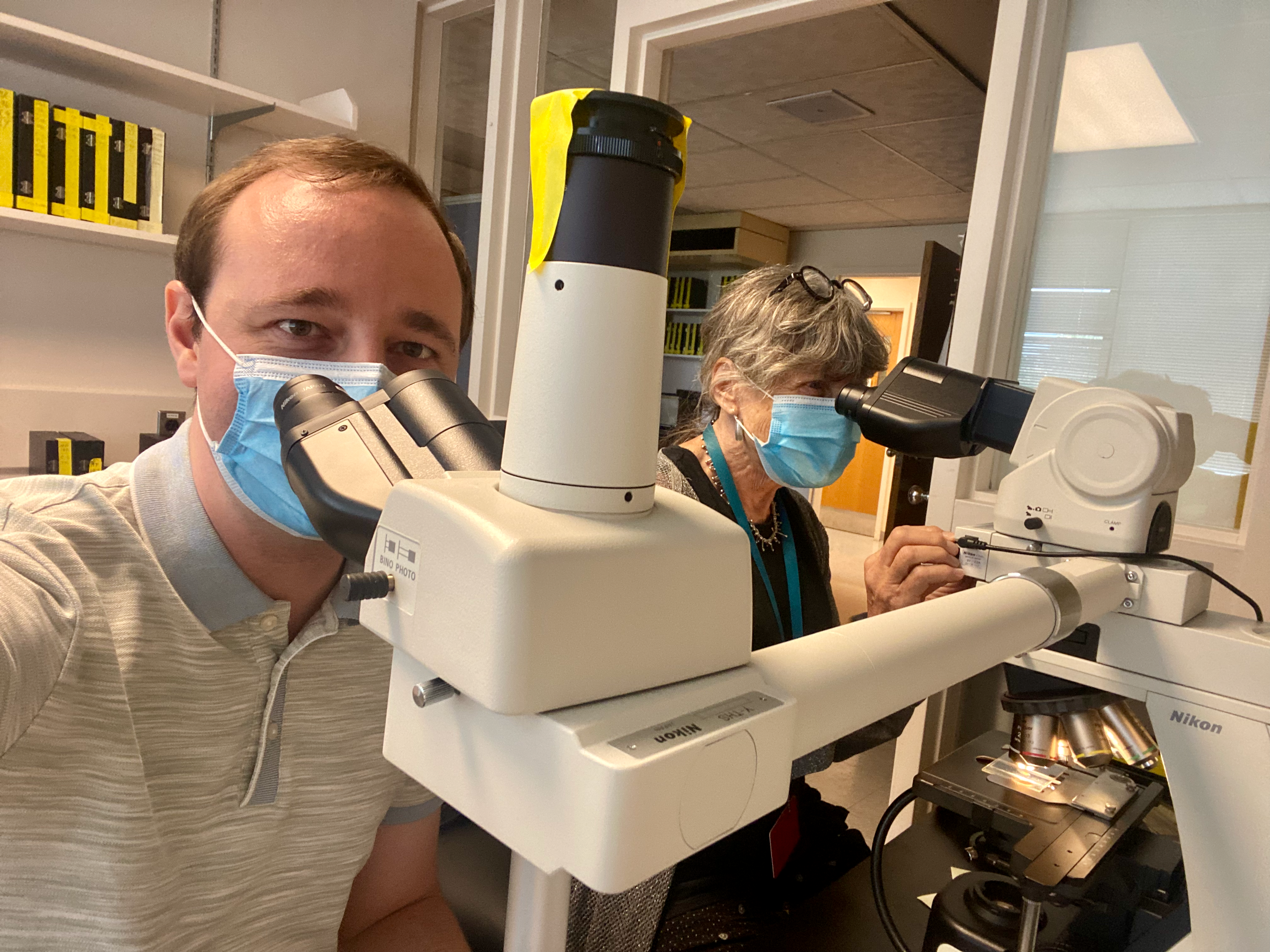
Suzanne showing Andreas some beautiful macaque tracing slices under the dark-field microscope