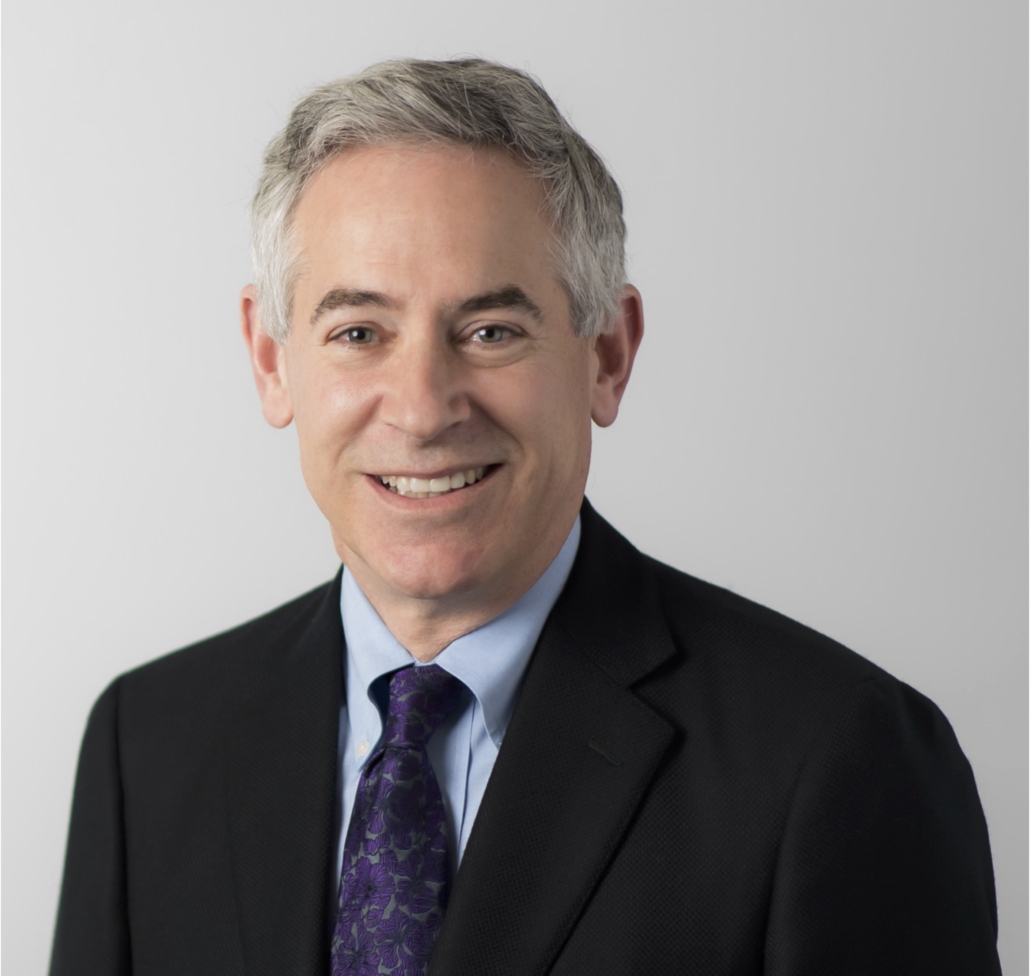
Phil Starr is a Professor of Neurological Surgery at University of California, San Francisco.
#54: Phil Starr – Using cortical signals to guide DBS, how lesions may produce brain signals and open collaborations in the field.
Phil Starr is a Professor of Neurological Surgery at University of California, San Francisco and a developer of implantable brain devices. At UCSF, he co-directs a multidisciplinary neurology/neurosurgery movement disorders clinic together with Dr. Jill Ostrem. I’ve been a long-time admirer of Phil’s work and in this conversation we blaze through quite a few of his numerous publications. One key breakthrough and invention of Phils work has been to include Ecog recordings – both intraoperatively but also chronically – to investigate brain signals in various states. We talk about the Open Mind Consortium, Mentorship and the cross-pollination between academia and industry. One key highlight of Phils work is a paper which was accepted for publication in Nature Medicine, at the time of recording this just yesterday. In it, the three co-first authors Carina Oehrn, Stephanie Cernera and Lauren Hammer demonstrate the chronic use of a newly identified cortical physiomarker, which is now referred to as the finely tuned gamma activity. I hope you enjoy this conversation as much as I did, and thank you for tuning into Stimulating Brains!
Phil Starr 00:00I really feel like Malin, in the United States anyway, started a whole new branch of neurology. He started this branch of... ...began thinking, you know, what could I contribute to this evolving concept? And it occurred to me, since cortical recording by electrocorticography was such a standard technique in neurosurgery, and there existed temporary ECOG strips to do this, that it would be a contribution I could make to expand that level of thinking about oscillatory synchronization to another site in the network. So we needed another technique that had some kind of real-time, that is intraoperative, high spatial resolution method to know we're in the right spot. So that's what got, you know, me and my colleagues interested in... ...at some of the recordings online. So we went on Stim, and we found, for example, a patient who had a huge 40 hertz sharp peak in the power spectrum,
Andreas Horn 01:09and thought, well, that's on Stim, that's obviously an artifact, right? It just looked like it. So then, years later, I had the opportunity to record the same thing in the patient after he'd been switched to a Percept pulse generator. And you could just, for out of interest's sake, I looked at it as you turned... ...you could just... ...you had Stim on, then you turned Stim on, and that huge 40 hertz artifact... Welcome to Stimulating Brains. Stimulating Brains Stimulating Brains Stimulating Brains Phil Starr is a professor of neurological surgery at University of California, San Francisco. Stimulating Brains 02:57Thank you for tuning into Stimulating Brains. 03:07So, Phil, thank you so much for taking part in this. I'm really honored to be able to talk to you also that long. And so, it's really an honor to have you on the show. And as you know, typically, to break the ice before we get into science, I always ask about your free time. So, what do you do when not in the OR? Or not involved in science? Yes. Well, I've always loved outdoor sports. I love skiing, snowboarding, scuba diving, overnight backpacking. And since I have a 15-year-old boy now, he has been my partner in these activities for a number of years. And that is my main source of enjoyment and stress relief as well. That's fantastic. Really cool. Yeah.
Phil Starr Going out outdoors, and especially with family, that sounds very lovely.
Andreas Horn Moving to your career, what are some of the things that you've learned in your career? As a neurosurgeon, but also a neuroscientist, who were key mentors? 04:01And also, what were the main maybe turning points to get where you are now?
Phil Starr Sure. I really want to talk a little bit about Malin DeLong, who you know well, our whole field knows well.
Andreas Horn He's been on this podcast.
Phil Starr And as we all know, he recently passed away a few weeks ago. So, there's been many thoughts and reminiscences about him. So, you know, him and his group were so influential in my career. When I finished my neurosurgical residency and was just thinking about what I wanted to do, I found kind of at the last minute the opportunity to go down and be a fellow in movement disorders surgery in the team led by Malin DeLong with other important folks, Jerry Vitek, who's now chair of neurology at Minnesota, Thomas Wickman, a wonderful, prominent researcher still at Emory, Roy Bacay, who unfortunately passed away a few years ago. That was the team. And it was just an incredible time at Emory. The university had absolutely launched my career, was very enjoyable. 05:02And I was also impressed that it was a fellowship, even though I was a neurosurgeon and recently finished, just finished my training in neurosurgery. It was a fellowship organized really through the Department of Neurology. And it illustrates something I really loved about Malin, that he was one of the first neurologists to stop recognizing the distinction, the artificial distinction, between neurology and neurosurgery. And, you know, everyone knows the contribution he made of the great 1990 paper in science, which is a foundational paper in our field, right, about lesions in the subthalamic nucleus and how they can improve Parkinsonism, influence Benabede and starting STN-DBS, et cetera. But I think some of his other contributions are a little bit more intangible. One is that I really feel like Malin, in the United States anyway, started a whole new branch of neurology. He started this. He started this branch of interventional neurology in movement disorders. 06:02Neurologists who are deeply involved in neurosurgery, in guiding it, thinking about it deeply, improving it. I don't really think that existed before Malin. And a number of prominent people that we all know have followed in that career pathway. So that's a big thing that I attribute to him. And he was just also a really kind and open person. I've often found this is true of Aline Benabede also, who I had the good fortune to visit in 1996 when I was just getting going in this area.
Andreas Horn And, you know, these leaders of the field have just been so friendly and open, have welcomed so many visitors.
Phil Starr And I think it shows a characteristic of people at the top of their game, right, that they do tend to be very open and kind people.
Andreas Horn How long did you stay in Grenoble?
Phil Starr Well, Grenoble was just a very brief visit. I was not a fellow there.
Andreas Horn Yeah. Yeah. And I literally was just recommended to me, hey, this guy, Benabede, is doing some very interesting new work.
Phil Starr 07:01I, again, was just at the end of my neurosurgical training.
Andreas Horn And so, yeah, I went for a couple of days to see.
Phil Starr I think it was the 13th subthalamic stim there.
Andreas Horn But, yes.
Phil Starr And do I remember correctly? Oh, the 13th. So it was really early days. Because you did kindly give a presentation in our talk series that we also have in the Stimulating Brain.
Andreas Horn And you were on the website.
Phil Starr And if I remember correctly, your then chair also wanted you to go to Grenoble and wanted you to essentially go into the DBS field. Do I remember that correctly?
Andreas Horn Not exactly.
Phil Starr The person who actually told me about Benabede and what he was doing was a professor in Lausanne, Switzerland, Nicolas de Tribolet. And I was as an elective in residency before I really got focused on functional neurosurgery.
Andreas Horn Okay.
Phil Starr He knew Benabede relatively close in various neurosurgical societies. 08:00He said, hey, as long as you're here, you should go see Benabede and see his work. So that was the first. My chair here at UCSF, Mitch Berger, another very influential person. He's the person who gave me a job right out of fellowship. And I've been here ever since. He did recruit me to set up a DBS program here. My fellowship was mainly learning microelectroguided techniques. for pallidotomy. This was in the beginning of the second wave of movement disorders surgery in the US anyway, emphasizing pallidolesioning And that resulted in my recruitment out here. So if it hadn't been my connection to Emory, to Malin, to the neurosurgery department there under Dan Barrow, that's, you know, I would not have my position at UCSF. 09:09Fantastic. And then I think if I remember correctly, you also mentioned another inspiration was Irving Cooper and the book.
Andreas Horn Yeah, my true, true first exposure to movement disorder surgery happened by chance when I was 19.
Phil Starr I was browsing our college bookstore and I saw his autobiography called The Vital Probe, My Life as a Brain Surgeon. And I liked reading biography and something about it struck me, so grabbed it. And it was and I've recently reread it also. I think it's been reprinted. It was hard to find. Well, I really recommend that.
Andreas Horn To people in our field. Have you read it, by the way, Andy?
Phil Starr I have not. No, I should. It's it's worth it. It's a great personal insights into the first phase of movement disorder surgery in the 50s and 60s before levodopa, before CT scanning, you know, and MRI revolutionized neurosurgery.
Andreas Horn 10:05So you can learn a lot about the field and also learn about those severe barriers between neurology and neurosurgery that existed then and exist much less now. Fantastic. So other turning points or people that maybe maybe maybe can also ask what first brought you into functional then. So into the palaeoctomy, was it the exposure in Emory or when did you decide that?
Phil Starr Well, it was at the at the end of my residency, which is at Brigham and Women's Hospital, a place that you know well. I liked image guided surgeries. I just had a certain attraction to those. There was very little functional neurosurgery there. But because I liked it, I was able to do it. And because I liked image guided things and I also had had done research in physiology, I was oriented there. I had a chance in elective time at the end of my residency to work a little bit with Reese Cosgrove across town. He was then at Mass General, actually. 11:00He was at Mass General. I had a chance to just scrub in on some cases. He was very kind about that. Got to meet Ann Young, who was working with him to build their palaeoctomy program in the mid 90s. So that was a big, a big influence on me as well.
Andreas Horn Yeah.
Phil Starr Really cool. And then and then I think in the talk you also mentioned much later, I think, but was Peter Brown that that kind of his work was inspirational?
Andreas Horn Yes.
Phil Starr So after after I had, you know, originally when I came in 1998 to UCSF, my mandate was to start clinical programs at both the university and in the Veterans Administration System to start really the first availability of movement sort of surgery in the VA hospital. So it's very busy doing both of those and really did not have much time.
Andreas Horn Yeah.
Phil Starr And I think that was a really good time to launch an independent research career in those first years. But I started reading in the in the 2000s the work of Peter Brown. And I was so what intrigued me a lot about it was how much information he was able to extract from this tiny little signal. 12:07Right. A lot of his papers were on the local field potential in the subthalamic nucleus, some in the pallidum and elsewhere.
Andreas Horn Yeah.
Phil Starr And applying enormous analytical depth and thinking.
Andreas Horn Yeah.
Phil Starr And the thoughtfulness to that little, you know, five microvolt signal, really tiny, could tell so much. And of course, it it launched, you know, maybe along with other people. But but but he was a main person to launch this whole theory that that oscillatory synchronization is important in the pathophysiology of movement disorders and in mechanisms of therapy, levadopin of DBS. So that intrigued me. And I began thinking, you know, what could. I contribute to this evolving concept. And it occurred to me since cortical recording by electrocorticography was such a standard technique in neurosurgery and there existed temporary ECOG strips to do this, that it would be a contribution I could make to expand that level of thinking about oscillatory synchronization to another site in the network. 13:12You know, motor primary motor area, which of course figures big even in the rate model. Right. Earlier models before the oscillatory synchronization framework, motor cortex features prominently. And so I think that was a big inspiration to start the subdural electrocorticography work. There were other influences on that. Bob Knight, Robert Knight, a scientist at Berkeley, had done a lot of work paired with some of our UCSF faculty in cortical recording. He was the person who really looked at phase amplitude in our work.
Andreas Horn Yeah.
Phil Starr And he was able to do phase amplitude interactions there in prefrontal cortex more than motor cortex. And that was another window using ECOG on, you know, cortical function that I thought could prove fruitful. So that was another intellectual influence. 14:01There were others, you know, I was reading some of the early work of Pascal Frese on the communication through coherence hypothesis. That was another intellectual influence.
Andreas Horn Yeah.
Phil Starr And I think that's a really good example of how maybe if we do multi-site recording, we can really leverage that hypothesis to gain insights about movement disorders.
Andreas Horn Super interesting. So we had actually a guest question by John Ralston who asked exactly what inspired you to start with ECOG recordings.
Phil Starr But you just answered that. So I just wanted to mention that would have been his key question. Before we go into the ECOG and more signal processing things, I wanted to briefly, you know, remember one anecdote of mine. I was standing with Reese Cosgrove much, much later than that in the Amigo Suite at the Brigham. I was still a postdoc at the Beth Israel. So now we are colleagues in the same hospital. But back then he was kind enough to show me the Amigo Suite, which is this intraoperative MRI suite. And he had opened a free e-book. 15:01It's called I MRI DBS by Paul Larson, Alastair Martin, and also yourself. So I think you also pioneered beyond the EFIS world. To some degree, this intraoperative MRI guidance.
Andreas Horn Can you talk a bit briefly about that and maybe also how you see it now? Yeah. Yeah, this was a super fun project that began early in my career.
Phil Starr And that, again, was one of the most fun things about it. It was a very close, close team, teamwork between myself, Paul Larson, who really put together that wonderful e-book, and Alastair Martin, an MR physicist, who is great at this. Thank you. And I think that's critical to our work. And we, the motivation, at least for me, to start the interventional MRI is we were starting to do more DBS in children for dystonia. My first was in 1999. Philippe Kubes was publishing a lot about that in the late 90s, early 2000s. 16:01And the awake microelectrode guided procedure that I had learned as a fellow at Emory, it was not really appropriate for kids. It can be done, but it's tough. So we needed another technique that had some kind of real-time, that is intraoperative, high spatial resolution method to know we're in the right spot. So that's what got me and my colleagues interested in a sort of a form of asleep DBS if you will, but guided not with physiology, but with real-time MR. And then, of course, I found as many who've done exclusively awake surgeries, there's a population of adults for whom getting through awake surgery is very tough. Anxiety, severe, in Parkinson's, severe off-period pain, in dystonia, severe, you know, neck postures that make it difficult to do these things awake. So, it was needed. It was needed something new. And that's how we got started with it. And we were 17:00fortunate after originally working with the NexFrame device from Medtronic to pair up with a company, you know, called ClearPoint to develop their so-called SmartFrame. And Paul Larson has continued to do quite a bit of development of that more than myself, Paul and Alistair. And I think just to summarize what's nice about that technique, of course, it offers an option for asleep DBS. That's accurate. It's conceptually very simple. There's no stereotactic registration step of one space to another. You're all working within the XYZ of the MRI bore, right, that appears right on the MRI console. You can do imaging at any point to guide the procedure. It's quite accurate in that if you pick a point on the MR, a patient's MR that you get right at the beginning of the surgery, you say, I want to go to that point. This method of sort of a certain marriage of imaging techniques and the device, 18:00skull-mounted aiming device that has four degrees of freedom, this sort of integrated system can deliver your probe or your drug or your cell or whatever to the picked point on the MR really more accurately than a stereotactic frame can. It's the average accuracy, what we call the radial error, the difference between where you wanted to go and where you wanted to go. And so, you know, where you ended up in an axial plane sort of orthogonal to the trajectory, that average difference last we measured is around 0.6 millimeters. And for a stereotactic frame doing the same thing, picking a point, dropping a probe, asking how close you did, it's generally not quite as good as that. So the conceptual simplicity, the accuracy, are very attractive, and that there exists a population of patients for whom it is more appropriate than awake surgery were the compelling features.
Andreas Horn Do you currently do exclusive asleep or a mix of the two?
Phil Starr 19:04I do a mix. I do still slightly more surgeries in the regular operating room awake, but don't hesitate to have people do the interventional MRI. All my pediatric cases, we don't discuss it. They just go right to the interventional MRI and we have a really great suite at our children's hospital that can do that. I am a bit envious of the Brigham. They had an interventional MRI suite, really developed since a long time ago for that purpose. We just got, we redesigned our MRI suite at our Parnassus campus and opened in January. So we now have a
Andreas Horn dedicated suite a couple of decades after Amigo. Fantastic. Really cool. So another guest question
Phil Starr by Julian Neumann, which, also is about ECOG, but a bit more about the, you know, machine learning capabilities. So he asks, the use of ECOG to study cortex basal ganglia interactions was a huge inspiration for me, 20:04for Julian. What inspired you to pioneer this? And I think that ECOG has a lot of utility for machine learning powered adaptive DBS and clinical BCIs, so brain computer interfaces in general.
Andreas Horn Do you think having an additional ECOG paddle could become standard in say, years from now? Yeah. Well, thanks Julian for that question. We already, of course,
Phil Starr talked about the inspiration and the intellectual influences on getting that started. You know, I'm very interested in cortical physiology and movement disorders. We have not proven that you must have, or you need this extra, you know, electrocorticography strip to do say adaptive stimulation. We have not proven that. I think what we've shown so far is that it's, very useful. You can find useful signals for decoding the patient's motor state. Of course, as Julian and others have done for just decoding movement and maybe movement speed, 21:04if you want to use that for adaptive STEM, it's a great signal. It's bigger than the STN signal
Andreas Horn because it's a layered structure, right? So the synaptic potentials add up in a layered structure
Phil Starr in a way they don't in a deep structure like the subthalamic nucleus. So the answer to Julian is, I hope that, it does become more standard, but I certainly don't want to claim that it is needed. And we've gotten some appropriate pushback on the cortical recording method from very serious investigators who think, you know, let's go, it's so much simpler to use the same lead, depth lead, as you need to put in for stimulation. Let's use that also for recording. That may be the answer. We actually have, we've been working a lot, as you know, on adaptive STEM, and we just had a manuscript on that accepted yesterday, finally, after a lot of work. Congratulations. 22:01And thank you. It's a manuscript based on our preprint of adaptive STEM that had three first authors on it, Karina Earn, Stephanie Cernera, and Lauren Hammer. It's on MedArchives, and now it will be coming out as a real publication. But there we had four patients, actually six hemispheres in chronic, adaptive stimulation at home and looked at, you know, we first did a naive search through frequency space in both the subthalamic lead and the cortical lead and asked what are the best signals for decoding movement state and use those for adaptive STEM. And in four of the hemispheres, the cortex was the better one, but two hemispheres, the subthalamic actually had the best signal, although in both of those, the cortical signal was, pretty good too. So from that limited series of six hemispheres, all of them could have been driven in cortically, cortically driven adaptive STEM, but two of them could be done well with subthalamic, 23:06the subthalamic signal, and we're done with the subthalamic signal. So that's where we are now on, on, on the cortical technique. And I appreciate so much, Julian is, you know, extending this as, as Mark Richardson and others are extending this, you know, in all sorts of new, fascinating directions and, and will help to establish it as a great tool. Yeah. I was still in Berlin when, when we got the IRB approval to do ECOG strips there, and we were all super excited that, following your, your footsteps there as well. So I think
Andreas Horn it's a, it's a fantastic concept and there's so much that we can do. We'll go into the new paper
Phil Starr soon. I of course want to talk about that one too, but maybe earlier work with Coralie Hemtig, who's very successful now in Florida, but trained with you showed that DBS plays a role in kind of 24:00decoupling the phase amplitude coupling between cortical activity and the beta rhythm in the
Andreas Horn subthalamic nucleus. I hope I said that right, but how do you interpret these findings looking back?
Phil Starr This is from I think 2015. Yeah. Yeah. Around. Yeah. Yeah. And, and papers in 2013, 2015 that, that, that Cora did.
Andreas Horn So yeah, the main finding is that DBS can, that the first, that this cross frequency form of
Phil Starr cross frequency interaction, the tendency of, of, of, of broadband activity to line up with the particular phase of the beta rhythm, that that is exaggerated in the Parkinsonian state in the cortex and can be disrupted by, by DBS. This is a finding that is easier to study with acute intraoperative recordings. It benefits from. High sampling rate. So it's been tougher to study with the chronic recording that we've done more recently. You know, it's been replicated by a few labs and certainly the, 25:02the idea that cross frequency interactions might be important in Parkinson's was first in a paper by, I think it was Allegra in, in journal neuroscience around 2010 or so. So that was there. And then we started working on that in the cortex. It's a difficult signal to use for adaptive STEM because it's highly non-stationary. It really, these bursts of increased phase amplitude interactions come and go in a non-stationary way. And of course, no implanted device can really use cross-frequency interactions. There's also, as you know, varying biophysical interpretations of the phenomenon of the cross-frequency interactions. So, you know, our original thought was that the broadband cortical gamma activity that is thought to be a surrogate for population spiking, that that activity in the cortex was excessively synchronized to the phase of the motor beta rhythm. There's other interpretations that, in fact, the synchronization occurs at the level of 26:02thalamocortical inputs, which tends to make beta waves sharper, which results in this phase amplitude interaction. So I think the biophysical interpretation is still evolving, although the finding has been replicated. And we replicated it with EEG as well. Some of Nicky Swan's work was to pursue that finding in EEG.
Andreas Horn But it hasn't been as practical as other signals to pursue for adaptive stimulation. Makes sense. Makes sense. And a very intuitive interpretation running the risk to oversimplify. Is there something like that there is some sort of hyper-oversynchronization that we can maybe block?
Phil Starr Block with DBS where this might lead to too much stopping signal or too much, I don't
Andreas Horn know, in that way, bradykinetic and rigid state? Do you have some words around that? 27:00Or is that too simplistic?
Phil Starr No, it's not. I mean, the idea was that, OK, look, you know, Brown's work and others had shown that this STN beta rhythm is suppressed by DBS.
Andreas Horn So what's happening at the cortex?
Phil Starr And first we thought, well, maybe the cortical beta rhythm itself is suppressed by DBS.
Andreas Horn Yeah.
Phil Starr We looked at that. And Cora showed that actually to a first approximation, the beta rhythm is not strongly affected by DBS itself.
Andreas Horn So what are some of the second order elements of beta synchronization that could be examined that might be affected?
Phil Starr So, you know, in that communication through coherence hypothesis, right, from Pascal Fries, the idea is that the oscillatory rhythm organizes population spiking. Right. And you can transiently synchronize activity and multiple neuronal elements organized through a rhythm like the beta rhythm. So the idea was that, well, in an untreated state, the cortical neurons that normally 28:05need to come in and out independently of synchronization to achieve a movement, those are excessively firing in lockstep with the beta rhythm and aren't adequately released from the beta rhythm in a normal time. So you can see that in a task-dependent way and that perhaps DBS is releasing these cortical populations from the successive influence of the beta rhythm without just simplistically suppressing the beta amplitude itself.
Andreas Horn Makes sense.
Phil Starr During this decoupling. So that's kind of the conceptual model.
Andreas Horn Fantastic.
Phil Starr Cool.
Andreas Horn Another one of your many fantastic papers that you put out was spearheaded by Whitney
Phil Starr Chen in 2020, published in Neuron. And you looked at evoked potentials. So you can see that the hyperdirect pathway, so that is single pulses of DBS in the subcortex and then you would record up there with ECOG strips in different parts of the cortex. And I think this built on work by Svetlana Miocino, which earlier also in your lab showed 29:04that there is a hyperdirect projection from the motor cortex. But I think in the neuron paper, you also could show that there's one from the right inferior frontal cortex. So you can see that there's a hyperdirect projection from the right inferior frontal cortex to the STN.
Andreas Horn So maybe in more general terms, how do you conceptualize these hyperdirect inputs to the nucleus from the cortex?
Phil Starr It seemed to be, you know, widely projecting maybe entire frontal cortex sparsely, but
Andreas Horn yeah. Yeah.
Phil Starr Well, first I give a lot of credit to Svetlana, who really spearheaded that original recording method. And it's not easy because to detect that hyperdirect pathway.
Andreas Horn Yeah. Yeah. Yeah.
Phil Starr So the first way with ECOG, you know, you're stimulating in the STN and you're looking for backfiring into the cortex at a very short latency.
Andreas Horn It's non-synaptic, right?
Phil Starr You're backfiring the axons that innervate the hyperdirect axons, innervating the subthalamic 30:02nucleus. So you're detecting something at a latency of two or three milliseconds from the stem artifact. And that has some challenges to detect. And Svetlana did a great job in this paper she spearheaded of teasing that out. And then Whitney's work built on that. You know, as you know, I mean, you've worked on hyperdirect inputs as well from prefrontal cortex and that great OCD work that you've done, Andy.
Andreas Horn The non-human primate work had indicated that, yeah, from the whole frontal lobe, there's
Phil Starr projections, hyperdirect projections in the STN. I will say that when Whitney started looking at prefrontal cortex, there was sort of a hot spot of higher. A higher retrograde evoked potential in that inferior frontal gyrus, which people like, you know, Adam Aaron at UCSD and others had hypothesized was important for a stopping 31:00signal. And we did find the IFG to be a bit of a hot spot for this evoked potential. On the other hand, I was very intrigued that the hyperdirect input from other areas, like in your OCD connectomics paper, right, that there is other hyperdirect inputs from prefrontal cortex that are important in DBS effects and pathophysiology. So I think of it as, you know, anywhere in the frontal cortex can have a hyperdirect input. I mean, I can relate to the hot spot. Like, there's often, the IFG often pops up also in the fMRI maps that to be, you know, seem to be more connected to the STN for whatever reason. Since it was right IFG, we probably both assume it's also. The same on the left.
Andreas Horn And do you think there could be speech and language issues? Or like, if we stimulate that connection, could that have something to do with, you know, verbal fluency? Any thoughts on that? 32:00And yeah, it's underexplored.
Phil Starr Whitney did show that you, the left IFG also had a bit of a hot spot of that hyperdirect, you know, retrograde evoked potential. It's there on the left as well as the right, even though she studied the right much more. Right. And so that's a, that's an underexplored area.
Andreas Horn Yeah.
Phil Starr Sounds good. And this study, I think is a great example of how DBS can not only be a clinical tool,
Andreas Horn but also a window into the brain. Do you have currently maybe other examples where you've delved more in the neuroscience of things using this technique or current ongoing work that you're excited about? Or how do you see that? Yeah.
Phil Starr We've moved, I'd say my immediate lab has moved. We've moved in the last, you know, five, six years, much more into chronic brain recording as we've had good tools to do that. And we're experiencing some of the profound limitations of the intraoperative environment, 33:01the time pressure, the unnatural state of it. So right now I don't have as much going on with intraoperative work. But my colleagues do, you know, my colleague Doris Wong, who should be on your program too. She's been doing both intraoperative and chronic recording studies of gait decoding in humans with Parkinson's and movement disorders and is doing some intraoperative task related work. So we have that continuing. And then occasionally we will get these sort of one-off cases where we are putting in, say subthalamic leads in a patient who already has palatal leads.
Andreas Horn And there's a lot of interesting things you can ask about the interaction. Yeah. So we have a lot of interesting things we can ask about the interaction that you can do intraoperatively with high sampling rates, right?
Phil Starr Because one of the advantages of intraop is you can use high sampling rates more than is available in chronic recording. 34:00So yeah. And then Simon Little, now we're really fortunate to have Simon Little join us at UCSF. And he and I have intersecting projects, but he has some of his own. I have some of my own. And Simon is doing a lot of work on prefrontal cortex motivation.
Andreas Horn Yeah.
Phil Starr So yeah, it's really nice. Very cool. So you mentioned Doris. And I think I actually have asked her already about the podcast, but I certainly will if I haven't. And we've been in contact with some other things as well. She's fantastic. And I wanted to actually move to one of her projects with you next, which is I conceptualized high-frequency DBS to act as an informational lesion, mainly as a first approximation. I know it does also other things, but, you know, as a first approximation, it really acts as a lesion, even though it might activate neurons. And I always tell people, even if that were true, that doesn't mean that anything that DBS does will lead to, 35:05you know, less activity. It can have very, a lesion can have very opposite effects, of course, other in other areas of the brain. You know, you, of course, you can lesion something that inhibits things. And so people, sometimes I feel tend to forget that. And one work you did
Andreas Horn was exactly in that domain where you looked at cortical recordings when you did palidotomies, and you could see that a new physio marker was all of a sudden came about after the lesion occurred. Can you talk about that study? Yeah, that's a paper. This was actually Cora and Doris were
Phil Starr co-first authors. On that paper in movement disorders. And that's one of my favorite papers from our group. It
Andreas Horn doesn't get talked about too much. But yeah, it was a study where, you know, Cora and Doris did
Phil Starr like ECOG recording the intraoperative subdural electrocorticography over motor cortex during a 36:06palidotomy lesion. And we still do occasional palidotomies in people who aren't good candidates
Andreas Horn for DBS. And had this really interesting,
Phil Starr finding that during the palatal lesioning, you could see you do the lesioning stepwise,
Andreas Horn right? You do one lesion, and then you pause and examine the patient, and then you move the
Phil Starr proval, you do another lesion. And during the stepwise lesioning process, you, as we call it, unleashed narrow band gamma rhythms in motor cortex, the same that are induced by levodopa. And it's just another indication to me that there's got to be something important about the palatal lesioning. And I think that's what's so interesting about these cortical gamma rhythms, because, you know, all the effective therapies, levodopa, palatal lesioning, DBS, all do something to this cortical gamma rhythm.
Andreas Horn And interestingly, I know you want to talk a little more about the relation of this to dyskinesia, but, you know,
Phil Starr 37:01Malin DeLong, I remember at Emory, he would always point out during palatal lesioning, and of course, we're doing hundreds of these then, that there was often a little burst of dyskinesia right when you did the lesion, even though palatal lesioning ultimately is protective long-term against levodopa-induced dyskinesia. And he always took that as a really good sign. Oh, look, there's a little foot wiggle there. You know, we're in the right spot.
Andreas Horn And so it was really interesting to see that, yes, during this acute lesioning, you can unleash this gamma rhythm, and maybe you unleash it a little bit excessively, right?
Phil Starr It's not just pro-kinetic, but pro-hyperkinetic and producing dyskinesia. So I really like that it correlated. It's something Malin had talked about a lot in doing paladotomy.
Andreas Horn Interesting. Yeah, I have this anecdote that Rhys Cosgrove once told me that he had one case that he did together with Leitinen here in Boston.
Phil Starr So Laurie Leitinen. And I think at that time, Rhys wasn't that experienced yet. 38:01Of course, now he's very experienced. But back then, he had done only six cases or so. And apparently, that same thing happened where they made a lesion. There was a lot of dyskinesia, and Rhys was rather afraid.
Andreas Horn What? What had happened? And then Laurie Leitinen said, he will do great. So apparently, this was the same thing. So it seems like a good thing if it's an acute effect. Very interesting. But that gamma induction that you described there, is that the same? And that we can use that as a segue to the finely tuned gamma story?
Phil Starr And maybe before we compare the two findings, we might want to talk about that. You already briefly mentioned it. It was a preprint accepted since yesterday. Three first authors, Stephanie Sinera. Lauren Hammer and Karina Earn.
Andreas Horn Karina Earn, exactly.
Phil Starr 39:02They've presented the work already at the Think Tank. I think it's fantastic stuff that we just had the OptoDBS conference again in Geneva that you were part of two years ago. And I think... Andrea Kuhn has already replicated this as well and showed some data there.
Andreas Horn So it seems like a really nice Fusio marker that is different to beta, rather a positive thing, or if at all a dyskinesia thing, right?
Phil Starr So we stimulate and then it occurs. But maybe you want to summarize the findings a bit.
Andreas Horn Yeah.
Phil Starr So our first kind of work on the narrowband gamma. So this is different, of course, we have to make the distinction between narrowband gamma, which is an actual peak. And then we have to make the distinction between gamma and gamma. So it's not a peak in the power spectrum of the field potential. It's an actual oscillation.
Andreas Horn It must be distinguished from broadband activity or broadband gamma, which was more a topic that we talked about a few minutes ago with phase amplitude coupling, right?
Phil Starr So the phase amplitude interaction does not involve narrowband gamma. 40:01It involves broadband gamma to beta. So the narrowband gamma is something different, needs to be distinguished, and not always is distinguished in literature. But this, of course, was described in some of Peter Brown's research. on levodopa, the STN would show this reduction in beta, but then an induction with levodopa of a narrow-band oscillation somewhere between 60 and 90 hertz. So our work on this really began with chronic brain recording tools because we've never really studied the on-medication state until we had chronic recording. And our first work on that was Nikki Swann's, where she was looking at recording from Activa PC Plus S, the first generation chronic recording device from Medtronic that was investigational. And she just began noticing in these chronic recordings in the power spectra,
Andreas Horn these narrow band gamma peaks, and then made the very, very interesting observation. And you always
Phil Starr 41:02ask about eureka moments, and we don't have very many of them in our careers. But this was one where Nikki showed that when you activate DBS, it can shift that natural frequency of narrow band gamma, typically 60 to 90 hertz, and shift it to a subharmonic of stem frequency. And as you mentioned, Andrea's group has now been working on this. And some of the Chris Beast papers have looked at that too. So then that was our earliest work. We did collaborate with some of the computational folks at Oxford, along with Tim Dennison and J.J. Sermon and Raphael Bogatz and others, who've done a lot of modeling on the entrainment phenomenon of gamma. And it turns out this is a fascinating, complicated story, but you really need to distinguish between gamma band phenomena, narrow band gamma, prior to starting 42:06stimulation versus after stimulation. So if you, say, have patients with implanted brain recording devices and look at them during their on-off fluctuations at home, before you start therapeutic stimulation, you can show that levodopa induces a cortical gamma rhythm, as well as a subthalamic one, and that it scales with dyskinesia risk. And so some of Nikki's early work suggested that. And then one of our grad students, Maria Olaru, has just published a paper in Brain on that, in a larger series of patients with the second generation recording device. So prior to STEM, narrow band gamma, it's a prokinetic rhythm. It's induced by levodopa. It scales with dyskinesia severity. But then when you bring in stimulation,
Andreas Horn very interesting things happen. The stimulation does entrain the rhythm. That is, it shifts its
Phil Starr 43:04frequency to a subharmonic of stem frequency. And then it's induced by levodopa. And then it's induced by stimulation. That is, it shifts its frequency to a subharmonic of stem. And it changes its properties in various ways we don't fully understand. But we think it becomes less pro-dyskinetic when you entrain it. And still figuring that out. And I believe that the Berlin group is going to agree with us on that, but not completely sure yet. So that brings up a very general thing I would like to point out from our work. And this is also advice to anyone working in the field. which is always one of your topics that you when we started working on adaptive stem we thought great there's all this beautiful work on biomarkers there's the beta rhythm there's you know the both the basal ganglia now the cortical gamma rhythm these are all markers of movement state we know a lot about these let's just plug them into a control algorithm and run adaptive stem and it won't be that hard it turned out to be much harder than we thought doing home 44:04adaptive stem and a reason it seems obvious in retrospect introducing stimulation profoundly changes the whole landscape of physio markers and movement disorders we didn't appreciate that enough so when you introduce stimulation it changes brain rhythms in a way that you really have to reinvestigate your what are the neural signatures of my my movement state because they're so changed by dbs and that took us a while to appreciate i'm sure i mean it always seems like i mean currently it feels like half the world is is looking into this with percept now being so available right that almost everybody that wants to can do it to some degree and um the in the discussions i'm not really part of of that 45:02field myself but in the discussions for example at the think tank it always feels like there there are these moving targets right and we've been at this for 10 years and haven't really solved it in a way i think some parts have been solved and we certainly made progress but um one one big issue in the beta rhythm is that if you stimulate it kind of goes away right or if your rigidity goes away then then and beta goes away so it is then probably hard to know um when to stop again so when i heard as naively from but the outside more and imaging person um about the finely tuned gamma i thought okay now there might be just two bands where you can you know stimulate when there's beta but stop stimulating when there's finely tuned gamma um but i'm sure it's not as as simple as you just said right things change and yeah yeah it's we wish it were so simple i i do think that you know using beta and gamma is going to be fruitful right um in the in our the paper that was 46:02just accepted um with with with karina uh karina and lauren hammer and stephanie serenara the the main physio marker that was used for adaptive stim changes was actually stimulation in trained gamma which is again has to be distinguished from levodopa induced gamma and once entrained the narrowband gamma activity becomes really an on med state biomarker more than just oops there's dyskinesia you better lower stim yeah but what it does say is if you have this stim entrained gamma activity it says your brain the parkinsonian brain is effectively in an on med state there's there's levodopa acting in the in the striatum doping acting the striatum and you can afford less stimulation so it's a signal to turn down stim okay but the nice thing about the entrained gamma it doesn't go away right away as you lower 47:02stim you have this entrainment over a wide range of stimulation amplitudes now you need some level of stem right if you go to stim zero it's no longer entrained but between a low therapeutic level of say you know one and a half two milliamps and a high therapeutic level of say three three and a half milliamps in many in many persons there is still this entrained gamma activity if you are in an on medication state so you can use it to say when you don't need it you can use it to say when you don't need it as much stim or when the entrained gamma activity is a marker for needing more stimulation so our adaptive stim paradigm that is is just coming out is is as several people have pointed out gerdinghauser and julian and others have pointed out the importance of time scale adaptive stim there's all sorts of different time scales the original simon little paper in annals of neurology that generated so much excitement was very fast adaptive stim right he they gave in peter brown's 48:02lab gave brief very brief pulses from from going from zero milliamps to a brief pulse of stem that shortened beta bursts that operated on a sub-second time scale yeah the the which is very hard to implement in existing fully implanted devices um not totally sure it's possible but it's at least hard so we started working more on a slower time course of adaptive stim where instead of trimming beta we were able to do a lot of adaptive stim and we were able to do a lot of adaptive stim and we were able to do a lot of adaptive stim and we were able to do a lot of adaptive stim you use signals reflective of the medication on and off states to adjust them over sort of a minutes to hours time scale and that's the paradigm where this entrained gamma activity becomes very useful for short very short very fast adaptive stim like in the original simon little peter brown paper you know it may well be that beta is a great signal so you have to consider the time scale with adaptive 49:02And then if you look at these, like the entrainment itself, it even looks like before you switch on DBS, there's finely tuned gamma maybe already present, but then it shifts really in frequency. You sometimes even see it smearing down. This was probably an image Andrea showed, but you probably saw similar things in your data. How do you think that works? Is it just, you know, tipping into the right
Andreas Horn phase and then it entrains it? How do you conceptualize that?
Phil Starr Yeah. Well, we, again, were lucky to pair up with some computational modeling folks at Oxford. One of the grad students there, JJ Sermon, did some modeling with his mentors. He had multiple mentors in the computational lab there and used a little bit of our experimental work as well and train gamma. And I really their framework principle in physics of coupled
Andreas Horn 50:04oscillators, right? Think of two pendulums that are linked by a little mechanical linkage
Phil Starr that you see in your first year college physics class. And so the brain is one oscillator
Andreas Horn and it has natural frequencies like a spring, right? Beta would be one natural frequency,
Phil Starr but in at least a Parkinsonian brain that's seen levodopa.
Andreas Horn Yeah.
Phil Starr There's a gamma frequency between 60 and 90 that is a natural frequency. And the, so that's one, that's the driven oscillator is the brain with its natural frequencies. And
Andreas Horn the driving oscillator is DBS, right? Yeah.
Phil Starr Which so far has been given as a constant frequency signal. And so that will entrain if there is a natural frequency near one of the sub harmonics of the driving frequency scale.
Andreas Horn Yeah.
Phil Starr So you will, by the basic principle of an, of coupled oscillators be able to entrain 51:00the brain to a sub harmonic. It's usually half stem frequency. And this may be a clue.
Andreas Horn Why is it that 130, 140, 150 Hertz seem to be the frequencies that we use so often in
Phil Starr TBS. Well, the half harmonic of that are in this pro kinetic gamma range. And maybe that's a clue.
Andreas Horn Um, to, to why those frequency work. That's just an animal. Yeah.
Phil Starr work that's just pure speculation did you try it half half half frequency stem so yeah both maria laro in the lab and maria sherbakova was actually our computer scientist in the lab have been doing these stem titration curbs and they presented at some meetings but it's not fully published yet where they look at a patient this is not at home now but in clinic we bring the patient in clinic and we titrate through a whole set of combinations of amplitude and frequency and look at cortical and subcortical recording and ask where does entrainment occur where does it occur at the lowest amplitude so often the lowest amplitude that that causes entrainment 52:06of gamma activity is near the stem frequency near 130 140 hertz but you can maria sherbakova actually showed and she's starting to present this work you it with with with 60 hertz and 50 hertz stem you can entrain the high beta range you can entrain 25 and 30 hertz rhythm interesting it takes a little bit more um and i i think of some of the early work by peter brown and others where they tried to do 20 hertz stem and show that you can induce bradykinesia and i feel like actually you should do those studies with 45 50 hertz stem because you entrain most efficiently at a at a sub harmonic of stem and and not only maybe does it entrain more efficiently but you can actually see what you're doing right because when you look at something at stem frequency you have a serious problem of stem artifact whereas when you go to a sub harmonic you have much less of that problem 53:04yeah yeah so much to do uh yeah to induce bradykinesia essentially right that that's the idea it would be the idea to test that that would be the idea yeah and and so so you talked about the artifact um issue and i think that's a really good question and i think that's a really good question and i think that's a really good question and i think that's a really good when you when i saw you present this first time you were probably much more cautious to convince people that this is not an artifact because you had to convince yourselves i think by now people the field has accepted it so we don't talk about it much more but but it feels like um that that must have been an important thing to convince yourselves this is not um you know just the
Andreas Horn stimulation artifact and maybe that might even have been the reason why it had been discovered
Phil Starr so late in the game could could could both be true
Andreas Horn absolutely in fact um you know interesting story we've we've seen in train gamma um early on that
Phil Starr we really thought was artifactual so when we were looking in in the in the early activa pc plus s 54:03device which tend to have a lot more artifacts um uh going for it than than than later later generations you know rowey gilrow in a postdoc my lab kind of took over from nikki swan when she left to go to um university of oregon as as a professor and you know i remember looking with him at some of the recordings on stim and we found for example a patient who had a huge 40 hertz sharp peak in the power spectrum and thought well that's on stim that's obviously an artifact right it just looked like it so then years later i had the opportunity to record the same thing in the patient after he'd been switched to a percept pulse generator and you could just for out of interest sake i looked at it as you turned you had stim on then you turned stim off and that huge 40 hertz artifact took two minutes to wash out after stim was fully off and realized 55:02it was actually one to four entrainment he was at 160 hertz so it was one to four entrained activity and people still debate about this it's not a closed debate about the artifactual nature because you can get subharmonic or electrical artifacts right those happen a lot so how do you distinguish the two of them and certainly um needing a washout time after turning off stim suggests physiological origin sensitivity to medication state of the brain levodopa um yeah and to sleep sleep effects entrained rhythms a lot so sensitivity to physiological state of the brain would suggest that it's physiological not not artifactual um the the fact that these entrained phenomenon are often more pronounced at a distant site from the stimulation locus right bigger in the cortex than in the right adjacent in the subthalamic nucleus also suggests a physiological pathway so 56:03not all subharmonic activity is physiological but it's very useful to ask the question yeah yeah and does that also make it harder to use as as a biomarker because it might be artifact sometimes yeah it can be it it can be and um we we have cases particularly in the basal ganglia nuclei where you're where you're recording right next to the stimulator where we see um subharmonic peaks in the power spectrum and it looks more artifactual one sign of it being artifactual is if there's no variance so when you have a physiological entrained gamma rhythm movement causes it to have variance arousal state causes it to have variance so if you're looking at one of these subharmonic artifacts over time and it just doesn't change there's minimal variance that's a sign that it actually is an electrical artifact got it and then last question on the gamma so we had we had three um gamma rhythms that we talked about already 57:03one is the new finely tuned gamma and then I understood um that what you showed with corally the mt and that was broadband gamma entrainment not not sorry not entrainment but you know um coupling with the beta rhythm so that's different but then the third one was really the paludotomy induced unleashed gamma and and that was not broadband right that was narrowband no that was narrowband gamma and it actually is I think the same the same thing as levodopa induced 60 to 90 Hertz narrowband gamma I think it's like getting a burst of levodopa in the operating room when you lesion the paladin correlating with the little burst of dyskinesia and then presumably after paludotomy maybe you know it settles down to a a prokinetic but not dyskinetic you know rhythm in the brain we we don't know because we can't afford the long term they are I will say that that's not the only you know story about gamma 58:00rhythms there is um one of one of my postdocs who's just finished her postdoc but hasn't published all the works yet Stephanie cernera has done some great chronic recording in patients with isolated dystonia and they also have cortical gamma rhythms they're a little difference they tend not to be the classic 60 to 90 Hertz narrowband gamma or finely tuned gamma um but uh more 50 to 60 Hertz but they can also be entrained by DBS so entrainment is a ubiquitous phenomenon it's not specific to Parkinson's and they are also I think predominant in S1 right in sensory cortex so yeah good good good pickup because we really have published very little about this but it's been presented uh at some meetings um Stephanie cernera has presented that so yeah in the isolated dystonia case again these are isolated dystonia not Parkinson's patients who have dystonia but isolated dystonia the these the 59:00you know naturally occurring if you will narrowband gamma tends to be localized more to post-central gyrus whereas in Parkinson's levodopa induced gamma is more localized to pre-central gyrus and Nikki had shown that a long time ago and then the entrainment of that dystonia gamma is that is that GPI DBS or ST and DBS or both uh so you can do it with both the the the person that that Stephanie studied the most with thousands of hours of recording was a palatal stem in severe cervical dystonia patients she's working on writing up those results very cool there's so
Andreas Horn much to learn here so fantastic work and um so many open questions but also so many you know so much progress already really fantastic so
Phil Starr um devices such as the Activa pc plus as Summit RC plus as and now the percept have allowed chronic LFP recordings at home and they have been I think led to a shift in your lab but also has spawned 01:00:00many other people to go into this um how did these tech how do these technology advances shape your work and what would be maybe needed for the next steps what hardware wise what would you need to yeah um well we had done between 2008 when we started doing intraoperative ecog and really focused on that until around 2014 or so and then gradually shifted because we had so many questions that couldn't be answered with intraoperative recording and when these tools became available pc plus s then Summit RC plus s and now percept that just made us you know switch at least for a while to the chronic recording because these are pretty amazing tools right to be able to do long-term recording at home in patients completely naturalistic environments with invasive recording levels of signal quality that's a new a new world 01:01:02um and so that was very compelling and fascinating to us you know what we need I mean I'm I'm I'm grateful to companies like Medtronic for having introduced this and putting resources into purely investigational devices but I'm grateful to them for their vision in this on the other hand we do need better chronic recording devices you know we need a percept-like device that will do time series recording at home over long times we we need the one huge missing piece from the current ecosystem of brain stimulators is cortical electrodes electrodes designed for cortical recording don't exist anymore except for an FDA approved uh examples except for the neuropace device has a cortical paddle but we need much better ones we need much higher Channel count we need much more 01:02:05flexible ones that you can kind of steer around corners like we can do with with temporary ECOG strips but the permanent ones are too stiff seems so simple right just as you know there's no new technology technology needs to be invented but we do not have enough we have almost no options in cortical leads we have to improvise you recorded local field potentials of a patient while skiing how did that work and yeah that was another fun project it's it originally um Rowie Gilrone when he was a postdoc and I went skiing with this patient he's one of our Summit RC plus S patients who happen to be work as a professional ski repair person and had a very good relationship with the patients and we had you know access to all sorts of ski areas and was well known and he was of course an expert skier who had Parkinson's and could ski both on and off meds had a lot of leg dystonias and difficulties but still could ski on and off so this was at the beginning in the early time of the pandemic in 2020 01:03:06um Rowie and I went met him up at up at uh ski area up at Lake Tahoe and we um this was more of just for fun kind of thing, you know, because we can not so much hypothesis driven work really. But we, Rowe wired him up with EMG, wireless EMG with the Delsys system. And of course we, we set his RC plus S to record, transmit to a small computer. He wore the computer in a little backpack. We skied, one of us skied behind him, one of us carrying the Delsys receiver and one using the GoPro to film. And at the top of each run, we would, we would do a procedure to synchronize the video and external system with the internal system, basically by delivering a synchronization pulse to each. So a person who, a neurosurgeon who came to work with me for a year 01:04:02and a half, Rodrigo Fernandez actually took up the mantle of that and is processing those data. And I think we're getting close to submitting that little, you know, case report. But again, it's a fun way to show, you know, you can now record invasive brain activity in patients doing outdoor sports. Yeah. Yeah. Super cool. The Open Mind Consortium,
Andreas Horn what is it and how important are collaborations in the field? Yeah. Thank you for asking. So,
Phil Starr so Open Mind Group is a, is a group of investigators that, that began around the challenges of implementing that metronome. So I think that's an important part of what we're trying to do. So I think that's an important part of what we're trying to do. So I think that's an important part of what we're trying to do. So as we go into this ecosystem of chronic brain recording devices, there's a lot of common infrastructure that labs need to have. And it doesn't make sense for them 01:05:00to invent it themselves. And one is just the, the regulatory documents in the U.S. It's the
Andreas Horn FDA investigational device exemption. Why should everyone start from scratch doing their own and get an agent?
Phil Starr what is going to be accepted or not. So that's one thing that the open mind exists to pool are regulatory documents. Another thing is with that first device, well, the second generation Medtronic device, RC plus S, they did a very novel thing Medtronic did is they opened up the application programming interface to investigators to use. And that means that investigators can write the software to run the device. It's like writing the programming tablet for a DBS device as an investigator. Huge opportunity to customize the device, but a huge new challenge. We don't write medical device software in academics. We don't know the FDA regulations around writing medical device software. So a big impetus behind open mind initially, 01:06:03this was around 2018 as groups were getting going with RC plus S, was to share, share software to run the device, share the regulatory documents, share templates, so-called quality management systems for being able to correctly document medical device software. So when we were getting started our own RC plus S work, Greg Worrell's group at Mayo, who is using the device in epilepsy studies, helped us, shared some software infrastructure. Dave Borton's group, at Brown did so, and Tim Dennison's group at Oxford did so. And we all got together to create this consortium and of investigators to share technical infrastructure, software, and especially regulatory documents like investigational device exemptions. And then subsequently another member joined us, Jeff Herron, who's a professor of engineering 01:07:00in the neurosurgery department at University of Washington, was a designer of Summit RC plus S, really joined our group, is a super active, active member. And then the open mind group has been helping other groups outside of this core five groups to develop their, their programs and bi-directional interfaces, not by sharing data or pooling data, but simply by sharing the infrastructure needed to get your research going. FDA investigation device exemption protocols, software infrastructure, and the best practices for even bench testing of devices and issues related to how to document your medical software. And it was spontaneous, it helped us all. And then we were able to get funding from NIH through the, NIH actually has grants for technology dissemination. And so it funded us starting in 2020 01:08:01for what we were already doing. And then we have, we have a very good relationship with the, worked to provide any of this infrastructure to other groups that might be using bi-directional interfaces. I think we've been really trying to expand it beyond the original motivator, at the summit RC plus S to include use of other devices, non medtronic devices, working with neuronica to bring some of these concepts to them to help to help the community. the community with common data analysis platforms, for example. And of course, we're not the only one you have, you know, the University of Florida group developed Bravo, a beautiful system for visualizing and storing percept data. You know, the Berlin group, of course, has systems for doing this. So a wonderful thing about our field, isn't it, that it is very collaborative and people develop tools that they want others to use. You've done an 01:09:05enormous amount of work with that with lead DBS and other work. And that's a beautiful thing about our field that I think we all love about it. And so open mind is one piece of that. Super cool. Really love it. I have one more guest question from Julian Neumann that's, you know, not so much about science. And he says an exceptionally high number of postdocs from your lab have made the jump to professorship with an excellent gender ratio. You're setting an example with that. And apart from being blessed with incredibly intelligent mentees, such as Coralie de Hemptine, Nicole Swans, Werdlana Miocinowicz and more. Can you share any tips for making sure your
Andreas Horn postdocs get the chance they deserve? Yeah, it's a it's really a sweet question. Thank you,
Phil Starr Julian, for that. You know, I will just mention a few more that are that are up and coming. You've heard some of them, you know, Karina Ern, originally from Germany. She's finishing her postdoc has 01:10:03several nice job offers, not sure where she's going to be. But she's going to be a great student. She's going to end up. Stephanie Cernera just took a took a position at I think it's Synchron. The people do the Stentrode as a clinical clinical director. Lauren, Lauren Hammer just got an assistant professorship at University of Pennsylvania. She's worked with us. So so quite a quite a few, as you mentioned, Roe Gilrone is a as the chief scientist at Rune, Rune Technologies.
Andreas Horn So, you know, yeah, Doris is now our faculty member. Exactly. With us. And, you know, there's
Phil Starr many more. And I'm sorry to.
Andreas Horn that I've left out. But it's a great part of our work, isn't it? Having these trainees,
Phil Starr I've been lucky to have this great group of people. I don't know, and also lucky that it's been, you know, a great gender balance, as you'd say. Actually, I probably train more women as postdocs more for our clinical fellowship. It's more male, but overall really good gender balance, 01:11:04which is great. I think I've been lucky. You'd have to ask the trainees if there's some formula behind it. I will say that I think one thing that we do well, I do well in the lab, is know when to provide help and know when to get out of their way. I think that's a skill. What do you think
Andreas Horn about that? You're now mentoring a bunch of people. I'm just beginning. I shouldn't
Phil Starr give advice or, you know, I'm trying my best, of course. But no, I mean, also on the clinical side, you've trained Mark Richardson and John Ralston, who are the two, you know, surgeons here that I work with, both, you know, couldn't speak higher about you and many others. I think Dario Englert and lots of people that are now, you know, the key players in the field. So there must be something you do right. But, you know, I have to,
Andreas Horn 01:12:03yeah, I have to give a lot of credit to the training environment at UCSF. And so,
Phil Starr you know, some of these folks have have done a formal fellowship with us that that I direct. And a number that you mentioned have have not done the fellowship, but have actually been residents at UCSF. Dario, John, Mark Richardson have gone out to have great careers. And, you know, I can take a little bit of credit for that. But, you know, UCSF has really created a pretty amazing environment for training people and emphasizing, you know, excellence in scientific inquiry. Mitch Berger, the person who hired me, really developed that culture at UCSF. And I have to really thank him for that. And then, of course, recently, Eddie Chang took over as our as our chair after a long period of Mitch and is, you know, going to the next level with, you know, the research that we're doing. So,
Andreas Horn 01:13:03you know, we're creating an environment that emphasizes excellence. And so, yeah,
Phil Starr there's a lot of people to take credit for the training environment at UCSF. Fantastic. And since we talked about so you mentioned Roy Gilron, who now is, I think, lead scientist or something similar at Rune Labs, and apparently somebody went to Synchron as well. Um, how do you think about, you know, do is it part of our role to also make, you know,
Andreas Horn train people for for careers in the industry? And how do you deal with that?
Phil Starr It absolutely is part of our role to train people. And I don't really make a distinction
Andreas Horn with, you know, grad students coming in or postdocs. Well, where are you going? Are you
Phil Starr planning on academics or industry? I don't make that distinction. And I think that that distinction is becoming less important. My hope is that we're going to see in the future, even more fluidity 01:14:00between careers and industry and academics. We've seen really nice examples of people going from industry back into academics, Tim Dennison, Jeff Herron at University of Washington, great examples. And I would like to see more of that. So, you know, I think both of these are very important, and the barriers between them are getting less. It's a great, great concept to, you know, reduce the barriers there. I totally agree. We I think the field has already been very important. And I think we're going to see more of that. I think we've profited so much from Tim getting back to Oxford, as one example, and have been meaning to get him on the show too, for a while. I think it might happen. So, all right. So to wrap up, I want to be mindful of your time. Some more rapid fire or general questions, feel free to answer as long or short as you want. I do always ask about eureka moments. You already have a lot of 01:15:03questions. So, I'm going to ask you about your time. So, I'm going to ask you about your time. So, about your time. So, I'm going to ask you about your time. So, I'm going to ask you about your time. I think I already mentioned the one with the finely tuned gamma, but do you have other examples of
Andreas Horn things that you really loved?
Phil Starr I think something that helped us get on to the cross-frequency interaction story, and Kai Miller actually helped me early in my career. Kai is now at Mayo Clinic. And he helped us a little bit just with some software and analysis methods. And when we started looking at cortical activity, time averaged around subthalamic syncope, we were able to get a lot of data on that. And so, I think it's a great way to get a lot of data on that. And so, I think it's a great way to get a lot of data on that. And so, I think it's a great way to get a lot of data on that. And so, I think it's a great way to single units. We could see not only were subthalamic single unit firing, not only were they synchronized to the phase of the beta rhythm, but they were also synchronized to these big waves of broadband gamma in a spike time spectrogram of cortical activity. That's a paper that my then lab assistant Sho Shimamoto published in Journal of Neuroscience. And that was, I thank Kai for kind of getting us started on that. And it turned out the very first one we analyzed was the most 01:16:00dramatic, right, to point the way to this. And so, I think that's a great way to get a lot of data on So, that was a really nice moment. Another thing I mentioned before, but I'll say it again, it's not a eureka moment, but a slow, very important realization in the field is the importance of reassessing physio markers, neural signatures that you understood before stimulation, reassessing those comprehensively after starting stimulation. That's not a eureka moment, but a slow and sometimes painful realization.
Andreas Horn Yeah. Did you ever think this was a big waste of my time?
Phil Starr Nothing really. I mean, Nikki, when she was in the lab, Nikki Swan brought EEG. She was an expert at EEG, and that was great. I tried to continue to do some studies with EEG after Nikki left, and it's just not my forte. Likewise, I've done some work in the distant past with non-human primates, not my forte. So, I think for me, doing what I do best, which is human invasive brain 01:17:01reporting, has been the best thing I've ever done.
Andreas Horn Yeah.
Phil Starr And I think that's been the most productive thing.
Andreas Horn Fantastic. Any advice for young researchers entering either neurosurgery or neuroscience and academia?
Phil Starr You know, my main one is sort of don't worry, be happy. I don't know if you've noticed this, Andy, but sometimes at our meetings at the think tank, there's been lately a bit of negativity in some of the device industry world. There's been a bit of negativity, the fact that, oh, we're not growing really as much as expected. We can't do a lot of the things in industry we thought we were going to do. There's been a little negativity recently over a decline in funding for the brain initiative, which may only be temporary, right? It may just be a brief one-year thing. We're not sure. But, you know, I think my advice to people is this is a wonderful field, this field of neuromodulation in particular. The
Andreas Horn fundamentals are incredibly strong, right? Fundamentals of the new tools, the new science,
Phil Starr 01:18:02the great people in it. The great interest of federal funders prior to the brain initiative is very hard to get funding for invasive brain studies and for devices. And the brain initiative changed that enormously. And it's not going to go away. It's going to have blips up and down, but it's not going to go away.
Andreas Horn So the fundamentals are fantastic. It is a great time to be getting into the field of
Phil Starr neuromodulation. It's better than ever. So that's my advice.
Andreas Horn How do you see the future of the field as a whole?
Phil Starr five or 10 years? Yeah, I mean, similar. I think it's fantastic what is going on and what will be going on. You know, I hope that we get even more flexible and high channel count and high sampling rate chronic brain recording devices. That's going to be huge. You and others, of course, have shown the power of different imaging approaches. The connectomic approach has been
Andreas Horn 01:19:02so productive. Or you had asked me, you know, about intraoperatively, what are the big trends?
Phil Starr I think the introduction of imaging into the operating room, and I don't just mean interventional MRI, I mean, using, for example, cone beam CT and the regular OR to localize electrodes has been a huge boon, and that's going to just continue. So I actually just realized I skipped that question.
Andreas Horn Unintentionally, the future operation room, how does it look like? And maybe attached to that, do you see your OR as a lab? Yeah, of course. We, you know, certainly many of
Phil Starr us in my department and now functional neurosurgeons around the country and world see the OR as a laboratory. We do have to be very careful as we do that. And I think the field is being careful about the ethics of this, about appropriately consenting patients. You know, 01:20:02we do what's sometimes called opportunistic research with patients who already require a surgical procedure, whether it's in the OR or later. And this is great. We have a wonderful patient community that wants to contribute. We do have to be, you know, always be vigilant about both consent issues and doing research studies really safely. And we also, I will say that one thing that I know I've done, John Ralston, Mark Richardson, a lot of us who do all of this kind of intraoperative work, we are very careful about the ethics of the OR. And I think that's a great thing to do. And I think that's a great thing to do. And I think that's a great thing to do. And I very quick to abandon something that is research oriented if it's not going well for the patient,
Andreas Horn right? We put in an ECOG strip. I sort of have a rule. It doesn't go super easy that first pass, you're done, right? If a patient just shows that they're not really appropriate for this in some
Phil Starr way, you're done. So we have to have a very low threshold to refocus just on the clinical care of the person. And I think most people are doing that. So that's, 01:21:02that's very important. Is there anything we should be doing as a field that we are not,
Andreas Horn so a missed opportunity that we should focus more on? You know, I thought about that a little bit,
Phil Starr and I can't think of too much other than, of course, the slightly slower than could be opportunity of chronic brain recording. But that's just a blip that it's a little bit, a little bit slower now. You know, I can't think, I'm sure that you and others can, can think of things, but I'm, I'm really quite happy with how things are going. Yeah. And I share that, to be honest, I'm, I'm, I'm an optimist. So I typically don't see the, the, you know, hair in the soup as much either. So I wouldn't really know what we should be doing differently either. But I think it's still a good question sometimes, because some people come up with cool ideas. So, but I would, I would agree with you. I think we're kind of on track as a field and that's great. So last question, anything you, 01:22:02you would have wanted to talk about more that I skipped or missed or. I do want to mention of all the people I've talked about influenced me and wonderful trainees and colleagues. I do want to mention my, one of my great benefactors in my career, a woman named Dolores Cakebread. So my, my official title at UCSF is, is Dolores Cakebread professor of neurological surgery. And Dolores, who passed away a few years ago, was a really wonderful woman who, who was a really, really, really, really, really, really, really, really, was one of my patients and, and gave me an endowed chair in, in 2006. She, her family still runs Cakebread Cellars, a wonderful winery in Napa. And so I want to encourage anyone who comes out to visit California is going to Wine Country, make an appointment at Cakebread Cellars. For some reason, they like to have people make appointments rather than drop in. And they
Andreas Horn have really wonderful sort of medium high-end wines. And yeah, they've been a great benefactor. 01:23:01And it also illustrates, you know, philanthropy is so important in our work, right? Not everything can be funded. So,
Phil Starr so having the philanthropic input is, is critical. And there's, there's a way to cultivate it. In the case of Dolores, you know, just out of nowhere, she sort of gave me this endowed chair. But, but in other cases, you know, we cultivate philanthropy and there's a way to do it that minimizes conflict of interest. And it's really important. I'm grateful to Dolores and please
Andreas Horn enjoy Cakebread Cellars. Thank you. Fantastic. Thank you so much. One more time, Philip, for, for joining. It was a big honor to talk to you.
Phil Starr Thanks. Thanks very much, Andy. This was great. Really enjoyed it. Thank you. 01:24:02Thank you.
Click any highlighted text passage to jump the Spotify player to that point. The transcript text is present directly in the page HTML for search engines and accessibility.
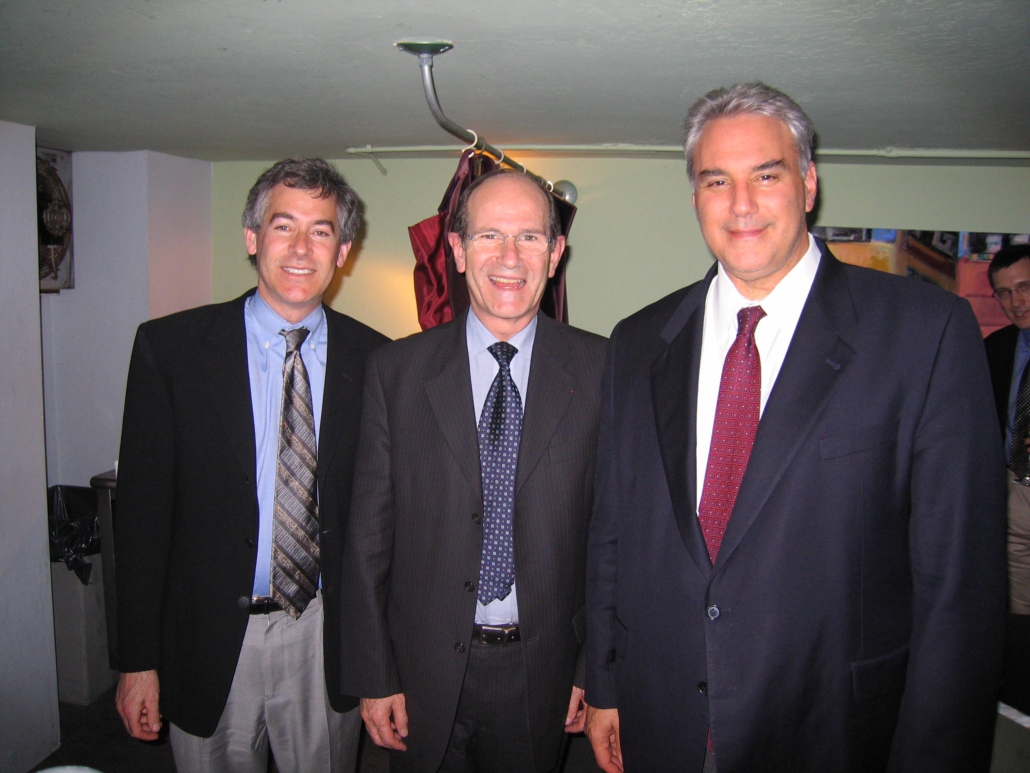
Photo from 2005 with Mitch Berger and Alim Benabid when he visited UCSF for a visiting professor dinner.
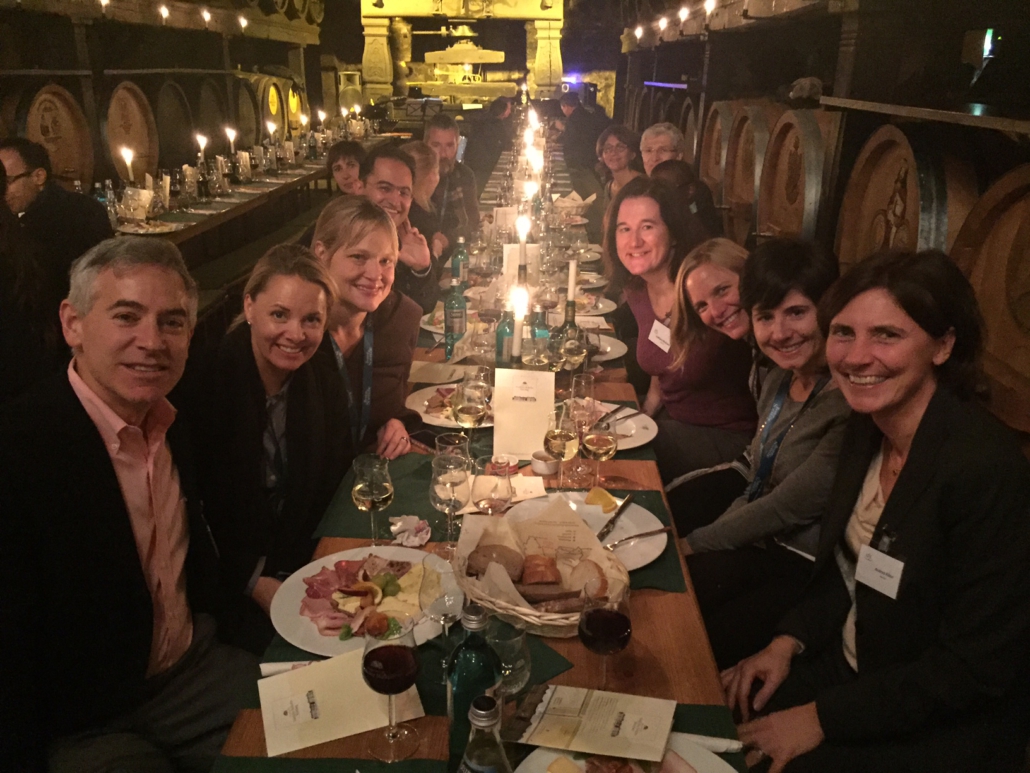
Photo from 2016 taken at the DBS experts summit in Würzburg 2016 with various colleagues from UCSF (Jill Ostrem, Lauren Schrock, Svjetlana Miocinovic, Cora de Hemptinne, Marta san Luciano) and Andrea Kühn.