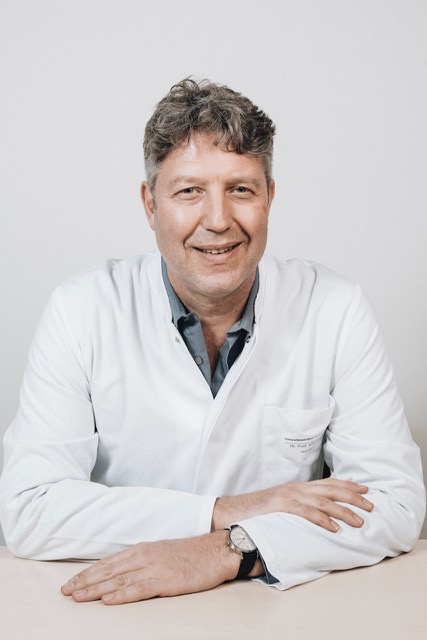
Dr. Volkmann is Professor and Chair of Neurology, University of Würzburg, Germany.
#55: Jens Volkmann – Image Guidance, Disease Modification and why there may be no ‘sweetspot’ for DBS.
Jens Volkmann is a Professor and the chair of Neurology at University Hospital Würzburg in Germany and one of the key DBS experts in the field. I have intensely collaborated with Jens and his team and he has been a mentor for me since a long time. In fact, in this conversation, Jens reminded me of exactly when we first met, during a summer school in cortona, italy, where I was fortunate enough to listen to fantastic talks by exciting faculty including Jens about the future of Deep Brain Stimulation. Jens has been a pioneer of image guided DBS and has come up with fantastic concepts and models around the mechanism of action of DBS. He has also largely contributed to advancing the fields based on clinical studies and is very broadly informed about the past, present and future of the field in both human and animal work around the technology. I hope you enjoy this conversation as much as I did, and thank you for tuning into Stimulating Brains!
Jens Volkmann 00:00The research question was to answer the question whether STN-DBS was not only symptomatic but also neuroprotective. These animals, when they become symptomatic, they also express beta oscillations, so very similar to what we see in humans. There are no sweet spots because sweet spots are very often an artifact of averaging. So basically averaging group data together. Welcome to Stimulating Brains. Stimulating Brains
Andreas Horn 01:21Stimulating Brains reminded me of exactly when and where we first met, which was during a summer school in Cortona in Italy, where I was super fortunate as a young trainee to listen to fantastic talks by exciting faculty such as Jens about the future of deep brain stimulation. Jens has been a pioneer of image-guided DBS and has come up with fantastic concepts and models around the mechanism of action of DBS. He has also largely contributed to advancing the field based on clinical studies and is very broadly informed about the past, present, and future of DBS. and future of the field in both human and animal work around the DBS technology. I hope you enjoy this conversation as much as I did. And thank you for tuning into Stimulating Brains. 02:13Jens, thank you so much for joining. I know how busy you are. So this is a big honor. Thank you for coming on the podcast. And I will. by now have more formally introduced you so we can directly start with the questions and as you you know with the first question i always ask to break the ice about hobbies and what you do if you're not involved in medicine or science or anything you you do in your free time yeah thank you andy first of all for inviting me it's a it's an honor and privilege to be here so what what am i doing when i'm not doing medicine i have a family first of all i have a dog which is part of the family so they they take some extra time and yeah in terms of my leisure time i like cooking very much i like inviting friends 03:03and i have a very special project that is to my heart which is restoring an old farm in the south of italy in pulia which used to be a vineyard and hopefully someday will be a vineyard again that's really nice and you've just been there right i think the last email you sent me was from italy yes that was from italy it's building projects in italy are special uh so it's a little bit slow going but yes we are seeing progress in the last four years great and that is meant for a you know for you a second home in italy or or to spend time there i assume or yeah it's it's meant as a family um yeah a vacation home of course um but but also as
Jens Volkmann a sort of 04:10sort of sort is that yes that's true he will be my neighbor so maybe this is like uh well you're not not the next neighbor but he will be he bought land approximately 15 minutes from from where i live and or will live or you know at least spend time and yeah maybe we can build up you know a southern italian dbs community at some point i have friends there that are also involved in dbs the italian friends but it's it's not formally work related i mean that's a purely leisure activity of course of course really cool all right so moving to your career as a neurologist and neuroscientist um who 05:00were your key mentors in your career and what were the main turning points that you would looking back identify that brought you to where you're now yeah i yeah i i think i yeah i can really say three mentors that were very influential on me a neurologist a physiologist and neurosurgeon uh the neurologist is professor hans jorgen freund he was the head of department in düsseldorf where i trained and was also the supervisor of my doctoral thesis he's well known for his motor research in germany that he conducted in the 1980s and 90s he was also someone who was you know he he organized the research consortia he basically founded the first motor collaborative research center in germany so that's that's one source of inspiration and 06:00a mentor in my early in my career already then rodolfo linus in new york where i spent my research time for the phd thesis as a doctoral student for two years and uh nyu in his physiology department and then after returning um professor volker sturm the head of stereotactic and functional neurosurgery in cologne professor freund contacted him uh it was about the time that stereotactic and functional neurosurgery took off by just by chance i got into this topic while i was as a phd student in new york seeing the first polydotomies there was michael dogali at best israel hospital um and um and he wanted me to enter this field and made contact with the stereotactic and functional neurosurgeon at that time the head of department of stereotactic and functional neurosurgery in cologne and this is how you know the circle closed and then i had 07:06very early on in my neurological residency i was exposed to stereotactic and functional neurosurgery and accompanied patients for surgery to Cologne and also got introduced into imaging at that time. Of course, very crude imaging, still ventriculographies and stereotactic planning, but also the clinical aspects of BBS. Really cool. That connection to Volker Sturm wasn't even clear to me. And I've actually been thinking about trying to get him on the show. My doctoral fellow, Clemens Neudorf, is still in
Andreas Horn contact with him and thought about that. That's fantastic. And so that was still in Düsseldorf, right? Because maybe for the international folks, Düsseldorf and Cologne are very close, so you could probably commute easily back and forth. Yeah, they're very close, but they are
Jens Volkmann 08:02very strong competitors in terms of carnival and different types of beer, which is very important. In Germany, of course. So a collaboration between Cologne and Düsseldorf was quite unique. I mean, these are usually two cities that like to stay separate.
Andreas Horn Really nice. Okay, so that's fantastic. I would love to talk more about that time also, you know,
Jens Volkmann even a bit about Volker Sturm, but probably in the interest of time, we would need to do that in a second episode or so. But then I think you moved to Kiel. That's true, yes.
Andreas Horn I finished my, yeah. Yeah, I finished my residency in Düsseldorf. I became board certified
Jens Volkmann neurologist. At that time, we had built up a DBS service together with Volker Sturm. It was a collaborative service between the neurology department in Düsseldorf and the stereotaxy 09:00department in Cologne, and we had treated approximately 200 patients. By that time, it was quite a number.
Andreas Horn Yeah.
Jens Volkmann This was really in the early days of DBS. We are talking of the time between 1994 and 2000.
Andreas Horn Okay.
Jens Volkmann And in 2000, I moved to Kiel to become attending in the department of Günter Deutsche. Great. Yeah. And I recently came across a picture of that original Movement Disorders team. And I think, you know, when I started off, that was already 2012-ish. Andrea Kuhn sent me to a course there. And that was in 2012.
Andreas Horn Yeah.
Jens Volkmann And that was really the, you know, that was learning from the experts. You know, you guys really were, I think, had a fantastic setup there. And they were, on that old picture that I came across, there was, you know, all the names that kind of still run the show, Medorn, Pötternerger, Herzog, Steigerwald, Pinsker, Deutschland, of course, you, Volkmann, were tagged in that picture. I think Sergio Groppa and Mutu Rahman, Mutu Rahman were also there at some point. So how did it come that, you know, Kiel became or was and still kind of a part of the movement?
Andreas Horn 10:06Yeah.
Jens Volkmann focus on tremor and was exposed to stereotoxy for a long time. There is also a department of stereotactic and functional neurosurgery, quite influential and famous. Mundinger was the neurosurgeon there in Freiburg.
Andreas Horn So he basically, yeah, from his early career on, he was interested in intervening into
Jens Volkmann 11:03circuits into the brain. And so he, when he was appointed in 1995 director of the department in Kiel, he was looking to turn this department that was originally with a focus on headache disorders into a movement disorder center. And the first person, and you didn't mention that very influential DBS person, which was actually my predecessor in Kiel that he recruited was Paul Krack. Oh, I didn't know that. Paul Krack. I did know that.
Andreas Horn Yes. Makes sense. Yeah.
Jens Volkmann Great. Paul was, Paul was recruited as a movement disorder specialist by Günter Deutschen and then sent off to train in DBS in Grenoble. So very early on, you can imagine 1995, the appointments, the first DBS patients and the first results of DBS were basically shown on the conferences in 1994, 1995. 12:02I still remember movement disorder conferences. When the first videos were shown. And I think Günter immediately recognized that this was a huge opportunity for movement disorders and system neuroscience to learn and also to treat. And he made contact with the Grenoble team and Paul stayed there, I think for a year or one and a half years before joining the team in Kiel. And then around 2000, when Patricia Limoser moved. To London, there was a vacant position in Grenoble and they asked Paul to come back to Grenoble and I replaced him in Kiel. So the world is very interconnected.
Andreas Horn Yeah.
Jens Volkmann It was a small group of friends and people that knew each other. And yeah.
Andreas Horn Fantastic. Okay. Yeah, that's great. And Paul speaks very well, very good German. Did, is it true that he studied in Freiburg or something or that he studied there as well? 13:04Yeah, Paul is from Luxembourg. Yeah.
Jens Volkmann And Luxembourg is, is of course a very, very small country in the center of Europe. And so people there speak usually fluently French, the Luxembourg dialect and language, Letzeburgish and also German. But he also studied in German and trained in Germany. Really nice. Okay, great. So and then. You, I think you rose to, you know, second in line so that, you know, the main attending together with Günter Dörsel and then moved to Würzburg where you became chair. And I think you once told me anecdotically that you had to get acquainted with maybe local politics there in Bavaria as well.
Andreas Horn Maybe you can share an anecdote or something in that order. 14:01Or was it some sort of culture shock coming from Northern? Yeah.
Jens Volkmann From Northern Germany to Bavaria in general or. Well, becoming head of department is a kind of a culture shock because all the politics that are involved in networking and the budget discussions, all this is something you're not necessarily exposed to when you are attending. I mean, you can concentrate on clinical work and research and actually that's a, it's not the worst position to be in. So I really appreciated what Günter was doing for the department when I became.
Andreas Horn Yeah.
Jens Volkmann A head of department myself. And yes, it's a sharkfish bond that you're jumping into. And of course, many other disciplines have an interest to keep your department small or at least, you know, defend their budgets and or try to steal a little bit of budget from you. And it's a constant fight.
Andreas Horn Yes.
Jens Volkmann And Bavaria is special because Bavaria has been ruled by one political party.
Andreas Horn 15:03Yes.
Jens Volkmann Basically continuously after the Second World War, that's the Christian Socialist Party. So there is on all levels in Bavaria, you basically find political influence.
Andreas Horn That's something, yeah, you need to learn and you need to deal with. Yeah. Yeah. Okay.
Jens Volkmann And then about Würzburg, I think there is a long tradition of movement disorders there to stereotaxy research. But then also, I think you once mentioned a strong tradition of anatomical studies.
Andreas Horn Yeah.
Jens Volkmann There was a tradition of actually neuroimmunological research in Würzburg from the founder of 16:01the department. I'm the fourth chair in Würzburg in sequence. The department was founded in 1934 and it was founded by George Schaltenbrand. Schaltenbrand of course for DVS neurologists or people that are interested in stereotactic and functional neurosurgery is a big name because of the Schaltenbrand-Wahrenatlas. That was a byproduct of his interests and work. But Schaltenbrand was primarily a neuroimmunologist.
Andreas Horn Yeah, Schaltenbrand was an immunologist.
Jens Volkmann He was an MS researcher. And it's actually kind of a... He had a difficult heritage because he was implicated in unethical research during the Nazi times. He was cleared from the accusations immediately after the war, but later on in the 70s, his 17:07research that he did to prove that MS was a conductable disease, he thought that it was a transmittable disease. I'm sorry. MS was a transmittable disease. He wanted to prove this hypothesis and he conducted unethical research by transfer experiments of CSF from patients to monkeys and then back from monkeys to patients. In his book that was published in 1943 where he described these experiments, he had a kind of ethical moral discussion about what would be... How this kind of research could be done in humans, but that human proof was necessary for his theory. And he came up with the idea that since it's ethically difficult to do this in normal patients, 18:07one could do it in those humans that were devoid of any human traits because they were mentally retarded. See, we're talking about human traits. I'm not saying that he was mentally retarded. I'm just saying that he was mentally retarded. And of course, from today's standards, this is outrageous. And this is a good reason for not mentioning him in the... Not honoring him anymore for his work and also clearly distancing oneself from this period.
Andreas Horn It's not in defense, but to say basically why this was so difficult.
Jens Volkmann I mean, I think it's a very important thing. I think it's a very important thing. I think it's a very important thing.
Andreas Horn That's why it's so difficult this time.
Jens Volkmann And it's so difficult to judge these kind of decisions from today's standards. The Nazis basically had decided that multiple sclerosis was a genetic disease. 19:00And they had an genic program laid out for multiple sclerosis patients to be sent to the concentration camps for genic reasons. And Shaltenbrandt was one of the motivations of Shaltenbrandt. to do this kind of research on the transmission of multiple sclerosis was to prove that it was not a genetic disorder. So it's a huge moral dilemma, obviously, and these were terrible times. But in general, Schaltenbrand is a name that is miscredited in Germany and worldwide now for this type of research.
Andreas Horn Yeah, yeah, it makes sense. Absolutely.
Jens Volkmann And then on the more recent front, for example, Helmut Heinzen was an anatomist.
Andreas Horn Yes.
Jens Volkmann He's still around, but I think he lives in Brazil at the moment. There seems to have been a tradition as well on the more anatomy kind of side, and there 20:04have been nice collaborations there too.
Andreas Horn Yes, but this was interestingly, this was not the neurology department, but this was
Jens Volkmann the psychiatry department.
Andreas Horn Okay.
Jens Volkmann And so the head of psychiatry at that time was very interested in morphological studies in patients with psychiatric disorders in the 1980s and 90s. And he created a position for an anatomist, and this was Professor Heinzen. So he was not even in anatomy, he was employed by the psychiatry department doing post-mortem studies, anatomical post-mortem studies.
Andreas Horn Okay.
Jens Volkmann And he was very interested in post-mortem studies on brains of people with schizophrenia and others to look for network disorders or anatomical histological disturbances. And Heinzen had a student coming from Brazil, Alio, and he basically was the connection 21:07to the Sao Paulo center.
Andreas Horn Sao Paulo has a very interesting post-mortem program where they basically bring people
Jens Volkmann together.
Andreas Horn And he was a very interesting person. Yeah.
Jens Volkmann MRI scanner there and then they basically do the histological analysis of these brains, which is quite unique. So there is this huge brain bank, which has images and at the same
Andreas Horn time also the specimen. And yeah, both worked on the ATLAS. They developed also or worked
Jens Volkmann on the SIN, on the six slice microscopy with polarized light to look at fiber pathways.
Andreas Horn 22:02So yeah, that was a very interesting connection, which slightly overlapped with me coming in
Jens Volkmann 2010 to Würzburg, but soon after Heinzen retired and then left for Sao Paulo. All right. Speaking more about your work now, finally, you're famous for many things, which includes the work of the Institute, you know, clinical trials and bigger ones, influential ones for DBS. Image-based programming is I think one of your key current hobbies to say, or, you know, endeavors, but then also your center runs a big animal work facility with DBS as well, which I think is
Andreas Horn unique and then many fantastic concepts you've published on mechanisms of DBS and so on.
Jens Volkmann So if you had to pick a few domains that you would think that's what I want to stand for, that's what I stand for, how I see myself, which is the DBS.
Andreas Horn Which would be the ones throughout your career and then more lately, more recently?
Jens Volkmann 23:00Well, I mean, my major goal has always been to make the therapy, to understand the therapy and to make it better for the patients. So it always comes from a clinical perspective.
Andreas Horn I, you know, what was most influential on me, I must say, was sitting down with the
Jens Volkmann first patients after the implantation of DBS. I mean, I had a lot of experience with DBS electrodes. First we did palatal DBS, then soon after we started with subthalamic nucleus DBS. There were no guidelines. I mean, there were a few people that were doing this in Germany. Paul Kruik was one of them. Wolfgang Vogel was one of them in Heidelberg.
Andreas Horn And we just telephoned and talked to each other and said, oh, I have this interesting
Jens Volkmann patient.
Andreas Horn How do you do it?
Jens Volkmann So we had to come up with solutions of how to set this multitude of parameters to get patient outcomes. We learned from these patients and we started to formulate it into clinical procedures that 24:00could be somehow guidelines for others that were following. And ever since, I think my role has mostly been in implementing this as a standard of care and making it fail proof, in making it teachable and reproducible and to some extent also automatized. And initially it was an art. You had to acquaintance a lot of knowledge that was very subjective and not so easy to transfer to others. And that's impeding actually, still impeding DBS from being a widespread application in clinical neurology and neuroscience, clinical neuroscience. So everything that came afterwards was a byproduct.
Andreas Horn Yeah. Yeah.
Jens Volkmann So it was the goal to make it easier, more reproducible and of higher quality standards 25:00in many centers. Great. So essentially the main driving force has always been to kind of standardize things, improve things, motivated by clinical perspective. And you've used whatever tools you could come across, animal work, imaging and so on, to make that happen. That's probably it. That's how I see you too, yes.
Andreas Horn Yeah, that's really what motivates me.
Jens Volkmann And still today, I'm more motivated by a patient that is in front of me than by, let's say, a theoretical neuroscientific question. But I'm using my training, my neuroscience background, my neurophysiology background to find solutions, let's say. Absolutely, yeah. So maybe I'm more kind of a neurological engineer than a scientist. Well, you're definitely very much so a scientist, but it's still fitting as a description, I agree. 26:05And so together with Andrea Kuhn, you lead the Transregio Collaborative Research Council, RETUNE, which was just awarded the second funding period. So congratulations again for that. And maybe for the international listeners, I think CRCs, these conferences. I think the collaborative grants are among the biggest things you can actually get in terms of funding in Germany. Transregio means it's even two universities, and that typically makes it even bigger.
Andreas Horn So this has been a huge blessing for the German field of DBS research and brought out many fantastic concepts already. And but now you have four more years and then there could be a third funding period after that as well. What are the key missions of RETUNE? What has been accomplished so far? And what is planned? Maybe for the next four years? Yeah, it's a collaborative research center and collaborative research centers, they have in general several missions.
Jens Volkmann 27:04First of all, they usually embrace interdisciplinary research. So that was a huge opportunity for us to have the positions to basically recruit engineers, physicists, data scientists, anatomists, etc. And so I think that's a big opportunity for us. And then also, I think it's also sort of like a sort of interdisciplinary skills also that can understand each other and to bring this to the field of neuromodulation, to bring neuromodulation forward. 28:03So the concrete scientific goals of RE-TUNE are to better understand the networks that are underlying movement disorders. We took movement disorders as the initial use case of network disorders to understand their anatomical underpinnings,
Andreas Horn but also, and this is more the focus of the second funding period, to understand their dynamical interactions. How basically do these networks work from a dynamic perspective of brain function and dysfunction? And how can we learn to basically... adapt deep brain stimulation to the language of the brain, to the dynamics of interaction of brain areas?
Jens Volkmann So, of course, oscillatory activity, which is the stronghold of Andrea, plays a very, very important role. 29:00And that's probably one of the best established biomarkers of network dysfunction, such as beta oscillations, for example. But in the future, we also want to understand how basically these signals interact. With the normal, let's say, dynamic changes that the brain is undergoing during behavior and behavioral changes and states, such as sleep or wakefulness, and then to adapt basically deep brain stimulation to the needs and necessities. Obviously, they're not the same in all states of the brain. And this is how we understand adaptive neuromodulation, adaptive deep brain stimulation, adapting basically... the therapy to the momentary needs of a patient.
Andreas Horn And that's actually the focus now of the next four-year funding period. So stimulating at the right time, but also in the right way, given to the needs for the patient in a way? Yes, exactly.
Jens Volkmann 30:01And probably with the right language. And we certainly don't believe that 130 Hz constant stimulation is the right language... because it's very subtle, fast, dynamic interactions and mis-interactions, basically, between brain regions. Really nice. Great. And so maybe I want to pick out one of your many great papers. And that's one that really has shaped my understanding or my conceptualization of DBS and its interplay with the cortex and basic ganglia quite a bit early on. And it's your 2010 article. The Nature Reviews Neurology, on which you're the first author. And I think, you know, it's an integrated... it's a review paper, right? I think part of the model is based on work by Valerie Woon and others. But you think you've made a great... you had a great job in integrating some concepts that at least shaped my understanding a lot. 31:02And there is this one figure where you show these three U-shaped curves about the motor, associative and limbic domains. And, you know, in the... in a way, the concept is quite simple, where you say overactivation of one loop will lead to a specific symptom and underactivation would lead to a different one.
Andreas Horn And in the motor loop, for example, one end of the rectum is akinesia and on the other hand you have dyskinesia. And then kind of there's a parallel to be drawn to the other two loops. And, for example, in the limbic loop, it could be essentially mania and depression.
Jens Volkmann And I think there are other symptoms that you cluster there as well.
Andreas Horn So at least for me, that shaped, you know, a lot of why I found it so interesting. I find it super interesting to study, let's say, the motor system, but think about how that would translate to other parts of the frontal gradient, essentially. Can you talk a bit about that?
Jens Volkmann Also, if you think it's still correct or if that's a valid, you know, helpful model, because it's from 2010, I would love to, you know, get an update on your thoughts on this.
Andreas Horn 32:03Yeah, it was still... it's very simplistic.
Jens Volkmann It's over simplistic. But it was... it actually derived from clinical observation. And so, I mean, this review contains, of course, a lot of literature that was compiled during the first years of DBS where our group and also many other groups, in particular, also the Granova Group and Paul Krug, realized that Parkinson's disease, first of all itself, was not a motor disorder alone. But it's... it's a neuropsychiatric disorder. And the effects of DBS in Parkinson's disease are often very... also, they are neuropsychiatric. So, you have motor effects, but you also have psychiatric effects and cognitive effects in many patients. And, of course, I mean, initially, it was a very, very important and it was a mission to prove that DBS was safe and was not altering personality. 33:09Right. Right. So, we had a very, very good study of the DBS and we found that DBS was not altering personality and was not leading to cognitive issues, you know, in the long term. But it was also a chance and opportunity to observe subtle changes that were more on the level of personality. And sometimes... sometimes you would see really, you know, psychiatric issues in some of the patients, such as stimulation-induced depressive episodes or stimulation-induced hyperactivity. Right. Sure. Sure. Sure. Sure. Sure. Sure. Sure. Sure. Sure. Sure. Sure. Sure. Sure. Sure. Sure. Sure. Sure. 34:00Sure. Sure. Sure. Sure. Sure. Sure. Sure. Sure. Sure. pharmacological treatment and to long-term pharmacological treatment because dopaminergic sensitization does not only occur in the motor system leading to dyskinesia but also in limbic and associative basal ganglia loop which then leads to impulsivity and other issues and they can also be found in the context of deep brain stimulation.
Andreas Horn So yeah, the review was an attempt to conceptualize basically the biological effects and their
Jens Volkmann causes in order to better manage patients with neuropsychiatric problems after DBS either by adaptations of medication, by adaptations of stimulation or by selecting the right candidates for the surgery in the right time point for the surgery. 35:01And I think in that sense it is still valid. I think it's still a good teaching material for newcomers in the field. Many of the issues that were discussed there unfortunately have been solved and they are not seen anymore because we have better precautions in managing these patients post-operatively in terms of medication withdrawal, etc. We operate earlier. We sometimes even use DBS to prevent some of these neuropsychiatric issues of dopaminergic sensitization that was put forward. In a recent viewpoint paper that several colleagues wrote from Germany and also Paul Krak was involved in Alfonso Fasano of changing gears and eventually using subthalamic nucleus deep brain stimulation to avoid and reverse some of the dopaminergic medication-induced changes in Parkinson's disease that would lead to long-term psychiatric disability. 36:04So because you can reduce the medication as a function of DBS, okay, yeah.
Andreas Horn Yes. Yes.
Jens Volkmann And then you may avoid some of these really devastating long-term effects of medication. It's not really Parkinson's disease related. It's related to the attempt, of course, to manage the motor symptoms of Parkinson's disease as long as possible. But dopamine is not a purely motor drug.
Andreas Horn Yeah.
Jens Volkmann And that's what we had to learn. So, yeah. Great.
Andreas Horn Really fantastic.
Jens Volkmann And again, that really helped me, you know, think about basal ganglia circuitry a lot and about, you know, the implied. So I think I agree it's still a great model, even if, you know, as maybe even the Albin de Long model is still, you know, still helpful, even though it might not, it's simplistic by now a standard, nowadays standards. But, okay. So one thing that makes your center and, you know, clinic for neurology. 37:03So. Special is that you have a broad human, but also animal research facility. I think also mainly led by by now, but also by yourself centered around DBS and maybe also to, to draw the picture. There are not many chairs of university hospitals of neurology that are DBS people in Germany. Right. So you might be the only one, or at least there are not many where. Last time I would say also comes from the DBS field in Marburg.
Andreas Horn Yes. Yeah.
Jens Volkmann Certainly.
Andreas Horn But it's, but it's, but it's a rare, it's a rare thing. And that makes your center quite special because the, let's say entire neurology department is kind of built around DBS. Do you often have situations where the animal work, which would also motivate clinical studies and the other way around? And can you maybe give some examples of how that interplay works? Yeah. Yeah. That's actually an interesting point because I'm not a translation of neuroscience.
Jens Volkmann 38:03I'm a neuroscientist in strict sense. So I did not train in, in basically animal research and then was looking in models for solutions for humans. I'm what I would call a reverse translational neuroscientist. So basically we use animal models to solve issues that come up in our patients where we need a better mechanistic understanding. And we cannot do this kind of interventional. Experiments, neuroscientific experiments, of course in humans. So we have to go to animal models to fill these knowledge gaps. And for this purpose, we also had to create our own animal models. So there is not a single model for the disease. Obviously it depends on the research question at stake and for system neuroscience. We had to reproduce models or we had to create models and we needed to create rodent models. 39:03So we had to do that. And we had to do that because monkey research is extremely difficult to conduct in Germany. And it's also usually not suitable for modern research techniques such as optogenetics and others. So we had to go to rodent models. Rodent models that reproduce important clinical aspects of the diseases that we are looking at. And so we basically started to work on two models. One was for Parkinson's disease. And we were very much interested in how therapies impact on the course of Parkinson's disease. So we required a model that was slowly evolving and where we can study compensatory mechanisms and network degradation mechanisms at the same time. So for this, we used together with the University of Toronto, the group of Thomas and Broach is a neuropharmacology group from Toronto. 40:02And we used their viral vector model of overexpressing alpha-synuclein in the substantial nigra, which gives a slowly progressive Parkinsonism in mice and in rodents. And we have been using this model for the past 10 years doing DBS research in this model, looking at mechanistic changes and also, of course, pathophysiological and pathogenic mechanisms of disease progression in Parkinson's disease. So we used this model. without intervention. So that's the one important model, and the other important model, which didn't exist before, was a model for dystonia. We wanted to understand how basically the network disorder that we were all assuming in dystonia, how this network disorder links to genetic mechanisms, or genetic causes of dystonia. And for me as a clinician, it has 41:01always been striking that dyT1 dystonia, which is the most severe form of dystonia has only a penetrance of 30%. So if you have a gene, only 30% of those that have the dyT1 gene will get dystonic, usually as children. I've also seen some something so you know, some families with dyT1 dystonia where
Andreas Horn interestingly, sometimes, even at old age, you can see some
Jens Volkmann dystonic features in the parents of these these children that have classical generalized dystonia. And then it's typically a focal dystonia is not the classical generalized dystonia anymore, it may be a dystonic tremor, or it may be just a writer's cramp or some other forms of subtle and more focal dystonia. So the question was why, you know, in one person that has the gene, even if you have a family, you have this outcome, and in others, you 42:00don't see anything, or you see very subtle dystonia. And the idea was always that it has to do with plasticity mechanisms, and so maybe some exogenous causes, you know, some some environmental triggers, since we know that dystonia is also linked to injuries, overuse, for example, writer's cramp or musician dystonia. And this is the, this is the second model that we established. And that is now I think, also recognized as potential model for the for the symptomatogenesis of dystonia. We took the do it one rats that were basically created by Catherine Grunmann and tubing and, and these rats have have noticed only they have noticed tonic or motor features. They look pretty normal. But we expose them to, to a nerve injury, as a stressor as a motor stressor, sensory motor stressor for for, for the dystonia. And we were able to 43:24to reproduce this in mice. We have been able to reproduce this also with more subtle stressors, such as overuse. The animals have to press a lever multiple times per day, which is creating a kind of an overuse. And we see the same. We see the evolution of dystonia. And that allows us in this model to study the transition from basically a network that has genetic predisposition, but is still not expressing the symptom. And then the symptomatogenesis on the basis of this network disorder in comparison to wild-type animals that do not have this 44:06kind of genetic predisposition.
Andreas Horn That's fantastic.
Jens Volkmann So these are the two models that we currently work on. Both are actually clinically inspired and inspired by the questions that we want to answer in rodents, Parkinson rodents. What we want to answer is...
Andreas Horn The question, how early should we do DBS? Does DBS in different stages of network degeneration and degradation have different effects? And we have some indicators that very early DBS is fully neuroprotective even, which raises the interesting question. Yeah, that was exactly the follow-up question. I mean, before we go into that, just wanted
Jens Volkmann to say, I love the idea of really reverse, you know, reverse transplants. Because if you had to put your criticism hat on for, you know, some of animal research
Andreas Horn that maybe is sometimes just not driven by clinical questions, right? And that has its
Jens Volkmann 45:05value and absolutely, you know, important too for other questions. That's more neuroscience essentially. But I read, you know, I sometimes think it should be done more to do, let's say, what we know works in humans, like DBS to the STN, for example, in animals and then study it better.
Andreas Horn And surprisingly, that happens quite rarely, right? It seems like maybe for some people too boring or so. But I love that you have exactly this idea of, you know, taking things
Jens Volkmann that we know kind of work in humans and then trying to better understand them or refine them or optimize them in animals. It's really great. I wanted to just shout out to that. But then to the early STEM idea, I think there was this 2017 paper in Annals of Neurology by Thomas. I was the first hint you had on that. And then there's now, I think, early STEM rat project in the CRC. We'd love to hear more about that.
Andreas Horn 46:03Yeah, I mean, the research question why we implemented the progressive model of alpha
Jens Volkmann synucleinopathy and Parkinsonism in rodents. The research question was, to answer the question whether STN DBS was not only symptomatic, but also neuroprotective. And the first proof of concept was really in the 2017 paper by Thomas Musacchio, who demonstrated that there is a strong symptomatic effect when these animals become symptomatic in terms of bradykinesia on the tests. But if you start STN DBS, then you can actually get a lot of results. And that's really the first proof of concept. And then the second proof is, let's say, in a kind of mid-stage of Parkinsonism, where you already have motor symptoms present, mild motor symptoms, then you will also find that more nerve terminals 47:04and approximately 20% more substantial nigram neurons survive in comparison to non-DBS treated animals. So there was a hint that there is some neuroprotection. And it was not very strong.
Andreas Horn strong, but it was significant. And then we, yeah, we came up
Jens Volkmann with this research question. So how does disease progression basically and the changes that occur during disease
Andreas Horn progression? How do they interact with DBS? Because in
Jens Volkmann Parkinson's disease, we have to assume that the, let's say, neurodegenerative process in Parkinson's disease and the pathogenesis starts approximately in humans, we assume approximately 10 years before we see the first motor signs and symptoms. So the alpha-synucleinopathy is slowly progressing. There are initially a lot of non-motor symptoms. 48:02There is spread of the alpha-synucleinopathy. And even when it reaches the substantia nigra, we know that we, it requires some terminal loss in the striatum of approximately 60%, and approximately 40 to 50% neuron loss. And that's a lot of non-motor symptoms. So we have to understand that there is a lot of non-motor symptoms in the substantia nigra to see first motor symptoms and signs. So the question is also what is happening in between, because obviously there's substantial pathology, but there must be compensatory mechanisms that basically prevent the symptom expression. And then it's almost a hysteresis approach. You know, you see a steep increase in bradykinesia, Parkinsonian symptoms within a relatively short period of time, and then it levels out. So the original idea was, what happens when we
Andreas Horn 49:02perform DBS in the compensatory period? What happens when we
Jens Volkmann perform it at a time period where motor symptoms just
Andreas Horn emerge, which was the Mosacchio paper in 2017? And what happens
Jens Volkmann in these animal models when we perform DBS in one of the later, more advanced stages of the disease that would be comparable
Andreas Horn to our current practice for DBS today? And it's unpublished so
Jens Volkmann far, but it will be published soon. It's obviously a lot of control experiments, and it's very tedious to do this. But I think since we already published abstract forms of the data, we can do this. And I think it's a very interesting point.
Andreas Horn The interesting point is if we perform a very early period of
Jens Volkmann deep brain stimulation, and then we stop even. So it's a period of three weeks where we stimulate these animals in an early course 50:00of disease, we can fully reverse symptom expression, and we can basically salvage motor terminals, dopaminergic terminals in the industry and substantial nigra neurons from degradation. So if you use the same three week period, same dose of therapy basically late on, you just get a symptomatic effect and you don't
Andreas Horn save anything. And the interesting question at stake is, of course, what is the mechanism? Yeah, yeah. Yeah. Very interesting.
Jens Volkmann Because alpha-synucleinopathy is progressing.
Andreas Horn Okay.
Jens Volkmann So you don't prevent basically alpha-synuclein to, you know, to spread. To extend basically in these neurons.
Andreas Horn But something is preventing them from dying or becoming dysfunctional. Interesting. So you're saying you do a three week period and you know, how long is that period in mice? 51:04So the compensatory period is that months or? Yeah. Yeah.
Jens Volkmann I mean, roughly in this model, you inject, you inject cell tactically, you inject the viral vector that starts to overexpress alpha-synuclein, the substantial nigra at week zero. And then you keep these animals alive for eight weeks. And at the end of the eight week period, they have substantial neural degeneration, approximately 60, 70% of dopaminergic terminal loss. And they have motor symptoms and they have dopaminergic dysfunction. The motor symptoms in behavioral testing, they seem to be very low. And they seem to be very low. And they seem to be very low. And they seem to be very low. And they seem to be very low. And they seem to be very low. And then you can sort of ! preclinical study period was defined as ST and DBS between week one and four. 52:07So basically in the pre-motor period, we're not suggesting that this should be
Andreas Horn done in patients, but this is exactly the period which is compensatory.
Jens Volkmann And then we stop DBS and these animals live on for eight weeks and the second group is stimulated from week five to eight and then they're sacrificed. And so you're saying in the ones where you stimulate early, there's not many symptoms. You really have a big effect on the symptoms, even though you stopped DBS, you just applied it for the first three or like week one to four.
Andreas Horn That's very interesting.
Jens Volkmann So if we had to- Very similar, no symptoms.
Andreas Horn Yeah.
Jens Volkmann Other biomarkers.
Andreas Horn Yeah.
Jens Volkmann Like beta oscillations. Right. So for example, these animals, when they become symptomatic, they also express 53:03beta oscillations. So very similar to what we see in humans. In the advanced, more progressed stages, we see a beta, we see abnormal beta synchronization between STN and motor cortex. And an early period of subthalamic nucleus deep brain stimulation is also preventing beta to be expressed. It's not only preserving motor function. But it also prevents beta oscillations to appear. Very cool. I mean, this is really groundbreaking. And I would love to dig a bit deeper there because I've been working a little bit with Mallory Hacker and David Charles as well. And there was also the, maybe I think you attended the think tank, last think tank remotely where Hage Bergman asked this, I think, historical question of, I think, I have it here. So imagine you have a 55 year old patient with REM sleep behavior disorder with no 54:03other symptoms than that.
Andreas Horn Would you consider the patient to receive DBS surgery?
Jens Volkmann And obviously nobody raised their hand. Maybe for the listeners, REM sleep behavior disorder has a 99% conversion rate to some severe problem like Parkinson's disease or other atypical symptoms, I think after 10 years. So I think Hage's provocative question.
Andreas Horn Was, you know, should we, should we do a, let's say, stimulation of the SDN to prevent or slow down this progression that seems to be happening also in these patients?
Jens Volkmann So, I mean, right now, I know your answer, you wouldn't recommend doing any of that sort of things in humans, but maybe if you had to speculate, do you think in maybe five to 10 years, more people would raise their hand and Hage is part of that we should at least
Andreas Horn consider earlier DBS in patients like that? Yeah.
Jens Volkmann 55:01you know now we come to the back translation you know we came from the human to answer some questions in the animal um and then uh when we understand the mechanisms i think it's time to to start thinking of uh how this could be transferred to human therapy yeah um there
Andreas Horn are different candidates why this could happen one obvious candidate is that
Jens Volkmann stn dbs is preventing glutamatergic excitotoxicity in the substantial nigra so basically you reduce the excitatory drive of substantial of sdn neurons on substantial nigra neurons and that could this or eventually um reducing yeah the firing rate of these neurons because you know you can you can you can you can you can you can you can you can you can you can you can you know somehow they have to maintain the the dopamine levels i mean the compensatory mechanism 56:02that prevents basically the early appearance of motors of motor symptoms is most likely that the surviving neurons take over and they they for example increase their firing rate they increase synaptic release of dopamine they have to increase dopamine metabolism for this and they also probably down regulate the dopamine transporter and some other mechanisms that basically preserve striatodopamine homeostasis and these metabolic changes in the surviving neurons um they will put an increasingly you know strong metabolic pressure on on the ones that are still alive so basically um the dopamine the the dopamine neuron loss could be self-promoting and if you uh basically uh replace the um this with the circuit effect of dopamine by sdn dbs and and give these guys a rest that are stronger and 57:04stronger uh you know um engaged in in making up for the for the loss of their neighbors uh that could in indeed be one of the mechanisms of of neural protection yeah but um that needs to be proven of course of course yeah uh and and and so i think that's a very good question um so i think that's a very important question and and if so then there are probably other you know ways of doing a kind of an anti-glutamatergic treatment maybe pharmacological maybe chemogenetics maybe genetherapy whatever that is less complicated compared to you know doing an implantation of a dbs system that needs to be adjusted on clinical basis so that's that's important so that's important so that's important clinical grounds and clinical symptoms without any biomarker.
Andreas Horn So, yeah, I don't know.
Jens Volkmann 58:01I think DBS is for clinical symptoms, but there will be other therapies that could be more suitable for these kind of pathogenetic considerations.
Andreas Horn Interesting.
Jens Volkmann I mean, just also to mention that to the listeners, I think dopaminergic neurons are among the most complicated ones in the brain. They have arbors that sometimes a single neuron projects to big parts of the striatum, maybe a third of the striatum. They have huge trees there. And I think that's why one hypothesis could be that they die off the earliest if there's
Andreas Horn stress, right?
Jens Volkmann Because they're just two of the most complicated neurons or the most delicate powerhouses. You know, it requires a lot of energy to kind of maintain their structure and everything. So you're saying that DBS could give them a break potentially as a mechanism. That could be one mechanism. And dopamine metabolism itself is toxic. As a byproduct, it's producing a lot of hydroxy radicals. 59:04And actually, one of the roles of neuromelanin is probably to buffer away some of the toxic byproducts of dopamine metabolism. So we know that.
Andreas Horn Yeah. Yeah. Yeah.
Jens Volkmann ! So I think that this neuromelanin is basically it's containing a lot of metals such as iron, iron molecules that can actually trigger also the hydroxyl radical synthesis during dopamine synthesis.
Andreas Horn Yeah.
Jens Volkmann So. So as a result, neuromelanin may actually throughout life evolve because you don't see it in children.
Andreas Horn Yeah. And that is probably one of the reasons why this region is also special and it is so metabolically
Jens Volkmann 01:00:06unstable, let's say.
Andreas Horn And the changes that occur basically widespread throughout the brain in an alpha-synoclonopathy, right? Yeah.
Jens Volkmann And so, you know, the changes that occur in the brain in an alpha-synoclonopathy have a major effect basically on the role of survival in that region in particular.
Andreas Horn Yeah. Yeah.
Jens Volkmann !
Andreas Horn Yeah.
Jens Volkmann 01:01:05after a few semesters, I realized that it was boring and that I really wanted to work with patients and I was enjoying working with patients and clinical work and I stopped my chemistry studies. But what I got in the first semesters of chemistry was a sound mathematical knowledge. I had to study for two semesters mathematics for chemistry. That still helps me. Physics. So some foundations in general natural sciences. Shifting gears completely away from animals to humans and another hobby or topic of yours not hobby is the wrong word. You're also an advocate and pioneer of DBS imaging. So electro-localizations, modeling 01:02:00and image-based programming. I think you were sort of sort of sort of sort of sort of sort of sort of sort of sort of sort of sort of sort of sort of sort of sort of sort of sort of sort of sort of sort of sort of sort of sort of sort of sort of sort of sort of is underway um and i i think one day in a dbs experts summit that we both were present you you wanted to had the idea of writing a prospective paper titled there is no sweet spot in estonia or something something of that sort because what martin showed in that brain paper is that it's more complicated than that is at least in estonia do you want to talk a bit about that broader topic either you know martin's work or your current applications of this in the clinic or yeah 01:03:00uh it's more a general criticism of group mean statistics in uh in medicine yeah um so uh there are no sweet spots because sweet spots are very often an artifact of averaging um so uh basically um averaging group group data together because you lose basically um the information on an individual level by but it's kind of averaging procedure and the same is also true for clinical outcomes um and that's something we should think about because dbs is a is a very individualized therapy it's probably one of the most individualized therapy approaches that you can have in in neurology and patients differ from each other the spectrum of of symptoms differ um but it's also sort of like 01:04:02sort of like sort of like sort of like sort of like sort sort of like sort sort of like sort sort of like sort sort of like sort DBS conference and we talked about this strange phenomenon, let's say, that we have been doing now practicing DBS for 25 to 30 years. And when we look at clinical trial outcomes in STN DBS, for example, we still see that the initial trials that were conducted in times where we were still using ventriculography and CT-guided targeting led to approximately 48% improvement on the UPDRS score. And still today, the clinical trials are somewhere in the order of 50% improvement. So does it mean that despite all the progress that we have made in imaging, despite the 01:05:02progress that we have made in predicting basically therapy responses, image-guided programming, segmented elements.
Andreas Horn Yeah.
Jens Volkmann And the results, the therapy has not improved at all. And I think that's damn wrong. And it's an artifact of averaging because, you know, an individualized therapy approach is basically aiming at getting the best individual outcome in a given patient. And what we are seeing is probably the overall biological, let's say, capacity of improving motor symptoms in a large group of patients with a certain range of dopamine-sensitive motor symptoms. So it is actually largely reflecting the levodopa response in these patients. And we know that we can, on an individual level, we can match the levodopa response 01:06:02in a given patient by STN DBS, and that's usually a good outcome.
Andreas Horn Yeah.
Jens Volkmann If you take a large group of patients with different types of Parkinson's disease, you may come to the point that roughly the levodopa response is not as good as the STN DBS response. So the levodopa response in this population is 50%, and roughly the DBS response in this group will be 50%. But it doesn't tell you in how many of the patients we really achieved the optimal outcome as set forth by the levodopa challenge prior to surgery, et cetera, et cetera. And I think this is exactly what we are seeing in later clinical trials. The variance is going down. So we see more excellent outcomes. As expected.
Andreas Horn Yeah.
Jens Volkmann And we see less outcomes that are inferior to what we were predicting prior to surgery.
Andreas Horn Okay. So, yeah, we are reducing, we are increasing the consistency of outcomes with all these
Jens Volkmann 01:07:02things.
Andreas Horn That makes sense to me.
Jens Volkmann With imaging and everything, it's at least natural to assume.
Andreas Horn Do you think that's testable? Like, could we run different statistics instead of just averaging? You know, has somebody ever done just a variance comparison in these data?
Jens Volkmann Or do you see ways of... I looked at the...
Andreas Horn Yeah, I looked at the variance in some of these clinical trials.
Jens Volkmann And, you know, in one of my talks, I have actually an image that shows that the average remains the same and the variance goes down.
Andreas Horn Oh, really?
Jens Volkmann So that would be pretty much in line with what I just said, but probably a better way of... We don't have the data on all the trials. Right.
Andreas Horn That would be, of course, very interesting to look at a more individualized comparison.
Jens Volkmann What we use is like an individual indicator of treatment outcome, which we call the levodopa response ratio. So basically how much percent of the expected levodopa-induced benefit is achieved by SDN-DBS 01:08:07alone in the medication off-state. So that's a score between zero and one. You can scale it. It's basically a percent. of achievable goal and then and then you can you can basically categorize patients in excellent outcomes intermediate outcomes and poor outcomes and on that level you know in our own data we have seen a shift that we have more consistent good outcomes over the years but yeah these kind of changes they average out in large groups another effect at least to the very early trials could really be that more severe patients were treated back then right on average so so
Andreas Horn that's another issue on this podcast or even pierre pollack was on the show they you know of course
Jens Volkmann they were often very severely affected back in the day and it was a last resort absolutely therapy 01:09:04right and so i think the baseline upgs is a strong predictor of dbs outcome it's also part of the equation of it so you you have a lot of symptoms you can improve more so maybe that's another point yeah yeah that's that's uh indeed that's a problem of uh the you know proportional improvements if you have a patient that improves from 60 points on the updates to 30 that's a 50 improvement if you have one that improves from 30 to 15 uh it's a it's another patient with 50 improvement yet having less symptoms which means only 15 points after surgery uh is of course better from the patient perspective but also from the general perspective of the neurologist so that's that's not reflected by percentages of improvement yeah yeah and so image guy in the same and i mean just to come back the same the same is true for imaging
Andreas Horn this is why i'm saying there is no sweet spots um so um very often by by basically taking out
Jens Volkmann 01:10:06the individual variability of outcomes from the equation we reduce a lot we we basically lose a lot of information in imaging and this was the idea behind the probabilistic map that we created for for dystonia where we basically annotated each voxel in the normalized map in mni space with um an outcome um with with the entire outcome curve basically yeah so uh all the patients that were included in the analysis um with the information of all these patients was retained by producing for each voxel um a distribution of outcomes and then using a gaussian statistic basically to describe the probability of of outcome for a given voxel so basically we we created a z map 01:11:01from a probability map of outcomes and then you can take whatever model that you want to create to create a volume of of treatment outcomes a vta for example and you can include all voxels with their probability and then come up with a prediction value of of outcome for that given lead location and and bta yeah that has proven to be more predictive than the proximity to a so-called sweet spot that makes a lot of sense and you can um it can it can probably give you a predicted outcome
Andreas Horn but potentially even confidence in theory, right? Yes. Because yeah, data is-
Jens Volkmann And it's also very much in line with your line of source, sort of so-called streamline analysis. If we are really stimulating fiber pathways, then it should not really matter whether we stimulate that fiber in location X or Z. 01:12:01It would still be the same fiber and the same effect annotated to that fiber that we would see. And in particular in the polydom, the fiber pathways are fanning out and then they are coming together. And of course, I mean, there's probably a higher probability of having good outcomes when you stimulate basically the fiber at their common trunk, let's say, outflow from the nucleus, but you can still get reasonable outcome also in other areas. So you stimulate those fibers in more proximal location.
Andreas Horn Yeah, absolutely. It's such an interesting field, tension field in a way.
Jens Volkmann We kind of need some sort of template to do statistics across people
Andreas Horn or some sort of way of aggregating patients, right?
Jens Volkmann But then of course we have the heterogeneity of the brain and there's so many levels where one could approach that problem and different approaches, some more fruitful than others.
Andreas Horn 01:13:00So I personally love working in this space because it's challenging, right?
Jens Volkmann Because it's really, I totally agree. There's not gonna be a single coordinate for everybody unless we maybe find a good way of actually putting their functions on top of each other
Andreas Horn and we're not there yet, right?
Jens Volkmann So I love the approach you guys took there and certainly helped a lot to create a great model. I think you could validate that
Andreas Horn with data from Portugal as well, right?
Jens Volkmann And the clinical trials is underway. So it'd be nice. But I may add one point. I mean, from a neurosurgeon's perspective, when he has to place a lead, the situation is of course totally different. They need a coordinate. Because a neurosurgeon loves the sweet spot. I mean, for them, it's a deterministic approach. You have one hit and you want to hit the best possible location that has the highest likelihood of creating good outcome. 01:14:00You know, the probabilistic maps, they have their value in terms of, you know, you can't just say, you know, you're gonna have to do this, you're gonna have to do that, you know, you're gonna have to do that. You have to do that. And that's the difference between programming because we are dealing with a situation where we have variability in the placement and we have to basically compensate by programming and by shaping an electrical field. So that's a totally different approach. I don't think a neurosurgeon should do probabilistic targeting. You should do deterministic targeting for sweet spot.
Andreas Horn Yeah, that makes sense. Makes sense.
Jens Volkmann So there's still value in some sort of average place for the average dystonia, for example,
Andreas Horn but yeah, or for different phenotypes of dystonia.
Jens Volkmann So, so yeah.
Andreas Horn Okay.
Jens Volkmann All right. And briefly to talk about image guidance, I think your clinic, you know, in the more clinical side of things, you have been a pioneer of actually using that
Andreas Horn and making use of this.
Jens Volkmann And recently met Gregor Brandt, I think,
Andreas Horn and of course, Martin Reich and others use this a lot. 01:15:00So what's your take home?
Jens Volkmann So far, I think it has been quite transformative to use image guidance,
Andreas Horn or can you talk a bit about that in a clinical practice domain? Yeah, in a clinical practice,
Jens Volkmann I think it is transformative because it brings basically neurosurgeons and neurologists that are involved in the treatment process. It brings them together and creates common language for discussion. I think that's the most important aspect of image guided programming. I wouldn't say that, you know, you can use it alone without any, you know, you know, you can use it alone without any, you know, any clinical feedback or some other way of basically adjusting it to clinical reality to program patients. It's a good starting point, but it has definitely also changed our clinical workflow in the sense that we have a common DBS conference. Just this morning, we had our Friday DBS conference
Andreas Horn before I came to join you in this podcast.
Jens Volkmann And this is where all the neurologists involved in the care process and the neurosurgeons, 01:16:01they come together. We discuss the patients that are up for surgery for the next weeks. We look at the common indication, and then we also for the patients that are planned for next week's surgery, we look at the surgical plan together so that there is, you know, mutual agreement between neurologists and neurosurgeons about the intended lead position. And then we also discuss the outcomes of our patients. And we look at clinical outcomes, usually in the videos, and we compare it to the VTA setting so that basically we are constantly feeding back now also the clinical outcome that prior to that only neurologists were seeing, but that are difficult to explain basically, you know, orally to a neurosurgeon, we refer this to anatomical space. And I think this has shaped 01:17:01understanding from a programming perspective of where are the best regions, what are the regions in the nucleus that we should stimulate or avoid for certain side effects. We have a better anatomical understanding of observations of side effects, for example, that are unusual. And it's also a very, very important source of information where we have to decide whether a lead is going to be revised. In particular, when we have patients for troubleshooting programming from other centers that we didn't implant ourselves. So it has now become our common ground truth, the lead location and the VTA location for discussion. Really nice. All right, shifting gears again. You're one of the most famous, likely even the most famous DBS expert from Germany. And there are just a handful of people that I would say everybody in the field knows and certainly among them.
Andreas Horn 01:18:01What were maybe key reasons for the success? Was it societies or studies or just mere brilliance? Can you share a bit about that?
Jens Volkmann I don't know. It's definitely not. I hate politics. If I have to choose to be a board member of a society and spending my time with patients to learn from them. I'm definitely the one that is staying with the patients. And so I think we have always been honest in the way that we didn't want to make a story out of things that was not clinically useful or related to clinical experience. And still today, I love doing programming myself and I'm learning every day from every patient that I program. Mm-hmm.
Andreas Horn I learn from teaching others how to program and that's my, yeah, that's my home base basically.
Jens Volkmann 01:19:06The clinical work is my home base.
Andreas Horn And maybe this is one of the reasons why the concepts that have evolved out of Würzburg,
Jens Volkmann they are usually tested in clinical practice sufficiently. And very often they work for others as well, which is good. This is how it should be.
Andreas Horn Yeah.
Jens Volkmann Sure.
Andreas Horn Yeah.
Jens Volkmann Sounds great.
Andreas Horn Yeah.
Jens Volkmann So, so maybe to condense it, it seems like staying true to the clinical work and close to the patient has helped being authentic and, you know, having impact in this field. That makes a lot of sense to me.
Andreas Horn Yeah.
Jens Volkmann Great.
Andreas Horn Since why you've also collaborated with multiple industry partners on cutting edge studies.
Jens Volkmann I don't know any details about it, but I, but I know that there have been some studies underway. Maybe even coordinated research or things like that.
Andreas Horn Yeah. In this podcast, we've recently begun talking with leaders in industry as well. 01:20:03So we had one episode with essentially Medtronic, one with Abbott is one plan with Boston Scientific and maybe BrainLab. So this is of current particular interest. Do you want to share a bit about your view on collaborations between academia and industry and how that is important?
Jens Volkmann Oh, it's absolutely necessary because it's the interface to our patients. the products that are implanted basically shape the possibilities of research and studies that we can do in these patients. Unfortunately, there are a lot of regulatory restrictions of what you can do with devices. And they limit, very often they limit progress. They limit progress to the extent that they're actually impeding clinical progress for patients. Because patients, you know, would not be afraid of having an acute testing period with new parameters, for example. 01:21:03So you were speaking about coordinated resets, using different burst parameters, using different temporal patterns of stimulation is definitely an area of great interest. It can only be, you know, in a very limited way tested in animal models. Because we don't have the same general, you know, circuits, responsiveness, etc.
Andreas Horn I mean, there are many features that will not be exactly the same as in humans.
Jens Volkmann So it's limited in terms of predicting what is possible in the human situation. So they should be studied in humans. And it takes an industry partner that has enough vision to say that this kind of basic research, at some point may translate into a clinical value and then also an economic or commercial advantage. 01:22:01Of course, in the beginning, there is a lot of chance of failure. And also, they need to be willing to undergo basically, or to support the whole process, regulatory processes, it's necessary to do these kind of exploratory trials. And the readiness of industry partners is there. And it's very different. It depends very often on people and their personal vision of the therapy or their commercial, you know, perspectives.
Andreas Horn And yeah, it is very difficult.
Jens Volkmann You have to find ways to collaborate with industry and to find the right partners.
Andreas Horn Yeah, totally. Yeah, it's very logical, right?
Jens Volkmann We apply some.
Andreas Horn Yeah. Yeah.
Jens Volkmann And I think that's something that has to be refined and analyzed. So it makes only sense to do this together. 01:23:00So I very much agree with that. Then one other thing you've been doing twice already, you have organized the DBS Expert Summit in Würzburg. And I think both were a fantastic success.
Andreas Horn In fact, there haven't been so many pure DBS conferences, right? Of course, there's DBS Think Tank, which is fantastic by Mike Oaken.
Jens Volkmann And then now there's, since recently, the DBS Society. And I think there's a DBS Society meeting that I think happens right now or is currently has just happened.
Andreas Horn Yeah, it just took place in Istanbul. Yeah.
Jens Volkmann And then I was there in Grenoble for the first time. But beyond that, you like pure with neuromodulations conferences, brain simulation conferences, pure DBS, there had been a gap in a way. And I think with that DBS Expert Summit, you really felt that on a more clinical, you know, had lots of clinical and also, of course, basic scientists. People.
Andreas Horn Yeah. Yeah.
Jens Volkmann A lot of people speak. And I think both were a great success. There were also there was a wine tasting in a cellar. I was only in the first one because I couldn't come to the second.
Andreas Horn 01:24:02But can you talk a bit about that? Will there be more events like that? How has that maybe helped shape collaborations? Or what do you think about that part of your work? Yeah.
Jens Volkmann The first DBS Expert Summit was held actually in preparation for our Collaborative Research Center because it was the best way.
Andreas Horn Yeah.
Jens Volkmann to bring smartest people together and basically learn from them about what's currently, what are the trends and movements in these fields and how we should incorporate and integrate this into the research plan for our collaborative research center. And then the second was done midway in our funding period, where we also wanted to present some of the results of the CRC. And I'm happy to announce that in 2026, we are planning halfway into the second funding period, 01:25:02another DBS expert summit, probably with a slightly different focus.
Andreas Horn Yeah.
Jens Volkmann Really good. Looking forward.
Andreas Horn We'll have a chance to attend, so that's fantastic. And then we just had also on this podcast,
Jens Volkmann we had Benjamin Stecher and Alfonso Casano on the show. Who has a couple of like patient and doctor co-wrote a book called Reprogramming the Brain. I think Benjamin Stecher had even done this before with Alberto Espe in the second round. And I think the setup is really unique and great to have essentially a patient and even their doctor in this case, Alfonso treats the DBS of Benjamin and to co-write a book because you show the same problem from two perspectives. And that I'm sure gets unique insights. And you did the same together with Frank Elsner, who is a famous figure of European television and has been diagnosed with Parkinson's disease. 01:26:01I think you also treat him. So that's how you got together. That was in some media article I saw.
Andreas Horn Can you talk a bit about the book?
Jens Volkmann It's called Dann zitter ich halt, Leben trotz Parkinson. It's in German, but maybe the process of writing it, how it came to be and what you learned.
Andreas Horn Yeah, it was probably one of the best outcomes.
Jens Volkmann Of COVID in the lockdown period. We used that time to write the book together. It's an interview. He's a journalist. He's one of the, he's an entertainer and showmaster and created some show formats that are still among the most successful show formats in European television history. And so he, in this book, he's a journalist. He's a journalist. So in this book, we reproduce a kind of an interview. And he's asking me the questions that a patient would like to ask a doctor about Parkinson's disease. 01:27:00Not necessarily about his own Parkinson's disease, but about Parkinson's disease in general. And this is how we, in several chapters, we explained basic mechanisms of Parkinson's disease, medication action, behaviour. But also how to psychologically cope with the diagnosis, etc. So it's. A. It's a book that should help patients to manage their disease better. So self-management is one of the most important, I think, issues of this book.
Andreas Horn And, yeah, obviously we hit a nerve.
Jens Volkmann We sold in Germany. It's in German only. But we sold almost 50,000 copies of this book in Germany. And the book was written for the newly established Parkinson Foundation because together he is the ambassador of the Parkinson Foundation that we started in 2019 when I was the president of the German PD Association and Movement Disorder Society. 01:28:10And at that time we got a heritage and we wanted to use it in a more sustainable way. And we created a foundation. The foundation has two missions, patient information and patient self-empowerment. And the other mission, of course, is collecting money for research. Great. Really, really nice.
Andreas Horn So, yeah, I read some passages of the book and really recommend it. So fantastic work there, as always.
Jens Volkmann So to wrap up, some rapid-fire questions. Feel free to answer brief or long.
Andreas Horn As you prefer. How do you think the field of neuromodulation and functional neurosurgery of the future looks like?
Jens Volkmann I think we will move towards smart and intelligent devices. 01:29:04It will be more brain-computer interface technology than deep brain stimulation alone. Great.
Andreas Horn And then maybe can you share a eureka moment of your career? Where you've, you know, a really nice positive moment or where you understood something or where something really worked out that comes to mind? Yeah, actually, seeing the first, you know, psychological or psychiatric effects of switching on subthalamic nucleus deep brain stimulation in patients with Parkinson's disease.
Jens Volkmann That was actually a revealing moment to understand that the basal ganglia do not only have motor function.
Andreas Horn Yeah. Okay. Interesting. Yeah.
Jens Volkmann Great.
Andreas Horn Did you ever think something was a waste of your time? Yeah.
Jens Volkmann Sitting in faculty meetings. That's a waste of time. Most of the time. Sounds good. And maybe failures because we think, you know, we always talk about the good things, but scientific, it's all could be helpful to also share some of the, you know, where things just didn't work out or anything that comes to mind on that end. So if you have any other questions, if you have other questions, feel free to write them in the chat. Thank you. 01:30:18There are many projects that we borrowed that didn't work out. It's too many to remember, I would say. In retrospect, you think more of the things that worked than of those that didn't work. Of course.
Andreas Horn Yeah, but I still have quite a sizable list of unpublished papers
Jens Volkmann on my hard disk, and I think they should never be published. They don't deserve it.
Andreas Horn Makes sense.
Jens Volkmann Okay, any advice for young researchers entering the field
Andreas Horn of either clinical neurology or also neuroscience research?
Jens Volkmann Probably, yes, very simple advice. 01:31:02If you are in the field of neurology or neurosurgery, I think you should get inspired by questions that come from your patients, research questions that have really a clinical context. I think these are the most valuable
Andreas Horn and important questions that you should ask. And very often I'm asked, how do I find these questions? Or, you know, everything has already been analyzed. What is my role? Where can I still do something?
Jens Volkmann And then I usually tell my students or the residents, let's do a round, ward rounds, and then let's see in every patient where basically what you know in the textbooks is not true or where you see a deviance. And this is where we find our research questions. True research is not confirmatory. It's rather, you know, challenging existing hypothesis and knowledge. And in clinical medicine, you find very, very often examples 01:32:01where things are not as they should be. And I think if you pick these kind of observations, then you have the greatest chance of finding the right answer. And I think that's the most important thing. And I think that's the most important thing. Thank you. I think it's time to do more physiology. We are very good at doing anatomy now.
Andreas Horn And this has to do with the fantastic tool of functional and structural imaging that
Jens Volkmann we have now with MRI. 01:33:00But our instruments for physiology are still blunt. I mean, if you compare basically a million dollar MRI machines and the possibilities there with an LFP, with a lead that we use for LFP recordings in the brain, I think there is room for improvement. And when we basically achieve the same level of decoding brain signals in multiple areas from the brain that we currently achieve for anatomy, structural anatomy, then I think then we are talking about solving some of the true problems. True miracles of the brain. Sounds great. Makes a lot of sense. I mean, there is a big hype in adaptive DBS now. So I think we're kind of using the opportunity, but you're right. It's just beginning to become main center stage for the entire field. So that's great. I started my career with MEG because I trained in the lab for DOL for Linus because 01:34:02at that time we were still believing that this was the best method of getting large scale, multi-channel recordings from various areas of the brain simultaneously, also from deep structures. I mean, it is a technique that has improved our understanding and the physiology of brain recordings, but EEG has also improved a lot in recent years. And still we have not achieved with this technology the same resolution by far, not the same resolution that we currently have with MRI. And there must be better ways of doing it.
Andreas Horn Yeah.
Jens Volkmann I think it is a very important thing to have a non-invasive recording of brain signals. Maybe a smart person at some point will help us to integrate that kind of information into an MRI scanner so that we get anatomical and physiological information at the same time.
Andreas Horn Yeah.
Jens Volkmann Good idea.
Andreas Horn Yeah.
Jens Volkmann Great. 01:35:00All right.
Andreas Horn Any last question? Any topic that you would have liked to discuss, but that I missed?
Jens Volkmann I know I asked a lot and took a lot of your time, but is there anything else you'd like
Andreas Horn to discuss? Yeah.
Jens Volkmann Thank you. Thank you. else that you wanted to know. I'm very happy. We didn't talk about when we met for the first time. And that's true. Do you
Andreas Horn still remember? At least when, when I became aware of your of your of your work in imaging? It was in Italy. Oh, really true. Yeah, in Cortona. I didn't really
Jens Volkmann mean Cortona. It was, it was it was a meeting in Florence where I was teaching and I lost my computer. I left it in in the plane. So I had to teach basically a DBS course without slides. Yeah, I remember that. So it wasn't for me, that was a very important, you know, it's advertised like that, where you know that these meetings are transformative. But I really think it's true that what makes it so different is that the 01:36:02faculty has to teach for four hours. And then the other thing is, if you're not able to do the The other thing is, if you're not able to do the four hour talk, then you're not able to do the four hour speech, right. So Lozano, for example, was there gave a four hour talk, and you did too. And, you know, having you guys be able to speak about on a force to speak about a lot of the details and not the high level talk is really helpful for for for the young folks. And Actually, you've been around in my career forever, so I couldn't point to the point where we first met. But now that you're saying it, I can tell you, at that point I thought, well, that's a smart guy. He will choose something. Thanks for saying that. That's really kind of you. All right. Yeah, great. So thank you one more time. This was fantastic. And I think you're on your way to Amsterdam, where you have a car trip in front of you. Yeah, I had a few. So thanks for taking the time and have a nice trip and safe travels. 01:37:02Thank you. Thank you, Andy. Thank you.
Click any highlighted text passage to jump the Spotify player to that point. The transcript text is present directly in the page HTML for search engines and accessibility.