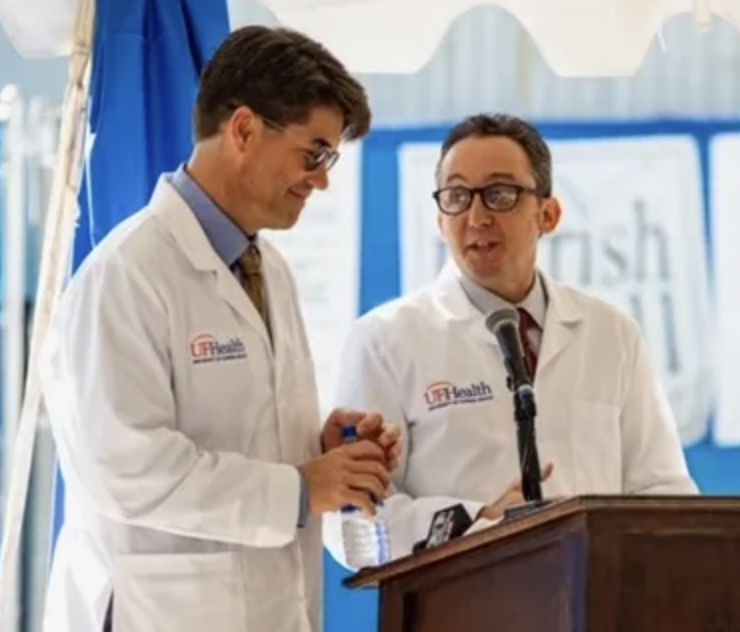
Profs. Kelly Foote (left) and Michael Okun (right) are (co-)directors of the Norman Fixel institute for Neurological Diseases and lead the UF DBS program in Gainesville, Florida.
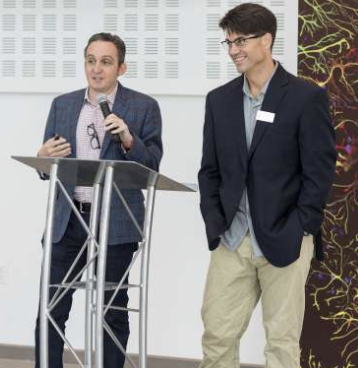
The two are used to “fluently talk” to each other and “gave a lot of talks” in the time when setting up their DBS center from scratch.
#25: Michael Okun & Kelly Foote – DBS Think Tank, Connectedness, Closed-Loop & Tic-Detectors
The tenth DBS Think Tank is about to happen in Gainesville, Florida next month – so it’s timely to talk with the masterminds behind it: Michael Okun and Kelly Foote need no introduction in the field & represent a role-model power-couple of how neurosurgery and neurology can join forces to build something unique. In Gainesville, they built one of the most important DBS programs in the world, essentially from scratch, after setting their minds to this goal during residency. We talk the concepts behind the Think Tank, their work on the DBS Tourette’s Disease registry, the importance of collaborations in the field and future / (present?) concepts such as adaptive DBS, their «tick detector» (about which we could already hear in episode #21 between Aysegul Gunduz and Julian Neumann) and the general future of the field.
Michael Okun & Kelly Foote 00:00something that Mahlon DeLong taught me, he showed me one of the papers that he and one of his students at the time named Miller, it's one of the original papers where you remember all the stuff that came out about the GPI being overactive and Parkinson's disease. And when it came to Tourette, I remember early on myself and then Justin Sanchez was with us for a while. We looked at a lot of the signals and he looked at a lot of animal signals. And then when Aysegul Gunduz came along, and she's the brains of the operation for sure, we got picked on some for looking at those signals. And even one of the reviewers on a grant really boldly questioned whether our signal was even real and wanted us to go back to raw signals too, getting back to the Sanjay Gupta thing. We went back to the raw signals and we realized that, again, we were focusing so much on the objective lens of the microscope. We zoomed out 50,000 feet. We can make a human tic detector off of the signal without even using that much 01:04trial just looking at M1-410. Even though what we do now is pretty crude, frankly, I think it's going to become more
Andreas Horn and more sophisticated. And we're going to, at some point, be able to do things that are augmentative and there will be an ethical dilemma. I think that this power is like a lot of power. It's a tool. And it can be used for good or it can be used for evil. Welcome to Stimulating Brains. Hello and welcome back to Stimulating Brains, this time episode number 25. 02:03In this episode I speak with none less than Mike Okun and Kelly Foote, who are the power couple of DBS folks in Gainesville, Florida. Together organized the think tank for the 10th year this year. The DBS think tank, probably one of the most important DBS conferences that happens on this narrow topic. We talk about a lot of exciting things. We talk about a lot of exciting things. And I think neither of them really needs an introduction. They're a really famous power couple. Started the Norman Fixel Institute together in Gainesville and essentially built one of the biggest DBS services worldwide there. Essentially from scratch, as we learn. And we talk about various things, efforts around connectedness, the think tank, setting up Tourette's disease collaboration database. And a lot of other things that I find really interesting. 03:00Also the interaction between neurology and neurosurgery in general and in Gainesville. So I'm sure you're going to enjoy this. Thank you for tuning in to Stimulating Brains, episode number 25. So Mike Okun, Kelly Foote, thank you so much for this interview. Thank you. And Kelly Foote thank you so much. you find the time to participate in this. Maybe to briefly summarize, Dr. Okun, you did your MD at U Florida and also trained with Mahlon DeLong and Jerry Vitek at Emory. And Dr. Foote, you did your Bachelor of Science at University of Utah, in materials and engineering and med school as well in Utah, and did surgery internship and residency at U Florida. So I
Michael Okun & Kelly Foote think you also in 2002, did some specialized training in Grenoble and Emory. So I read Emory in both of your CVs and
Andreas Horn 04:01thought maybe that's where you met up. Is that correct?
Michael Okun & Kelly Foote Dr. Well, actually, we were both residents at the University of Florida at the same time. So that's where we originally met. And the collision at Emory on our paths was engineered. That was after we had already decided when we were residents, that we were going to start a DBS program at the University of Florida. So I went to Grenoble. And then my last three months of fellowship time, I intentionally went to Emory where Michael was finishing his two year fellowship, so that we could spend that last three months together, scheming and planning and stealing everything we could from the smart people at Emory. Dr. Amazing. And in Grenoble, did you train with Benabid as well,
Andreas Horn who was a student?
Michael Okun & Kelly Foote Dr. Yes, yes, I did. And that's, we stole a bunch of everything we
Andreas Horn could steal from them as well. That's, that's the secret, right?
Michael Okun & Kelly Foote 05:01Dr. I like to use the term steal. I like to use the term import, you know, or export. So they exported their knowledge through us, but it's not a small, it's not a small point, you know, that, you know, one of the, you know, most important things in our careers has been our friendship. And, you know, they, we've been friends so long and respected one another at the bedside and seeing people, you know, when we were in training, even as a neurologist and a neurosurgeon. And then, you know, bringing that, you know, forward into our relationship over the years has, you know, kept our, our work marriage together, you know, for, you know, now we just on July 1, we just hit into our 21st year. Dr. Yeah. Dr. So we hit 20 years here together at University of Florida, but we've been, we've been at it for a long time. And, and, and we, honestly, we 06:03learned
Andreas Horn Dr. 20 years on faculty, right? Dr. 20 years on faculty, right? Longer than that.
Michael Okun & Kelly Foote Dr. 25 years previously, probably. Dr. Yeah.
Andreas Horn Dr. So how many DBS surgeries did you do together? Do you, do you know?
Michael Okun & Kelly Foote Dr. How many DBS surgeries? Well, we have a plaque somewhere when we hit 1000, I remember. Dr. Yeah. Dr. And that was a decade ago.
Andreas Horn Dr. Yeah, that was a long time ago.
Michael Okun & Kelly Foote Dr. So, I think we hit around 2000, but then at some point, so it used to be the... Dr. So first of all, let me just say for people listening, one of the most important things for me was a lot of times the neuro... Dr. the neurosurgeon will not let the neurologist into the operating room. Dr. And if they let you into the operating room, you weren't, you weren't necessarily allowed to talk or participate or anything. Dr. And so, so, you know, it was a privilege for me to come through the operating room and get a lot of advice. through Emory and then coming through the Emory program, we both came through that program and overlapped for, you know, three months during fellowship. And that really allowed us the 07:03opportunity to be together. So before there was anybody else here and, you know, when we started, there were only two faculty, just, just Kelly and I. And so I did everything, you know, botulinum tux and kids, adults, I mean, anything that had anything to do with movement. And, and, but over a number of years, we've trained over 70 fellows. And so I think we probably did the first 1500 or so together. And then, but now we have a bunch of really talented people who,
Andreas Horn you know, have trained here and other places that come to the OR, right? So it's not just
Michael Okun & Kelly Foote the Kelly and Michael show anymore. The last couple of years, it's, it's, it's expanded. Now there are 16 movement disorders, neurologists, and two neurosurgeons.
Andreas Horn Two including you?
Michael Okun & Kelly Foote Two including. Yeah. So me and my, my partner, Justin Hilliard. One of the amazing things is, is how he made it so many years as the only surgeon, you know what I
Andreas Horn 08:00mean? Like the volume. One man's amazing is another man's stupidity, right? Like that, that seems like a crazy thing.
Michael Okun & Kelly Foote In retrospect, I should have gotten a partner much, much sooner.
Andreas Horn Makes sense. Sure. Sure. So, so we'll dive into that a bit more, the neurology, neurosurgery
Michael Okun & Kelly Foote relationship, but maybe just to break the ice, for listeners to get to know you a bit better independently from work. I often ask about hobbies or things you do beside work. Is there anything either of you does that, you know,
Andreas Horn is interesting or doesn't have to be interesting, can be boring as well? Or do you do some things together beside work as well? Well, we, we do things together. Like we, we go eat
Michael Okun & Kelly Foote and our wives have been close friends for a long time. So we do things together. So we do things at the same time. So we do whatever they tell us to do. So various activities like that. I would say one of the unusual things in terms of hobbies that has kept me sane over the years is I've had 09:07a running weekly poker game for 25 years. It started with, you know, well, actually you used to play in the poker game. Even, even Michael Okun used to play in the poker game. He hasn't played for a long time, but it's, it's one of these poker games where, you know, once a week we get together at one of, one of the people's houses. And for us, it's, we drink wine and, you know, have a meal provided by whoever's hosting. And frankly, it's much more about the people than it is the cards, but, but there's a poker game that, that ostensibly, gets people together. So, so poker, I guess is one of my hobbies. And then I would say my other hobby is being outside. I like running in the woods, which is one of the things that's really 10:04nice here in Gainesville, Florida. I like going to the beach. I like, you know, hiking, that sort of stuff. Yeah. And I'll say, you know, over the years, we, we've spent a lot of holidays together with our families and his kids are older than my kids. I have younger. Kids. So we're, we, we have a, a little bit of a, we're out of sync on that, you know, and, but we've watched both of our kids grow up over the years, which has been great. And, and when our house got, you know, we had a huge leak and we had to move out of our house. We actually moved into the foot's house for a month, which was fun. And, and that's when I learned really what, how hard a neurosurgeon works. And then his kids started calling me dad because I was around more than he was. And so we, we, we have a good thing. And then, with my kids, we like to do history stuff and, you know, not, not, not unpredictably for people that know me, I love history. So we go around and look at history 11:00stuff and try to learn the history of things and find hidden stuff. And so we're kind of nerds in
Andreas Horn the Okun house. And it is, it is sort of an interesting relationship because Kelly would be
Michael Okun & Kelly Foote the more athletic, you know, you know, impulsive risk taker, you know, and, and, you know, I'm more the, the conservative historian nerd, but we, we, we, we, we fit together pretty well. Sounds amazing. We have talked about some turning points in your career already, but maybe do you want to highlight some of the key mentors or turning points that were important to get where
Andreas Horn you are now? Either of you?
Michael Okun & Kelly Foote Sure, I'll go first. So when I was looking for a place to train after medical school and neurosurgery, Albert Roten was the chairman of neurosurgery at the University of Florida, who, for any neurosurgeons who may be listening, they all know who he is. But he's sort of the guy who was largely responsible for us learning 12:04microsurgical anatomy and using a microscope to do neurosurgery. So he, he was someone that we all would have loved to train with. And I was, I was lucky to train with him. But when I started, it wasn't that common. I was lucky to have an engineering degree before going into medicine. And I wanted to exploit that and functional neurosurgery seemed like the, the, the obvious choice. And William Friedman was becoming chair and was a prominent person at the University of Florida. So he was one of my primary mentors. I actually did an enfolded stereotactic, and functional neurosurgery fellowship during my fourth year of residency with Dr. Friedman, and did largely research on radiosurgery. So that was my first research focus. And then 13:07he offered me a job. And at that point, you know, what I had distinguished myself in was radiosurgery. And he offered me a job. And I said, No, I'm not interested. Because if I come here, I'm just the other guy who does what the famous guy does, I want to go somewhere where
Andreas Horn they need someone like me. And he said, Well, what would it take to get you to stay here?
Michael Okun & Kelly Foote And I said, Well, deep brain stimulation is about to be FDA approved for Parkinson's disease. You know, it looks like it's a problem. And he said, Well, I'm not interested in that. And I said, Well, it looks like it's a problem. And he said, Well, I'm not interested in that. And I said, Well, it looks like it's a problem. And he said, Well, I'm not interested in that. And I said, Well, about to be approved. And Michael Okun and I are very interested in this. And, you know, what if you were to pay me as an instructor at the University of Florida, 14:00while I go to Grenoble and learn how to do deep brain stimulation from Professor Benabid.
Andreas Horn And then I come back and start a DBS program here. And interestingly, his response to that was,
Michael Okun & Kelly Foote that's a great idea. Let's do it. Right, which is not what you expect. The normal response to a question like that is,
Andreas Horn well, that's an interesting idea. Let me talk to the dean and see if we can get funding and,
Michael Okun & Kelly Foote you know, that sort of thing. But he didn't hesitate at all. He just said yes. And so, then, you know, in a negotiation when your first demand is this crazy, unreasonable demand,
Andreas Horn and it's immediately met, then you're on the right track. And then you're on the wrong track. You're on your heels, right? So, anyway, so I ended up,
Michael Okun & Kelly Foote Dr. Friedman was largely responsible for my going to Grenoble and learning to do DBS. 15:01And then I had at the time talked to Roy Bakay, who was at the beginning of Michael's two-year fellowship. He was the neurosurgeon at Emory. And I was going to join him for the last three months of my fellowship time so that we could, you know, work together, Michael and I, and get things ready to start the program at the University of Florida. And while I was in France, Roy Bakay moved to
Andreas Horn Chicago. And so, I had to decide what to do. And interestingly, now, you know, it's funny because
Michael Okun & Kelly Foote Bob Gross, who is now, you know, just an amazingly large figure in functional neurosurgery. At that time I had never heard of him and he was taking over for Roy Bakay and you know I was thinking oh I'm doing a traveling fellowship I want to study with the masters so I had to decide if I 16:01was going to go to Chicago or if I was going to go to Emory and study with this guy that I never
Andreas Horn heard of and Michael's idea was well if you want to study with the masters why don't you study with Mahlon DeLong and Jerry Vitek which was an interesting idea yeah yeah and and actually
Michael Okun & Kelly Foote what I ended up doing I did I did a a a little bit of a neurology fellowship for three months at Emory and that that in the end I think that gave me an interesting perspective that's been useful over the years to do those three months following Mahlon DeLong around and seeing patients in clinic with him yeah that was really useful and I think it also gives me the unique distinction of being the only person on the planet who has trained directly under both Benabid and DeLong yeah I so wanted them to win the Nobel Prize sure after they won the Lasker 17:01Prize yeah so that I could be like you know trained by them anyway so my mentors I've been very very lucky with my mentors they're they're amazing um and uh well yeah I've spoken way too much yeah I think the um I think you know at the end of the day it is really all about the lives that you impact and the people that impacted us and were generous with us along our road I want to be a history teacher and um and so medicine was a little bit of a of an offshoot you know of that and and um and you know but the path has been very very interesting and I think that's been a very very important thing for me to be able to take care of people and be a black bag sort of family practice kind of person and then I ended up loving the brain I didn't know much about the brain until I got to medical school and frankly 18:00for people that are listening Kelly and I are mainly clinicians you just like to take care of people both of us that's how we grew up we didn't grow up in a research environment even in our residencies and and the neurology residency that I went to had no movement specialists no Parkinson's specialists had about six or seven neurologists almost all behavioral neurologists famous figures Ken Heilman Bob Watson you know Steve Nadeau you know people that are known for behavioral neurology and how the brain works and spending an hour or two examining people so I learned from a I got a good core of how brains and circuits worked and then was able to apprentice with you know Mahlon DeLong and Jerry Vitek and at the time there were over 10 movement specialists at Emory it was the PICO Emory they had come from the University of Michigan and they were from Hopkins and and and then the peak ended kind of right as I left it like they all went off to be chairs of various places Jerry Vitek Ray Watts went to Alabama and now is the president there of the whole University of Alabama in Birmingham and Tim Greenamyre went off to 19:02Pittsburgh and has had a a story career and and just you know just some wild amazing like people were there and and just happened to be there at the right time and they were very kind to us and I like to say about me when Mahlon saw something in me I didn't see in myself you know and it was more the excitement and that's what a good mentor a good coach does and the excitement of learning about the circuits and then I realized okay I can do research but they didn't realize that you know if it's fun if it's something you're interested in then it's great then you're just asking questions and then people will pay you to answer those questions if you can learn how to write and I knew how to write because I came from the history of poetry and I knew how to write because I came from the history of poetry and I knew how to write because I came from the history of poetry background and um you know so we've made some good friends along the way but it's definitely been the people that looked out for us along the way and so we try to pay it forward as much as we can and I know you're doing so that that's amazing so did last question about the Emory time did you overlap with Cameron McIntyre because he was also 20:02a non let's say neurologist that made a neurological Fellowship there right Cameron took my office when I left Emory so we we uh we maybe uh passed um you know like as he was interviewing to come kind of do postdoctoral work with Jerry Vitek and uh and then he took my office after I left so um so and then like I had Rob Turner's computer like there's a whole bunch of people that all crossed in that and then and then Phil Starr was a little before us you know there in Emory so and then there's a whole club of pedigree of people and then if you look back on neurotree they they trace back this you know like to, you know, DeLong and then Everts and then back to Sherrington and some really famous physiologists and people. So there's kind of a whole pedigree of people, but that's the group that is kind of physiologic circuit-based groups of people. Then we all kind of think in some common circuit, or look at the circuit connections differently. That's why we have a hard time with understanding how transplants are just going to cure complex 21:15disease is because we're thinking in terms of the whole circuits and how complex they are. And so there's an old school of thought that came out of this Hopkins Emory place. And then Roy Bakay, who I was with before Kelly was there for a year and a half before he went to Chicago, is also a history of medicine guy, by the way. And we learned a lot from Roy as well. At a TEDxUF event in 2012, the two of you gave a talk entitled how to control the brain, which is obviously, I mean, control is a big word, but we do control obviously tremor and, you know, other symptoms with deep brain stimulation. So how, how much are we, you know, let's say thinking a bit towards the future and neural link and all these things, how much are 22:02we controlling the brain and then currently, and then maybe in the future. And then of course,
Andreas Horn is that even a good thing? And you also,
Michael Okun & Kelly Foote you talked about ethics in the talk. I don't know if Michael has the same experience, but every once in a while, someone will remind us of that talk. And, and I've watched it a few times over the years and every, every new time I see it, I become increasingly embarrassed about it. We went for pizza and beer after that talk. And we thought it was like one of the worst talks we ever gave. No, I did not know that. That was not my intention. I think we thought, we blew that talk, you know, like, and we went for pizza and beer at a local place called Paisanos. And the reason was, is that Kelly and I, we've done something kind of unique. There's a lot of unique things about our relationship, but one of the unique things is we actually speak fluidly together. Like, so we can get up on a lectern and, and sit next to each 23:02other and talk like fluid, like we can give a talk fluidly, like we've been practicing it forever. We've always been able to do that. And when we built the program at UF, there was no patients, there were no research grants. So we would have to go out and convince people to send us patients in, in their early 2000s. We gave a lot of talks. Yeah. There weren't like, you'd have to beg people to get on the table, you know, like for a DBS, I'll stick something in your brain. And, and so we spoke a lot together. So, so the, you know, the, the talk we, we, we were filling in for somebody, if the truth be known to your listening audience, somebody had canceled. And I think, you know, we were, we were, we were, we were, we were, we were, we and I think our wives, or Kelly's wife, was on the Performing Arts Center board and they said, we need a fill-in. And so they put us in and then I had to look up, I think you did too, what a TED Talk was, to make sure I understood what had happened. And we had to come up with one quickly. And we just thought that we really struck out on the talk, but over half a million people got on there, loved it. And the idea was pretty simple: your brain controls everything, we can control your brain. And we wanted to show 24:08very simply how you could do this from a simple disorder and then tease people and build them up. The idea was a bit of a tease. Like we would tease you by building you up like, oh, what if we got a little bit more complicated, a little more complicated. Then all of a sudden we show smiling or mood changes or memory changes. And then you're like, oh crap, you know, like there's like, this could get out of control. So we kind of like wanted to get to that point where we got people, you know, like, I think when we talked about it, we wanted to make people uncomfortable. We wanted to get people like excited and jazz, like, oh, we can control your brain. And not many people did do TEDx's or TED talks together. So, and we knew what the reasons is, it's hard to do. Right. So we thought it was horrible because we had given so many talks together and we thought, oh, this is like one of the worst talks we ever gave, but people enjoyed it. And I think, you know, the one thing that's interesting, you know, you write a lot of papers 25:00and books and chapters and communicate, but you know, like in that TED talk, like, citation wise, people cite that as being an important moment for the field where people said, you know, there has to be an ethical guiding principle. We came to that and we were able to express that better than you can express in a paper or something. And that's to alleviate human suffering. And, and it, you know, and as we head into the next era and the next generation and all the young people that are going to, you know, have to figure out how this field is going to go, you know, the, the, the idea of enhancement, brain enhancement and everything is going to be one that I know people are uncomfortable talking about it. But, you know, we got to talk about it and you can't stop it. You know, like there's too many countries, there's too many people. Kelly made this point and, and it's, it's we either deal with it and talk about it or we ignore it and we end up in a lot of trouble. I don't know if you want to comment on that, Kelly. Yeah. At the risk of sounding hyperbolic, I, I think that 26:06the ability to manipulate the function of the human brain even though what we do now is pretty crude, frankly I think it's going to become more and more sophisticated and we're going to at some points be able to do things that are augmentative and there will be an ethical, ethical dilemma. I think that this power is, you know, like a, like, like a lot of power,
Andreas Horn right? It's a tool and it can be used for good or it can be used for evil. It's like, you know, nuclear energy, right? You, you can, you can do wonderful things with it and you can do terrible
Michael Okun & Kelly Foote things with it. And, and I think this is a similar thing. I, I can remember a day, a specific moment
Andreas Horn 27:05when I had an epiphany. I, I was being interviewed by, you remember the magazine reporter?
Michael Okun & Kelly Foote I remember the day. So we, we were doing some, we had agreed to do this magazine article. Oh, it was, With David Noonan and Smithsonian.
Andreas Horn What was the magazine? Smithsonian Magazine. Yeah.
Michael Okun & Kelly Foote Was doing an article and they came and just sort of hung out with us for a week. And, you know, just were constantly with us and, and, and now I'm nervous.
Andreas Horn About that sort of arrangement, because of course they want things that are interesting
Michael Okun & Kelly Foote and fascinating. And so, you know, whatever the most outrageous thing you say in a week's time of being, you know, talked to, that's the thing that's going to be used in the article. And, but anyway this very insightful Smithsonian Magazine reporter 28:00at one point asked me this question about augmentative neuromodulation. And I said, no, you know, we, we would only ever, the risk is, is unacceptable for that sort of application. Like you know, no reasonable person would ever use this sort of surgical intervention for augmentative purposes. It's only, it's only used to treat pathology. And he sort of turned it around and he said, well, you know, you've just told me over the last several days that, you know, the. The. The risk of this intervention has, has gradually diminished over the course of, you know, the time that you've been doing it and.
Andreas Horn Yeah.
Michael Okun & Kelly Foote That the risk is becoming more and more acceptable and that the benefit is actually improving as well.
Andreas Horn And it seems like that ratio is trending in a direction where, you know, at some point it might be reasonable. And the, the, when I had the epiphany was, he said to me, think of the plastic surgeons, right?
Michael Okun & Kelly Foote 29:04Think of these, this field that began. As reconstructive surgery for people who had disfiguring problems. You know, they got good at their craft and they got to the point where the risk was, was acceptably low. And, you know, unfortunately there's a, there's a market. That drives. And I just realized, oh my gosh, this is going to happen.
Andreas Horn Yeah.
Michael Okun & Kelly Foote This is going to happen at some point.
Andreas Horn Yeah.
Michael Okun & Kelly Foote And I'll just add, I was just looking up here because this is like ancient. History, but when David Noonan was with us for the week. You know, Kelly had this enlightening moment.
Andreas Horn And what's interesting when he wrote the article, we ended up on the word of the day.
Michael Okun & Kelly Foote There's a, there's a, a famous website called the word of the day. And that the word that, that, uh, this is probably our greatest moment. Not any paper we ever wrote. It was being part of the word of the day. And the word of the day was Satori, uh, which means sudden enlightenment or intuitive understanding. 30:03And so they use the term. Satori. Um, And, and the, in the article, uh, about the pathways and the complexity of the, of the brain. But, um, but there was like this moment where we both thought, you know, plastic surgery didn't start to enhance, you know, people, you know, like it, and it gets there. And then we thought, oh my God, you know, this is really going to happen. This is going to happen. I mean, I would even think if, if we have this neural link implant that you can just control your cell phone with, I think that's the first. Concept. There will be a crazy enough person that just wants it, you know, because a geek that has the money or so, and go to an oil platform to get surgery. I, I will, I also, I agree this will happen. Right. And, and, uh, it is, it is dangerous. Um, but, uh, also really exciting. Uh, People won't talk about it though, Andres. And when they did the film hunting for Hedonia, they, they did a series that, you know, we 31:03almost helped them there, you know, kind of. Narrate it throughout the series.
Andreas Horn Yeah.
Michael Okun & Kelly Foote Throughout. And so they did a series of interviews with a number of people in the field and Kelly was talking about it openly and people didn't like it, you know, like they, and it made people nervous. And then Kelly said, oh, you said, I don't know, maybe I like was, you know, and I said, no, I mean, like, we got to talk about it. You don't bring the dialogue then, you know, we're, we're going to have more problems by not having the dialogue. So I, I have applauded him for really continuing to.
Andreas Horn Yeah.
Michael Okun & Kelly Foote To make his colleagues uncomfortable, you know, by, by saying we need to have this discussion. Super. Maybe for the listeners, that's a, that's a great movie. I think hunting for Hedonia, you, you played a big part in it. I think the private team was also part of it and some other, um, worldwide, I think it's kind of based or leaned on the book, uh, the pleasure shock, um, that, um, the author of which we also interviewed in the podcast actually about Robert Heath and also 32:00the history. So definitely can recommend that, um, for the listeners as well to, to watch.
Andreas Horn Yeah. Okay.
Michael Okun & Kelly Foote So, so I did bring up the, um, in part to you, Kelly embarrassing Ted talk only, or mainly because I wanted to talk, I think in the beginning of that you said, um, and I don't think it was embarrassing by the way, for the record, but, but I think in the beginning you said something like we're neurologists and a neurosurgeon and we, we can talk to each other. Right. So that was the key thing I wanted to, um, go into a bit more. You're a power couple. You've you've been managed, you know, we've talked about it a bit already. So, um, but I wanted to ask some more questions just to, to, to highlight that, you know, unique situation you have being close friends, but also this July marks the third year anniversary of the Norman Fixel Institute that the two of you built together, um, kind of from scratch as far as I understood. Um, and, um, so I great, you know, history, uh, as friends and colleagues, if you had
Andreas Horn to compare yourself with, let's say Lennon and McCartney, who, who would be who and why?
Michael Okun & Kelly Foote 33:04That's an easy one because, uh, when I, when I was in college, um, everybody said, and I had a little bit longer hair and everybody said, I look like Paul McCartney and people still say I have a resemblance to Paul McCartney. There's even some things that have gone around the internet with the, with the faces, particularly when he was younger. And now, uh, you know, I'm, I'm a little more seasoned than I was before. So, and I used to, um, work out in the morning, every morning I would get up at five o'clock I would go to the gym. I would go to the gym. I would go to the gym. I would go to the gym. I would go to the gym. I would go to the gym. I would go to the gym. I would go to the gym. I would go to the gym. I would go to the gym. I would go to the gym. I would go to the gym. I would go to the gym. I was younger and I would go for a workout. Next to the gym was a Starbucks and I would cancel my workout every morning, you know, with a latte or it was like, it was like a one for one deal. You know, I'd work out at 5am and then I would cancel it. And every morning until that Starbucks closed during the, you know, when the market crashed, they had to close a bunch of their locations every morning for several years. The woman would write Paul on my coffee cup. And then when it closed, I finally said to her, I said, you know, after all those years 34:02that, you know, my name's not Paul. And she said, I know. I just, you know, like you were reminding me of Paul. I was like, yeah, I think I'm the Paul McCartney character.
Andreas Horn I mean, what do you think? And you're more willing to do, to do more, you know, drugs publicly. So you're probably more like Lennon, right? Yeah.
Michael Okun & Kelly Foote I mean, I, I think not just because he looks like Paul, but I think behaviorally that that's sort of an apt analysis as well. Um, I will say that in some ways. He has what people would consider the neurosurgical personality. You know, Michael is always, uh, the, this is good. Let's do it. Let's go right now. Get it. You know, let's send this in. And, and, and I have always had sort of the, the more, uh, careful methodical, wait a second. 35:01Let me read this over one more time. I don't, I'm not sure this is ready. Um, so, and I think that in most cases, those roles are reversed. So, so he's, he's the fast mover and I'm the one who's trying to say, Hey, hold on a second. The joke in the last laundry is that like, I'm the dreamer. Like I wake up and I get to work and I've thought up some idea. And then Kelly's like, if I'm not careful, I'll put a grant in and I'll end up in the operating room, trying to figure out. How to make something work. That doesn't really work. You know, like it doesn't like, you guys are going to get like, cause we're, we're kind of always thinking out a few steps out in front. And so there have been circumstances where we've gotten there and realized, you know, that we were ahead and that certain capabilities aren't there yet. And then, but Kelly was materials engineer. So my response to Kelly is we'll figure it out, dude. You know, like just like, you know, like, like it should be possible. 36:01We should be able to do it. And so. So this has been the heart. I mean, it's a good summary. The heart of the relationship is I kind of wake up in the morning, you know, with all these kind of new creative ideas, we go in and we try to innovate it. But Kelly has never said, you never kicked me out of the operating room. He's never said, oh, Michael, you're completely crazy. I mean, you know, we, we walked away from a lot of projects and things, you know, like as we've thought them through, but we've always, we've always taken the time at, you know, to like the loss of eyes through. And, you know, and, and think about even if we didn't do stuff and there are grants and projects that we didn't get that we look back at and we say, gosh, I'm glad we didn't get that grant. That probably wasn't a good idea to do that. And so, so, you know, and, and people should know that and wisdom that not all decisions are perfect and, and you gotta, you gotta work through them.
Andreas Horn But, but yeah, Kelly's right.
Michael Okun & Kelly Foote It's a little bit of role reversal, neurologist, neurosurgeon.
Andreas Horn Interesting. Who would be captain Kirk? Who would be Spock? 37:00Who would be Kirk? Who would be Kirk and who would be Spock?
Michael Okun & Kelly Foote So that's an interesting thing because I think there are two ways. And, and that, so I think in some ways, but for the reasons I've already given, I would consider myself more of the Spock figure.
Andreas Horn And of course, Michael is the one that everyone knows, right?
Michael Okun & Kelly Foote Michael is, is out there interfacing with every single person on the planet. And I'm, you know, I'm not. I'm not, you know, doing my thing here and trying to reign him in to some degree, which is an impossible task. As you, as you know, he's, he's unregnable. But that's, that's one of the amazing things about Michael is, you know, I think this happens to most of us, you know, you, you'll be engaged in some clinical activity. And you'll have this idea and say, you know, I'll bet we have data that we could use to answer this question. 38:08You know, we should look into that. Right. I mean, that I'm sure that happens a lot. But the difference is throughout my career, whenever I've done that, the next week, someone comes up to me with a draft and says, hey, I did it. You know, I've looked at the data. Okay, well, well. Here's what we have.
Andreas Horn You know, what should we do now?
Michael Okun & Kelly Foote And so, like, so many of those ideas that I think most of us have just because Michael's around get executed. He is, he is a person who executes ideas. I mean, to an amazing degree.
Andreas Horn Yeah.
Michael Okun & Kelly Foote I mean, I think I would say, you know, because he's avoiding your question, I would say that, that he doesn't realize it, but he's, he's definitely the captain. Like everybody, all the fellows that come in, we trained over 70 fellows, all the faculty, 39:03everybody has ultimate respect for Kelly. And the one thing that people don't know about Kelly Foote is there's this dig on stereotactic surgeons that they do stereotaxy because they like the Greek Cartesian coordinate system because they can hit anything from outside the brain. But if they get inside the brain, they get lost, you know, and they're not great surgeons. And one, I don't think that's true. But two, I, you know, he is the hand surgeon, like even within the group here at UF. So if you have something really bad, a brain tumor stuck somewhere, if you need somebody that takes their time, that does it right, that has the highest Press Ganey satisfaction ratings for anybody in the institution, I mean, even higher than any of the neurologists that we have in our department, it's this guy, like he spends more time with patients and families. And so he's the captain for sure. I mean, people follow him, you know, by, by, by example and by respect. 40:04And when they graduate from here and they, and he stops and he's teaching all the fellows, even if they're neurologists, he's talking to them and PhDs, we have programs. So, so he's definitely the captain. And then the other thing probably that people don't know about me is I'm a born introvert, you know, so even through elementary school, he, I had talked to my parents. I'll tell you, I didn't talk much at all. Like I was always the quiet kid in the back of the room that when, and I'd have to be, you have to like prompt me to say anything pretty hard to believe now, right, Kelly. But, but, but so I had to learn, it's not natural for me to be out there, but to get registries going, to get data together, to get groups to work together, I've learned the connectedness as a compensation strategy, because it's not my normal like thing, but I realized to get things done. You got it. You got people moving and connected. And then maybe that's also helped me as an observer of the world, because I, when you 41:00don't say anything, you observe everything. So I don't know.
Andreas Horn Interesting.
Michael Okun & Kelly Foote So he's like, no, Adam, let's talk about that a bit. So, so I think one, one big thing you both organized, maybe especially you, Michael is the DBS think tank. And I think it's going to be the 10th edition this year.
Andreas Horn Is that correct? So it's 10 decade long effort. How did that start? What is the significance?
Michael Okun & Kelly Foote I think it has a tremendous significance for the field. It is in its 10th consecutive year. It's survived hurricanes, two hurricanes, tropical storms, the, the COVID, but it, but it has happened either on zoom or in person, and this will be the 10th year in person. It actually, the birth of it comes from the, the.
Andreas Horn Yeah.
Michael Okun & Kelly Foote The idea that really great projects come when you take experts and you lock them in a room together and you tell them to check their egos at the door and try to get things done 42:04and collaborate and maybe even provide some resource and get people to share data. They wouldn't normally otherwise share, get people talking a lot of these people, you know, they're, they're all our friends. And maybe they didn't all start our phones, but you know, they're all, we all respect each other and maybe friends isn't even the right term. We're all colleagues. Some of us are friends, but the more that we'll talk to each other and share with each other, the better chance we have of moving something forward for the field. And Rick Saab, who's the CEO of Tyler's Hope for Dystonia Cure. We first started doing think tanks with Rick when there are just not enough people in Dystonia. And so we would bring the top people in the world. We fly them here to Gainesville, Florida, at the University of Florida, and we would put them in a room. And, and, and. All right. So we're going to do a little bit of a talk. We're going to do a little bit of a talk. We're going to do a little bit of a talk. And, and, and a lot of these people, friends would not be the term I would have put on them when that started and, you know, sharing animals, sharing things together. 43:03And, you know, over the years we've been able to get people to break down barriers, walls, get a lot of grants, get a lot of great researchers come out of that and get a group of people together. So it started with Dystonia. We moved it. And as a group, we realized, you know, you have certain things you're good at, and maybe our group superpower is connectedness. And so we leaned into that and we've had a couple of different think tanks. And then the DBS think tank is going into its 10th year. The PICSEL campus that you mentioned, we started as a program 20 years ago, and now we have a campus, an independent campus. One of the goals we have for the campus is to create a conference center place where people can come in and we can lean in and do more of these things.
Andreas Horn But the idea is not just to address the science. We all love the science, right?
Michael Okun & Kelly Foote But we didn't realize. We didn't realize that there are ethical issues. We didn't realize there are policy issues. We didn't realize that we could come up with all this hardware and people might not actually 44:00be able to get the hardware. And then we realized there are real lives and there's a real impact to a delay. And so if there's from point A to point B, if you can shorten that down and different people can be doing different parts and we can appreciate each other for doing the different parts and not reduplicating. We can actually move things along faster. So there's a whole bunch of things. And then just the idea of fighting and cussing and getting in a room and getting real with people. That's my role in the think tank.
Andreas Horn Yeah.
Michael Okun & Kelly Foote My role in the think tank is to generate controversy. Kelly's a grappler.
Andreas Horn Yeah.
Michael Okun & Kelly Foote But something magical happens when you get a bunch of smart people in the same room who are heavily invested and care about the same stuff.
Andreas Horn Yeah.
Michael Okun & Kelly Foote 45:02room talking about this, the stuff that we're all passionate about, something magical happens. And that is by far my favorite meeting of the year. And it has been every time we've done it. When we first started that first time, it was amazing. And there were, we said, we're going to have less than 30 people by design in this, in this room. And the, to be honest, that was our plan from the beginning. We said, we're never going to have more than 30 people at this meeting. It's just going to be a, you know, a little meeting. And then it became impossible to make it less than 30 people. So now the format of the think tank has evolved over time to this hybrid meeting, where now we, we have, I think, less than 50, we try to have less than 50 people at the table. 46:00And, and, and, and you've seen it. I love it because we do these UN style microphones, where you have to activate your microphone in order to speak. And only four of these,
Andreas Horn you know, 30 microphones can be active at any given time. And so my measure of how interesting
Michael Okun & Kelly Foote the conversation is, is how many people are smashing their microphone, trying to turn it on. And, and just the key to that meeting for me is we have made an absolute rule that we will never spend more time on presentations than we do on discussion. Most of the meeting is dedicated to discussion.
Andreas Horn And the presentations really, their primary role is to initiate the interesting discussion,
Michael Okun & Kelly Foote because the discussion is where the magic happens. And, you know, when we go to most of the meetings that we go to, people make presentations, 47:00and there may be a minute or two at the end where you get to have a little conversation.
Andreas Horn And those are usually the most interesting part of the meeting.
Michael Okun & Kelly Foote And so usually that's not enough time.
Andreas Horn And so this meeting is designed to maximize that, which is why we love that one.
Michael Okun & Kelly Foote Yeah. And, and, you know, and really, you know, there's an opportunity to bring forward science. There's a, oh, gosh, I have to complete a thought because I left it out. It's important. This is part of our relationship. I mentioned, that it was, it's a hybrid meeting.
Andreas Horn So that now it's set up so that in person, what we, what we try to do each year is say, okay, who's doing the most interesting, impactful work in neuromodulation right now?
Michael Okun & Kelly Foote And let's get those people in the room if we can. And, and so we invite as many of those people and we get as many of those people in the room as we can. But now, you know, there are so many invested people that it's ridiculous to, to, to not let people participate and experience it. 48:09So the rest of the meeting has become a Zoom accessible meeting. And even sometimes you can, as a Zoom participant, if you have something good to say, you know, we, there's a way that we've curated so that, you know, we can put you up on a screen and you can have a temporary microphone.
Andreas Horn Yeah.
Michael Okun & Kelly Foote And, and participate.
Andreas Horn Yeah. Yeah.
Michael Okun & Kelly Foote And you can participate as if you were sitting there. But the truth is, it's harder if you're in the Zoom crowd to, to be as involved in the conversation.
Andreas Horn Yeah.
Michael Okun & Kelly Foote But, but if you, if you have too many people, it's, it's cacophony. And you can't have a meaningful conversation. But it's culture too, because one of the things that's important about the TINK is we've, we've encouraged people to show unpublished data.
Andreas Horn And what's really interesting, Andres, is that.
Michael Okun & Kelly Foote You know, that's a risk, you know, like that, that a lot of scientists worry about, you know, things getting stolen and all this stuff. 49:08And in my mind, and it's all culture. And when we built the Institute here from two of us up to a hundred and something, it's all about culture, like how people treat each other and everything. And even creating culture and creating safety is unlocking and letting people interact and everything. And so people, even as the meetings become more and more open, people are still willing and excited to show their.
Andreas Horn Yeah. Yeah.
Michael Okun & Kelly Foote And starting to realize, what's the price of not sharing your data to people with the disease? There's a price that society pays for that. And so getting over ourselves and being able to do that. So one of my biggest fears going forward is, as you know, more people jump on with the Zoom and want to be part of it, it's great, keeping that still the core of the, like, we're still going to really challenge each other and say, well, that's dogma,
Andreas Horn like why do we you know maybe that's not right and um and continuing to share things that other
Michael Okun & Kelly Foote 50:06people haven't seen and not worry so much even if somebody does try to jump out you know and take your data or run with it try to worry less about that and more about the societal impact of why we're at the table it's hard yeah so it's it's a tough tough balance i totally agree but on the other hand i would probably perceive that too that with you know preprints and you know a bit more this culture shift towards um potentially open science open data it might also be in the right time and you know there could be this random person from some country you know see it replicated really fast and publish it but then is that really being scooped though you know most of the things are probably you can still publish them and if you do it better than you know so so um but ! it is a cultural change that needs to happen that that is happening and uh you're right at it 51:00with the covid and um zoom uh hybrid event so i must say for me i i only participated um via zoom so far once as a speaker which was a big honor and it was it was amazing to um to just listen in and essentially that he made it open i think there's so much benefit for so many people how many listeners did you have on zoom i think it was thousands right um or a lot of people yeah yeah ! come on but you know we want people to share and you know and i'll just say for anybody that's
Andreas Horn listening to this podcast most of the time when somebody takes your stuff and we've been victims
Michael Okun & Kelly Foote of this too you know where you show yourself somebody takes it even if they do it science needs to be replicated and usually they'll they'll give some half-baked you know paper on something maybe they're first but a lot of times you know the first mouse you know the first mouse you know the first mouse you know the first mouse you know the first mouse you know the first mouse gets caught in the trap they get the cheese but they get caught in the trap so you don't tell you you know like and a lot of times it's half-baked and and as anybody and and he's we should all know 52:03better as scientists you know when you work on something for a long time and you really work it out well and you write a really good paper that's the meaning of it and the rest is sort of you know kind of you know noise does it continue to replicate across the field and i think we like you said i i think we we we worry and there's too much of this race you know the the the the the is it to be first or is it to be right and impact society and do it in a non, what I call, half-baked way? And most of these, like random people that try to scoop, they're half-baked and they come and they go in the field. There's no story there for their groups. They just jumped in and jumped out. And they play a role in just providing Google-level data to say, you know, Andreas was right. It's kind of like, that's where we're right. But let him explain now that he's been doing this for years, like how this actually works in this network. No, I totally agree. So, so that's, yeah, I once heard, I think one of my mentors said, 53:05it's, it's, you know, better to, it just doesn't matter to be first, but to do it best, right. Yeah. Don't ever say you're first. So that, that helps you, right. That's a good coaching method because you probably aren't probably lots of people probably appreciated it, but they never published it. Absolutely. Yeah. Super. So moving forward, similarly, probably originated from think tank is that Michael, you're the founding PI for the international database and public registry for Tourette deep brain stimulation, which again, I think a major effort that helped the field tremendously. Can you speak a bit about that,
Andreas Horn maybe challenges, but also what came out of it so far, what the plans are?
Michael Okun & Kelly Foote Yeah. I mean, just for folks to know that there there's a disease, you know, that, that is very common called Tourette that you can have motor tics and phonic tics and all sorts of behaviors like obsessive compulsive disorder and ADHD and can be very disabling, although it's a 54:06very common disease. So a lot of people are not necessarily disabled by a big delay in diagnosis. And then there's a group of people that their lives are really impacted by that. So a small group within that, you know, larger, you know, swath of people that have tics and behavioral disorders that really have no options. Some of which might, you know, have such bad tics that their neck moves back faster than what happens in a car accident and, and can cause spinal cord injury. They can have self injurious issues. You know, they can have social adjustment issues. You can imagine with, with, with tics. And so, over the years, a number of us have been interested in those circuits. And so in my lab, I actually started my career focused on Tourette, on Parkinson as a paroxysmal disorder that, 55:01you know, there must be a physiology. Remember we all came out of this DeLong circuit based, you know, you know, almost like, you know, group of, of, of people that were interested in, in where the circuits and how and the why. And so to me Tourette always fascinated me. There must be a paroxysm of physiology.
Andreas Horn And so could we track it down?
Michael Okun & Kelly Foote And so through a series of NIH grants over a number of years, pulling in all sorts of people to Kelly, what's been the whole way along with the lab, Aysegul Gunduz, Justin Sanchez worked with us in the lab before he went to DARPA, did some of the early physiology work with us when he was at university of Florida. You know, we've sort of been on this, you know, kind of unpopular and difficult area. And a lot of people didn't go into Tourette, even in the stereotactic and functional area, because it's the management of the folks and the families and everything is so difficult. It's a very tricky management as well. And so people shy away from that. 56:01There's a great article by Joe Jankovic showing that the majority of telephone calls in the movement disorders clinic come from Tourette. And so, you know, it's kind of like opening Pandora's box, but these people really needed help. And so it's something I've been passionate about, and we've been developing physiology as to why, and trying to, trying to develop it from voluntary movements and, and tic movements and showing the different physiology is trying to develop some closed loop and open loop technologies and duty cycles. But somewhere around, you know, 2010 or so, you know, Tourette syndrome association became the Tourette association of America, their board, half of their board was like, this looks super like, cause they didn't have any options for these people. And half of their board was scared. And, you know, cause they thought if you wait long enough, kicks are going to go away into the twenties. And so they had a huge, you know, kind of, you know, fight among amongst themselves. I don't know if it's a fight, but disagreements and normally, 57:01because they wanted to protect people. And so they came out with a guideline. Um, it was led by John Mink and there was a lot of John's great. I mean,
Andreas Horn obviously fantastic scientist at the surround inhibition model of Tourette.
Michael Okun & Kelly Foote And, um, but they, you know, kind of delayed the, um, the age of, of onset to, to be able to give DBS to 25, cause they didn't know,
Andreas Horn would it be safe?
Michael Okun & Kelly Foote You know,
Andreas Horn would it go away?
Michael Okun & Kelly Foote Um, and a lot of debate and we all got together in Italy, somewhere around like Como. I have faint memories of, of that probably because of the food and, and, uh, and wine were so good. And, uh, there was a lot of debate during that time. A lot of people going to TV stations, a lot of hype, uh, you know, I mean, it just was like, it was crazy. And so, um, we decided what if we could get everybody together and no single center is going to be able to implant enough patients to, to, to get a randomized study together.
Andreas Horn So if we just temporarily give up on that idea, 58:02what if everybody just gave their data into a central registry?
Michael Okun & Kelly Foote And so, um, so we proposed it to the Tourette association of America, um, try to get some matching funding, read some grants. And then we were able to offer, uh, anybody in the world that wanted to contribute the generous contribution of no money because we didn't have any reminds me when we started our lab, we spent all our money on equipment, $150,000. That was our startup package. We spent it on equipment. So we had to get students to volunteer in our lab for many years because we didn't have the money. And, uh, here in Tourette, we had to get people to volunteer to give us their data. And it comes back to the connectedness equation. People were willing to do it. We, we got enough data together and, and, fast forward now, a dozen or more papers. The group has been working together, publishing. We've been able to get some much better guidelines out there. We have a publicly available data database that was put out in JAMA Neurology, and a lot of good imaging and predictor models have come out. We got more images than we thought. And I'll tell you, Andreas, when we started the project, the goal we wrote the first grant was, could we get 30 good cases together? Okay, could we just get 30 good cases? Maybe 59:17we could help the field and what happened is now we have over 300 registered and we have a lot more because people are sharing it they can see it in real time it helps people in management and like kelly foot says like they're the intangibles like people say oh you're looking at all these pictures the intangible is probably the most important thing on the project the intangibles that have happened now people know what to measure you know what to who to select what to measure you know like just the little things that actually change the safety and the trajectory of this disorder as we move forward have been really you know important for the field and now we have enough data that we've been talking to regulatory agencies around the world to see you know can we get to some sort 01:00:03of approval we've been writing ethics papers because we've got all sorts of ethical dilemmas now we have a disorder we know can help or a treatment that we know can help a disorder maybe even stop somebody from having a bad injury like a spinal injury and we've where the regulatory systems are 20 or more years old in the u.s and in other areas we've got to figure out how to navigate that how to navigate you know payer systems how to navigate insurance and and there's a problem across every country in the world and we have another common paper coming out with um early visit and you know in uh cologne and nature medicine talking about this and ocd and you know we could blame the payer systems we could blame the insurance companies we could blame the countries but then you start to look at it it's a worldwide problem where we can't get access to people with these small diseases and so we become really interested so there's another intangible of these registries that it's helping to push the dialogue along 01:01:05because think about it close your eyes and think about the world we live in when we can have a therapy and your kid has something in there or your you know or your child has something they
Andreas Horn can't get it it's a problem so it is a big problem and interesting i guess that the network itself
Michael Okun & Kelly Foote strengthened probably with that database as well right now you have you have a a group of people that have have a shared voice you know that that you're leading there so that that might also be a really great benefit beyond all the signs of it so yeah it's hard to measure that in number of papers or whatever but i think i don't know kelly what do you think you talk about i mean intangible benefits like i mean the truth is scientists in surgical neuromodulation of the brain have the problem of low end right this is this is our life we don't have enough power because we just don't do enough of it yeah statistical power you mean right statistical 01:02:05power right so so so you know the registry is is an approach to deal in these disorders where we're not going to have enough power to say something that is scientifically meaningful about this disorder unless we all get together um and so you know i i think that that's
Andreas Horn what probably the genesis of it um but you know interesting things happen when you create a
Michael Okun & Kelly Foote registry um a bunch of smart people get together and say well what what's the data that we should try to gather and we're not going to have enough power to say something that is scientifically meaningful about this disorder right so we have to generate a form to fill out right for each patient who has surgery for this disorder um if you have this data please fill it in right so we send this form out but but a bunch of smart people got together to create that form and then when we 01:03:03send that form out people who are doing this say oh gosh i wasn't collecting that data but perhaps i should yeah and so it's this subtle way of of encouraging best practices by asking for the data that we think you probably ought to be gathering yeah um and you know uh you may or may not know this but functional neurosurgeons and neurosurgeons in general don't like to be told how to do things yeah that's probably the line of the podcast you want to say that again well i mean it's really one of the sort of ridiculous things about our field is we don't tell each other like this is a better way than that you know and we all do things the way we do that we're all smart people we all do things the way we do them because we believe they're the
Andreas Horn 01:04:01best way but we don't talk enough together about why we do the things the way we do them
Michael Okun & Kelly Foote and you know it's i think we do a relatively poor job of sharing best practices um because where people target or how they target you know which corners which landmarks they use yeah that's a good point yeah but i will tell you this you know the counterpoint to this that i love that i didn't understand 20 years ago that i understand now is the variability in how people do stuff when you actually don't know what the answer is this this is like the wisdom like of being around when you don't know what the answer is it's actually good yeah you are doing it even if they're even if they're totally you know like there's no way and they're they're married to their way and then as long as they're willing to share the information and then you can look at that variability you can learn from and i remember kelly and i had a grant with a very famous surgeon and uh and and you know we were testing a method and i won't give you the details because i don't want to out the person but 01:05:03but you know like part the way through the grant we ended up it ended up a huge failure because they decided like you know like they were sure their way was right and then at some point during the grant they were like oh my god i'm not going to do this i'm not going to do this i'm not going to they pulled back and decided, oh no, I don't do it like that. I would never do it like that, because when you're assessing the risk of things, that's good. Of course it's hard to lose a grant or to lose a paper, to lose an idea. But on the flip side, when you actually put it to the test, you see, like people say, you can't change people's minds. Well, maybe that never makes it to the light of day, but certainly the idea that sharing best practices and putting them to the test certainly changed minds and then over time that the idea of how people do that has changed in the field and and and i think this is a very good very credible person and and i and so i i i would also say to people that you can change minds you know and uh and i think it's an important 01:06:02part of the journey absolutely well said so speaking a little bit more about tics i i heard um kelly actually you'd give a talk in china might be shanghai or beijing about a tic decoder and we also had Aysegul Gunduz that worked on the podcast before but can you maybe summarize either of you but maybe you can start kelly what that work is about and um also maybe pivot that to closed loop DBS in the future with neuromodulation um sure sure well um it let it be said from the outset here that Aysegul Gunduz is the brains behind this whole thing right she's the one who is able to figure it out um and uh the tic detector uh is this uh amazing thing i i can tell a funny story about Sanjay um as part of this right he and i can't remember which top what version of that talk i gave that 01:07:04you might have seen but but um in one version of that talk i show a video of Sanjay Gupta because he came and visited our OR and did an episode of his TV show on CNN i can't remember his he has a he has a medical TV show called Vital Signs and he did an episode and you know um we it was our second case of Tourette where we were implanting cortical strips um for contact cortical strips over the motor area and then um central median nucleus of the thalamus deep electrodes bilaterally and plugging them all in at the same time so 16 channels of a uh of recording continuously in an awake behaving person with Tourette syndrome so we were super excited about you know what we could do with this um anyway um we're and and we're all kind of huddled around the microelectro recording machine 01:08:09um and looking at the raw signals and and um at one point on the TV show the cameras comes in close on Sanjay Gupta and he points at one of the lines on the machine and he says you can see right here when she tics you can see the signal change you know and and we all just sort of rolled our eyes like thinking they're like yeah of course you can
Andreas Horn can see in the raw signal that you know exactly what's happening you know um and we could because
Michael Okun & Kelly Foote what we were used to was recording signals in the operating room taking them back to the lab post-processing doing a whole bunch of stuff and then maybe a couple of months later saying hey there was something in here yeah uh you know so that's what we expected and i'll be damned if Sanjay Gupta wasn't completely right the signal was so strong in the raw central median nucleus 01:09:04of the thalamus signal that it was tightly correlating with that that low frequency activity was correlating with tics and not correlating with voluntary movement so i mean it was such a cool moment when we realized this and um you know if there's ever any question of whether the central median nucleus of the thalamus participates in the circuitry of disorder i can tell you unequivocally and absolutely it it is part of that circuit because this tic detector is just so reliable yeah um then you don't need any statistics right if you can see it in the data i think peter brown said that it was super easy it reminds me of um something that malin de long you know taught me where he showed me one of the papers that he and one of his students at the time named miller it's one of the original papers where you remember all the stuff that came 01:10:03out about the gp i being overactive and parkinson's disease and then the primate and so they they wrote about it and everything and then it'll show you the paper and i have the picture sometimes i show it to the students here and they totally missed the pattern change like at first like they saw the rate that they totally missed the pattern and you know and you look at it you're like there's no way like how could you not see there there's a pattern you look at it you know but you know like you see what you want to see in the data there are famous scientists that have said that and and when it came to Tourette you know i remember early on myself and then Justin Sanchez was with us for a while we looked at a lot of the signals and he looked at a lot of animal signals and and um and then when Aysegul Gunduz came along um and she's the brains of the operation you know for sure you know we got picked on some like for looking at those signals and even one of the reviewers on a grant um you know really boldly questioned whether our signal was even real and um and wanted 01:11:04to get back to raw signals too getting back to the Sanjay Gupta thing we went back to the raw signals and we realized that again we were focusing so much on the objective lens of the microscope but we we zoomed out 50,000 feet and John Shute who was in the lab i think he works for boston scientific now at the time you know some of these kids are really smart john was a really smart guy you know he was able to as we had the discussions in lab group go home literally within a day or two pop back up and say look you can we can make a human tic detector off of like a signal very i mean without even like using that much you know trial just looking at m1 cortex and
Andreas Horn and entalamus and so it is a it is a really interesting moment and of course as you think
Michael Okun & Kelly Foote about closed loop you know you think about that but it's not just as it's like you say when somebody can steal you know some piece of this there's a there's a 20 years worth of this that's been going on and in our collective laboratories you know and then being able to separate voluntary tic 01:12:02from tic movements, being able to pick it up, the different body parts. There's a lot of complexity to this. It's going to take a lot of people to unlock this journey, but it still gets back to that original thing we had when we started the lab: why do people tic and where in the circuitry? And there must be some paroxysmal thing that's popping up. And remember we said, Dr. Evil, we should be able to find that. You start out with this Dr. Evil thought, there must be some way to capture this energy coming out of the brain and that was really how it all started.
Andreas Horn Yeah, it was sort of a, in retrospect, a naive notion. The reason we picked Tourette
Michael Okun & Kelly Foote as the first target for closed loop DBS was because it's a paroxysmal disorder. Most people
Andreas Horn aren't ticcing all the time, right? And most people have this premonitory urge that builds
Michael Okun & Kelly Foote 01:13:01prior to the tic. And so, we said, well, you know, there must be some neurophysiologic correlate with that urge. Let's find that. That'll be our trigger for activation for therapeutic stimulation. It's a sort of an obvious application for closed loop, paroxysmal with the precursor, behavioral precursor. And, you know, I laugh about it when I think about it now because, boy, if we were smart, we would have done essential. Right. We took us a few years to write that grant and show how we feel like that would be. But we've been trying to do closed loop DBS for Tourette for 15 years. It got us into like a much more difficult, you know, disease and a much more difficult problem. But the journey along the way, even for the companies, and the companies are part of the think tanks too, you know, we've been able to, them participating too and sharing with us, there's another intangible of driving the technology. Like a lot of the technologies 01:14:01are, you know, they're not going to be able to do it. They're going to be able to do it early on that you're using now, the LFPs, the other things that the way they measure, the way they change, like little things that you, that's like, you wouldn't even think twice about those devices couldn't do before. And it's the people on the laboratories that are slaving along telling things you've got your, if your device doesn't do this, we, you know, we can't get to the next moment. And so there's a whole shadow culture here that has to happen in order to enable the next generation to go forward. But those early devices, you know, they're not going to be able to do it. And so, you know, we've been I remember some of the early ones are like, we can only turn, it would be like taking a clicker and, you know, like, you remember the old click, click, click, you know, on your TV, you know, it was like that. I was like, what, you know, and then you can't independently do between sides and different channels. I mean, there were all sorts of like, whoa, you know, like there's, this isn't going to work. This isn't going to translate. And so all of those things had to be worked out early, but there were a lot of RadioShack moments. I think, you know, I know RadioShack's gone, but there's a lot of things that are going 01:15:01to be working out. But just to go back to your original question about closed loop, I mean, because that was a part of the question, I think. I do think that closed loop neuromodulation is the next phase. I think it's just so intuitively obvious to me that it would be better in these network disorders that are all dynamic. Adam O' Adam O' can identify a pathologic signal and respond to it than to just continuously bombard the circuit this circuit with pulses of electricity so i think more intelligent DBS is going to be adaptive
Andreas Horn uh it and there are a bunch of reasons that that that makes sense to me um i i don't know what the
Michael Okun & Kelly Foote timeline is but i'm absolutely certain that closed loop all DBS all brain neuromodulation will be 01:16:07adaptive in the future because that's just the obvious better way to do it yeah i'm not i'm not sure i totally agree with that i mean he's wrong yeah so i think it's i think it's you know people look for the big c you know we talked to support groups you don't want to cure everything and i think it's really the it's it should be the big p it should be personalizing across right and so i think duty cycle you need adaptive yeah well personalized so duty cycle works really well for a lot of the tourette patient you know showing that it doesn't have to be on another step in the journey right showing these things don't have to be on all the time um so that's a transitional phase to an adaptive which would be better perhaps but but you know like it just you know i i think that the limbic tone as you like to say in people the tone it's going to be you know different and i don't think it's going to be a one-size-fits-all and when you have all these 01:17:02circuits that do different things and have different symptoms and you're tuning against different symptoms there's going to be more efficient ways to get to the solution and i remember when we started 20 years ago frank bova said to us you guys do everything on everyone you know that's how you start like as a research group you do everything on everyone and he's like you know 20 years down the road here we are we're just entering our 20th year this week and uh and our 21st year and um you know here we are right like and we've learned that lesson you know like where you're going to find the chaos and so it might be more efficient to do continuous stem or some things or to do coordinated stem or to do duty cycle stem and for different symptoms and then have it cycle into different different modes and different things but i think as our understanding evolves we haven't been at it that long to i mean you know i mean you talk about a generation of the 20 or 30 years old and you're like oh my god i'm not going to do this i'm not going to do this i'm not going to do this i'm not going to do this i'm not going to do this i'm not going to do this i'm not going to do this i'm not going to do this i'm not going to do this i'm not going to do this 30 years that's not that long for for being at this type of work you know like where is it going 01:18:03to be in 100 years you know from now when we're all gone it'll be it'll be a lot more elegant we'll understand the circuits and maybe if we understand the circuits well enough we won't have to do this um like we're doing now so well i assume that in 50 years um people in our field are going to look back at what we're doing today and think wow those guys were completely crazy you know i think that's a good thing i think that's a good thing i think that's a good thing
Andreas Horn yeah exactly the feeling we had after we gave the 10 talk right yeah that was terrible it could
Michael Okun & Kelly Foote it could happen i mean probably not crazy not like you know we now look at let's say the robert heath time probably not like that but i think work is more scientific now and you're more potentially a bit more evidence-based hopefully but but you're right they might i think we were we didn't have a clue what we were doing that that could certainly happen i totally agree i want to be mindful of your time but i have i so many questions on my list still but um it could go on for forever but i know you're both 01:19:02really busy maybe just um a few rapid fire questions to wrap up so so since we were talking about timelines um what's your estimate maybe in a single sentence when will we have a cure for parkinson's disease or how will it look like um and maybe alzheimer's as well is that going to happen that you don't know i'll leave that one to you yeah so um i get asked this all the time recently in fact i slipped a card at a at a um you know a talk that i was giving to folks who have parkinson's disease and um you know like a card saying when are we going to get the cure on an index card and so so um people promise the cure you know like in five years give me give me a whole bunch of money and i'll give you a cure in five years i think the fundamental problem is um that parkinson isn't one disease that's the first thing to think about is that it's a disease that's not going to be cured and so i think that's the first thing to think about so thinking about an 01:20:02an all-in silver bullet cure is probably not the right question and not the right way to go about it that's the first point the second point is we're all mortal okay and um and you know i think that we have to come to terms with that so i think we have to more meld in healing with medicine and and eastern medicine cultures talk less about cure and more about living well so there's a difference between health span and lifespan so i think you know evolving on the health span now having said that you say oh where is he going with this having said that i do think that there are you know smaller numbers of genetic abnormalities that we might be able to you know to to really develop something that could be you know akin to you know to making a huge dent and you think about powerful symptomatic therapies which is where we at with things like neuromodulation. In the middle, you think about slowing disease 01:21:00in some meaningful way, disease progression. You haven't always used the term neuroprotection anymore, right? Because you fail enough times, then you change the word, right? So we thought of disease modification or whatever. And then people talk about cure. There are three buckets. But I've kind of been over my career changing the C bucket to the P bucket, to the personalized bucket, starting to think about lifespan, instead of lifespan, thinking about healthspan, and then
Andreas Horn And then if there are going to be shots at really like, you know, if you were looking at a cancer or something like that in a complex degenerative disease, for example, if you're going to have a shot at it, probably some of the more monogenetic things might be the ones to go at.
Michael Okun & Kelly Foote But I think curing everything is probably not really what humankind, what we're on the planet to do.
Andreas Horn You're saying Kelly Foote is going to keep his job? Well, I don't know. Like, so he's the surgeon. He probably thinks we're going to cure everything from Alzheimer's. It'll be interesting to see what he thinks.
Michael Okun & Kelly Foote 01:22:04No, no. I, you know, I, I remember when we, gosh, I, it was probably 15 years ago, one of our collaborators at the Brain Institute here created dopaminergic neurons that were patient specific. From stem cells, from autologous stem cells from one of our Parkinson's patients and created these, like was able to go back. From an autopsy.
Andreas Horn Yeah.
Michael Okun & Kelly Foote From an autopsy. Was able to go back to the lab and create the exact cells that are missing. Right. These are the cells that this person with Parkinson's disease is missing. Like we got it. We did it. Right. We didn't do it.
Andreas Horn Yeah.
Michael Okun & Kelly Foote Again, it was one of these big moments. Right. But, but, you know, I mean, I think gene therapy is a powerful tool. I think stem cell therapy is a powerful tool. And some combination of those with modern genetic techniques, you know, is those are the tools that are going to lead us more in the direction of, of, of Mike says C word stuff, you know, like he doesn't even want to say cure out loud because it's, it feels really bad. 01:23:23It feels ridiculous. But, but I do think that there are technologies and, and, and tools now that are going to move us in that direction. And, and I would love to be put out of a job by some biologic solution that someone figures out for sure. So far, a lot of the interim, you know, the attempts still involve neurosurgical, you know, implantations of some of these cells. So maybe I wouldn't be completely. Out of a job. They'd still need me.
Andreas Horn I don't know about you, but when I go home, a lot of times my wife, Leslie says, so, I mean, you've been at this so long. Have you, have you cured? Have you cured Parkinson's yet? You know, and you know, you get that every night when you come home and sure, we would love to put it, you know, you know, book it, put it behind us.
Michael Okun & Kelly Foote 01:24:14But, but I think we have to think and I don't think I'm becoming wiser to know that. I think we have to reframe. This, this, this dialogue.
Andreas Horn I mean, you, you did co-author the book ending Parkinson's disease, right?
Michael Okun & Kelly Foote So with the attempt, maybe to, I must admit, I haven't read it yet, but, but I think what I've gathered is it is also a really a plan for action also in terms of science communication to politics.
Andreas Horn Is that correct? Like what would need to happen? Yeah.
Michael Okun & Kelly Foote So it's a different kind of book. It's written by Ray Dorsey of Rochester, Bas Bloem, in the Netherlands, and Todd Sherer at the time was the CEO of Michael J. Fox foundation. The title was changed by the publisher, which anybody who publishes, you know, from these major publishers, you know, the major publishing houses will, will push you and change your title.
Andreas Horn 01:25:09Right?
Michael Okun & Kelly Foote So the original title was actually the Parkinson pandemic. And it turns out that as it came out, the pandemic came out like right around the same month and they kicked themselves for changing the title. So our title is Parkinson pandemic, but the, it isn't about. It's about curing Parkinson. It's about other diseases and tells the story of HIV, the story of breast cancer, the story of polio and how did they sort of get ahead and, and even the funnel. So like we all fight like over scraps, like we're all fighting over, well, that was, you spent all that money, Dr. Horn on that project. And that was dumb, you know, like we shouldn't have done it. And we're all fighting with each other about this. And it turns out that the funnel. Against these other diseases. You know, you put 250 million dollars.
Andreas Horn Yeah.
Michael Okun & Kelly Foote You put 250 million dollars of NIH, National Institutes of Health money, biggest funder of medical research in the world. You put 250 million, you know, or 200 million in for Parkinson. 01:26:03You need 3 billion a year to move the HIV needle, you know, to something that isn't a cure for HIV, but has changed it to a chronic livable lifespan condition, right. From, from lifespan to health span, as we talked about. And so if you were going to move the needle, you know, on, on Parkinson, we need to have those. Discussions. And so we came up with the pillars of other diseases. Like what did they do to move the needle, prevent advocate care and develop new treatments, but there has to be sort of weight on each of those pillars.
Andreas Horn But yeah, I'm not a big fan of that title.
Michael Okun & Kelly Foote I told the publisher that along the way, I like our original title, but but you know, but it does get a point and it, I think it's a, it's a great discussion. Maybe last question to wrap up with advice for young students that. That. Are interested in the field that might be listening.
Andreas Horn How did you get where you are now? What should they do? What did they look into?
Michael Okun & Kelly Foote 01:27:00Well, first of all, I would like to say that this is perhaps the most exciting time. To enter into this field that I can imagine. I feel like we have a bunch of new tools that we didn't have before. That we can exploit and make dramatic progress in, in, in the future. in a much shorter time. So I think if you want to have a career in the science of neuromodulation, this is the time to be in that. It's pretty exciting. I would say things that have been beneficial to my career over time, I think some of them we've touched on in this interview: relationships with people. You cannot underestimate how important that is to have good relationships 01:28:01with people. And we don't talk about it, but it's critically important. And making sure that people get credit for what they do. Making sure that if someone's working hard, they feel like someone notices that they're working hard and that they're making a valuable contribution, that they're acknowledged for that. Those are sort of core principles that we have tried to instill in our culture here that I think have been powerful. And this is sounding a little preachy, but just a culture of mutual respect is so powerful. If you have a bunch of people who like coming to work, you can get so much more done. And what determines whether someone likes coming to work or not is whether they feel like they're doing something meaningful and whether they feel like somebody cares what they're doing and they're being acknowledged. 01:29:03So anyway, those are big things. In terms of my personal evolution, I mean, I attribute my success to relationships and mentors. I've been extraordinarily lucky. I have a partner that I was friends with first and partners second. And that has been a secret weapon over the years, I think, because we sort of understand each other. And I think that that's useful. So people, I guess my answer is people.
Andreas Horn Love it. Michael?
Michael Okun & Kelly Foote I agree with it.
Andreas Horn Yeah, obviously. And you can see why hearing a neurosurgeon, the words roll off his lips,
Michael Okun & Kelly Foote why I love working with the guy so much. Talk with people, don't talk at people. I think it's 01:30:01really important. Culture is really important. Kelly touched on that. Our career is in my career,
Andreas Horn and I want people listening to understand that when we started, people thought we were crazy. When we came here, there was no DBS program, there was no Parkinson program, there was no Parkinson neurologist. Michael? Yeah, absolutely. Yeah, absolutely. Yeah, absolutely. Michael? Yeah, absolutely. Michael? Yeah, absolutely. Michael? Michael? Michael? Michael? Michael? Michael? Michael? Michael?
Michael Okun & Kelly Foote My boss said, you're a nice kid, you're a polite kid, you're the kind of kid that writes thank you notes and opens doors and is friendly to people. But you're talking about sticking things in people's brains, so try not to embarrass us. There was a moment of that. I want people to understand that you can start out on your path and go at what you're passionate about. I have a summary slide of our careers, and it's basically three Muppets or Sesame Street figures. The one on the left is Beaker. That's when we were assistant professors. 01:31:01You're crazy, just crazy in the lab. You want to do this to people. So we're like, Beaker. And then you move to the middle. The middle is when we get promoted to associate professor. That's Joe Cool. Snoopy with the Joe Cool sunglasses on. It's cool. Not accepted, but what you're doing is cool. You get a promotion. You're moving along. And then the third one is the Sesame Street character of Cookie Monster in the smoking jacket. Everybody from all over the world wants to come to the Norman Fixel Institute. And they want you to fix it. And they want you to fix anything that's potentially wrong with them. And it's like now you're the Muppet sitting in a smoking jacket, and everybody's walking in the office. Dude, we want you to do this. Before, it's like we're not even sure we want to go on the table. And it's that transition across the career. And for us, it's all been about the people, as Kelly said, the passion, sticking with it, being honest. 01:32:03Not everything we did worked along the way. It was about sharing credit and creating the culture. And we've had a simple culture we live by. And that's that the patient's the sun. And we should all orbit around the patient. We've done this for 20 years. It was serendipitous luck. The picture that hangs on the front of our institute of Norman Fixel has a sun over his left shoulder. It was his favorite picture. But it epitomizes what we always say that we are. We do that. The doctors know better than anybody else. We're no better than any scientist. We understand the people that are out there like, you know, Aysegul Gunduz and others that are making the big contributions that are really moving the needle. And we all work together and we do it to impact as many lives as you can. So spend as many minutes as you can doing the things you're passionate about and get somebody to pay you to do that. And you're going to have a great life. 01:33:00Sounds great.
Andreas Horn Thank you so much for these words. Anything else you wanted to discuss that we didn't cover?
Michael Okun & Kelly Foote That was crucial. I mean, it was so long. We covered a lot.
Andreas Horn But anything you want to share? Well, I mean, I would just say that over the years, you know, we've been, you know, I mean, we've been honored to be part of groups that have been involved in a lot of interesting pioneering, mind blowing. Can you believe that happened?
Michael Okun & Kelly Foote We've had serendipitous moments of smiles and panic attacks that are in.
Andreas Horn And, you know, we've had a very interesting career.
Michael Okun & Kelly Foote But instead of, you know, just immediately like celebrating and going to the pub, I think it was important to share that information and that knowledge with people. And so that groups of us could get together and figure out what those circuits really were doing. 01:34:04And so I would just say for people. That are out there, the serendipity, the discovery, just what you see on the road as you're traveling there, there were no roads, you know, until people walked on them. Right. It's a famous philosophy. And as you're looking at one on that road, you got to look at that road and then you got to draw the map and you got to tell people. So the people that come after you can help you to pick up the details. Mahlon DeLong's model. We talk about this a lot in our lab meetings. It wasn't perfect. I love being like father, but his model wasn't perfect. But it gave us the basis, the foundation to build a house and to improve. And so as we lay down some road for people to travel after us, we've got to publish, we got to be real and we got to help people to so that they'll be able to. We're talking to one of the world's greatest map makers right here. That's what I'm saying. Like I'm looking at the guy that's the cartographer right now. 01:35:01Kelly and I are the simpletons, you know. And it's going to take. Smarter people like you and Aysegul Gunduz and Chris Butson and Coralie de Hemptinne and others, you know, that are going to have to take this field to the next level.
Andreas Horn Thank you so much for saying that.
Michael Okun & Kelly Foote It's too much. You're certainly much smarter and much wiser than most of the people you said and have so much experience. It's amazing to have you as mentors in the field and as the whole field. I think we we all profit so much from your activities. So. Thank you for that. And also thank you for participating. This was a true honor to be able to spend time with you. Pick your brains. It was busy to find a schedule for the two of you for so long. So thanks for that as well. To the secretaries to help that help. And then.
Andreas Horn Yeah.
Michael Okun & Kelly Foote Thanks for letting me spend my birthday with you today. Yeah. Happy birthday. I did not know that. Happy birthday. My good boy. You saw all this stuff all over my office. 01:36:01People have been there. So that's great. Thanks. Congratulations.
Andreas Horn It's been fantastic.
Michael Okun & Kelly Foote This was fun. To chat with you and keep going with your career. You're doing a great thing.
Andreas Horn Thank you so much.
Michael Okun & Kelly Foote All the best. Take care. Bye. Bye. Bye.
Click any highlighted text passage to jump the Spotify player to that point. The transcript text is present directly in the page HTML for search engines and accessibility.
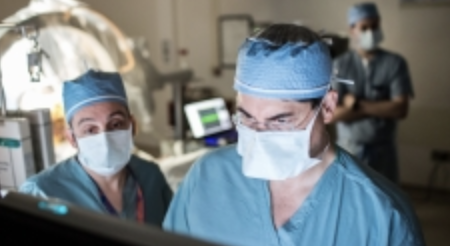
A scene from the OR
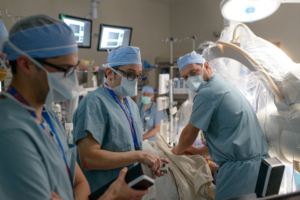
A scene from the OR
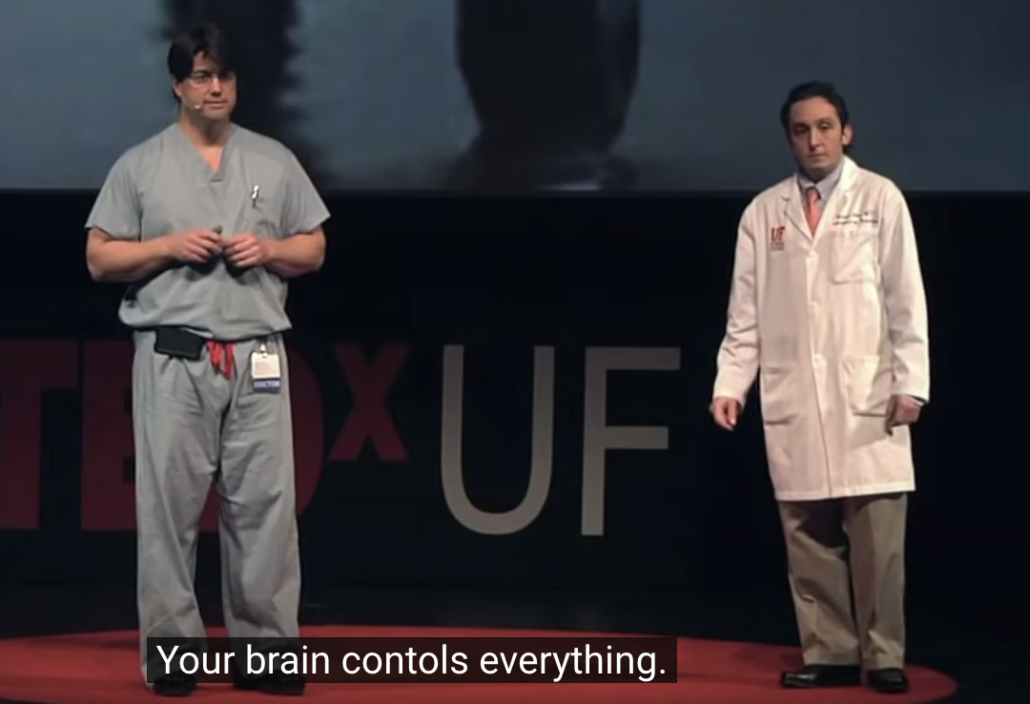
Early TED talk the two gave together on DBS
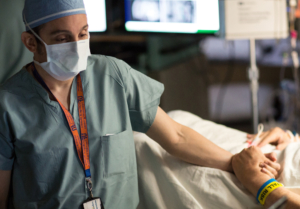
Prof. Okun examining a patient during surgery