
Prof. Peter J. Snyder, from the University of Rhode Island, where Peter is the Vice President for Research and Economic Development, Professor of Biomedical and Pharmaceutical Sciences, as well as Professor of Art and Art History.
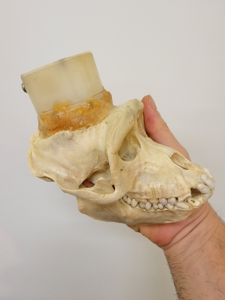
One of the few remaining stimoceivers implanted & fabricated by Delgado on a macaque skull.
#15: Peter Snyder about Jose Delgado: Remote-controlling the brain
In this episode, Peter Snyder and I talk about Jose Delgado, one of the inventors of deep brain stimulation. Peter’s father, Dr. Daniel R. Snyder, served as Delgado’s last American-trained post-doctoral fellow at Yale in the early 1970s – and took over the laboratory at Yale when Delgado moved back to Madrid. We get a good feeling about Delgado as a scientist, his many inventions, his relationship with the media and his grand-plan toward a ‘psychocivilized society’ that would control behavior by means of neuromodulation.
Together with others, Peter wrote a book called ‘Science in the Media’, in which he uncovers a quite spectacular deceit in the way Delgado communicated to journalists and the media about his famous ‘brave bull’ demonstration at a bull ranch in Cordoba, Spain. The bull demonstration – in which Delgado remote controlled a ‘brave, angry, and dangerous beast’ into a docile animal by the push of a button – is certainly a famous cornerstone in the history of neuromodulation. In this episode, we can learn from Peter that, in a way, it was a certain scam – or at least has been overinterpreted by the media and even most researchers in our field.
Peter Snyder 00:00but I'm holding now in my hand a rhesus macaque skull with a stimoceiver implanted, probably one of the only remaining surviving stimoceivers that Delgado created, that he fabricated. By contemporary standards, a fairly simple design with the electrical system in the cap, and the electrodes actually are penetrating the skull, and I can see them through the foramen magnum. But he was a self-trained electrical engineer as well. I remember one of the big rooms in his laboratory was an electrical engineering lab, and he had technicians working in there full-time developing equipment. To me, one of the most amazing pieces of equipment he developed, given the years that he was working, was the remote control for electrical stimulation. The same way that... We have remote controls now for our TV sets. 01:00At the time, in the 1950s, no such device existed. This was really at the edge of science fiction. And he knew it. He knew exactly what he had, and how exciting it would be for futurists at that time.
Andreas Horn Welcome to Stimulating Brains. Stimulating Brains Hello and welcome back to Stimulating Brains, episode number 15. I just got off a fascinating conversation with Professor Peter J. Snyder from the University of Rhode Island, where Peter is the Vice President for Research and Economic Development, Professor of Biomedical and Pharmaceutical Sciences, as well as Professor of Art and Art History. 02:02In contrast to most episodes, Peter and I did not talk about his own research today, but about somebody else, a very prominent historical figure in the field of deep brain stimulation. Namely, Peter's father served as José Delgado's last American-trained postdoctoral fellow at Yale in the early 1970s. If you have never heard about José Delgado, don't worry, you'll learn about him in this episode. Potentially, it's fair to say, though, that José Delgado invented deep brain stimulation independently, together with Lawrence Pool and Robert Heath around 1948. You may remember the work of Robert Heath from episode number six, where I interviewed the author Lone Frank, who wrote a book about Heath. I made contact with Peter to learn more about the life and work of Delgado after reading Peter's excellent monograph about him. Together with other stories, it is published in a book called Science and the Media, which recounts historical scientific events and examines how scientists communicated with the 03:04public, often via the media. The book is an amazing read of utmost relevance in our modern times, and for instance, also features a story about Louis Pasteur, which might be surprising to read as well. So I can really recommend Peter's book. Before we begin, as a small side note, I want to thank the Interventional and Cognitive Neuromodulation Laboratory at Charité, led by none other than Julian Neumann, who today vacated their precious office space for me to make recording this episode possible. Thanks a lot. So now, let's begin. I hope you will find my conversation with Peter as exciting as I did, and thank you for tuning in. Stimulating Brains, episode number 15. Dear Professor Snyder, thank you so much for taking time for this. So today we agreed to talk
Peter Snyder 04:02about a specific historical figure in the field of deep brain stimulation. Your father, Dr. Daniel R. Snyder, served as Delgado's last American-trained postdoctoral fellow at Yale in the early 1970s.
Andreas Horn Could you tell us some more about your relationship with him?
Peter Snyder Thank you.
Andreas Horn So when you went to Delgado, were you in the lab as a child every now and then? How did that work? How are your memories about that? Sure. Yeah, I spent an awful lot of time in the laboratory as a child growing up,
Peter Snyder probably between the ages, well, as far back as I can remember, up through about age 12 or 13. That's when Delgado had moved back to Spain by then. And my father, carried on in the lab up until the early 80s, at which point he left to pursue a private company startup. But I grew up in the lab, helping to take care of the monkeys in the lab, 05:07assisting with surgery, doing some behavioral observations, just helping as a kid as I could. Amazing. So let's talk a bit about Delgado's work first. So it seems that it all started with fear. Delgado was working as a young physiologist with Professor Neal Miller at Yale, where they discovered fear responses when stimulating the reticular ascending system in cats. Then around 1954, Olds and Milner came about with their bent electrode that led to the discovery of the
Andreas Horn Pleasure Center. Can you remind us what happened there? Yeah, so Olds and Milner were working
Peter Snyder in Montreal and accidentally made this discovery in cats of the Pleasure Center. And it was a very fortuitous discovery, but it gave Delgado the idea that rather than using more permanent means to 06:08alter behavior, such as neurosurgery, and at the time, frontal leucotomy surgery was was being widely applied, sometimes completely indiscriminately. He believed that the next wave would be in electrical stimulation of the brain, using remote means in order to treat all sorts of diseases and or disorders, including criminal behavior. And it was the work of Olds and Milner that really prompted him to try to chart that course. Yeah, and I think,
Andreas Horn yeah, I find it so funny that it was indeed the idea that Olds and Milner wanted to reproduce
Peter Snyder something from the Miller lab with Delgado with fear response, but then went into a different center and essentially discovered a pleasure response, which then Delgado also worked with 07:03later. So great serendipity in science here. Going back to Delgado, he started his career in Madrid, then went to Yale in 1946 and stayed there until 1974. When he,
Andreas Horn when he went back to Madrid in 1953, he was catapulted into spotlight by coverage by the New York Times, Time Magazine, and even national television. How was Delgado's relationship with the media?
Peter Snyder Dr. Delgado had a very deep and abiding relationship with the media. He loved the activity. He loved to have media coverage, and even controversial coverage was great. That was fine. I mean, in many ways we have current political figures, particularly in this country, but certainly in Europe as well, that are addicted to media coverage, even if it's negative. This was long before what we're experiencing now. Delgado was excited by media coverage and saw it as a useful platform because he was continually seeking 08:13more resources. from Yale University in terms of space, personnel, equipment, and also support. A lot of his funding came from the Department of Defense or Department of the Army at the time here in the United States. And he was constantly working to ensure that his program of research was seen as being highly relevant and fundable, particularly by the military. Great, I think you mentioned it already briefly that Delgado was mentored by John Fulton, who had shown that prefrontal lesioning 09:00turned a violent chimpanzee named Becky calm and compliant. John Fulton demonstrated that in a 1935 lecture in London, where someone crucial to the history of stereotactic lesioning was in the audience.
Andreas Horn Yes, so yeah, so this was, you know, Fulton,
Peter Snyder I think he was never comfortable with the directions that his physiologic research would take the world. But certainly that presentation in the early 1930s led to the rise of psychosurgery. And Delgado in the late 40s, early 50s, was riding that wave. It was a very prominent activity by many American psychiatrists. 10:02And Delgado, of course, his medical background is in psychiatry. And he saw this being a very important part of his life. And he saw this being a very important part of his life. He knew that behavioral control using psychosurgery as a very powerful tool, but he also, I think, began to see... He started working at Yale at a point in time where there were some initial questions being raised about the long-term efficacy, as well as long-term safety of psychosurgery. And so he was looking for an alternative, and it was really electrical stimulation that led to that alternative. What I found...
Andreas Horn interesting about this is that it seems like this 1949 Nobel Prize for Egas Moniz for leucotomy,
Peter Snyder who was informed by Fulton or motivated by Fulton, was shared with Hess, right, who was another hero of Delgado, who had more the electrical side in it. So it seems it was a shared Nobel Prize between the two fields at the time. That's right. So if I remember correctly, 11:06Delgado even wanted to try to get away from lesioning the brain, right, with electricity. That's correct. Yes, that's right. I think one undoubted success of him was that he was a great inventor, right, was referred to as a technological wizard by colleagues. So he invented these stimoceivers, half dollar sized, and also I think chemitrodes that could release precise amounts of drugs directly into the brain.
Andreas Horn Did you, with your contact to the lab, you know, experience some of these technological inventions or parts of that? Oh, absolutely. Yeah, so your audience won't see this,
Peter Snyder but I'm holding now in my hand a rhesus macaque skull with a stimoceiver implanted. And this is probably one of the only remaining surviving stimoceivers that Delgado 12:06created. that he fabricated. And it's by contemporary standards a fairly simple design, with the electrical system in the cap, and the electrodes actually are penetrating the skull. And I can see them through the foramen magnum, looking from the ventral surface. I can see the electrodes in it. But he, he was, you know, a self trained electrical engineer as well. He, I remember one of the big rooms in his laboratory was an electrical engineering lab. And he had technicians working in there full-time developing equipment. To me, one of the most amazing pieces of equipment he developed, given the years that he was working, was the remote control for electrical Stimulation. The same way that we have remote controls now for our TV sets, you know, sitting on our couches, and you can use them across the room or across in the case I think we'll probably talk about a bullring. 13:16You know, at the time in the 1950s, no such, no such device existed. There were no remote controls for television sets. This was, this was really at the edge of science fiction.
Andreas Horn And he was developing these electronic instruments that really pushed the imagination of readers of the New York Times and other publications, and he knew it. He knew exactly what he had and how exciting it would be for futurists at that time.
Peter Snyder Makes sense. And it's still really impressive, I think. Maybe last question. Before we get to the bull, from 1952 on he implanted DBS electrodes and stimoceivers in around 25 patients, mostly with schizophrenia and epilepsy at a now defunct mental hospital in Rhode Island.
Andreas Horn 14:12Well, he was, yeah, a little bit in Rhode Island, but he was working mostly with Mark and Ervin in, in Boston, in the Boston area.
Peter Snyder Mark and Ervin put out a book in the early 70s describing these. Patients.
Andreas Horn And it seems like he narrowly beat Robert Heath and also published his first account before Lawrence Pool, who had apparently made the first DBS surgery in 1948, but published on it later. So do you think it's fair to say that the three of them, Delgado, Heath and Pool have independently invented deep brain stimulation back then? Yeah, I would say so.
Peter Snyder Yeah, I think so. I think Delgado's innovation was
Andreas Horn the
Peter Snyder remote control.
Andreas Horn That
Peter Snyder really was unique and proved certainly in a dramatic way to be a useful tool for him. Great. Let's go to the main story. In 1963, Delgado completed a demonstration experiment to prove to a skeptical public and to the scientific community that he could turn a brave, angry and dangerous beast 15:27into a docile animal by the push of a button.
Andreas Horn What happened? Yeah, so Delgado, as I describe in that book chapter,
Peter Snyder which I think is how you found me, at that point in time, he was under fire from his colleagues at Yale who had some ethical questions about what he was doing. He was very interested in planting electrodes into the brains of convicted prisoners who were incarcerated in Connecticut. And Yale was very uncomfortable with that. 16:03He had married the daughter of one of the vice presidents of Yale, who was a beautiful woman who worked in his lab. And he was using those connections to curry some favors in terms of space and access to students that his colleagues were not comfortable with.
Andreas Horn Yeah.
Peter Snyder He actually was not in the Department of Psychiatry at that point because his colleagues weren't comfortable with his work. And he was in the Department of Comparative and Laboratory Medicine, really a veterinary department, because he was really working at the edge
Andreas Horn of what was considered acceptable.
Peter Snyder He was also garnering some concern being raised by colleagues externally around, you know, internationally, and with his own study sponsors through the Department of the Army, about the real relevance of this work in modulating behavior the way he was purporting to be able to do. So Delgado, to answer those critiques, relied on what he was really good at, 17:26which was self-promotion. And he developed, he designed a, what he called an experiment, but really not an experiment because it wasn't a controlled study of any sort. It was a demonstration where he implanted his stimoceivers into the brains of two bulls, two aggressive bulls, brave bulls. That's actually the name of the breed. And he did this in Ronda, Spain, 18:01where he grew up. He brought a film crew with him and he intended and did a film, this entire demonstration that he had, you know, he had produced the film, directed the film, narrated the film, and was the principal actor in the film. And the purpose was to show that he could get in a bull ring with a charging bull and have the bull come at him with obviously an intent to attack and gore him. And he would stop it in its tracks, ostensibly by modifying behavior. And that's where he wasn't quite being truthful with the public. And he was not being truthful in what he was actually doing. And I'd like to just point out that Delgado was an exceptionally well-trained neuroanatomist and a highly skilled surgeon.
Andreas Horn 19:03He had tremendous skills in surgery and he knew exactly where he was putting these electrodes.
Peter Snyder And in fact, he was putting the electrodes that led to the bulls stopping in their tracks and engaging in forced, stereotypic turning behavior. These were implanted into the caudate nuclei. And he was really interrupting the pyramidal motor pathway of the bull. And that led to a very expected cessation of the bull's behavior once when he depressed the button on his remote control. And he could have a charging bull at him and stop in its tracks and turn. The sleight of hand is that this really is controlling the mood
Andreas Horn 20:01or affect of the bull. That's what he claimed, right? So he claimed that he controlled mood, but instead you're saying he
Peter Snyder mainly controlled motor.
Andreas Horn Yes, yes, exactly. And so when you listen to the film and you dissect the words and look at where
Peter Snyder the electrodes were placed, He was not being truthful, but you can't point to any one statement that was an abject lie either. So he was skirting that fine line and he knew it. This is an extremely bright guy.
Andreas Horn He knew exactly what he was saying and he knew exactly how far to push the story without being accused of crossing that line and just abjectly lying to people. Maybe we can actually recount the episode how you recovered that film because I found that really interesting.
Peter Snyder You wrote your father took over Delgado's lab, including the monkey colonies for 10 years after Delgado returned to Spain. 21:02And then you write that a number of items, for example, books and several reels of 16 millimeter film made their way from the laboratory to my parents' home. The original print of the Brave Bulls film was found on the top. Shelf of your childhood bedroom closet, where it most likely resided under a pile of T-shirts for 20 years or more.
Andreas Horn Is that really true?
Peter Snyder Yeah. So, yes, I found the film. It was an old 16 millimeter reel. I still have it. It was definitely in my closet for at least a couple of decades under under old T-shirts of mine. And I was I was just stunned when I found it. At the time, I was working for the drug company. I was working for Pfizer and I had to scour the company to find a 16 millimeter film projector with a working light bulb in it, which was not easy to find. 22:02Can imagine.
Andreas Horn Yeah.
Peter Snyder And I remember sitting setting it up in my kitchen where where I was living at the time and I just couldn't believe what I saw. But the the magnetic strip that contained the audio somehow had slipped or bent. The pieces had broken off. It was it was frayed and and it wasn't timed well with the video any longer. So we I hired the help of a local TV editor, television editor, and he digitized both the audio and video separately. And then we sat in his editing room and remastered and reapplied the audio where the video where it made sense. And so the remastered film is in the process of being donated to the National Library of Medicine in the US. And it will be available internationally free any time to view very soon where it'll be available in their video archive for anyone to see within the next probably month or two. 23:10That's amazing. We can link from the show notes to that. So I hope you. And so you're claiming that if. If the result was really a remote motor control, so not controlling the emotion of the animal, the New York Times would not have reported as much about that. Right. So I think we haven't even mentioned that so far. New York Times wrote about that on the front cover in 1965. And the author, Osmundsen, concluded that it was probably the most spectacular demonstration ever performed of the deliberate. Modification of animal behavior through external control of the brain. Say, remote controlling motor behavior of an animal is still kind of spectacular. Right. But your point is it wouldn't have had the same effect. 24:01Correct. I think so.
Andreas Horn Yes.
Peter Snyder I mean, that was that's a major advance all by itself. And I certainly want to give him credit where it's due. He was a very inventive scientist and he was a very skilled one. But he knew. His audience and he knew that the military was funding his work not simply to control motor behavior, but really to control the aggressiveness or affect of of soldiers. I mean, that was part of their interest. You know, it also is clear in his later writings, such as the book he published, Toward a Psychocivilized Society. It's very clear where he wanted to head. He was interested in treating again. He was initially trained as a psychiatrist. He wanted to treat schizophrenia, criminality, 25:01untreatable major depression, all sorts of conditions and really by controlling mood and affect, not not motor control. But but the question I think we all have to ask ourselves if if if if you were going to get in a bull ring with a two thousand pound charging bull,
Andreas Horn do you want to make them a little less aggressive as they're charging at you? Or do you want to stop them in their tracks and force a contralateral turn?
Peter Snyder And I would I would argue it was the latter.
Andreas Horn Yeah, I agree. Yeah.
Peter Snyder It's much safer. It seems much safer to do that. Well, well, great point. I think I think you mentioned that he was also challenged about this potential. And he was also challenged about this deception by his contemporaries. And in his defense, he then reported on evidence of caudate nucleus stimulation in the bully of a macaque colony, the bully had been aggressive, 26:00but other monkeys could then press a lever to stimulate his caudate nucleus, stopping that bully as well in his tracks.
Andreas Horn Could you tell us a bit more about this experiment?
Peter Snyder Well, yes. So, you know, the bull demonstration exercise that he did in Spain, that was that was really meant for media consumption, that wasn't his mainline work. His mainline work was in primate in particularly rhesus macaques in the laboratory on the fourth floor of Yale's med school in New Haven, Connecticut. And he had several social colonies. These social colonies were under 24 hour observation, video observation recording. He was doing EEG recording. A lot of these monkeys were tethered for telemetry at the time. And he was very interested in the ability to modify the social organization of a colony by changing the dominance hierarchy 27:06of the males using electrical stimulation. And so certainly if you put the stimoceiver of the dominant male and stimulate the caudate repetitively over and over day after day, you are going to modify that animal's behavior. You know, it's very hard to maintain a complex social hierarchy for that dominant male when the caudate nucleus is being stimulated erratically over a protracted period of time. It's certainly not good for the ego of such a monkey bully if you are repeatedly stopped in your tracks. Right. So that's how I experienced this effect that also his social role would, of course, change if others could manipulate him. So I think you make an excellent point here. And you also back that up further in your article that by 28:05work from Forman and Ward, who in 1957 stimulated 66 separate points in the head of the caudate nucleus and the most common response was forced contralateral head turn. And in 64, MacLennan stimulated the caudate nucleus of cats and reported that complete arrest of movement upon low intensity and frequency stimulation, whereas then greater intensities and frequencies led to contralateral turning. So this research and evidence must have been known to Delgado at the time. Yes, I think so. I think so. It's worth pointing out also when your listeners are able to watch the film when it's uploaded. So he tested this first with his research assistant, which I thought was hilarious because any of us who have had graduate students could argue that that's a nice thing about having graduate students. 29:03Is you can put them in the bull ring first before you go in with the bull charging at you. So he had a grad student or research assistant in there first. And
Andreas Horn you know they were working the kinks out with that student oh wow that is uh ethically interesting i
Peter Snyder agree okay so so maybe some more questions um about the impact of these pioneers on the modern day field of deep brain stimulation if us modern scientists dbs scientists carefully read the work of delgado and his contemporaries for example robert heath we discover or we may discover that there is not really much new under the sun they seem to have done everything right delgado has carried out the first adaptive deep brain stimulation robert heath had targeted the medial forebrain bundle and induced flashbacks by hippocampal stimulations the first human 30:00deep brain stimulation in Parkinson's disease was carried out by Lawrence Pool in 1948 so you also quote the historian Elliot Valenstein who characterized this period of time as one during which efforts were made to describe as many behaviors as during which efforts were made to describe as many behaviors as possible that could be elicited by brain stimulation do you see differences in the way the experiments are carried out now versus they were carried out back then um it's marginally different now i think you know now there's a more heavy dependence on randomized controlled trials even for surgical interventions um there's now a you know, at least, you know, I'm speaking with respect to the United States, because this is where I live, you know, back then our Food and Drug Administration was not reviewing or approving devices. Now, if you are using an implantable device, it has to go through a review process, much like any drug treatment would go through. 31:05So there's, you know, now a weight of evidence, there are new processes that require anyone who intends to market any device for use to treat anything therapeutically to go through a series of controlled experiments that are as free of bias as possible to both show efficacy as well as safety. None of that really existed back then. So I think that the future of deep brain stimulation for treating disorders like Parkinson's, like major depression, you know, is potentially bright. And there are some, like Helen Mayberg is doing phenomenal work in this area now with major 32:01depression. Her work is probably beyond reproach. But that didn't exist back then. It was the Wild West. It was, you know, at the time that psychosurgery was being advanced, and these were overlapping periods in history, you know, American psychiatry didn't, you know, were vocal in really not thinking that any controlled trials were necessary. They just went right into wide use. And I think that happened to a certain extent with deep brain stimulation, I think Robert Heath ran into that problem. He lost a lot of credibility historically as a result. And yet the underlying technology, when applied carefully and also at dosages of current that are a little bit safer, can have very wide promise. Makes sense. So to recapitulate, you also write that by 1960, the Heath team had conducted brain stimulation 33:12experiments in 52 patients, of which 42 were schizophrenics, and I think Delgado had around 20 patients operated, then I think the discovery of chlorpromazine in 1955 largely hindered further advancement of this program in Tulane and other places. But recently, novel programs, for instance in Barcelona, are attempting to treat schizophrenia using deep brain stimulation and if you read the novel papers, they don't seem to cite the old work. Do you think we can still learn, you know, if we, especially if we attempt to do the same thing again or similar things again, should we read the papers and learn from maybe past mistakes? Oh, I think, I absolutely, 34:05I, you know, we're bound to, you know, historically, I think humans are bound to just keep going. I think we're bound to keep repeating history over and over again. I think the progress in science will be more rapid and efficient if we understand the historical origins of the questions that we're looking at today. And, you know, we have a lot to learn from these historical figures. You know, some of the research methodology is not consonant and not up to today's standards, and yet, you know, there's a lot of information buried in these papers that really will inform how we design experiments properly today. So I think we're really remiss not to pay attention to the historical origins of this work. 35:05And that's to advance the technology. I think also in that paper, I make the case that you know, there's a broader lesson here in how we engage the public in conveying really complex information. You know, the topic that we're discussing is really a complicated one on many levels. And as scientists, we're trained, most of our training, I think, is really geared to helping us to appreciate and understand nuance in an argument. and shades of gray, where there's very little black and white answers to things. The proper way to proceed, let's say, therapeutically with a technology like this is largely dependent on all sorts of mitigating factors that have to be considered. And that's hard to convey to the public. It's hard to tell complex stories in the 32nd sound bites. Now, Delgado chose to 36:11take a very simplistic approach. He created sound bites that were alluring, that were exciting, that sparked the imagination, but also edged on the border of being not factual. And, you know,
Andreas Horn I can see why he did it. It made sense. It wouldn't be my style. But I see why he did what he did. You even report that journalists have the opposing goals, right? So maybe they want
Peter Snyder the spectacular and simple story. And even if scientists want to report the nuances, they might not find somebody who is willing to write them up in that way. That is a huge problem. That is right. We have different drives and needs in these professions. 37:04And, you know, the public is ultimately going to consume what the journalists write. And, you know, we have to do a better job of being able to communicate clearly and effectively, because science, particularly what we do, it's a social enterprise. It's like any other social enterprise. And ultimately, if we can't convey what we're doing and what we're thinking of and what is truthful in a meaningful way to the public, then we're wasting our time. We have to be able to communicate clearly and effectively. And that's what we're doing. And that's what we're doing. And that's what we're doing. And that's what we're doing. And that's what we're doing. We have to be able to communicate better. And I would argue that PhD programs have virtually no training inherent in them to train our graduates and how to engage with the media. And I think such training is important and necessary. 38:01That's a great point. So science communication should be taught in these programs. I agree. Yeah. So maybe to wrap up for the last questions, can we talk a bit about,
Andreas Horn Delgado's book? In 1969, he published his now famous book, Physical Control of the Mind
Peter Snyder Toward a Psychocivilized Society. In 1970, the New York Times Magazine hailed him in a cover story as the impassioned prophet, prophet of a new psychocivilized society, whose members would
Andreas Horn influence and alter their own mental functions. Is it possible to summarize that book? The main concept of it, a society that neuromodulates themselves?
Peter Snyder Oh, he was advocating for broad use of ESB in order to improve the human condition, particularly treat our societal ills. We could treat criminality with this. We could treat 39:06mental illness with this. We could, help people to feel more self-actualized and have better relationships. This, you know, he was very provocative. He took it, he took this idea, you know, to the nth degree and both excited people like the woman who wrote that New York Times review. But also, he, he scared a lot of people. And if you, if you search the web now, you'll find hundreds and hundreds and hundreds of conspiracy theory driven blogs about this and about now the military's involvement with it. Some of this, you know, I, I, I, I, I feel that, you know, conspiracy theories 40:08in general are causing the world a great deal of pain and 39:55and about now the military's involvement with it. Some of this, you know, I feel that, you know, 40:06conspiracy theories in general are causing the world a great deal of pain and problems at the present time. But I would say that Delgado, again, probably knew what he was doing at the time. Of course, there was no internet back then, but the idea, you know, he knew that publicity was good, whether it was positive or negative. You know, to be controversial was a very useful tool for him. And I think that was part of the motivation for his writing. Wasn't he even sued by some patients who claimed that he had implanted
Andreas Horn stimoceivers into their brains that he never met?
Peter Snyder Yeah, I think so, yes. So I peeked over the book again this morning and had read parts of it before. So I think it's really a fascinating work, even though it is, of course, 41:03very, I'd say, crazy. And I think there are also passages in it, so in the introduction in the last chapters, that are quite philosophical even. So I think at some point he talks about Galileo demonstrating humankind that we are not the center of the universe. And then I think there's Freud also demonstrating, you know, that we are deceived by our subconscious. And he also claims that I think the individual might think they have a free will and they should be entitled to their own decisions, but then that might not always be true. Right. So and I think one question he also deals with that he seems to leave open a bit
Andreas Horn is who would really control the stimulation, right?
Peter Snyder So at some point he makes the point it should not be an elite doing it. He's controlling the others, but even has some maybe communist parts in there 42:01where he says everybody that is entitled or smart enough to control should control. So sometimes people could even control their own brains to work better in the society.
Andreas Horn Yeah, yeah.
Peter Snyder But you're right that he kind of left these as open questions, which I think is, you know, reasonable because I don't think any... rational individual would have an answer to this. But he also, you know, he knew that he was working in a very politically charged arena. He was, you know, still a Spanish national. And, you know, Spain was going through a very tumultuous political time with, you know, a post-World War II fascist regime. And he didn't want to be, you know, he didn't want to be targeted by them. 43:00Particularly, you know, he obviously went back to Spain and worked in that milieu for many years afterwards. I think he left these points vague intentionally. But just imagine comparing your work as an advance on the, you know, as the inheritor. And I think that's a very important part of the work of Galileo and Freud. You're absolutely right. So I think in one interview, 1970s, in the Yale Alumni Magazine, Delgado claimed that his aims were to cure epilepsy, to cure mental disturbances, and to construct a better world. And that's all. So he did not have humble aims. Right. No, no, I'll tell you my... I remember him as a... He was a tall man. He was very tall. He had a deep, booming voice. He had a theatrical voice, like a baritone, real deep voice. 44:02And he was very, very well-dressed. He showed up... He met my parents once for a play. They went to a play in New Haven. And my mom told me that he showed up in a cape with a cane. But he was wearing a black cape. And in the late 1960s, early 70s in New Haven, no one was wearing black capes. That was not a thing. So he was a showman. He was really a showman all the time.
Andreas Horn Yeah, gotcha.
Peter Snyder I think in the very end of his life, he moved back to California, right, and died there.
Andreas Horn So as a... As far as I know, did your father meet him again when he returned to the U.S.? Or did you see him back then?
Peter Snyder No, no, no. 45:00My father lost touch with him in the early 80s. But I know that he had a son there. And I think he probably went to live with his son. Gotcha. Great.
Andreas Horn So thank you so much. Is there anything else that you would have wanted to cover more about the ethics or the reporting or any question I didn't ask?
Peter Snyder No, I think we covered it well. I think that, you know, the point of my writing the chapter was first to make sure that there was a historical accounting of this really famous event in 20th century neuroscience. And it needed to accompany the film. Because if you see the film without the context, you know, there's so many, there's deeper layers in that film that need to be understood. So I wanted to make sure that was recorded. Recorded and available to everybody. But there's also, to me, a deeper lesson about the ethics and how we communicate what we do as scientists. 46:02Particularly at the present time where we're living in a world facing many serious challenges that will only be addressed with good science. Climate change being a good example. And without public trust in science, we're going to fail. And so how we as scientists communicate the complexity of what we do in a way that garners support from the public and their trust is very important. And so I thought that really reviewing this episode in neuroscience history could provide some contemporary lessons for how we as scientists need to engage as the social beings that we are in our profession. I couldn't agree more.
Andreas Horn And I had a great time reading the book. 47:00There are also other similar chapters by authors in it with the parallels, right? For example, about Pasteur and reporting back then, which was also really interesting to read.
Peter Snyder So I can only recommend that, that book to anyone, anybody interested in these things. And also like, if you're more interested in Delgado, I think also for that alone, there's a lot of in that chapter. We did not cover so can only recommend it. And I think the CD of the book also has the film with it, right? It does. I think they replaced it. If someone were to buy the book now, I don't think they'd get the DVD. I think they'd get a web link to see it. But, but I will be posting the film on the National Library of Medicine's website. So amazing.
Andreas Horn Thank you so much, Professor Snyder.
Peter Snyder This was really great for our listeners and also for myself. It's really such an important figure in the field of DBS. And so it was amazing to talk to you.
Andreas Horn Thank you so much for taking the time.
Peter Snyder 48:00Thank you. It was a pleasure. Take care. Bye. Thank you.
Click any highlighted text passage to jump the Spotify player to that point. The transcript text is present directly in the page HTML for search engines and accessibility.