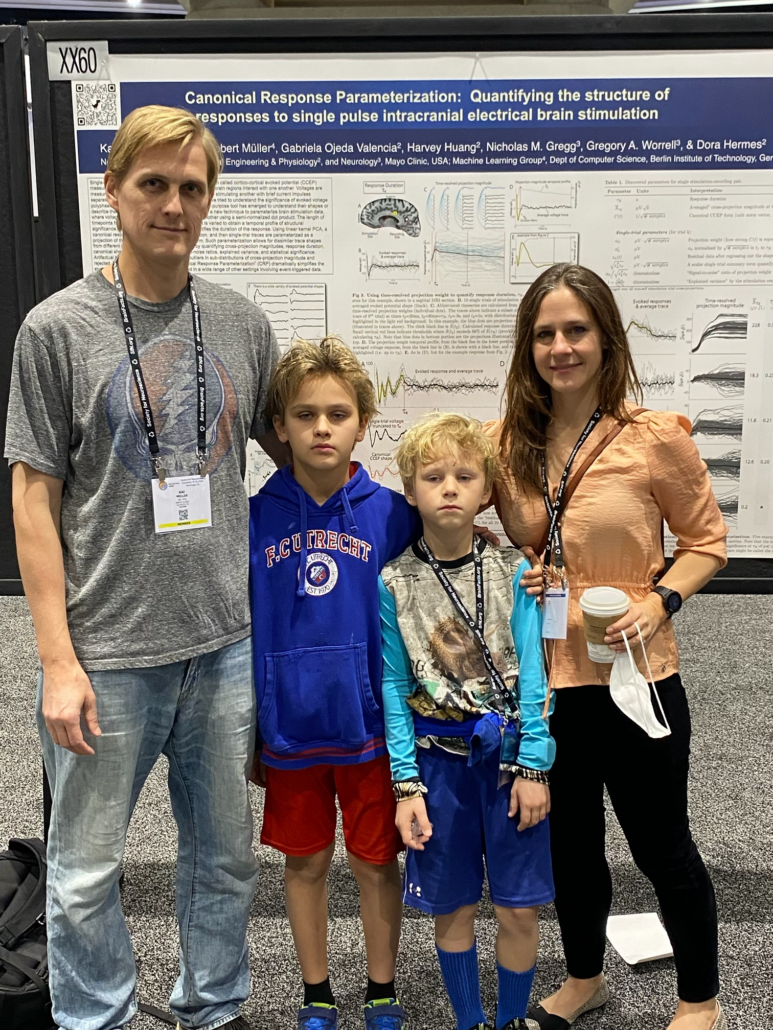
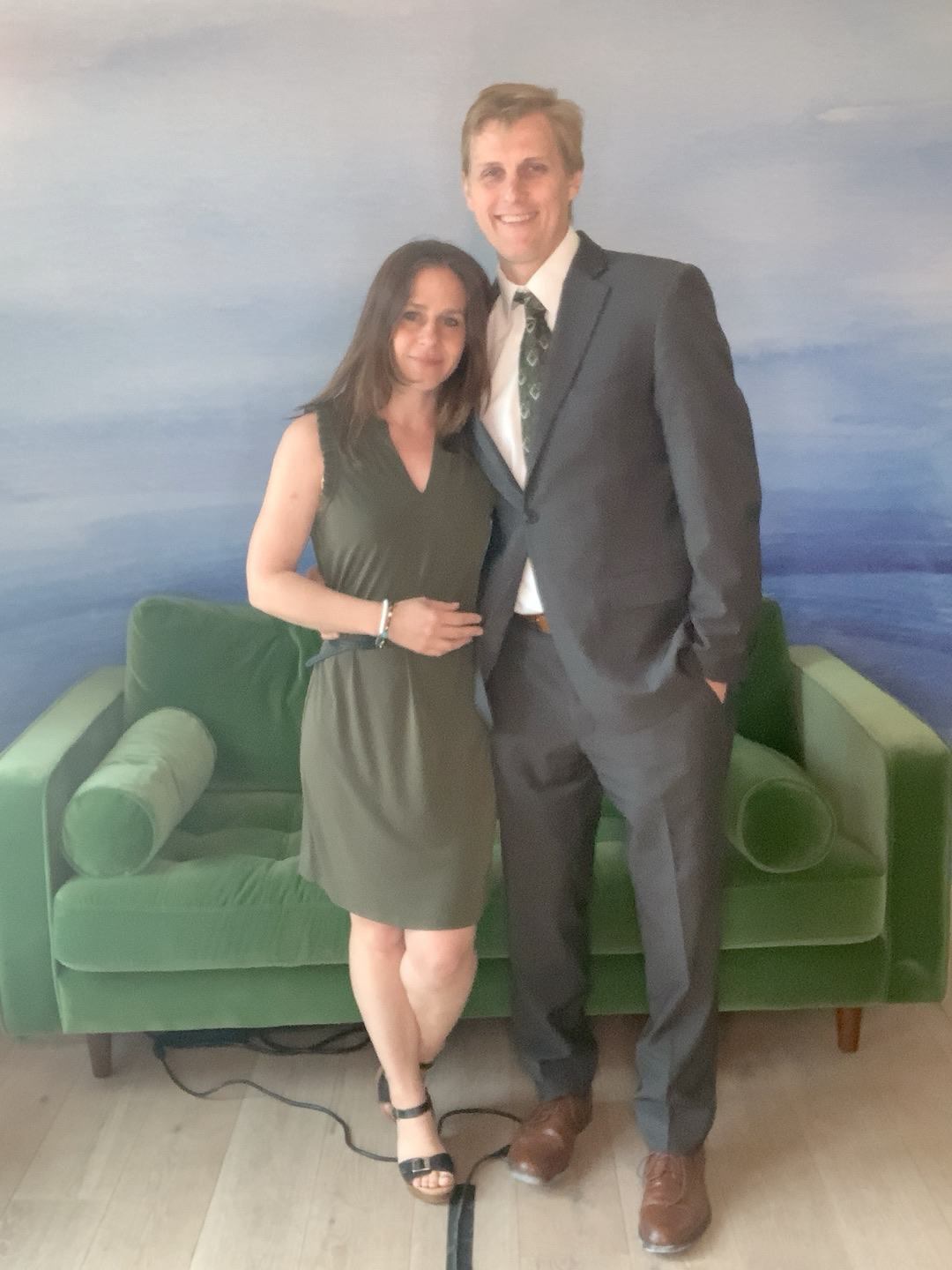
Dora Miller and Kai Hermes are Associate Professors in Biomedical Engineering and Neurosurgery, respectively, at Mayo Clinic Rochester
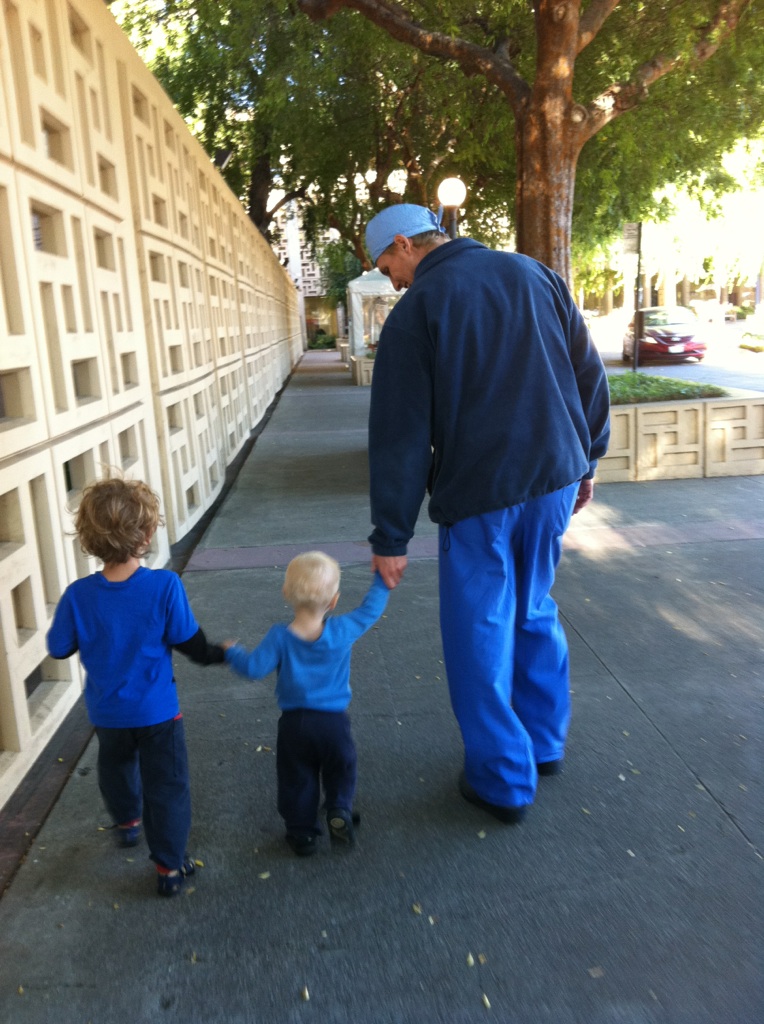
Kai with the kids
#49: Dora Hermes & Kai Miller – Discovering the secrets of the brain by invasive stimulation & signal recording
Dora Hermes and Kai Miller are associate professors at Mayo Clinic, where they have become a powerhouse on neuroscience, due to their strong collaboration and work in neural signal processing and analysis. Dora has a mathematics background, while Kai studied physics, including a PhD in physics, before becoming a functional neurosurgeon. Last year, both of them last authored a paper each at Nature Neuroscience, each with remarkable and groundbreaking findings about pretty different topics. The first paper dove into the organization of the primary motor cortex using invasive electrophysiological recordings in humans. The second measured conduction delays along fiber tracts in the developing brain.
We hope you enjoy this conversation as much as we did!
Dora Hermes & Kai Miller 00:00Are the kids actually the same as the adults? Because if these evoked potentials really reflect direct inputs... But it is interesting that we can take signal principles we learned from the brain surface and apply it to stereo AVG. So there are specific models now that predict the circuits. Welcome to Stimulating Brains. I met Dora Hermes and Kai Miller at the Rotondeo. 01:00We took a Boliviera course on functional neurosurgery and neurology at Mayo Clinic Jacksonville this February and was lucky that we could find a time to sit down and talk about their fantastic work in invasive stimulation,
Andreas Horn signal recording, modeling and signal analysis. Both Kai and Dora are super smart researchers that care deeply about how to actually do things and have been leading the methodological camp of signal analysis for years now. Dora has a mathematics background and Kai studied physics including a PhD in physics. Before becoming a functional neurosurgeon. Together they have become a powerhouse and each lead a lab that heavily collaborate at the Mayo Clinic in Rochester, Minnesota where both are associate professors. Last year both of them last authored a paper each at Nature Neuroscience each with remarkable and groundbreaking findings about pretty different topics. And with this prelude I'm quite sure you will find the conversation as inspiring as I did and would like to thank you for tuning in to Stimulating Brains. Thanks a lot for taking part in this Dora and Kai. 02:14I think this is the most beautiful setting for a podcast recording. We're here at the beach in Jacksonville, Florida met each other of course and spontaneously it's also the most spontaneous episode we ever had. We have a lot of fun. done so far. And usually, to break the ice, before we get into science, I ask all of you about hobbies and free time. So what do you guys do when not involved in science? I mean, there's not a lot of free time, right? So that's one of the, we have two little kids, two boys, age eight and 12. So they take a lot of our time. But you know, when we have a little bit of time, I like running, cooking, hanging out with friends, reading a little bit, but that's about how much time... 03:05Making Halloween costumes once a year. Makes sense. You make them yourself? Yes, once a year. I try to block some weekends for that. It's like a project months out. Okay. She's making it months out. And you guys? I play tennis. I spend a lot of time coaching our boys who are right there doing their math. I had them across the street earlier today. I spend a lot of time either with Dora or the kids. By a lot of time, because of the surgery, I basically... Surgery and science. Science is 90% nights and weekends. So a hobby in a way.
Dora Hermes & Kai Miller In a way. I spend a lot of time doing the science, obviously at work, but a lot of the science at work is the things around doing the science.
Andreas Horn 04:01And of course I like doing the science too, which means if I want to squirrel away some time, that's weekends.
Dora Hermes & Kai Miller And you surf, I think?
Andreas Horn Yeah, yeah, yeah. With Nolan, right?
Dora Hermes & Kai Miller I surfed a lot growing up. It's hard in Minnesota now, but we travel because of conferences. So, for example, last week we were at the Peds Neurosurgery meeting. There's a friend of mine who also surfs, who's also a pediatric neurosurgeon.
Andreas Horn So we went surfing four or five times last week. Fantastic. Cool. Who were your key mentors in your career? And also maybe turning points that led you to where you are now? So I did my PhD with Nick Ramsey, who was a fantastic mentor.
Dora Hermes & Kai Miller He was my PhD advisor and he would always ask questions and questions and questions. So he was a really good person to work with. And then during my postdoc, my primary mentors were John Winniver and Brian Wandel, 05:00who had a very different style, but also extremely supportive and great to work with. I learned a lot from both of them. And they were also, you know, the postdoc period is always a difficult period.
Andreas Horn Yeah.
Dora Hermes & Kai Miller You know, you try to get your own funding.
Andreas Horn Yeah. Which is not always successful. And they were very supportive in teaching that and getting through that kind of challenging time. And were interested in very similar topics. So it was really great to work with them. Fantastic. And when did you move to the U.S.?
Dora Hermes & Kai Miller So I did my, I finished my PhD in 2011. And then we moved to the U.S. as well in 2011.
Andreas Horn Okay.
Dora Hermes & Kai Miller I think you moved to the U.S. in... Fall of 2010. I visited Seattle in the fall of 2010. Oh, you lived with them.
Andreas Horn Yeah.
Dora Hermes & Kai Miller Jeff Ojeman invited her to come to the lab for a while. So that was sort of when we were together during my last year. And then her visa was running out and Max was on the way. So... Oh, wow.
Andreas Horn Okay.
Dora Hermes & Kai Miller 06:00That's when she moved.
Andreas Horn Fantastic. Okay. Yeah.
Dora Hermes & Kai Miller So that worked out really well. It did.
Andreas Horn Yeah.
Dora Hermes & Kai Miller And I think that's what I learned.
Andreas Horn Yeah.
Dora Hermes & Kai Miller And I think that's what I learned.
Andreas Horn So she moved. Fantastic. Yeah, so that worked out really well. It did. Yeah.
Dora Hermes & Kai Miller And then she actually finished her PhD with Max on her belly. She'd wear one of these... They have these carriers that go on your belly.
Andreas Horn Yeah.
Dora Hermes & Kai Miller So she'd stand at a countertop in our apartment in Palo Alto with Max on her belly and just sit and type when he was a small baby and she finished her PhD, I think, when he was two or three... As old as your son is. Wow.
Andreas Horn Yeah.
Dora Hermes & Kai Miller When he was two or three months old is when she finished.
Andreas Horn Yeah.
Dora Hermes & Kai Miller They still sleep a lot when they're two months old. So...
Andreas Horn Yes. Yeah. Yeah.
Dora Hermes & Kai Miller So they did a lot of typing and they love just sleeping in one of these carriers. So there was a lot of...
Andreas Horn Yeah.
Dora Hermes & Kai Miller That worked out. I can relate. So our two months old... It was also called Max, by the way, so... Oh. ...uncoincident. 07:00That's great.
Andreas Horn Yeah. Yeah. So, okay. And for you, Kai?
Dora Hermes & Kai Miller I mean, I had an interesting childhood, but I think my dad was really into science.
Andreas Horn Okay.
Dora Hermes & Kai Miller He's a banker, but he was into science. And so he was... He was a banker, but he was into science. And so he was a banker, but he was into science. And so he would talk to me. I remember talking to him about imaginary numbers when I was a little kid. And he would always kind of, he read these popular physics books, Stephen Hawking and Mr. Tompkins in paperback. So it's what got me into physics was my dad and his bookshelf as it were. And then when I went to college, there was a guy who was a mathematician who was really into James Joyce named Patrick Ledin. He subsequently passed. A big aspiration of mine is one day to get to go back to UCSD. And they have named an auditorium after him at Muir College in San Diego where I was an undergrad. 08:01Oh, wow. And my goal is to get to go back. I haven't thought.
Andreas Horn And you did an undergrad that was a bachelor in physics in San Diego, right? Yeah. And then you did the master's in physics and a PhD in physics afterwards too, correct? Yeah.
Dora Hermes & Kai Miller So I went to, from UCSD, I went to, well, at UCSD I worked with this guy David Kleinfeld. I don't know if you ever heard of him or met him. He's a physicist who does neuroscience. He just does very careful experiments. He's a very careful thinker. And he told me I should go work with a guy named Fred Ricci at University of Washington. And that didn't work out. But I wound up interacting with first a guy named Mike Schoen. And then I met him at the University of Washington. And then I met him at the University of Washington. And then Raj Rao. And then Jeff Ogeman. And when I was at one, Raj Rao was a computational neuroscientist who had some interest in BCI. And I didn't, at the time I wasn't so much into it. But I said I'll go learn about EEG and stuff so we can do it. And that's when I met another neurologist who introduced me to George Ogeman, who's Jeff Ogeman. 09:05He's actually Otto's godfather. Oh. His dad. And he said, well, I'm going to retire soon, but you should work with my son. And so that's sort of what got me into neurosurgery was this guy, Jeff Ogeman, who I had all this access to working with him.
Andreas Horn And he had a background in physics, too. Interesting. And I just kind of developed this research program when he moved to University of Washington. And he's still a mentor of mine. I mean, we saw him at the PEATS meeting last weekend in neurosurgery and also in science. And then I did my PhD with a guy named Marcel Diniz, who's a theoretical physicist who does condensed matter physics. And then I did my neuroscience PhD with Raj Rao, who's this computational neuroscientist there. And then after that, you decided to go into medicine, right?
Dora Hermes & Kai Miller No, no, no. I went to Seattle to do MD-PhD. MD-PhD. Got it. I had wanted to be an astronaut, and I was going to do emergency medicine. 10:02But NASA was sort of winding down the in-house space program, so they don't have shuttle launches. They don't have shuttle launches or anything like that anymore. And I got a lot of exposure through Jeff Ogin into neurosurgery. And I knew I loved operating. I didn't think, I never thought I was going to do neurosurgery. In fact, Dora was the one that told me to just do it at the end of the day. I was going to do radiology and do neuroradiology.
Andreas Horn Okay, interesting.
Dora Hermes & Kai Miller Which is awesome. I work closely with neuroradiologists now. But I had no interest in the rest of the body. It's out of the brain, at least not professionally. And so I wound up doing neurosurgery. I went to Stanford, and I had a number of great neurosurgical mentors. You know, Jerry Grant at Duke, who we're going to go visit, and Casey Halpern, who I know you know well, because we both interact with him together.
Andreas Horn 11:00And a guy named Griff Harsh, and another guy who was my chairman named Gary Steinberg. Okay, fantastic. So when you became a neurosurgeon, why in pediatrics? And why? Was it functional? How did that come up?
Dora Hermes & Kai Miller Oh, you asked about turning points.
Andreas Horn Yeah.
Dora Hermes & Kai Miller A big turning point was another mentor of mine, Nick Ramsey, who was her PhD advisor. He introduced me to Dora. It's the best thing I got out of science and life in general was because of that guy.
Andreas Horn Fantastic. And when was that again? When you met in your careers?
Dora Hermes & Kai Miller You were finishing your PhD, and you were... I was in the middle of my PhD. No, that was several years prior. She was in the beginning of her PhD when she first met. Got it.
Andreas Horn Okay.
Dora Hermes & Kai Miller We did long distance.
Andreas Horn Yeah, we had a long distance relationship.
Dora Hermes & Kai Miller We were in the same lab for two years.
Andreas Horn Okay.
Dora Hermes & Kai Miller And then I visited his lab.
Andreas Horn Okay.
Dora Hermes & Kai Miller She was one of like five people in the world that would think I was cool because I was a scientist.
Andreas Horn Okay, fantastic. And then, so why functional? And why like epilepsy in pediatrics?
Dora Hermes & Kai Miller Well, that's a complicated story.
Andreas Horn 12:01So functional fits with the, you know, I'm interested in understanding the large scale circuitry in the brain. And physics gave me a good background for that. And functional is an actual extension of neurosurgery into understanding how the brain works, right?
Dora Hermes & Kai Miller Functional neurosurgeons are the ones that study circuitry in the brain. I figure if you're going to do neurosurgery and neuroscience, that both of them better make you better at both, or you're going to be worse than other people who focus on one, because those people are equally intelligent and equally hardworking. But actually, the type of surgery I enjoyed the most during my training, and that I still do some of, is basically awake brain mapping. And so that's not, I don't think I'm going to contribute a lot intellectually to that part of neurosurgery, but it's the part that, it's technically the most fun for me.
Andreas Horn And with that, you mean electrical stimulation of the cortex? Yeah, electrical stimulation with patients awake.
Dora Hermes & Kai Miller 13:01But then there's also this thing where you, when you're taking out a brain tumor, you're finding the electrical boundary by stimulating and interacting with the patient. Sure. And there's a tactile boundary that you find as well using your neurosurgical instruments. And the art of that is the part of neurosurgery that I enjoy the most. So functional neurosurgery, a lot of what we do is, you have to be technically proficient, you have to be precise, and extremely avoidant of errors. You want to be as accurate as possible with as little chance of anything going wrong as possible. And so I spend all day thinking about that. And so there's a practice to it, but not as much of an art to it as other types of neurosurgery. And so I enjoy both. And I actually did a fellowship in the Netherlands where she's from. We went back one year of residency in my fifth year, and I did a tumor fellowship in awake mapping with a guy named Pierre Robé, who is a Belgian guy, but I guess your background is more in neurology than neurosurgery. 14:05But he's wonderful. And then there was a pediatric. And epilepsy team there. And so we went back at the end of residency. I was awarded this thing called the Van Wagenen fellowship. That's a really nice program. If any of your listeners at any point are neurosurgeons, it was sort of a key turning point in my career was getting this award, being able to go to the other side of the world and learn the techniques they had in open surgery for epilepsy for kids. Because the whole every every kid that needs epilepsy surgery, and all of the Netherlands should go to Utrecht, this one pediatric hospital they have there. Got it.
Andreas Horn And so that was we went there and I did science with Nick Ramsey, and I did surgery with the epilepsy and pediatric teams there. And they've got a great collection of surgeons. So how did you like Europe and how do you relate to the US?
Dora Hermes & Kai Miller I'm sure you have acclimated by now.
Andreas Horn It's like, what's the right? 15:01Do you ever think of moving back or consider, I don't know, spending sabbatical there? Yeah.
Dora Hermes & Kai Miller Oh, yeah.
Andreas Horn Yeah.
Dora Hermes & Kai Miller I think we would love to move around a little bit.
Andreas Horn But right now things are Mayo Clinic is fantastic.
Dora Hermes & Kai Miller And there's in Rochester, Minnesota, there's such a great neurology team who we collaborate with right now. It's also like just a very, very good city to live. It's a it's a small town, but it's really good for families. So right for now, if this is a great place, but I don't think I would have moved here. From when I moved from the first time to the from the Netherlands to the US, that would have been maybe a little bit moving to a place like the Bay Area or Seattle was much easier when we just got here. Compared to moving to Rochester, which is much smaller. And Dora, you have a background in engineering.
Andreas Horn How did you choose to get to the brain into the brain?
Dora Hermes & Kai Miller 16:02So I have a kind of a strange undergraduate because I did math for two years, which is, in the Netherlands, a full time math undergraduate. You don't do anything else, but it was theoretical math. So I after about a year and a half, I realized that it wasn't that it was a little bit too theoretical for me, and I wanted to apply it to some things. And so we had like just one very small course on some modeling, and I loved it and applying it to biology. And so I need to know that I need to switch. So I switched to a psychology and neuroscience at that time, and finished as neuroscience undergraduate and then a neuroscience masters, which you do in the Netherlands before you do a PhD. And then, you know, starting to look at brain signals was kind of a natural, you know, whenever the first time I remember the first time we got to measure EEG signals or fMRI signals, it's just fascinating that you can actually measure human brains. So I just knew I wanted to just measure as many different signals as possible, 17:03such that we could actually learn what kind of dynamics are going on in human brains.
Andreas Horn Yeah, fantastic.
Dora Hermes & Kai Miller And so, so Kai, on one hand, you have, I think, 13,000 citations and an age index of 45, 54. Just Google that and numerous publications. And then you're also a full blown neurosurgeon. And you have two kids. And you told me, however, you still code a lot yourself. So you don't, I think you develop electrophysiological methods,
Andreas Horn right?
Dora Hermes & Kai Miller Really do hardcore, like new, new methods development. new methods development.
Andreas Horn How much time?
Dora Hermes & Kai Miller And it's hard to delegate that type of work. You said,
Andreas Horn right?
Dora Hermes & Kai Miller Because it's really complicated and involved.
Andreas Horn So how do you, how much time do you get to code and do that? And how does that all work out?
Dora Hermes & Kai Miller It's hard to imagine.
Andreas Horn Yeah.
Dora Hermes & Kai Miller I mean, well, look, any time you're, we, you're, you're a doctor. So you understand. And you code. So you also understand. But, 18:00um, any time you're taking care of patient, you're doing surgery, like all of your attention. Of course, is on that, first and foremost always. But when I'm not doing that, if I'm out screwing around with the kids playing tennis, or I don't know, if I'm in the shower or whatever, I'm thinking about the problems that I'm interested in. And it always goes from thinking about the general problem, trying to frame the scientific question that you think is important. I think some people are very interested in a particular modality in the brain,
Andreas Horn or a particular disease. For me, what's fun is the signals that we measure, right?
Dora Hermes & Kai Miller And I measure those in the operating room, and I'm lucky to have some wonderful graduate students and postdocs and be able to work with Dora and Nuri Ince and Greg Worrell. 19:01We sort of have a big team at Mayo. And so when I'm not operating and directly taking care of patients, I'm immersed in this environment and I'm thinking about problems.
Andreas Horn Yeah.
Dora Hermes & Kai Miller And then I go from trying to frame the problem best I can, and then I usually start kind of writing things out just symbolically on, I keep either notebooks or on a whiteboard in my office, and then the code is the end step.
Andreas Horn Yeah.
Dora Hermes & Kai Miller And so for me, it's just I go directly to that, or I tinker with data and I get sort of wrapped up in something, but that's usually episodic. So it's a weekend where I'll kind of go manic on a particular scientific problem, and a lot of it comes from conversations that I have with Dora about some problem that she's interested in, and I'm interested in the fact that she's interested in that problem, and then we'll talk about it, and we'll talk through some strategy, and then the code is just articulating, 20:00trying to interpret the data that we measure as far as I'm concerned. So I think most people that are real coders would look at the things that I write and say this is sort of primitive and there are more efficient ways to do it, but if you take the math...
Andreas Horn Yeah. Yeah, exactly. I mean, that's not what this is about, right?
Dora Hermes & Kai Miller But yeah. I mean, to me, it's even much more impressive that you apparently start on a whiteboard and then only use code to finalize things, and usually the other way around. I have to implement stuff and visualize things to understand it and follow it, but it's great that you... Yeah, I mean, I think, you know, I mentioned my PhD advisor in physics. He really, you know, he's a Dutch, and Dutch people are... They say they're direct. Other people would say they can be rude or whatever,
Andreas Horn but I always, you know, I clearly have gravitated towards them, right? I mean, it's the most common language in my house, and I don't speak it, or I don't speak it well, 21:01but he really hammered into me, this is how you think about problems, right?
Dora Hermes & Kai Miller If you do what these people that are theoretical physicists have done, and experimental physicists, what you need to do is you need to articulate the boundary conditions for any problem that you have, and then express a set of algorithms that address those boundary conditions clearly, and then the analysis of the application of that in code or whatever is just... That's sort of... You know, the theorists, at least, kind of like they look at that as the... No, I get... As the... I don't know. They look down on that part as the end, so that should be the part that's trivial. It's not trivial for me, but...
Andreas Horn Yeah.
Dora Hermes & Kai Miller I learned that that's what I should aspire to. Sounds great.
Andreas Horn And then you also mentioned that each Friday you are on a call with Klaus Robert Müller, who is a famous brain and computer interface expert out of Berlin. How did that come to be?
Dora Hermes & Kai Miller Sounds like a great signing meeting.
Andreas Horn 22:01Yeah, I first met Klaus when I was a graduate student.
Dora Hermes & Kai Miller I think Raj knew him, and I met him at some conferences. And the truth is that we kind of just hang out and drink beer together, and... Talk about some problems. And it was clear to me that this guy's really smart.
Andreas Horn Yeah.
Dora Hermes & Kai Miller And I intermittently kept in touch with him. You know, by the way, in addition to doing brain-computer interfacing, which is how I initially interacted with him, I mean, he's one of the top machine learning guys for decades. And his recent work is in... I mean, it's in quantum computing, and the synthetic chemistry, and sort of a wide variety. But he's making major contributions in all these different fields. And what happened, the way that I started interacting with him, I guess after we moved to Rochester, I hadn't... 23:00He'd had me come talk at a conference in Korea. He has some joint appointment thing in Korea. And he had me come talk about the work that we were doing before we moved to Rochester, and then something like a year and a half, or maybe even just a year later, because COVID hit right after we got there. I was working on this problem related to cortico-cortical vocal potentials.
Andreas Horn So you stimulate one brain area, and you measure another brain area. And this was work I did with Nick during my postdoc in Utrecht, and this is, you know, what Dora's first R01 was on, and what a lot of our work now is on. And I was trying to think about how to... Because it's this very large end-to-end problem, right?
Dora Hermes & Kai Miller Mm-hmm. So let's say you have 100 electrodes that you're stimulating from, stimulating at, and 100 electrodes you're measuring from. If you look at all the comparisons, that's 10,000 comparisons that you're trying to make.
Andreas Horn Yeah.
Dora Hermes & Kai Miller And if you want to simplify this algorithmically, you first have to say,
Andreas Horn well, how can I make this a tractable problem?
Dora Hermes & Kai Miller 24:01And what we realize is you can look at... You can think about it as stimulating one spot and measuring everywhere else, but inversely, you can also say, well, if I look at one spot and measure everywhere else,
Andreas Horn what are the flavors of responses that we get?
Dora Hermes & Kai Miller Because one particular brain area, if you stimulate a bunch of other brain areas, the shape of that response of the voltage signal you get in time is very different depending upon where else you've stimulated, presumably because the types of connections that you have are different. But it's constrained in the sense that you're always measuring from the same place in the brain. And so when Dora and I were working on this, we were talking about it, and I was able to constrain this down to a problem that I thought was a hierarchical clustering problem.
Andreas Horn Yeah.
Dora Hermes & Kai Miller So you measure some stimulation from one... from stimulating some other brain site at the place you're measuring from, you measure 10 of those. But you have 10 from these 100 other sites. And so you can say, well, first of all, is there a consistent pattern
Andreas Horn which is when I stimulate one other site 10 times in a row, are there 10 consistent patterns? But then, are those 10 patterns similar to anywhere else?
Dora Hermes & Kai Miller And so you have this hierarchy that's set up. 25:02And I thought, well, I articulated it well. I articulated that the problem was well. And I've been talking with Dora about it, and I was looking at it, and I thought, well, there must be just some off. There must be some off-the-shelf solution. So I looked for an off-the-shelf solution. Couldn't find one. I contacted Klaus, because he's, you know, I figure this is the smartest guy I know. And I said, this is the general problem. Do you have a minute to talk about it, or are you... And so he met with me. It was over Zoom. And he said, well, I can't think of a problem, but the way you're starting to formulate things is similar to a field of statistics called functional data analysis, which I hadn't heard of. I hadn't heard of it before. And what we did was we just started meeting regularly, and I treated it as if, you know, this is another postdoc or something. And I hope I can keep doing this. I had a cluster of time right when COVID hit for about three or four weeks, and that's when we started this. And we came up with this new way of doing 26:01sort of hierarchical clustering that I think has general applicability, even though we did it in brain signals. And so we just sort of kept meeting in between. We've actually been to visit him a couple of times in Berlin since. But mostly, it's just, you know, I think he's really fun to interact with, and he thinks about things in a way where I learn every time we talk. And Dora does a lot of that, and the boys love him, because they, you know, they happen to have a particular talent for mathematics. And since I've said, well, Klaus is the smartest, you know, physicist, mathematician that I work with, Max is always trying to jump in on the Zoom and make funny faces.
Andreas Horn Fantastic. Yeah.
Dora Hermes & Kai Miller I love it. And Dora, I think your work, you mentioned you were interested in any type of signal you could get your hands on, but also, I think your work also combines electrophysiology
Andreas Horn with imaging quite a bit, right?
Dora Hermes & Kai Miller So I think often collaborative project with intraoperative EEG data, so EFIS data, 27:00but then also tractography. How would you, like, if you had to, in a nutshell, characterize your focus,
Andreas Horn maybe as opposed to Kai's or together with Kai, what would you want to? Like, what do you mainly work on?
Dora Hermes & Kai Miller So the thing is that we can, you know, we have these, we have this access to, you know, working with neurosurgeons and neurologists, we have that access, access to this unique set of intracranial EEG data, where we can learn something at sparsely sampled nodes in the brain. You know, there's always, you know, maybe up to 256 electrodes, which might seem like a lot, but they're still placed in pretty, you know, small areas. And, you know, there's a lot of data, you know, and so the only way to connect kind of our field in which I see it to, you know, to the rest of the world, basically measuring fMRI, diffusion imaging, EEG, those types of signals non-invasively, is by combining them. And the other thing is that it gives us a really nice way 28:01to, this combination of techniques, gives us a very nice way to both sample very sparsely with a lot of, you know, temporal detail, but also integrate that, you know, with the, you know, integrate that with this large body of other data that already exists and that we know a lot more, across a lot more subjects that are, you know, typically healthy so we can compare our data and understand also what the neurovascular coupling is, for example, that gives rise to the fMRI signal, which is extremely essential because there's so many little details in, you know, variations in fMRI that can be explained potentially by the underlying physiology or by changes in the vascular properties. And so understanding those relationships was essential at first. The other, so that's from a fundamental perspective that we want to tie these networks that we can measure or the, you know, for example, you can have models developed for fMRI and you can apply them to the other and understand how the different signals correlate. 29:03The other more clinical translational purpose of this is that if you see a patient and you have to implant them, an electrode, either for brain computer interfaces, or for deep brain stimulation in a particular region, to either stimulate the brain or to read out the signals. You have an infinite amount of options basically of where to implant that electrode exactly. And so you need some level of imaging, either from a functional fMRI perspective, to understand where you have to place an electrode for brain computer interface purposes, to make sure that you're implanting on a functional region that actually has a reliable signal during what you'll want to measure. Or for deep brain stimulation, you would want to implant it in an area where you're actually going to get outputs in the network that you're interested in. And so I think that combination, that's the kind of the clinical translational aspect 30:00of it. I can explore these things from a very fundamental perspective, but I can collaborate with people like Kai or with some other neurologists that we work with to really translate this to practical purposes, which I think is fantastic.
Andreas Horn Yeah, very translational.
Dora Hermes & Kai Miller So in a way, the imaging part fills the gap of the where more than, or at least that's one purpose of the imaging in your work.
Andreas Horn Yeah, so one of the purposes is really filling the gap of the where in kind of the translational
Dora Hermes & Kai Miller component.
Andreas Horn Yeah.
Dora Hermes & Kai Miller The other aspect, which is what we've done in the past as well, is in visual cortex. There's been a lot of models for vision that have been developed for the bold signal.
Andreas Horn Yeah.
Dora Hermes & Kai Miller But when we have electrophysiological measurements, we don't only have one signal. We have all the different frequencies in the field potentials, broadband, gamma, alpha, 31:02sometimes different oscillations. You have evoke potentials. We have all these different signals that can tell us different things about neural computation. And these models that have been developed for fMRI have pretty specific parameters in them, such as amount of compression, which is related to the amount of surround suppression, for example, or suppression in nonlinearities in contrast response functions. So it tells us very specific things about the computations of vision. Now, when we translate these models to the electrophysiological signals, they might describe one type of signal extremely well, but others not so much, which means that other signals are related to different processes that we can then quantify using different types of models or modifications of those models. So it really gives us a way to get this combination, gives us a way to get one way of thinking 32:02about the vision.
Andreas Horn Yeah. Yeah. Yeah.
Dora Hermes & Kai Miller So that's the computation of vision. And then we can combine that with different models that capture different types of brain signals and tell us complementary, basically complementary information from different modalities.
Andreas Horn Fantastic. So both of you had a paper last authored, like two of them in Nature Neuroscience last year, right?
Dora Hermes & Kai Miller Congratulations.
Andreas Horn That's really fantastic.
Dora Hermes & Kai Miller And we could maybe focus, like briefly speak about... Well, both of them. And maybe start with Doris. I think in this one you combined a lot of evoked potentials, probably also using some of the methods that Kay and Klaus, or you all, developed together with 74 patients across child development.
Andreas Horn Can you summarize the study a bit?
Dora Hermes & Kai Miller What's about...
Andreas Horn Yeah. Yeah.
Dora Hermes & Kai Miller So we've been collaborating for a long time with Utrecht, who have been collecting these 33:02single-pulse stimulation data for the last 10 years. And so they have done this exact same type of single-pulse stimulation experiments with intracranial recordings where they measure, they stimulate a pair of electrodes with a very brief pulse and then measure the propagation throughout the rest of the brain. And they've done this across a population of age four to 54 years old, I think. And so they had this large data set.
Andreas Horn Yeah.
Dora Hermes & Kai Miller And when you started looking at these different evoked responses, they were very different across different types of connections, different...
Andreas Horn And one of the questions that we were asking is like, are the kids actually the same as the adults?
Dora Hermes & Kai Miller Because if these evoked potentials really reflect direct inputs from one area to another, we know that there's a lot of structural changes between these areas caused by myelination, 34:00for example. Mm-hmm. And so that evolves over this kind of age span. And so we just wanted to know is that if those changes are there, they should generate different types of latencies.
Andreas Horn Yeah.
Dora Hermes & Kai Miller And so the earliest response... I mean, there's many different waveforms other than the early response, but the earliest part of the response is hypothesized to be related to direct cortical-cortical connections. So we looked at subsets of regions that are directly connected across the, For example, the arc-kid fasciculus, superior longitudinal fasciculus, the temporal-parietal Aslan tract.
Andreas Horn Okay.
Dora Hermes & Kai Miller And we looked... We wanted to understand, like, what the rates are at which these things are developing. And so we looked at the earliest response and quantified the earliest response latency. And we saw that it is about twice as fast in the kids compared to the adults.
Andreas Horn Interesting.
Dora Hermes & Kai Miller And so that's actually a really large difference from 50 to about 20 milliseconds. 35:00It might seem like a small difference. But it's an order of... It's like twice as fast. Mm-hmm. And we saw this across... And it kept... You know, when we started to fit different types of maturation curves to that, it kept developing until the age of about 30 to 40 years old. So it was a really slow maturation curve that actually fits the diffusion imaging data extremely well. Whereas from previous evoked potential studies, we would have expected that... Maturation would be kind of done by the age of, like, maybe 15 or so.
Andreas Horn Yeah. And definitely by 18. But it actually has this very long timescale of maturation that is really interesting. Did you go beyond 30 and 40? Probably not, right?
Dora Hermes & Kai Miller Or... So we... Our oldest subject... Given that our oldest subject was about 54 years old, we could see that some areas plateaued.
Andreas Horn Okay.
Dora Hermes & Kai Miller Like... 36:00We don't... We could not capture what happens on the aging end of things.
Andreas Horn Yeah, yeah, yeah.
Dora Hermes & Kai Miller So we know that... We kind of see that developmental curve, but aging, I don't...
Andreas Horn Yeah. Yeah. And so the degree of myelinization from DTI, you also had that in the same, like, subjects or similar age spans?
Dora Hermes & Kai Miller No, we actually had a... We used an atlas because we didn't have diffusion imaging scans in all of these subjects. We would have loved to have that. But we didn't. It's a clinical population, and so we just had to work with the data that were available. Of course. And so what we did to estimate the conduction velocities across these fiber bundles is we used a diffusion atlas, and we basically mapped it to every individual subject to get an accurate estimate of the length of each fiber bundles, given where the electrodes were placed. So we could basically calculate a conduction velocity for each fiber bundle per subject. And then we would...
Andreas Horn Okay.
Dora Hermes & Kai Miller 37:00So we looked at that in addition to just looking at the latencies.
Andreas Horn So we couldn't match, but yeah, that's the basic approach that we could take in this
Dora Hermes & Kai Miller case.
Andreas Horn Yeah. Fantastic.
Dora Hermes & Kai Miller And then, Kai, you also, again, had... It's a second paper. You were last author there. What is yours about... I think you're both co-authors on both, but...
Andreas Horn Yeah.
Dora Hermes & Kai Miller So mine relates to motor function, but, you know, our group, or at least the...
Andreas Horn Yeah. Yeah. Yeah.
Dora Hermes & Kai Miller So my central... My lab is called Cybernetics and Motor Physiology. It's mostly because motor's an easy dial to turn. You ask people to perform different movements, and you can... If there's differential representation of the body, you can make different areas become active. And so work that we had done a long time ago when I was a grad student, we sort of found that if you look at the signal from the brain surface, electrocorticography, so pads of electrodes in the brain surface. You have these brain rhythms that people talk about a lot. 38:05And the topic of my physics thesis was the discovery that in addition to oscillations, there's also something that has one over F structure. What that means is that the power in the signal falls off like one over the frequency to some exponent. And that's important because there's no oscillatory property to that. So if you look at it in time, it looks like a random walk. And we had shown that in electrocorticography. And then we had shown that in the...
Andreas Horn and then we had found that if you capture this, what we call broadband,
Dora Hermes & Kai Miller the power law activity in that voltage trace, if we capture that broadband, you could do things like resolve, activity in that voltage trace, if we capture that broadband, you could do things like resolve, find representation of different fingers and that kind of thing in electrocorticography. And there's been a transition in how we identify where patient seizures are starting from an epilepsy monitoring from these electrodes that go on the surface of the brain, electrocorticography, to electrodes. And then we had found that the ones that penetrate throughout the brain and let us sample from 39:01all these deep structures and identify basically seizure onset areas that we hadn't been able to with electrocorticography. And these types of measurements in Europe actually go back to... They go back to Jean Taylorac as somebody in France 50 years ago. And there've been pockets of places where stereo EEG or these depth electrodes have been done all along. But really there's been a transition to this in the US. And because I... I do this with... And most of my... I've got two thirds pediatric practice. And most of the kids that we monitor to figure out the seizure coming from their stereo EEG.
Andreas Horn And so I thought it would be an interesting project to look at first whether or not you
Dora Hermes & Kai Miller just can capture these same types of broadband changes in the voltage trace and that those correlate with local cortical activity. And so... My first project was... I was in the US. My first graduate student. 40:00His name is Michael Jensen. I had him... I wanted him to do that.
Andreas Horn And so we started out by just saying, why don't we have just a simple task to try to
Dora Hermes & Kai Miller get the different somatotopic areas of the brain, the different representational areas of the brain for movement. See if there's some differentiation in them. And I wanted to give him kind of a dumb project to start. Dumb not in the sense that it's unimportant.
Andreas Horn Yeah.
Dora Hermes & Kai Miller But dumb in the sense that it is relatively unsophisticated neuroscientifically.
Andreas Horn Yeah.
Dora Hermes & Kai Miller And so I said, well, we know that there's this representation of different areas in the body for movement in different parts of the brain in the precentral gyrus. And that's really been established well on the surface of the brain going back to Penfield and other neurosurgeons, Penfield, Wolsey. And then... Osler.
Andreas Horn What's that?
Dora Hermes & Kai Miller Osler. I think that Penfield's mentor...
Andreas Horn Yes.
Dora Hermes & Kai Miller ...in Germany did the same stuff before as well.
Andreas Horn Yeah. And so I said to Michael, why don't we just...
Dora Hermes & Kai Miller 41:02We think that the representation is just going to extend down into the sulcus, but we can actually measure that with the stereo EEG. So Michael, basically, I had him do a hand, foot, and tongue task. And I wanted to use this as essentially a training task to get him to teach him the tools that we would need. We're sort of a tool building lab. And so we had to then go ask more sophisticated questions about the motor system and do brain-computer interfacing, all of which we've done, but none of which we published because this turned
Andreas Horn out to be more interesting than we expected.
Dora Hermes & Kai Miller Because when Michael looked at this representation, he found that there are these somatotopically specific areas. There's an area that's just hand, an area that's just movement of the tongue, and there's an area that's just movement of the feet, follows the classic representation that we knew from fMRI and from electrocorticography. And so we did that. And then we did a little bit of a... And he came to me and he said, there are these other regions that seem to be active no matter what part of the body the patient's moving and which side of the body it's moving 42:03on. I think I'm just doing something wrong with the analysis. We did the most simple referencing scheme so we could reduce the problem to the most simple analysis possible. So we knew it wasn't referencing, but he said, I think I'm screwing up somewhere. So I said, you probably are screwing up somewhere, but let's just see if we continue to see this pattern. And we saw it. And I think at that time, it was something like this. So I'm going to go ahead and do that.
Andreas Horn Okay.
Dora Hermes & Kai Miller So I'm going to go ahead and do that.
Andreas Horn Okay.
Dora Hermes & Kai Miller So I'm going to go ahead and do that. And I think at that time, it was something like 13 patients in a row had these areas that were somatotopically not specific. And so we said, well, it looks like there's something different here. And there are these areas that look how we expect premotor areas and other parts of the brain to act, but they're down in the depths of the central sulcus. And so this association area that Michael discovered along with the rest of us, we call it Rolandic motor area.
Andreas Horn And what's kind of interesting is that folks using FMRI.
Dora Hermes & Kai Miller Another institution at Wash U seem to find that there's a network of areas that interact 43:03that maybe serve a little more sophisticated function than had been recognized previously in the precentral gyrus. And I think what we really established is that there's these non-somatotopically specific areas. And while you can't resolve the spatial problem. And I think that's what we're trying to do. And I think that's what we're trying to do. And I think that's what we're trying to do. So the spatial resolution of FMRI is a little different than what we have. You can't resolve certain types of network behavior well. I think we found something that's this robust new area in the depths of the precentral gyrus and that this emerging work in functional imaging may provide some explanations for what the role of it is. And so we're actually working with that team at Wash U now with John Willey and Peter Bruner on trying to understand this network a little better.
Andreas Horn Very interesting.
Dora Hermes & Kai Miller So essentially the classic, it's a similar finding came out the same time as the Dozenbach paper where it's really about these, like the original Penfield's homunculus was broken 44:05up.
Andreas Horn Yeah.
Dora Hermes & Kai Miller So it's the general organization is there, the somatotopic. That Dozenbach, that's Wash U.
Andreas Horn Okay. Yeah.
Dora Hermes & Kai Miller And I know, I know, but essentially it's a similar finding and both of your papers came out the same time.
Andreas Horn Yeah.
Dora Hermes & Kai Miller We both put them up on our bio archive within a month.
Andreas Horn Exactly.
Dora Hermes & Kai Miller And they both came out published within a month. And then now we're trying to sort of collaborate and we've... It's electrophysiologically... It's robust electrophysiologically.
Andreas Horn Yeah, very interesting. And what types of movement is that area active?
Dora Hermes & Kai Miller Everything we've looked at.
Andreas Horn Okay.
Dora Hermes & Kai Miller So it's the truncal complex. So movement of both sides of the body.
Andreas Horn Okay.
Dora Hermes & Kai Miller Anecdotally, truncal and speech. That wasn't in the paper, but anecdotally, that's also there.
Andreas Horn And also like these precise finger movements? Yeah. Yeah. Yeah.
Dora Hermes & Kai Miller So is that really more respected to the classical... You know, the differentiating individual finger output, finger representation, so breaking 45:02up let's say hand area is a little difficult to do because I'm not putting in stereo EEG electrodes to sample. Sure. I mean, usually not. Sometimes seizures seem to start from there. But usually we have these electrodes because we want some sampling of motor areas on electrodes that are on their way to the insula because there may be some motor component of the seizure. But we don't...none of these things are placed. I don't do any electrode placements for pure research with these stereo EEG patients. They're all clinically indicated. Of course.
Andreas Horn Yeah. But it is interesting that we can take signal principles we learned from the brain surface
Dora Hermes & Kai Miller and apply it to stereo EEG.
Andreas Horn Yeah.
Dora Hermes & Kai Miller Interestingly, we're also doing some similar stuff with DBS, I think I've told you about, where these broadband spectral changes seem to resolve representation of some kind in the thalamus. And Brian Klassen, who is actually at this...
Andreas Horn Yeah. Yeah.
Dora Hermes & Kai Miller At this meeting, I really want you to meet him because he's a big fan of, you know, the DBS and your work has really guided a lot of how we think about targeting for DBS 46:04at Mayo. And Brian Klassen is, you know, he's the guy for that. But he found that you have these broadband changes in thalamus as well from our, you know, from the ring electrodes and microelectrode recording in DBS. So it's a general property of the brain, this broadband phenomena.
Andreas Horn Okay.
Dora Hermes & Kai Miller And representation...
Andreas Horn Yeah.
Dora Hermes & Kai Miller ...is tougher with stereo EEG. And with current technology, we're not getting, you know, broad spans of the thalamus to look at representation, but emerging work may show something different. In his talk, I think Casey Halpern, whom you worked with...
Andreas Horn Yeah.
Dora Hermes & Kai Miller ...who was also on the podcast before, often describes his operation room as an electrophysiology lab, but he gives you the credit that you're the reason that it's that way. And I think your own OR is also a lab.
Andreas Horn Yeah. Yeah. Yeah.
Dora Hermes & Kai Miller So you've worked with a lot of things.
Andreas Horn Yes. Can you describe it, maybe Dora or both of you? How does the OR look like? What makes it special? 47:00What can you do there?
Dora Hermes & Kai Miller Dora likes working with the patients in the epilepsy monitoring unit. She doesn't come to OR a lot.
Andreas Horn Yeah, I actually... Yeah, I sometimes come to the OR, and it's really impressive.
Dora Hermes & Kai Miller But I spend most of my time with the patients in the ICU. So the... Because...
Andreas Horn But that's because I work with the most with the stereo EEG cases, which are not as interesting
Dora Hermes & Kai Miller as the DBS cases. Mm-hmm. So I'm not sure if you can see those.
Andreas Horn Those are really fantastic.
Dora Hermes & Kai Miller And I think I can describe those in more detail.
Andreas Horn Yeah.
Dora Hermes & Kai Miller I mean, I think within neurosurgery, most people think of DBS as a not technically nuanced surgery because you're putting in... But the truth is, is that every electrode we put in, it's a matter of millimeters.
Andreas Horn Yeah.
Dora Hermes & Kai Miller So it is nuanced just in a different way than a lot of other things in neurosurgery, like those awake mapping resection cases I talked about, which I love. The DBS OR is definitely... The DBS is a subset of what I do. Mm-hmm. It's... And so for those cases, we're trying to understand the signals that we can measure from different areas of the brain. We measure both field potentials and single unit activity. 48:03I have Dr. Klassen in there with me, so neurologist is an equal partner in every part of what I do.
Andreas Horn Yeah.
Dora Hermes & Kai Miller And we also now have bioengineer, Mary Inche, who just came to Mayo, who is there with us in these cases. We... I have... It's important to note, anytime we're talking about this human research...
Andreas Horn Yeah.
Dora Hermes & Kai Miller ...the patients are in control of whether or not they participate. Of course. No, no, yeah. They're not... I don't consent them. Somebody who's completely unrelated consents them, so they don't know that it has anything to do with the research that we do until after they've already decided that they want to participate. So there's no crosstalk there.
Andreas Horn But yeah, we take these different techniques that we're looking at, things like ERNA, which
Dora Hermes & Kai Miller you may know about. We look at that. We look at... We're starting to... We're starting to incorporate some single pulse electrical stimulation into paired depth
Andreas Horn and surface recordings. And there's been a lot of great work that people have done in their OR.
Dora Hermes & Kai Miller I think you work with Mark now, right? 49:01I do, yeah.
Andreas Horn Yeah.
Dora Hermes & Kai Miller So Mark, I think, has some similar things. We've talked to him a bit, Mark Richardson. And Phil Starr. And I really followed that model. When Casey first came to Stanford, I was just starting my fourth year of residency. And that's supposed to be a research year. But since I had a pretty extensive research background, I was... I had a pretty extensive research background already. They let me do a functional fellowship. And so I was Casey's fellow right from the start of when he got there. And so we would look at these things together. We did some fun work with patients who happened to be getting away surgery for OCD. And I've continued to work with him. So I'm a subcontractor on his OCD work now. And we try to port the techniques over. I really enjoy being a tool developer. And trying to understand the signals and understand the neurophysiology more than, like I said, more than diseases or representations. So it's wonderful to be able to work with Casey, who's really passionate about helping 50:00some of... And I'm passionate about helping patients. But he's really passionate about helping these patients with these new indications. And we may move into that at some point at Mayo. But most of the things that I'm doing now when it comes to new indications like OCD, I'm doing in partnership with people like Casey.
Andreas Horn Yeah.
Dora Hermes & Kai Miller And so we've had people from his lab come to Rochester. One of my graduate students and one of her graduate students, Harvey Wong and Michael Jensen, have both been... And they spend time there in Philadelphia. And so we try to interact a lot. The collaborative part of... I think one thing about trying to develop tools, at least my hope, is that people are really just open to the idea of collaborating.
Andreas Horn Yeah.
Dora Hermes & Kai Miller And so I think that's one of the things that would be useful and let them ask the questions they want to ask. And for me, the reward is the getting to tinker.
Andreas Horn Yeah.
Dora Hermes & Kai Miller Trying to get new methods.
Andreas Horn I'm sure you can appreciate that, right? Yeah, yeah.
Dora Hermes & Kai Miller No, I do.
Andreas Horn Yeah. 51:00Absolutely. So yeah, many have described you as a really one-of-a-kind electrophysiology crack.
Dora Hermes & Kai Miller And I think one thing I find really interesting but have no clue about is that when it comes to measuring brain connectivity by means of electrophysiology, you have criticized the communication by coherence hypothesis of Pascal Friess and Andreas Engel.
Andreas Horn And can you maybe first explain what that is and then also in like simple terms and then why it might be wrong?
Dora Hermes & Kai Miller Or I think it also has been openly falsified, for example, in the Schneider Neuron paper. But I think that's an interesting idea. I mean, I should say that when I first started my PhD, I was looking for...
Andreas Horn Yeah. Gamma oscillations, right? Yeah.
Dora Hermes & Kai Miller And that was the big thing. And Pascal was really somebody leading that. And I think he's done a lot of good work in trying to understand those and particularly looking at attention. 52:00And in looking for those, particularly in other areas of the brain that were not related to vision and never finding them was when we said, well, if there aren't oscillations, but there are fluctuations in power, which is what we started to find. And then we fit those to power laws and we found that instead of being oscillations, 51:54there's completely different oscillations.
Andreas Horn 52:16Yeah.
Dora Hermes & Kai Miller And that's the other phenomenon. So I should say that the communication through coherence hypothesis, which I think is an epiphenomenon, which Dora can actually tell you about because when we've written papers on this, Dora was the first author, not me. So I better not talk too much or I'll be paying for it. But the thing is, is that I went and I went when I was just sort of an early level graduate student. And I went to Nijmegen where Pascal was and showed him these ideas. And he said, yeah, I think this is something completely different. And he actually went out and told a lot of people about the fact that I had come up with this and I was just some grad student from the other side of the world. 53:00And so he was really generous with that. The thing about the communication through coherence idea is that, and Dora will be able to tell you about that, is that we didn't see gamma oscillations a lot and it may be that you can use some physiologic tricks. And I think that at the end of the day, they may be exploiting some physiologic tricks that have to do with lateral inhibition, early visual areas that let you tag a certain pathway. And so there may be some real validity to that hypothesis, but there's nothing essential about the oscillatory nature of it. And so I'm going to let Dora talk so I don't... I mean the... So we... When... So for the first...
Andreas Horn Yeah.
Dora Hermes & Kai Miller So the first part of the question is like communications through coherence. The assumption in that case is that you have two brain regions that communicate at a particular clock cycle because they have the same clock cycle. So they have the same frequency. It should be a specific oscillation which should have a peak in the power spectrum and 54:05those should be coherent between the two brain regions. So there's a number of requirements for this theory to work because both brain regions have to have an oscillation at a particular frequency. And now at some point, Kai mentioned that he'd talked to... We were starting to figure out... He talked to someone and he said that maybe these oscillations are only there when there are gradings on the screen. And we had... We were discussing that with John Winnebren and Brian Mondell. And we were like, okay, we have to do this. We have to do this. We have to dig into this because we sometimes have these patients with these visual recordings.
Andreas Horn Why don't we just show them a grading?
Dora Hermes & Kai Miller And then as a control, we can show them a noise image that also has contrast, drives visual cortex very strongly, drives firing rates in visual cortex, drives fMRI bold signals. 55:01And so we showed these patients... But the gradings... Sorry. And we showed these patients sets of gradings and sets of noise patterns. And then what we saw for the first... For the first time is that these gradings induced these very strong narrowband gamma oscillations around 50 hertz that we had never seen before in ECOG, in none of our previous ECOG recordings, in motor cortex or in language areas or even in ventral temporal areas. We had never actually seen these very strong narrowband gamma oscillations. So we were very surprised that we actually had a stimulus that could drive those. And they were just stationary on the screen. Mm-hmm. And the idea behind it was that we made them... We made the gradings with different spatial frequencies because we thought that it may be the spatial layout of the image that would drive it. Now we have... Now we later fine-tuned this because that didn't seem to be the simple case that the 56:02spatial frequency translated into a temporal frequency. That was not the case. Mm-hmm. So that hypothesis was not true. But we did see that we had very strong gamma oscillations for gradings. And not as much for noise patterns. And then we also thought like, you know, noise patterns, it doesn't really have content. So let's look at this large image set that we had before that has faces and houses and other objects in it. And then we noted that out of those images, there were many images, like most of them did not have any gamma oscillations, but the subjects reported whether it was a face or a house. And so what we were doing, they could see the image. So it wasn't even the fact that there had to be some content in the image. There are many images that had content that you could see that did not have a strong narrowband gamma oscillation, but had a strong broadband signal.
Andreas Horn Yeah. So there's... In other words, coherence was not necessary for any kind of perception, right? 57:01Yeah.
Dora Hermes & Kai Miller So coherence was not necessary for perceptions or for any feed-forward propagation of the signal. It wasn't an essential component. There were plenty of cases in which it was not there. And we did see this... But we did see for these gradings, we saw very beautiful coherence also. The supplement of the paper shows that a very beautiful coherence between V1 and V4, if there's overlapping population receptive fields, beautiful coherence between the two areas, but you have to have a particular stimulus that drives that. So if you have... And then... So it was not related to these two regions talking, but rather both of them receiving similar stimulus. We... Both of them... So we think that these gamma oscillations are generated in V1 if you put a grading on the screen. And we think it's particularly a large grading with the same... With larger contrast, larger gradings. So it's somehow related to these orientation columns responding strongly to the same inputs. 58:03Being connected to...
Andreas Horn Yeah.
Dora Hermes & Kai Miller And then it's related to inhibiting each other as well with cross orientation suppression. And so there are specific models now that predict the circuits. There's a lot of specific models that predict the narrowband gamma oscillations only for gradings but not for noise patterns, for example.
Andreas Horn Okay.
Dora Hermes & Kai Miller The way I'd always thought about it was if you think about the Hubel and Wiesel experiments, I don't know if you remember those. This is where they take a bar and run it through the visual field.
Andreas Horn Yes.
Dora Hermes & Kai Miller And you would have basically... You would have these orientation selective columns.
Andreas Horn Yeah.
Dora Hermes & Kai Miller But they would selectively inhibit through lateral connections other areas in early visual cortex. And so the way that we thought about in the beginning was that the trade off, maybe you were getting some kind of spatial to frequency trade off because of the spatial scale of the lateral projections of those orientation selective columns in V1. And so by setting a bunch of bars, you might be able to change the frequencies. 59:02Now I don't know actually...
Andreas Horn Yeah.
Dora Hermes & Kai Miller Dora's been doing work since then. But I don't know what the newer hypotheses about that are.
Andreas Horn Yeah.
Dora Hermes & Kai Miller So we still think that it's these horizontal connections that in V1 that inhibit the same orientation columns. So we still think that that's part of the strong component that drives the gamma oscillations. But in a more general sense, we think it's more... It's a phenomenon that's potentially... Because we made a model that from the visual image predicts whether your...
Andreas Horn Yeah. Yeah.
Dora Hermes & Kai Miller It predicts whether you're... Whatever you see, whether you're going to have a gamma oscillation or not from a large set of images. So you can basically run this model on a new image and see if it's... What the chances are that you're going to see a strong gamma oscillation. And that model specifically uses orientation variance. So if there's only a single orientation on the screen and it's larger and higher contrast, 01:00:01it's going to drive a strong gamma oscillation. If there is more orientation...
Andreas Horn Yeah.
Dora Hermes & Kai Miller If there's more orientation in a particular patch that a population of neurons respond to, so this is really specific for the population receptor field of a particular region, then there's going to be low gamma if you have a lot of different orientations. And so even if you have an image and it's not a grading, but you have a bar in a certain area...
Andreas Horn Yeah.
Dora Hermes & Kai Miller We saw that if you have an electrode...
Andreas Horn Yeah.
Dora Hermes & Kai Miller And it has a very small receptive field right on that bar, it's going to have a strong gamma oscillation. So it's really this type of... So we think it's really this type of single orientation within a receptive field. And those similar type of signals have been predicted by, for example, gain control. If you have a very strong type of input, which is a bar of a single orientation for visual 01:01:05cortex, then you have a very strong input signal. So there needs to be control of that type of input. So we think that it's related. And then this one you see is strong gamma oscillation. So we think in those cases that there's gain control that's related to kind of the gain control mechanisms in visual areas. And so if you have that type of signal in V1, it can propagate throughout V2, V3, V4. But after V4, we don't really see strong gamma oscillations as much. Hmm.
Andreas Horn Yeah. Interesting.
Dora Hermes & Kai Miller As far as we've looked.
Andreas Horn Yeah. Yeah. Yeah.
Dora Hermes & Kai Miller Very cool. So I don't know if we're at a good spot to take a break, but they're seated and...
Andreas Horn Yes.
Dora Hermes & Kai Miller ...they text us. Can we... And then we could resume tomorrow. I'd love to tell you about... Working on understanding...
Andreas Horn Are you hiding, Otto?
Dora Hermes & Kai Miller 01:02:04okay sorry okay so dora um your early work uh does include um an algorithm to localize grid electrodes on the surface of brains based on photographs i think um or cte and or photographs okay and i think kai once you mentioned as well that you did um create an algorithm to localize electrodes back in the day if i remember correctly you told me that in in la once so did did your paths cross similarly with sim you know before you guys met on an academic basis to work on similar problems or um so actually back in the past but yeah this was the first this was the first paper um in i published for my phd and that's actually when we met we were working on that project together so we were working on that project together and we're working on that a lot so we got a lot of 01:03:03chances to interact and work late evenings etc because the first thing when we when i started my phd i was in so i was in the netherlands for the summer for the for my phd and kai visited for the summer um and because we were combining the uh electrocorticography data with the fmri data we needed to have a very accurate electrode positions on the cortical surface in just millimeter coordinates that are co-registered with an mri to be able to combine the data and at that time when ecog was still like the most common um the most common modality rather than stereo eeg now there was also this brain shift that we had to correct for sure so we spent a lot of time talking about different ways to correct for that and how to project the electrodes to the mri volume correct for the brain shift and so we spent a lot of time just talking about 01:04:03linear algebra and then grabbing food together and then programming some med lab together later on so it was a it was a really fun summer just working together do you still use that tool i think back in the day it used spm5 i screened through it so it's maybe a bit dated or has it been developed since so it's actually still working it's on github oh cool and it's um there are much better tools out there right now there are several um there are portions of the algorithm that have been implemented in like larger tools that are like more standard in the field right now but all the functions still work so if you ever need something like a really good old basic tool that where you don't mind clicking through individual electrodes on all the individual slices rather than doing something that's much more optimized like several other groups have developed you know much more user-friendly tools um the basic principles still work and we used spm12 at the time okay and um and 01:05:07then we did a small upgrade to make sure that no we didn't use spm12 we used this no because this was in 2008. well maybe it was spm8 then yeah we so i had made an electrode localization because when we started we would have these five millimeter sliced ct scans yeah and lateral radiographs and so i when i started we just wanted some way to try to infer something about brain position from lateral literally lateral radiographs and operative photographs yeah and so we would take the lateral contour of the skull and like i wrote some matlab scripts that would let you stretch basically stretch the brain to the fit the contours of the skull just like a simple offline transformation and then when i i went to visit her because jeff ojeman knew nick ramsey and sent me there so we actually have a picture from when i first visited of the day we met which is pretty fun and that was a year before i came from a summer but that summer we were working on the biggest 01:06:03problem with that that i remember from the ctmr package when we were working on that was this we wanted to be able to look at brains that were the actual patient's brains that looked reasonable and they had high quality mris and utract but you we had to extract like a cortical ribbon from that and there wasn't like an easy tool that we knew of so we were reading about like boron eye tessellation how you go from these voxels to an interpolated mesh and um it turns out there's a function in matlab called iso surface that made all of it really easy after like you know whatever it was two months but that that that that that extraction of the mesh and like this boronite tessellation and then discovering that there was some simple function that solves the problem in 30 seconds that's the big technical thing and then once you have those meshes you can identify the orthogonal you generate a smooth version of the cortical surface you can have orthogonal projections out to account for the fact that the brain has uh you know when csf is lost and you stick a grid on has shrunk away from the convexity of the skull so to try to project back 01:07:03to infer where the electrode positions would be on the brain before it shrunk away from the ct scan super cool yeah so so since you mentioned um late late uh nights and talking about algebra i um actually asked casey halfon yesterday for a guest question for you two of you he was curious how your dinner conversations would be like this is a bit off topic that was his question what are the things that you want to talk about with your kids well the things that we want to talk about with our kids are currently i mean they're all over the place right because it's often like what are we doing tomorrow do we have gross what do we need for groceries what are the kids doing so there's a lot of practical things that have to be um uh have to be dealt with but in addition to that it's sometimes like you know i have this issue at work with these signals and then you know we get we get to talk about those things as well well I mean 01:08:00strictly speaking I usually don't eat dinner okay so but but our evening conversations are a lot of I don't know a lot yeah he's generally home too late kids will talk about you know Minecraft and that's the big of course and then we watch a lot of YouTube videos with the kids so we spend a lot of time just doing fun things with them right like do you know about have you ever seen like Veritasium no or Kurskazak these are these are these YouTube channels about science oh great principles and science and like we spend a lot of time with the kids what you know watching those and so there's a lot of general science discussions with the kids they're like the perfect age for that
Andreas Horn fantastic
Dora Hermes & Kai Miller yeah and yeah I don't know a lot of ranting about the bureaucratic process of science related to grants and but you know and then there's talk about our work together actually 01:09:00yeah of course because you know our work is dynamic it's not a like a dynamic in the sense that you have a patient that's implanted and I'm thinking about the clinical stuff that's going on and she's been doing you know research protocols with the patients and you know she'll do clinical so when we talk about work at home a lot of times it's she'll do clinical tests with the grad students and so forth that then you know I use some secondary diagnostic techniques for these patients to actually try to say well do we know about their functional representation is that going to play a role in limiting resections we would do or where we put stimulators that kind of thing yeah so going back to science we have a good work life balance even in this conversation I think it's all mixed right so you also you mentioned you work a lot with devices and BCI currently have a grant with core tech or on the core tech 01:10:00device from Freiburg yeah do you want to talk a bit about that and this interaction yeah I mean you know I think right now there's this phenomena where you see lots and lots of different companies that are all you know you have you hear about the Neuralink device and Synchron and you know and the RC plus S device from Medtronic and these kinds of things but it is sort of like a lot of things are done related to special access to these things and a notable exception that actually is there's this guy Tim Dennison who had been at Medtronic he's now at Oxford he's trying to develop this open source Pico stem device but what we what we're working on is trying to take the core tech device which is 32 channel sense and stem device where you can arbitrarily index channels back and forth for stimulation and it's 01:11:01sort of fully implanted but uses inductive coupling for power trying to take that and create an ecosystem by combining that with the BCI 2000 software environment that my friend who I think you know who's actually been affiliated with our lab intermittently and was one of my mentors for a long time and now Peter Brunner who is his protege and really runs the whole BCI coretech device so that no matter who wants access there's a low barrier to entry to be able to have an arbitrary closed loop task that you want to do or online signal processing task that you would want to do with patients in a simplified open source ecosystem so actually I mean given what you've done and how useful lead DBS has been for people to develop customized and tailored approaches to implanting stimulation electrodes what we want 01:12:00to do is something similar but in the hardware domain where it's open source people can take it tweak it how they want but there's a set of tools that sit there that lower the barrier to entry for people to be able to do these things so we want to like it's really your philosophy but in devices yeah
Andreas Horn fantastic
Dora Hermes & Kai Miller so the idea could be that people can buy the cortic device for animal research mainly currently well so it has some human approval but this is currently going through it but they could essentially buy it and use your software to do whatever it is that they want to do and then there's some basic functionality that's there so like for things like phase lock stimulation for basic brain computer interfacing the the ! there'll be whether and for back end control for assisted devices like for Toby devices and 01:13:01WeGo devices there'll be back end control so patients with disabilities are able to use eye tracker keyboards and this kind of thing and this would make it so you could supplement the eye tracking for example for locked in patients you could supplement that with brain signals and then as the ability to do eye tracking is lost you'll be able to increase the relative influence in the signal that you're putting in to control these assisted devices with a brain signal and so people will have back end access into those into control of the Toby devices and so forth from this BCI 2000 brain change ecosystem but they'll also have this guy Peter Brunner at Washington Wash U has a full suite of modules for for example doing 01:14:00interacting with data gloves or motion sensors or controlling robotic arms that's all already built into this ecosystem so it really would let people have just a rich library that they could use but it's all open source so whatever their functionality that they want is they can take what's there and it can be tweaked and and then as a group we will try and help people to do it everywhere so the idea is to play some support role much actually like you've done with LeadDBS we want to have a hardware version of that and so it's a multi-PI initiative with Peter Brunner and this guy Greg Worrell who's a neurologist where we are is it tied to the open mind consortium of Tim Dennison at all or like interact do you guys interact with that so Peter Brunner and Greg Worrell interact with open mind it's not explicitly part of our research initiative but two of the three PI's interact I'm bandwidth 01:15:00limited and then for indications with that device the company or you and or both would think of epilepsy mostly or PTSD what do you think will be the first lowest hanging fruit to bring into actual therapy with this I mean there will be epilepsy indications I think that are initially treated with this so things like detecting HFOs online and stimulating and responses high frequency oscillations you see in epilepsy there's a guy who's a bio engineer that's now at Mayo who has a separate grant from the NIH to do that and he came to Mayo with that grant we have this critical mass of people and I think that will be great opportunity to help patients with ALS so Mayo is one of the largest ALS treatment centers in the country and we work with Nathan Staff who directs the ALS clinic 01:16:00at Mayo and so at the conclusion when we have this device working well and we have these applications working well we'll immediately apply it to help the patients in this clinic with rudimentary VCI so actually kind of with the electronic device or at that time it was the PC plus S it was the non rechargeable one and then we will and that was one or two dimensional control and we'll have a little bit higher dimensional control but it's really extending his work and the idea is we want to have a cohort that we work with so we don't want to be the fanciest tech demo on the front page of the newspaper we want something that will be able to help patients where we are now and that's kind of fun absolutely you mentioned yesterday that many of the current tests where they for example controlled a robot arm were just in 01:17:00the lab and there was no real treatment benefit in most of these existing examples yeah so I think brain computer interfacing the real question becomes at what point is this something where there's where the motivation is relatively unimportant but where the end goal of what's being undertaken whether it's science or clinical is to provide patients with a service that they can use to help them in their day to day lives and I hope that more of the brain computer interface community will actually be doing this I think right now you have this synchron device by virtue of where the stent is placed I think that initially at least there's a couple degrees of freedom but their goal is to treat patients now and I like that I think that's noble I think that a lot of 01:18:00brain computer interfacing has been plagued by a motivation that has to do with the scientific understanding and also career advancement if I'm honest and I think that's been something that has limited the pragmatic improvement of devices that would help people and instead you have a lot of very fancy tech demos where the people that participated in those tech demos have never had free use of the device and I think that should be more transparent scientifically and I feel like the motivations of many of the people involved are not what is advertised because at the end of the day they haven't provided people with the therapy and if you're going to be implanting things in people I do feel very strongly that there should be some at least ancillary benefit related 01:19:00to what they're doing that's in some way independent of the science that you want to do and publish and now I would say the synchronic device sometimes has this feeling in general in science where it's a bit like a theater you build up all the stuff and make one picture for the paper and engineering is different where you want to build something that works and I always try to go more towards that and build upon it but sometimes it's you at this whole meeting everyone loves what you've provided for the DBS field I feel like you have the same philosophy it's not about essentially just showing it once like a proof of concept and then all falls apart again but you want to build something that actually helps people I think 01:20:01separately from the idea of helping patients there's also scientifically you should have the philosophy that the work that you do should be able to reproduce by anybody and you should have the maximum degree of transparency possible so for Dora that's been a big thing for her she's doing this data standardization with bids which makes it so anyone around the world can access those data and at some point take the data into a usable form and I do feel when you publish these data particularly if you have patients that have volunteered that you want to maximize the utility of scientific understanding that's going to come to the widest degree possible so all your data and your code should go up with your papers so in this space of interfacing the interaction with industry is critical without it it would not work at all I 01:21:00think you both do some consulting I do too you can talk about that I know but maybe you can talk about that I mean Kai has more interactions directly due to his practice as well like in his practice he interacts more with devices that he implants for patients benefit I think it's very
Andreas Horn interesting
Dora Hermes & Kai Miller for those interactions to see what your techniques can possibly be used as maybe in five or ten years such that if you do a ! I mean that's the advantage about working in a hospital in general is that you can collaborate with clinicians who have specific relevant questions and so even though my scientific efforts are relatively fundamental you see where they can be used in a number of years and all the tools for example that you provide can be 01:22:00used in several different settings and I think that's the same with companies that are interested in using these things or actually applying these things but it has more interactions for example like what you just described for the brain computer interface work yeah I mean so most of the interactions that I have with companies are not well I haven't had any I've never had a dollar from a company ever yeah so the interactions that I have are more co-development kind of a thing so I you know it's difficult because companies have to respond by definition especially if they're publicly held company they have to respond to incentives and so you know I didn't really understand for a long time so I started talking to them that you know things like the ability to patent something I always thought well look you put it in the public domain as fast as you can and then anyone can use it and any company can build whatever they want the 01:23:00problem is if they don't have any kind of exclusivity then a lot of times they won't pursue things and I don't know where the best balance for that lies I do think there's this you know there are these NIH initiatives now like the blueprint med tech program where you know like we have our grant where we use the core tech device is not core tech it's not a co-development grant we just buy their devices and then we're in the integration with the software on the side but we're working with companies like I don't know if you've heard of Neuronexus they developed these high density electrode arrays primarily been used in animal experiments along with amplifier systems and we're working with them to develop things I feel like that especially as part of ! So Mayo is pretty cool in that regard that I can work with the companies and 01:24:00then hopefully Mayo and the companies can have some kind of agreement and I can not have that be part of anything I think about I think that's a little bit idealized but this idea that you can just work with them as collaborators to develop something I think is important because the curse of the engineers when you're dealing with engineers and doctors is that the engineers try to tell the doctors what they need and then when you like there's some classic examples that I've seen where you use these navigation softwares and you go to people in the company and you're like I want it to be able to do this thing and you can draw we can take lab software that we made and they say this thing works we're able to do whatever task it is that we want with this functionality 01:25:00and it's something trivial and you'll have engineers tell you what you don't want if you get involved with companies earlier maybe there's a way to work together and then the other thing is that a lot of the people associated with the space we live in who are companies left academia and at some point to start these companies so that's the case with Neuronexus there are a few notable like Tim Dennison is an example where he left industry to go into academia and has been able to accomplish things there but I think he's also a pretty exceptional individual have you met him before I have not I have been meaning to ask him to come on the show he would be a great person to have on the show he would be great he was a really fun guy he went to Oxford I want to be mindful of your time rapid fire questions 01:26:00feel free to answer briefly but of course if there's more to say take longer what does the operation room of the future look like rapid fire question blue blue I would say the operation theater of the future has a lot more multidisciplinary and integrated with technology I know it's catchy to say that but even since I started my practice the idea of robotics and neurosurgery is now that's now the standard for certain types of surgery that we do imaging software is more standard and I think that the operating room of the future requires a technical expertise that I think we have to start thinking about should we be pulling all the doctors from biology or should there be more 01:27:00of an emphasis in selection of people who go to medical school from people that come from different backgrounds and actually I guess since you come from the European system actually you have a PhD how did that work because it's harder to do in Europe than it is here I'm not sure it usually takes shorter so it's more like four years in Europe usually and it's in medical neurosciences so it is very close to what I've been doing anyway so okay eureka moments in your career or things where you thought oh now I understand it or that was a great success or what was moments like that there were I'll describe two so the first was when we finally had all the intracranial EEG pooled in together with fMRI data basically matched from each electrode and we could across patients see spatially 01:28:00how the fMRI signal correlated with ECOG and there was a strong correlation between broadband signal and fMRI signal we could ! I had these big discussions with my PhD advisor Nick Ramsey about whether it would be low frequency decreases or the high frequency increases that would correlate with BOLD and we didn't know until we actually could see that it was locally really the high frequency increases that correlate most strongly with the BOLD signal and more diffusely that broadband captured at high frequency yeah broadband captured with high frequencies over 60 hertz basically the other thing that was that was very that was like a Eureka moment is when we had when we were looking at these 01:29:00narrow band gamma oscillations in visual cortex and there was and we had this difference between I mean we started looking at more complex ! Spatial patterns basically with these curved lines, and in general, the curved lines did not induce narrowband gamma oscillations. But there was a couple of electrodes, two electrodes in one patient, where these curved lines induced narrowband gamma oscillations. But then we calculated the population receptive fields of those electrodes and overlaid those on the curved lines. And we could see that the population receptive fields were so small that within the population receptive field, there was basically only a grating. And so then we thought, if it's like this detailed, have to capture the population of the field and look at what is the content of the population of the field and now we can explain this variability but in patients it's really these like straight lines that we can predict also use for our model to predict these narrowband gamma oscillations so those are two like really cool findings when we thought like now we have something that's
Andreas Horn 01:30:00actually really there yeah yeah fantastic do you have any key moment
Dora Hermes & Kai Miller like that kind you're a couple I mean so we had this you know we talked before about how he went looking for gamma oscillations and then I was talking with my thesis advisor Marcel Denise and and I was showing him these things I was like it's not there's there's no there's no real evidence for oscillations and
Andreas Horn he's like well why would you start out thinking that there would be oscillations
Dora Hermes & Kai Miller at all and then that's where this 1 over f and broadband story came from and that was I Marcel's aha moment he was truly because amazing and I think this idea of oscillations in motor cortex I went and found that there was rhythmic 01:31:00entrainment I'd read a paper from Ryan can all tea about this idea of having they called it theta gamma coupling but really it's this idea that you have local brain activity with broadband reflected by these broadband changes in the macro scale potentials we measure and I said well let's see if these things exist in motor cortex and they were there was entrainment that was there and it was clear that this entrainment was going away when you engaged in movement and so from that I thought well I mean we'd known from Peter Brown some other people that they thought that oscillations were somehow suppressive but there was this idea that I still think is an amazing idea and I think it's sort of entered in the background of how people think about these things but I don't know that it's quite caught on but we had this idea of suppressing neuronal populations by synchronizing them and that rhythmic entrainment was the biomarker of this and and I think seeing that in the data and just saying you know wow it's like 01:32:01there's this thing right and it yeah there's rhythmic entrainment it appears to be a mechanism for suppressing cortex and that doesn't have to be a direct inhibitory input it you could actually just anything that synchronizes our own over a neuronal population will reduce the amount of computation that population can perform of neurons and so this was a general mechanism and it's something that now that I have my own lab and so whether I want to go back to and we've been collecting data for this I mean there's a number of aha moments... Yeah... Yeah... clinically the biggest one was uh i wrote about this in my applications to residency i there's guy phil star who's in san francisco and i went to do a sub-internship which is in medicine as your training when you're a medical student before you do residency and spent time at ucsf and i went with him to his clinic and he he said i want to show you something and he shows me this video of this kid who's just wrapped up like a pretzel on the ground having to crawl in order to get 01:33:05across the floor and he's like you're gonna see this patient later today and uh you know then you know five minutes later after seeing the video this kid the kid walks in runs across the room and gives him a hug and i thought this is the most amazing thing i've ever seen right dbs is magic and estonia yeah yeah yeah and so i'm really excited because this was this was the thing that for me was like you know i'm not a religious person but this was like a spiritual moment i was like this is what i want to do yeah and uh and i think that for me that was that was when i thought what movement disorders it yeah and treating kids this is amazing so for me that was a clinical moment and then every time i'm sure you've been in the dbs cases and turn the stimulation on and the tremor goes away like that doesn't ever get old yeah yeah hundreds and hundreds of times and you still get goosebumps even when you know, at least sort of know how these things work. And you do them all the time; it never gets old.
Andreas Horn 01:34:04fantastic yeah i agree um any advice for young researchers or clinicians entering the field of neuroscience or neurosurgery? Work on things you find interesting and work with people
Dora Hermes & Kai Miller that have similar scientific interests and are interested to talk about the science with you. that topic um and that basically give also and that are supportive in that sense to support your scientific development um i had like very great relationships with these mentors that i mentioned like nick ramsey john winnemer and brian waddell and they all had very similar interests in terms of uh what we were interested in and with all of them i had you know very long conversations on these topics and how we would um how we would capture these different signals and describe them and how we would capture these different signals and describe them and how we would capture these different signals and describe them and i think that that was 01:35:01and i think that that was and they were all also extremely supportive uh career-wise you know supporting when i was in the u.s and got pregnant and had to finish my phd remotely and you know having two kids during a postdoc you know sometimes having just to stay home because you have a sick kid at home yeah transitioning between postdoctoral grants all those things um if you have a supportive environment with the same interests that was extremely helpful throughout my career and develop your own code, learn how to code, and that's for people who start out. Which definitely helps progress. I would say two things. The first is, people early in their career, and maybe even later, should focus as much as they can on the development of a set of fundamental tools. Okay, try to understand whatever signals you're measuring and put in the hard work upfront. So rather than it's important to focus on the technical details of how you do science more 01:36:04than how interesting the problem is and what it's working i think especially early in your career right the best science is unanticipated right the best results i think and most of the most inspiring results we know about in science have come when people weren't looking for them yeah but they were doing very very careful measurements and trying very carefully to reduce those measurements to some simple statements and then the second would be to find a confrontational environment so you want you you don't want to have a you don't want to have hostile interactions but you want to be able to have um arguments and you want to be you want to be interacting with people where you can be adversarial about the same concepts and you want to be able to be convinced and you want to be able to convince the people that you're interacting with because that forces you to articulate your idea as well and i think it's how the best science is done so you want to pick an environment to work with and you want to be able to have a conversation with people that you can work in that is um confrontational and it's supportive if we mention i think i think 01:37:08in terms of like the supportive environment a supportive environment is an environment that asks a lot of questions right because that's what you want to learn as a student you want to learn how to think about these things so you want someone who asks you know asks a lot of questions and asks you to look at all the raw data to look at every single trial of your measurements yeah so you want and that is a way of that i think of as supportive rather than you know kai may describe that as confrontational i may describe that as um just having a lot of questions yeah but then i think it's not exclusive the two points right you can be supportive in a career perspective but then confrontational in the content and scientific development um but then i'm also dutch so i don't know whether what kai calls confrontational is for me just normal interaction you know i mean look when you're giving a talk and if somebody comes up to you at the end of your talk or if 01:38:03they get up at the podium and asks you regardless of what their internal motivations are if they ask you a tough question that is actually a tough question and not and not just being hostile yeah look that that person was paying attention to what you had to say i remember early in my career i had uh there's a guy named tiered boonstra who had written an article he's he was in australia he's a dutch guy who was in australia he worked with microbrakespear and he wrote an article when we found this power law stuff saying well you know another different way to do it that probably better would be to look for house something called the hausdorf dimension in the time series data that we measure and at the time i was you know because it was somewhat um you know somewhat critical and maybe you know maybe there's a better way to do it i remember talking to um marcel denise and larry sorenson these two physicists i worked with on when we did that work um and i was you know i was like oh we should you know we should write some letter back and 01:39:04they said well you should actually be like somebody cared enough about the stuff we did like that
Andreas Horn you know exactly i mean you're lucky that people would read your work yeah spend enough time on it
Dora Hermes & Kai Miller to understand it and then do this, like that's really you should be grateful, so I've always been grateful this guy tiered boonstra yeah because of that yeah i've had like one conversation with him in my life but i always remember you know no i totally agree yeah i've always been grateful to It's much easier to get ignored in this field of so many papers and so on. It's always a good thing if people react to your work. I do agree. Dora, any advice for women in neuroscience or academia? So one of the things that I've heard that is, that I do more naturally, maybe than others, is to learn how to sometimes interrupt. not interrupt people in a mean way, 01:40:02but if you feel like you're being ignored in a room, you can just speak up. If you have a valid argument, it will be listened to. And I think that that's something that people often don't feel like they can do or they feel like someone else is maybe talking too loudly. In those cases, it's really helpful to make sure that you ask your question, maybe not interrupt in a mean way, but in a nice way. The other thing is that when, as we just were discussing these types of critical questions, if people give you critical feedback, that's generally a positive thing. So I really benefited from the critical questions that people asked. And even though they don't always make you feel good about what you did in the past, you have to go back and think through the problem and then come back with something better.
Andreas Horn Yeah. Yeah.
Dora Hermes & Kai Miller So I think you just have to think about what the sources of why people are asking these questions. 01:41:05And you can always come back with, you know, people always trust the science in the end. And good mentors that I've worked with generally trust the science. And so I've had a really positive experience with those kinds of things and speaking up.
Andreas Horn Yeah.
Dora Hermes & Kai Miller Sounds good. You don't get to comment. We don't get to comment, I think. The only comment I would make is that if you're anybody and you're in an environment where when you say something, people discount you because of something that's independent of the content of what you said, that's an environment to get out of.
Andreas Horn Yes.
Dora Hermes & Kai Miller Especially in the modern world, there are plenty of environments where people will take you on the merits of the content of the thing you're doing rather than the... Whatever else.
Andreas Horn Yeah. Yeah.
Dora Hermes & Kai Miller Great.
Andreas Horn Yeah.
Dora Hermes & Kai Miller The future of the field. I asked about the future of the OR already, but the future of the field of neuroscience, 01:42:00invasive neuroscience, neurosurgery, what are the big next things that will be on the horizon,
Andreas Horn in your opinion?
Dora Hermes & Kai Miller I think for these like stimulation type of studies, we'll start to see like these. I mean, I'm really excited to see these biomarkers for specific networks.
Andreas Horn Yeah.
Dora Hermes & Kai Miller So I think we'll get much more detail incorporating.
Andreas Horn Yeah.
Dora Hermes & Kai Miller Anatomical, detailed anatomical studies that are happening on the one and more detailed imaging with these types of electrophysiology studies where you get really a very detailed understanding of the network, the area you're measuring, the area you're stimulating, and what type of responses and interactions those types of networks should have in an individual subject. I think that that's where there's going to be dramatic advancements in the next decade or so.
Andreas Horn Anything to add, Kai?
Dora Hermes & Kai Miller I don't know. I like to think about the, I'm a small scale thinker, not a big picture thinker. 01:43:02I just want to find the fun data to work on and then let it show us what it'll show us.
Andreas Horn Yeah.
Dora Hermes & Kai Miller And then are there any missed opportunities, though, that you think we should be doing as a field, like not the three of us, but the entire field that we're not taking enough
Andreas Horn these days? Yeah.
Dora Hermes & Kai Miller I think we need to de-emphasize the flash.
Andreas Horn Yeah.
Dora Hermes & Kai Miller And I think as a community, like people...
Andreas Horn Yeah.
Dora Hermes & Kai Miller People... People...
Andreas Horn Flash? Flash means sort of the notoriety, right?
Dora Hermes & Kai Miller It's like the, people call it the Superman phenomenon, where you develop, you have these environments where you have these huge personalities and then you have, you know, these results that change everything and yet they're never reproduced and, you know, like there needs to be an emphasis on reproducibility and rigor. And I think that the rhetoric is very strong for that, but the trend is not. True.
Andreas Horn Yeah.
Dora Hermes & Kai Miller So the rhetoric is growing. And I think that, oh, that's how things should be, but then the rhetoric is not matching reality where, you know, there... 01:44:04Where there are big things that happen that are never reproduced.
Andreas Horn Yeah.
Dora Hermes & Kai Miller They get a lot of attention.
Andreas Horn Yeah.
Dora Hermes & Kai Miller I think, I mean, in terms of that, I think also we need to start like taking apart the brain behavior relationship because the big picture things that you're talking about are correlations between networks and behavior. And if we think about that in more detail, like what makes that relationship, it is processing times in individual regions, inputs through the visual stream, things spreading from visual
Andreas Horn to cognitive areas, cognitive output, yeah, cognitive regions sending a motor response
Dora Hermes & Kai Miller to a button press. We need to start breaking down that relationship into like lots of little details that make that up because otherwise we can never, I think, explain the variability that we see, in terms of behavior. So I think we have to start thinking about these boring details much more specifically 01:45:02rather than this big picture. Take it apart into little details such that we can actually start quantifying these things in a much more specific way.
Andreas Horn Yeah.
Dora Hermes & Kai Miller So more rigor, less flash.
Andreas Horn Yeah, I get the point. Yeah.
Dora Hermes & Kai Miller I very much think so.
Andreas Horn There's just so much incentive also monitoring any single nature paper, right? And so, there, it's hard to break that system in a way, right? But we should. We're going to have to agree. Yeah. We should be persuaded by data and argument. We should be persuaded by data rather than by charisma.
Dora Hermes & Kai Miller I mean that's true of life in general.
Andreas Horn Yeah.
Dora Hermes & Kai Miller Cool.
Andreas Horn So then thank you so much for taking so much time.
Dora Hermes & Kai Miller And it was a great honor to talk to you.
Andreas Horn Yeah, thanks a lot.
Dora Hermes & Kai Miller Thank you very much.
Andreas Horn Yeah.
Dora Hermes & Kai Miller Thank you. 01:46:11Thank you.
Click any highlighted text passage to jump the Spotify player to that point. The transcript text is present directly in the page HTML for search engines and accessibility.
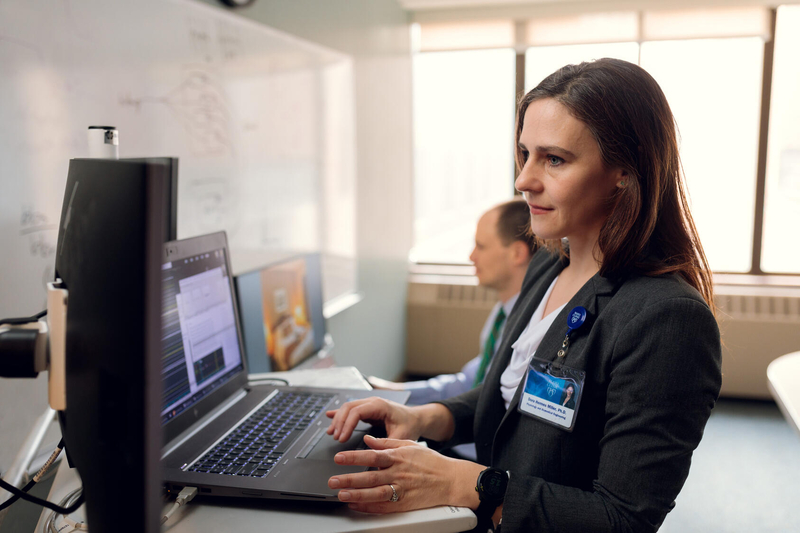
Additional resources mentioned in the conversation: