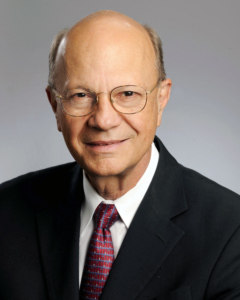
Mahlon DeLong is Emeritus Professor at the Medical School of Emory University.
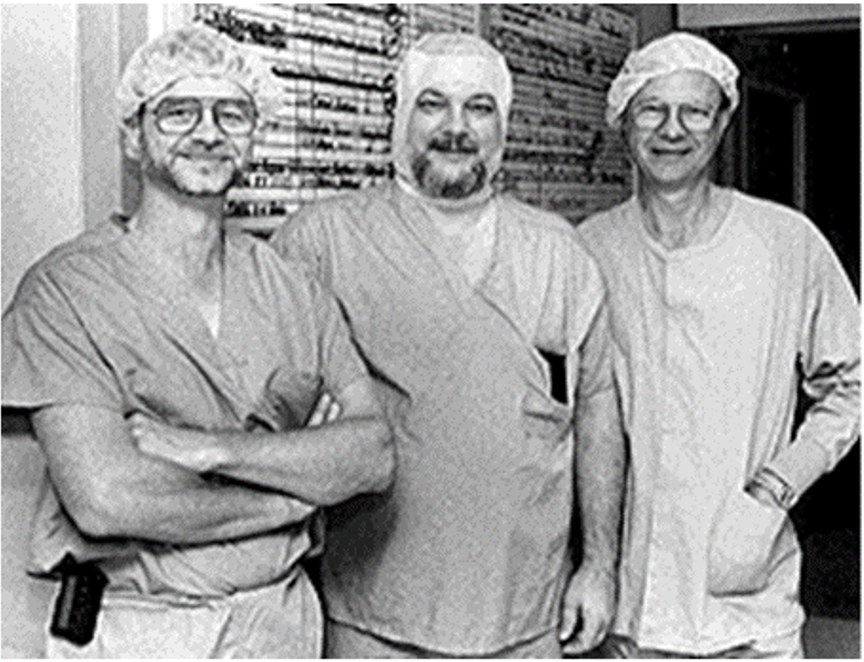
The “three caballeros”: Roy Bakay, Jerry Vitek & Mahlon DeLong. A typical OR scene in the early years.
#22: Mahlon DeLong – The Basal Ganglia in Health & Disease
In this episode, I had the great pleasure of speaking with Mahlon DeLong about the past and future of our field, the most influential model of the basal ganglia circuitry, microexciteable zones in the striatum, the role of the nucleus basalis in Alzheimer’s Disease and many other topics. We also touch upon the role of the basal ganglia model for psychiatry, more recent topics such as psychedelics or how instrumental the MPTP model for Parkinson’s Disease in nonhuman primates was.
Mahlon needs no introduction and can certainly be seen as one of the key founding fathers of modern basal ganglia research and together with Hagai Bergman and Thomas Wichmann directly paved the way to establish deep brain stimulation to the subthalamic nucleus. The episode is enriched by guest questions from Marwan Hariz and Hagai Bergman, as well as planning input from Helen Mayberg. I hope you enjoy the episode with Mahlon as much as I did and thank you for tuning in!
Mahlon DeLong 00:00Oh, I think the translation of this to the treating diseases has just been the most amazing thing. I can honestly say when I went to the NIH to study the basal ganglia, I had no intent of curing any disease. I didn't know what disease to even cure. Okay, so the question you asked me earlier on about key people, I was going to extend it to key animals, or key models. By all means, the introduction of the MPTP-treated primate was a door opened to understanding, I think, the basal ganglia and Parkinson's disease. And when we saw that, we just shifted immediately to begin studying that.
Andreas Horn 01:12Welcome to Stimulating Brains. Hello, and welcome back to Stimulating Brains, episode number 22. This conversation I had with Mahlon DeLong is surely a key highlight of this podcast. Mahlon has been, and still is, one of the key important figures in the field of neuromodulation, and has been instrumental in paving the way towards detailed models of the basal ganglia, and how to cure it. So, let's get started. How they interact with cortex and thalamus. Mahlon DeLong studied at Stanford and Harvard, then did his internship in Boston, 02:01spent five years at the NIH for research, and continued residency at Johns Hopkins later on, where he then became an assistant, then associate, and then full professor. In 1989, he was recruited to Emory as chair of the Department of Neurology, which he did until 2003, and then became the interim director of the Comprehensive Neuroscience Center. He's the co-director and founder of ENTIZ, the Emory Neuromodulation and Technology Innovation Center, whose goals are to foster advancement of neuromodulation and the development of innovative neuromodulation technologies for the treatment of neurological and psychiatric disorders. Dr. DeLong's most recent award is the 2014 Breakthrough Prize in Life Sciences. He was cited for his work defining the interlocking circuits in the brain, and for his work defining the interlocking circuits in the brain, and for his work defining the interlocking circuits in the brain, This scientific foundation underlies the circuit-based treatment of Parkinson's disease by deep brain stimulation. 03:03We have some guest questions by Marwan Hariz and Hagai Bergman, to whom I want to express my deepest gratitude. I also want to express deep gratitude to Patricio Rivapossi, who introduced me to Mahlon DeLong, explicitly facilitating this podcast episode. Thanks a lot, Patricio. And I hope you all have as much fun. listening to this exciting conversation I had with Mahlon DeLong. Episode number 22. Welcome back, Stimulating Brains. So, Mahlon, thank you so much one more time for taking part in this. And by now, I will have introduced you more formally.
Mahlon DeLong So we can directly start with questions. And to break the ice, before we get into science or medicine, I usually ask about hobbies.
Andreas Horn So what do you do when not involved in medicine? 04:04That's an interesting question.
Mahlon DeLong Well, I retired formally, I guess, about five years ago, or four or five years ago, and cut back, COVID struck, and everything converged. So, I'm ! Filling time somewhat vicariously, in a sense that I had to plan a lot of trips to my wife and to myself. a lot of trips, my wife and I. Those didn't happen, of course, and we're just starting again. But we've tried to do virtual cruising, I guess, on television, and really quite a lot to see out there.
Andreas Horn That's been interesting,
Mahlon DeLong especially going sometimes back to places that you know you've been. And that's been a fun part. I read a lot. I read incessantly, as much time as I can find. 05:02I started in physics and astrophysics, actually. That was my passion when I started undergraduate. But I ended up in history because of some stimulating courses and interactions, opening up a new world. So I read a lot of history. I'm very interested in particularly ancient history, what happened before societies were developed, formed before agriculture, that early period. It's a wonderful book out. I just ran across the history of everything. It is an amazing recommendation for anybody who wants to come on. Great to hear. Thanks.
Andreas Horn Yeah.
Mahlon DeLong David Graeber is the, I think it's the number one book on, this is not a hidden or obscure recommendation. It's fascinating.
Andreas Horn Do you still play the alto sax?
Mahlon DeLong I read that you had a band in high school a long time ago.
Andreas Horn 06:04Oh my God, where have you been? Where did you... Yeah, that was a passion for middle and high school.
Mahlon DeLong We played swing band... It was a swing band. And that was... I still have the sax. I still play guitar and some recorder and...
Andreas Horn do those things but not like I did before. That was a wonderful part of my life actually. And I heard six grandchildren, is that still true?
Mahlon DeLong I think that's right, seven. I was going to say what do I do? Fortunately, six of the grandchildren live in Atlanta so we have them every weekend and through the week as well so it's a remarkable thing. That's amazing, I can imagine.
Andreas Horn 07:08Yeah, great. All right, let's dive into the topic though, science and medicine. So you studied
Mahlon DeLong at Stanford and spent your junior year in Berlin, I had to ask. Do you still speak a little German or Russian? I think you learned the two languages.
Andreas Horn Yeah, I was going to be a diplomat, that was my goal and I got a scholarship or an exchange program
Mahlon DeLong at the Free University, Freiburg University. So that was a wonderful year and did a lot of traveling and at that point the wall was up, was not up, sorry, and we could go back and forth between east and west. And I traveled to Russia and Poland and got to see a bit of the world. I was thinking about history 08:00and also diplomatic service and then something happened in my last year at Stanford, I'll tell
Andreas Horn you about. It was one of those aha moments. Please do, yeah, please do tell what happened.
Mahlon DeLong Well, I had come to the US and I was in the US for a year and a half, I was in the US for a year and a half. I had come back and was getting interested in behavior and psychology, I guess you would say, and all my courses were hard science, so I had never taken a life science course. So I took it because I had to, I mean, to graduate and it was biology, sort of a basic course everybody took and I saw on the screen cells dividing and I thought, oh my God, You know, the chromosomes. It was like this world, this life science, I didn't call it life science, but it just hit me like a bolt of lightning. 09:01Oh, my God, this is what I want to do. Something dealing with the brain. The brain came very quickly, but the initial was something about biology, I think, and understanding life. Great. Amazing. So later, you went to med school at Harvard and then also did your internship at, I think, Boston City Hospital.
Andreas Horn What were, in general, in your career, crucial turning points and who were the mentors that really stuck out, that influenced you most?
Mahlon DeLong Well, I'll back up a little bit to Stanford. The person there who probably had more to do with that than anything and as much as anybody was Don Campbell. He was a great mentor. He was a great mentor. He was a great mentor. He was a great mentor. He was a great mentor. He had come there from Harvard and Syracuse, I think. But he said, I talked to him and I got to know him quite well. He was working on invertebrate nervous system and helped. 10:04I took a year as a, not a graduate student, but in a post-doctorate, and spent a year with him setting up lab and doing experiments, if you want. And his advice to me... To me, it was kind of shocking when I... Because I had planned to just stay there at Stanford. I knew a lot of the people and had gotten underway. And he said, go east, young man, not go west. And so I ended up at Harvard. I applied and they gave me a ticket to come. So I said, okay, I might as well. And that's how I got to Harvard. It was one of the best decisions. Well, I don't know.
Andreas Horn You know?
Mahlon DeLong You never know what the alternatives are. But it was just at a time that Kufler, Steve Kufler, had, for the first time, put together the neurosciences in a department. 11:00He didn't call it a department, but he called it neurobiology. It was the first grouping of anatomy, physiology, pharmacology, and all of the imaging at the time. You know, all of those pulled together in a department. And we had the most wonderful faculty. First pen and pot. You know, Nobel laureates. And their youth who were teaching these courses. So it was a remarkable experience and a rich one for neuroscience. I may have taken us off track here a little bit.
Andreas Horn That was exactly the question.
Mahlon DeLong So I read that you also got to be taught by Danny Brown at Harvard. And then also, yeah, I can tell you a short story. After my freshman year, I was in anatomy, in anatomy in the second year, and I came down with a viral encephalitis and had myoclonus, and it was really kind of severe. And they decided I probably wasn't going to survive, and called the family, and Danny Brown came to see me 12:18during that time. And I'll never forget watching him, looking up at him. I didn't know who he was at that time. They just said, this specialist is coming to look at you. And I heard him mutter, my acronis, which I didn't know what it was at the time. But it was a remarkable experience because then I got to know him when I went to city hospital. Not know him close, but anyway, I had exposure. One of the giants of basal ganglia research.
Andreas Horn Yeah.
Mahlon DeLong Interest. That's great.
Andreas Horn And then other mentors that were important or turning points in your career? 13:00Yeah.
Mahlon DeLong Well, certainly when I went to the NIH, I have to say a turning point was the Vietnam War because we all had to scram, skedaddle, and get a place where we could, we could avoid the draft. We were the yellow berets, as they called us. But I applied to the NIH and visited and got, this was just, it was remarkable. And Ed Everts, who had just, you know, was the top primate physiologist in behaving primates. There was, I mean, he was on fire. He offered, you know, he was the last physician available in his lab. There were three or four who had just come on. So that was a huge turning point. And I'm, I'm really grateful to Ed. 14:00And he, he was a rather difficult fellow as a psychiatrist. And, you know, that's another whole topic, but he was very instrumental with everything.
Andreas Horn Yeah. So would you, would you say you learned single cell recording in that five years at the NIH?
Mahlon DeLong Because I read you also looked at grasshoppers before that even,
Andreas Horn right? Is that true?
Mahlon DeLong Well, that, that was with Don, or Dave, Don Kennedy.
Andreas Horn Yeah.
Mahlon DeLong That's right. Well,
Andreas Horn yeah.
Mahlon DeLong So Tom, really, I learned it from Tom Thatch, single cell recording and behaving primates. Tom, Tom was, he was working on the cerebellum. And we were very close as the entire group was over half a dozen people there. And we learned from each other. Ed was on the scene, but not in the lab. And each of us, 15:01we had our own, it was incredible. We had our own lab and we're responsible for doing everything. It was a great experience. And, I can name other people, but I think those are the key ones. Guy McCann at Hopkins, who was a tremendous father-like figure. I mean, he had just started the department there and had turned it into the greatest group of young people I think you could imagine. And that was a tremendous environment for everything that followed. And I heard that was the golden era at the time.
Andreas Horn Absolutely. Absolutely.
Mahlon DeLong It was, you know, as I, as I mentioned to you, strangely, we, we, we got into the straight, this is getting ahead of the story, but we got, I got interested in the basal forebrain for a number of reasons, 16:01but we, we had identified those neurons in the work I did at NIH, the basalis neurons. And, and, and, the basalis neurons and their dispersal throughout the pallidum and, showed that that was related. That was a, those were lost in Alzheimer's. And so we, we followed that up with a lot of physiology. Russell Richardson was one of the, was the key person in that looking for what, what that might be contributing. So I, I think that one of the key achievements in your scientific career is, of course, circuit model of the basal ganglia. So, and it is really hard for somebody like me that's younger now in science to even retrospectively learn how it emerged, you know, what the story was at the time, what the knowledge was at the time.
Andreas Horn So could you share a bit, you know, how it emerged, how you even came to the idea? 17:01What were the key points in coming up with such a model?
Mahlon DeLong You're right. Yeah, so at that time, I think the consensus was clearly that the basal ganglia were structures, and maybe the best would say Kemp and Powell's 71 paper sort of summarizes the thinking better than any. His view was that the basal ganglia...
Andreas Horn Yeah.
Mahlon DeLong ...are the mechanism whereby different cortical areas can initiate movement. So it's an action selection, I think you use that word actually.
Andreas Horn Yeah.
Mahlon DeLong But the notion was that different cortical areas could initiate movement via the basal ganglia and thalamus with that output going directly to the motor cortex.
Andreas Horn 18:04Yeah.
Mahlon DeLong And, you know, there was also some sense that it was going to the medial areas as well, SMA.
Andreas Horn But that was, I would say, so accepted that, well, how did we come to the different view?
Mahlon DeLong The work at the NIH, what we found was that the neurons related to body parts and movement were in a very circumscript. And so to these neurons to these body parts to these body parts to these body parts to these body parts to these body parts to these body parts to these body parts to these body parts to these body parts to these body parts to these body parts to these body parts to these body parts to these body parts to these body parts to these body parts to these body 19:01ditto GPi, that they were each, at each level, the specificity for movement was preserved as far as we could tell. Very little driving from any movement of any other part. There were associated movements, but that was a separate issue. So we saw that the organization was one that was functionally specific. There was an arm, leg, motor area, face as well. And these were all separate, but focusing narrowly into smaller and smaller numbers of cells at each jump. I mean, a remarkable reduction, of course, from cortex through striatum to thalamus and on down to the output. And then what we found at the same time, was that the cells outside the motor areas of those 20:02were not specifically related to movement in any obvious way. Not that they were not related, but not in the somatotopic pattern. And then a lot of anatomy began to show, you know, that the projections to the striatum were, well, we knew the projections of the striatum were topographic, if you will. And then the question was, how did it proceed from there, was the real issue. So we had a strong hunch and believe that the outside, that the non-motor areas were receiving input in a similar manner that is topographic and that that was maintained throughout the network. That was the essence of it. This view,
Andreas Horn was interesting because, well,
Mahlon DeLong 21:02this idea came to us pretty clearly, and Apostolos, Georgopoulos and I were working together at that time, this is by total coincidence, Tom Powell, the person who co-author or the major writer of the summary, was visiting Vernon Mountcastle's lab for the year. And we, we began to talk to him about this and he kind of sort of went, you know, no guys, sorry. This is not the way it is. Oh, very nicely. But so we proposed that we meet on a regular basis week after week, after week until he would agree or not agree, disagree. Well, after about a month, he began to accept everything we were kind of proposing. And was fully, fully behind it. It was a remarkable change. 22:04When we put this thing together, I sent it to various people. Nobody likes it. Really. No, no. I don't want to say that. Some people did not like it. Thought of, you know, this. I don't know. Ed Edwards never replied to me.
Andreas Horn Okay.
Mahlon DeLong He never commented. So. But anyway. Were you,
Andreas Horn were you at the Mountcastle's lab at the time or were you already a PI there? Yeah. Yeah.
Mahlon DeLong Mountcastle had space is how I happened to be there for a couple of years. And then, then we went over with new space at the city hospital. Maybe just to clarify, I think Thomas Powell was the leading anatomist in the field. He's from where he was from Wales. Right. And he, in the beginning did not believe you, 23:01but then apparently after many discussions came, came across, which, which is amazing.
Andreas Horn Yeah.
Mahlon DeLong Were there other other key roadblocks or challenges or breakthroughs that, that had to happen until the model was came,
Andreas Horn became established?
Mahlon DeLong Well, it didn't, I didn't feel that it lasted. For long. I didn't hear much in the way of after it was published. I think people generally accepted it. And the data, I mean, the studies just seem to go further and further and supporting it. Great. So one, one key thing in the original model was that it proposes a partially closed loop,
Andreas Horn right?
Mahlon DeLong Projecting. So the thalamus, so cortex projectors, striatum, then pallidum, pallidum, substantia nigra back to the thalamus, which would then project only to one of the regions that, 24:04you know, originally. Yes, that's right. That's right.
Andreas Horn Is that still true?
Mahlon DeLong Like, well, you still think, I, I, I think it's probably, uh, part, maybe partly true. I, I don't know the answer, but, but the, the, the, the original one was, was because that's what the data, was kind of pointing in that time. But I think since the projection to the, um, motor cortex and, you know, the different cortical areas, I think that has become clearer and clearer. Great. So, um, maybe, maybe in that regard, I, I really, I'm a big fan of Larry Swanson's, um, extension of the concept striatum and pallidum. I think Swanson would argue that this, you know, you can, all of the deep nuclei, you could divide them into either being a striatum or a pallidum essentially, 25:03you know, um, having the function to inhibit or disinhibit, uh, other cortical areas. So, so I think he proposed that you could, you know, essentially replicate your model across other regions that are not formally striatum and pallidum.
Andreas Horn What do you think about that?
Mahlon DeLong Uh, I don't, I don't have any strong reaction. I, I, I, I, I, I really don't. Uh, I, I, I, I, I, I, I, I, I, I, I, I, I think it's an interesting,
Andreas Horn very interesting concept. Yeah.
Mahlon DeLong I think the model right now is,
Andreas Horn is often referred to as the Albin-DeLong model, right?
Mahlon DeLong In, in, in brief. And I think it builds on two, um, papers, at least that's the main, um, conception in the field. The first one being from Albin, Young and Penney in 1989, um, researchers at Ann Arbor. And then your DeLong 1990 paper from Johns Hopkins. Together, they cited 10,000, 10,000 times. So, um, where, where many know about the model, um, 26:00maybe few people know how, how it emerged. So how maybe was there communication between Ann Arbor and sort of the team at Ann Arbor, uh, and yours, or, you know,
Andreas Horn did you exchange ideas or was it more similar ideas at the same time?
Mahlon DeLong Well, I, I think, uh, I think our focus was on the somatotopic organization and the motor and the separation, uh, they were focused on motor. Uh, it seemed to me heavily and, and, uh, and, uh, most of it was rodent. Uh, well, it was rodent. So. Gotcha. Right. So, so, and then what,
Andreas Horn what I found really interesting,
Mahlon DeLong you know, when trying to understand your models as a, as a student, um, you know, is that the models are, uh, functional models,
Andreas Horn right?
Mahlon DeLong So the, the, the, the, the, the, the, the, the, the, the, the, the, the, the, the, the, the, the, to 27:07was, I think, quite well understood way before your model, maybe as early as the 1920s by the folks or also clinical work by Hot Freak first, building on top of them back in the day.
Andreas Horn But your model is a functional one and that was the breakthrough. Is that correct?
Mahlon DeLong So that we suddenly understood
Andreas Horn not just what was wired together,
Mahlon DeLong but how these net activities could shape each other and then lead to deficits and movement disorders and psychiatric diseases. I've always thought about it.
Andreas Horn It's interesting.
Mahlon DeLong I've always thought about it as a functional anatomic model because the anatomy and the physiology were so important and understanding the detailed organization within the motor circuit. 28:02So I... I... I... I...
Andreas Horn So it's interesting to say that clearly it's functional, and it's not anatomical in the classic sense, but it's physiologic anatomic. Absolutely.
Mahlon DeLong So this is really great. So I think one other key paper, maybe the key paper, was the Alexander, DeLong, Strick paper, where, as you mentioned before, and that was built, I think, on top of the paper between you and Georgopoulos in 1981, which showed the parallel organization of these functionally segregated circuits. And I think it's still, you know, there are these two concepts. One is being the funnel.
Andreas Horn Where the basal ganglia compresses information to some degree, right?
Mahlon DeLong We have less cells in the STN than in the cortex. But then, of course, also the parallel circuits. 29:04Right.
Andreas Horn And probably both concepts are true to some degree, right?
Mahlon DeLong There is some sort of integration and compression, but it's still also very important that the segregation is retained.
Andreas Horn So I find that really crucial and important to learn about the brain. How much is being integrated? You know, from different areas in the cortex, but how much is also being segregated?
Mahlon DeLong No, no, I think that's, I agree with you.
Andreas Horn That's probably one of the most difficult and interesting issues in this whole business.
Mahlon DeLong I mean, there's so much. I mean, there's the fact that the dendritic tree of the palatal neurons is flayed out like a come stick on me, do something to me. I mean, it's a very good thing. It's a very dense layer of the, you know, the arbor, dendritic arbor of the GP neurons. And so they want to collect, like they want to collect a lot of information from a large area. 30:06You know, we're here. And yet the recordings point very much to specificity. And I mentioned the micro excitable zones. I don't know. I'm going to say a word about that. There are zones in the striatum that are micro excitable at very low intensity through the microelectrode, that the neurons recorded in those zones are totally congruent, or not totally, but almost always highly congruent with the movement. If it's a wrist movement, you will find neurons under in that. Micro excitable zone. They're just all related to passive or active wrist movement. 31:01So it's. That that segregation of function. Seems so. And it's present at every level, every level we've looked in the pallidum. And we did in Japan, we did a lot of work with the group there. Exploring very close penetrations in the pallidum. So but but the issue is not so much the how much congruence is there within the motor circuit, but how to what degree do these outside circuits, the cognitive associative limbic. Play a role. Are they able to. Influence. And, you know, I know there's some evidence now that striatal or STN neurons can have. 32:00Input from two different cortical areas or some influences, but I haven't seen a lot of water. The work says there's a diffuse dusting of terminals, but doesn't show that they actually connect, you know, so the physiology is not there. It's an open question. It's an open question. It's an open question. It's an open question. It's an open question. It's an open question.
Andreas Horn Yeah. It's, I also think a lot of insight is in exactly that maybe question, because I also learned from Hagai Bergman's book that I recently read, that the GPi neurons are really, really orthogonal to each other.
Mahlon DeLong Off right. They don't. They don't share much information. So even though you're right, they stretch out. No. Condenser. No. No. No. No. No. No. No. No. No. No. No. No. No. No. No. No. No. No. things and years and years of recording at NIH and Hopkins and all that. I don't think I ever saw 33:04two neurons that were correlated. When you could record two neurons,
Andreas Horn they were always doing different things. In the TBI?
Mahlon DeLong In GPi, yeah. GP, GPi, doesn't matter. Okay. Yep. That is so fascinating. So, I think it's a good time to play one question I recorded, or a guest recorded, which is Marwan Hariz. Let me see. So, this is the first question by Marwan Hariz. Dear Mahlon, I am so honored to have been asked to participate in this interview and to be given the honor to ask you a question. I have three questions. This is the first one. Given that the two main output structures of the basal ganglia are the GPi and the SNR, how do you explain that it is only the GPi that is a valid, 34:06efficient target for lesions or DBS in Parkinson's disease, while DBS on the SNR does not seem to
Andreas Horn work? Thank you for your answer. It's an interesting question. We have mapped the SNR in the primate and found some
Mahlon DeLong neurons related to face movement and face and tongue movements, and a little bit, some other body parts, but very little, and they're very lateral. So, it's like the pars lateral, Well, no, that's the rodent story. No, so there is very little there that is getting input from the striatal motor portions. The rest of the nigra is caudal or is associated with limbic, I don't think. So it's just that the substrate isn't there. It's mostly all in GPI and in the ansa.
Andreas Horn 35:17So, well, no, that's a different topic too. Yeah, that is interesting. So that could mean that potentially the nigra could be a psychiatric target? Yes.
Mahlon DeLong Yeah, I think it could be. And it's also the eye movement stuff was there in the nigra. Great.
Andreas Horn So moving on, in the early 1980s, some drug users' bad luck was exactly the opposite for neuroscience and also for your lab.
Mahlon DeLong A powder produced in backroom labs and sold on the street as a new synthetic heroin sometimes became contaminated by a close chemical cousin leading to what the press called frozen addicts.
Andreas Horn 36:04Can you tell us a bit about that time? Okay.
Mahlon DeLong So, yeah. So the question you asked me.
Andreas Horn Okay.
Mahlon DeLong Earlier on about key people. I was going to extend it to key animals or key models. And by all means, the introduction of the MPTP-treated primate was a door opened to understanding, I think, the basal ganglia and Parkinson's disease. And when we saw that, we just shifted immediately. to begin studying that. As I said, I was always interested in the basal ganglia. I was going down that independently, but that was a hard turn to Parkinson's. And it's interesting, little tidbits and just the reaction of different people when I told Vernon what we were doing, he shook his head. 37:11He said, no, no, don't do it. You won't find anything. Wow.
Andreas Horn Yeah.
Mahlon DeLong So I said, well, Vern, we're doing it now. We're starting. I'll never forget the first day. I should have thought of this before as a eureka moment, because the first day, Bill Miller was a graduate student who had started in the lab. And I said, look, this is your chance, your job, your life, a chance of a lifetime. And he did a bang up job on the whole thing. He's just super. But anyway, the first day we recorded, we stuck the electrode through the striatum. 38:00As you go through the striatum, you don't really find very much. There are a few cells that are active, but it's a very quiet place. And I had already, believe this, this is the rest of the story. I had already done this when I was at the NIH with drugs to create Parkinson's disease. I thought the striatum would just light up, would be on fire, zero. And I never had the sense to go deeper. I don't ask. That was a strange thing.
Andreas Horn But we were so convinced that the striatum. Would light up if there was going to be anything. But anyway, neither with MPTP nor the other agents to create Parkinson's. Did we see any striatum change?
Mahlon DeLong And that's true in most animals. So it's really much more in the, but in the external pallidum, it was immediately obvious. And as we went on down into GPi, it was crystal clear. 39:05First track. That was a eureka moment, you'd say. Because of the. Oh yeah.
Andreas Horn Okay. Yeah. Yeah.
Mahlon DeLong And I'd forgotten about that until just start talking here. Sure. So great. So, so, and then in the old days, so if surgeons did a subthalamotomy, that did not mean they would lesion the subthalamic nucleus, but lesioning below the thalamus, because in fact, people shied away from lesioning the STN out of fear of hemiballism. But then your paper with. Hagai Bergman in 1990 in Science changed that.
Andreas Horn Can you tell us that story? Yeah, that's, that's a, that, that was clearly one of the biggest findings and most important in a way.
Mahlon DeLong But, and, and I agree with, you know, the subthalamotomy has been done. 40:01We're not really subthalamic nucleus. What they talked about that area. I. I. I. I. I. I. I. I. I. I. I. I had, I was almost a hundred percent convinced that it would work.
Andreas Horn That, I mean, why wouldn't it?
Mahlon DeLong And, and there was a, I think a general consensus from all of the available evidence that, that, you know, showing that the output was excitatory from GPe. That was a big finding. And. and that the 2DG studies clearly showed that the changes were as predicted would be consistent with that overactivity in the STN so shutting it down ought to make 41:00it better so I was very pleased and excited the guy was very very excited and I think everybody was amazed when it happened but I didn't have any I wasn't surprised I felt okay
Andreas Horn that makes sense
Mahlon DeLong but isn't that amazing maybe for the listeners we should clarify that a bit further that this was really a prediction from the model that you and the the ! 42:06! maybe just to clarify that a bit further like how it felt like to then even though you were not surprised I'm sure it was still yeah that's maybe playing it to I was more pleased than surprised and I have to mention the work that others had done on that you know with Filion had recorded and and Michelle Filon had recorded and not in MPTP monkeys but he recorded and we saw the similar findings and that and Alan Crossman working with 2DG had done beautiful studies showing confirming what we suspected so I think the sub I think the ground 43:01I don't know how many people were really surprised but I think the people who were thinking and knowledgeable about this probably weren't surprised but you know maybe glad then for Hagai Bergman that was likely his breakthrough and he told me he was on the podcast before as well he told me he was kind of late to science so he was already he wasn't very young at the time right he was he came to Emory when he was already
Andreas Horn had been had been in research for a while in Israel as well is that correct?
Mahlon DeLong oh yeah he had you know he came well trained and ready to go I mean most of the people I've worked with have just been tremendously you know wonderful people well trained but Hagai did Hagai say he was surprised or no I don't I don't remember whether we talked about surprise or not 44:02yeah well it was it was it was it was obviously very important and sort of check to box kind of and I mean if if we stop like if we if you just think think think for the next like then five years or so then as as everybody knows Grenoble did something tremendous with STN DBS right producer was also on the podcast and Pierre Pollack was on the podcast and in a way, you know, I asked that question to Hagai as well. You obviously paved the way to deep brain stimulation, and with that, STN DBS, I mean, and with that you paved the way to you know, helping thousands of people worldwide that have received deep brain stimulation so far so how does that feel like let's say maybe you you you have some friends um even with the brain stimulation or some people that you know, how does it feel to know that this builds on top of 45:04your breakthrough oh i think i think the the translation of of this to the treating diseases has just been the most amazing thing i i i can honestly say when i went to the nih to study the basal ganglia i had no intent of curing any disease i didn't know what disease to even cure i mean well i mean i was purely interested in the neuroscience and it was only after I went back to Hopkins that in the clinical environment i think and in the in the rapid you know development of the model uh this one and and then the experience so but we had not done anything with that you know my my i'm a little bit ahead of the story but you know i 46:07i felt that dbs when it was introduced was really a breakthrough of enormous magnitude but we had because of the concern about lesioning the subthalamic nucleus, we had said no, but we've got to do something but that's a little bit later story
Andreas Horn so that's where we went to pallidotomy, and we spent a good amount of effort to So that was with Jerry Vitek, right?
Mahlon DeLong Then to establish pallidotomy.
Andreas Horn Yeah, so Jerry and a whole large group of us moved en masse to Emory.
Mahlon DeLong That was the so-called hemorrhage to Emory. And that was just the movement disorder part of the department. 47:01But that's when we began preparing for surgery. But we'd been doing surgery at Hopkins with Hank Nauta's son, Wally Nauta's son, Hank, and Fred Lenz. We had recruited Fred Lenz to come. So we were starting to do, and we were doing thalamotomies, but had never, had not. Gone beyond that. I was just saying, my interest in contact with surgeons, while I was at the NIH and at Hopkins, was I think my greatest contact was Narabayashi in Japan. I spent a lot of time in Japan with Narabayashi. They were sort of world champions. 48:01And he was a famous psychosurgeon. He was a psychiatrist. So the idea of doing surgery was very much on my mind.
Andreas Horn Yeah. But what kind was a separate issue?
Mahlon DeLong Maybe before we get into that, I think it's good to play another question by Marwan,
Andreas Horn which fits perfectly at this point, shall we?
Mahlon DeLong Sure. My second question, is we know that the STN as a surgical target for Parkinson's disease is a discovery by Hagai Bergman and yourself. And the STN is considered the most favored and efficient target for DBS in the whole world, except maybe in the United States, where many still insist that DBS in either GPi or STN give equal results.
Andreas Horn How do you explain this discrepancy?
Mahlon DeLong 49:01Thank you. That is a wonderful question. We are guilty of all of that. We, our experience with pallidotomy was so positive that we felt it was important to try it and explore it. And others, had done it previously. It wasn't a brand new step. But we found, we had very good results with pallido-DBS. And we did, the most important thing is that we did careful mapping, microelectrode mapping of the motor area. So we could place our electrode in the right spot. 50:00And all of this is basic to anybody who does this kind of stuff. But the microelectrode mapping was very important, both in our lesioning and for our recording, for our stimulation. And so we felt quite comfortable with it. And I honestly think the results are fairly similar. We do separate people with COS, and we do separate people with COS. If there's any cognitive or any other problems, we will do GPi. I think GPi, the motor area in GPi is quite a bit large, because it's greatly larger than an STN. So you can hit the motor network, motor circuit, without spilling into overlapping or nearby cognitive, or whatever the code is. It's a very, very rich network. 51:00or associated limbic, not limbic so much as cognitive. And I think the studies are pretty comparable in terms of outcome. But I think we do select patients. Young patients, we would do STN. Tremor, we'd do STN probably. But GPi is very effective for tremor.
Andreas Horn It may take a little longer, interestingly, to manifest.
Mahlon DeLong But we've found all kinds of tremor-related cells with lesion. But it can be delayed. That's the curious thing about it.
Andreas Horn Yes, very interesting.
Mahlon DeLong I suspect we have poisoned the water. Because early on, I think we were doing this quite a lot.
Andreas Horn Okay.
Mahlon DeLong I hope Marwan is happy with that answer. 52:00Because I also, myself, I've worked in Berlin and then now here in Boston. And I wouldn't even think we have seen such a big difference in the choices of how DBS is done. It's still, at least between these two centers, still, I think, I would say both centers, STN is usually, for most cases, the default. But then there are sometimes cases. With more dyskinesias or so, or other issues where then GPi is favored with great results as well.
Andreas Horn But it's certainly a very interesting question also to me why both work so well.
Mahlon DeLong So that already suggests, obviously, that it's a network effect. So I think we can play another question, this time by Hagai Bergman. Because we talked about him. But that question will lead us to maybe a slightly different topic, a slight detour. And I might just for the readers also say a bit about that. 53:00So it's about GPe neurons. And Hagai, in his book, writes about recordings of the GPe neurons that show particular pauses. That I think you know very well. But not so many people might know that are not doing electrophysiology in the basal ganglia. Because I think they still remain. And I think that's a big mystery. So there have been some, you know, apparently there were some relationships to, for example, you know, arousal levels. So apparently the pauses will be less frequent and shorter when the monkey is engaged in a behavioral task. But there's no clear, so according to Hagai, there's no clear reason yet for that. Or we don't know what these pauses signify. And I think that's exactly what Hagai wants to know. So let's, from you. So I'll play that question now. Dear Mahlon, long time no see. I miss you. 54:00Andy was kind enough to ask me to pose a question to you. So I'll follow my Middle Eastern style. Don't change over 30 years. And I'll ask two questions. My first question is if you can, if you remember the first time you noticed the spontaneous pauses of the GPe high frequency discharge neuron.
Andreas Horn What was your thinking? Have you been thinking that this is artifact, or did you recognize it as a very strong feature of this neuron? And second question is now 50 years later, what do you think is the role of these pauses? Thank you so much, Mahlon. I am looking forward to this podcast.
Mahlon DeLong Hagai. Thank you. Well, Hagai, it's an embarrassing question. Because I have no idea of what those could be. 55:00We noticed them, you know, prominent findings. And I never could make any sense out of it. But we never tried. I never tried to think about them or look at them in different conditions. I think they become. I've seen them. Become longer with periods of rest or quiet, you know, relaxation. But I don't think we once looked at the basal ganglia in sleep. There's a lot of recordings during sleep and never published it, believe it or not. But never saw any correlation. But I can recall or any specific changes. Everything got slower. 56:00Everything got slower during sleep. So after 50 years, I haven't learned a thing. No.
Andreas Horn Okay.
Mahlon DeLong Great. But I think according at least to Hagai's book, he would say the same. So it still remains one of the big mysteries according to the book. So yeah. It's yet to be discovered by a new. Generation.
Andreas Horn So maybe thinking in a similar line of Hagai's question, if you look back 50 years later now, what of your model do you think still holds true today? Or which crucial things would you adjust or add?
Mahlon DeLong Well, I think. I mentioned a couple things. The first is that. The second is that. The third is that. The fourth is that. The fifth is that. The sixth is that. The sixth is that. The seventh is that. The eighth is that. The ninth is that. I mean, there's a lot, there'll be a lot of modification, further modification of the model. I have no doubt. 57:01And to what extent these zones remain segregated and to what extent there's cross talk or, you know, modulation from not other cortical areas, I think is still up for grabs. But I mentioned these striatal micro excitable zones. But I mentioned these striatal micro excitable zones. But I mentioned these striatal micro excitable zones. Which to me were just further evidence for the fine grain specificity of organ and organization of these motor networks. It is one of the most remarkable thing. I know that others have picked it up and tried to do something with it a little bit, but nothing seems to have come out. But I think there are. There are. Equivalent to the cortical micro excitable zones. There must be. We've lesioned the GPi and could not evoke, not the GPi, but the striatum, could not evoke the responses. 58:14So I think they're activating output elements.
Andreas Horn And then a decade after your work, what was the next step? What was the next step? What was the next step?
Mahlon DeLong your work and your model, the Redgrave, Gurney and Prescott model originated which became popular in
Andreas Horn the computational modeling domain. How would you say the two models were different? So what was added
Mahlon DeLong in the Redgrave-Gurney model and what was similar? Well, I was going to, I think we had talked about that briefly, but I was going to ask you what, I'm not as familiar or I can't be
Andreas Horn as incisive perhaps as you would be and what specifically were you seeing? 59:11So it's exactly the point that to me these models look very very similar
Mahlon DeLong but yours was 10 years before. So I thought, you know, maybe you know what has changed between them. I think one key point that I've understood with the Redgrave model was that it
Andreas Horn was a computational model where they really implemented, you know, simulated, let's say, the computer code, right? So maybe that was the key addition but I just thought maybe you had
Mahlon DeLong been in contact with them. No, not really. Well, we did talk about, we've published together and done other things but I've never had this conversation. So I'm not very enlightening. 01:00:05So while the model was crucial in advancing our knowledge in movement disorders, you also mentioned that it was a godsend for psychiatry and I was talking very briefly via email with Helen Maitland,
Andreas Horn who was the director before this about the upcoming podcast with you and she also mentioned that you were increasingly interested in depression. So do you want to share some thoughts in that direction of psychiatry?
Mahlon DeLong Oh boy, yeah. I'm very interested in, I almost went into psychiatry to fill in the gaps. I was 50 50 when I left Hopkins.
Andreas Horn Yeah.
Mahlon DeLong Or when I left NIH and the department at Hopkins was still very, it was starting to be biological, but it was still not, not, not, and I knew it knew where neurology was going. So I, 01:01:03I got on that train and stayed on it and that, that I had never had any second thoughts, but my interests I think are still in many ways highly pushed towards that psychiatric, psychopathology kind of issues. And I've been really very stimulated by learning more about something I should have learned about a long time ago, which is the effect of psychoactive drugs, the LSD and what's happening in psychiatry. You know, my, the remarkable effects of that drug that seemed to set a different, with Helen Mayberg, Helen, you know, Helen has this idea that something is set and can't be,
Andreas Horn 01:02:03you got to get out of that set. And that seems exactly what these drugs do is to take people out
Mahlon DeLong of, out of their set and expose them to a far greater world, a far more beautiful, integrated, you know, place that they come back from. They have this transcendental experience. I'm talking about, I'm talking about the real cases, you know, where they really, really do take the trip. And they come back altered in ways that are unbelievable and, and, and a lasting way. And so it's, it's the drug that precipitates the experience, but it's the experience that seems to have lasting effect. It's not a drug effect. And there's a, there's a, there's a, there's a, there's a, there's a, there's
Andreas Horn and there's no drug addiction craving. So that to me was like, oh, my God, how did I miss that?
Mahlon DeLong And Ed Everts, who I worked with at NIH, he was in the midst of that. 01:03:03He was a psychiatrist who was very much involved in all of that with Leary
Andreas Horn and the whole debacle. Definitely, and that's very interesting. So I'd be more than happy to hear a bit more about that. When you said these were real effects, did you see patients, or have you seen cases of treatment now that it's becoming more popular again?
Mahlon DeLong It's all being done under very strict protocols. There's always a person with a patient who helps. You may need it. You need it. You need somebody to make the right setting and can support and all of that. And I've talked with a psychiatrist, and I've talked with our chair, and my idea was, oh, somebody will take it, but that's fine, 01:04:04that this should be used for patients, not only those with terminal cancer, but maybe those with chronic debilitating disease, diseases like Parkinson's and other disorders. My God, if you could really safely take people out of this world, out of their world, and into something more glorious and unified and wonderful
Andreas Horn and let them come back with that, why not?
Mahlon DeLong I couldn't agree more. One very remarkable, you mentioned it's safe, a remarkable thing about LSD is that
Andreas Horn you essentially can't overdose it, right? And that doesn't apply even to aspirin, right?
Mahlon DeLong There's hardly something that you could, in theory, take with a very high dose. And the only, I think, real danger with an LSD trip would be maybe that, you know, 01:05:03if you already have a heart failure that, you know, you get too excited and then could die out of heart failure. That's the only real thing that could happen. So there are not many even. Drugs that are like medicine, drugs that are as safe as these hallucinogens. So, and I also, I find it very fascinating as well. So taking, as you say, taking people out of the maybe high entropy, so sorry, low entropy state where they are locked in in their, let's say, small world. I had not thought about Parkinson's with it.
Andreas Horn So that's really interesting, but definitely in the present. Yeah, I don't, I mean.
Mahlon DeLong I don't think it would help their Parkinson's, but. Sure. But if just the positive outcome, it would be, you know, you just have to try.
Andreas Horn Yeah.
Mahlon DeLong And it's a whole spectrum of drugs. 01:06:01I mean, all starting with LSD.
Andreas Horn Yeah.
Mahlon DeLong Psilocybin on down, you know. Psilocybin.
Andreas Horn Yeah. Yeah. Absolutely.
Mahlon DeLong And you're right, maybe also for the listeners. So these trips that I've done. I'm medically now. I think at various institutions, including also Joe Hopkins are often five times the doses of what is done on the street. So it's a full on trip that, that, that.
Andreas Horn Yeah.
Mahlon DeLong Michael Poland's book was what turned me on to this. His fairly recent book.
Andreas Horn Interesting.
Mahlon DeLong Same for me. Check how to change your mind. I love.
Andreas Horn Yeah.
Mahlon DeLong It's just, it's a remarkable book.
Andreas Horn Yeah. Yeah.
Mahlon DeLong I'm pushing it on everybody. I think for me, I bought some copies, sent it to people. I totally agree. It's a great overview.
Andreas Horn Yeah. Very interesting.
Mahlon DeLong 01:07:00So, so then one, one, maybe last topic that you focused on in your early years of research at Johns Hopkins was the nucleus basalis and you found support for the cholinergic hypothesis in, in Alzheimer's disease.
Andreas Horn Could you tell us a bit about that? Yes.
Mahlon DeLong Oh, okay. That that's, that's a fun story. So I, I was thinking about, you know, people who have influenced your life, you know, who are they places you've been, where, where are they, you know, environmental, uh, money,
Andreas Horn all kinds of things come into interesting and important events.
Mahlon DeLong But.
Andreas Horn Yeah.
Mahlon DeLong of us who were at the NIH at that time, Mark Hallett was there, Tom Thatch, you know, Bob 01:08:01Works. I mean, a lot of them were oculomotor physiologists, but a lot of physiologists and just a roster of Nobel Prize, future Nobel Prize laureates, whatever, were there. But we had a journal club that met every week and we'd go to everybody's house, rotate. And we had the most wonderful discussions you can ever imagine. I think all of us, every time we get together, it's one of our recurrent thoughts.
Andreas Horn What a wonderful world it was, both physically and intellectually stimulating. And a remarkable, wonderful group of people. And so why am I telling you this?
Mahlon DeLong Oh, okay.
Andreas Horn Yeah.
Mahlon DeLong So the next thing I thought about, the other situational environmental thing that had a 01:09:01tremendous idea, and it gave birth to me, where to look for the cholinergic deficit in Alzheimer's. And I had done work with these basal forebrain neurons. We had recorded from them because they were in the way. You know, we were trying to record palatable activity. And there they are scattered all through the lamina and below. And so we had to describe and separate these out, you know, wheat from the chaff. But we knew they were cholinergic. That was well known. And others. And I was out at the... We had a primate center and we had discussions about them. But nothing ever really clicked until I realized that the cholinergic deficit could be from the loss of these cells. 01:10:00And so we studied, we looked at... We started looking at Alzheimer patient brain, and that's what we found. And so it didn't... The cholinergic hypothesis was well established. That was a part of the thinking. But people were not clear about where it... How it came about. And sure enough, it was the first time. It was like recording in the MPTP monkey the first time. The first time... First brain we looked at, they were wiped out. And of course, you know, Lewy bodies are often... Were found initially and still in these cells. So that's the story of that.
Andreas Horn Very nice.
Mahlon DeLong But I hope... But they came out of discussion in this carpool we had. Dave Zee, you know, and Bob Wirtz and the usual crew. That we're... Great. That's a wonderful story to share that, you know, how these discussions led to these discoveries.
Andreas Horn 01:11:03It's always, yeah, crowd wisdom, picking other people's brains.
Mahlon DeLong We young people should do that more as well. I think the world has become so fast. I was really envying you when you mentioned about the... These journal pubs. So that looks... That sounds really great. So another thing that you already mentioned a bit that has then also received less attention in your body of work is the presence of these striatal micro excitable zones. You call them SMZs.
Andreas Horn And you already mentioned them quite a bit. But can you talk a bit more about what they are? Yeah.
Mahlon DeLong So Gary Alexander was the key person in this, and Gary, really wonderful physiologist. And what he found was in recording from the motor regions that there were, it was kind of not an afterthought, but was added on after mapping out and looking at these areas 01:12:14in the putamen in rather great detail that showed that stimulation evoked movements at very low threshold, I mean this is microstimulation, and we were so puzzled, and, you know, I think they would run anywhere from five millimeters to, I'm sorry, from one to five millimeters, one to one and a half millimeters in in length or they could be some could be short some some longer than others but they were definite zones and all of the neuro virtually all the neurons in that zone were related to 01:13:03the movement evoked at threshold so we never went above threshold once you go above threshold then you start getting other movements so it's not to say that other but but the but the basic building block seemed to be these little tiny zones and we could only imagine that they came somehow by this very topographic projection from the motor cortex from the uh from the motor cortex micro excitable zones a number of people have talked about it and i i don't know and even anatomically i don't know maybe there's something to be said. I mean, the bundles from the striatopallidofugal bundle in the striatum, if you look at that right there the wilson's pencils they are also these thin zones that would obviously have a lot of white matter, and then the other thing that came to mind would be the striosomes 01:14:03that also are these patches in the striatum. Any chance that could be linked up like your SMZs,
Andreas Horn would they coincide with either Wilson's pencils or striosomes, do you know? No, they would not.
Mahlon DeLong the pencils are downstream and are right there in gp uh and so these all of this is up in the
Andreas Horn putamen, it's in the receiving area. But you have these pencils in the striatum, right?
Mahlon DeLong You have the same, like they do start in the striatum. Oh, that's it. Well, you know more than I do, because I always just sort of thought they were bundled, you know. Well, that, but those those would be so big, those pencils would be so big, I think they would but uh i'll have to i'll have to look at yeah yeah i'll talk to you along uh smith here 01:15:05you know i i confess ignorance about any of the [inaudible]
Andreas Horn that these take origin in the putamen or in the striatum?
Mahlon DeLong Huh. At least maybe we can discuss offline. So this is obviously also not my strong suit, but I'm pretty sure that you have these streaks in the putamen as well. Right. Let's maybe wrap up with some rapid fire questions, more like general questions
Andreas Horn before I let you go. Thank you so much. I'm stealing so much of your valuable time.
Mahlon DeLong And maybe the first one could be Marwan Hariz's last question, which is a very general one, I think. So I'll play that. I have the last question here. So in your opinion, as a movement disorder neurologist, 01:16:01what is the difference between a neurosurgeon implanting DBS leads in the brain in order for the neurologist to deliver electricity to the patient on one hand, and on the other hand, a general surgeon implanting a catheter in the duodenum
Andreas Horn in order for the neurologist to deliver duodopa to the patient? What's the difference between these two, according to you? Thank you.
Mahlon DeLong Well, I think it's a lot easier to put the catheter in the duodenum into the right part of the brain, getting the electrode in the right spot. And I want to say, I think that's one thing, or maybe two, about the neurosurgery, neurosurgeons. I was going to add Roy McKay's name to the people who have made a huge difference and done wonders in a sense. When we came to Emory, we were leaving, you know, an environment, 01:17:02a neurosurgical environment we had sort of established with Fred Lenz and others, and Naota, who had been there. But, we knew there was a neurosurgeon at Emory, but we didn't know much about Roy. And Jerry and I, I'll never forget our first meeting. We were so amazed how interested and eager he was to join us. And we did know that he was very interested in research, and he had already done some really very important work in adrenal and other things were going on and protection. So, Roy, I think, was so much, played such a critical, important role in our early ventures into the brain. It was a member of the team. I mean, we were there all together. And Roy, 01:18:08was involved in every aspect. And he was a meticulous surgeon, having worked with a number of surgeons and seen other people. I spent time with Stripler and I had been with Narabayashi. I sort of had a good feel for how people operated. So, it was a wonderful discovery about Roy. And so, we, I'll never forget day we did our first pallidotomy and this is coming after the STM and all that we didn't want to we had made an investment in that we had a lot of NIH support to do it so we but we were up until 2am with that first patient and the first patient was absolutely scary in a way 01:19:01it was a young, a fairly young man with Parkinson's definite Parkinson's but was largely unilateral and had tremor he wanted to be the first patient to ever have this experience lesion, we told him and we thought that will dissuade him, that made him determined so we thought, he shakes out every way we could test him it was the real thing so we did it and we the mapping went well but we were very careful and we used our mapping to place the lesion and it was a tremendous success it was just incredible the benefit I'll never forget that night all that happened so Roy Roy left us later 01:20:0010 years later or so went on to better things but he was a tremendous contribution and the importance of neurosurgeon who for neurology is to find a neurosurgeon who will take the time and can work
Andreas Horn and understands exactly what you're doing
Mahlon DeLong and it was a tremendous asset great so again wrapping up just some very general questions
Andreas Horn what do you think the future of the field of neuromodulation will look like what are the big next things that you're going to be doing in the future? what are the big next things that are coming up?
Mahlon DeLong well all of the technological and then you know quote closed loop all of the technological advances are so remarkable I think it's going to get this is a no-brainer it's going to get better easier 01:21:00there is a long-term commitment the thing that bothers me the most that bothers me about deep brain stimulation is the like the the patient after pallidotomies in the pilot we did many pallidotomies highly successful very effective I should make this point clear I still carry this bias I think this should be considered in patients but there may be better ways of doing this now you know with the focused ultrasound and all that stuff focused ultrasound and whatnot that this can be done but the effects of pallidotomy are remarkable and lasting I followed the first patient I mentioned the first patient we had I followed him until he died maybe 10 years ago and he was absolutely rock solid motility and that arm was just incredible 01:22:01I was thinking of how we're going to do this and I think that's what's going to happen and how we were patients had a pallidotomy was diagnosed treat and adios almost you know to extend that a little bit not really but you'd see them back in six months or whatever and they were free and they were able to navigate now you have an umbilical cord to sort of to some extent with patients with DBS they're coming back so the more independent that becomes of you or a programmer the better I think everything should work in that direction so that this can program itself and turn itself on at the right times and do all the pick the best settings and do all the heavy lifting without all of the commitment and ties that's a great point 01:23:00I'm I'm I'm I'm I'm I would also argue that that oh well I I think I said it I think there there might be indeed a place for when pallidotomy has gone in and out so many times in the history of functional surgery I mean it was abandoned prematurely of course when when you leave a little pancake oh can I just can I just say one thing about pallidotomy is you've got to put it in the right spot it's a no-brainer but what we found is that the classic target isn't the right target and that's what Sennelson demonstrated in that much neglected and underappreciated article he showed that the real target was more postero- lateral, or however you describe it you know it was it was not central as people were using it even when I was with Narabayashi 01:24:01he was using essentially the same thing as the central target and I could not persuade him even though we were best of friends I could I just I at least I didn't see him nudging back he had done it for so long we did not know that that it was started central now with DBS being posterolateral it's so obvious too because that's the motor domain right but I didn't know that but that's where we found it you know we went we went where where we found it that was so we did often three four or five tracks depending how many we needed to be sure we got it in the right spot
Andreas Horn and you did test simulate them before you lesioned?
Mahlon DeLong yeah yeah okay yeah great because maybe that is one big misconception in the field nowadays that people think you know that that's what what the Grenoble team came up with 01:25:00that they they had test simulation and then the tremor already started but everybody knew that at the time you know we didn't always do test stimulation I don't I don't want to say that but we what we what we did was we knew the boundaries and we often made three lesions um two lateral and one more in between more medial so we were careful to get the the complete motor math as complete as we could be the biggest problem with pallidotomy was that you made the lesion too small often that patients that we saw who had surgeries done with a single lesion and even in our own case when we didn't make it large enough the results would fade great I mean I think the FDA approval for focused ultrasound was a little bit more complicated than what we had in the past but I think that's a good point um 01:26:00focused ultrasound pallidotomy is really pending or coming soon so um might be that there's a real renaissance again of pallidotomies in the future so are there missed opportunities I mean pallidotomy is maybe one of them but are there missed opportunities that you can think of things we should be doing that are not doing as a field um I guess the the the the issue is beyond motor into the cognitive emotional pieces I think those are the wide open areas you know with a lot of controversy um and uncertainty but I know talking with Helen um that that can really that can really work and the newer work seems to work I mean some progress but I think that's where I would be if I if I were doing anything now 01:27:02I'll stick to drugs sounds great and then maybe maybe last question any advice for young researchers that are entering the field of neuromotivation what any tips or tricks well I I think what's happened pretty obvious is that people with engineering capabilities are should find their happy home and you know it can be extremely valuable I think I mean we have Cameron of course is the model the role model that I have Cameron was with us for a number of years and Jerry worked closely we did a fellowship with you right in to learn movement disorders and so on
Andreas Horn is that true
Mahlon DeLong yeah yeah he was a fellow yeah yeah that's right so 01:28:00yeah but that's picking out a particular type of person I think you know you've got to you've got to follow what you really want what you enjoy what you want and and but there has to be an opportunity there has to be resources there has to be an environment that will be supportive and [inaudible] [inaudible] [inaudible] [inaudible] [inaudible] [inaudible] [inaudible] [inaudible] Yeah, I've occupied you long enough, I think.
Andreas Horn 01:29:01So thank you so much for this.
Mahlon DeLong This was really exciting for me to talk with you. This was fun. I think what you're doing is really a wonderful thing. And I'll have to listen to some more of the podcasts. I just listened to a couple of them. But it's a great opportunity, I think, to bring people together in COVID times, in a sense, or to share some of the, but also people who have lived through difficult and other times. Super. I totally agree. For me, it's a great way to learn as well and really to hear a bit about things. And I lived it myself. So this is really amazing.
Andreas Horn Thank you so much.
Mahlon DeLong Thank you. Thank you, Randall. 01:30:00Thank you.
Click any highlighted text passage to jump the Spotify player to that point. The transcript text is present directly in the page HTML for search engines and accessibility.