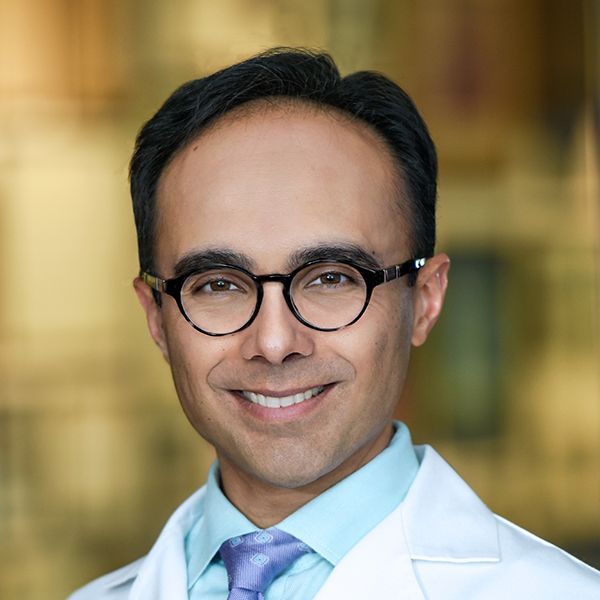
Sameer Sheth is Associate Professor and the Cullen Foundation Endowed Chair, McNair Scholar and Vice Chair of Research at Neurosurgery, Baylor College of Medicine in Houston, Texas
#19: Sameer Sheth – Neuromodulation for Psychiatry – the last frontier?
In this episode I had the honor to speak with Sameer Sheth about recent advances in deep brain stimulation for psychiatric indications. We focus on two recent publications, a paper published in Biological Psychiatry that introduced a revolutionary novel concept of treating depression by inserting stereo-EEG electrodes to determine the individual circuitry involved in each patient’s disease. The second was published in Nature Medicine and involved long-term local field potential recordings carried out during daily live in patients with obsessive compulsive disorder.
It was a very unique opportunity to learn more about the background on how these studies originated, how they were carried out, and what the future may bring for this exciting field & I hope you enjoy the conversation I had with Sameer as much as I did.
Sameer Sheth 00:00So this started, you know, really like around 2016. I mean this is kind of coming off the heels when RECLAIM had been published and BROADEN was about to be, and the results were just starting to be talked about at meetings. And so we knew that, you know, both these trials had, you know, failed or been aborted. And Nader and I, as well as Joseph Neimat, who's the Surgery Chair at Louisville, put this conference together. It was a pre-meeting to the ASFN meeting. It was like a satellite conference the day before, where it was something like, you know, charting the road forward in psychiatric neurosurgery. And long story short, you know, we discussed a whole bunch of different, like, reasons to sort of, you know, post-mortem analyze those two trials and also try to figure out, like, where do we go from here as a field. Amazing attendance with, you know, by, of course, neurosurgery, but psychiatry, neurology, NIH, FDA, industry. So a lot of, you know, all the stakeholders were there and discussing it. And the idea that had been floating around a bit was, look, you know, we need to understand the circuitry of these disorders. And so we started to talk about, you know, the, you know, the way better in order to have any hope of engaging them with the neuromodulation tools that we have, like DBS. And so the idea is, well, how do you understand these networks well enough to be able to engage them successfully? We thought, look, we do this in epilepsy surgery all the time, where we put electrodes into the brain to understand that epileptic network precisely for that individual patient and then make a surgical decision based on that.
Andreas Horn 01:28Welcome to Stimulating Brains. Hello and welcome back to Stimulating Brains, episode number 19. Today I had a great conversation with Sameer Sheth, who is an associate professor, the Cullen Foundation Endowed Chair, a McNair 02:03Scholar and Vice Chair of Research at Neurosurgery at Baylor College of Medicine in Houston, Texas. Sameer did his Bachelor of Science at Harvard University, then went to med school at UCLA, where he also finished his PhD. Completed his residency at Massachusetts General Hospital, where he also did his Fellowship for Functional Neurosurgery neurosurgery before moving to Texas. In our conversation, we talk about two very exciting papers that most of you might have heard about that have been recently published by Sameer and colleagues within his big network and team. So the first one is a biological psychiatry paper that Sameer first authored with the aim to show a quite disruptive design for deep brain stimulation and depression. The second one was published in Nature Medicine, where the team recorded over a thousand hours of data in patients with obsessive-compulsive disorder from deep nuclei in the brain. We also 03:07briefly touch more general topics about deep brain stimulation, and of course I also pick Sameer's brain about the future of the field. So I very much enjoyed this conversation. I'm pretty sure you will too. Thanks so much to Sameer for taking part in this one. So have fun with Stimulating Brains, episode number 19. Yeah, so thanks so much, Sameer, for taking the time to do this interview with me. And as a general question, just to break the ice, I sometimes ask about hobbies. So what you do in your surely very busy life when you're not doing surgery or think about the brain, is there a unit of time for further things or what do you do?
Sameer Sheth The answer is no. Next question, please. I'm just kidding. No, Andy, thanks a lot. I mean, let me just 04:02take a quick second to say that, you know, really appreciate you doing this. It sounds like a lot of fun and I saw the other ones you've done and great idea. Like, wouldn't it be cool to get to know each
Andreas Horn other in a little bit different way? So yeah, good for you for doing this. And thanks for thinking of
Sameer Sheth me. Yeah, what do I you know, it's evolved over the over over time, I think maybe I would start by
Andreas Horn saying that I feel like I used to be way more interesting and have a lot of hobbies. And now,
Sameer Sheth especially if you were to interview my wife as corroborative evidence, as she would say that I'm much less interesting than I used to be. And I have fewer hobbies. I think that is probably true. But some have been retained. I think, you know, it evolves over time as our lives, change, right. And as our stages of life of life changes. I feel like a lot of time outside of work 05:01is spent with kids stuff. So like the hobbies kind of evolved with what the kids are doing. So you know, I mean, right now, it's, you know, it's sort of spring season here and softball starting again, my daughter's 12. And I'm assistant coaching her her team, I can't commit to the coaching thing, because I think it's a lot of work. And I think it's a lot of work. And I think it's a lot of work. And I think it's a lot of work. And I think when you look at the areas that just, you know, might not make it on a particular day. I love that. I mean, I played a lot of sports growing up, you know, was never all American in any of them. Don't get any ideas. But, you know, enjoyed it in high school and in college and in med school and beyond. And I really love seeing them get interested in this. And I don't know, perhaps 12 year old girls are somehow easier to year old boys, which is my son's age. So that's been a lot of fun over the years, kind of, you know, working with her and her team and getting back into myself and going to the batting cages 06:05and, you know, like, you know, hitting balls with her. I think just in general, like sports and fitness, I mean, whether it's Peloton or jogging, my son runs track and cross country. And so now, like, you know, forget it, like last year, he totally surpassed me. So I can't really keep up, but it's still fun. It's a chance to also kind of like, spend some time with the kids in a different way and kind of just get to know them a little bit. And they let their guard down a little bit and tell you things that they wouldn't otherwise tell you maybe about what's happening in school and friends and relationships. So that's a lot of fun. You know, I used to do a lot of rock climbing and ice climbing, and that's been less now. Although like when, you know, when the opportunity is there, like last summer, we went to New York and we were able to do some outdoor rock climbing and that was a lot of fun. So I think those are, those are the main, main things I can still try to keep in touch with now. Love it. It sounds great. And I 07:03do see a New England Patriots poster in your background. So, so that's the perfect segue to the next question, which is essentially, you know, key turning points in your career. How did you get
Andreas Horn where you are now? And I, I know you've been to Boston, that that's why it's the segue. So yeah, can you tell a bit about that? What were the key turning points or? Yeah, for sure. I mean, I guess the first one,
Sameer Sheth the biggest turn was, I suppose, in med school when I decided to do neurosurgery, because I came in with an interest in physics. I mean, well, that was my major in college. You know, my senior thesis was on, you know, nuclear magnetic resonance of hyperpolarized, xenon nuclei. And so I went into med school thinking I wanted to do imaging research, did and just happened to do it in a neuroscience lab and then got very interested in the brain. And so then on med school rotations, realized, you know, knew that I wanted to do neuro something 08:06and then love surgery. And so then the choice was obvious. And the next big one then would be,
Andreas Horn yeah, going back to Boston for residency at this point now, later in life, like five years into
Sameer Sheth our marriage. So I was in Boston for about seven and a half years. And, you know, in residency, so, you know, both our kids were born in Boston, and it was about seven and a half years of residency, you know, and now it's a seven year program, usually, but I was on the remedial track, so I needed some extra time. So it was a little over seven and a half years. And it was a blast. I mean, it was grueling, but it was a blast. And, you know, just totally provide affirmation to the field that I was in. So I really enjoyed the program. So I really enjoyed the program. So I really enjoyed the program. So I really enjoyed the program. So I really enjoyed the program. And also very much got me set on the sort of specialty that I chose, which is a functional neurosurgery. You know, kind of retooled a bit in terms of the research to get away from that totally away. But 09:06to pivot a bit from what I had done in grad school, and focus on electrophysiology, neurophysiology, quite a bit at that time in non human primates, which was tremendous training to to really kind of do this really rigorously. But then working with my mentor, Matt Eskandar there, who does an amazing job with human cognitive neuroscience to understand that as a neurosurgeon, I have the opportunity to actually do some of these kinds of studies in patients during surgery or in the course of an evaluation and use existing opportunities for when electrodes are in the brain to study how the human brain works. And I was like, oh my God, this is amazing. And because we as humans do amazing things and to be able to actually study that as a surgeon and not only have the great joy 10:01of taking care of patients in a very trying time in their lives, but also to push the envelope in terms of what we can understand about how this amazing 10 pound blob of jello between our ears works. It was really cool. So that was the big transition there. Plus, of course, becoming a father,
Andreas Horn which, yeah, was pretty cool.
Sameer Sheth And I think it was another transition, I think, just for the family. Like my wife also retrained in the field that is truly her passion, which is education. And I think we just kind of hit our stride a little bit as a young family. I mean, I don't know if this is all the kind of stuff you want me to get into, but I mean, it's true. And I think, you know, like you can't separate it from the rest of life. So, you know, a couple of kids in Boston, 11:00like I know what I want to do. She knows what she wants to do. So, you know, we're kind of gelling as like a unit and kind of having a sense of like what we want to do with our lives, how we want to raise the kids, all the values that we formed as a four person unit, as opposed to a one or two person unit. Those kind of all really occurred during the pandemic. And I think that's a really good way to kind of bring that time. And we're certainly shaped by the people around us. I mean, in Cambridge and, you know, at work and all of our friends there. And the friends we have there are just, you know, such dear friends. I mean, we go back at least once a year and see them. It was a formative time in our lives, I guess. Maybe the most formative, you know, those first, you know, first seven years of my son's life and, you know, three years of my daughter's life.
Andreas Horn Yeah.
Sameer Sheth I mean, those are days you don't get back. And yeah. And then, you know, from there, I went to New York and then here to Houston. Maybe we can talk about that a little bit as well at some point. Great. 12:00Sounds really cool.
Andreas Horn And you've mentioned, Eskandar, so some mentors that were important. So it's two questions, mentors, but also why function of neurosurgery. So who got you into that?
Sameer Sheth And maybe then other mentors along the way.
Andreas Horn Yeah.
Sameer Sheth I mean, I had a sense that I wanted to do it. You know, going into residency. And so, I mean, you have to have, you have to have some answer to those residency interview questions.
Andreas Horn Like, well, what do you want to do?
Sameer Sheth You have to have some answer to that. And, you know, coming out of a PhD lab that had to do with brain function.
Andreas Horn I was like, oh, well, yeah,
Sameer Sheth I mean, functional neurosurgery, you know, and then, you know, that worked most of the time. And then every now and then, like a particularly smart interviewer, this happened with both Bob Gross and Phil, who are, you know, asked me a little bit deeper of a question. I'm not sure I did a very good job with the answer because, you know, I'm still a med student, didn't know a whole lot. But anyway, I guess I fooled them enough 13:01to match into, you know, an awesome residency program, which does everything. And I could have, you know,
Andreas Horn specialized in whatever and had a fantastic training.
Sameer Sheth And I certainly had an awesome training across the board. But then, yeah, I think it really was the interest in how the brain works that really, really kind of solidified just, you know, even within the first couple of years that,
Andreas Horn yeah, I got to do this thing that we call
Sameer Sheth functional, stereotactic, or epilepsy, whatever, you know. And so, you know, Emad was the person there doing all of that. And I mean, his lab, like, was awesome. I mean, he had, I don't know how he did it, like to be a busy functional neurosurgeon and to have a non-human primate lab, which is a big, you know, time, requirement. But it was awesome. It was a great experience because, you know, it was filled with really smart students and postdocs, but also my, like, neurosurgical colleagues. 14:02I mean, my residency colleagues, you know. So, you know, so he was, of course, the mentor overall. But like, you know, like a lot of labs, certainly his. And I think, you know, like mine, like, there's a lot of teaching, training, mentoring that occurs, you know, in the lab. And so then I, you know, I had six months of just the way that the residency was working, we're shifting from two a year to two, three to three a year. And so I had a six month block of research right after internship. So, you know, we did the internship, which was a full year of general surgery doing, you know, gallbladders and, you know, whatnot. And then right after that, six months of a research block in order to set up this dagger. And so I spent that time in his lab. And that's when. You know, the people in the lab were Ziv Williams, Wael Asad, you know, I mean, like their own, you know, now giants in the field who are setting up their monkey rigs and doing their experiments. 15:00And, you know, I just learned a ton from that. And then a couple of years later, when I did my full, like two years and two months as a sort of PGY five and six. You know, while I was finishing up his time in his like long portion of the lab, Ziv was probably already. faculty or maybe about to be faculty. And then it was, you know, Jason Jar was there. Actually years prior to that, Rameen Amarnovan had been there. So it was all these like neurosurgery residents who had gone through there. And so we would all just kind of work with each other and teach each other. And, you know, I, as the young person in the beginning of my research time, just learned a ton about how to do, I mean, neurophysiology, which I had done a little bit of in grad school with very little, I had done mostly optical imaging. And so that was a really formative experience. So I think, you know, Ahmad is the overall mentor, of course, but then the sort of the environment of the lab and being
Andreas Horn with those other folks who had a similar mindset of like, yeah, we are neurosurgeon scientists.
Sameer Sheth 16:03And there are just so many of them that it was, it was an awesome, you know, formative experience. Sounds like it like a cradle of really interested people, people interested in not only surgery, but really how the brain works. And I guess that is, again, the perfect segue into the like real scientific questions that I wanted to talk to you about today. And because what strikes me, I mean, you're a very famous neurosurgeon, probably also doing a lot in movement disorders. But it seems like you've also done really much in the more psychiatric domain. And that again, might be
Andreas Horn because these are the very interesting questions of how the mind and brain works. And so,
Sameer Sheth one particular study that has been published last year, where you first-authored and, I guess, led the study together with Wayne Goodman, in Biological Psychiatry, has really made the waves, as you know, in the case of major depressive disorder, 17:03where you've essentially done things differently with a bit more like maybe inspired from the epilepsy field. I don't know that that was what I thought. So,
Andreas Horn what was that study about? Or what was how did it come up? And how did you decide to do what you did? And what did you do? Yeah, yeah, if you'll indulge me with a bit of background, I mean, it may be interesting. So yeah, I mean, the I mean, the the end result is this trial that we are
Sameer Sheth doing now, which is to try to improve DBS for treatment resistant depression, which is obviously a huge public health. burden, etc. And, you know, there's a really strong track record in DBS for depression, but results have been heterogeneous, and two trials were aborted, etc. So, and I'll just, you know, mentioned the other two co PIs of the project, Wayne Goodman, who's chair of psychiatry here 18:03at Baylor and Nader Pouratian, who's chair of neurosurgery at UT Southwestern, who, by the way, um, is the one who got me into my PhD lab, we did our PhDs,
Andreas Horn together, UCLA, and so I've known him for about half my life, since 1998. So that's Yeah, 24 years,
Sameer Sheth little over half my life. Oh, my God. So. So this started, you know, really, like around 2016. I mean, this is kind of coming off the heels, when RECLAIM had been published. And BROADEN was about to be or you know, the results were just starting to be talked about in meetings. And so we knew that, you know, both these trials, you know, failed or been aborted and not, not shown the efficacy that was, of course, hoped for. And so, Nader and I, as well as Joseph Neimat, who's neurosurgery chair at Louisville, put this conference together as a pre meeting to the ACEs, ACEs FEN meeting was like a satellite 19:04conference the day before, where it was something like, you know, charting the road forward in psychiatric surgery. And long story short, you know, we discussed a whole bunch of different, like, reasons to sort of, you know, postmortem to analyze those two trials and also to try to figure out like, where do we go from
Andreas Horn here as a field? Amazing attendance with experts in surgery, but psychiatry, neurology,
Sameer Sheth NIH FDA industry. So a lot of all the stakeholders were there and discussing it. And the idea that had been floating around a bit in my mind and that of a couple others was, look, in my mind and that of a couple others was, look, you know, we need to understand the circuitry of these disorders way better in order to have any hope of engaging them with the neuromodulation tools that we have like DBS. You know, we've got a headstart of, you know, orders of magnitude more patients in Parkinson's, 20:02plus, you know, pretty good animal models. And we don't have that in psychiatric disorders. I think that's of course a challenge, but also a real attraction. I think that's one reason why I got really interested in it. It's kind of like, you know, I don't know, sort of last frontier of what we don't really know enough about. And so the idea is, well, okay, how do you, how do you understand these networks well enough to be able to engage them successfully,
Andreas Horn especially at an individualized level?
Sameer Sheth So, you know, we do this, we thought, look, we do this in epilepsy surgery all the time,
Andreas Horn where, you know, every person's seizure network is going to be different. And so how do we figure that out?
Sameer Sheth Well, we put in electrodes into the brain, either on the surface of with grids and strips, or more and more now, you know, within the substance with stereo-EEG, to understand that epileptic network precisely for that individual patient,
Andreas Horn and then make surgical decisions based on that. But we don't use that approach for really anything else. 21:01And so could we use it to understand depression?
Sameer Sheth Obviously there's no obvious, you know, the most obvious electrographic biomarker, like a seizure that tells us that we're in the right spot. And so there's plenty to figure out. But the interesting thing that I think a few of us took away from that conference in 2016, is that perhaps the time is right, because a couple of discussions, even a year before that at another meeting, actually at the Michael Okun DBS Think Tank, you know, there's a lot of like, oh, that's sounds crazy. That's risky. You know, like no one's going to let you do that. But like the very next year at that meeting, there's a little bit preaching to the choir, but still, it felt like, oh, that's, that's crazy. And it felt like the, there was going to be some reception, you know, some positive reception. I mean, NIH people, FDA people didn't shoot it down. So the three of us wrote the grant that fall and it was funded and, you know, soon after that.
Andreas Horn And the idea is that, yeah,
Sameer Sheth we put DBS electrodes into two targets, the VC/VS target and the subcallosal cingulate target, both are, you know, well studied. 22:00But then we also put in these temporary sEEG electrodes into frontotemporal regions that we, you know, think are relevant for depression, keep the patient for 10 days in the epilepsy monitoring unit and try to understand these networks on an individual basis. And, you know, two main things we're trying to understand. Number one is what are the patterns of neural activity
Andreas Horn that relate to better or worse mood states? So what are the neural correlates of mood? And then secondly, how do these networks respond to stimulation across a wide range of different stimulation parameters?
Sameer Sheth Because if you can know those two things perfectly, well, then you can say, all right, this is the mood state we're trying to achieve. Here's its neural correlate and here are the stimulation parameters that will achieve that. And of course that's hard, but figured let's start trying. So we did. And so I was at Columbia at the time and then transitioned here to Baylor and now just over four years ago. 23:00And so now it's, you know, Baylor and then later moved from UCLA to Southwestern. So now it's a Texas grant. And with these two sites, and we're now, you know, four patients in, the fourth one was just two weeks ago.
Andreas Horn And the first one is the, you know, has graduated, so to speak, you know, from the trial. And that's the thing that we published, yeah, end of last year, which describes how he did.
Sameer Sheth So I think one particular great idea in that trial
Andreas Horn and also that paper is the inverse solution, right?
Sameer Sheth Where you try,
Andreas Horn you try to do essentially exactly what you've just said.
Sameer Sheth So you have these two states, maybe the desired one and maybe the depressed one, you know, and then you can inverse solve the problem of which are the parameters needed to stimulate
Andreas Horn to achieve the optimal state, right? Did I express that correctly? Yeah, exactly.
Sameer Sheth Right, and that's intentionally framed in a sort of mathematical way. 24:02You know, there's a lot of math involved. You know, as a physics major, I remember just enough to be dangerous, but I mean, it really is, you know,
Andreas Horn exactly that inverse problem because you have control,
Sameer Sheth you know, as the clinician, you have control over the inputs, which are what you do with the DBS device. You can control, you know, the pulse width, the amplitude, the frequency, you know,
Andreas Horn the contact configuration, right?
Sameer Sheth You know, and then in the normal way of programming, whether it's psych disorders, movement disorders, whatever, you know, you kind of, with an educated guess, you program in certain parameters and then like something happens in the brain. You don't know what that is. And then there's some output. There's some behavioral output, which, you know, maybe tremor arrest or maybe mood improvement, whatever. And that's sort of, you know, the forward way of doing it. The typical way of doing it. But here we have this intermediate measure, which is a spatial spectral features across the frontotemporal network with our sEEGs.
Andreas Horn 25:02So when we look at the areas of the brain, right?
Sameer Sheth our sEEG recordings, and so now we can try to invert the problem and say, all right, instead of deciding what what input features to put in and then just seeing what happens and sort of guessing and checking instead can we decide what output we want let's say mood improvement um it's complex yes of course but uh let's say we start with that and then we can say well what are the neural features that um are most likely to produce that uh output and then what are the um stimulation inputs that are going to produce these neural features that are going to lead to the desired output um and and so that is basically you know the posing of this inverse problem which is like
Andreas Horn yeah super challenging, but yeah, I mean, fun because of that. Yeah, great. No, I love the
Sameer Sheth concept it's it's really great and um i think it's really interesting to see how you know the the disease burden of uh depression 26:04patient that undergo surgery is going to be at least as much as an epilepsy patient or comparable at least um so so i i certainly think it's a great approach um so so i'm a big fan of the study as you can tell. And then one other, I think, really cool thing you did is the HoloDBS planning, right, in that study. Can you talk a bit about that? I think you do that now not only
Andreas Horn projects. Yeah, yeah, so this is all Cameron McIntyre, who now is at Duke. And I mean, you know,
Sameer Sheth anybody listening to this like knows who he is he's uh way way famous rather than me um you know he had a podcast episode with him so and he he talked about it briefly as well oh very good i didn't give you that plug but there you go um yeah so i remember exactly well i don't remember which city where it was but i could i couldn't picture the airport uh like terminal that we were sitting in um in whichever city it was after whichever meeting it was where 27:03we had this conversation um and you know everybody knows the work that he did in terms of um kind of you know neural cable modeling and kind of the effect of electricity on neural tissue and tractography and all that stuff but i didn't know that he was working with this augmented reality system and so we're sitting there talking about something you know about this trial i think and he brought this up and he said you know i'm going to do this and i'm going to do this and i'm going to do this and i'm going to do this and i'm going to do this and i'm going to do this and i'm going to and it was immediately obvious that like this system that he'd been working on for a number of reasons you know he was at um uh case western before that i think there was a big push in their medical school to use you know augmented reality to teach medical students to teach you know whatever uh and so but he was using it to you know study basal ganglia and connections and interactions between um electrodes and neural tissue and so he told me about this and it just became super obvious within that conversation that we we have to start doing this so it was an add-on thing well 28:03after um the study had started before we had implanted patients but um as we were gearing up to do so um and so what it is i mean basically is a augmented reality system that that runs on the Microsoft HoloLens and what it allows you to do is to really visualize, you know, all these connections in full 3D, which are so important for this study and others that might come that are like it, because it's not just about like the DBS leads and the target. That's good enough almost. And it's not just about kind of three-dimensional planning of a stereo-EEG implant that you might use in epilepsy, but even that would be worth it. It's the combination of both. You've got stimulating things, you've got recording things, and you've got the connections between them. And to be able to appreciate that on a flat screen, which is where we do all of our planning otherwise tractography-wise is so hard, but here it's like just so intuitively obvious and it allows for group 29:02planning. I mean, there's five or six of us, you know, there's me and Nader and Cameron and Kelly Bajonke, you know, who's in our department also, and, you know, we're all planning together, you know, collaboratively and pointing and looking at each other's avatar fingers and, you know, being able to really explore this three-dimensional space together. And we did that for the first patient in person pre-pandemic, but the second, third, and fourth have all been during the pandemic and we're all just doing it from our homes. So Angela just emails us, emails us, FedExes us, you know, the lens and we put it on and, you know, we decide when to do it. And then there we are in virtual space, you know, planning the next case collaboratively. We just did it a couple of months ago for the case a couple of weeks ago, you know, over really over two sessions, each an hour, hour and a half long, you know, we had the whole thing planned out and it's amazing. I mean, to really be able to appreciate the complexity of the plan, but to really, we learned a lot. We didn't just get the plan done. 30:02We learned a lot about how different, you know, stimulation, different regions affects different brain regions. So I think we're still trying to synthesize all that. Hopefully. Really cool. And especially that, you know, you know, it's a pandemic remote planning. So,
Andreas Horn so is there a lot of lag if you do it? Like if you talk and then, or is it really like working more or less?
Sameer Sheth It's seamlessly lag free. Really pretty seamless. It's amazing. And there's, there's 3d audio. So if, you know, Nader's avatar head is to my right and Kelly's to my left, like I hear him that way, you know,
Andreas Horn you can hear the sound coming from the virtual head. And yeah, I mean, 95% of the time I would
Sameer Sheth say it's totally seamless. Really cool. Yeah. Amazing. Okay. So, and then maybe to relate that to the broader field of DBS in depression, I think around the world, you know, there's a lot of, you know, there's a lot [inaudible] at the same time you published your study. There was also the other publication from Katherine Scangos et al. from UCSF that had a slightly different setup, but it was, you know, 31:05to me, they, I grouped these studies of course, together because they are kind of both new, both a bit similar, but also different. Do they have something to do with each other in terms of
Andreas Horn like grant funding or planning? Did you co-inform each other or was it more, you know, like happenstance that they came out the same way?
Sameer Sheth Yeah. Totally the latter. I mean, I'd love to say, and I don't know, maybe Katherine and Eddie would love to say that we all kind of plan this and, you know, surprise everybody by doing it separately, but no, it was, I think it just speaks to the like receptive environment of the field at this time, however many, you know, three, four, five, six years ago, which is, you know, I think a confluence of a lot of optimism of psychology and a lot of optimism of the field. And I think it's, I think it's a lot of optimism that we have in the field, you know, in the field of psychiatry, neurosurgery and DBS for depression, et cetera, that, that kind of hit the reality of this is really hard and two
Andreas Horn 32:03multimillion dollar trials have not been able to prove it. So that reality check to what was
Sameer Sheth otherwise a really like, you know, optimistic environment, I think that's what led to this plus the realization that we, okay, we could just give up, this is too hard, but like, there's a
Andreas Horn real cost to inaction, right? Which is that, you know, patients continue to suffer and take their
Sameer Sheth lives and all this stuff. So I think it just, that environment is a little bit more, you know, the first, I know that it's, it's great to have other people doing this. I mean, I think, you know,
Andreas Horn it's fantastic that, that other groups, you know, have also adopted a similar strategy. It's, you
Sameer Sheth know, it's validating, but, but of course it's also going to move the field forward a lot faster. Yeah. The first I heard about that idea, I was talking to Phil Starr again, I can picture the restaurant, but I don't know which city it was sitting and having dinner after the meeting where he's like, oh, I don't know. I don't know. I don't know. I don't know. I don't know. I don't know. It's cool. You guys are doing this. And, you know, our psychiatry group has been thinking about it and, you know, like the FDA lets you do it. Yeah. They let us do it. And so, right. Their 33:04study, I mean, it's, it's easy to put it together in the same kind of group, which is, which is appropriate. You know, there's, there's subtle differences. I think that's actually a nice thing that it's not exactly the same. And I think we're going to summarize them briefly. Like, yeah, sure. So, I mean, I think, so the commonalities of course, is that we're, we're both using, intracranial recordings, you know, stereo-EEG for the most part, to sort of decide how to deliver DBS. Okay. For depression. Um, it's really funny how convergent, well, I don't know, maybe it's because it's based on literature. It's not so funny, but it's, it's, it's amazing how convergent it is in terms of the brain region of study. If you look at the two papers, you know, there's like a lot of overlap in terms of where we stuck our electrodes without having spoken to each other at all. Um, differences are, um, the following. So like, like in ours, we, um, predetermine and decide, uh, where the 34:02stimulating electrodes, where the DBS system is going to go. Like we implant the VC/VS and the SCC bilaterally. We have made that choice to put all the eggs in that basket. And the, in the UCSF study uses the recordings to decide where to put the final device, which in their cases is an RNS device, responsive neurostimulation device. Um, so that's one difference. Um, and you know, I mean, pros and cons happy to discuss them. I think, you know, they're certainly, it's, it's an illuminating discussion to have that, um, the, uh, the, the, the actual stimulating system, you know, on the one hand is a DBS system, which is, you know, continuous as you know, and versus a responsive system. So I think that's a philosophical, uh, discussion about, you know, like, uh, which disorders TRD or others, you know, like, perhaps are best treated with responsive adaptive stimulation versus with, uh, well, 35:00let's not say adaptive responsive stimulation where it's usually off, but it only comes on when necessary versus a continuous or adaptive stimulation that is on. And maybe just varies, um, in terms of how the system is engaged. So those are, um, a couple of the main differences. Um, yeah. I mean, I can elaborate in terms of pros and cons. you know, if there's time to do so or, you know, or not. Maybe I think even more interesting is we haven't talked about this at all is,
Andreas Horn is just, you know, what, what was the outcome?
Sameer Sheth And maybe especially in your study, like it was one patient. So I'm sure you met the patient a lot and of course you operated on him and so on. So could you tell us a bit, you know, obviously it was successful. I can already say that.
Andreas Horn But, you know, what, how was the success like?
Sameer Sheth And I think there was also a discontinuation part in your trial. So that would be important too.
Andreas Horn 36:00Yeah, sure.
Sameer Sheth Right. So just details of that thing.
Andreas Horn Yeah, absolutely.
Sameer Sheth So just the overview of what we did, we implanted, you know, the four, four, four DBS and 10 Siege electrodes. We, we kept them in the hospital for 10 days, did a bunch of studies to understand again, how the networks encode mood and how they respond to stimulation. Then there's a second surgery where we remove the temporary Siege electrodes, internalize the four DBS electrodes to two generators. And then the design is basically like a couple other studies have done where we, we start with an open label optimization phase. The idea being we've learned a ton of information about the network and its response in the inpatient phase. And so now let's use all that data to, come up with just a few stimulation sets that we're going to implement in this open label optimization phase. So we're not doing, you know, trial and error kind of guess and check in a, you know, sort 37:02of programming because, well, you know, we've got a ton of data, so let's use it and narrow down this vast stimulation space, which I had to, you know, did some rough calculation in that thing. It's like, you know, it's four to the 32. I mean, it's like some, I don't know, billions of possible combinations. Let's narrow it down. Just a few that we're going to check in this eight month open label phase. And so that's, that's what we did. We kind of created what we call this, you know, electrophysiologically guided stimulation set, which basically said, okay, you know, here's what the brain looks like in a better mood state and which stimulation parameters produce that neural state most closely. So that's what we defined as our EFIS guided parameters. So we created a, as a sort of, as a backup plan, you know, a behaviorally guided one as well, based on his responses and the sort of more trial and error kind of way. 38:00And then anyway, over the eight months out of the EMU, we basically just, you know, implemented these sets and, you know, just saw his response. And I mean, the response was progressively better. And one thing we talk about in this paper that, you know, I think is important because it came up in review a lot is that. You know, our trial is not set up to be able to prove that any one stimulation set is the best set.
Andreas Horn I mean, like, how do you do that rigorously?
Sameer Sheth Well, I mean, you'd have to have a blinded randomized thing where you take this set compared to another one, you know, in a blinded way, which we're not, you know, set up to do by FDA and all those other things.
Andreas Horn So can I, can I tell you that, you know, this electrophysiologically determined set, like was the only set that would have made it better?
Sameer Sheth No, of course not. That's not the point. The point really was to show that, you know, one can solve the inverse problem, at least in this one way. I mean, there's gonna be a hundred ways of doing this. 39:00We chose one and do it in a safe and feasible way. Anyway, so fast forward eight months later, you know, he was, he was in remission. This is still open label. And then, you know, he had a neuropsych evaluation at that point. And again, most things were stable. A couple of things were actually a little bit improved. And then we had, in the end, we had a couple of things that were actually a little bit improved. And then we had, and this is, you know, programming again with the FDA, this double-blinded randomized discontinuation. The randomization was to which target got reduced or discontinued first. And it says in the paper, which I didn't know at the time, obviously as a blind person, but the SCC, you know, he was randomized to having the SCC target discontinued first. So then over the course of weeks, again, in double-blinded fashion, we had a couple of things that were reduced. So, you know, in double-blinded fashion, you know, every visit, you know, only the programmer, Dr. Goodman knew what the amplitude was and it was reduced by 25% every time with blinded 40:03ratings. And so over the course of that time, and you can see that in the graph, I mean, his, his ratings get worse and worse, and then he meets rescue criteria at which point the blinded portion is over. He's reinstated with full stimulation. And then, you know, then he's basically done. So, you know, it's a little bit of a, [inaudible] [inaudible] [inaudible] [inaudible] [inaudible] [inaudible] [inaudible] to do that phase. And again, I mean, the FDA not only allowed it, but they encouraged it to be able to have some idea of what we're going to do next. Like after these 12 patients are done, if everything is all open label, okay, we've learned a lot about the brain and neural responses and stuff, but we figured it'll be important to have at least, you know, some inkling about sham versus true response. And the fact that in a double-blinded way, this subject got worse with withdrawal, you know, it was a pretty strong argument that 41:00his improvement was not all sham, that it was a true response.
Andreas Horn Sounds great. So I, yeah, really congratulations. Amazing study. I want to be mindful of your time,
Sameer Sheth but I guess the second study I want to discuss, we can be much briefer, but it's also a really
Andreas Horn interesting one. That's the Provenza 2022. So also this year, Nature Medicine paper where
Sameer Sheth you're talking about the nature of medicine. And I think it's a really interesting one. Your co-author, but I guess also very involved site in this. And this was now in OCD patients, not major depression, a different concept, I guess, more going into the closed-loop
Andreas Horn direction. Can you summarize that? Also again, like just talk about it a bit. Yeah, sure. I mean, I'll keep the comments briefer. Yeah, this study had just started here at Baylor.
Sameer Sheth I mean, before I got here, and I got here just as it was ramping up, Wayne Goodman is the PI of it. 42:00The idea is just that, okay, we do it decently well with DBS for OCD. As you know, there's a
Andreas Horn humanitarian device exemption, there's a CE mark, but we need to do better. And how can we do better?
Sameer Sheth Well, maybe one way is by trying to figure out a biomarker of symptom state. So, and perhaps that's electrophysiological. So if that's discoverable, if there's a signal in the brain that correlate predicts, you know, symptom state, then one could potentially train a classifier that would be programmed into the DBS system such that the DBS device can auto-regulate. And you're not waiting until the next appointment a month later with a psychiatrist to make an adjustment because, you know, your symptoms, you as the patient, your symptoms are changing on a moment to moment basis,
Andreas Horn but the DBS device is going to be able to regulate it. So you're not going to be able to do that. So that's one way. And the other way is to try and find out what the DBS device is doing. So instead, can you, you know, can the supply meet the demand better? You know, if the demand is varying, then shouldn't the supply vary? So that's the idea.
Sameer Sheth 43:04And I mean, you know, really Herculean effort, you know, Wayne and the other, you know, folks in the study, Dave Borton and Brown, and then Nicole, who was a PhD student in his lab and is now happily a postdoc of mine. You know, the, you know, I think the, the, the, um, a couple of things I'll say about the paper. I mean, I think it's a, it's a very proud of it. We're really proud of, um, Nicole's work. I'm proud of the whole, um, effort. Um, I'll start by saying something that like is barely even in the paper, which is that the five patients in the, in the study, all were responders. Um, you know, it's kind of a scientific technical paper. Uh, and I think it got into that journal because of the science and technology, which is appropriate, but I think the clinical outcome is actually really great. Uh, five patients in the study. This is with, um, you know, the PC plus S device, uh, and RC plus S device that can record, uh, as well as stimulate. And I, all five were full responders by the standard 35% 44:03criterion with the Y box. Um, the science part that was really cool is the ability to, um, uh, tag neural recordings with symptom states, um, in the, in the clinic, but also at home. I think this is, these are the data that were really, um, the, the, the driving factor behind, um, you know, our, our excitement for it is that, you know, you can stream data in the home environment where, you know, the patients are living their own lives and being exposed to things, you know, and having worse or better symptoms on a, again, moment to moment basis. And we can, you know, uh, Nicole did these sprints with the patient, you know, uh, where they, and they, you know, quote unquote sprint fashion, like recorded, you know, hours worth of data. And so overall, the paper reports in like over a thousand hours worth of data, but, you know, like hours with the data with, with one patient where there's, you know, dense, um, sampling of symptom state, um, 45:02along with the neural recordings. And so then, and only then can you have some hope of, of correlating the two and modeling them. Um, and I think, you know, the patient pressed the button, pressed the button when they felt they had a lot of symptoms or because there was also a, um, like a, um, facial detection system. Right. But did that, was that applied at home or was that only,
Andreas Horn that's not done at home yet? That's, uh, maybe the next grant. Yeah. Okay. Yeah.
Sameer Sheth Yeah. At home, it was just, uh, uh, self-report of symptoms using this SUDS, this severity scale, and the neural recording. So at home that was done, um, in the office, all those things, plus scalp EEG, plus the, uh, automated facial recognition system with Jeff Cohn at Pittsburgh.
Andreas Horn With that, yeah, kind of, you know, using machine learning on the,
Sameer Sheth on the, uh, imagery to decode, um, affect from facial expressions. Um, yeah, I think, you know, 46:02the, well, I'll get to this in a second, but, um, I think those home recordings were really, uh, what added to the, just the, the, the density and the amount of data to be able to do the kind of analysis that, that produced the last, you know, the last figure, which is the kind of, I'd really like to look at the example. kind of, I'd say, you know, not the answer, not the classifier, not the answer, but rather the working hypothesis, you know, that, you know, power in certain bands, you know, relates to, and let's see if it can predict symptom state, mood state, and even side effects like hypomania, which you can get as a side effect. And one thing I'll say is that I think like an overall take home from this is just that, you know, and this is across human neuroscience, the desire to do more and more, you know, in a ecologically valid, you know, home environment. I mean, it's, okay, the EMU is better than the OR, you know, and maybe the clinic is in some ways 47:05better than the EMU, but like the home environment in there, you know, the people's day-to-day interactions, I mean, once we can push the recordings and data collection out to there, I think that's what we're going to be able to do. I think that's when we can really make strides because that's really the range of, you know, input and output that we experience in our lives. And that's going to be the most relevant
Andreas Horn and probably produce the strongest signals, honestly, you know? Yeah, great. So, you even have had an Apple watch device in there, right? Was that to trigger things or was that to measure sleep or?
Sameer Sheth Measure sleep and get some actigraphy.
Andreas Horn Right, exactly. So the more we can incorporate these kinds of wearables
Sameer Sheth in daily life, the more we can incorporate these kinds of wearables in daily life. Like, you know, activity monitors and sleep monitors and even like, you know, in some, you know, HIPAA compliant way, like, like quality and quantity of speech and interactions and all these things that we do as humans are all going to influence and be influenced by our, you know, 48:01our networks, neural networks. Amazing. So, so what's your estimate,
Andreas Horn maybe pivoting to two more rapid fire questions in the end? What's your estimate of how can, how will we, when, when will we have adaptive? DBS for OCD, like in clinical practice, you already kind of hinted at it with the paper, but is that coming?
Sameer Sheth That's the next paper. No, I'm just kidding.
Andreas Horn Yeah. Yeah. Well, how do I answer that? I mean, let's, let's say like, well, when are we going to have it for something that we have one to at least two orders of magnitude more experience with, Parkinson's?
Sameer Sheth I mean, we're almost there. We're not, but it's, it's not, it's not going to be a prime time. Yeah. But I don't know, maybe we're a couple of years away from kind of prime time in, you know, a bunch of experience centers.
Andreas Horn So if that's a couple of years away, I'd say it's, I mean, at least two, three times as long, you know? 49:01Yeah. Great. So, but yeah, it's great to have, you know, promising results, I guess, with the Scangos paper we talked about, and then for, for adaptive, you know,
Sameer Sheth 48:54DBS and depression, and then your paper now for OCD. Yeah, it's an exciting time. So maybe 49:24to wrap up, just general thoughts, like what, what do you think is the future of functional neurosurgery or deep brain stimulation can be like? Yeah. So, yeah, I think, I think one step before that is like, you know, as a, as a, as a neurosurgeon, I just, I'm so like bullish about functional neurosurgery within this field. I mean, like while, you know, other bits of neurosurgery have to kind of adapt and, you know, are being attacked. This is one that is just growing so rapidly, like who the heck thinks that you'd see a neurosurgeon to talk about depression, you know, for the most part, you still don't, but maybe you will, you know, 50:02more and more often at some point. So I think this growth is for a couple of factors. I mean, one is, you know, just the number of indications that we can try to treat is growing rapidly. And
Andreas Horn why is that? Well, it's because after all, most of these things, I mean, if not all of them are
Sameer Sheth manifestations of neural activity, you know, and if the name of the game is to understand the dysfunction underlying whatever disorder, the neural dysfunction, and then to optimally engage it with some kind of modulation technique,
Andreas Horn and maybe it's surgical because it's very precise for now. Then, I mean, yeah, the future is bright.
Sameer Sheth And I think the, the second, the corollary of that is the science and the technology and the, you know, the device development, the funding environment, regulatory environment, this is all very conducive to doing this kind of work right now. So I think in the next many years are going to be filled with just, you know, amazing advances from, you know, all the groups around the world that are getting into this stuff because it's super promising, 51:02exciting, it's a big problem, but it's tractable, you know, and, and I think excitement begets excitement. So I think, you know, this is something, you know, tell our residents, tell the students, you know, it's the place to be for the next many years. Great. Speaking about young people, students and residents,
Andreas Horn any advice for, for people entering the field? Yeah, I mean, future is bright, you know, it's super exciting.
Sameer Sheth It just allows you to, you know, work with patients at the, you know, who are in a very trying time in their lives, and to try to make that better and to do so in a scientific and rigorous way. So I think that's extremely exciting. You know, I think I just sometimes have to like pinch myself that, you know, like, this is actually a good job that, you know, like I get paid to do because, you know, I mean, heck, I'd probably do it if I didn't. 52:03I mean, it's, it's, it's so rewarding and exciting. No, I think the advice is, look, you know, everyone should do what they enjoy and what they like. I think, you know, but if, if this is something that, that a student or resident or postdoc or whatever is thinking about, I think that, I think there's a ton to do. And I think, you know, invest the time and do it because your mark will be made.
Andreas Horn There's a lot of, yeah, there's a lot of hay to make in this, in this field, as we say in Texas.
Sameer Sheth And, you know, don't, don't be afraid, you know, spend the time and find the right people and like jump in with both feet because it'll be worth it. Great. And then maybe last question. Mr. Platt.
Andreas Horn Yeah.
Sameer Sheth I mean, I think the field is currently missing opportunities.
Andreas Horn So, so should we be doing something that we're not and why, why not? Anything we should maybe change in the future that the field is currently missing?
Sameer Sheth 53:04I don't know, man. I'm not one to look back a lot. I'm not one to regret much of, you know, I think, I guess I think more about the learning. And so, I mean, I don't know. You can call failed trials missed opportunities, but you can think of them as learning opportunities too. So I guess I just feel like we've gotten here through a series of random like Miller ball collisions and we'll keep moving forward in the same way. I think the more intelligent, motivated, smart, excited, engaged people that are in this, the more maybe orderly those random collisions. And, you know, we can move towards, you know, an area of better therapeutics. Yeah. I mean, I'd put that spin on it that I think that, you know, we've gotten this place because of all the stuff that happened before us. 54:00And let's just intelligently move forward from here. And I think that's well within our grasp. That's great. We've covered a lot, but is there anything you would have wanted me to ask
Andreas Horn or anything else you want to add just from your side?
Sameer Sheth I don't know. I think I talked a lot. Yeah, I think I didn't have any particular agenda, of course, but I think I really enjoyed this. I really want to thank you for doing it. And it was a lot of fun. I think if anybody bothers to listen, I hope the excitement and the enthusiasm, you know, is contagious. And I hope, you know, more and more people start working in this field.
Andreas Horn Great. Thank you so much. And then, yeah, thanks again for your time doing this.
Sameer Sheth It was a great honor to interview you. And I learned a lot. So I'm sure that the listeners will enjoy it too. 55:01Yeah. Thanks, Andy. This was great. Thank you. [inaudible]
Click any highlighted text passage to jump the Spotify player to that point. The transcript text is present directly in the page HTML for search engines and accessibility.