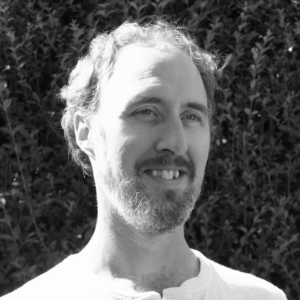
Mark Humphries
Chair in Computational Neuroscience, Faculty of Science, School of Psychology, Nottingham
#13: Mark Humphries – Basal Ganglia Models, Highs and Lows in the Brain and… how does DBS work?
It was a tremendous privilege to pick Mark Humphrey’s brain who has insight about broad domains of the brain like few others. His new book The Spike: An Epic Journey Through the Brain in 2.1 Seconds takes us on a journey through the brain starting at the retina and ending in the spinal cord. As we follow spikes along, we learn how information is processed in the brain, but also how it’s simply lost and forgotten. Mark has done his PhD with Kevin Gurney, who together with Tony Prescott and Peter Redgrave has published an influential computational model of the basal ganglia in 2001. We disentangle how it differs from the Albin-DeLong model, talk about implications for whole-brain computational models and the mechanism of action of DBS. Based on a twitter thread that Mark once published about the Wishaw decorticate rat experiments, I ask him: Does the brain even need the cortex? Finally, we touch about compression of data and his recent paper about a weak and strong principle of dimensionality reduction of the brain.
Mark Humphries 00:00strongly suggesting that the activity when you're looking at nothing, a grey screen, or even your eyes closed, is very similar to the activity when their eyes are open, which suggests that most of the activity is actually not then encoding stuff that's coming in, but also is doing some ongoing processing. And the ongoing processing, the best guess is what it's doing is just simply predicting the features that are going to be there. Each layer is predicting what the layer below it should be sending it to. And so V2 should be predicting the elementary edges that V1 should be seeing from the fact that it's predicting these lines. V4 should be predicting these lines and these corners, seeing the outlines of these objects and so on up. So down the hierarchy, well, it actually is then just difference between what's coming down and what's coming up from the retina so what's being passed forward is the thing that needs to be tweaked in the predictions welcome to stimulating brains
Andreas Horn 01:12so hello there and welcome back to stimulating brains episode number 13 this time together with mark humphries who is the chair in computational neuroscience of the faculty of science at the school of psychology nottingham uk mark has just published a book called the spike an epic journey through the brain in 2.1 seconds with princeton university press which is a highly recommended read it's really entertaining it's also easy to read i'd say and still very informing and beyond talking about that book of course mark and i talk about a new paper he just published on two principles of dimensionality reduction in the brain and 02:03going back a bit further in time also about his phd work together with kevin gurney who of course together with prescott and redgrave developed one of the most influential computational basal ganglia models in 2001 we also have a slight detour in there about the question do you even need the cortex in the brain and yeah it was a great privilege to be able to pick mark's brain i think his work is really excellent and outstanding and i'm pretty sure you're gonna like the conversation we had so um thanks for tuning in once more stimulating brains episode 13 have fun Great. So thank you so much once more, Mark, for taking the time to do this. I will have introduced you more formally by now. But to break the ice, I always start with the question, what do you do when you're not involved in research? So in your private time. That's a really good question. So 03:12what private time I have away from from yeah um doing research and obviously a family with young kids so in that smidgen of time yeah um I it gets split mostly between between sort of traditional academic pursuits of reading a hell of a lot of stuff that is not anything to do with what I research um so I just love writing and also I read all novels of all stripes um and uh non-fiction of all kinds of history and science and so on particularly love evolution oh great stuff so I'm not quite sure why I didn't end up being um an evolutionary theorist because I've spent my entire
Mark Humphries teenage years reading Stephen Jay Gould and Richard Dawkins books and thinking wow theoretical evolution is great um well ended up being a computational neuroscientist instead um and uh and the other 04:03pursuit mostly of music so a lot of play guitar oh great um uh historically in a bunch of uh fairly um mediocre bands of various kinds but these days mostly just for fun in fact we share that I also played in mediocre bands all my younger years yeah has gotten much less um do you have any good recommendations for evolutionary books to read for us that's a good question um I have to say I recently reread Richard Dawkins blind watchmaker and it's still amazing it's great yeah um Irrespective of his social media persona, which is a little bit contentious to say, he remains a master of writing for a lay audience. Both in terms of this, his style alone, its content. He's a master writer, and The Blind Watchmaker, yeah, probably is, that's probably his best book. The Selfish Gene is the most, obviously, well-known and most famous, beautifully argued piece, but it's a little bit 05:12too, I don't know, sort of committed to the argument. It's kind of goes, it goes really strong. But as a blind watchmaker is much more nuanced, it's much more, takes you much more into the highways and byways of the arguments about sort of the deep thinking of evolutionary theory, about how genes are the element of evolution and what that means in terms of both phenotype and in terms of what we would, how things came to be evolved. He spent a lot of time in the blind watchmaker, of course, talking about how complex things appeared, given this, we think of this,
Andreas Horn the unit of hereditary and that of evolution is the gene. How on earth did you end up with, you know, eyeball and stuff? So that he spent a lot of time on that,
Mark Humphries that this sort of big evolution questions. Great. I also liked that. I don't know the 06:00English title with the rainbow, something rainbow. I think it's the positive, opposite. Of the selfish gene that he wrote in response to making a more positive claim and things. On weaving the rainbow, I think. On weaving the rainbow. Yeah. Yeah. Rainbow. Yeah. That, that I really liked as well. Anyways. We're not here to talk about Richard Dawkins, unfortunately, but about neuroscience, I guess. And you've done exceptional work in the field of computational neuroscience, maybe even theoretical neuroscience. I don't know if you would identify with that a bit. Would you mind
Andreas Horn telling us a bit about your broad take at research and what your lab's focus is? Is that even possible?
Mark Humphries It's a good question to ask of any computational neuroscientist, because so many of us have, don't have a focus as much as a sort of bunch of things that we like to do and find problems that we like to apply them to. So for my lab, so the bulk of what my lab does is focus generally on 07:03the problem of how populations of neurons do what they do, take the data, and then they do what they do together. So how, when you have a whole bunch of them active at the same time, that creates more than the sum of their individual capacities. Particularly, we're interested in cases where we can decode and understand things from groups of neurons that are invisible when you look at them individually. So, yeah, that's one of our things. So we want to take sort of computational views of how groups of neurons do what they do and we do that in a sense of analyzing lots of data as opposed to building models of neural sort of neural computation these days um so i often tell people we're a neural data lab so we obviously we're computational neuroscientists but we take experimental data um to answer questions about how populations of neurons encode things or what we can decode from them and the dynamics they have when they are encoding these things uh and because we're 08:02interested in that as a general problem we don't focus on a specific brain region or a specific species so we have worked on things ranging from um uh sort of encoding of the present and the past in prefrontal cortex in rats to the encoding of um encoding of the galloping escape movement in the sea slug Aplysia, in its motor centers in the pedal ganglion circuit
Andreas Horn and you recently looked at 10,000 neurons simultaneously recorded from the Stringer, Carsen Stringer data as well, right? so so it's also a lot about high volume data these days or is that true yeah so we've um we have looked
Mark Humphries at data sets on that scale from some data from Karel Svoboda's lab where they have a slightly earlier data set than the stringer data where they recorded from um pretty much every single neuron 09:00in a single barrel of the barrel cortex on the stringer data set and then we've looked at the uh mouse um so the so simultaneously they recorded a maximum of about sort of 1700 simultaneously okay but when they patch stitched recordings together they meant basically they're recorded from every neuron in layers two three and four of the um of the barrel cortex which is a pretty exhaustive uh survey of a tiny chunk of tissue um but in this case of this particular mouse it's the uh barrel corresponding to the only whisker that it had intact on its face so all sensory information from the whisker was being passed to these neurons, neurons so whatever those neurons knew the rest of the brain knew which is great sort of bottleneck to ask all sorts of key questions about yeah yeah that sounds good so um but and we'll dive into that more but maybe to go back a bit in time you recently published a retrospective look back paper on the gurney prescott redgrave model of the basal ganglia um from 2001 together with kevin Gurney, and in it you wrote, on the first day of my PhD, 10:02in October 1998, I was handed a thick, 51-page report held between covers of pale blue card on which were printed the ominous words analysis and simulation of a model of the basal ganglia
Andreas Horn what was that about in the beginning of your phd so yes so the bit i missed off the answer to your
Mark Humphries question about what my lab does is, we also, I am historically a computational modeler of the basal ganglia so i spent a lot of time building computation models of that chunk of the brain and that report i was handed the first day my phd was so my supervisor kevin gurney had literally as i started just finished his what had taken him i think three four years of building this model of the basal ganglia which realized this theory that the basal ganglia to collectively do some form of selection um between competing inputs and in particular that they solve the problem of action 11:02So this report then was what ended up being two papers in Biological Cybernetics published together, because it was 51 pages, it was quite dense. The first half was really sort of a review of all the anatomy of the basal ganglia from a sort of theorist's eye. If we think the basal ganglia does something to do with action, can we look at this anatomy, at the wiring inside it, all the outputs, the way it's set up, the scaling of the neurons and so on? How do we interpret that anatomy in the context of action selection. So that's the first paper was saying, okay, we start from all this information and we distill it down into a sort of a wiring diagram that says this wiring diagram looks as though it should be able to do some form of action selection.
Andreas Horn Question is, does it?
Mark Humphries So that's the whole point of being a modeler is that you take that wiring diagram, build a model of it, and then you show does it or doesn't it, and what exciting things pop up along the way that you weren't expecting. 12:00So the second half of the report is this model in a simple sort of population level dynamic model, which is then analyzed for all of its sort of stability and selection properties and then stimulated towards the end. So it's particularly the page after page after page of the sort of the analysis stuff that at the start of my PhD completely lost me. I imagine, yeah. Yes. So another famous model of the basal ganglia is of course the one by Garrett Alexander, Mahlon DeLong and Peter Strick from around 1986, or I think more frequently now people refer to it as the Albin DeLong model from 1990. As the younger students of the basal ganglia weren't there at the time, so it's sometimes hard in retrospect to even understand, you know, what each model added.
Andreas Horn So could you maybe help us disentangle the two? What was new in the Gurney-Prescott-Redgrave model, and how did you find it? And how do they differ? Or did it build upon that? 13:01Yeah.
Mark Humphries So the original sort of direct indirect pathway model, as you say, has this sort of tangled history of a few papers. And if you go back and read them, there's no one paper where she clearly says this model is.
Andreas Horn Yeah.
Mark Humphries It sort of emerged out of those sort of collection of papers. There was Mahlon DeLong's sort of twin paper and the Albin-Alexander one in the same issue, which the kind of 1990 sort of formalized this. I'll say they were just wiring diagrams. And they were also quite simplified wiring diagrams. They had knowingly omitted some stuff just to sort of get a view of the world that was you could think through in your head. And the key aspect they were emphasizing in that model was obviously that you have two pathways that go from the striatum to the output nuclei of the basal ganglia. So one population of the striatum sends this direct projection to the output nuclei. So you've got direct projection neurons to the output nuclei. And the other one goes via some intermediary nuclei. And the way they originally drew the 14:01indirect pathway, they have a sort of three synapses, two regions interposed. So they have the population of the striatum projection to the globus pallidus, globus pallidus projection to the subthalamic nucleus, subthalamic nucleus projection to the reticulata. So you have this indirect pathway leading up with a direct pathway.
Andreas Horn And so one question you want to, you know, when we build models is just to ask the question, when we build models is just to ask the question, when we build models is just to ask the question, well, you say that works, but does it?
Mark Humphries Sure. And the answer is when you build a model of that actual pathway, it doesn't do what they think it does. One reason for that being that the entire control of the indirect pathway relies on the, if you just add up the signs in your head, you have this inhibition from striatum inhibiting the globus pallidus, which itself is inhibitory. So you turn up the striatum, you turn down the globus pallidus, and you have this net excitatory effect. Except that actually, you don't know what's going on. You don't have to turn striatum up that much to turn off the globus pallidus. 15:00At that point, the indirect pathway has no extra effect whatsoever on the output. So the minus times minus doesn't work anymore if you turn it off completely.
Andreas Horn Exactly. It's just gone.
Mark Humphries So there's no longer any competition between two pathways. And what also misses out is, obviously there's a feedback from the subthalamic nucleus to globus pallidus. So one of the big things investigating the Gurney model was this feedback loop.
Andreas Horn Yeah.
Mark Humphries And the other key thing in the Gurney model was also the indirect pathway model is just literally just two pathways. It's just literally one set of arrows and another set of arrows. It doesn't address the question of how do you represent multiple things in this structure. Sure. And as soon as you have more than one thing you need to represent, you need to decide whether you're going to sort of, how you're going to make those things meet up again,
Andreas Horn whether they're going to follow exactly those two pathways
Mark Humphries or just meet. So if you have action one in the direction indirect pathway, 16:01they meet as action one of the output, action two meets as action two of the output or some different combination. And again, so the other thing with the Gurney model was an exploration of, we actually expect that subthalamic nucleus output doesn't go to a particular action. It goes to all of them because it's output is the axon into the upper nuclei go everywhere. So they don't go to a specific topographic location. So we expect them, no matter what the representation is, they just, go over the whole lot.
Andreas Horn So, yeah, so those are two of the ways in which it works. And in that realm, the STN would be really important as I understand it, in that model, in the Gurney model to do switching, right? Is that correct?
Mark Humphries Yeah. So in the Gurney model, certainly the subthalamic nucleus, that diffuse output is key to its operation in particular, that the ability to turn an already selected action, back off essentially by the fact that if you have new options arriving to choose between, 17:03the subthalamic nucleus activity should then grow and that growth excitation should pull the activity of the output nuclei back up again, away from having shown some selection with this inhibition. And then the input, new inputs arriving should hopefully drive one of those outputs down again. One of the things that was a little bit missing from that paper was a detailed analysis of that process. It just says, so this should happen,
Andreas Horn but also there's at least lots of scope of what exactly,
Mark Humphries what sort of balance do you need of the inputs to be able to have enough inhibition to overcome the extra excitation and that kind of thing. So that's where the simulation comes in to do that complete sort of scope that out.
Andreas Horn Interesting. So, and I guess as far as I understood,
Mark Humphries the Gurney model then of course was really influential in the field of especially computational neuroscience. And one prominent example is its inclusion into the SPAUN model. 18:10So I'm going to give a slightly vague answer here because it's been many years since I've read the SPAUN paper in detail. Sure. Well, see, the SPAUN paper was 2016, I think, or 2015, something like that, so it was a science paper on this 1 million plus massive spiking neuron model, in which the goal was to have a single model which was plausibly brain-like, so it has spiking neurons connected together in a big network that had different plasticity rules in a range of different regions, one of which was basal ganglia architecture, that could learn and then perform a range of different cognitive tasks. So I think they tested on eight simulations of different tasks you'd give a human and 19:00showed that the model, without any sort of special reprogrammed organisation, could learn all of these tasks and perform them using the exact same architecture. And within that model, because most of the tasks were about performing some kind of response, so some kind of choose left, classic human response task, left or right thing, for either going to be action time stuff or just decision making stuff, so you needed something to choose the responses. So the basal ganglia component, as I understood it, was the part which was central to all the sort of the, as we designed originally, the action selection part of the model. And the model they used was literally just a spiking rendition of the Gurney model, even more literal than the one that we built. We built one which we published in 2006, which had all sorts of extra stuff in it to be more sort of biophysically realistic and show that this dynamics action selection works while you can still replicate a whole bunch of like electrophysiological data. 20:02But the Eliasmith team literally took the Gurney model and replaced the populations with spiking neurons and it just worked. What they added is that they used a lot of data. What they did though was they added synaptic plasticity to the striatal inputs so that they could have it to learn the responses while the rest of the SPAUN architecture was learning the structure of the task. So their model was, in a sense, a little bit more advanced. They had it learning away.
Andreas Horn Yeah, so that was really cool.
Mark Humphries So in the core of this massive model, there was, as we predicted in the core of the brain, this group of nuclei sitting there constantly learning the correct responses in different contexts, given the same architecture for every single different process. So it was a really good task. It really is amazing.
Andreas Horn I mean, also, as you just said, they literally used it and it worked. So that must feel great, I guess. Would you think the model is still correct?
Mark Humphries Since you said 2006, you did some additions, you know, now it's 2021.
Andreas Horn 21:00What do you think about the basal ganglia? Is that still the main role with action selection?
Mark Humphries That's good. So the...
Andreas Horn Yeah.
Mark Humphries It's certainly... So the model, that original Gurney model, I finished a little retrospective with thinking about, of course, over the many years, it has been tweaked and embellished in many, many, many ways to the fact that even the last versions that Kevin has been working on are sort of quite extensive sort of ornamentation built on top of that original core.
Andreas Horn And there's a sense in which you have to ask, at what point is it no longer the original model? Is it now something of its own kind?
Mark Humphries So we see the original model, so we don't think is an accurate depiction of what we
Andreas Horn now know about the basal ganglia anatomy, hence why we have to embellish the model over and
Mark Humphries over many years. But of course, then, obviously, that's true of any model, no matter how advanced the model, 22:04the model is not all of biological reality. So, but the...
Andreas Horn Yeah. Yeah.
Mark Humphries So it's remains that the original Gurney Prescott-Redgrave model is useful as a way of thinking about how the basal ganglia work because it sets out an entire way of thinking, which we touched on earlier about the subthalamic nucleus role in switching, thinking about how it's wired up in order to do selection, still make predictions that are testable. So because if it turns out you can do action switching without subthalamic nucleus in your brain at all, then clearly that's wrong. So that would be a good start. So... So, sort of the broader basal ganglia theories, the action selection theory remains as one of the theories that people are entertaining about what basal ganglia do, particularly of late, thanks a lot to the work of Josh Dudman in particular, and obviously Robert Turner and others who've done a lot of work on how basal ganglia activity encodes the 23:03kinematic variables of movement. They're setting up a strong case for it's not doing action selection. What it's doing is it's setting up the parameters for the action you're doing. And these two look, you know, can look indistinguishable because you still need the actions to be represented independently if you're going to control the kinematics. You still need to independently represent the movement of your arm from movement of your leg because the kinematics is separate. So they are controlled separately. So it looks like you have separate control of these things. But nonetheless, they believe their evidence suggests that you have basal ganglia is there for this. So they really look at the kinematic parameters of movement, particularly how sort of vigorous you do the movement as opposed to sort of de novo selection of the thing you're going to do next.
Andreas Horn Interesting. Okay.
Mark Humphries Great. So ah, yeah. Not yet. Completely solved. I guess. Of course. So you recently wrote a book called the spike. 24:03I think an epic journey through the brain in 2.1 seconds. That was with Princeton University Press. It's an amazing book. fascinating tour de force journey through the brain and in it we follow a single action potential from the retina via visual to parietal to precentral and so on cortices can you tell us anything about eating cookies in an office environment yeah so the book is written from the perspective of obviously you the reader as you say following spikes individual spikes through the brain from the retina onwards through the early visual system region of the cortex even all the way down to the spine eventually and um i situate the reader in a in a fairly sort of everyday office environment um in which the face with a a everyday but sort of non-trivial choice which is office environment in which you're faced with an everyday but sort of non-trivial choice, which is something to pick you up and you notice that on the desk in front of yours there is the last cookie 25:01in the office cookie box and the ethical dilemma is you're really hungry do you get to take the last cookie i'm going to go into the last cookie and i'm going to go into the last cookie and i'm going to go into the last cookie i guess depending on your culture that's either a really big ethical dilemma or a small one so in britain that would be a huge ethical dilemma do you take the last cookie in the office cookie box other cultures i imagine not quite anyway but um The whole point of this, the setup of the story then, was to give elements that obviously would would feed into your into that thought process of first being able to describe just how your um how your individual system is going to be and how your um how your you know visual system is going to be and how your you know visual system is going to be picking up all this information around you how it's resolving the fact that there is a cookie and it's in a box and synergy that's kind of where it is and whether it's moving or not and how far away it is from you um and how all that information gets processed now what's happening in the first what 150 200 milliseconds after your retina falls on the uh sees the cookie um and then there's the process of deciding whether you're going to take 26:00it or not and having and then in that process trying to remember where people are around you in the office what's who's looking at you where people are going to be looking at you and then you people are moving away from you or towards you um about uh so working memory stuff and then deciding what's based on evidence around you whether or not you're going to take this cookie and having finally decided to take it then the spikes they needed to move your arm and rather than do anything else um to reach for the cookie and take it and eat it to give away the ending um but the
Andreas Horn The reason why this ends with two seconds is this rough estimate of the total process
Mark Humphries time with some cogitation in between or how long it's going to take you to you know um see something
Andreas Horn and decide to do something about it uh why 2.1 though is there a reason for the point one no the reason for point one is it was to make it more interesting so yes i figured that yeah it was
Mark Humphries specifically yes so obviously um we're looking at a period of time of we know it's going to take 27:01longer than a sort of classic sort of a visual response loop which you know could be a few minutes just less than a second of seeing something to reaching for it all that sort of decision making stuff in between um a couple of seconds is pretty typical for you know an everyday action to be
Andreas Horn enacted so yeah yeah makes sense so in in the book you you explain a lot of things and i really can recommend it but this podcast is explicitly is is really focused about brain stimulation and you
Mark Humphries also seemingly explain how the brain simulation works but you keep it quite brief in the book so it seems to have something to do with synaptic failure what's that ah yes yeah so glad you picked up that because that's one of my favorite little bits of the book
Andreas Horn but it has to be sure because it's kind of like a little interesting detour for the reader um the general reader who's going to be doing a tour of the brain i'll be wondering why in this
Mark Humphries chapter in cortex am i reading about the brain stimulation um but let's see so synaptic failure is just the general idea that synapses are not reliable um and it's even most 28:05I would wager most people who call themselves neuroscientists, which is a pretty broad church, right, if you go to the society for neuroscience annual meeting there's 30 000 people who call themselves neuroscientists many of whom would never have thought about how scientists work because it's you know just too much a little time in the day for everything every scale um so synaptic failure then is the fact that um when a spike reaches a synapse to a post-synaptic neuron the release of the transmitter often doesn't happen so you know, textbooks were taught: spike arrives at the synapse, the calcium floods into the synaptic bouton, and that calcium influx forces the vesicle into the membrane increases through the membrane releases the transmitter it locks into the other side blah blah blah what actually happens is the spike turns up and nothing happens um and it happens and sometimes the failure rate is enormous so there are recordings in hippocampus or failure 29:01rates of 90 percent so only one in ten of the spikes arriving at a particular silence hippocampus will cause any effect on the neuron on the other side and the average in uh studies in bits of cortex is about 75 percent i think obviously when this versus gold internet's as much this month though if this widespread there's a lot of theorists wondering what the hell it's for because being theorists love these sort of questions um and it was uh a nice theory took hold of it really what's what's great about failure is it's a sort of from a dynamics perspective is that it's a low-pass filter. It means that if the spikes come in and out of the in are generated with a particular pattern, that pattern, is it lost to the postsynaptic neuron it can't see it because there's so many spikes drop out of the pattern that the pattern is so if If the spikes were an oscillatory pattern, the oscillatory pattern would be filtered out to some degree because obviously the spikes happen at the peak of this oscillation would be massively lost um there's the ones at the trough so it would really thin out the oscillation yeah it brings us 30:03neatly then to the DBS question. So the idea is that, let's see, in the parkinsonian basal ganglia, a bunch of those structures, particular subthalamic nucleus and the globus pallidus, are oscillating really strongly. And that oscillatory system is entraining the output of the basal ganglia, so it's now sort of jamming the basal ganglia targets to not be able to respond to their input sense the sort of Akinesia and Bradykinesia of Parkinson's. And then this thing, then what the stimulation does when it's put into the subthalamic nucleus is that because it's driving the subthalamic nucleus axons so intensely, so this lockstep 100 hertz, what actually it's doing is it's causing, because it's so intense, it's causing a massive failure rate at the end of the subthalamic nucleus axons. 31:00So it's filtering out the input they're actually sending to the basal ganglia. which removes the entrainment to the oscillation. Because it removes the entrainment to the oscillation, then it resets the system back into firing normally. And so that would be pathological noise, maybe the beta power signature that we describe in STN or GPi, that's present there, and that's probably pathological. We see that more in PD; it codes for symptoms and so on. and then with the 130 hertz stimulation we turn that down by inducing synaptic failure, I guess
Andreas Horn Yeah, exactly. So the thing that we think of as, yes, so the
Mark Humphries bursting of individual the sort of individual neuron bursting we see in the animal models of parkinson's yeah where we assume is what the beta band in the lfp in humans is and then that indeed 32:03so that the 130 hertz stimulation is knocking that out by forcing the sort of synaptic failure to filter out all this oscillation that's happening so that you no longer entrain particularly the GPi no longer can entrain it to the oscillations that are happening, and DBS to the GPi would also work with that
Andreas Horn So that's the, yeah, good question. So who knows? Because the theory was worked out here
Mark Humphries was from john rubin's team uh i think with working with his albar get um so they were they put together this bits of the story so they already had john rubin's team already had a paper about how you use uh how you uh how synaptic failure can act as a low-pass filter and because he's a basal ganglia researcher too, I imagine something in his brain went, I bet that will work with the information. they put together this nice little paper and neurobiology of disease which showed that it 33:02works, but that's specifically for a subthalamic nucleus DBS. We can see it makes sense and so it'll be a separate modeling question of sure does that actually happen to gp because because one of the questions with GPi DBS which foxes a lot of these basal ganglia researchers like me is if the GPi is the output of the basal ganglia, we understand subthalamic nucleus DBS works because it restores the output to this output structure to be able to do what it does.
Andreas Horn But if you put the DBS stimulator in GPi and just entrain that to 130 hertz, how does anything at the other end respond when you've entrained the output structure you thought you were returning to normal?
Mark Humphries So one guess would indeed be that what it's doing is it's simply removing GPi's influence completely from thalamus by having a synaptic failure perhaps. And then that's, it's just restoring the ability of the rest of the brain to work rather than restoring the basal ganglia function of any kind.
Andreas Horn And that would make sense because a lesion to GPi also works, right? So, so yeah, it is, I, I, I,
Mark Humphries 34:01I guess I personally agree with you that there must be something at a oscillatory level that toning down pathological signals is, is key. And that is probably gone possible with different mechanisms, but yeah.
Andreas Horn Really interesting.
Mark Humphries So maybe going back to the book and, and synaptic failure, you also talk about type one and type two dark neurons.
Andreas Horn What are those?
Mark Humphries Yeah. So these are, so these are, you can start with one if you want. They're very different. So this is a dark neurons are the general idea that the neurons in the brain are a lot less active than we think they are. So historically, we also, we recorded individual neurons in the brain by lowering thin slivers of metals, thin electrodes down into, into cortex. 35:00And I'll see you doing that blindly. So the only reason, you know, like you have recorded from an individual neuron is because you can see the spikes on the oscilloscope or here on the lab speakers. And you've been at that. That's how it's been done since the thirties and the original sort of recordings. But that of course means that you can only record neurons that are firing spikes. So it looks like all neurons are firing spikes, because the only neurons you're recording from other ones firing spikes. When you start recording from neurons, just generally just unbiasedly recording neurons, it turns out that many, many neurons aren't firing any spikes at all for much of the time that you're looking at them. And that's what we're calling the dark neurons or at least the type one dark neurons. So generally when I talk about saying dark neurons, I mean this, this set that are barely active, I'll say they raise all kinds of queries, simple ones like, well,
Andreas Horn what are they for?
Mark Humphries If we, we imagine the brain is, you know, lit up with activity, we see, they're looking at fMRI scanner. 36:00We can see big chunks of the, of the sort of the blood oxygen demands, these big chunks of brain. But it actually turns out that in that chunk, there's only a handful of neurons really doing the work. And most of them are just not sending any spikes at all. So,
Andreas Horn and I've seen the book of speculated a bunch of ideas about why they would
Mark Humphries exist. So simplest one being that obviously when we record these neurons, neurons in our experiments, we only record them from, you know, a half an hour, an hour, two hours at a time, a tiny fraction of their lifetime. And we give them really simple things to do, either show them some pictures or we get an animal that they're sitting in to do really simple tasks. For which case we're just not exercising them in the, in the regime that they would actually respond. That's one option. The type two data neurons are kind of the, the, the sort of even more slightly difficult to understand cousins. So off the subset of neurons that are active, they divide nearly into ones that responds to the thing that you're, 37:00what's happening in the world. So this response to the stimuli, they're responding to the, the movement, whatever those are the neurons that were analyzed in the papers.
Andreas Horn Yeah.
Mark Humphries And then there are the neurons that are active. We can definitely pick them up, but they don't respond to the stuff that you're doing. So those in the book, I call them type two, dark neurons on the grounds that again, to the outside world, they would seem to be invisible because they don't talk about them. Right. They, they just don't fit their agenda. So they, they record them. They don't make sense. And then they don't talk about it. Right. So particularly there was, you pick up almost any sort of open an issue of journal of neurophysiology from like the late nineties, almost every paper, the opening of the results would say, so we did, we recorded 150 neurons in the, in the rats while they did press the lever or whatever they were doing. All those 150, 80 were tuned to the task. And we're only going to analyze them. And this paper,
Andreas Horn yes.
Mark Humphries You go,
Andreas Horn what about the other 70? What were they?
Mark Humphries And so those, those sort of those, the other type, 38:00type two, not type two, dynarons have been, I've been there forever. We've known about them, but they're not analyzed. I wanted the big thing has happened in sort of recent sort of particularly last decade of systems, neuroscience, and computational neuroscience is the looking at neurons as a population and understanding that it doesn't really matter where the individual neuron is seemingly tuned to something or not the population. You can, you can read out stuff just fine. You can read out choice of going left or right. You can read out aspects of the stimulus. You can read out the task phase the animal was in, even if the individual neurons are passing no statistical test whatsoever for being tuned to this stuff. Because all that might matter to the brain is the fact that there are enough neurons bearing their activity on this particular occasion that you can tell the difference. Also, like from the reading, the how to build your brain, the brain book by Elliot Smith. I learned that. And I think you can then run their, their analysis software as well. 39:01And basically encoding a variable in a, in a number of hundred neurons is much easier than in a single neuron,
Andreas Horn right?
Mark Humphries So, so he has these like code examples where, where if you just want to encode a sine wave in with hundred neurons, it's quite easy and you get can reconstructed really well, but with a single neuron, it's, it's more complex, of course. So, so is that the same, context that, you know, only the legion of,
Andreas Horn of neurons could encode well enough? Or do you think it's just the way the brain works that we need multiple neurons? Yeah,
Mark Humphries I think that's, those are sort of,
Andreas Horn there are parallel arguments why you have many neurons.
Mark Humphries One, so the, yes, there are arguments to be made for the fact that you need a certain level of representation to be able to encode the things you want to be able to encode. So it means you need, need many neurons. And there's the argument, for example, the mixed selectivity arguments, sort of the Rigotti and the Panzeri arguments about the fact that there are parts of the brain, 40:04in that case prefrontal cortex, where you deliberately want to make your, your activity high dimensional because you're trying to combine things non linearly. And if we do that in a few neurons, then the signals are really hard to decipher. But if you take these nonlinear combinations and you represent them in this really high dimensional space, you spread them across many, many neurons, um, then they actually can be decoded really easily because they're in high dimensional space. You just put a, put a plane between them, simple flat plane, and you can just decode one from the other. Um, so there,
Andreas Horn there are lots of good reasons why you want to have lots of neurons encode stuff rather than individual neurons.
Mark Humphries In the book, they were kind of talking about the, the flip side, which is, um, the fact that if we believe, uh, with the brain is, uh, the brain is a noisy thing and we know lots of neurons, both don't fire very much. And when they do fire the spikes fail. So how do you encode things robustly, 41:01um, against all this,
Andreas Horn this sort of stochasticity?
Mark Humphries And the answer is you're going to in lots of neurons. They're almost no matter how simple it is. Um, so from that perspective, then thick is more of a question of, um, uh, it's not off the complexity of thing that you're encoding. Um, but off, uh, it's not about, uh, you know, many neurons supposed to wonder run, but whether or not, um, uh, there was any such, there's more question of any such thing as neural encoding at all at the single neuron level. And that actually the brain just easy encoding stuff all the time at sort of population level. And it just so happens that, um, because you have so many neurons, of course, some of them seem to respond reliably to particular features. So they get called edge detectors or they get called play cells or whatever.
Andreas Horn Makes sense. Interesting.
Mark Humphries So, so another small, uh, detour in your book, you jump from retina directly to the primary visual cortex, 42:01mischievously skipping the lateral geniculate nucleus. But, um, indeed the first thing I learned from you actually on Twitter is that, um, I think you posted this, uh, while back December, 2018, you placed the PDF on your, of your tattered copy of Wishaw's classical book chapter, the big, the court, you can't read from 1990 there. Um,
Andreas Horn basically you asked what can rats do without the cortex?
Mark Humphries And you said a lot, and then there was a whole threat and, um, took me a while to read the original Whishaw, um, PDF,
Andreas Horn but I learned a lot. So, so can you maybe talk a bit about that? Is the cortex that important?
Mark Humphries Even, right. It's a good question.
Andreas Horn Yes.
Mark Humphries Um, so coming from a basal ganglia group, when I was trained, um, obviously we were, they were big fans of this, the course got wrapped work showing that cortex was not particularly necessary. So you can leave it all to the basal ganglia to do the hard work. 43:01Um,
Andreas Horn so yeah,
Mark Humphries so that it's, it's, uh, one reason I pulled that out is because it's a, it's a huge body of work from the eighties and early nineties in which there has never been a systematic, any kind of review written of it, except for that one book chapter of a book that's out of print. Um, and isn't available as well as I could tell on any sort of, you know,
Andreas Horn yeah,
Mark Humphries any online system. Um, uh, and I, I was thinking about it, I think because I just read Randy Bruno's paper on where they were, they were training mice to do a, uh, I think a poll detection task with their whiskers. Um, they lesioned off the whole of the barrel cortex and it could still do the task. So,
Andreas Horn okay. So I can take away the whole of the region of cortex represents the whisker. How on earth are these rats learning this task?
Mark Humphries And the answer of course is they're doing all subcortically. The, the whisker information is going into the striatum, it's going to subcortically. So, you know, since the superior clitoris just as it is up to cortex and if all you're asking it to do is discriminate two simple things or hit a pole, then that's fine. 44:00Um, and though in the Whishaw chapter, there was a synthesis of all his and Bryan Kolb and others' work on, you know, lots and lots of studies of what rats can do without their cortex. Um, and if I remember, remember Riley, the sort of the review basically says almost everything is fine. It's an extended, they, they, you know, sent, they tested, they did a lot of work on the cortex and stuff based. There's the kind of body of work that could really be done beautifully redone now, particularly when we have things like deep lab cuts. So we can really quantify the behavior much more, you know, um, in much more detail than their sort of observations of, of what's still gonna be fairly gross, you know, behavioral changes and stuff. Um, there, but maybe to, to name a few things they can mate, they can raise pups, right. They can nurture pups. They, um, walk on a treadmill and they do a lot of things without cortex. So stay back.
Andreas Horn Yeah, absolutely.
Mark Humphries Um, indeed. So the, I seem to remember the, the main things that they was struggling with was, uh, see appropriate, 45:00um, sort of, uh, interaction to some conspecifics. So some of those, some of the social stuff was occasionally appropriately aggressive and stuff. And in particular, I think they concentrate a lot in that book chapter was the problem to have with trimming their nails. So that too, it's like a figure of that of a rat with really big overgrown nails because they can't, they can't groom, groom the nails properly. Um, which was the suggestion that obviously you've got the perfect fine gross motor control, but you don't have, you've lost some fine motor control and that's the most obvious sign of it. So, um, so one wonders, for example, or they could run to find the treadmill. If you're going to look at their actual grip, which they probably will have issues with slipping. I imagine.
Andreas Horn Yes.
Mark Humphries And they wrote a cortex. Um, but yes,
Andreas Horn yeah.
Mark Humphries So they put it in terms of the things you need to do to survive. They don't seem to need cortex, which as you say, Oh, aren't raised the question of what do you need cortex for,
Andreas Horn for the nails? Yeah.
Mark Humphries For trimming nails. 46:00I think that's, that's, do we think that's, that might be something in the field of neuroscience that we are too much cortex, Torbenists, and that is not a well enough known fact that I'm not, you know, of course, cortex is not useless and used for a lot of things, but, but still, I think a lot of people really think of reach of function of brain, being localized, this or that cortex, um, region, and they might miss a lot. That's, you know, that it would even work without that region. As you say, I said with the barrel cortex, do you think that's a problem or, um, yes, the short answer.
Andreas Horn Yeah.
Mark Humphries So I've, I've had the advantage of, of, as I said, I've been trained from a group that don't work in cortex at all. And then moving to working on cortex, um, quite a lot. And, um, obviously you can, you know,
Andreas Horn we can see that there are various historical reasons why cortex is,
Mark Humphries is, is dominates thinking. So obviously one is simply that, um, 47:01we know from various, you know, uh, very ancient, uh, lesion studies in humans, the various reasons of cortex are really important and various things. And so back to Bronco and Veronica, and so on.
Andreas Horn Yeah.
Mark Humphries Um, so we, we have this view that a lot of what makes us uniquely human is centered in the cortex. So we want to understand the cortex. So when we go to the cortex of, of animals to understand the cortex of humans, that's a slight disparity of course. Sure. Um, and then of course there's simply the fact that the cortex is the easiest bit to record from. So just go through the top, um, which means they didn't have a, that's correct. So something of a kind of, and another bias in how we, how we gather data. Um, so obviously that, that the, the fact that the sort of the visual cortex is the most, so most research part of the brain systems, general science.
Andreas Horn Yeah.
Mark Humphries Um, is because of those two reasons. It's because we're humans or are visually driven animals. So we understand how our visual system works and it's the easiest bit of cortex to record from. 48:00It's just there at the back, which is pretty electric on top. There it is. Um,
Andreas Horn but then as you say that that's all makes sense.
Mark Humphries Okay, great. But also that means that you, that people tend to really, um, uh, put almost everything into cortex of cortex does, you know, it does all decision making. It does all, um, you know, value judgment. It does all the things. It does all the things. Which is particularly bizarre to people who work on things like Parkinson's disease and go pretty sure. Cortex doesn't do the things you said. Um, cause you can just put a bunch of disorders where cortex is absolutely fine, but the things are completely going wrong. So then,
Andreas Horn yeah, yeah.
Mark Humphries And hypothalamus, uh, it's important, I guess if you, if you're losing that, you die that, that we know. Right. So I, I, I think this could maybe lead, hopefully lead us to the last topic, um, um, which is focusing on your recent paper, um, on the strong and weak principles of neural dimension reduction published in this amazing new journal, Neurons, 49:04behavior, data analysis,
Andreas Horn and theory. Can you briefly summarize what these two principles would be or what you mean by that? Yeah,
Mark Humphries sure. So as we touched on, so in the last two decades, system neuroscience has been recording, um, more and more neurons simultaneously. So, uh, we're now up to the ability to record routinely record hundreds of neurons at the same time. Um, we've discussed examples already where we can record thousands of neurons at the same time. And in back in February this year, um, the preprint from a group in Rockefeller announced they could record up to a million simultaneous neurons, individual neurons in the cortex of a mouse. Um, with some extremely. Difficult to reproduce, uh, kids. So I think calcium imaging, of course, um, so a genetically expressed calcium sensor across all the neurons in cortex and lots and lots of clever tricks to put the planes of lights, 50:03uh, in all the way, scanning it as fast as possible across multiple planes, lots of different places going off, uh, just kind of tech demonstration to go. It is possible to do this.
Andreas Horn I'll do that raises the question then across why would you want to do that?
Mark Humphries Um, scientific questions that can follow, but so the ball, see the more and more neurons that we get the higher and higher dimensional data sets become. So even with a thousand neurons, you've got a thousand time series of neurons responding to things in the world. It's a thousand dimensional data set just in the number of neurons. Um, so the first thing that we reach for then to understand this is dimension reduction of some form, and the weak and strong principles are the question of when we reach for dimension reduction. Is it that because we think it's just a tool, it's the weak principle is that it's just a tool. It's just the thing we use to make sense of the data. Um, that helps us just grasp what it is is there to make the data more, 51:01more handleable,
Andreas Horn right?
Mark Humphries As a, as a research tool. So we can visualize it, so we can analyze it in low-dimensional space.
Andreas Horn It makes sense of it.
Mark Humphries Um, so, and that perhaps that works because, uh, we're only recording these neurons over a little short period of their own of their lifespan. So they're, they're, they're responding in a low dimensional space. So we can visualize it in a low dimensional kind of way, um, for the particular task that we're giving it. The strong principle is the, um, is the view that this dimension reduction applied to these neurons is not just a tool. It's actually showing us the level of which the brain operates. The brain is actually operating as a whole series of low dimensional dynamical systems or coupled together. And what the dimensionality reduction is showing us is that low-dimensional signal. That is the thing that's doing the encoding. The thing that's been passed from region to region. Um, rather than the individual spikes, individual neurons, it's the level of which it's operating. Um, so those are the,
Andreas Horn yeah,
Mark Humphries the two principles. And the idea was to lay out this just as put it in sort of in writing or going, uh, 52:00you're making this choice implicitly whenever you're doing your paper.
Andreas Horn Is this what you mean?
Mark Humphries Because the first question for people to think about,
Andreas Horn do you mean it's a tool? Do you mean it's what you think the brain does?
Mark Humphries Um, and then to talk about, um, in the, in the paper sort of evidence for, and sort of against the strong principle, given that the weak principle would kind of be end up being the default position,
Andreas Horn right?
Mark Humphries So you can, uh, we can always believe it's useful tool. No problem. We can all agree on that,
Andreas Horn but is it something more and something more?
Mark Humphries These are a stronger debate.
Andreas Horn Do you have a gut feeling? Is it, is it, is the strong principle true or not? Or is that like, do you want to lay out some pros and cons for us? Yeah.
Mark Humphries So the most obvious, uh, because myself is pro, um, is that it's, uh,
Andreas Horn that point of view makes sense of a whole lot of data that we have about how the brain
Mark Humphries works. So particularly in most of the regions that we can, um, do these low dimensional projections of activity and from that low dimensional projection, 53:01we can read out everything we want to know about the movement that's happening. Um, and it solves a whole bunch of problems about how you, you know, about how individual neurons can encode things.
Andreas Horn Can we ask all those questions?
Mark Humphries Just go away.
Andreas Horn How do, how is the individual neurons that fail and send spikes and stuff? Okay.
Mark Humphries Well, that's not the, those,
Andreas Horn those aren't interesting questions.
Mark Humphries It's how this whole population encodes this simple low dimensional system, which means that if individual neurons fail or don't fire properly or fire, well, too much, it doesn't matter because they not affecting in any meaningful way, the low dimensional signal in the population. So it explains how you can have the exact same system generate exact same movement in different animals where the individual spiking activity looks different because the underlying dynamics are the same.
Andreas Horn Okay.
Mark Humphries That's a low-dimensional system. Um, so it explains a whole bunch of stuff. Uh, one of the cons though is that, 54:00um, there are systems for which, for example, um, low dimensional activity doesn't seem to make a lot of sense. So most obviously in the sort of early visual courtesies that we have, I have no doubt also in some of the sensory reasons and in auditory regions, um,
Andreas Horn in which we have compelling arguments about why instead you would have a high dimensional
Mark Humphries sparse code because any kind of low dimensional code requires that you have correlated activity between the neurons. That is the thing that's creating that low dimensional signal. But that correlated activity is, um, from an information perspective redundant.
Andreas Horn So why would you just have all these neurons sending the spikes at the same time?
Mark Humphries If you could get away with having just a few neurons sending a few spikes because the energy requirements is so much less. Of course.
Andreas Horn Yeah.
Mark Humphries Um, so that's the, that's the big, that's the one of the big cons against that point of view. Um,
Andreas Horn yes.
Mark Humphries So,
Andreas Horn yeah.
Mark Humphries So, so I think one thing exactly in that regard that I personally missed from the paper is 55:00that you focus so much on which of the two principles is true, how the brain does that, but you seemingly ignore the where it does so. Right. So for me, I, have this naive thought that the same type of information could be more expanded, more decompressed in the cortex, but then be compressed are always the same size, but if you move away from cortex, the receptive field of each one is
Andreas Horn bigger, right? So you have more cortex, more striatum to the same neuron. And then you go
Mark Humphries back through the thalamus back up and it spreads out again. So you, and similar way could be true
Andreas Horn for, let's say V1 versus V4, right? As you, and I want to talk about that as well. In the last
Mark Humphries 56:05chapter of the book, you also talk about that. So could it be that just, you know, some areas use, let's say the strong principle more than others, or like V1 would have less,
Andreas Horn less compression in it than V4 would have or motor cortex versus STN?
Mark Humphries Yeah, I think, I think so. So yeah, obviously I end that paper with the, yeah, by hedging my bets, by pointing out that, yes, see, there are reasons because we have, we have good reasons to believe that both can be at play, but they seem to correspond to different things, different reasons of the brain. How to do that. Perhaps indeed there are reasons of the brain that conform to the strong principle. They do use low dimensional dynamics, what they do. And there are reasons of the brain that, that as you say, clearly expand their input. So we have, you know, as you say, we have great evidence that V1 dramatically expand its representation from LGN. And to do so then 57:00has a sparse code to cope with the fact that it's massively expanded it. So then that would, would correspond to something that's not the strong principle to therefore, the dimension reduction applied to it would be, would be the weak principle.
Andreas Horn Yeah. And then the big question then becomes, then how does one talk to the other? How do we get from, from one to the other? And as you say, there is a whole, I guess I didn't talk about it at all, but there was a whole interesting thing about that. The, the, the ideas of, is it going to be
Mark Humphries doing some kind of dimensionality reduction, which we know intuitively because of the scaling of the size of the nuclei around from the rats, you know, rats, it goes from what 17 million cortical and neurons, or 3 million striatum to about 21,000 reticulata neurons. So many orders of magnitude,
Andreas Horn and it gets expanded out again at the other end. Yes. So a whole interesting question is
Mark Humphries completely untouched is yes. Where does the sort of the translation happen on how do you, yeah. Yeah. I, I, I want to go back to Chris Eliasmith in this context and in his book, 58:07How to Build a Brain, he explains semantic pointers. which he argues are a fundamental principle of how cognitive architectures could be built. And the fundamental principle is that they are constructs that work at both low dimensional and high dimensional states. So he, I think he, he calls it dereferencing. So you can calculate with them on a low dimensional space, but if needed, the cognitive architecture could, could dereference them and expand their information.
Andreas Horn Yeah.
Mark Humphries So he has good, good ideas, like good, good examples about that, where, you know, sometimes you can make a decision fast, but then potentially you, you want to dereference, and, and look at the details more to some degree. I don't know if, if, if that could map to any degree on, on something like that, where you know, it's sometimes helpful to make computations in a 59:04low dimensional space, such as in the STN of the same data, because maybe, maybe they are just better to handle. And sometimes, but you need the whole information state that's maybe more in the cortex.
Andreas Horn So, yeah, that's really interesting idea. Yes. I've forgotten the semantic pointer idea,
Mark Humphries because I know it's supposed to be underlying the SPORM architecture we just discussed earlier.
Andreas Horn Yeah.
Mark Humphries But yes, I guess it's kind of related to the sort of the mixed selectivity idea that you deliberately projecting this stuff up into a high dimensional space, so that you can do stuff more easily with it.
Andreas Horn Yeah.
Mark Humphries 01:00:08activity in pre-motor cortex where we definitely don't have it in V1. So is it that it's possible in pre-motor cortex for it to move between a purely low dimensional and a sort of more high
Andreas Horn dimensional thing, depending on what you're doing? One can imagine that you might want
Mark Humphries some more sort of high dimensional control over finger movement than you do over the arm movement. Yes. Yeah.
Andreas Horn For example. And I know that, yeah, so people are starting to really look at
Mark Humphries finger movement coding inside motor cortex. Didn't you even write in book that that's something exclusive to primates,
Andreas Horn that you have a direct cortical input to hand movements because of the finger?
Mark Humphries That's right. I think that's, yeah. So what Roger Lemon and others that you've done, as far as we know, primates are the only animals that have a direct projection from the primary motor cortex to the actual spinal motor neurons that connect to the fingers, 01:01:03as opposed to the interneurons that then control, coordinate the motor neurons to produce the gross motor cortex. So that gives them, yes, direct control over individual muscles, whether, yeah.
Andreas Horn Yeah.
Mark Humphries Yeah. But maybe as the very last point, it's related to what we discussed before. And I really love that semi last chapter of the book, you write that the intrinsic activity, We've all seen these diagrams of the visual system with arrows pointing from V1 to V2, to V4 up to parietal cortex.
Andreas Horn Maybe these arrows are misleading in the first place?
Mark Humphries 01:02:07progressive sensors, they're combined together into corners and long edges in V2, and they are combined into outlines of things in V4 and into textures by combining lots of lines together to make a texture. And then further up in IET, they get turned into objects from the outlines and the colors and stuff all put together.
Andreas Horn So yeah, this hierarchical process is going up.
Mark Humphries But we know that for various recordings, the activity in these regions is enormous and ongoing, whether or not you're looking at something. And there has been some various bits of work strongly suggesting that the activity when you're looking at basically nothing, a gray screen, or even your eyes closed, is, at least in animals, is very, very similar to the activity when their eyes are open, which suggests that most of the activity is looking at stuff. So most of the activity is actually not then encoding stuff that's coming in, but also 01:03:01is doing some ongoing processing. And the ongoing processing, the best guess is what it's doing. It's just simply predicting the features that are going to be there in the world that you're looking at. And the more advanced idea is that the activity, because it's hierarchy going up, is a hierarchy going down too. So what's happening is that each layer is predicting what the layer below it should be sending it. So V2 should be predicting the elementary edges that V1 should be seeing from the fact that it's predicting these lines. V4 should be predicting the lines. And V5 should be predicting the corners that V2 should be sending it because it should be seeing the outlines of these objects and so on up, so down the hierarchy. So the idea then is that the spontaneous, the ongoing activity in these regions, these just these predictions, because obviously our experience of the visual world is continuous, that it makes more sense that the system simply fills in things that are different and changed 01:04:02or wrong than it has to fill in the whole visual world every time that we...
Andreas Horn Yes.
Mark Humphries Our brain refreshes or however we want to think of it. And these predictive processing accounts mean that that's really simple. You simply now, instead of thinking of this bottom up information coming from visual cortex as this complete picture of the world, what it actually is, is then just the difference between what's coming down and what's coming up from the retina.
Andreas Horn Yes.
Mark Humphries And what's being passed forward is the thing that needs to be tweaked in the predictions. And then you just continue to go on this loop with the ongoing activity.
Andreas Horn Yeah.
Mark Humphries And it's probably, it's a loop, it's an oscillation likely in reality. And so I sometimes wonder, are these arrows that we sometimes draw on these diagrams, are they even... Maybe they are confusing to people new to the field because it should... They probably aren't. So the way I see it after reading that is really that all of these regions seem to oscillate. They basically synchronize whatever their state would be with each other.
Andreas Horn 01:05:05Right? So let's say V4 with an electrode, V1 would change and the other way around. Is that correct?
Mark Humphries That they somehow, they keep, they have neural networks wired up in a way that they need to add up. Wherever you change it, it would change.
Andreas Horn Yeah.
Mark Humphries So it's the... Indeed, there's a sense in which it makes more sense to think of the visual system as a kind of holistic thing, which is a continuous processing unit. But it's not. It's not. It's not. It's not. Nonetheless to touch on the book, it is true. We have quite strong evidence that there is a strong feedforward processing path in the visual system. So we have really reason to evidence to this to different sources. Adam Dewaiea Adam Dewaiea Adam Dewaiea Adam Dewaiea Adam Dewaiea Adam Dewaiea Adam Dewaiea Adam Dewaiea Adam Dewaiea Adam Dewaiea Adam Dewaiea Adam Dewaiea Adam Dewaiea Adam Dewaiea Adam Dewaiea Adam Dewaiea Adam Dewaiea Adam Dewaiea Adam Dewaiea Adam Dewaiea 01:06:00Adam Dewaiea Adam Dewaiea Adam Dewaiea Adam Dewaiea Adam Dewaiea and look at the activity in the last layer of that deep neural network, which is going to be your IT region, and you go and record from that, and you go and record in IT, and the neural responses look more or less the same, then you perturb the objects you're giving the neural network without retraining it, and the responses perturb in the output layer the same as they perturb in the IT when you give it to the monkeys. So you have this purely free-forward architecture to be able to sort of recapitulate some of the responses. And clearly those responses are to the input that's being given, so obviously the input is quite free-forward. And then we also have the lovely recent work from the Allen Brain Institute, where they've recorded hundreds of thousands of neurons now in the visual systems of the mice, from mouse V1 forward, using both calcium imaging and Neuropixels probes to get the spike trains. And in both of those cases, they find quite a nice hierarchy 01:07:00of the hierarchical structure to the dynamics in the visual system when showing a thing. So they give a strong sense of this sort of free-forward process.
Andreas Horn One reason why that might be, of course,
Mark Humphries is that when we have this free-forward and feedback pathways, they're actually going from different layers. So there is a clear sort of free-forward loop going on, which is feedback is then laid on top of.
Andreas Horn Yeah.
Mark Humphries And they are...
Andreas Horn where exactly they meet in each cortical region
Mark Humphries is a little bit less obvious. Sure. So, yes. So it's good to... So in terms of our thinking about how the visual system works, we still get quite far with this sort of view of this free-forward system. And then to think about what information is actually sent by that free-forward system is probably then where we need to think about the feedback being added to it. So that makes a lot of sense. But if we close our eyes, and we... 01:08:00if we record from V1, there shouldn't be coming in much sensible information from the eyes and LGN. So, but we would, I think, in babies, we wouldn't find much. But in, as you say, I think in adults, we would find a lot of information and that could still be really proactive information from top-down sources.
Andreas Horn Yeah, exactly.
Mark Humphries So that is the current sort of, I guess, grand theory that marries together lots of electrovisory recordings of what happens in the brain,
Andreas Horn Yeah.
Mark Humphries of what happens in the brain,
Andreas Horn Yeah.
Mark Humphries whether you're watching V1, whether you're not looking at stuff, and theories of how you do inference in your visual system.
Andreas Horn Yeah.
Mark Humphries Of that, in fact, you need this top-down signal to be able to infer the information that's in the world. And wouldn't you think if you then, you know, take instead of showing pictures, you would take an electrode into IT, and that's your feed-forward stream going down to V1, you could record V1 and find whatever, like something that responds to that stimulation in IT.
Andreas Horn 01:09:00Yeah. Yeah. Yeah.
Mark Humphries You should. I'm trying to record. I think someone pointed me to a paper that's actually started doing that recently. So yes, indeed, these feedback accounts indeed suggest that if you strongly perturb the correct layer of a top-level visual cortex area, you should be able to read it out downstream. So in this case, if you manage to strongly stimulate something up in layer 2, 3, then hopefully you'll be able to read it out.
Andreas Horn Yes. Yes. Yes.
Mark Humphries Great. All right. This was really fascinating. So I think a lot of these topics to some degree converge to, right, the Basal Ganglia as a compression system, action selection system, but also the streams or like these strong and weak principles that might be more true depending on the region, potentially, or even at least the dimensionality. Probably strong principle is true everywhere, but 01:10:00how much dimensionality is reduced might be different per region, actually.
Andreas Horn So thank you so much once more for taking the time.
Mark Humphries And yeah, I think this was really interesting for everyone. You're welcome. Thank you very much. [music]
Click any highlighted text passage to jump the Spotify player to that point. The transcript text is present directly in the page HTML for search engines and accessibility.
References most relevant to the episode
Other references