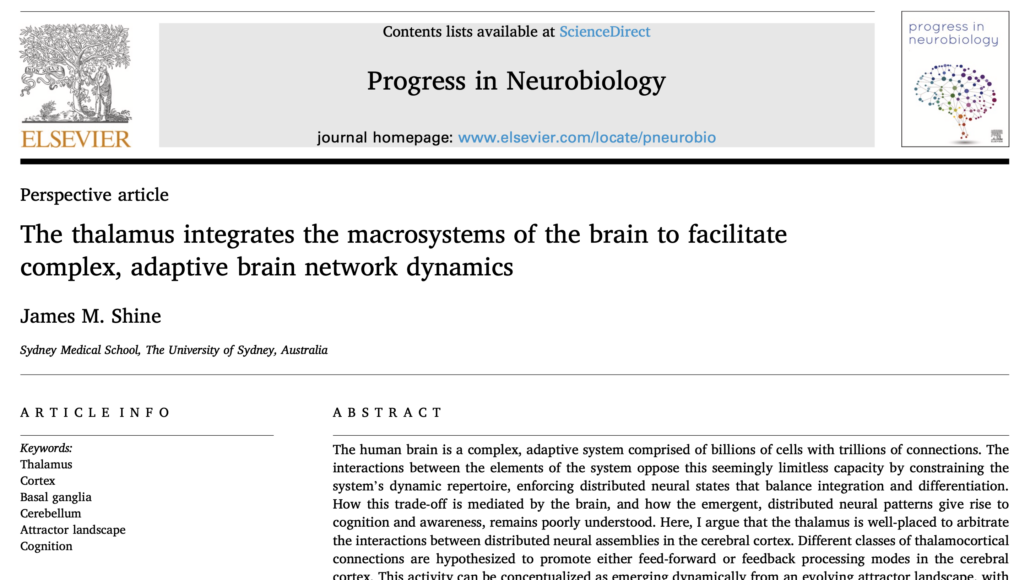
#9: Mac Shine – A thalamus-centric view of basal ganglia, cerebellar and cortical interactions
Mac Shine and I talk about Mac’s recent intriguing opinion paper that may have radical implications for systems and clinical neuroscience. In it, the thalamus mediates between feed-forward type input from cerebellum, sensori nuclei and cortex one one hand and input from the basal ganglia that introduces an element of randomness. By projecting to the cortex in a specific manner, the thalamus can recruit these inputs to shape the attractor landscape of cortical activations. Mac develops this a theory from the cell- to the systems neuroscience level and hints at how Kahneman’s system I and II levels of thinking fast and slow could be implemented in the brain. The theory radically extends and partly opposes existing concepts such as the thalamus as a mere relay station and the model of the basal ganglia for action selection proposed by Alexander, DeLong and Strick in 1989 – so there is vast potential of this becoming transformative for deep brain stimulation, as well.
00:00We can't think of any part of the brain as existing in a dish,but the idea that you would place the pressure,the computational pressure of an automatic functionon something as capacity-limited as the basal ganglianever really meshed with me.Welcome to Stimulating Brains.Stimulating BrainsHi, it's Andy.Welcome back to Stimulating Brains, episode number nine.When I started the podcast project,I thought of it as a very broad concept to interview people,of course, in the field of deep brain stimulation,but also,01:00anatomists, physiologists,people that try to figure out how the brain works,people that have radical new ideasof how deep brain stimulation might exert its effects on the brain,people that study non-invasive brain stimulation,people that are looking for better ways to map anatomy of the brain.So basically, to interview stimulating brainsthat are able to move the field forward.So far, I've mostly...I've mostly interviewed people that were clinicians and important in,especially, I think, the history of deep brain stimulation.I've interviewed Lone Frank as an author,but she had written about Robert Heath.So again, a historical figure of DBS.And recently, there was the excellent guest episode by Luka Milosevicwith Majgan Haddai.That was a pure joy to listen to for myself as well.So hopefully, there will be more guest episodes.And hopefully, we will interview as many clinicians and experts in DBS,02:00as we can.Still, I think the scope and the idea of the podcast is broader than that.And today's episode may be the first onewhere we dive further into how the brain works.Of course, with a focus or some context of the brain stimulationor the basal ganglia, or in this case,even the basal ganglia, thalamus, cerebellum, and cortex.I talked with James McShine, who is a brilliant scientist in Sydney,Australia, and who recently wrote, in my view,a phenomenal paper that comes up with a radically new theoryof how these aforementioned systems may interact.It extends or partly even confronts existing theories,such as that the thalamus is a mere relay station in the brain,or even more importantly,also the Alexander, DeLong, and Strick model from 1989.His paper is quite dense,but we still try...03:00to focus on the paper and really go into depth.And I think and hope that we were able to get across the main points of the paperstill with the notion of motivating every one of us to delve into that paperand even more so into the underlying literature.So Mac invites us into a long journey of how the brain may truly be wired upand to think about these ways and concepts and their implications.I hope you'll all enjoy this particularepisode.And I'm as always curious to hear about feedback of what you think.Thank you so much for tuning in.And now have fun with James McShine from Sydney.So Mac, thanks so much for taking part in this.You were just mentioned a week ago by Russ Poldrack in an episode of the brilliantBrain Inspired podcast by Paul Middlebrooks.And I think Russ mentioned you.04:00You sucked him into the field of dynamic network theory, screaming and shouting backwhen you were in his lab at Stanford.Why do you love the tractor state so much?Yeah, that was that was quite a spin out.I think I've listened to every single episode of Paul's podcast and I absolutely love it.And then to hear Russ mentioned my name on the podcast, I think I was blushing as I waswalking around listening to the talk.So attractors are a really, really exciting, interesting idea that make a lot of reallycomplicated mathematics much more intuitive.And so I've gone on a really long and winding journey through a lot of different subfieldsthat I see as being very important for sort of really understanding the brain at the endof the day.Things like fieldwork.05:00Fields like cognitive neuroscience, fields like neuroanatomy, fields like clinical neuroscience.But one of the more challenging conceptually is the field of complex systems and dynamicalsystems, because the language there is really written in mathematics, which is not my strongsuit.And so for me to understand what collaborators are thinking about or what are really greatpapers of writing about.For me, I really needed.Intuition, intuition pumps.And I think attractors and attractor landscapes and all the things that go with them offerthat for the for the non-specialist, the non-physicist, the non-dynamical systems expert.And so I've really tried to kind of capitalize on that intuition and use that to help mereally understand what I'm reading about, hoping that also someone that comes along thatreads it will have a good answer.That will have the same background maybe as I do and say, oh, cool, I never knew that06:03those equations were really actually that simple because they seem so complicated whenyou see them on the paper.That's my hope.But we can get into maybe more of some of the details.Sounds great.So I guess the basic idea of an attractor state is really that it's a bit like a valleyand there is a river that then is attracted by that valley by flowing into that.Right.I guess that's somehow...Or that's the landscape, I guess.Yeah.Yeah.Yeah.Yeah.Yeah.Yeah.Yeah.Yeah.Yeah.landscape yeah well there are many different um types of attractors there are there are sort ofa whole field unto themselves but the basic idea is that um you can conceptualize the activity ofa complex system as it's evolving over time and so that means that it falls into what we call athe state of a dynamical system now there's lots of dynamical systems everywhere and they don'tnecessarily have to be interesting so um walking down the road to the beach near our house there'sthe sand on our beach is a dynamical system it changes over time with the tide and the winds07:02but we don't think that it's carrying any information forward or any memory or anythinglike that so to say that the brain is a dynamical system isn't that profound it's a particular typeof dynamical system but if you want to describe any kind of dynamical system a really good placeto start is to ask what kind of attractors are enslaving that dynamical systems activityand what what that means is that is there a set of rules or a set ofconstraints that are being used to create a dynamic system and so that's what we're going totalk about in a minute but what we're going to talk about is that there are certain constraintsthat are allowing the system to act in a particular way and we can imagine that as a valleyand that a ball would be rolling towards the valley so a classical example comes from geneticswhen we're born a particular gene will be expressed that's like a valley forming in a landscape andthen where we are before that gene has had its effect is up the top of a hill and now we'regoing to roll down the hill into that valley and express the phenotype of that gene so that's that'sthe kind of concept now that type of attractor this sort of idea of a fixed point attractor isreally only but one of many there's there's lots of different types of attractors and there's a lotof different types another one that people that listen to this podcast might be familiar with08:02by a different name is a limit cycle now a limit cycle attractor is one in which there's a movementwhich then comes back to the to the origin and basically if you play that movement out thatcircle in in two dimensions it looks like a spike or an oscillation and so anything anytime we seean oscillator or a phase synchrony we often think of a limit cycle as as the attractor that'senslaving the dynamics of that system and so that's what we're going to talk about in a minuteand so that's what we're going to talk about in a minutethat's causing its the emergent activity to look like let's say spiking or oscillateoscillatory behavior and there's many other types um the other one that people maybe may have heardof as a sort of chaotic attractor where you can have movement in one particular direction butthen with a subtle change it can then slip into a new movement the classical lorenz attractorsa really beautiful example of this um and often chaotic behavior systems have this kind ofsignature where um you can't always tell from where it is where it'll end up it's not alwayslike a limit cycle where it'll always go in the same direction it could always move into these09:01different surprising directions um and and obviously people that study brains reallyget excited about those because they sort of bake in this idea of randomness orum the sort of break the idea of determinacy so you published an article in progress newerbiology this year and i i personally think it was really an instantaneous classic andum in my view a radical new lead for the field there was also a lot new to me personallyum so after writing such a you know thought and skillful piece do you want to retire nowat least that's that's what i would probably do i'm not sure if there's video associated withthis podcast but i'm blushing um uh quite severely right now um that it's very sweet of you to say ithat was a really really fun paper to write um and it took a really really long time umhow did you come up with it like start how was the start um there's a there's a longand winding path to explain the true genesis um i think the the proximal cause was that10:03um i live about an hour and uh and a half away from campus uh with my wife and two kids my wife'sa general practitioner and so i had to come up with ways to pass the time with that wereproductive that didn't involve going into a clinic or going in and working with studentsand so i tried to set myself some goals uh of trying to understand neural circuitry at a levelthat i think was available to us from this beautiful work in the field you know all thesereally beautiful new data sets like the allen brain atlas and all this optogenetic studiesthat are now really refining out the interactions between the parts of the of the nervous systemum so that that was the reason that i had the time to really dive in and read um the genesisof the idea really came from a long while ago uh back when my oldest son tyler was only uh justover a year old and my father who's an evolutionary biologist umwas was asking me uh you know about my son and when he was walking he noticed that one month11:04before he was walking he was really unsteady and really focused on his feet like staring down athis feet and then about a month or two later all of a sudden he was able to look around the worldand he could coordinate and everything was happening really effortlessly and he asked mewhat's a really simple question but in many ways it's sort of um really stuck in my mind ever sincei've been trying to grapple with the the answer to this question which is what had changed in myson's brain in that small interval that made him so much more automatic that made him so much moreeffortless and when i went to read the literature at the time i i just finished my phd um i did aphd in parkinson's disease and non-motor symptoms of parkinson's predominantly on freezing of gaituh but also um on visual hallucinations and so i knew a lot about the basal ganglia i know a lotabout the basal ganglia and i've been really uncomfortable with this idea of the basal12:02ganglia as the seat of habits i know that they're very important for forming habits and forexecuting particular habits uh in in a particular part of the life cycle but the idea that you wouldplace the pressure the computational pressure of an automatic function on something as capacitylimited as the basal ganglia never really meshed with me um part of that was that i came from aback myclinician supervisor simon lewis was really interested in this idea of overloading thebasal ganglia we thought of it as a as a funnel rather than a set of parallel loops like theclassic alexander long and strict we thought of it as this funnel that could be overwhelmedits capacity could be kind of um short-circuited at particular points in time and simon's hypothesiswas that freezing occurred because there was a sort of short-term overloading of the circuitsome crosstalk in the cerebral cortex and that the striatum could no longer fulfill its role ofa function or helping you to dual task let's say think while you're walking and all of a sudden you13:02got this overwhelming increase in inhibition inhibition from the globus pallidus which wouldthen inhibit let's say the mlr or back into thalamus and you get this paroxysmal cessation ofgait um and so for us the the traditional model of the basal ganglia is sort of this place whereyou store to have it there's never really was never really baked in from early on um and sowhen i went looking around for answers that that of systems that could support the basal gangliato to to to to to to to to to to to to to to to to to to to to to to to to to to to to to to to to to to to to to to to to to to to to to to to to to to to to to to to to to to to to to to to to to to to to to to to to to to to to to to to to to to to to to to to to to to to to to to to to to to to to to to to to to to to to to to to to to to to to to to to to to to to to to to to to to to to to to to to to to to to to to to to to to to to to to to to to to to to to to to to to to to to to to to to to to to to to to to to to to to to to to to to to to to to to to to to to to to to to to to to to to to to to to to to to to to to to to to to to to to to tothat hit both the parallel fibers as well around the cell body from the olive. It has a very14:02particular learning rule, which admittedly is still being sorted out. And then it can actuallycontact the cerebral cortex back via the thalamus and then control that kind of feed forwardprocessing mode. So for me, the cerebellum was like, it was just like, it was kind ofthis eureka moment, like, oh my God, the cerebellum is this beautiful structure. It's sitting rightthere. And really ever since that time, we wrote a paper about this. It's in the Frontiers Journal,which was really conceptual about how that might be beneficial for cognition. We can maybe talkabout that later. But that idea has been really in my mind for a long time. And I finally kindof had the chance, the time to sit down and really read the literature required to etch out thedetails. And it's actually kind of amazing.How these things happen. I was sort of reflecting on this a little bit before going on the podcast.I can actually pin down the moment when I think the solution really presented itself.15:03I was having a conversation with a really talented postdoc in my lab, Eli Muller.We were just discussing, he's a physicist. We were discussing interesting things to model. Andwe both think the idea of automaticity is just really fascinating and parallel processing. Andwe were just really having some interesting discussions. And then I was talking to himand we were chatting about neuroanatomy. I was sort of catching him up on some details. And Isaid, oh, you know, the basal ganglia and the cerebellum, they both contact the thalamus, butno one really knows. Some people think they contact the same cells and some people think they'redifferent and, you know, sort of big hand wave. And then I went, I thought, you know what, wecould probably do better than that. And I went and did a Google search and I stumbled upon thisabsolutely beautiful paper by Kuramoto and colleagues in Japan that basically traced the!The cell populations in the thalamus, which we call the core and the matrix populations.I can speak about them in a second. But what they basically showed was that the core matrix16:00populations, which are identifiable by a calcium binding protein that is expressed individually oneach of those different cells, actually differentially receive input from the cerebellumto the parvalbumin expressing core cells and basal ganglia input from the globus pallidusonto the carbidin cells. Now, the reason this was so importantis that I had read before this beautiful work by Ted Jones. Ted Jones is kind of like Murray Shermanlevel important for the thalamus, right? He's like extremely like a, like there's two grandfathers ofthe thalamus and they both have such important stuff to say. Murray Sherman's approach was totake the lateral geniculate nucleus, primary receptive nuclei from the retina, which thenprojects on, it has multiple types of cells, but it's predominantly core type cells that projecton into the granular layers of the parvalbumin. And so what I did was I took a look at thev1, it also has some interspersed cells within it, but they really focused on that architectureand really, really etched it out in really pioneering work. And they would call that a17:01first order nuclei. And then in the thalamus, there's also other nuclei, which they would callhigher order. And they characterize those because instead of receiving sensory input,they receive cortical input and then send input back to the cortex. So they're a little bit likethe hidden layers in a deep neural net, right? They never see any of the input. They never getanything to do about the output. What they're doing is they'recontrolling the context and they're changing what information will be passed on where. They'rekind of like a way station. So that was Murray Sherman's way of characterizing things, veryinfluential. Ted Jones started from the thalamus and he said, what if we go and look under themicroscope? What kind of connections can we see? And he described what he saw as a spectrum oftypes of connections. One of them is the classic core type. They're the ones that Murray Shermanspent a lot of time thinking about. The retina comes in, contacts a core cell into the granularlayers of the cortex.Interdigitated and sort of mixed in in every nuclei of the thalamus with those are thesematrix thalamic cells. And they have a completely different type of connection. What they do is they18:03project up diffusely and hit the super granular regions of the cortex. I don't know if you havevideo, but it's this sort of thick area up the top of these layer five pyramidal neurons, right?So we don't have video, but yeah. So the matrix cells contact the apical layer dendrites. So thesame neuron, but that goes through more or less the whole cortex. But you know, we have the apical layer.It goes right up the top and it branches out and it hits multiple different cells and it hits them in a region where the corticalfeedback from a higher level of the cortex is making its impact. And so this automatically suggests that these two things havevery different functions, right? If you have a very different type of connectivity, then you're going to have a different type offunction. And now all of a sudden we can track it even further back. We can say now the cerebellum is going to be the same neuron.And so we can say now the cerebellum is going to be the same neuron. And so we can track it even further back. We can say now the cerebellum iscontacting one type of connectivity and the basal ganglia is gating the other type. So all of a sudden, instead of having a bunch ofliterature that I'd read about the cerebellum and a bunch of literature about the basal ganglia and a bunch of the thalamus and a bunch of the19:03cortex, now all of a sudden I could see a way to knit them together. I could see a way that I could trace the logic of the connectionsaround. And it's admittedly, you know, a very simple, sort of simplified story to how they might work together. But the logic of thatinteraction was so...enjoyable for me. And so it was so much fun to think of the implications that I really dove into that and tried to work out, okay, if this is the architecture, why would it be like this?What would it buy the system? How would we describe the way that the system's dynamics would evolve if, let's say, the basal ganglia or the cerebellum or the cortex was the predominant controller of the action at any point in time?And this sort of drives us back around to where you get to attract a landscape.So I think that's a really good point.Adam Dewie to Adam Dewie tocan evolve over time in particular ways. And so that's really the genesis of the story. I'm not20:02sure if that's more involved than you were hoping for. Did the lockdown help to work out the detailsat all? Did that have an impact? The lockdown came after the paper gotone of the absolute worst rejections of my career. I sent it to a really nice journaland I was extremely surprised when they sent it out for review. And I received, this was probablygoing on a year and a half ago. And I got four reviews back that basically called into questionmy credentials as a scientist. They thought that it was too speculative. They thought that it wascombining areas that didn't need to be combined. They didn't understand why you would go using thelanguage of dynamical systems when you were talking about neuroanatomy and why would someonewho does functional MRI researchhave to go through the process of talking about cells and the whole thing. It was just, honestly,21:01like it was like the old school pie in the face kind of slapstick movies. No, no, look, academiais one of the best jobs in the world, but one of the prices you pay is that you get humbledintellectually a lot. And I'm either like, I've either got really bad Stockholm syndromeor I've convinced myself that it's actuallyreally helpful because it causes you to reflect upon your assumptions and to make argumentsstronger so that they hold up to scrutiny. And so basically COVID was great because what it meantwas that instead of just like saying, oh, you know what, I'm not going to deal with that anymore.I was forced to like really confront what I'd done. And in the end, I think the version thatended up in Progress in Neurobiology is much more mature, much better defended, morerefined. I'd been reading a lot of Valentino Breitenberg, who's a real academic influence22:03of mine. And he has this beautiful way of breaking things down to the kind of the nitty-gritty of theneurobiology that I just love. And I tried really hard to take what I had before, which wasvery kind of like, I was painting a picture rather than really etching it out. And I triedto etch it out much more. And I'm, you know, it was a hard road to go down. It was definitely like,very humbling. But I learned a ton through that process and I'm much happier with the outcome.So yeah, COVID helped in a way. Okay. So let's dive into it a bit more in detail now. Maybe just torecap, and I plan to roughly follow the stream of the figures. So talking maybe about, so iflisteners want to pull up the article in parallel, speaking a bit about figure one now, there, that isreproduced from Ted Jones, whom you already mentioned from his TINTS article in 2001.23:03And again, just to recap what you already said, we divide by that the thalamus into core and matrixcells, or, and these are some, some cells have both properties. And so it's more a gradient,I guess, between core and matrix core means they have, they are parvalbumin positive and matrixmeans they are carbondine positive. And they seem to be classed as a!So specific no place in different, like are more core or more matrix than core projects to thegranular layer and matrix to the super granular layer. So layers one and two. And from that,we can also learn. And that's, I think what's radically new or what's the, what's the centerpieceof your articles, the central role and the core cells basically receive input glutamatergic inputfromcerebellum, since we're in a. And the cortex, but cerebellum is key here, I think.24:03And the matrix cells receive input from the basal ganglia.Yes, yes, that's right. So you know you'll probably already tell listeners that this is a sort of verydetailed neuro anatomical argument that I'm trying to make, but my hope is that by laying out thingsin detail people can go and read the source material, definitely go read Ted Jones, go,think of go read, you know Helen Barber's work on the cerebral cortex, the structural model and,and read about these really beautiful constraints and patterns that have been kind of etched out bythese really brilliant neuro anatomists. And another one that I'd recommend is FranciscoKlaska, whose work is just beautiful. He's sort of like, I've told him this to his face,he's sort of like the reincarnation of Ted Jones to me. He's, he's really etching out this beautiful,dizzying,complexity of thalamocortical connectivity that really kind of captures this idea that,25:04that Andy just mentioned, which is that every nuclei in the thalamus, we traditionally,when we look at it, if you look at a Google search of the thalamus, you'll see that people will oftenchop it up into sub nuclei, like the anterior nucleus or the mediodorsal nucleus, the lateralgeniculate nucleus, the pulvinar. But if you go down and look in the actual sort of cellularcompartments of these cells,Adam DewaardAdam DewaardAdam DewaardAdam DewaardAdam DewaardAdam DewaardAdam DewaardAdam DewaardAdam DewaardAdam DewaardAdam DewaardAdam DewaardAdam Dewaardto the striatum as well. And the intralamina nuclei are extremely likely to project to the26:02striatum. In fact, much more so than to the supergranular regions of the cortex.But yeah, there's this idea that the thalamus is actually, instead of being a set of littlekind of like modular nuclei, is instead a kind of smear of different cell types,which are then projecting onto the cortex. And then the way in which they project onto the cortexbased on the logic of the cortical connections can then tell you about the kinds of differentprocessing that could occur when the different thalamin nuclei were recruited.So maybe I think for the listeners of this show, the human motor thalamus is the one they knowbest, they would know best. So I guess in this logic, the VA nucleus, for example,would receive input from the basal ganglia. So it's likely a matrix type nucleus, right? Andthe VL of the thalamus is the one that's the most likely to get input from the basal ganglia.The VL of VIM would receive more of the input from the cerebellum. So that wouldrather be a core thalamus, right? Can we say that?27:01Yeah. And I think this, yeah, that's fair. There are exceptions to that rule as well. So biology is,if anything, is fickle. Laszlo Axady has done some really nice work showing thatthe output of the cerebellum, the deep cerebellar nuclei do contact the intralamina nuclei.They also send connections to lots of kind of weird places like the locus cerellis and thedorsal raphe and the ventral tegmental area.And all kinds of other areas as well. So in a way, you could think of the kind of logic ofthe organization is kind of predominantly in one way, but there's lots of exceptions to the rule.So I don't want people to come away thinking that this is like the way it is organized.Absolutely.This is one of the sort of major backbones of connectivity that's present.We still need to simplify a bit, but I totally agree with you. And if you look it up,everything seems to be connected to everything in the brain always. So there is more,more detail to each level. I totally agree with you on that.So one of the things that's really fascinating to me, and probably just to kind of steer this in a28:00direction that your listeners might be interested in, is that the fact that the basal ganglia cells,so the striatum inhibiting Globus pallidus internus and Globus pallidus internus, and thensending GABAergic projections down to the thalamus.The fact that those cells are matrix type predominantly and not core type was,was really,was really contrary to what I think the PhD version of me would have expected.I think if I was taking the Alexander DeLonghen strict model,which I think has been extremely influential and has, you know, again,I don't want to feel like I'm arguing against that model. I think it's,I think it's, it's got a lot of logic to it in the idea of corticalregions in a distributed fashion,sending projections down to specific locations within the basal ganglia whereorbitofrontal is to the occultal,the lumbar and there's a lot of prefrontals to the chordate and motor to butane.The logic is all very consistent.The the segregated pathways within again,29:02consistent, there is a collapsing of the dimensionality,which I think is a really important feature,which we can talk about if you'd like.Charlie Wilson at UTSA has done some really beautiful work on that.He has a paper in the neuroscientists called active de-correlation of the basalganglia, which is one of my favorite papers on the basal ganglia,which we can talk about if you'd like,which talks about that collapsing nature.But then the really important feature is that the DeLonghen-Strick model,Alexander DeLonghen-Strick model was always the analogy that was brought up asthis idea of gating an action plan.The idea would be something like if your dorsolateral prefrontal cortexinnervated the chordate,the chordate could then silence a particular globus pallidus neuron,which would then lose its inhibition over a thalamic region,which would then allow a synchrony between the cortex and the alveolus.And it could, let's say, oscillate along at some high frequency,which would mean that it had,an impact in some other area it didn't.That idea of thalamic-cortical synchrony is sort of inconsistent with this idea30:00of the way that the matrix thalamic nuclei project back to the cortex.They don't,they're not coming back and hitting the same neuron that contacted thestriatum and then sort of opening up the gate.They're projecting back in this,I'm going to call it diffuse,I'm doing inverted commas with my fingers here.It's a diffuse asterisk.Yeah.So,it's not diffuse in the sense that every single neuron in the brain gets contacted.Sure.But it does come up and it projects to the supergranular areas in,in a relatively diffuse fashion,such that the,the region of the cortex that innovated the chordate,let's say to open up that channel,we'll get a little bit of a boost.It's feedback signals will be now primed.You could say the gain has increased in those signals and made them moreexcitable,but so will a range of other regions around it or another,uh,cortical areas.And that means that you're,you're sort of almost in a way losing control over what you've done in,in,in a sense,the basal ganglia is,is opening up the channels such that now more of the cortex can have a vote31:03in what the ultimate action is.Uh,and I think that has some really profound,uh,implications for how we think about,uh,what the basic angle is doing for normal behavior,but also what happens when the basal ganglia becomes dysfunctional,uh,let's say in Parkinson's disease or Huntington's,um,BP,BP,a number of others.So,the BP,the,the,the,the,the,the,the,the,the,the,the,the,the,the,the,the,the,the,the,the,the,the central point,right?That the basal ganglia seemed to broaden the attractor,uh,um,uh,um,um,valleys.But before we go into that,I think let's,let me try to dump that down even more.Uh,I know we're,we're simplifying a lot.I know that,and everybody should be advised to,of course,read the original material,but just for understanding.So,so I guess what you're saying is theclassical,the classical,the classical,the classical,the classical,classical Alexander de Long's trick model would usually be conceptualized in,you know, talks maybe for med students that, you know,there are different types of actions in the brain, in the cortex.32:02And then, you know, one is selected, the action selection thing.And that's being done by this inhibition via the GPI, you know,that, you know, this action is now passed through and done.That already is a very, very strong simplification of their idea.But that's, I think, how people see it.And your model would propose instead would rather be that the basal gangliaadd some sort of randomness into the model.And, you know, the specific region of the cortex that was starting the whole thinggets more feedback from other cortical areas that are close to it.Does that sound right?And let's maybe try to shape out once more why that is.So, so.Yeah.It's because of the matrix cells in the thalamus diffusely project to the apical dendrites,while the core, and we haven't talked about the core that much,which comes rather from the cerebellum,33:00would rather somehow via some interactions with stellate neuronsand go to more specific region, right?The feed forward type.Yeah.Yeah.So, so it might, I think, yeah, everything you said was, was, was right on track.So I think to help understand why it would,would matter that the cerebral cortex was perturbed either in a precise granular layeror in a diffuse super granular layer.It helps to sort of zoom out a little bit and think about the organization of the cerebral cortex.Now, the cortex is a, right, a thin sheet, six, you know, approximately six playing cards thick.It's all convoluted and smooshed inside the skull.And, you know, we're still understanding the mysteries of the cortex,but essentially,the simple way to think about it is that there's one end that's,that's tethered into the external world.The retinal inputs hit V1,the auditory inputs via the cochlea hit the auditory cortex,the sensory inputs via your body hit S1.34:01They're the tethered areas.And there's a, at the, all the way at the end of the other end of the,of the, of the connections are the,what we call the cingulate cortex or areas in the orbitofrontal cortex or M1,the movements.So the, along those two extremes,the cortex changes drastically in, in the way it's organized.On the sensory end,it has this really thick granular layer,which is where all the core cells are coming in.And it's typically thought of that they're a feed forward layer.What that means is that an input will come in and they'll project to cells that are what we call the supergranular layer,then propagate forward up towards the more motor or cingulate regions.At the other end,there's much more of what we call output cells.They're in the infragranular layers,layer five,in particular.And if we're in the motor cortex,a layer five cell would be the bet cell that project down to the spinal cord and make contact with alpha and gamma motor neurons.It can move muscles and make very precise refinements to movement.35:03And the idea is that this is,this is an idea that's been around for a really long time.Classical work was done by Fellman and Van Essen,Pat Goldman-Rakich,some of the more modern work,Helen Barbus and Vas Tsikopoulos have shown this really beautiful patterns,where the sensory regions,which we call granular cortex,the rule is that if the inputs are received by that area,they'll send a feed forward projection to a granular layer of a higher level,a region that's closer towards the motor end.In contrast,a motor region will set a projection that feeds back to the lower areas,but instead of contacting the granular layers,it actually ignores them completely.And it's,it hits,it sends projections to the infragranular layers around the cell bodies,and also,to the super granular layers of the cortex,this really big thickened area that's full of dendrites.Now,what are dendrites?Dendrites are the connections that are sitting on the ends of cell bodies that receive the inputs to a neuron.36:00And one of the really fascinating things that happens in the mammalian cerebral cortex,and it's really kind of expanded and it's really augmented in humans and non-human primates,is that the big output cells of the cerebral cortex,these layer 5 cells,have a really elongated stalk.So the cell body is sitting there in layer 5,receiving feed forward inputs from the lower layer,but it's got a really,really,really,really long tube,a long stalk that connects it to its feedback from the higher area of the cortex.And what that means is that because the stalk is so long,there's just so many ways for the message to get lost.You can imagine that if you had a long walk to the post office,as people were sending you letters,if your walk was treacherous,there's just every likelihood that you turn around and go home a bunch of times before you finally got to the post office to receive that message.And so what really happens then in the cerebral cortex is absolutely fascinating,is that if those messages are received in short order,37:04or if there's neurochemicals around like noradrenaline or acetylcholine,the cells can get,those messages can get pumped down to the cell body and they can cause the cell to function in a completely different mode.The idea is that when there's only feed forward connections hitting the parameter cell,it just sends a spike.But when the feedback connections come to what they do is they,they basically cause a huge increase in calcium that then causes that cell to burst.And that bursting can have a really big change,a big effect on ongoing dynamics.It can change the way that the the cells forming the attractor landscape is forming.Now,why is this important?Because the basal ganglia now has control over the,the,the signal.It can control over whether or not a particular cell receives its mail,whether a particular cell shifts from a spiking into a bursting mode.And it doesn't do it in a way that just causes the cell that sent the message down to the basal ganglia through the thalamus to,38:00to,to get its map,to get its mail,but its entire neighborhood.So what you've now got is a different way in which the cerebral cortex is using the input of the basal ganglia to inform its ongoing brain state.Which of the different cells are firing in that.First firing mode in a way that is not completely inconsistent with the Alexander to Nolan strict model.It still is going to gate the function of that particular area.But it does it in a way that also buys in some randomness.Um,the fact that your neighbor could also get their mail when you went to check for yours means that the neighbor might get some,um,you know,mail that might change their behavior and the whole system can now evolve in and do what we'd call almost like a swerve from,from what it would have had before.And I think that's really,fundamentally important when we think about our behavior and the importance of chemicals likedopamine and the architecture of the basal ganglia for informing that kind of behavior as we sort ofchange over time. Super. And I think that's a really crucial concept that you just mentioned.39:03I think that was established among others by the group of Matthew Larkin. You have the same neuron,PT type neuron in the cortex. If you just give it input to the basal dendrites, it fires a singlespike. If in a specific time window, you also activate the apical dendrites, then it goes intoa bursting mode. Is that correct? Yeah, that's right. And that bursting mode is, according toyour model, more or less activated by input from the basal ganglia, right? So the basal gangliawould recruit that.That one single neuron, but also its neighbors to somehow go into a bursting orchestra. Is thatcorrect? Yeah, that's the idea. And I think this is where it becomes kind of interesting. That kindof a mechanism is a really great way to almost hedge your bets. Let's say that you decided you40:02want to learn how to shoot a basketball and you take a shot and you miss it and then you take ashot and you make it. Well, part of the argument is that you want to learn how to shoot a basketball.And part of it was the architecture of the movements of your muscles that caused you to make the shot wasbeneficial. And part of it was completely terrible. And part of it was you missed out on the ideal,let's say, angle of your elbow and the ideal timing of the contraction of your triceps andrelaxation of your biceps, let's say. But in a way, because there was an outcome that was positiveover time, the idea is that the system can have some of that variability required for optimallearning. You don't have to be spot on perfect every single time. You don't have to be spot onperfect every single time. What you have to do is get experience and feedback and continually try toimprove. And by having that variability baked in, if we go back to the attractor landscape idea,if there's a perfect idealized attractor somewhere that represents the perfect basketball shot,let's say Steph Curry's jump shot and your ability to kind of like coordinate all yourmuscles in the correct way to shoot the ball, being variable gives you, the amateur, a much,41:06much better chance of finding that perfect attractor.Adam O'Brien said to Adam O'Brien to Adam O'Brien to Adam O'Brien to Adam O'Brien to Adam O'Brien toAdam O'Brien to Adam O'Brien to Adam O'Brien to Adam O'Brien to Adam O'Brien to Adam O'Brien toAdam O'Brien to Adam O'Brien to Adam O'Brien to Adam O'Brien to Adam O'Brien to Adam O'Brien toAdam O'Brien to Adam O'Brien to Adam O'Brien to Adam O'Brien to Adam O'Brien to Adam O'Brien toAdam O'Brien to Adam O'Brien to Adam O'Brien to Adam O'Brien to Adam O'Brien to Adam O'Brien toAdam O'Brien to Adam O'Brien to Adam O'Brien to Adam O'Brien to Adam O'Brien to Adam O'Brien tolife are really, you know, it's extremely important that they learn how to sing the family song.But then later in life, as they become juveniles, it's actually much more important that theydeviate from that song, kind of like Miles Davis playing a solo. They need to be able to come upwith their own progression of the song that's unique enough that they can stand out from theirfather. And it turns out that the Bezos Ganglia is actually incredibly important for both of those42:00things, right? It's important early on for learning how to mimic the song. It's also important laterfor deviating upon that and actually soloing and improvising. And I think that this architecture,this contact between the Bezos Ganglia and the metric cells offers a mechanism that can plausiblybuy you both. It's slightly less efficient, let's say, as a learner, but it also has a longer termefficiency where it'll find the optimal solution more often than if you try to try a very preciseoutcome and only execute the precise outcome with high validity every single time.So it's a...It's a...It's a slightly gnarly concept. It's really a systems-level way of thinking about the brain andhow it's functioning. But I think it's much more parsimonious for the kinds of ways that we learn,the sort of noisy trial and error and then improvisation that I think is a real characteristicof how we learn skills and habits.Definitely. So I guess that really poises us now to talk more deeply about how43:05this all fits into attractor landscapes. And I guess we're now at figure three around that,right? And you show that basically, again, cerebellum and other systems would activatethe core, which gives a single spike, which maybe forms the attractor landscape in one way. But thenif you just hit the matrix, that doesn't result in spikes. So that's the apical dendrites,but it rather broadens the attractor landscape a bit.So that's more the basal ganglia input. And then if you do both, you would get the bursting mode,and that would really make a deep valley of that attractor state.So part of my sort of long winding road that I mentioned before, after my postdoc withRoss Poldrack, where we had done a lot of work on brain networks and human brain imaging and tryingto understand some of the rules that govern how brains can kind of change over time, I started44:04working with my colleagues at the University of New York, and they were really interested in thebrain. And I was working with Michael Breakspear, who's at the University of Newcastle here inAustralia, using what we call neural mass models to try to model brain activity and try to thinkabout the kinds of rules that go into governing how the brain can change over time. So remember,from earlier, I talked about how the brain is an example of a dynamical system, and it's a reallyinteresting type of dynamical system. It changes over time in particular ways. Well, the equationsin the top of figure three are some of the kind of ways that we approximate that change over time.It seems complicated. Don't forget, I have a clinical training. I still feel slightly illevery time I see an equation. But the idea here is actually relatively simple. If I want to look,if I want to ask how will my region, let's say x, change over time, the little dash that you seeafter the x just says, how is it changing over time? What is its rate of change? All that I needto do is I need to find out what it was doing the time point before, and I subtract something like45:04it's, it's, you know, it's, you know, it's, you know, it's, you know, it's, you know, it's, you know,how much it will relax. That's the tau version, the minus tau. I then, then the big E is the sum.What I do is I sum all of the inputs from all of the regions it's connected to. That's the AIJ,that's its adjacency matrix at the previous time point. You can think about if I've got a bunch offriends, they're all egging me on to jump off a high diving board. The second before, if 20 of myfriends all say jump, I'll be much more likely to jump for the next time. However, the sigma parameteris then you could think about how much I'm listening to my friends. So if I decided thatI wasn't listening to them all, sigma zero, it doesn't matter whether they're talking. I justblocked them out. If sigma is one, even one of them could talk and it would be enough to make me jump.And then the final thing at the end is the E parameter. That's just noise.That's just saying that there's other stuff in the system that we have the model.So it's actually really simple, but one of the things that it lets us do is that it turns out46:00that that equation that we have on the right side of that equation is actually, is actuallyempirically the same. It's actually the same, but it's actually the same. So it's actually the same.So it's actually the same as talking about an attractor landscape with a ball rolling aroundthe landscape. So we can think about X being the ball. And then the way that the X X moves is thetau parameter. The inputs is receiving is how much of a kick the ball receives to move in a particulardirection. And there's also a little bit of noise. So this is where I sort of mentioned before thatif you were coming at the field to the field of convex systems, um, you know, as a, as a newbie,it's incredibly overwhelming. There's all these new terms and equations and everything seemsto be really, really stressful. And if you realize that you can get a lot of your intuitionfrom this idea of a ball rolling around a landscape, I mean, we've all seen, you know,um, you know, a ball rolling down a hill and we all, you know, really intuit the idea of gravity.So these things kind of help kind of like bootstrap you up. So the idea was if we were thinking aboutthe ball rolling around a landscape, and then we thought about what would happen if the basal47:00ganglia got involved in the balls movement or the cerebellum got involved. And I think it'srelatively, um, uh, easy to, to imagine what would happen if the basal ganglia got involvedand you got more apical, um, input that'll widen out the basin. And if the apical input then causedthose cells to change from a spike to a bursting mode, that's going to deepen the attractor down,right? The burst is going to mean that that group of cells has much more influence over the brain.That would be like turning the Sigma parameter up on that particular subset of the neurons thatreceived that boost. And so that means that the ball will be much more likely to roll into that,into that attractor.Yeah.Before it then dissolves in contrast. One of the things that the cerebellum is really good atis actually conditioning on its own output. So if you feed the cerebellum, a context signal,like shoot the basketball and you do it enough times, the cerebellum will learn that every timethat you actually re you know, bent your knees, then half a second later, you pop your knees up.Then, you know, a third of a second later, that's when you needed to lift your arm.And then another quarter of a second is when you need to flick your wrist.48:01It can start to learn that sequence. The way it does that is quite fascinating.The output of the Sarah, the deep, the deep cerebellum nuclei of the cerebellumactually send a projection back to the cerebellum cortex and some beautiful work by Michael Malk'sgroup in Texas have actually just shown that that can be that you can use that circuitryto learn arbitrary sequences of inputs. And so putting those together, the idea is thatthe cerebellum will slightly deepen the attractors, but it'll do it in a really brief way where theattractors are almost kind of coaxed along in time. So with the basal ganglia, you'll get thisbig deepening,of the attractor that'll maybe last for a little while, whereas the cerebellum,you'll get a deepening that it'll move on almost allowing you to sort of flow through the landscapemuch more quickly than you would have with a basal ganglia.And so this was really just trying to give people an intuition about, because about what I see isthe importance of this architecture, this logic, because at the end of the day, I'm really inspiredby the work of James Houck, who unfortunately passed away this year, which is that we can't49:04think of any part of the brain as existing in a dish. The cerebral cortex is beautiful andcomplicated, but its computations are only as good as the information that it's fed, and only as goodas the feedback it's receiving from the thalamus and the basal ganglia and the cerebellum and thecolliculus and the hypothalamus. It's only in thinking of the system as a whole that we gainthe understanding of the algorithms that it's trying to solve and trying to embody. And sofor me, this was my way of trying to say, I think there's a really clear logic of cortex, thalamic,basal ganglia, cerebellar connectivity, and this is how I could see it playing out at the level ofthe system in the idea of it coaxing the ball around the landscape in a slightly different way.I mean, to comment on that, your paper is really one of the rare examples that goes fromcell to systems level neuroscience. And that's what makes it so precious, I think.50:01Well, thank you very much. I think I haveprobably a lot of gray hairs to show for all of the furrowing of my brow that I've done trying tothink about this stuff. But I think it's really rewarding. And to sort of put a shout out therefor systems neuroscience, I think this is a really exciting time for young scientists. If you'recoming out of undergrad and looking for what to do, it doesn't really matter whether or not youtrained in coding or in physics or in neurobiology or in psychology. If you're curious about how thesystem works as a whole, you're going to be able to do a lot of things. And I think that's reallyimportant. And I think that's really important. And I think that's really important. And I thinkthat's really important. And I think that's really important. And I think that's really important.There is so much data out there now, so much information, and it's like way too much forany one person or one group to do. So it's a really great time if you like complex problems and tryingto think about high dimensional variables and how they interact with one another, kind of akin towhat it was like before the Human Genome Project came along, where people were starting to get agrip on start codons and stop codons and mRNA and tRNA and rRNA and all of the players and then51:02starting to work out how they actually work. And I think that's really important. And I think that'sreally important. And I think that's really important. And I think that's really important. Andactually work together to fulfill the function that's sort of bigger than all of them. That'sthe time we're out of neuroscience and systems neuroscience right now. I think it's a reallyexciting time for, you know, young scientists in the field.I couldn't agree more. We are currently in a situation where we have so much data,more data than we can probably analyze. And I think I've heard it at least two times in theBrain Inspired podcast that what we currently need is theory, right? Not so much more data,probably. So I totally agree. There's so much to do.In this regard, let's talk about more about the cerebellum core system. I think you mentionedto some degree, and I'll cite you there that the cerebellum can be conceptualized as acting likea storage center for the spatio-temporal patterns that have been learned over time to instantiatewell-learned behavior. And it's really, the idea is that you have a specific particular52:04context and within that particular context, such as throwing a ball, but you know, eachpart of that movement, even that particular context, it is really good at predictingwhat will likely occur next and then doing what is needed next, right?Yeah. So I'm really inspired by a lot of really brilliant thinkers about the cerebellumthat have come along.Before me, the, you know, I mentioned Houck and Wise before. The Lina family, husbandand wife combo did some beautiful work. John Montgomery, Kiwi, just across the pond fromme in Australia has done some really beautiful work thinking about implications for the cerebellum.And John's work, I think, I wasn't aware of it when I was doing the, the, the, the, the53:03cerebellum.I was thinking about the, the, the analyses and thinking back in the original Frontierspaper with my father, but I came to John's John's work later. And I think he has a reallybeautiful way of putting what the cerebellum does. And it comes from the, the cerebellum'sevolutionary history. And it turns out that the first kind of known sort of time thatthe cerebellum popped up was right around the Cambrian explosion. When all of a suddenin the water, there were these mega huge sharks.And Tilios fish that could basically hunt and, and and take out their prey, big, biganimals. And to move in the water for them was a huge cost. And so they needed neuralstructures that were really, really good at anticipation. And they also needed good structures,terrible several structures that could cancel out the, the, the inherent noise in theirbig lumpy bodies and systems and give them what was left over kind of like noise canceling54:03bones. And it through a remarkable feat of, of, you know evolutionary engineering thecerebellum is really wired up to do precisely that it's, it's wired up to take a particularcontext signal, subtract out what is known and leave the remainder, this sort of activenoise canceling. And in the context of of the, of the human system, which, you know,evolved over time and the kinds of inputs we feed it.It's really good at anticipating what people call the sensory consequences of motor action.So sometimes you'll have heard of this is called an efference copy. The idea is thatevery time you move your arm, let's say you reach out to grab a glass of water. As youreach out, there's a bunch of signals that your, your brain is sending out saying movingto location X. And, you know, that requires moving this muscle and that muscle, this particulartone. What the cerebellum is really good at is saying55:02the last 10,000 years, you know, I've been in the water for a long time. And I've beento these environments to to to to to to to to to to to to to to to to to to toto to to to to to to to to to to to to to to to to to to to to to to to to to to toto to to to to to to to to to to to to to to to to to to to to to to to to to to toto to to to to to to to to to to to to to to to to to to to to to to to to to to toto to to to to to to to to to to to to to to to to to to to to to to to to to to toto to to to to to to to to to to to to to to to to to to to to to to to to to to to toto to to to to to to to to to to to to to to to to to to to to to to to to to to to toAnd I think this is actually extremely crucial.If you were a shark trying to hunt your prey, if you could anticipate its movement, youcould get there before the prey got there and you could eat it.If you are a human and you're trying to shoot a basketball, if you can anticipate how thebasketball will feel as you lean forward to shoot the ball, you're going to be that muchbetter at shooting the basketball than your compatriot.And I would go even further than that and say, if you were playing chess and you cananticipate the way that your opponent would react to your movement or your perceptionof their movements, movements, corollary, what have you, to some large level of abstraction,you're going to be much, much better at beating your opponent because you've been able toautomatize the anticipation.And I think that's incredibly important.56:00It's a really beautiful structure, the cerebellum.So this idea of adaptive noise cancelling and prediction of the next step, anticipation,I think are really crucial for what it does.And that is really central because the brain is a prediction.Right.I realized that quite recently only that if we train an AI currently, you know, neuralnetwork that has to classify, for example, apples versus oranges, then we usually uselabeled sets, right?We have, you know, we give it a set of thousand brain images where we say, this is an apple,this is an orange, and then it can just make sense out of that.But when we grow up as toddlers, as babies, we don't have such sets.So we have to have a set of labeled data to learn from.So I think one of the few strategies, sorry.Yes, noisy parents.Exactly.So, so, so, so, and one of the few strategies without labeled sets is really to introduce57:03time to have a temporal difference learning where we do something, we get a result andthen we over time form or are able to form predictions by repetitive doing that, what willhappen?Next.Right.So we, we, all of us have seen toddlers throw plastic cups to the, to the ground and weask ourselves maybe in the beginning, why do they do that?Right.But they just want to see what happens.Right.So they explore their environment and form predictions.And then there might be, of course, what, what happens can be in prediction error when,you know, the model needs to be updated because you see something that is not expected.One, one example could be that it, you know, that it is a.Not a plastic cup, but a real cup, and then it shatters to the ground and the toddlerneeds to update its model.So I guess in that regard, and we are slowly migrating to figure four now your novel insight58:03with the cerebellum has also, and I think that involves the basic ganglia as well, right?So the orange part of the figures is basically the basic ganglia as input.So can you.Contrast the older view, which is more the cortical route with the cerebellum route?Yeah, sure.Sure.So, um, this, this last section of the paper, um, was really my attempt to, uh, zoom out a littleand say, okay, if you've joined me on this journey, you've learned a bunch of neuro anatomicalterms that you didn't think you'd ever care about.And then I force you to learn about dynamical systems and all of the language that goes withthat.Why would I do that work?And my hope was that in the future.So I'm doing that by seeing the system with new eyes, you could see how could it achieve some ofthe things that we think are really crucial, um, functional capacities of our brains.Um, as you've mentioned, one of them is predicting ahead anticipation.59:01Um, uh, there's, I think, you know, as we stand here in 2020, um, there's very little pushbackon the idea that the brain, um, is somehow instantiating some form of what we would callpredictive, um, coding or predictive.Control over the environment.The idea is that if you expect to see something, you're, you're, you're sort of changing the way that you interpret.The incoming input, there's always a hypothesis and then a collection of evidence and then an ongoing refinement betweenthose.And that's a better model for perception than say, just a camera taking a photo, um, and then registering where thepictures were dark or light.So there's this really different way in which the cortex is, is, is functioning.Um, and there's been a huge amount of really beautiful.Elegant work in that space, looking at how is it that the cerebral cortex could, could, um, instantiate this idea of hypothesis or a prior, which is the, the, in the language of, of, of Bayesian, um, uh, Bayesian mathematics.01:00:00Yeah.And then the posterior being the, the, the extent to which the prior your, your guess matches the evidence that came in.If they match really well, then the posterior is really, really, really big.You're like, oh, great.I expected to see my friend's face and I saw it.But if you.Have an expectation, your friend will come and then someone else walks through the door, then there's a big error and they call that a prediction error.Um, so, um, one of the things that I, um, always found a little frustrating is that a lot of those models are really based on an understanding of the cortex as the brain.And I think, um, not, you know, not to, not to throw shade at, um, at the field, but in a lot of ways, a lot of what neuroscientists have done over the last little while is really sort of take the cortex as the seat of all the interesting behaviors in a brain.Yeah.Um, th it's really obvious in mammals, it's expanded in humans.It's right there on the outside.If you have a lesion to it, let's say a stroke or your, or a tumor, you get really, um, specific localized impairments.So there were, there was a lot of logic going towards this, this sort of conclusion.01:01:03Um, but then there's also evidence to the contrary that you can have, um, you know, to court at animals, uh, you know, in experimental settings, animals that have their cortex removal often be much more, um, more.active and move more.This is the work of Yark punk.Sep.Um, there's also really fascinating syndromes like the Sprague effect where, um, cats that have a lesion to V one, uh, functionally blind until they perform a small lesion right near their superior colliculus.And now they become sighted again.So there's all these really fascinating descriptions of the, the sort of primacy of subcortical, or at least let's just say the importance of subcortical structures for a lot of the functions that we think that we think, um, mammals and, and humans are.Yeah.Yeah.Yeah.Yeah.Yeah.Yeah.Yeah.humans are capable of. And so I've really had that in the back of my head for a really long time.And one of the things that I always got a little bit annoyed by was that the cortex, you know,might send a prior or an expectation. But what if some of the ways that it's getting that01:02:00expectation is because of some of the subcortical architecture, like the basal ganglia, the thalamus,the cerebral cord, the cerebellum, or the colliculus. And I was just trying to play outthe idea of, well, if anticipation is what we care about, here's this great structure,the cerebellum, that's set up to do anticipatory functions and do it in a way that the cortex isreally bad at, which is with high precision, really, really quickly, and do it in sequenceswith really, really high affinity. In a way, it's a little bit like those classic player pianos thatyou might have seen in the old spaghetti westerns, where the piano is playing itself, there's alittle roll, a little set of bumps like Braille, and they play out a particular song, right? It'snot going to be able to deviate from the piano. It's going to be able to deviate from the piano.But it does it in a way that will play it out with really high precision over time. And so I think,in a way, what I'm trying to do is just make the argument that if we think about the benefits ofthe subcortex, maybe they're going to help make our priors better in a different way. They're01:03:01going to make them quicker. They're going to make them slightly more automatic, let's say. They'regoing to help you see the outcome and then rely on your knowledge of that outcome so you can focus ona higher detail.So with the basketball example, I don't have to worry about where my elbow is. I can focus onwhether or not a defender is coming in front of my face or whether there's enough time left on theclock. Whereas if I didn't have that automatic function, I'd have to be worried about whether myelbow was wobbled into the right angle before I shot the ball. And so I think, you know, in a lotof ways, expertise really is making these really automatic predictions or priors rather than thereally deliberate, explicit, specific priors that we make via the sort of what I've described as thecortical route.Would that still be involved if you learn something completely new? Or would that really be the, youknow, once you've learned it, you delegate it to the cerebellum?Yeah, that's a great question. I mean, part of this is, you know, the stuff that's to be worked out. My01:04:01guess is that the first time that you see something novel, your cerebellum is trying its best. It'ssort of like the helpful friend. It's like, oh, maybe you should try this. And, you know, if it's,that's kind of the core of the process.So yeah, that's kind of the core of the process.So yeah, that's kind of the core of the process.You know, if you just gave me like a, let's take an example, curling, right? I've never curled inmy life. And someone goes, here's a curling broom, go have some fun curling. I'm going to be out onthe ice, brooming my best curl. And I'm sure if you asked an expert curler, they'll say, actually,it's a little different than sweeping with a broom, you have to do this, this and this. But tome, my cerebellum would say, you have a broom shaped object, they're trying to sweep, you shouldjust do the broom action. Right? And so to me, the cerebellum is always going to be givingguesses for what might work. And this is where it kind of gets real fun, much more speculative.But, you know, this, this, this kind of starts to have the flavor of what we would call intuition,right? Sometimes people have anticipatory behaviors that they can't quite put theirfinger on. It's not something that they consciously thought, oh, I will do ABC to achieve01:05:03Y. They just feel like they ought to do it. And one prediction might be that the cerebellumand maybe other structures that are really set up to automate the movement of the brain,like the hippocampus, are sending out, you know, priors that say, hey, this is this might be a goodbehavior for you in this current context, even though you haven't joined all the dots, youhaven't noticed the elephant in the room that, you know, something's happening, you ought to actquickly. And I'm really compelled by that. And I think it's a much harder idea to test empirically.But, you know, as you sort of mentioned before, we need the theories first to be able to makethe predictions that we can then go out and test.You mentioned the frontiers.I think you mentioned in your paper in 2014 that you wrote with your father, Richard Schein,who is, as his brother, John Schein, as I've read up, a famous scientist and fellow of theAustralian Academy of Science.I think both received the highest top awards of Australia for research.And how was it like to work with a father on that?01:06:04And maybe how did having such an academic background shape the way you looked at these things?Yeah. Yeah.That's a good question.So it's really funny, right?I, my dad and my uncle never, never really kind of put pressure on me to do anything with science.Yeah.They, they're both really, I think in a way science traps you in your own little world.And, you know, if I ever asked my dad or my uncle about what they were doing, they would tell me,but they weren't offering it up as much.And I actually noticed myself doing that with my children a bit.So I, I think I try to bring a scientist viewpoint to them, which is to ask questions, look at the evidence,try to arbitrate between different options for how to explain the evidence, you know, hold multiple hypotheses in mind.In fact, that's actually one of my favorite things about the scientific viewpoint is that you don't have to be so sure of everything.01:07:02You're allowed to, you're sort of trained in a way to be uncertain and to, to be comfortable with that uncertainty.Whereas I think a lot of the problems that we kind of get into, you know, when you're in the scientific world, you're not always able to understand.And that's kind of what I've been doing.I think the way that we kind of get into in the world is that everyone needs to be so certain that politicians is right and the other one's wrong, or this is the way to act and this isn't.And I think in a lot of, a lot of answers, the places, there's just not a clear answer for what the right way to act is.A lot of gray in the world.I agree.There's a lot of gray and, and I think we need to embrace that a little bit anyway, that's a side point.Honestly, working with my father on that paper was one of the highlights of my academic career.It's, you know, my dad is an incredible scientist.He's a great scientist.He's a great scientist.He's a great scientist.My dad is an incredibly deep thinker and unfortunately has spent most of that beautiful brain thinking about reptiles like cane toads and snakes, which is a real shame because brains are so much more interesting.And so I finally, with this project, got a chance to kind of see my dad in action.And that as a son was just like a real treat and something that I truly cherish.01:08:06My father actually also is a co-author on a paper I did a couple of years ago with a few other of my academic heroes, Olaf Sporns, Russ, my postdoc supervisor, and Mike Breakspear.And my father also still has the ability to make me feel like a seven-year-old who's done something wrong.I still remember him sitting across the table from me interrogating me about the statistics that I'd run on a particular analysis and just feeling like I was about seven years old.Like I just like, you know, tatted on my brother or something.But no, it was absolutely magical.So much fun.Going back to your paper for a final round, I think.And, you know, I must say the paper wasn't at all complicated.Thank you very much.Well, it was.I guess we're moving to the final figure five now.In 2013, Nobel laureate Daniel Kahneman wrote an influential book that most of you will have heard of.01:09:06Entitled Thinking Fast and Slow.Do you have anything to say about that?Yeah, sure.Other than that, you caught me in a moment of hubris.I apologize for the complexity of the paper, but in a way I was trying to kind of capture what I saw as a kind of way to integrate across fields that I think is really exciting.And it needs to be complicated.It's amazing.Yes.Don't take that as critique.So to Kahneman's work.So there's a whole field.Of ideas that people will describe loosely as dual process models.So the idea being that a lot of what psychology focused on in the early days, because it's much easier to test, is the sort of serial moment to moment chunk of stuff that we're aware of.I'm going to flash you a letter.01:10:01What letter was it?You tell me the letter.I'm going to give you a choice between the blue and the red box.I'm going to give you.A dollar for the blue and 75 cents for the red.And you know, you have to push the button with the blue, right?The thing that you're aware of is the thing that they're trying to measure.And so a lot of psychological theories are really focused on that seriality.But if we stop and think a little bit about the kind of construction of our mental lives, there's so much that happens subconsciously, right?This goes all the way back to Freud and even further back, even to Plato and Aristotle.So the idea of what was the shape of our cognitive life.And Kahneman, I think, really beautifully summarizes this idea that there's these different kinds of modes in which the system that our system can act.And he calls them System 1 and System 2.System 2 is the traditional one that psychologists have studied a lot.The thing, the small chunk that you're aware of, you know, the serial, slow, deliberate process.Yeah.Under the hood is a really rapid, fast, precise, really.01:11:05People would kind of call it automatic parallel processing architecture.We would call System 1.System 1 is quick, but what it gets, what it buys in quickness, it trades off in accuracy.It's going to make heuristic errors.It's going to be the one that jumps to conclusions.It's going to be the one that, you know, sees a shadow and thinks, oh, no, someone's coming to get me.When really the shadow was caused by, you know, a tree that had fallen down or something.And then you need, the idea is that you get a System 1 input and then the System 2 can come through and kind of clean up the D.C.details.Again, as I sort of mentioned before, what I was trying to do in this last section was kind of like re-emerge out of the muck of neurobiology and dynamical systems to say, OK, what can we now say about things like predictive processing, but also things like architectures of cognition, like this dual processing theory?And I think there's a really strong analogy here between the mechanisms we talked about and System 1 and System 2.01:12:00System 1 really is sort of strikingly like what we've described as the cerebellum.Yeah.And the way that we've done it is we've kind of like re-embraced the system.Every time you act, you now get an anticipation of what will come next.And then anticipation can be a real quick guess at what might be coming.It can make you really adapted to the environment or it can make you incorrect.If you have errors, if the system is in a heightened state of arousal, you're much more likely to awaken all those apical dendrites we talked about before.Maybe the basal ganglia does it in a targeted way.Maybe the locus coeruleus and the raphe can do it in a slightly more distributed way.But in doing so, what you do is you then recruit more burst firing.And you make it more likely that that more slow deliberate process will actually occur.We've got some modeling work coming out from the lab hopefully soon.Brandon Munn, a really talented postdoc in my lab, has been doing some really beautiful work showing that modeling that apical amplification of those layer 5 pyramidal cells can kind of recover many of the different signatures that we associate with consciousness and arousal.01:13:01Yeah.And we've been chatting a little bit with Matt Larkham, who did a lot of the really beautiful work.Yeah.We've been talking about some really incredible empirical work there recently.And trying to refine that model and make it sort of capture even more of the phenomenology that they see when they look under the microscope.But really, rather than saying that this is the system 1 and system 2 in action, it's really to sort of show you that by appreciating the neurobiology and appreciating the way that it could shape system dynamics.All of a sudden, these things that seem like completely different, like predictive coding and system 1, system 2.And Dan Dennett's idea of fame in the brain for consciousness can be kind of looked at through the same lens.And you can start to ask, well, if consciousness is related to a subset of these little pyramidal cells burst firing, well, now the basal ganglia becomes really important for controlling which subset is active when.And now if you're in a motivated state with high dopamine or, let's say, a less motivated state with low dopamine, or if you have Parkinson's and then you've lost the dopamine.01:14:02Yeah.And then you've lost the dopaminergic inputs to the basal ganglia, maybe you over medicate.These all now have an impact on that circuitry.And instead of just thinking about it in the realm of movement figure, we can now start to extrapolate out and ask about whether or not people with Parkinson's have a different conscious experience.And so this is where the loop really closes for me because it comes back to my world of thinking about hallucinations, sleep dysfunction, cognitive impairment, freezing of gait in Parkinson's.And trying to work out how can we control that?Yeah.And how can we draw a more complete model of what's happening in the brain for those people so that we can make better treatments?So I can come to someone like you, Annie, and say, hey, maybe we ought to stimulate here and not there.Yes.That's the real goal for me at the end of the day.So I guess this paper really is a new mechanistic backbone for the things you're usually doing, right?Maybe one could say it like that.And of course, will probably be refined in the future as well.01:15:01So system two, the slow one, the thinking, conscious and so on system in your model involves several regions of the cortex to transition into this burst firing, right?And that is being directed maybe more or less by the basal ganglia.Is that correct?Yeah.So Matt Larkham has done some really beautiful work where there's sort of two lines.One of them, they take these layer five pyramidal cells and they place the animals under different forms of anesthesia.They use a couple of different gases.I think there's like one with isoflurane.There's another one with they give propofol.And they show that the apical dendrites decouple from the cell body.And then that's one line of evidence to suggest that this function of those cells is really important.The second line is that they actually record from awake animals in the, I think it's barrel cortex, but it could also be visual cortex.01:16:06Don't quote me on that.They have a really beautiful nature paper on this.And they put the animal into a condition where the visual or the sensory input to their whiskers is at threshold.And what I mean by that is on 50% of the trials, the animal will report that they felt or saw the stimulus and on 50% they won't.And so the idea is that it's like a light touch or a little light flash.And they're trying to get the animal to feel the stimulus.And the idea is that then they can then sort trials into the seen trials where they pushed a button and said, yep, I saw a flash and the unseen trials when they didn't.And they found that on the seen trials, they were much more likely to have bursting of these layer five pyramidal cells and coupling between the apical and the basal compartments.And on the unseen trials, there wasn't.So there's really beautiful empirical work to suggest that, you know, this, this, this bursting in these layer five pyramidal cells is really important.Brandon's modeling work that I, that I spoke to,refines that slide a little bit.Adam Adam Adam01:17:27sigma parameter we talked about before to one.So now everything's bursting.That's a problem.In fact, you're probably likely to get something like epilepsy.What you want to do is you want to tune itsuch that a small subset are bursting and the rest aren't.And here's why that's important.Now that bursting subset can have an influence over whatever comes next.If they're bursting, everything you see in the next little momentwill be completely defined by the context of that bursting subset.And it turns out that this characteristic, this shape,is something that Dan Dennett spoke of a long time ago.01:18:00It's what he calls fame in the brain for his model of consciousness.And the idea is that consciousness is kind of like the most famous subsetof the brain that is the most active at a point in time.It has a constraint on what comes next.And it has almost like a sort of idealized statusaccording to its overactivity.And in a way, this kind of robs consciousness of some of its mystery.But it also explains...It explains a lot of what consciousness is.Because at the end of the day, consciousness is contextual processing.It's the fact that when I'm awake,I will act in a way that I would not have acted if I was not awake.I am grabbing this part of information.I'm letting that information change the way that I will function.And then to bring it back to the basal ganglia,the basal ganglia will then be incredibly importantfor changing what it is that becomes famous.They're going to have a huge influence over the subset that end up bursting.So, you know, where this gets really fascinating and fun01:19:00is to think about the fact that a lot of models,Bjorn Brems has done some really lovely work here,some really nice models of what we would call free willor sort of volitional agency in the brain.All that they really require is the ability for the systemto have a little bit of flexibilitythat's constrained by the system's architecture.So you don't want it to be that every time you act,the system might do something different.You don't want it to like...You're driving your car and all of a sudden the car sort of like jerks off the road.What you'd like is that the car is drivingand based on what you see right now,let's say a gas station versus a fast food outlet,depending on whether or not you need petrol or you're hungry,the system is able to be sensitive to that new input, right?That's really what we need to give the notion of free will some real oomph.And so I'm really excited by the idea that something like the basal gangliacould be really important for kind of imbuing the system,that variability, we call it constrained variability,01:20:00the variability that is related to what you care about nowand can change the way the system acts.Admittedly very speculative,but really fun to think about how these things all link together.Beautiful.This implies so many things,and I would have a ton of questions,but maybe to focus a bit more on the specific field of this podcastwith the brain simulation,in our field,the corticobasal ganglia thalamocortical loops are all the buzz.They have been since a few decades.And with some exceptions,maybe such like prominent exceptions,I mean,such as the dimmer switch model of tremor proposed by Helmick around 2010,the cerebellum is often ignored largely,or we seem to have refined maybe the rate models of the basal ganglia overthe years.And we speak of parallel loops for motor premotors,right?So we have the basal ganglia,the premotor associative and limbic and all that.And people have also slowly begun to see strong parallels between,01:21:03you know,the rate models and maybe the reinforcement learning models of the basalganglia.And these,the basal ganglia act as the main axis or the actor.And then there's the dopaminergic centers that are the critic or theteacher that reinforce actions by pouring dopamine over large territoriesof the stratum.And we also know that a lot of the,lots of dopamine leads to a loss of movement.And some,some claim that in the end,this all can also be nicely explained by reinforcement learning models.Well,but how do we now connect these concepts?You know,maybe the movements or this clinical,you know,no dopamine means you're,you're a bradykinetic and the,you know,reinforcement learning literature and your concept of how,how would you connect the thing is the dots here.Yeah.Great question.And part of me wants to say,please ask me in a few years once I've had a time to think about it a01:22:01little more.So,yeah,I think,I think you're,you're hitting the nail on the head though,which is that to have utility clinically,there needs to be ways that a model or a theoretical viewpoint moves theneedle in terms of what you would have done.Right.And I think Rick's work is a really beautiful example of how,you know,embracing,you know,neuroanatomy can help you work out some,you know,novel ways to think about the system,you know,giving rise to a particular set of symptoms like tremor,you know,the,the cerebellum VIM connections,I think it's like a really compelling way to think about how that,that kind of a function would occur.Part of what,part of my guess for how to link these things with reinforcement learning isthat you're going to need to change how reinforcement learning is going towork.So,you know,reinforcement learning is,is,is thought about a little bit.So reinforcement learning is,01:23:00you know,a way of modeling at a kind of real systems systems level,but with the agent as,as the kind of modeling exemplar,you're trying to work out if an agent was in scenario a how do they choose,you know,outcome a,B or C,you know,are they,they're going to go and look for the reward in the first corridor,the second quarter,the third corridor,depending on what kind of situations you give them.And,and,and,and,and,and,and,what kind of situations you give them.And then all of the modeling is then based on how to work out how to model thatagent's behavior.And that's,you know,that's this like end of one,um,um,explanatum up here and up in the sort of,uh,sky.And then we have the neural processes that link to that.Now,one of the parts that makes it so hard to link between those two is thatthere's no one place in the brain where,you know,function is,it's really distributed.It's,it's,it's,it's,it's,it's,it's,it's,So, you know, we talked before about this idea of system two being this kind of like maybe, you know, a hypothesis is that it's the subset of layer five pyramidal cells that are burst firing at a particular point in time, maybe contacting the matrix thalamus and the colliculus that form the basis of the conscious percept, let's say.01:24:10That's still an incredibly high dimensional notion, right?Multiple pyramidal cells, each which have their own connections and own characteristics, own firing receptive fields, things like that.And so the question of whether or not our self can be modeled effectively as a one, whether or not you still need to find ways to link those things together is a really interesting question.I don't have anything super wise to say in that space.But one thing I will say is that there's a lot of really fascinating mathematics around.And how populations of animals make decisions like ants deciding when to go out looking for food or when to stay and defend the nest or bees deciding when to move from a particular nest to another nest.01:25:01And these are these are examples of what people would call sort of distributed computation or distributed cognition, where each individual is but one part of a multiverse of different options.And as a whole, they somehow come to a consensus as to how to act.And then you get this emergent behavior out of that system that's really low dimensional.But the rules that govern it are really high dimensional.And that the mathematics of that for the physicists out there follow something like a pitchfork bifurcation, which is another type of attractor that we talked about before.And I don't quite know how the answers will look here.But my guess is that if we can follow the neurobiology up.And start to ask questions about how a distributed system cells with the constraints that we think the base of gangrene and cerebellum and thalamus, etc, impose, could make decisions.Does that look like reinforcement learning models?And when does it and when doesn't it?That's the kind of question that I'm excited to ask.01:26:01I don't have anywhere near enough experience in the reinforcement learning fields to be able to come from the other direction and say, you know, here are the two leading theories of reinforcement learning A or B and whether we can arbitrate between them.That's why you collaborate, right?Of course. Yeah, makes sense.Okay, so a lot of that remains to be studied.And one last thing I wanted to ask more and types of more detailed questions that you mentioned before.You said that, you know, you think of the basal ganglia as a dimensionality reduction system, like a sort of funnel coming from the cortex.You go to the striatum that is already smaller than you go to the external pallidum.That's already smaller than you go to the internal pallidum.That's even smaller.And there's some STN involved that's even smaller.So I totally am on board with that.And then you go back to the thalamus and it projects again, maybe more or less to the whole cortex.So you have some sort of the architecture of, you know, an autoencoder or, you know, going from high dimensional to low dimensional back to high dimensional space.01:27:09Just because you mentioned it before that we could talk about that.What are your thoughts on this?And how crucial is that for the brain?Yeah, it's a great question.So, I mean, how crucial is it?Well, I mean, Stan Grillon has just shown that the basic sort of architecture of the basal ganglia is pretty much conserved over, you know, something like, was it like half a million years or something?So I think it's really important.And I, whether it's important for things that we would kind of.Call quote unquote intelligence or whether it's important for things that we would call sort of adaptive behavior is another really interesting question.You know, as a, as a, you know, an organism that has to kind of ultimately decide to do a particular thing.01:28:00Let's go back to the analogy before of me driving down the road and seeing a petrol station and a fast food outlet.If I'm, if I both eat petrol and I'm hungry, I can't both get petrol and eat.I have to make it.I have to, I have to like fall off the cliff in one way or the other.If my system was set up such that I could do multiple things at once, I'd probably be organized more along the lines of an octopus or something or a slime mold where you can distribute out and achieve multiple things at once.But by being a multicellular organism, a mammal, we are really constrained into particular actions.And one, one way to think about what the basal ganglia does is that it sort of takes the temperature of the neuromodulatory system.The valuation system, and then imposes its constraint on the subset of, um, lea-5 primal cells that will burst.It like makes it such that if I currently value, uh, food over petrol, I will go to the pet.I will go to the food, uh, outlet and get food.01:29:01Um, whereas if I currently value petrol over, uh, food, I'll go to the petrol station.So in a way it's sort of like shaping the system such that it has, uh, adaptive biological behavior.Now, a fascinating thing.A fascinating question is whether that's actually a good thing for AI or not, right?Do we even want our artificial intelligence systems to have that?Or is that a constraint that something like AlphaGo doesn't need, right?If it's going to beat the best players at Go or chess, uh, it's actually an imposition to only do one thing at once.It would be better if the system could try billions of different things and then, you know, come up with the solution.So, so in a, in a way it's sort of like, it's interesting to think about these things, but, um, it's also really important to remember that, you know, the basalganglia itself.Um, extremely embedded in the biology.Now, whether the particular bow tie is important.I, I'd again think, yes, it seems like there's something really important, um, in funneling down and then expanding out.This is something that we see.It's a kind of a characteristic feature of, of complex systems that we see again and again and again, um, where you'll, you'll, you'll see this kind of collapsing down of the dimensionality of the signal only then to reinvigorate the signal.01:30:11And what's really interesting is that.That happens in multiple places in the brain, right?So the basal gang is one where you see this collapsing, but, um, as the cerebellum receives input from the cerebral cortex, um, you're right.It's if you, the layer five cells send down the projection to the pontine nuclei, there's a one, there's a many to many connection there.The pontine nuclei then projected a granule cells of the cerebellum, which are the most numinous cells in the whole brain in a many to many f fashion.So you've got this huge expansion, right?They contact the Pekingi cells, parallel fibers, which then.Pekingi cells then project back to a tiny population of deep cerebellum nuclei, which then contact as another tiny population of core cells before coming back to the cortex.So there, what you have instead of having the collapsing and then re-expanding, you've now got the expand, expand, expand, collapse.01:31:01And understanding the benefits and costs of organizing systems like that, I think is actually one of the really, really exciting things that.Will help to, um, really.Yeah.Yeah.Yeah.Really, uh, you know, open up our understanding of, you know, the, the sort of architecture of the brain, um, in a language that people like deep neural network people could understand.Could, could it be that I could one factor be that, you know, manipulating data in a low dimensional space is just simpler, you know, that, you know, for example, it would be harder to, to form something like a decision on the whole court.It's just because.You know, it's so distributed and maybe it's easier to do that in a, in a, in a, in a part of the brain where the information is somehow condensed and then you have to find the backup to, and it's not only about decisions, you know, it's about.Manipulating information, I guess.Um, that could just be easier in the low dimensional spaces.01:32:00So I a hundred percent agree.I was actually chatting with some postdocs last week about writing and we were kind of, um, Finding this commonality.And I think that's, that's, that's a really, really important thing.Yeah.Yeah.Yeah.Yeah.Yeah.Yeah.Yeah.Yeah.Yeah.Yeah.Yeah.Yeah.Yeah.Yeah.Yeah.Yeah.Yeah.Yeah.Yeah.Yeah.Yeah.Yeah.Yeah.Yeah.Yeah.Yeah.Yeah.Yeah.Yeah.Yeah.Yeah.Yeah.Yeah.Yeah.Yeah.Yeah.Yeah.Yeah.Yeah.Yeah.Yeah.Yeah.Yeah.Yeah.Yeah.Yeah.Yeah.Yeah.Yeah.Yeah.Yeah.Yeah.Yeah.Yeah.Yeah.Yeah.finding this commonality wherein if you're trying to write something down a paper or something likethat that isn't yet clarified in your mind it's still a bit of a jumble you don't quite know thestructure whatever it's really hard to do and you could spend hours on it typing away sentences andthings just don't come out but if you take the time mentally to kind of organize your thoughtssuch that you have worked out a structure and this you know doesn't have to be entirely mentalit could be you know writing down a logic of a structure at a really high level but as soon asyou find a way to sort out the system such that it's now low dimensional it turns out that thewriting is much easier and and it can it can really flow out and so i think there's reallysomething to that right that low dimensional descriptions of data are just much more01:33:02wieldy they're just easier to handle and juggle and move around and now you can takethe first paragraph and flip it around and you can just sort of sort of sort ofround to the fourth and the fourth down to the discussion and those are things that we're capableof doing because they're things that we can keep a hold on whereas if you're just got sentence ifyou've got a thousand sentences versus 10 paragraphs the thousand sentences are justgoing to take you forever but the 10 paragraphs you can start to mess with and i think there'sreally something to that great so as you see there there would be tons of questions more that i wouldhave but um i have to also value your time is there anything you think we missed about the paperif not i would have some more generaltimerapid fire questions to wrap up no no i thought your questions were great i'm um i'll just i'lljust say that if anyone has um questions i'm more than happy to answer any emails or you know chatto me on twitter i'm more than happy to chat amazing so so very quick questions what researchquestion would you think someone should study but you don't have the time to do it um wow that's a01:34:02really really great question um uh one of the things that we're really fascinated in at themoment is the kind of logic of how the brain communicates with itself without a controllerand so i i think that that's that's an area that i think there are millions of questions and itdoesn't matter if you come from philosophy or neuroscience or engineering i think that's areally amazing question how is the what is the kind of language of causal interaction in a complexsystem with no one region being the sea or the ocean or the ocean or the ocean or the sea or theocean or the ocean or the ocean or the ocean or the ocean or the ocean or the ocean or the ocean or theocean to to to to to to to to to to to to to to to to to to to to to to to to to to to to to to to to to to to to to to to to to to to to to to to to to to to to to to to to to to to to to to to to to to to to to to to to to to to to to to to to to to to to to to to to to to to to to to to to to to to to to to to to to to to to to to to to to to to to to to to to to to to to to to to to to to to to to to to to to to to to to to to to to to to to to to to to to to to to to to to to to to to to to to to to to to to to to to to to to to to to to to to to to to to to to to to to to to to to to to to to to to to to to to to to to to to to to to to to to to to to01:35:08we must always be developing wings on the way down.Um,and I,I,I firmly believe in that.And I think it's a really,really important feature for a scientist to have.If you stay in your world and on,on the thing that you're good at,it's like developing a little silo and you start to sort of like get into thismindset of defending people from your silo.Don't come near me.My,my results are perfect.Whatever.I have the opposite.I'm like,I think this is all fascinating and I want to learn about it and I want to bearound,uh,really smart people.I,I have people around me that are far smarter than I am.My collaborators are far smarter than I am.My students are far smarter than I am.I'm trying to bring them together,point to stuff that's really weird and curious and exciting and just try to bea part of that interesting conversation about how it might work.I think that's a really,really fun way to practice science and it,it lets you navigate the grant rejections and the,01:36:02you know,rejections from journals by four of your peers that nearly kill you.Um,you know,and,and,and see the positive side of it,which is that you get to be professionally curious.And I just love that.Any Eureka moment that you would like to share or like stroke of insight or,um,success that stuck out.Yeah.Um,the,the one with my,with my dad asking me about Tyler learning to walk and then thinking aboutthe fact that the cerebellum was just set up to do it.Um,we didn't talk about it much,but then the implication from that is that by standing up and forcing thebrain to do it,um,and then starting to deal with that extra challenge of this weird,um,kind of heavy head on this really,um,awful,um,bipedal with two hips,uh,bipedal legs with,uh,um,unsteady hips was such that the extent to which the,the animal could,could delegate that to the cerebellum and,and start to anticipate the movements of the hip was a real computationaladvantage for that animal.01:37:00And so we started thinking about whether or not the ability to delegate allbehavior and to do it in a cognitive fashion would actually be beneficial for,for humans.And I,I,I,I really do think that that's a really good explanation for,um,what formed the basis of our ability to have this conversation.You know,language is,is a beautiful example of,um,of a particular set of input output rules that we automatize.I never think about the sounds that go into a phoneme until I'm trying toteach my six year old how to look,how to read,uh,or the verb endings.We just automatize all this stuff so that we can have this fascinatingconversation at a high level.Now,my hat's off to you as someone who's speaking in a language that wasn't there.Um,their natural born language,that's like a whole other layer of complexity,but it's probably even more acute to you that the more that you can automatizeEnglish,the more that you can think in high level concepts in English.And so I really do view the ability to automatize and to delegate behaviors tothe cerebral architecture as a really fundamental aspect of our cognitive01:38:00performance.And I'm really excited to try to like unpick and carve some of that stuff outin the next few years.The paper we discussed,as I mentioned,and I had to focus on this one,uh,given its depth here.Um,but you've also published amazingly high all the time and seem to pumpout all these,you know,high tier papers.Um,the paper we discussed also shows in my view that you reada lot.And,um,given that you're maybe,uh,generally more the computational modeling person,um,you seem to also read a lot outside of your own arena,um,to,as you,uh,as you,uh,as you,as you,uh,as you,as you,as you,as you,as you,as you,as you,as you,as you mentioned a bit as well,any tips to make all that work?Like what's your secret and you know,how,what to read,how much to read and then,um,how to be so successful.Yeah.Um,I'm,I'm flattered,Andy.Thank you very much.Um,my wife would say that I read too much.Um,we,we just recently had to recruit my two sons to come helpclean up all of the papers that I'd printed out and highlightedall over my office floor.01:39:00we,that was one of the other benefits of COVID is that we hadthe time to help organize my office.Um,so look,I think,um,there's no secret.I think,um,being curious really helps.Um,I think one thing that is really useful is to think longand hard about what you actually truly find interesting.Um,if you can,can,could put that effort in at the start and think what,how on earth does this thing work?You know,let's say you're a clinician and you're really curious as towhy,um,some people that get deep brain stimulation with Parkinson'send up being,uh,having massive,uh,annex side effects and other ones can't sleep and other ones,um,you know,get weird dyskinesias or something like that.If that's the thing that absolutely fascinates you,then now all of a sudden you've got a target for yourinquiry and you can go after that.You can,you can find the papers and you can really try to breakit down.And I'm not saying that that causes the,uh,the whole deck of cards to fall over and,and the,the answer,um,presents itself.But I think that's a huge part of it.01:40:00Um,the other part is,is something that,um,I,I'm really a big fan of,of Richard Feynman and the way he kind of approached,um,being a theoretical physicist.And one of the quotes that he has,um,is that he doesn't understand people that try to learnthings by rote.Um,you need a model.You need to have a model of the thing you're trying tounderstand.And if you do now,all of a sudden,it's not just regurgitation,but there's,there's missing parts of the model.And I think one of the things that I've worked really hardto do,and this is going back to,um,finishing medical school and being really dissatisfied withthe kinds of,um,stories that we were given about the brain.You know,we had this great story about the heart,we had a story about the lungs and the kidneys and theliver,and then they'd get to the brain and people would sort ofthrow their hands up.And I was really dissatisfied with that.And,and I really wanted to kind of make better models andstories of the brain.And so,you know,for the last 15 years,I've been really,you know,iterating and thinking deeply about that problem.Um,and so I'm not saying that this thing kind of like just,01:41:00you know,click happens overnight,but by having a guiding principle of what you'retrying to understand,um,by developing that model,you essentially make it such that you can be,it's like the basketball player shooting the shot.You can go and read a paper and inadvertently updateyour understanding of some other part of the space ofthe model that you didn't realize.And I,I think that really,really helps.Um,and so I,I would encourage everyone to,you know,find the question that really,really kind of,you know,makes the hair on the back of your neck stand up.You get really excited by,and then work really hard to,um,um,you know,collapse your,um,your misunderstanding and,and,and think long and hard about developing your intuition about thesystem.Cause I think that really helps.Um,and then just,you,you just have to write so much,man.It's like,so you have to practice writing.You have to really force yourself.Um,the big thing I'll say for any students out there is that,um,you know,I've,I've published a few papers,but,um,I'd never,ever write it.The first draft,01:42:00the first draft is always awful.It's disgusting.It's gross.I wouldn't show anyone,the first,I wouldn't even show my wife the first draft of the writing that Ido.Um,you have to write it.You have to get it down.You have to like,get it out of your brain,uh,onto the page.And then you can start to shape it and make it nicer and clearerand clean.And the paper that we discussed today,I must've gone through a hundred different edits of that paper,if not more,just tweaking it and thinking about how to craft it.And,and I think you have to have to really work on that as a skill.So,so,so really spending time to write,also spending time to think,I guess,um,do you do that?Like,do you think,you know,next two hours I'm going to think,is that something you do?Um,I think part of it is,um,is,is trying to be really honest with yourself about the parts of the,of the,what you've,what you know and understand feel strong and the parts that feel flimsy.Um,I try to read in a really,so I feel like the reading that I do is in like two really clear categories.01:43:01One category is,oh man,that looks awesome.Like,that's a cool paper.I just want to read that.That seems wicked.Um,the other one is there's something I don't understand about that.And I really want to understand,I really want to get to know it better.So,um,you know,microglia,they're so super fascinating.They can release,um,adenosine,adenosine can then go inside cells,change G proteins,can doubt down,regulate the excitability of cells,but it doesn't on a timescale.It's much slower than neurons.Wow.That's so cool.Like how,what kind of an effect does that have on that little Sigma parameter we talkedabout earlier in,um,uh,figure three,um,thinking about the cerebellum and the different kinds of modes of processingor the inner neurons.There's just these areas that I know a little bit about,but nowhere near enough.And I try to really focus in on the areas that I know in my own mind arenot clear.And I try to be really critical on that.And that's,that's again,really challenging,but fortunately,you know,neuroscience is just chock full of amazing stuff.And so you can really find,01:44:00um,a lot of really good literature out there to kind of,um,diminish your ignorance about the system.Do you associate patients?I do not.I do not.I,um,so my PhD,I,uh,was on call,uh,at,uh,one of the local hospitals.And,um,it got to the point where I was having to like Google,um,stroke criteria on,on my phone.And I realized that I just wasn't doing the post patients,uh,an appropriate justice.So I decided to duck out and,and really focus on academia.And then after my PhD,um,my PhD finished,I got a fellowship,went over to work with Ross in the States,came back,I got another fellowship.I've just got a third one.Um,it's sort of just sort of going from,you know,fellowship to fellowship in a way that's sort of insulating me from,from that world.And I,I miss a lot,a lot of parts of it.The,the,the patient contact is something that I held really dear.I,I didn't leave medicine for a lack of,um,01:45:00of caring or,or,um,or love for the job.It was more that,um,the research,the way that research embraces uncertainty was something that really suited me.whereas in clinic,in the clinical world,you really have to end,I think you have to end up coming up with a really certain decision for yourpatient's benefit.And that was something that just never sat well with me.You should not be creative,right?Yeah.Yeah.It's best if you just know the answer and do it.Right.So I,I found that,um,that really suited me.Um,but I still work with a lot of clinicians and,and collaborate and what I want to,I want to get closer back to that.So,so what,what will you do now that you have explained the brain,uh,to conquer the world?What's next is the question.Uh,well,um,yeah,that's,that's hilarious.Um,uh,so look,I think one of the things I love about science,right.Is,um,is that it's like another Feynman quote.It doesn't matter how,um,beautiful your theory is.If it doesn't agree with experimental evidence,then it's not right.Um,so having,having an idea is,01:46:00um,is fine.Um,and,and a great experience.And,and I've really loved the deep thought that I've gone into with this paper,but the next test is to,um,to go out there and test these ideas and,and see whether or not they hold up.Um,you know,one,one big challenge there that became really acute to me,uh,after,um,finishing this paper was just how big the gulf is between what we,what is actually happening in the brain and the kinds of things that we measurewith,let's say EEG or fMRI or calcium imaging.And so,this is what physicists would call an observation model.Um,and so I,I actually have become really,really interested in trying to work out how does,let's say activity of layer five primal cells versus layer two primal cells versus interneuronsaffect the bold signal versus EEG versus spiking and trying to think long and hard about howthose things work together.Because until we have that language sorted or that process,uh,clarified,we can have the,01:47:00uh,the most interesting data that we wanted in the circuitry or the most beautiful pattern we ever saw in the,in the brain imaging.But without being able to link them together with any confidence,we're kind of sort of still in the dark.So I still think there's a long way to go.So last question,how does the future of neuroscience look like?Yeah.Um,I'm really excited by where we're at with neuroscience.I feel,um,there's a lot of really great data out there.I think if you're a young,enthusiastic scientist with some good questions and a couple skills,there's a lot of really great data sets out there that you can start to kind of,analyze and,and ask really interesting questions on.Um,uh,there's a really strong collaborative effort at the moment across neuroscience too.I really like the idea that different groups are sort of like merging and binding together as needed,depending on expertise.Um,I'm really interested to see what happens post COVID,assuming we can get on top of this awful virus that,you know,there's now a little bit less of a constraint,um,01:48:00on people being,you know,wedded to particular environments,like going into the office.I think scientists,particularly systems,neuroscientists are really well set up for that,where if there's a data set that can be shared and a zoom call can be made,then we can make progress,I think a lot more rapidly than we could have in the past.Um,so I'm really excited by the idea of clinicians and neuroscientists coming together with cognitive scientists and,and try to sort of blend ideas together so that we can start to say,all right,if this is our model of the brain,and we think that,you know,this part's broken,what part could we hit in order to make the brain work a bit better?Or what chemical could we add in that would make the brain function in a slightly better regime for a little longer while we fix this other part?So I'm,I'm really excited by that.I think that's a huge effort and it's not going to be the kind of thing that we solve in a year,but it's the,it's the kind of idea that we could bring people with different expertise together in the same space to start to have a common conversation about how we can actually intervene on this complex system.In a way that's actually going to help in the long run.01:49:01Sounds like an amazing future.So,so Mac,thank you so much for your time in this.Um,it was,it was a great honor,um,to,to hear you about the,this,um,incredible paper.And I,I,um,I really would recommend it to,to most people to read that are interested in the brain.I think it's really tremendous and it can open up new,new ways of thinking about the brain.So thank you so much for your time.Thanks Andy.It was really fun.Adam Adam Adam Adam01:50:00Adam Adam
Click any highlighted text passage to jump the Spotify player to that point. The transcript text is present directly in the page HTML for search engines and accessibility.
We use cookies to ensure that we give you the best experience on our website. You may “Accept All” or visit "Cookie Settings" to provide a controlled consent.
This website uses cookies to improve your experience while you navigate through the website. Out of these, the cookies that are categorized as necessary are stored on your browser as they are essential for the working of basic functionalities of the website. We also use third-party cookies that help us analyze and understand how you use this website. These cookies will be stored in your browser only with your consent. You also have the option to opt-out of these cookies. But opting out of some of these cookies may affect your browsing experience.
Necessary cookies are absolutely essential for the website to function properly. These cookies ensure basic functionalities and security features of the website, anonymously.
Cookie
Duration
Description
cookielawinfo-checkbox-advertisement
1 year
The cookie is set by GDPR cookie consent to record the user consent for the cookies in the category "Advertisement".
cookielawinfo-checkbox-analytics
11 months
This cookie is set by GDPR Cookie Consent plugin. The cookie is used to store the user consent for the cookies in the category "Analytics".
cookielawinfo-checkbox-functional
11 months
The cookie is set by GDPR cookie consent to record the user consent for the cookies in the category "Functional".
cookielawinfo-checkbox-necessary
11 months
This cookie is set by GDPR Cookie Consent plugin. The cookies is used to store the user consent for the cookies in the category "Necessary".
cookielawinfo-checkbox-others
11 months
This cookie is set by GDPR Cookie Consent plugin. The cookie is used to store the user consent for the cookies in the category "Other.
cookielawinfo-checkbox-performance
11 months
This cookie is set by GDPR Cookie Consent plugin. The cookie is used to store the user consent for the cookies in the category "Performance".
viewed_cookie_policy
11 months
The cookie is set by the GDPR Cookie Consent plugin and is used to store whether or not user has consented to the use of cookies. It does not store any personal data.
Analytical cookies are used to understand how visitors interact with the website. These cookies help provide information on metrics the number of visitors, bounce rate, traffic source, etc.
This domain of this cookie is owned by Vimeo. This cookie is used by vimeo to collect tracking information. It sets a unique ID to embed videos to the website.