#10: Cameron McIntyre – Pushing the frontier of biophysically plausible DBS models
Cameron McIntyre and I talk about biophysically plausible deep brain stimulation models that his laboratory has established and continues to refine since about 20 years. Cameron shares insights from a time where DBS modeling was not a thing – how his career choice to step into the realms of medical hospitals as a biomedical engineer had been risky or at least unusual at the time. We learn why the VTA model was originally a step backwards and why there is a large difference between inventions & prototypes vs. commercially useable products with direct clinical impact. Cameron shares his insight on why DBS modeling for movement disorders and for neuropsychiatric diseases are currently asking very different levels of questions. We touch upon amazing recent inventions by the McIntyre lab – such as the holographic basal ganglia pathway atlas and the HoloDBS system to plan surgeries – collaboratively and remotely from different living rooms throughout the United States.
Cameron McIntyre 00:00The VTA, you know, that was like a step backwards in my personal philosophy, right? Because we already were at more complex models. And we said we've got to downplay them. We've got to scale them back so that they can become more approachable. But then, you know, when you make a model more simple, you know, you lose things. This is it. For 20 years, I've been working on trying to get somewhere. And now I feel like we're doing it. We're finally doing it. He called me and said, I can't really tell you a whole lot about this, but I got this thing and you got to see it, man. The clean black and white of the neurosurgery site. You either got it where it was supposed to go or you didn't. You know, like that's much more appealing from an engineering perspective. And the pandemic actually forced us to rethink. If you can't travel and you can't do in person, then you got to have a different method. 01:01And this forced us to develop that platform, you know, for that, you know, kind of new reality.
Andreas Horn And frankly, I think it's better now. You know, I guess I kind of told Utah, well, no thanks for the job, but I will take Chris Butson. You know what I mean? So he was, you know, effectively, you know, he and Svetlana were, you know. Welcome to Stimulating Brains. Hello and welcome back to Stimulating Brains, everyone. In this episode, I had the great honor to speak with Professor Cameron McIntyre from Case Western University in Ohio. Cameron is without any doubt the world expert, expert in DBS modeling and has been creating realistic 02:03and biophysically plausible DBS models since around 2002. So for around 20 years now. Cameron's lab also focuses on software prototype development and on industry collaborations to create commercial products to make these models impactful in the medical community and in hospitals. More recently, Cameron has created a realistic pathway atlas, of the basal ganglia, so the region between the subthalamic nucleus and the GPi, which are the most common targets in DBS, and also has come up with a software to holographically plan DBS and SEEG surgeries. The system has already been used to plan surgeries, and during the pandemic, the team had to come up with creative solutions to do that offline. So there were several surgeons involved, each in their living room, each in a different city, and they were able to plan holographically in augmented reality together. 03:03So that will surely revolutionize the way we do DBS and other types of functional neurosurgery in the future. Cameron gives great advice about how to run a lab, how to found a research career. And he's a really interesting person in general with also a very particular hobby, as you will hear in a second. So it was a lot of fun to pick his brain and I'm sure you're going to like this episode. Thank you so much for tuning in. Stimulating Brains, episode number 10. All right. So dear Cameron, thank you so much for doing this. I will have formally introduced you by now, but to break the ice and so listeners can learn a bit about yourself, what do you do when you're not in the lab? Any hobbies, passions? Yeah, yeah.
Cameron McIntyre So, you know, my passion, my main hobby and passion, at least, you know, over the last six years of my life 04:01has been my son, Leo. So he is, you know, at the stage now where it's fun. Those first couple of years were not very much fun. No matter what people tell you, I don't know. That's not for me. But now it is a lot of fun, actually. And I understand now, you know, I had kids late in life. So, you know, I'm not a fan of kids. And, you know, it wasn't a motivation to me in the past.
Andreas Horn And now I understand why people do it.
Cameron McIntyre So anyway, so that takes up most of my time, you know, outside of work. But then, you know, probably my passion that I've spent the most time on over the last, you know, 20 years of my life has been car racing. And it's, you know, great fun. I really love it. You know, I started. I started in, you know, kind of street cars that you take on racetracks. 05:01And then, you know, you evolve. It's, you know, it's kind of an addictive drug. And you, you know, start putting more and more resources into it. And you get faster and faster cars. And then you get factory-built race cars. And then you get, you know, it snowballs. Sounds amazing.
Andreas Horn What type of cars are these? And, like, how fast do you go? Or, like, is speed the only thing?
Cameron McIntyre Probably also the...
Andreas Horn Yeah, so speed's not the only...
Cameron McIntyre So, you know, so I do what they call road course racing or sports car racing. And so these are closed tracks, you know. You know, so not, like, circuit or not oval tracks like NASCAR. They're twisty and turny. They call them road courses. And then these are sports cars. So things like, you know, kind of Porsches or Ferraris or whatever. Or... Mazda Miatas or Volkswagen GTIs or whatever. 06:00You know, I mean, there's a whole spectrum.
Andreas Horn But they are regulated in terms of how, like, how many PS they can have? Or is that all open? Yeah, well, so there's many, many different classes.
Cameron McIntyre And so, you know, for every different type of car, there's kind of a different class of racing that you can, you know, enter into. And then, you know, you have everything from, you know, kind of, I guess you'd call, like, your weekend mechanic who has, you know, a very small budget
Andreas Horn but can deal with their car themselves and build the car themselves. And, you know, to people that show up in helicopters, you know, with giant semi-rigs full of equipment and cars and people supporting them, right?
Cameron McIntyre And all these people converge, you know, at the same time at these racetracks.
Andreas Horn And it's actually kind of interesting in that regard because it's such a diverse, you know, group.
Cameron McIntyre But you all have a common... It's a common passion. And you all have something, you know, that you like. 07:02And you always have something to talk about with these people, even though, like, you wouldn't think a billionaire would be interested in talking to, you know,
Andreas Horn you know, whatever, a redneck mechanic kind of thing, right?
Cameron McIntyre So, but they do. And that's kind of cool. Cool. The other thing I like about it is that it is so, you know, diametrically opposed to my academic life. Of course.
Andreas Horn Yeah.
Cameron McIntyre You know, so completely different people, completely different, you know, sort of like approach to life. And, you know, I look at academia and to me it's like amazingly risk averse and very, you know, focused on, you know, a goal.
Andreas Horn Yeah.
Cameron McIntyre And, you know, kind of my racing life is full of all these people that are, you know, crazy risk takers. And, you know, like they got all kinds of different things going on. And, you know, just like you couldn't imagine two different groups of friends. 08:01And I really like that part of it as well. So, so I think that's, you know, really fun. Really, I have to ask two more follow up questions about the risk.
Andreas Horn Have you had accidents and like how many cars did you ride or do you ride? Is it more in parallel or do you have one favorite at a time? How does that work? Yeah. Yeah. Yeah.
Cameron McIntyre So, once again, many different race series. So, you know, as two. So, time has gone on and you kind of it's a skill and you practice and you get better. And then as you get better, you get more opportunities to race in different things. And so I do kind of what I would consider two levels of racing. So, you got to imagine, you know, racing has, you know, like an unbelievable number of levels. Right. So, Formula One would be the very, very top. You know, the most money you're spending more than a hundred million dollars a year to race in Formula One. Right. 09:14racing or, you know, sort of like Le Mans, 24-hour Le Mans kind of cars, you know, and that would be then, you know, let's say, let's call that the third level of, you know, kind of racing. Still, you know, many, many millions of dollars. And then there's like NASCAR racing in the United States. So not as expensive because the cars aren't as expensive to run. But same thing, you know, you got, you know, just huge expenses. And then you get into more of what they would call grassroots racing. So more, you know, driver-financed racing. And, you know, no one is a pro. You know, they might call themselves a pro, but they're not real pros, you know. 10:01And then there, you know, within that, then there's all these stratifications of, you know, high level, mid-level. You know, entry-level kind of racing. And so, you know, I spend half of my time maybe running with, you know, my buddies in what I would call entry-level racing or, you know, club racing. So National Auto Sports Association or, you know, things like that, you know. So these are like weekend track warriors or weekend warriors, you know. And then, you know, about, you know, so let's say I do eight to 10 races. I do eight to 10 race weekends a year. You know, so four of those would be in NASA and four of them would be in then this series that I would consider sort of like, you know, I don't know, mid-level, you know, serious racing. And that's in this series called International GT. And that is, you know, like fans actually pay tickets to come watch us race. Like that kind 11:03of thing, you know, like it's pretty cool. And I can't believe it. But, you know, the cars are a lot cooler. So these are, you know, 911, Porsche 911 Cup cars, Ferrari 458 Challenge cars. You know, so they're factory-built race cars that are really cool. Now, I can't afford to run those cars. I actually run what's called a Volkswagen TCR car. So that's a factory-built Volkswagen GTI race car, basically. And so, you know, whatever, you know, I do what I can to compete against those guys. You know, I've got a two-liter, four-cylinder engine. They've got, you know, six-cylinder, 400 horsepower, you know, engines, four liters. So, you know, big difference. But there's a lot of, you know, kind of things that you can do to stay competitive. And I try my best.
Andreas Horn Great. And the risk, the accidents that you had?
Cameron McIntyre 12:01Oh, sorry, I forgot about that. Yeah, yeah, yeah. So yes, I've totaled like three or four cars in my life, some of which I owned, some of which were someone else's that I was driving for, you know, like, it happens. It's part of it. But, you know, I tell my wife this all the time. So my wife is amazingly risk-averse person. And I am, you know, I consider, at least in academia, I'm a pretty big risk taker, you know. So anyway, you know, I tell her, you know, like racing, like everyone is out there with an appropriate level of training and a huge amount of safety equipment. And so from my perspective, you know, it's safer than driving on the highway. You know, like, if I get in a wreck in a race, like, I feel like I'm way safer than if I get in a wreck, you know, on the highway. So I've never been injured. I've never been on fire. You know, never even, you know, had that kind of like scary risk. Because usually when you wreck everything, 13:01so you wreck, you know, probably once each season, you're going to have a wreck, you have to plan for it. It's part of your budget. Okay.
Andreas Horn But yeah, everything happens in slow motion. And it's not scary when it's happening. Like,
Cameron McIntyre because, you know, it's, you know, you're going to hit the wall. And, you know, like, those milliseconds take forever. Wow. I wouldn't be scared, I'm sure. But probably get used to it at some point, if it's really one time a season. So. Great. So let's dive into the science a bit. Maybe looking back, what were essential turning
Andreas Horn points in your career? Who were the mentors that truly stuck out? What do you think was important for you to learn and know early on? Yeah, yeah, man. So, you know, you had asked me this question before. And so I kind of
Cameron McIntyre spent some time thinking about it, because I think it's, you know, you kind of, you know, you follow your daily path, and you kind of know what you're doing. And you never really 14:01spend time reflecting on how did you get to where you are, and actually, and, you know, enjoyed thinking about this a little bit. And so, I felt like, you know, my career has been somewhat unique for a biomedical engineer, I think, in many ways, and for good. You know, I don't know why more people don't follow the model that I, you know, have put together. But fine, whatever, you know. But anyway, I think one of the most important turning points for me was kind of in that 2001, 2002 time. window, where, okay, I had finished my PhD. You know, I've been trained in kind of academic biomedical engineering. And, you know, there was a very traditional path that was available at that time, you know, for someone like me. And I decided, you know, like, I didn't want to 15:00stay on that path, I actually wanted to basically go and do a movement disorders fellowship, even though I had no MD training.
Andreas Horn Right? You know, it was not an MD. But I knew deep brain stimulation was, you know, like,
Cameron McIntyre the thing that I could make a contribution towards. And I was pretty sure that, you know, deep brain stimulation was going to keep growing, and it needed some scientific, you know, I don't know, guidance, if you will. And so, what I did was then, you know, went to Emory, because that was, you know, the, the only place for deep brain stimulation research in the United States at the time, and still is now. But at the time, you know, that was, they were kind of like the only place almost in many respects. And, you know, I went there, and, you know, Jerry Vitek was my mentor. So, you know, very well known movement disorders neurologist that was doing intraoperative 16:00electrophysiology research. So, I could go there, I could learn stereotactic neurosurgery, you know, not learn how to do it. So, I could watch by, you know, learn by watching, you know, learn the intraoperative electrophysiology process, and learn the kind of clinical management, if you will, of deep brain stimulation patients. So, I don't want to be a neurologist, I never wanted to be a neurologist, you know, but I wanted to learn what they do, and how do they use these devices, and how do they interact with them, and what do they, what do they think that they know about them, what do they actually know about them, you know, like, those are usually pretty big differences. So, so that was such an eye-opening experience for me. And it really changed my perspective on everything. Because then I realized that, oh my gosh, there's so many things that, 17:01you know, that we could do as engineers to help this field. And not necessarily about, you know, the science projects, but more on the kind of technical development, the technology development, the, you know, I guess you'd call it like, clinician education front, you know, there were just things that were like, oh my gosh, you know, there, there's knowledge out there, these people don't necessarily have direct access to it, or they even know where to find it. But maybe there's an avenue that, you know, you could tap into there. And that was a really important turning point. For me. Another, I think, you know, so this time window from 2001 until 2003 or four, it was, you know, maybe one of the most productive times in my professional life. Even though it was, I was, you know, it was just me, you know, it wasn't, I didn't have a lab, I didn't have 18:02anything. You know, but I had, I guess, a willingness to take a little bit of risk, and, you know, kind of get outside of my comfort zone, and go and see these things. And then, you know, learn by seeing and realizing what the opportunities were. And I think that that was, you know, while I was at Emory, I realized that, you know what, like, I don't want to follow the traditional academic biomedical engineering department faculty member path. That I wanted to focus on being a, you know, let's call it a medical clinical researcher. But I was just an engineer, as opposed to being, you know, a neurophysiologist, or whatever, a behavioral, you know, measurement person. Yeah. And I think that was, you know, that was a really important decision. I didn't realize the significance of it at the time. But I did have to make a conscious 19:02decision. You know, because I had now I had, you know, been trying to find a faculty job. And I had offers and, you know, offers that were at traditional, you know, BME departments and School of Engineering, versus, you know, positions that were more in like, you know, research hospitals. And, and, you know, and I chose the, you know, the research hospital route. And that was, you know, amazingly important in shaping my, you know, kind of future path, even though I didn't really understand the implications at the time. And then it was once I got to the Cleveland Clinic, which is the job I ended up picking, you know, it was a really special time right then at the Cleveland Clinic, 2003, four, five, six, we had, you know, like, so they had consciously made the decision that they were going to try and 20:01be the new Emory. Okay. You know, hire lots of stereotactic neurosurgeons, hire lots of movement disorder neurologists, and, try and just dominate that clinical market. And, you know, they really did that, you know, they made a lot of investment. Myself on the science side, they actually ended up hiring Jerry Vitek as well. And his whole group moved up there. Jamie Henderson was there, Nick Boulis, Nitin Tandon, a whole bunch of really amazing clinicians that were really inspired to do these things, that were really interested in neuromodulation technology. And you have to keep in perspective at this time in the United States, you know, this was all like very fringe. This was not mainstream medicine, at least not in the United States at that time. So it was a kind of a risky bet, you know, on the part of the Cleveland Clinic. But I think it worked out well for them in general. 21:03But it was great because it put all those people together. You know, in a common working environment.
Andreas Horn And that was hugely important for me because I got to learn so much about the clinical practice and not just the science of it or not just the clinical research of it, but really like the day-to-day operations of it. Where are the costs? Where are the profits? Where are the losses?
Cameron McIntyre There were a lot of losses.
Andreas Horn How do you maybe address it?
Cameron McIntyre You know, how can you address some of those losses,
Andreas Horn maybe with technology? Or maybe with efficiency? And that's an engineer's dream, you know, being able to see the problem and maybe come up with ideas around that to solve that problem.
Cameron McIntyre And I think that really changed my whole viewpoint.
Andreas Horn And I would not have seen any of that if I had been in a traditional academic BME department. Right?
Cameron McIntyre I would have chosen...
Andreas Horn Yeah, it's really exciting that you say that.
Cameron McIntyre 22:01Because if I think about the worldwide experts in DBS, that are not MDs, that are really seeing patients, there are just a few, you know, and you come up, Chris Butson comes up and we come to him in a second. But it's cool to understand that this was actually a risky choice and a good choice, I guess. It felt like, you know, I mean, it was an alternative choice. You know, it just, people didn't realize that that was, you know, when I told people, this is what I'm going to do.
Andreas Horn They're like, why would you take that job?
Cameron McIntyre You know, like, you know, that was, and many people also at that time were like, you can't have a full-time faculty career based on modeling. Forget it. No way. You know, like that is not going to work. And so I was doing two things that my environment was telling me is not a good idea. But I just didn't care. I didn't have any obligations. You know, I didn't really care so much. 23:00I just wanted to do what I wanted to do. You know, these were the questions that I had. I had passion for.
Andreas Horn And I was young and I didn't have any obligations. And so, hey, why not?
Cameron McIntyre Let me give this a try, you know. And the rest was history, I guess. So a lot of success on the path. And then you also mentored a lot of people yourself that became famous. I just mentioned Chris Butson. He's now a professor in Utah. Osvetlana Miotinovich, who is now at Emory or stayed at Emory, potentially.
Andreas Horn Yeah, she's at Emory now.
Cameron McIntyre So she was my very first graduate student. So, you know, basically the first person that I hired in the lab. Well, her and Chris at the same time. So, you know, actually one of the finalist jobs that I was comparing at the time was actually at University of Utah, which, you know, is a great engineering school and a great BME program. 24:00And it's also located in one of the most beautiful places in the whole world. The Wasatch Mountains in Utah are, you know, just unbelievably wonderful. And at the time, I was really into snowboarding. It was a big part of my life. And it was very hard to say no to that job.
Andreas Horn Yeah. You know what I mean?
Cameron McIntyre Like, very hard. But what I, you know, I met Chris when I was out there interviewing at Utah. Chris did his Ph.D. at Utah.
Andreas Horn Okay.
Cameron McIntyre And I met him while I was out there. And I tried to explain, you know, to various people, you know, here's where I want to go. This is what I'm thinking.
Andreas Horn And Chris really understood my, you know, kind of idea and the vision that I had. And he could see it. And I knew that he had the technical skills, you know, to really push that idea. And so, you know, I guess I kind of told Utah, well, thanks, you know, but no thanks for the job. But I will take Chris Butson. 25:00You know what I mean?
Cameron McIntyre So, he was, you know. And effectively, you know, he and Svetlana were, you know, my first day one employees or, you know, trainees or whatever it is you want to call it. And, you know, Svetlana was an MD-PhD student at Case Western Reserve University. So, across the street from the Cleveland Clinic, which is where my lab was actually housed. And so, you know, those two, you know, I have a huge debt of gratitude. To both of them. Because they were both rock stars. Amazingly skilled. And you don't really understand this when you're starting a lab. But those first two or three or four people that you bring in, they can make or break you. Because they have to be successful. They have to be productive. They have to be self-motivated. Because, like, you're going to get so overwhelmed. 26:02And you're not going to be able to keep your head up. You're not going to be able to keep your head above water. You've got all these new responsibilities that you didn't even know about before when you were a postdoc. And you were just working on your own thing. And no one ever bothered you. Like, those days are over. And it's those first two or three people that have to make the lab work. Or, you know, or you could really be in trouble. And so, I was so lucky. Because it doesn't always work out that way. And so, to get two, you know, like, rock stars. From the very get-go. Like, that was so lucky. Like, that is not, you cannot expect that to happen. So, that was really important. Then, I think I had a different story to sell to young PhD graduates. And young, you know, graduate students. That was kind of compelling. Because I wasn't like a regular BME faculty lab anymore. 27:02It was really like. We were so. Selling a different story. That you can be a biomechanical engineer. And work on questions that are, you know, like science questions. Like, we're going to write engineering papers about this. But we're doing it, like, in a clinical environment. And, you know, that sounds common now. I mean, you know, like, that is not abnormal. But trust me. In 2004, that was pretty abnormal. And so, I think that that was something that we could use to then, you know, kind of grow the group. And bring in, you know, other great people. That, you know, maybe wouldn't have necessarily been interested in working for an assistant professor. That they never heard of before. And having to live, you know, in Cleveland.
Andreas Horn Which isn't exactly a recruitment tool.
Cameron McIntyre I love Cleveland, by the way. You know, I've lived in Ohio my whole life.
Andreas Horn And, you know, I'm moving next year. And I'm going to miss it very, very much. Where are you moving? 28:01Yeah.
Cameron McIntyre So, our lab is moving to Duke. Oh, great. Next year. Congratulations.
Andreas Horn Yeah, yeah.
Cameron McIntyre It's a great fit for us. And I think, you know, I think it's the right, you know, step, you know, for this point in my career. But, you know, it's hard to walk away from Ohio.
Andreas Horn Yeah.
Cameron McIntyre Very special place. And Case. You know, Case Western Reserve University, it's a very special place. So, you know, I mean, Case is a very special place.
Andreas Horn Yeah.
Cameron McIntyre Case has a terrible marketing, you know, strategy, in my opinion. But, you know, whether you want to believe me or not, like, the field of clinical neuromodulation was invented at Case. And, you know, the whole, you know, concept, the very first sponic cord stimulator was developed here. You know, the, you know, the industry of engineers, you know, are supplied primarily by Case Western Reserve University. 29:01And so, we have a very unique environment. And a very special, you know, sort of, I don't know what you want to call it, but, you know, kind of historical knowledge base that, you know, man, I couldn't have ever, you know, had the impact that I've had in deep brain stimulation if I hadn't learned all that stuff that Case, you know, kind of established primarily in peripheral nerve stimulation. So.
Andreas Horn Let me quickly circle back because that was really interesting that you said. Yeah.
Cameron McIntyre It wasn't common in 2002 or so that a biomedical engineer could be a PI at a hospital and now it is. I would say in Germany it still isn't.
Andreas Horn And I really think that's a problem. So, and we should have more, you know, PhD PIs at hospitals. And we somehow don't seem to manage to have the funding system for that. How do you, like, what do you think, what changed in these years in the US? How did it?
Cameron McIntyre Well, I think it was just an opportunity of access. 30:01You know, so America has so many advantages when it comes to science, mainly just because of our funding infrastructure and mechanism. Right. So, you know, having a, you know, multi-billion dollar a year NIH budget focused on, you know, neural, you know, neural engineering, neuroscience, neurotechnology research, you know, I mean, that is such a gigantic advantage over the European system. And, you know. You guys have other advantages that I think I'm envious of. But clearly, America provides a better funding mechanism opportunity for a PhD to kind of have that kind of, you know, opportunity. So, I wouldn't want to say that, you know, back in the early 2000s that, you know, PhDs weren't PIs in clinical departments.
Andreas Horn in clinical departments. They were. What was lacking was those were mostly people that are
Cameron McIntyre 31:04more like what you would call basic scientists, as opposed to, you know, kind of engineering technology people. And that was, you know, I think the break, you know, because the engineering technology people were primarily, you know, they had grown from traditional academia, you know, traditional biomedical engineering departments in school of engineering, you know, kind of
Andreas Horn environments. And they were just all comfortable in that, right? You know,
Cameron McIntyre hey, I can build some new technology and I can write a little paper about it. And,
Andreas Horn you know, but what they were lacking was the translation aspect of it, right? They were
Cameron McIntyre building technology for other PhDs and or for other research applications, not necessarily for that clinical step that goes from, you know, maybe you're building technology, you're saying, 32:03well, in 10 years, this is going to be clinically relevant, but it never got to that 10 years, you know, like this is a big problem. So, where there was a gap there and the gap was, you know, accepting that, okay, maybe I can't work on the latest and greatest, most cutting edge, you know, double E technology. Um, electrical engineering, you know, kind of like hardware technology,
Andreas Horn but if you're willing to scale back and say, okay, I got this, you know, four contact system, one channel, how can I make something useful out of it? You know, it's a different kind of
Cameron McIntyre engineering problem. Um, and, you know, not necessarily less challenging, maybe even more challenging in some respect. Um, but the impact is there, you know, the human impact opportunity is there. And that's what was important to me. And that's really, I think the thing that, you know, 33:00you had to kind of get people over is that it wasn't just about the, you know, the, the, I guess, how cool is it, you know, how cool is the widget that you are creating as a biomedical
Andreas Horn engineer? It was more of how can you use your engineering knowledge to have a clinical,
Cameron McIntyre a direct clinical impact. And that was the, you know, I think, a little bit different thought process that I was working with. So great. Going the same direction in terms of translation. I also think what's really special about your lab is that you're, you seem to be really good at training PhDs that would go on to pursue a career in industry. Um, for instance, Nick Malling, I know has a position with Boston scientific. Now he was in your lab before that. And we know that not every PhD can become a professor and not everybody wants to surely. So I think there's a need for that. Um, do you have any advice in that direction? How we,
Andreas Horn 34:00how can we best prepare PhD students or postdocs for life outside of academia?
Cameron McIntyre Yeah, I think that's, you know, so that's always been a goal for us. So, you know, I figure, you know, half of the people that kind of come through our group are going to go to industry and half of them are going to stay in academia. And, um, and this is actually, you know, so I've, I have historically, um, you know, tried to focus more on postdoc training than graduate student training, um, for a variety of reasons. That's a whole other, you know, kind of topic. But the first question that, you know, kind of, I ask people when they, you know, are, are kind of interested in and working with us is, you know,
Andreas Horn which path are you interested in? I don't care. I'm totally fine with either one,
Cameron McIntyre but we are going to design a completely different training plan for your fellowship, if you're going to go, you know, more towards an industry career or more towards an academic
Andreas Horn career. Do people always know that already? Well, I mean, sometimes I'm the first person
Cameron McIntyre 35:02that asks them, which is kind of a problem. Like, for example, when I was in graduate school, I was completely convinced I was going to follow an industry path. Um, you know, that's once again, you know, I think case, uh, so I did my PhD at case and, and, you know, it already had this sort of pipeline of supply to Medtronic or, you know, or whatever, you know, name your major, you know, medical device manufacturer. So, so that was already kind of like a common
Andreas Horn thought as a student that, oh yeah, you know, like staying in academia is only one path. In fact,
Cameron McIntyre most people don't do that because there aren't enough jobs for them. So, so I think that that was, you know, always in my mindset and, and part of my original training. And so, you know, but now I'm in my, I'm in my, I'm in my, I'm in my, I'm in my, I'm in my, I'm in my, I'm in my, you know, you're, you're getting a little bit where your lab is getting a little bit bigger, you're starting to attract attention from outside people and they then come to you and they might be 36:01from, you know, a very prestigious university, but one that isn't necessarily geared towards training industrial, uh, you know, kind of scientists. And then, you know, you ask them this question and they're like, oh, I guess I never thought of it or, you know, thought about it. And, and then given that I've had, you know, a good bit of interaction with industry, I can at least give them, you know, some moderate insight into what that career is going to be like. Um, it's going to be different. Uh, but frankly, if your real goal is to have impact on patient care, that's the way to go. You know, like people think I have an impact on DBS or whatever, but you know, all I'm doing is just creating new ideas or writing little, you know, silly research papers. You want a real, you want to really build devices. You want to really have, you know, like engineering impact on medicine, you've got to go to industry. That's just it,
Andreas Horn you know? And some people, you know, are really into that. They get excited about it. They're
Cameron McIntyre 37:03like, yes, this is, I understand that concept. I want to develop the skills that are going to make me attractive to, you know, either a startup company or to, you know, a big, you know, major device manufacturer. And so how do we design, you know, my fellowship, research so that that's the path. Um, so going back to science, likely the most influential concept that you introduced in your early work was the volume of tissue activated in, I would say seminal were definitely seminal work, but I think it was main, mainly together with Chris Butson and some others. How did you come up with the concept
Andreas Horn and how do you think about it now? Maybe? Yeah. Um, so it was, I mean, the, the whole concept of
Cameron McIntyre volume of tissue activated was the volume of tissue activated. So I think it was, I think it was the volume of tissue activated. So I think it was, I think it was, I think it was, I think it was, I think it was, I think it was, I think it was, I think it was, I think it was, I think it was, I think it was, was created completely as part of this dream that we were going to, you know, take biophysical 38:00science and translate it into a, you know, kind of clinical software tool. So we knew that, you know, like, I mean, it was pretty obvious to me that, okay, there were these neurologists out there, they were programming these DBS devices. It's kind of a blind search and, you know, and they, you know, they might be able to benefit from some, you know, computer guided assistance, but they're not going to care about the firing of individual neurons, you know, like they just need the quick and dirty. Right. And, you know, and maybe that's not a very good scientific approximation, but it's better than nothing kind of, you know, that was the thinking. Yeah. Um, and so, uh, you know, I mean, I think, you know, Chris and I, this was really what, you know, we worked on together was, okay, how can we, because we already had models of like the biophysics of how these neurons would, you know, respond to 39:02stimulation. That was kind of like my PhD. And then we were thinking, okay, now how do we take that generic, you know, kind of scientific knowledge and condense it into something that might be a rough approximation that could have some clinical value. And, you know, and we, we settled on, you know, axons, fibers of passage, and we thought, okay, this is probably the simplest thing we could do. So easiest thing we can calculate, we can come up with this volume. So it's a picture that someone can look at and actually like comprehend, you know, it, it, the volume size modulates as you change the parameters, as you change the contact, you know, like it's visually useful. And, um, yeah. So in retrospect, like, I don't know, I'm not so sure I'm, I'm not so sure I'm all that proud of that contribution to tell you the truth. Um, you know, yes, it's, it, it might eventually become, you know, clinically useful. I think 40:03it's caused as much clinical confusion as it has utility, frankly. Um, I think it's used inappropriately in the scientific literature. I think that it's, you know, there's so many caveats that go into calculating the neural response to stimulation. Mm-hmm. And so the more we learn, you know, the deeper we get into understanding the real biophysics, the more we, I really realized the limitations of that kind of an approach. Sure. So, so it was, I think the original concept was kind of validated by, um,
Andreas Horn capsular effects, right? Then now people use it for something very different very often, right? Exactly. And that's, you know, so back to, you know, kind of Chris and I's original
Cameron McIntyre thought process and motivation, it was, you know, they're already, you know, you already knew that
Andreas Horn you could get therapeutic benefit from DBS, right? As long as the electrode's in the right place,
Cameron McIntyre all you got to do is just turn it on. It was more of finding the limit and the limit was 41:01primarily dictated by capsule spread. And so that's where the justification came from the
Andreas Horn parameters that went into the original concept of the VTA, right? We use large diameter fibers that are basically straight as they're passing by the electrode, i.e. the internal capsule, right? So that's where the 5.7 micron diameter fiber came from, right? That's a completely arbitrary
Cameron McIntyre decision that, you know, but that is rep, you know, representative of, you know, kind of a human motor internal capsule fiber of passage. And that that's what the VTA was kind of designed to do
Andreas Horn was to show you, okay, as I turn that knob, that amplitude knob, you know, this is how that volume is going to get bigger. And what I'm trying to do is make it as big as I can, but I'm not going to encompass the STN, but not spread outside of that into capsule, right? To give me where that limit is,
Cameron McIntyre because, and maybe even still today, I think most clinicians, you know, kind of approach 42:05DBS programming as more is better until I get to a side effect. Now, whether or not that's actually a good programming strategy, I would beg to differ, but that doesn't change that that's the way it's done. So. You mentioned in a recent conversation, that back then modeling, DBS modeling was not really a thing. And clinicians even didn't see the value in, you know, maybe even crying and most surgeons assumed their electrodes were all on spot, probably they still do. And in the optimal target. But now, I mean, it seems like you and others have established this concept of DBS modeling for us. And now we cannot think about a world without
Andreas Horn it. So how, how did it feel like when you, you know, pitch these ideas? To clinicians? Can you share some stories of that time? Yeah, I mean, you know, most of them kind of laughed at me either blatantly to my face or
Cameron McIntyre 43:01under their breath when they, you know, when they left the room, I think, you know, but so there were
Andreas Horn people that did get it, you know, so Jerry Vitek, like, you know, he, that's why I went to work with
Cameron McIntyre him, you know, he, he, he didn't understand what I was doing. He didn't understand the methods he didn't, you know, but all he knew was that I was doing it. And so, you know, I think that's kind of what I was doing. And so, you know, I think that's kind of what I was doing. And so, you know, I think that's kind of what I was doing. And so, you know, I think that's kind of what I was doing. I don't know what you're talking about, but this sounds really interesting to me. And I think you got something here, you know, it was kind of, you just need that, like, a little bit of validation or verification from someone that, hey, you're on the right path. I don't know what you're doing, but keep going down that road, you know, like, and then when I got to the Cleveland Clinic, Jamie Henderson, actually, I think was, you know, hugely influential on me. Because so he's a neurosurgeon, you know, and he spent, the time to kind of teach me about stereotactic frames, how they work, you know, how the coordinate systems are set up, you know, being able to actually quantify where electrodes, you know, 44:02where you plan them to go, where they actually go. And, you know, let's do some checks and see, you know, oh, wait a minute, these things don't necessarily go where we thought they were going to go, you know, like, that was hugely important to me. And those people had a giant impact, because they were already, you know, willing, willing to accept that, hey, we're probably not doing this as great as we think we are. And we're probably going to need computer assistance to help. And, and we don't have the skills to do it ourselves. You know, we're going to need someone else to do it. And maybe eventually Medtronic could get around to it. But frankly, you know, their track record in that kind of technology development, you know, is not the greatest. So, you know, so maybe there was room for academia to kind of push that kind of, I don't want to call it product development, because it's really more like, you know, prototype development, because that's what 45:02I feel like I do. You know, there's a big difference between building a prototype of a software concept or a navigation concept, or programming tool, then building a real product. You know, those are gigantic differences. But sometimes, you got to show people, you know, kind of a blueprint of how it might be done, so that they can then move forward with some kind of a commercialization concept around that. Okay. And since then, your models have become increasingly complex. So from the VTA, now stepping, stepping stones, I think were, there were many, but some were to include anisotropy, to augment the way we model conductivity in the tissue, capacitance effects, effects on frequency, and so on, later the inclusion of axon models that would be fit to anatomically plausible pathways.
Andreas Horn And I guess the paper by Kabir Gunalan in 2017 in PLOS ONE 46:02was a big milestone, at least from outside. And recently, I also saw a paper where you included axonal terminal fields into these models as well. So do you think you'll stop at some point? Or
Cameron McIntyre will models become ever more complex? Yeah, yeah. I mean, you know, yes, I will always be creating more complex models. I'm sure of that. Great. You know, that's, that's my, you know, kind of approach to the problem. It doesn't mean that that's the best way to do it. It's just the way I do it. You know, but my strategy, so I guess there's many different philosophies on, you know, what a model is, or what it should be for. And, and, you know, my personal strategy is that, you know, we want to use, we want to build the model to evaluate novel hypotheses, and evaluate what factors actually 47:00are important or not important in, you know, kind of predicting some kind of effect. And the only way that you can, in my opinion, the only way that you can kind of get at that is that you have to make the model more complex to then figure out whether or not that additional complexity is going to be mattered or not. Right. So you kind of have to, you know, keep pushing it further and further and further, especially if the questions that you're asking become more and more detailed or more and more complex. So, you know, that's where the, you know, kind of the, you know, the VTA is, is,
Andreas Horn was a very, you know, kind of, you know, that was like a step backwards in my personal philosophy, right? Because we already, we already were at more complex models.
Cameron McIntyre Sure. And we, we said, we've got to downplay them, we've got to scale them back so that they can become more approachable. But then, you know, when you, when you make a model more simple,
Andreas Horn 48:05you know, you lose things. And, and do those things that you lost, do they really matter or not?
Cameron McIntyre You know, you can, and, and then whether or not they matter actually really only depends on the question that you're asking. Sure. So, if you're only asking a very generic question, then maybe a very simple and generic model is, is good. You know, you want to use the most simple model you can to explain the phenomenon that you're interested in. But, you know, so Newtonian physics, you know, worked for hundreds of years
Andreas Horn until it didn't, right? The questions became more complicated. The questions became...
Cameron McIntyre Like GPS, so, so, yeah. Yeah. And, and I feel like that's the, you know, that's always, that's always going to continue to happen in neuroscience or in, you know, deep brain stimulation or whatever. Right. We're always going to, we're going to learn something. Then we're going to ask a more complicated question. 49:02Then we're going to learn something. We're going to ask a more complex. And, and as that process evolves, the models have to evolve as well.
Andreas Horn The problems of assumptions. How do you deal with those? You know, how, as you said, for example,
Cameron McIntyre the 5.7 diameter axon was a, was a choice that was informed by biology, of course. But you know, you could have, could have likely chosen, I don't know, a four to 5.5. Yeah. Yeah. Yeah. Yeah. And that's the thing. That's where, you know, so, you know, you and I have had this conversation,
Andreas Horn right? We have a different philosophy on, you know,
Cameron McIntyre distribution of these kinds of tools to the masses. And, you know, people probably think I'm a, an a-hole, because sometimes I don't want to give random access to some of this technology. But it's not that I don't want to give access to it. I just want to give access to people that actually understand what they're doing. 50:03And so whatever, that's a whole other conversation. We don't have to go there. But the point is that when you use a model, you have to understand the assumptions that go into it, or you're setting yourself up for making mistakes that are really not mistakes that the model has made. They're mistakes in the questions that the user has asked or the application that the user has attempted.
Andreas Horn That makes sense, yeah.
Cameron McIntyre And that's what takes years of training, is to actually be able to call bullshit on assumptions and make decisions about where assumptions are valid and where they're not. And that's a very hard thing. And it's hard. That's this constant struggle that I feel like I personally have with trying to translate scientific biophysics into clinical practice. 51:03It's a hard balance. And there's nothing in the world I want more than for DBS clinicians to use knowledge and information and scientific data that have been used in the past. And that's the most gratifying thing that has come from our research. That's the most gratifying thing that can possibly happen to a PhD research scientist. But you also don't want them to use that knowledge and information inappropriately and then do stupid things with it. Sure. And I can't, I mean, I can't, now at this point in my career, I can tell people, like, you're stupid. And they're not going to shun me. And some people might actually respect that. But, you know, at earlier points in my career, right, you know, it's not as if I could just walk up to, you know, the Andres Lozano's of the world and say, you know, oh, my God, you're doing this completely wrong. You know, like, that is not a good political strategy. 52:02So, yeah. And that must be frustrating because, as mentioned before, you are somewhat in a community that 99% are MDs, right, that have no clue about these things, but think they have a clue of these things. So. I can only imagine that at conferences or in conversations, including with me, of course, it can feel quite frustrating. Well, I think that that's what is truly special about the, I think, you know, more so in the DBS neurosurgery community than I find in the DBS neurology community. I mean, don't get me wrong. There are many great people in the DBS neurology community. But in general, I find that the DBS neurosurgery, the neurosurgery community is a little bit more willing to accept where their knowledge limitations are. And maybe it's because they don't actually deal with the programming as much, you know, and the neurology side does. 53:01And they're like, listen, I know what I'm doing. Get out of my way, you know. Whereas the, you know, the neurosurgery, I think over the years they've slowly acknowledged and realized that, oh, maybe our targeting isn't as good as we, thought it was. Maybe it's not as accurate as we thought it was. And maybe there are things that, you know, we could improve. And there's kind of this constant evolution. The technology gets better. You know, the stereotactic targeting systems get better. The planning software gets better. And I think that's why more recently in my career, I've more gravitated towards the neurosurgery side than I have the neurology side. You know, I just find, I find them to be slightly more, you know, willing to accept that there are limitations than we need to fix them kind of thing. So I agree. And I would, I would also say another, like I'm hurting my own field now, but I would say that neurosurgeons on average, 54:01at least are also much more knowledgeable about, about anatomy. And since, you know, they are really putting the electrodes in, they kind of care more. Everything they do is irreversible. And you know, what, what neurologists do is not. Right. They can just, you know, turn it off again. And I, I've talked about this also with,
Andreas Horn with other colleagues and with Marvin Harris here in this podcast as well.
Cameron McIntyre And, and, and I think, you know, maybe neurosurgeons do care more, at least on average. I could imagine.
Andreas Horn Yeah.
Cameron McIntyre Well, I think that their success is more binary. You know, it's either I got the electrode in the right place or I didn't, you know, and, and it can be quantified. It can be observed. It can be, you know, documented and, you know, the neurology side is so much more of an art and, and, you know, there's something important about being, you know, having that artistic skill of being able to manage, you know, it's not just turning on the stimulator and selecting the contact. 55:02It's also balancing the medications. It's, you know, trying to figure out what it is that this patient really needs, you know, in terms of their symptom control and not just, you know, so I like, you know, the clean black and white of the neurosurgery side, either got it where it was supposed to go or you didn't, you know, like that's much more appealing from an engineering perspective. And, you know, you know, I don't know. I don't want to get too, too conspiracy theory cynical about it, but, you know, frankly, that's where the money is. And, you know, I have a general philosophy when developing technology or thinking about, you know, kind of the clinical opportunity for impact, you know, the strategy is, you know, start with the money and work backwards because that's where you have an opportunity to actually develop something that might be, you know, 56:00kind of translatable. The neurosurgeon is in many respects, the customer of the device companies. And, and, and so, you know, it's another kind of reason why I think I have gravitated more towards the neurosurgery side of, of the technology development or recently.
Andreas Horn Yeah. Yeah.
Cameron McIntyre And your development, which has been a true milestone for our field was the holographic tract atlas that you published in neuron as spearheaded by Michael Patterson.
Andreas Horn Could you tell, tell us a bit about this project?
Cameron McIntyre I know some of the most knowledgeable anatomists, especially basal ganglia researchers, were involved and you use pretty cool technology again to create this Atlas.
Andreas Horn Yeah,
Cameron McIntyre that was, uh, without a doubt the most fun science project I've ever worked on. I mean, you know, so must've been about like 2015. Um, you know, I, I saw the, you know, like the HoloLens, the Microsoft HoloLens was the platform technology that we kind of, 57:03you know, built this around. That was, uh, that was, you know, that was a mind blowing experience for me. Um, you know, like there are a few times in my career where I feel like I, I have like whatever had like a, an epiphany and, and that was one of them, you know, like, so this device, it's, it's, it's a head mounted display that's, uh, intended to give you a visual perception or a visual simulation that looks like a hologram. It's not a real hologram. Um, but your, you know, your, your retina interprets it as such. And, um, and, you know, I put this on, uh, you know, at the time, this was not a public technology. This was, you know, a unique research, uh, collaboration between Microsoft and Case Western Reserve University. And, and my, one of my best friends, uh, at work was the guy who was leading this collaboration. 58:00Uh, he's a MR physicist, Mark Griswold is his name. And, and so we had worked together for many, many years and we already knew each other. And he called me, he said, I can't really tell you a whole lot about this, but I got this thing and you got to see it, man. And, you know, so, you know, go in there, sign a bunch of confidentiality papers and, you know, put this on. And at the time they didn't really have much, um, you know, in terms of, uh, you know, content for this device. And so it was this, uh, you know, it was the, the solar system, you know, the sun was in the middle and the planets were rotating around and, and, you know, it was, it was cool, you know, but I was like, I don't really care about astronomy. That's not my thing. But after having the headset on, for, you know, for 15 seconds, I was like,
Andreas Horn I know exactly what we're doing with this in neurosurgery.
Cameron McIntyre Like it was so obvious to me,
Andreas Horn it was so clear exactly what it was going to be,
Cameron McIntyre how it was going to look, you know, what we were going to do with it. 59:00Um, but I knew that, you know, like we still had a long way to go, right. You know, you can't just build a neurosurgical navigation, you know, kind of planning visualization system, you know, in a day it's going to take time. And, um, and we also needed to get some funding to pay for this. You know, it wasn't like I was just going to be able to, you know, make money magically appear. So I thought that the, the real opportunity was, you know, the human connectome project at that time was like roaring hot. Right.
Andreas Horn And people were using tractography for everything, right?
Cameron McIntyre This is 2015, 16, 17 kind of time window. And I was like, man, I don't think these streamlines look anything. Like the real pathways look like, I think this is all bullshit. Um, but you know, uh, I was like, you know what this tool, you know, that was kind of another, you know, I think good idea. I was like, this tool is the way that we could bring, 01:00:01you know, that anatomy knowledge into a space where the real anatomist could, you know, kind of capitalize on, you know,
Andreas Horn like what are these pathways really look like?
Cameron McIntyre And so that was the grant, you know, like, like the next day, like I went and started writing this grant, like the next day after I put the HoloLens on for the first time, you know, I was like, okay, this is how we're going to pay for this. We're going to get NIH to pay for bringing these anatomists together. We, you know, populate this, all this data into the holographic environment. And we basically let them, you know, uh, draw these pathways in, uh, uh, uh, uh, uh, uh, uh, uh, uh, uh, uh, uh, uh, uh, uh, uh, uh, uh, uh, uh, uh, uh, uh, uh, uh, uh, uh, uh, uh, uh, uh, high quality brain Atlas space.
Andreas Horn Yeah.
Cameron McIntyre And, and, and it worked pretty well. I mean, I was, it was pretty fun. Like, I mean, I'm sure Mikkel would say the same thing. I mean, it was, it was a, 01:01:00it was a crazy fun thing. You know, it was like, well, one, these anatomists. So we had gotten Suzanne Haber, Peter Strick, Yoland Smith, and Martin Parent all together. Okay, these people had never worked together before in their whole life. Yeah, that alone is amazing, I think.
Andreas Horn Right?
Cameron McIntyre And frankly, some of them really don't like each other. Like, you know, there's actual personal animosity. And yet, you know, I don't know. You'd have to ask them, but they might say that I kind of tricked them into this. You know, because I was like, you know, I call them up or email them and say, you know, I can't really tell you a whole lot about this because at that time, even when I submitted the grant or when I'm writing the grant, the device, the original HoloLens, still wasn't even publicly out there.
Andreas Horn So I can't even tell them about it, right?
Cameron McIntyre Because I already signed these confidentiality agreements. So I can't even tell them. I'm just like, listen, I got this thing. And what we're going to do is use holograms to draw accidental pathways. 01:02:00And trust me, I know you're not going to, you know, you don't understand what I'm saying,
Andreas Horn but just trust me. I'm going to be on this one, you know? And, you know, they agreed, you know?
Cameron McIntyre And so finally, you know, we get the money. We, you know, kind of pull the group together. We find times that we can all, you know, kind of come to Cleveland together
Andreas Horn and do these group interactive environments. And how long did they take time for that? Was it multiple days or? Yeah, we would do it.
Cameron McIntyre We'd do a two day thing. So they'd fly in, you know, try and get there in the afternoon. Maybe we do a little bit. Say for dinner, you know, we'd kind of discuss the plan over dinner. Then the next morning, you know, we'd kind of get back to work. And we, you know, kind of did that, you know, kind of cycle twice. And which, you know, sounds kind of like, wow, that's not really very much time. But really, Mikkel did tons of back leg work or, you know, background work to kind of get it all set up. 01:03:01And so it was really more about, you know, kind of interactive discussion. And then Mikkel would, you know, kind of add, edit, delete, you know, modify based on the discussions. And we could do interactive, you know, kind of adjustments. And we did some of that too. But, you know, what we found was it was really more about the conversation. You know, the visualization facilitated the conversation.
Andreas Horn And each one of those anatomists had really a different kind of expertise, right?
Cameron McIntyre So, you know, Gilon Smith's kind of more about the synaptic connectivity. Martin Parent's more about the single axon trajectory. You know, Suzanne and Peter, you know, their spectrum of skill is wider because they, you know, I mean, they've been in the game for so long, you know, and they're really more about the big picture connectivity matrix. And it was just, I don't know. I mean, like I said, 01:04:01it was the most enjoyable scientific experience, you know, I think, that I've ever been a part of because, you know, you just had the opportunity to blend that knowledge in a way that I just don't think could be done in any other mechanism or any other medium.
Andreas Horn So anyway, yeah, that was a great, you know, paper.
Cameron McIntyre And I've been working for years now on getting the HoloDBS paper put together. One more thing about the tracks that I wanted to mention. I think what's so cool about it is that, you know, if you go back to, 1900, that's where anatomists drew structures. And these are still among the best representations we have. They are, you know, then I sometimes feel then MRI came and, you know, people lost all that. And when I really want to know, you know, the exact course of the Ansel Anticolarius is something I often pull up these very old textbooks that are hand-drawn by, you know, 01:05:00by people that you don't know anymore about. And I think,
Andreas Horn you know, you transformed that into a 3D experience, right?
Cameron McIntyre So it should be done more. It's really amazing that, you know, that basically went back to drawing. I mean, I know you use histology in that atlas and everything, so it wasn't just made up out of thin air, but that's still probably one of the best ways to depict these structures, but now you do it in 3D. So it's really cool.
Andreas Horn Exactly.
Cameron McIntyre That's what, I mean, you know, frankly, I thought that the scientific reception of this article would be far greater than it has been. And I think that the lack of interest in reality really just goes back to the massive overinvestment that both America and Europe have made in, you know, tractography and connectomic research, which is, in my opinion, is terribly misguided and frankly not very representative of actual anatomy. 01:06:03And, you know, but when you have billions upon billions of dollars and thousands of researchers whose careers are, you know, completely based on this one form of connectomic definition, you know, man, that is a gigantic supertanker that is going to be very hard turn. I even think a lot of people see your article and think it's tractography and think it's DTI.
Andreas Horn Oh, exactly.
Cameron McIntyre People tell me that all the time.
Andreas Horn They're like, oh, so how did you make the tractography go that way?
Cameron McIntyre You know, because the tractography won't make those pathways.
Andreas Horn I mean, it won't. I tried. Yeah, it's true.
Cameron McIntyre Mikkel and I have a paper that we're working on, you know, still, you know, you know, trying to kind of compare it against various tractography methods.
Andreas Horn And like none of them can even, you know, yeah, do very well. And it's interesting because I met Mikkel before he joined your lab still here in Europe, and he was a tractography guy, right? 01:07:01So, so yes, yeah, must have been.
Cameron McIntyre Yeah. An experience for him as well.
Andreas Horn Yeah, yeah, yeah.
Cameron McIntyre And, you know, man, I wish I wish that guy still, you know, worked in the lab. I mean, he's back in Denmark now, and I think he's very happy and, you know, and good for him. But man, we could we could have done ten more papers like that that I think would have been amazingly impactful. And, you know, and I still hope to do that. You know, like you said, we can do this. We can take this platform and we can apply it in other, you know, networks, other parts of the brain. And I think it will be equally useful. The motor system in the basal ganglia is, you know, it was a good one to start with because there's so much background data to help guide the development. Much of the problem with, you know, some of the newer areas that we would like to put deep brain stimulation electrodes into is that we actually don't have very good 01:08:00circuitry maps and we don't really know much about the single neural neuron anatomy or the axonal connectivity. And that, you know, is kind of a, you know, the old school anatomist is actually more relevant now than I think they were, you know, 20 years ago, 50 years ago. I agree. I agree. Yeah. So that leads me to the next question. You recently mentioned that DBS models for movement disorders are fundamentally different than for neuropsych. For example, major depression. So CD in the internal capsule or C.G. 25. And I think that that is because of that. Right. Because we have much more ground knowledge about the pathways in the basal ganglia area. St. N. G. P. I. Area.
Andreas Horn Yeah, absolutely. And so, you know, I feel like they're completely different levels of
Cameron McIntyre questions that, you know, we are scientifically interested in DBS for movement disorders 01:09:01compared to DBS for neuropsych. And, you know, we just have so much more knowledge about, you know, or maybe not just knowledge. We just have more advanced hypotheses about what we're stimulating for the treatment of Parkinson's disease compared to what we are stimulating for the treatment of depression or obsessive compulsive disorder or epilepsy, for that matter. You know, there are just so many things about the, you know, kind of prefrontal territories of the brain and the axonal connectivity of those areas that are just completely unknown, in my opinion.
Andreas Horn So we're asking much simpler questions, right? It's more about which rough thing are we stimulating?
Cameron McIntyre Whereas in STN DBS, we know it works. We roughly know the sweet spot.
Andreas Horn And yeah, it's more about the details. Exactly. Exactly.
Cameron McIntyre And so that's how, you know, my, you know, my research is kind of geared, you know, over the last decade or so. 01:10:03We've, you know, we've seen. We've spent about half of the time working on DBS for neuropsych and half of the time working on DBS for Parkinson's, but completely different kinds of models and completely, in my opinion, completely different kinds of models and completely different kinds of questions that we're really working on for that. So. I interrupted you before. I think you were elaborating on the holographic DBS that you're.
Andreas Horn Yeah.
Cameron McIntyre So that, you know, that's the real my real goal was not to build the anatomy program. You know, like that was just a stepping stone to get to, you know, building the let's call it neurosurgical planning and, you know, kind of, you know, visualization tool. And so. I don't know, I've struggled with how to construct that paper and what to include and frankly, like what kind of journal to target. 01:11:01And so, you know, instead of just getting it done. I've spent years just delaying it. And that's actually one of my, you know, like personal failures, I think, over this pandemic is I haven't just like gotten it done. But anyway, you know, I am very excited to kind of get that paper out. But instead of worrying about the paper, most of my last two or three years has actually been just throwing that tool out into the field and showing it to people and beta testing it with. You know, the neurosurgical community. And so. Well, that probably hasn't helped my, you know, scientific, you know, impact factor or whatever. I think we learned so much by taking that technology and showing it to people and getting their feedback and talking with them about it. And then, you know, actually now we're, you know, actively doing prospective, you know, kind of neurosurgical planning studies with it. 01:12:02And. And. And, you know, like I said, I haven't written the papers about this, but frankly, I don't even care anymore because, you know, like this is this is this is it. For 20 years, I've been working on trying to get somewhere. Well, and now I feel like we're doing it. We're finally doing it, you know, and maybe I'm a little too you know, you always get wrapped up in your own hype and your own, you know, kind of dreams.
Andreas Horn But, you know, yeah, I guess that's kind of it.
Cameron McIntyre You know, I've kind of. I've not been working on those papers because I'm actually doing the thing I wanted to do all along. And that's to me more important. So I think in the think tank, DBS think tank, Sameer Sheth showed some videos and he also said this is surely the future of how we do these. And I think what you use it for. I don't know if we can tell that we can cut it out later if that's. Oh, no. So I think what you're doing is really also the main difference.
Andreas Horn 01:13:03Maybe that you're currently using it with a lot of leads. Is that correct? Yeah, exactly. Exactly.
Cameron McIntyre That's the killer. The killer app for this particular technology is not just regular old, you know, subthalamic DBS targeting that, you know, I mean, that's a very well defined art that, you know, doesn't really need much in the way of groundbreaking visualization. The killer app. And this is what, you know, I learned this by testing. with Sameer and with Nader and with, you know, people from all over the world. And it's, you know, it's really hard to think about the interplay between ten different leads. You know, the 3D trajectories, their places relative to all the different anatomical structures. And so right now, yes, those are, you know, SEEG cases for epilepsy or stereo EEG. 01:14:01Or these, you know, new, you know, some may say, you know, kind of out there, investigational clinical trials and DBS for neuropsych, you know, the UCSF group, the Baylor and UCLA group, you know, and some others that, you know, kind of are doing this. Let's call it, I think Sameer calls it, you know, stereo EEG informed DBS.
Andreas Horn Okay.
Cameron McIntyre You know. So, you know, can you, maybe, you know, you're still going to put the DBS leads in the same place as we always did. But maybe you learn something more about how the circuitry actually, you know, is impacted by the DBS. And that might then help you figure out, you know, like different ideas of how we stimulate through these DBS leads.
Andreas Horn Yeah.
Cameron McIntyre And I, you know, at first I was kind of like, well, this sounds a little, you know. 01:15:00A little out there to me. But now I actually had to come to quite enamored with this concept. And I do believe that it is going to bear quite a bit of really amazingly important scientific fruit. And I feel like, you know, our holographic, you know, kind of planning visualization actually, you know, is playing quite an important role. Sure. in helping to define where we're putting these leads and what the connectivity matrices, you know, really are between these different electro locations and, and relative to the anatomy. And, you know, I don't know, it's hard to put in words because, you know, it's like, I don't know how, how do you quantify, you know, the fact that we move the electrodes by, you know, 10 millimeters, you know, because we were using this plan or this, you know, this visualization platform. I mean, it looks impressive. I think people that see the videos 01:16:01would, would, would, would agree. I mean, maybe one, one question. So I completely see the value. I haven't used it at all, of course, but, but I completely see the value in more macroscopic way of, you know, how the leads interact, do they even cross each other or come too close or something.
Andreas Horn And in the, maybe then more focusing on the contacts themselves, is that precise enough? Is the looking at it and moving it precise enough, or would you still fine tune that in the, in the normal computer with a mouse or so?
Cameron McIntyre Yeah. So, so the way we're doing it right now anyway is, you know, we've got, you know, giant, you know, kind of pathway representations throughout the entire brain. So, you know, we're using the Ye et al connectome atlas for kind of the big, global pathways. And then we use the Peterson pathways for, you know, some of the, you know, 01:17:02more basal ganglia structures, all those streamlines, you know, we're talking about, I don't know, tens of thousands of streamlines get warped into patient space. And then those streamlines then are available for, you know, kind of overlap analyses with the, you know, we'll call them VTAs, but actually we just, you know, kind of call them contact volumes because we're also using the recording.
Andreas Horn Contact volume, right? Because the interaction between the area where you're stimulating
Cameron McIntyre and the area where you're recording. Sure. And you're trying to see, you know, whether or not those contacts are actually, you know, going to get to interaction with the stimulation so that you are going to record, you know, from areas that, you know, presumably should have a high degree of connectivity and others that, that maybe shouldn't. And the beauty of the stereo EEG trajectories is that
Andreas Horn while you're sampling across a lot of things along that general space, right? 10, maybe 15 contacts.
Cameron McIntyre 01:18:03And so the connectivity or the, you know, whatever you want to call it, the tractography results are going to tell you, well, you know, three of these contacts should have very high connectivity
Andreas Horn and seven of them should have almost none, right? And now it's the first time that we can actually
Cameron McIntyre like electrophysiologically validate or verify whether or not those predictions are actually legit or not. That would be normal DBS leads in Parkinson's and STN, but then you have additional SEEG electrodes
Andreas Horn and then you can maybe like investigate that scientifically, right? Yeah, yeah, exactly. You know, like, you know, we're stimulating a bunch of things that we know
Cameron McIntyre we're stimulating. We're also stimulating a bunch of things that we don't know that we're stimulating. And, you know, this is a way to kind of, to figure out what are all those things that, you know, that we were stimulating that we didn't even know were getting, you know, modulated. Or maybe they're indirectly modulated, but now we know that they are, 01:19:01you know, somehow connected into this really complex network system. And it's just very hard to think about a different strategy in which you will acquire that kind of knowledge and data. And so these patients, you know, I mean, I, I struggle with actually the risk that they are undertaking for nothing more than just scientific data collection. You know, it's not as if these, these tools are really ready to, you know, guide anything from a clinical perspective.
Andreas Horn Yeah. But eventually they will, right? I mean, it's a chicken and egg problem. You got to,
Cameron McIntyre you got to do it to figure out where the stuff is and where the connectivity is and where the, you know, kind of stimulation based, you know, effects are. So then you can actually maybe eventually, turn it on its head and use that kind of knowledge and information to customize the 01:20:01stimulation to the patient. And, you know, I do believe that eventually we will get there. We're just, we're not there yet though. So beyond creating academic software, such as the one we, we were just talking about. And before that, I guess the first one was Cicerone and Svetlana was the first author on that, if I'm not mistaken. And I think you had Stim Explorer and Stim Vision, currently the main software,
Andreas Horn is that the same software you use for the holographic thing? Basically. Yeah, basically.
Cameron McIntyre Yeah. So it's, you know, the whole, we call it HoloDBS or HoloSEEG. Like it's just Stim Vision running on Microsoft HoloLens. Yeah. So beyond that, your centers also work with industry partners to commercialize software, such as the Boston Scientific Guide System or its newer version, GuideXT. And I think that is, again, something very unique.
Andreas Horn Yeah.
Cameron McIntyre I think that's something that's very unique in the field that not many labs have done successfully.
Andreas Horn 01:21:00So, so I have to ask these questions to pick your brain, you know, what, what were the challenges and also the perks of working with industry? Were there also, you know, downsides? I guess there were probably, but you know, what, what are the, what did you learn? Which tips would you give fellow academics if they would be interested in doing something like that?
Cameron McIntyre Yeah. Yeah. I mean, so for me, it's a no brainer. Like if your goal is to impact, you know, clinical medicine, this is the only mechanism. You're not going to do that with your silly little research papers, you know, and, and you can, you can help people understand things with research papers. You can't actually, you know, create products with them. And the only person that's going to create products, you know, are these industry partners. And so, so I wouldn't change anything, you know, about what I have gone through or learned. Well, there's many things actually I would change financially about, how I was handled or things that, you know, decisions I made, but in terms of just the 01:22:03fundamentals of working with industry, absolutely, you know, I wouldn't change anything about my current strategy or approach to that. And, and so to me, there's, there's, you know, almost all benefits and, and really, you know, I can't think of too many negatives aside from maybe people think that, you know, my work is corrupted in some way, by that, but, you know, well, it's, it's probably not clear to the outside world. Like my lab takes zero funding from industry. We have, you know, all of our money comes from NIH and we do not
Andreas Horn do sponsored contracts or whatever. And yeah, so you try and minimize the perception of conflict
Cameron McIntyre of interest, you know, as much as you can. But, you know, in my opinion, everyone has a conflict of interest. I mean, a basic scientist has a conflict of interest. I mean, a basic scientist has a conflict of interest that their results look good so they can publish it in nature or 01:23:00whatever it is that they want to do. So. This is saying that, that in science, overfitting can get you a nature paper and in industry, overfitting can get you lose your job. So, and I think that there is something to that, right? I guess. Yeah, we, so, so that makes sense. But, but I think, I think specifically what you said, the, you know, things, how you have been handled or so, I think that is, part of the fear that some people might have, you know, that I think one preconception would be, oh, industry will just abuse me, you know, and in the end they take my stuff and I get nothing or whatever. I think that for the people without any experience in that, that would be the fears, I think. Yeah. And I think that that's, it's real, like, you know, so, you know, the company that, you know, was, you know, the original startup that, you know, became a company that was, you know, the original startup that, you know, became a company that, you know, became Guide, you know, Guide XT or whatever. Like, like one of my good friends 01:24:02said, well, you know, that experience was not the best for me. You know, but, you know, one of my good friends characterized it as, well, you know, like you just had to pay really expensive tuition
Andreas Horn to learn a bunch of really important lessons, you know? And, and, and so nowadays, you know,
Cameron McIntyre once again, you got to go back to 2004 when that company was formed. You know, like, I mean, it, it wasn't common, like, you know, it wasn't normal to be creating spinoff companies, you know, as an academic. And so, you know, I didn't know what I was doing. I was, you know, 20 something years old, you know, like, gosh, of course I don't know things. And, you know, and sometimes, you know, you, you end up in relationships that you don't want to be with, you know, and, and, but you also have a goal in mind. The goal is what you got to, oh, you know, if, if your real 01:25:04goal is to get something out there into the real world and have real clinicians using it, then, you know, you have to kind of prioritize that, okay, that's the real goal, not something else, not something academic. And, and then, you know, deal with the situation and make decisions that you have to make to see that happen. And that's hard when, you know, people might look at that and say, well, that's not, you know, that's not the academic way. And you should stay pure or you should stay, you know, like uncorrupted or whatever. But frankly, it was that corruption, if you want to call it that, you know, that led to me understanding more and led to realizing where the opportunities actually are
Andreas Horn impact and where the opportunities are not. Maybe that's even more important, right? You realize
Cameron McIntyre 01:26:02that, oh my God, like I could spend a lot of time working on developing this thing. And frankly, industry is going to have zero interest in it. You know, no interest whatsoever, even though
Andreas Horn my academic colleagues are saying that this is exactly what we have to work on. Okay. Right.
Cameron McIntyre Right. So, so I think that, you know, nowadays I have a great relationships with industry and, and I'm very happy with them and, and I don't feel like people quote unquote, take advantage of me or whatever. So I don't want that perception to maybe come across that of our last 10 minutes of conversation. That's definitely not true now. You know,
Andreas Horn but that's because I'm in a different state of respect and maybe some people, might even say fear, right? Sure. And, and so, you know, no one's going to screw with me anymore.
Cameron McIntyre Yeah. You know, but, you know, that's because we keep producing results and we keep asking 01:27:04questions that are relevant to industry. And so you always got to kind of stay ahead of the game too, if you want to play in that game. And, and it's not for everyone. It's not for all, you know, I'm not, I certainly don't advocate that, you know, all, all academic neuro engineers or, or whatever should be doing this game plan. It's, it's not, it's not right for everyone. But, you know, I think that it's important to do if, you know, we want to see these technologies actually out there in the real world. Yeah. I totally agree with that. I think, I think, and DBS might even be a special case for that, where we have to somehow develop things with, with industry together. Jens Folkmann always says that, that, for example, devices, you know, we only get better devices that are more capable of, you know, recording or something like that. 01:28:00If we, you know, collaborate with industry, for example, to, to use them and then, or to ask them the right questions to, to develop them and so on. So, so, you know, maybe that isn't the same in every field, but DBS is so much in the interface between medicine and technology that probably
Andreas Horn there's, yeah, it has, has to be done. So, yeah, makes, makes complete sense to me.
Cameron McIntyre Yeah, I think so. And, and it's good for, you know, it's very hard for a startup company to, even though they might have a lot cooler technology than Medtronic or Boston Scientific can provide to the masses, you know, it's very hard for a startup company to have the capital and to have the resources and to have the, the hospital connections and all these things that have to go into, you know, sort of providing the environment for testing, you know, novel neuromodulation platforms and novel neuromodulation technologies, whether they be hardware, software, you know, whatever. 01:29:05So, you know, you're not going to be able to have the most cutting edge academic prototype in a clinical environment. It's just not like those two things just don't go together for safety reasons, if nothing else.
Andreas Horn So, for capital reasons and for, you know, kind of, you know, whatever you want to call it, infrastructure reasons. And so, yeah, you know, I mean, I used to think that, you know, why isn't Medtronic doing more? And why isn't, you know, Abbott doing more? You know, like, my gosh,
Cameron McIntyre like, there's so much need, there's, there's so much more, you know, that these devices should
Andreas Horn be able to do. Why aren't they doing more? And, and, you know, maybe partly with age and partly with perspective, you come to realize that, you know, there are really good reasons why they're
Cameron McIntyre not doing more. And maybe they're not obvious to the academic community. But, but there are 01:30:01really good reasons why. So, yeah.
Andreas Horn And so you collaborated with the big fish, but you also founded spinoffs. And that were sometimes, I guess, been bought. So how many spinoffs did you found, if you still remember? And
Cameron McIntyre so founding a startup sounds like a lot of fun.
Andreas Horn Yeah. Is it that way? Or is it since you do it in parallel to academia, academia, it's probably
Cameron McIntyre not like that you hang out in the startup room all the time and, you know, talk with,
Andreas Horn how can we pick to that? Yeah, yeah. So, so I have, you know, been a key co founder in three different companies.
Cameron McIntyre And then I do a lot of consulting, you know, for other companies, right. And so I, you know, whatever I have, you know, very small roles in a bunch of companies, but then really only had this kind of key role in three. So the first one was very complicated company, it was really, you know, it was called intellect 01:31:03medical. It was an amalgamation of many, many, many different pieces of IP from many different investigators. And, and it was put together, you know, with the idea of becoming like the next Medtronic.
Andreas Horn Yeah.
Cameron McIntyre And it was going to be, you know, like a device company, that's what it was designed to be not a software company. And it was only after, you know, several years of evolution that it became a software company in the end. But, you know, and so that was a very unique situation. I don't think anyone would be dumb enough to try and do a startup company like that again. Or if they did, I would personally call them and tell them, do not do this. Yeah. So it was the huge, hubris of, you know, the Cleveland Clinic thinking that, you know, they knew a lot more than they really did. And, you know, just personalities and people that, you know, were, I think, very 01:32:03well-intentioned and had a vision that was really exceptional. But the realities didn't actually line up with, you know, with the vision in many ways. So then, you know, the next company that I co-founded was a much more focused and small neurosurgical targeting company called Surgical Information Sciences. This was a collaboration with Noam Harel and Guillermo Sapiro. And it was really completely a follow-on to Intellect Medical. The whole point was,
Andreas Horn I knew exactly what the problems were, you know, with the whole concept of guide.
Cameron McIntyre And ! the programming software ideas. And I knew that the real problem was that, well, one, the electrodes aren't going where they're supposed to go from the surgeons. And then, once the electrodes are in, we didn't have good enough anatomical descriptions to help, 01:33:04you know, actually make the models relevant. So you had to fix those two things. And actually, you could fix that, you know, with improved techniques for anatomical imaging. And that company was really more of an imaging and image processing company than it was anything else. And still is today. It actually, you know, it's still going on. They have FDA approval. They're moving forward. But, you know, I don't know. I learned a lot through that company. Once again, a bunch of things that, you know, mistakes that I wish, you know, we hadn't made. But they were. And, you know, you learn from them. And hopefully, you don't make, that mistake again. The third company is called Hologram Consultants. And it is, you know, effectively the offshoot of, you know, our holographic visualization stuff. But it's not a prospective surgical targeting company. In fact, it's an education company. 01:34:06And, you know, so the big device manufacturers, you know, people don't, I think, understand this as much. But they spend more money on marketing.
Andreas Horn And clinician training than they do on technology development. Oh, really?
Cameron McIntyre Oh, yeah. Yeah. So, you know, and to me, that's one of the things about the, you know, kind of HoloLens experience that is, it doesn't matter who you are. It doesn't matter what you know. When you see things in that environment, you learn something different every time. Even me. I mean, I use the device, you know, every day almost. And every time, I'm like, oh, I learned something new. And it is just one of the greatest teaching environments that, you know, I've ever been in. And so that was, that's the play, you know, is that this is a
Andreas Horn teaching tool. You have specific rooms for that? Or can you do it anywhere with the thing?
Cameron McIntyre 01:35:05No. So the really cool thing about HoloLens 2, which was released in, you know, last year,
Andreas Horn or yeah, last year, is it's got, it's really,
Cameron McIntyre it's got amazing remote networking capabilities. So, so all throughout the pandemic, actually, we've been doing this stuff. So we FedEx lenses to people's houses. And then we all get in, you know, like this, you know, common virtual environment and can do the surgical plans,
Andreas Horn right? So that's how we've been doing the surgical plans for, you know, like Sameer's project or
Cameron McIntyre whether it's Nader Pouratian in LA, Sameer is in Houston, you know, myself and Angela are in Cleveland. And we're all in a common holographic scene. You know, I'm in my living room, he's in his living room, she's in her living room. And, you know, but we all are seeing the exact same hologram in a co-registered space. And we see each other as, as, you know, like my hand shows up, 01:36:04you know, as an, as an avatar hand and my head shows up as an avatar head. So, you know, where the other person is, and then the device has 3d audio. So when, when you're standing over there and talking, I hear you as you're on my left and, you know, and, and you can point and I see where you're pointing and I can point, you see where I'm pointing. And so it's, it's, it's amazingly transformative in my opinion. And it's a great
Andreas Horn way to collaborate now without traveling, right? We, we were not, you know, like the very first
Cameron McIntyre time we did this, everyone, you know, like with the anatomists or, you know, like with the anatomists or, you know, like with the anatomists or, you know, the very first surgical planning things we did with this, like everyone flew to Cleveland and we did it all in Cleveland because that's where the thing was set up. And the pandemic actually forced us to rethink, you know, like that was great because in-person communication
Andreas Horn 01:37:03is always better, right? I mean, I don't care what your situation is, but if you can't travel
Cameron McIntyre and you can't do in-person, then you got to have a different method. And, and this, this forced us to develop that platform, you know, for that, you know, kind of new reality. Really cool. And frankly, I think it's better now. I can see so many applications also just for remote programming, of course, later and then,
Andreas Horn or for, yeah, you know, if, if a surgeon wants expert advice, you know, someone in China wants
Cameron McIntyre expert advice from the US or so too. Absolutely. Absolutely. And it can be patient specific or it
Andreas Horn can be general, right? You know, that's what I'm saying. There's a training environment there that
Cameron McIntyre is, you know, I think will be amazingly helpful to facilitating kind of the dissemination of new ideas of how do you do surgical planning or new ideas about how do you do clinical programming 01:38:04using these different kinds of data sets. And, you know, you can do it with a 2D computer screen. It's not that it can't be done. It's just, this is a much more, uh, immersive and engrossing kind of experience that I think helps reinforce the concepts.
Andreas Horn Makes sense. I've stolen already so much of your time. Maybe a few rapid fire questions to, to wrap up. Um, would you be willing to share a moment or story of true success with us? You know, a Eureka moment, you mentioned one before, but you know, what was where you saw something and say,
Cameron McIntyre this is amazing. I think it was when you put the HoloLens on, but maybe something else.
Andreas Horn Yeah.
Cameron McIntyre Yeah. I think, I think that is, you know, probably my best, um, example. Um, and I think the, the first time that we, uh, you know, did the, the surgical plan, um, you know, with Nader and 01:39:01Sameer, uh, in, in Cleveland, you know, that was that those, you know, those were pretty special
Andreas Horn moments I'd say in my scientific career. Like they were like, yeah, you know, you had a vision,
Cameron McIntyre you built a vision, you built a vision, you built a vision, you built a vision, you built a vision, you built a tool, you, you know, you know, kind of throw it out there and then you get the response that you dreamt of, you know, that that's pretty much as good as it gets in science. I think.
Andreas Horn Amazing. How about the opposite? How about failures or did you ever think this was a complete waste of my time or, you know, this didn't go well?
Cameron McIntyre Yeah. Like daily. So yeah. Yes. That's normal. Yeah. I mean, I think that's kind of, you know, I think that's kind of the, you know, part of science is, you know, you gotta be okay with getting, you know, punched in the face on a regular basis and, you know, and just shrugging it off. And, you know, I think, you know, maybe one of the low points for me was, I don't know, I'd say maybe in the 2012, 01:40:052013 time window, you know, we had kind of gotten to the point where like, you know, we've got these software tools, they're, they're out. They're, you know, being developed commercially. We're, we're using them and, and you start asking harder questions with them, you know, feeding in, you know, kind of, you know, retrospective patient data and, and like, and they're just not doing very well. You know, like, you know, what we've seen in the literature recently, you know, really poor predictive qualities. And, and that is coming in my opinion from, you know, low quality imaging, coming from, you know, maybe, you know, not such a great clinical score data or just, you know,
Andreas Horn like retrospective data, just in general, it's, it's problematic. And, you know, man, yeah, it was,
Cameron McIntyre 01:41:03you know, I remember thinking, oh my God, like, this is not going to work. And my whole career is, you know, a joke.
Andreas Horn And, you know, at the same time, though, we had the new work in the neuropsych arena, where the models, it didn't matter that the models were weak. Yeah. They were still able to make relevant predictions that were clinically impactful, right? And we were doing prospective
Cameron McIntyre surgical targeting and making a big difference. And, and so that's when, you know, you know, sometimes it's those low points that you then come to like, realize, oh, wait a minute, you know, like DBS for neuropsych modeling is totally different than DBS for movement disorders modeling. That makes a lot of sense. The questions are different. 01:42:01The application is different. The need is different. Yeah. And the, you know, and the opportunity then, you know, to then, you know, kind of say to myself, all right, you know, like, whatever it is that we were doing in 2010 for, for movement disorders, you know what, it's not good enough. Like we've got to really, you know, improve our anatomical accuracy. We've got to really improve our electrical, you know, realism. And, and maybe those will be the key to making it work better in those applications where, you know, it's just a much higher bar that you have to go.
Andreas Horn Yeah. across because it's so much more of a mature, you know, DBS, you know, kind of technology. Yeah, I
Cameron McIntyre guess that mature really puts it 80 are top respond or well responders then you have parkinsonian 01:43:00symptoms that fluctuate a lot and so on. The scores are messy, so you're totally right. I guess in in neuropsych there is more variability in targeting still and so on so easier questions as we said before yeah it's just you know i mean they're they're new you know research um clinical trials you know so you know it's very different than trying to apply a technology in you know in a 30 year old established clinical workflow that has a level of expectation that is just much, much much higher, you know. Which things should the younger generation of DBS researchers know should also not be forgotten as younger people often just haven't lived through the years yeah um i don't know i don't think i have we've talked a lot we're talking about a lot of stuff yeah you know people um you know get something useful out of this because i think that they're 01:44:02um man they're they're there's lots of up and downs and you gotta you know so i guess here's my you know, my advice to young investigators is you know first don't be afraid to do something you know different with your career path than what everyone else around you is doing. Um, you know, if you truly believe in your idea and you truly believe in your direction then you know trust your gut um you know so i guess that's kind of you know you know lesson number one number two is uh you're going to get kicked in the face so many times,
Andreas Horn and that is science that's why it works is because you know like people call out bullshit
Cameron McIntyre and make you address your assumptions and make you address your limitations and, you know, like 01:45:00you have to be you know able to respond you know with okay i went and i fixed this and it is better now or no i went and fixed this and your stupid suggestion was total crap you know like but you got to be able to respond with data not with you know like i don't know uh you know anyway so i say those are the two things that you know you have to just have that grit to just keep going because you know there are very few times of enjoyment in this field in my opinion um you know and there's a lot of negativity
Andreas Horn but that negativity is actually what makes science work. Gotcha, gotcha. Makes sense. It's a bit pessimistic, but I guess you're right. Yeah, yeah, yeah, I'm a glass half empty kind of guy, so
Cameron McIntyre you know like i guess yeah cameron anything else you would like to say that we didn't cover um before i let you off uh yeah i think you know oh another important this was a another note i 01:46:09would like to say is that i think it's a really important thing to do is to think about the building a lab is you know number one is you know those first couple people man they're so important and then second is that you know you know a good lab should have people coming and going all the time you know like that's how that's how the new ideas kind of get there new people come in they got new you know kind of techniques new methods whatever it might be but you want them to leave you know like that's the whole point is you know like you got to get rid of them after two or three years and hope that they go on and you know do other cool things but in parallel with that it's really important I think or it has been for me to have two or three people that are like you know long-term employees and so for me that's always been 01:47:07Angela Noecker and Anneke, now her last name's Gilbert, but you know, those two people you know kind of like you know whatever I'm only in the well in the old days when we actually went to the office you know like I'm only in the office like you know two maybe three days a week and the conferences you're you know doing other stuff that you have to do as a faculty member but those are the people that are there every day right they provide the continuity they provide the structure and, you know, they provide the soul, if you will, of the lab and and sometimes those people kind of get lost and forgotten because they're not you know first authors on the big papers and things like that but yeah that you know has been key I think to you know to our laboratory function and I think that's a really important 01:48:07thing to put into your plan as you're you know kind of developing your scientific laboratory
Andreas Horn that's great advice thanks a lot all right thank you so much for your time I learned a lot so that
Cameron McIntyre I think other people will enjoy to listen to this so thank you so much for that good I hope so you know it was you know more fun than I anticipated and you know I enjoyed telling some of these stories that I haven't thought about for a long long time so thank you ...
Click any highlighted text passage to jump the Spotify player to that point. The transcript text is present directly in the page HTML for search engines and accessibility.
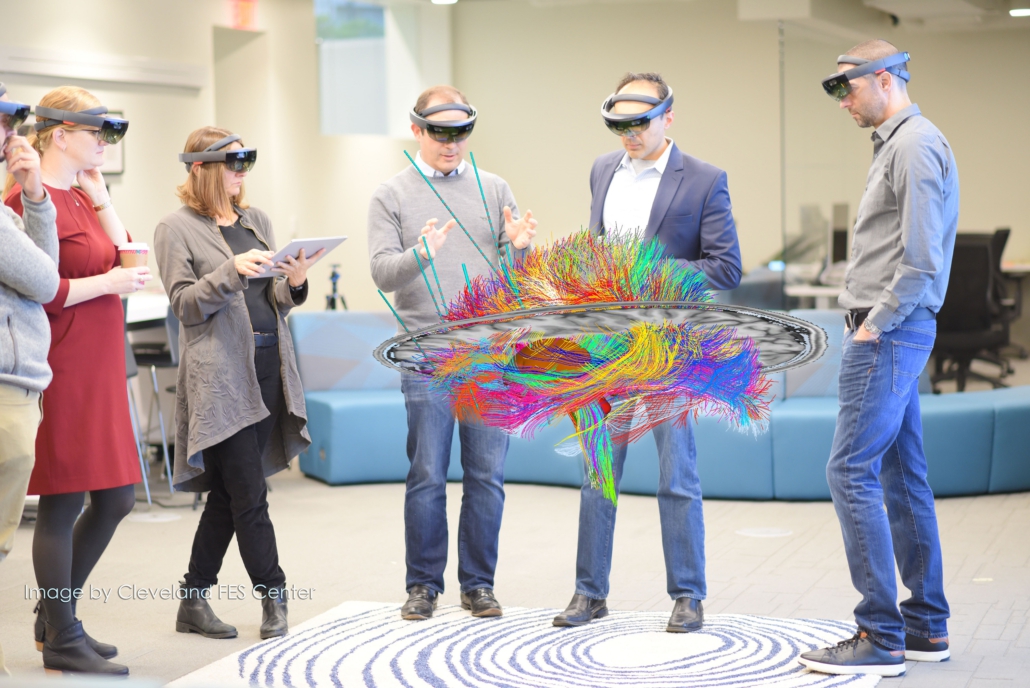
A picture from the first HoloSEEG planning session with Sameer Sheth and Nader Pouratian
Papers by Cameron McIntyre’s group that we touched upon during the episode include:
- Holographic Pathway Atlas: Petersen, M.V., Mlakar, J., Haber, S.N., Parent, M., Smith, Y., Strick, P.L., Griswold, M.A., McIntyre, C.C., 2019. Holographic Reconstruction of Axonal Pathways in the Human Brain. Neuron 1–13.
Colleagues mentioned in the episode include:
- Svetlana Miocinovic (Neurologist at Emory University)
- Christopher Butson (Engineer in Salt Lake City)
- Jerrold Vitek (Neurologist in Minnesota)
- Sameer Sheth (Neurosurgeon at Baylor University)
- Nader Pouratian (Neurosurgeon at UCLA)
- Andres Lozano (Neurosurgeon in Toronto)
- Mark Griswold (MR physicist at Case Western University)
- Mikkel Petersen (Neuroscientist at Aarhus / former student of Cameron)
- Suzanne Haber (Neuroanatomist in Rochester)
- Peter Strick (Neuroanatomist in Pittsburgh)
- Martin Parent (Neuroanatomist at Quebec)
- Yoland Smith (Neuropharmacologist & Neuroanatomist at Emory University)
- Jens Volkmann (Neurologist in Würzburg)
- Noam Harel (Neuroscientist in Minnesota)
- Guillermo Sapiro (Electrical Engineer at Duke University)
- Angela Noecker (Neuroscientist at Case Western University)
- Anneke Gilbert (Neuroscientist at Case Western University)