#11: Katrin Amunts – A modern take on human brain anatomy and its relevance to DBS
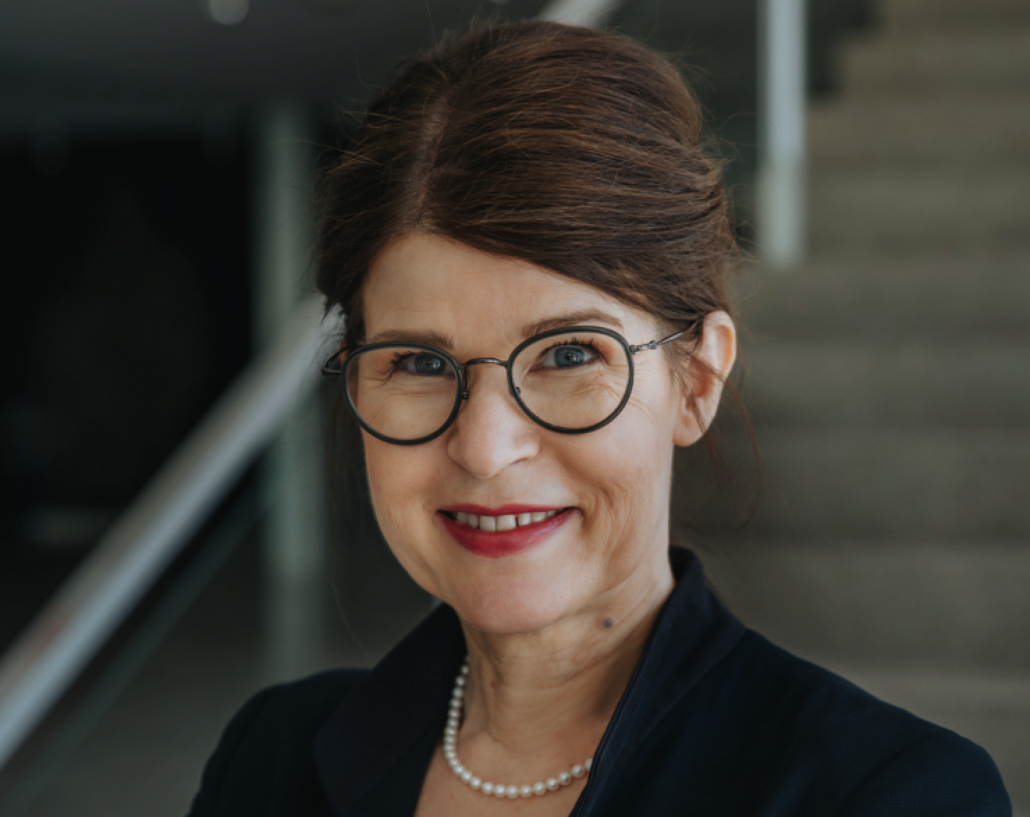
Katrin Amunts is the Scientific Research Director of the Human Brain Project and leads two centers at Forschungszentrum Jülich and the University Hospital Düsseldorf. With her internationally recognized work that includes the BigBrain and JuBrain projects and use of novel methodology such as polarized light imaging, she follows the footsteps of famous anatomists of the past, such as Cecile and Oskar Vogt, name givers of her institute.
We talk about the relevance of anatomical models and ultra-high-definition atlases for successful deep brain stimulation procedures, the impact of open data sharing and upcoming advances in the field of whole brain anatomy.
Katrin Amunts 00:00In particular, our atlas work and deep brain stimulation, they can really tightly benefit from each other because we as anatomists, we learn much more about the function of these brain regions. And for the neurosurgeons, it would be perhaps really important to have also other atlases available when we think about Schaltenbrand and Wahren, which is still a very important reference. I mean, it's quite a long time ago that this atlas was built. And we need digital atlases, three-dimensional, also covering intersubject variability, also capturing individual features of the patient brains. Somehow these things should be brought together. And this is one of my major goals, I would say, or even a vision of bringing this atlas to clinical applications. Welcome to Stimulating Brains.
Andreas Horn 01:16Hello everybody and welcome back to Stimulating Brains. Today it's my great honor to introduce Professor Katrin Amunts from Jülich, who is amongst the most important, important researchers in neuroscience today. She is the director of the Institute's Structural and Functional Organization of the Brain at the Forschungszentrum Jülich in Germany. She's also the director of the Cecile and Oskar Vogt Institute of Brain Research at the University Clinic in Düsseldorf. And she's also the scientific director of the Human Brain Project, which is a flagship project of the European Union. Katrin Amunts' work includes the BigBrain Project, advances in polarized light imaging, cytoarchitectonic maps, receptor maps, and in general, I would say, 02:01the large-scale mapping of the human brain from macro to meso to micro scales. For instance, upcoming work will include a whole brain atlas of the human brain that has a resolution of one micrometer. So with this atlas, it will really be possible to map single cells, but also see their shape, and that really on a whole brain scale. Professor Amunts and I talked about the importance of the brain, and we talked about the interplay between anatomy and neurosurgery, especially functional neurosurgery as deep brain stimulation. We conclude that it remains important to use anatomical resources, such as, for instance, the big brain atlases and polarized light imaging data, to inform on an atlas level surgical decisions. But of course, we also discuss how these could be adjusted and adapted to the patient brain, so that they could really enhance the information we have from the individual patient, for example, by means of MRI and diffusion MRI and these sorts. 03:04So thank you for tuning in, and I'm pretty sure you will enjoy the discussion I had with Professor Katrin Amunts from Jülich. So, dear Professor Amunts, I will have formally introduced you by now. And to break the ice, and so that listeners can learn a bit more about yourself, what do you do in case you are not involved in science? So what do you do in your free time? That's not an easy question, because I'm the director of the Vogt Institute in Düsseldorf for brain research and the director of the Institute of Neuroscience and Medicine in Jülich. No free time? As well as the director of the Human Brain Project, the scientific director.
Katrin Amunts So indeed, there is not so much free time. But in my free time, I like to work in my garden, to shape it, to see it growing, blooming. 04:03I like music very much, do a little bit of jogging, also reading a little bit, cooking.
Andreas Horn So yeah, that's great.
Katrin Amunts Super.
Andreas Horn Yeah, you already mentioned it.
Katrin Amunts You are the director of both the Cecile and Oskar Vogt Institute of Brain Research at University Düsseldorf and the Institute of Neuroscience and Medicine at the Research Center in Jülich. And since 2016, I believe you are the scientific research director of the Human Brain Project. Your work entails large scale projects such as the BigBrain and JuBrain projects, which were both published in Science.
Andreas Horn So if you had to summarize your mission, goal or main interest in a few sentences, what would it be?
Katrin Amunts Well, my major wish is to develop a Human Brain Atlas, completely new kind of Atlas, perhaps more similar to a kind of 05:01Google Brain, zoom in, zooming out, having lots of data. Because I think this is necessary in order to get a deeper and more comprehensive understanding of the human brain.
Andreas Horn So for me, this is a tool.
Katrin Amunts And why do I think that we need a new Atlas? Well, because the human brain is so complex and it is organized on so many different spatial and temporal scales. So I think that the human brain is so complex and it is organized on so many different spatial and temporal scales, starting from the molecules, from the receptors and neurotransmitters to cells, to cellular networks, to large scale cognitive system, large networks.
Andreas Horn And all this is important in order to understand how the brain contributes to cognition, to behavior, but also what role does it have in brain diseases?
Katrin Amunts So I really think for the human brain, we need such a comprehensive approach and the human brain Atlas could provide a reference to link all these different types of data.
Andreas Horn 06:00So your work follows the footsteps of exactly people that have tried similar things back in
Katrin Amunts the time, for example, Cecile and Oskar Vogt and their students such as Corbinian Brodmann or Rolf Hassler, who's important in the brain stimulation field historically. So you are indeed pursuing large scale anatomy research, and I've discussed in episode number
Andreas Horn one of this podcast with you.
Katrin Amunts Thank you. And I've also discussed with Christian Moll, but also in episode three with Marwan Hariz, that we need a tight interface with anatomists to improve functional neurosurgery and deep brain stimulation. I have the impression that, you know, for a while, the field of anatomy had been on a decline. Maybe let's say in the eighties, nineties, and now is back on the rising side with the advent of digitalization and three-dimensional datasets.
Andreas Horn Is that fair to say? And do you have thoughts on that?
Katrin Amunts Well, I wouldn't say that it was on the decline, but rather the anatomy moved to other fields, 07:03very much to cellular and molecular mechanisms. And the gross anatomy that was classically teached was not so popular at a certain time. However, also due to the development in neuroimaging and also the requirements in neurosurgery, I mean, we see now that it's not just the development of the neuroimaging, but also the development of the anatomy. And so, I think that anatomy comes back and there is a new quality, I would say, of precision from digital high resolution anatomical data. And this is becoming now real and it will for sure make its way into the clinics because at the end, it is very important to be precise and not only have a rough estimate. And this is not only true for each single patient where you want to be very precise, but it's also important for understanding the brain mechanisms and functions in general. So this digitalization and hand-in-hand development of high-resolution brain atlases 08:04and of new optical methods, so that created quite some synergy and it may give the impression that now anatomy is back. Great. I like that.
Andreas Horn Do you think MRI led to anatomy decline for a while or did that have the advent of MRI?
Katrin Amunts Well, some colleagues, I think, have said that the anatomy decline is a huge part of the brain development. Well, some colleagues have said that the anatomy decline is a huge part of the brain development. Well, some colleagues have said that the anatomy decline is a huge part of the brain development. Colleagues may have assumed that it's good enough to know functional activation and see it. And it's enough to know the gross anatomy and to know which gyrus or which sulcus is it where you see this activation. It's more important to see the function. But then, of course, it becomes very clear in my view that that's the structure and function. These are two sides of the same coin. And only when you can bring both together, then you can come to these new insights. And when we see how functional imaging is developing, then it goes into the direction of ultra high field imaging with very high fields of 7 Tesla or 9.4 Tesla.
Andreas Horn 09:12And indeed, these scanners allow to go to scales. Where you can see even single cortical layers. And at least at this point, it is quite helpful to know precisely where you are, which cortical layers, what is the connection and so on and so forth. So also from that development, it is clear that anatomy brings in quite valuable information. Do you think it could be possible to draw back your scientific ancestral tree to, let's say, Karl Wernicke? Or if not?
Katrin Amunts Likely not.
Andreas Horn Who were your mentors and who really stuck out? Well, Karl Wernicke is so interesting for me because he developed the first model of language processing, which was not only interesting as basic scientific concept, but had very clinical, practical applications for patients with Wernicke aphasia.
Katrin Amunts 10:10And Broca, in my view, is equally important. Perhaps from an epistemic perspective. From a logical point of view, I would say that the Vogts are quite influential for me. They built in the 20s a modern brains research institute in Berlin-Buch, where they had under one roof anatomy, physiology, histology, also documentation, speech and even genetics. And this at the beginning of the century before the DNA was decoded. So they had a quite broad. Approach to understand brain diseases and understand the brain.
Andreas Horn And in my view, this concept is still true. And a little bit this concept of their institute at Berlin-Buch is reflected in our approach now in Jülich, but also in Düsseldorf in the Brain Research Institute. 11:09Did they actually move to Düsseldorf at some point or is your institute just named after them?
Katrin Amunts Well, it's a follower of this institute. But the history was more. More difficult because. Vogt went to retirement by the beginning of the 30s. By age, but also because Hitler simply dismissed him. And I mean, he just wanted to not to have him anymore. He was politically not.
Andreas Horn Yeah, desired. Should I say it?
Katrin Amunts And that was the reason that Vogt and his wife and also some staff They moved to the Black Forest, to Titisee. And in the Black Forest they built an institute there also with the help of donations from Krupp and also Rockefeller Foundation was involved. And the whole institute, almost all specimens went to this Black Forest. 12:05And perhaps this was really a good move when we think about the later times, which were so difficult in many respects. And Cecile was a French. So, of course, when the. When war started, it was much safer for them to be a bit far away from Berlin. And the Berlin Institute was then led by Hugo Spatz, who was more on the alliance with the Nazis, of course. And then this institute at Titisee-Neustadt, they moved then to Düsseldorf. So it's really this institute. And and the follower was Adolf Hopf. Who still had. Met Cecile at least. And so that's really the Vogt Institute in that respect, which which I'm leading now. And the specimen of them are still there or some of them are still there. 13:01Well, we have about, I would say, 200, 300 thousand specimens of the Vogt collection. I mean, they moved several times from Berlin to Titisee, from Titisee to Düsseldorf, from one room in Düsseldorf to a second room in Düsseldorf. So there is, of course, a little loss. Of course. Of sections. But what we are trying now is to have a better overview of what is there, to digitize the collection and also to make it available to a broader science community. It's very valuable collection, in my view, with so many slides. And it's one of the most important collections in my as far as I can see. Also in Frankfurt, of course, with some of the specimens in Frankfurt. Some of them are also in Munich. So there is not only one place where you can find collections by Vogt. But I would say the Vogt Institute in Düsseldorf hosts a major part of this collection. 14:02That's really amazing. Also that you want to make some of that available. That's really cool.
Andreas Horn So you made a phenomenal career in neuroscience. As we said in the beginning, what were crucial turning points or important advice that you could pass on to others? that are now starting in the field?
Katrin Amunts For me, it was a big, so to say, luck, how should I say, or also a success that I worked at the intersection of different disciplines, that is neuroscience, medicine, but also image analysis, data science and now digitalization, and I feel that such an interdisciplinary approach is very often the right approach because there's a lot of dynamics and there is a lot of possibilities to develop. So when digitalization really became powerful and computers became fast, we were able to solve the problem of how to reconstruct the BigBrain. 15:03This was not possible before, and a few years earlier when we were able to quantify the way how we define borders between brain areas, this was also a breakthrough because it enabled a different quality and we were able to make mapping reproducible and less and less dependent on the observer. So this interdisciplinary area is quite important in my view and will be important. Great, any specific advice for women or young female researchers in the field um [pause] Well, maybe just an observation. So I see many very powerful measures to support young women in their career now. There are lots of funds, also stipends, also special professorships,
Andreas Horn which is extremely important to help them to develop, also kindergartens of course, yeah,
Katrin Amunts 16:06all the possibilities to take care of the family. mobile working. These are very important steps. So it's not, this is important, it's a real improvement, I would say, but when women achieve later stages, the competition is of course extremely high and very often there are not so many tools and measures, and then, so to say, it's extremely important that people or that women are assertive outspoken and that they are able to be confident in what they are doing, also ready to contribute large parts of their life to this work. And here we also see changes, but perhaps they come a little bit later than we see the benefits coming out from the measures for younger women that are already in place. That makes sense. Yeah. Good point. So we've spoken about open science a 17:11little bit already. How crucial do you think, because I think your institute has a long history of pursuing that concept, even before it became more popular, I would say, how crucial was the release of the anatomy toolbox that was spearheaded by Simon Eickhoff to make impact, making these cytoarchitectonic maps available to the bigger field of, I think, fMRI, especially
Andreas Horn with SPM? Yes, sure, this was. I mean, we published our maps from the very beginning
Katrin Amunts with the intention that please take it, use it for your fields. But there's a difference in using one particular map, let's say for the Broca region, as compared to having something like more complete Atlas. And Simon Eickhoff's approach of embedding all the different areas into a toolbox that can 18:03be used to be compared with functional imaging data was extremely important, also to provide tools that allow to quantify this relationship and say, well, for example, this focus is with 80% probability in area A, but with 20% it is in B. And such conclusions are of course extremely valuable and important and help to overcome the old traditional view. You have a map like Brodmann's map and then you say, well, this is area 44. It's not so easy and you have different choices and such tools help to quantify it. And along these lines, we are now developing in the Human Brain Project an atlas that includes this type of analysis, but also other analysis. So this was really a pioneering work that made our work more accessible and available to other users. 19:00Great. And I think we'll come to that in a second.
Andreas Horn But going back to the field of anatomy, do you have a favorite brain region?
Katrin Amunts I mean, I started for Broca's area because I had really a deep and large interest in language and still I have it.
Andreas Horn But then going more and more into mapping, I found out that, wow, it's so interesting and important to understand the parcellation of the brain into area.
Katrin Amunts As a whole, and not only to understand the cerebral cortex and its different areas, but also to understand the relationship to all the subcortical nuclei. So from perhaps I started as a Broca lover, but now I'm in favor of really having the whole brain and mind and understanding the interplay between the different brain regions better. Makes a lot of sense. And I think that's exactly what your 20:00BigBrain work looks from the outside. So you have been creating whole brain resources that in my view have really moved the whole field forward. Together with Karl Zilles, you have published seminal work on also concepts such as neurotransmitter maps, polarized light imaging, then the high resolution whole brain atlas, the BigBrain we've mentioned two times already.
Andreas Horn Where does it all flow into?
Katrin Amunts And I think you hinted at that already.
Andreas Horn Is there a. A grander atlas planned, as you mentioned, is that the recently published JuBrain platform? Is that a first step into that direction?
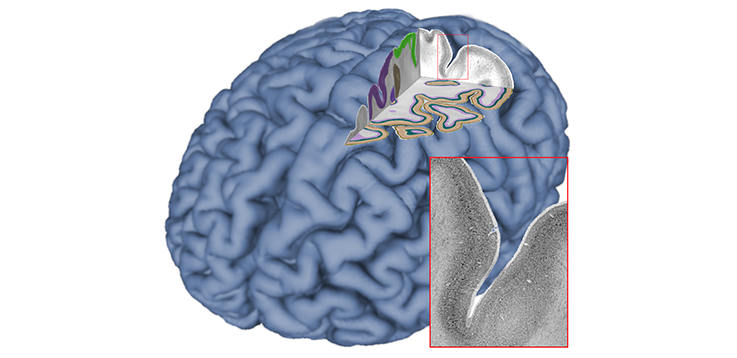
Katrin Amunts Well, the JuBrain is. So to see the basis or the reference data to which other data can be linked or other aspects of brain organization. And I've worked for a long time with Karl Zilles, and this was a very productive and successful time and shaped, of course, my scientific thinking In a significant way. 21:00And Carl's idea was, was also that you cannot understand brain organization if you rely only on, on one single modality. So he developed at that time receptor autoradiography to understand the distribution of receptors for neurotransmitters, which are so important for signal transduction. And then also he gave, so to say, the initial push for developing polarized light imaging. Because he found. That. That. That was a very good idea. And then he found a very old paper from Goldman, by the way, you used polarized light microscopy. In order to, to image the axons. And more precisely, the myelin sheaths surrounding the axons using birefringence properties. And he, so to say, he worked on the cellular level plus on the functional magnetic resonance imaging. So he was really very broadly, very broad set up. And what I then did when, when I started to, to develop. 22:04the cytoarchitectonic brain atlas as an atlas, As a community resource, covering the whole brain. that was that we tried to relate all the different data modalities to this atlas and to see how a certain axonal structure related to the cellular distribution. Or how is the concentration of a certain receptor type. And how is the concentration of a certain receptor type. Related to a certain brain area. And what is functional significance of, of this relationship in terms of our cognitive function or behavior. And, and the Atlas very nicely allowed to, to do this. Correlation and co-localization analysis. But there are of course many methods that we have to develop. These methods have been developed in the past only for specific single research questions. But when you want to do it at large scale. Then it becomes very quickly clear that there's a huge amount of methodical work. 23:07Neuroinformatics work programming work that is needed in order to bring all these data together. But, but this is what we have in mind. We have in mind to develop a multi-modal brain Atlas that reflects the different types of brain organization also across a different scale. From the single cell scale, I would say to the molecular scale to large networks. And then when you can superimpose them and compare them, then you can better understand what is the relationship. For example, of, of anatomy and, and a certain brain activity or certain behavior. So, so that was from the very beginning, our vision, I would say. And with the human brain Atlas and the human brain project. We are now much closer. To the same. Amazing. I love that. 24:00So I remember attending a talk by Karl Zilles in 2017 at the Würzburg deep brain stimulation meeting that was organized by Professor Jens Volkmann. And he mentioned, so Zilles mentioned that he was looking at high resolution slides from the human polarized light imaging data. He said nearly each day. And he, he nearly each day finds novel structures or found novel structures. That were not even described. In the excellent atlas by Jules Dejerine from 1895. He mentioned that a goal was again to create a whole brain Atlas from polarized light imaging data. And unfortunately his untimely death prevented Professor Zilles from achieving this goal himself. So it seems like this is now one of your missions to continue that. And it was probably a joint mission already in the beginning. The first question and second question. You know, for, for, for layman people, it might be very surprising that there are new structures that we can see that are not well described even in these old atlases.
Andreas Horn 25:06But is that something you, you agree on?
Katrin Amunts Yes, certainly. I agree. And in the human brain, we have really a major problem of understanding the tiny fibers of, of brain organization of axons. So to give you an example, it is estimated that every brain has about two. Or three million kilometers of cables. That's almost difficult to, to believe and to understand. But, but this seems to be the case. So it's a huge network of, of incredible complexity that axons and dendrites, that is the branches of the neurons are building. And, and to map it, it's extremely difficult in the human brain, much more than in the brain of the mouse for example. And not only because the mouse is so much smaller. But also because it is of course much less complex when we think about the folding pattern. 26:05Mouse brains are less variables. Human brains are extremely variable, which plays a large role for the clinics. And, and last but not least, many methods that can be applied in mouse brain, in mouse brain, are not the same. And mouse brains cannot be applied in human brain. So what we know from, for human brain connectivity is very often an interpolation from mouse or macaque brains. Which is not always helpful when you think about language, for example. And, or it is inferred from neuroimaging studies, for example, diffusion imaging studies. Which can map living human subjects. But there is a spatial resolution that does not go down to single axons. It does not go down to single axons. So we have a gap. And this gap was filled by polarized light imaging. Which is a method that we are developing now for many years in my institute. 27:03And Professor Markus Axer is a group leader in the Jülich Institute. And he is continuing to develop the methods. And we are indeed aiming to publish a first whole brain atlas of the connectivity based on polarized light imaging. In the next few years. Amazing. I think our whole field is really looking forward to that. And since Professor Zilles' talk that I mentioned, I have dived myself into older anatomical atlases. For example, the one from Dejerine. But also, you know, from Otto Marburg, Cornelis Winkler, Ludwig Edinger, Gerbrandus Jelgersma. And most of them were, seem to be, have been around 1900. And sometimes I think they are still there. The best descriptions of human anatomy we still have. And they are really hand drawn by the scientists that were also artists at the time. In my view, only a few examples of more modern work seem comparable in quality. 28:05For example, I really like the Nieuwenhuys handbook. But recently Markus Axer and others from your center published ultra high resolution polarized light imaging slices from the vervet monkey. That are also openly available in full resolution on the EBRAINS platform. That is from the human brain project, if I'm correct. So already my impression is that these supersede everything we had before. For instance, looking at the striatopaleidofugal bundle of these slices is really eye opening. You know, you really see data compression happening in my view. And I think once you will release similar maps for the whole human brain. Potentially even registered to MNI space or similar. That will really have a drastic impact on human brain mapping.
Andreas Horn What are your thoughts on that? What changes will it, could it bring? And you mentioned one or two years. 29:02Is there an estimate on that?
Katrin Amunts Well, to develop such a high resolution fiber atlas is extremely, again, labor intensive. And it is very data intensive. So if you map. A whole human brain on the level of axons. This ends up is four or five petabytes. And that's a lot of data. Even for Jülich, which has a supercomputing center, of course, with a large storage. But to process these data, to analyze the data and also understand them from an anatomical point. Even for Jülich, which has a supercomputing center, of course, with a large storage. But still, PLI polarized light imaging has a big advantage. That on the one hand. It allows to see even down to single axons. But on the other hand, you can see the whole brain. Or it opens up the possibility to see the whole brain. And this is so important because nerve fibers are sometimes 10 or 20 microns thick. 30:04But they can be 10 centimeters long or 15 centimeters long. And that's a very ill-posed problem. So if you want to follow really these tiny, tiny axons. From the very front of the brain to the last part in the occipital lobe. That's a very long distance. And fibers are doing all kinds of difficult movements on this pathway. So to understand this complexity is really a challenge in terms of neuroscience. But also in terms of 3D reconstructing the pathways that then allow to visualize the connections in the human brain. And PLI, in my view, is the only method at this moment that makes this possible. That is from the single axon to the whole brain as an organ. And this makes it so valuable. 31:01And therefore, we are working hard on it for 10 years now. I would say maybe a little bit longer even. To develop the methods. To develop the equipment to measure it. To develop the programs. Running on high-performance computing. To process all the data. To develop visualization methods. And then to analyze region by region what does it mean from a neuroscientific point of view. And that takes quite a long time. I can imagine. There's also a new method similar to that. It's called scattered light imaging.
Andreas Horn Does that have a future, do you think? Or is that just a sidekick to the PLI?
Katrin Amunts Well, it supplements PLI. So PLI is measuring axonal sheaths by using the birefringence of the myelin sheaths. And scattering is another physical property. And it helps to dissolve ambiguities when the signal that we detect with PLI is not, so to say, clear. 32:08And when we have to decide whether it's one direction or the other direction. And here scattering information can help a lot. And indeed we see different types also of information from the scattering light. So I'm curious to see what happens in the next years. And we are also following this path because we see it's complementary to what we're doing with PLI. So I have focused a bit heavily on polarized light imaging so far. And the reason for that is that in stereotactic neurosurgery, white matter structures are currently really the most focused on. Because we really think with deep brain stimulation, for instance, we activate or modulate axons. So rather than gray matter, really the axons seem to be of importance. And we believe that disrupting information flow by modulating axons is one of the main mechanisms of action of DBS. 33:06I believe your group also explores the possibility to perform tractography on the PLI data sets similar to on diffusion MRI.
Andreas Horn Is that true?
Katrin Amunts Yes, this is true. And of course, PLI data has the advantage of this very high spatial resolution. So some of the problems that we see in diffusion imaging that are related to kissing fibers or crossing fibers can be solved simply because of the higher resolution. But still, I mean, also axons cross each other. And here we have also a problem. So we can also find the right models in order to predict the direction of fibers. But certainly PLI will contribute, hopefully with new and good models more and more to brain surgery, to deep brain stimulation in particular. 34:00Great.
Andreas Horn Moving beyond that, what are the current aims for the Big Brain Project?
Katrin Amunts I think currently there's one brain that's openly available.
Andreas Horn But I heard that you have more planned or more that have been scanned. Is that true?
Katrin Amunts Yes, I would say the development is going into two directions. So first, we want to make available and usable the big brain for a larger community and really take use of this very high resolution information. So for instance, for colleagues that are doing modeling and simulation of dynamics, And there is, with the HIBALL consortium, now a group that is developing all kinds of applications And there is, with the HIBALL consortium, now a group that is developing all kinds of applications and methodical developments based on this single big brain. And the community is quite big. 35:0050 researchers are immediately dealing with it. And there are 200, 300 people that are, so to say, following what we're doing. So that's one line of direction. And the other line is, of course, to go to even higher resolution. And we have now with a big brain a resolution of 20 micrometer, which is very high. But still, it's a little bit too large in order to see every single cell and to appreciate the morphology of each cell. And this is important in terms of the function of cells and their network. So we would like to go to one micrometer. One micrometer spatial resolution. And we are indeed processing now actually a brain to go to this one micron brain. And we have, so to say, we have also a second big brain available now, which is almost finished with respect to the 20 micrometer spatial resolution. So there is, so to say, a sibling to the first big brain will be available very soon. 36:05So this is a one micron big brain. It's a major project. Again, technically very challenging. I would say like a Formula One competition. But we are going this way. Amazing. And that is whole brain as well, the one micron one.
Andreas Horn Yes.
Katrin Amunts And this makes it so difficult. So we are cutting it into 20 micrometer thick sections. And then the idea is to image the sections and also detect the volume of each.
Andreas Horn Yes. Yes.
Katrin Amunts So we have 20 micrometer thin section and two 3D reconstructed at the end.
Andreas Horn Yes.
Katrin Amunts Amazing.
Andreas Horn Would you like to talk a little bit about the Human Brain Project? What were or are the challenges? Which directions are you currently going into as the whole consortium?
Katrin Amunts Well, the Human Brain Project started in 2013 and it will end in 2023. 37:02So we are now starting with the last two years. So we are now starting with the last two years of this project. And neuroscientifically, we are focusing on connectivity. That is to come to a better model of brain connectivity throughout the different spatial scales. And then to understand how this connectivity is related to cognitive behavior and consciousness. And last but not least, to understand what are the rules governing connectivity in the human brain, in these natural networks and translated to artificial neural networks and make use of these networks. And all three research questions are related to each other. They are extremely challenging. And in order to achieve them and also to help neuroscientists, not only in the project, but more important, outside the project, we are developing eBRAINS, which is a research infrastructure.
Andreas Horn 38:01So what does an infrastructure mean?
Katrin Amunts It means that there are platforms for neuroscientists where they can collaborate. For example, use the Atlas or do a certain simulation based on data that others have been obtained in the past, where they can exchange data with each other or use high performance computing in order to run large analysis. And this under one umbrella. Or one roof where we quite complex workflows can be generated that links the different elements to each other. So we would like to have something like a CERN for brain research. But it's not a physical equipment. It's a distributed infrastructure. But the idea is very much the same. Okay, so it's a centralized processing, both data and infrastructure and pipelines. 39:00And it really looks very promising from outside. I have to say that. So let's briefly, before we wrap up, let's talk a bit about the future. How do you think the data sets and techniques that your centers develop and the Human Brain Project develops will be able to improve clinical medicine, but also maybe even more in focus,
Andreas Horn stereotactic surgery or other like translational fields?
Katrin Amunts I think the first step is to design from basic neuroscience, I would say, to clinical translation. And of course, almost everybody tells that this is important. But to do it in practice is quite challenging. And the first is, of course, that one needs reproducible data, high quality data. And this high precision anatomical data, in my view, are extremely important to inform researchers to better understand the data. And I think that's a very important step. 40:00So to say, where they can remove some pieces of, for example, epileptic tissue or where better not to touch. But this is more than just providing information about localization. So together with my colleague Viktor Jirsa from Marseille, from France, we are developing possibilities that the big brain with its different areas and distribution of nerve cells informs models that Victor is developing in order to make individualized brain models for patients undergoing neurosurgery for epilepsy. And in France, the first clinical trial is going on with 400 patients. And the preceding studies have shown that if one applies this model, then the benefit for patients is better. And this is extremely important also in our view. So there's a direct outline already. And in a similar way, I would like to go also now into collaborations with colleagues from neurosurgery, 41:08helping to develop methods that before the surgery is started,
Andreas Horn where we can together understand when you put an electrode to a certain position, what would it mean in terms of activity of this particular piece of tissue of this patient?
Katrin Amunts So that we can simulate things before we go, so to say, to practical surgery. And again, I would hope that this at the end will bring in benefit. But also when you think about post-surgery, some patients benefit quite a lot. Others not so well or even have side effects.
Andreas Horn And the question is why this is the case.
Katrin Amunts And of course, there are many physiological parameters that can be different. And individual. But one parameter is of course also localization. 42:01So we could also post-factum check the localization of the electrode, of the poles of the electrode with respect to the underlying anatomy and see whether there is a relationship and then correct it and use this info for the next time. And in that respect, I think in particular, the atlas work, our atlas work and deep brain stimulation, and the atlas work, our atlas work, and deep brain stimulation, they can really tightly benefit from each other because we as anatomists, we learn much more about the function of these brain regions. And for the neurosurgeons, it would be perhaps really important to have also other atlases available. When we think about Schaltenbrand and Wahren, which is still a very important reference. I mean, it's quite a long time ago that this atlas was built. And we need digital atlases. Three-dimensional, also covering intersubject variability, also capturing individual features of the patient brains. 43:02Somehow these things should be brought together. And this is one of my major goals, I would say, or even a vision of bringing this atlas to clinical applications. That's great. And I couldn't agree more. In fact, that's, I would say, one of the core interests of my own research.
Andreas Horn So why?
Katrin Amunts Because one follow-up question in that regard, if we use atlases, atlas resources in general, in the latter part, so not like the virtual brain type of study, but maybe post-operatively where we would want it as a reference for stereotactic targets, for electrodes and so on.
Andreas Horn One key issue is to make it, to map it to the individual brain, right? So that mapping, and that mapping is, I would say sometimes as important as the atlas itself, right?
Katrin Amunts To make that transition between atlas and patient.
Andreas Horn 44:02Do you think good ways of how this will become possible or like how valuable are atlases above and beyond being just reference systems, but really to morph them into the patient space?
Katrin Amunts I think there are indeed these two lines of analysis. So one is, of course, you have an atlas. And with an atlas, you have all the knowledge of the neuroimaging or neuroscience community available. And you know this is area four, this is a primary motor area, you know about the connections and so on and so forth. And cytoarchitecture is something like the link allowing you to determine where you are in the brain. But equally important is, as you say, to warp or to register such an atlas to an individual brain and to see where a certain brain lesion, for example, some dysplastic cells in an epileptic brain or tumor where precisely it is located in terms of cytoarchitecture. 45:03And you can get an answer to this when this registration is being done. And just this morning, a few days ago, I have seen a very nice example where from our colleagues in Düsseldorf, we have received some MR data set of patient brains with a localization. Some localization information. And we have warped to it our cytoarchitectonic maps, our atlas. And we were also able to visualize it on the surface of the patient brains. And this is what the surgery, what the surgeons are seeing. So they look from outside to the lateral surface very often of the brain. It's very hard to orient yourself in such use. And the atlas is not reflected. Usually the atlases show coronal sections or sagittal or whatsoever. But the surgeon sees it from the outside. 46:01So what we did is we projected the maps to the surface of the patient brain and have, so to say, next to it the view that you see during surgery. So in my view, these things should be combined together. And also we should adapt our atlas tools in such a way that it is suitable for surgeons and that it reflects for the patient. So that's what the surgery is needed. And I would be really happy to move ahead here. But I see the technical tools are there. That's not so difficult. There are different tools for alignment, which are not so bad, I would say. And having now closed this gap will for sure help to better inform surgery
Andreas Horn or see it post-surgery what was happening.
Katrin Amunts Super. Last questions.
Andreas Horn How do you see the future of human brain mapping?
Katrin Amunts So going away from the clinical side, you're also, I think, very important for, for example, the organization for human brain mapping.
Andreas Horn 47:01What do you think is coming there on that side?
Katrin Amunts Well, really integrating different aspects of mapping and understanding what the relationships are and better understanding what do we see in neuroimaging studies. We see parcellations that are not one to one the same as we see at post-mortem. So to understand what is their relationship is extremely important. So in my view, to have such type of analysis will be a continuing topic of research. But the other line is going towards higher resolution. And there are incredible results on a cellular level where people better and better understand the single cell level and particular cell types. And in particular, what gene expression is at the single-cell level. And the question is now how to link this information then back to the whole brain as an organ. 48:01There are 86 billion nerve cells.
Andreas Horn And we know so much about each single cell. But what does it mean for the whole organ?
Katrin Amunts And again, for our behavior and cognition. And in my view, this is probably the most tough challenge to link this incredible knowledge from cryo-electron tomography to the brain. From all these molecular techniques, single cell genomics.
Andreas Horn So how to make this usable again to the whole brain, which has subdivision into areas, which has certain networks, where you have certain hierarchies and certain groups of areas that are working together. What does it have to do with the cellular markers? And how variable are brains with respect to these networks? And how variable are brains with respect to these networks? With respect to these cellular markers? So we know that brains are quite variable in their folding pattern, also in the size of their areas. But how is it related to the cellular scale? 49:04And has it a relationship to how many branches does a cell have or not?
Katrin Amunts And here, I think we are only at the very beginning of understanding what this interplay is. But for clinical neuroscience, I think that has a major importance. When we think about neurodegenerative disorders, these are molecular mechanisms going from cell to cell. So we have to bring these different worlds together. And that's, in my view, one of these big challenges in the future. Great.
Andreas Horn Is there anything we have missed that you would have liked to talk about for this type of audience?
Katrin Amunts Well, I would like perhaps to advertise a bit. I mentioned EBRAINS quite some times. And EBRAINS is a growing infrastructure. And I would like to participate in this development, use it, find out whether it is helpful for your own type of research. And also let us know when you are missing something. 50:02And there's a website. Please visit us. Then the second is, I mean, although I'm a neuroscientist and interested in brain diseases in particular, I think also that we should do everything in order to find solutions in this very special time of corona. And EBRAINS as an infrastructure, and in particular Fenix, which is a supercomputing part, we are offering a lot also for those communities coming from molecular science or cellular biology. And we have just opened a call looking for COVID-related consequences and brain health and brain structure and function. I think that's a good way also to collaborate across again, the disciplines and, and I would like to invite you. Yeah.
Andreas Horn Thank you. So, so thank you so much,
Katrin Amunts Professor Amunts for taking the time to talk with me. 51:01This was a big honor and it was really exciting to, to listen to what you think about past, present, and future in both neuroimaging, but also clinical work.
Andreas Horn Thank you so much. Thank you so much for giving us the opportunity and for inviting us. Very nice.
Click any highlighted text passage to jump the Spotify player to that point. The transcript text is present directly in the page HTML for search engines and accessibility.
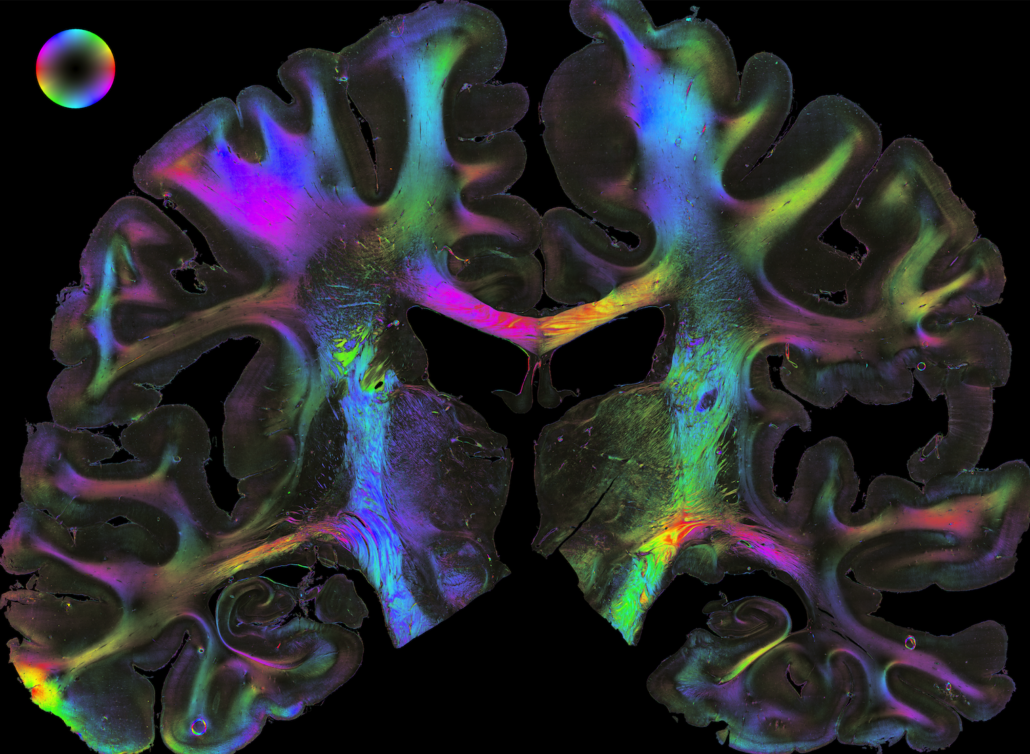
A coronal section of the human brain as visualized by Polarized Light Imaging.