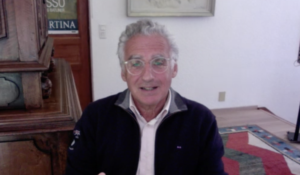
#4: Pierre Pollak – How modern-day Deep Brain Stimulation for movement disorders was introduced in Grenoble
In this episode, Pierre Pollak shares insight about his life in neurology, music and sports and how he introduced modern-day deep brain stimulation for movement disorders together with Alim Louis Benabid and the team in Grenoble in 1987. After his retirement from academia and neurology, Pierre took up playing piano and spending time with physical activity (cycling, winter sports, etc) – and he mentioned that our conversation was the first about deep brain stimulation he had in over five years.
He talks about the first patients that received deep brain stimulation for tremor – the first one using an externalized stimulator approved for animal use only over the course of three weeks. We then advance to the incredible anecdote of how Patricia Limousin switched on the first bilateral STN stimulation to treat a patient suffering from severe akinetic Parkinson’s Disease. For both, it was incredible how the patient could walk – without any help from pharmacological drugs.
Pierre Pollak 00:00Patricia was the first to stimulate bilaterally this patient. So I entered the office and I saw a patient, a normal patient, walking normally. And I said, he's on levodopa. She said, no, no, no, no levodopa. Oh, so you injected apomorphine. She said, no, absolutely no drug. She said, try. So I stopped the stimulators. And within a few seconds, two or three seconds, he returned to severe Parkinsonism, unable to walk, and totally akinetic. I switched back on the stimulators and immediately normal. All my professional life can be abstract with this patient suddenly cured from Parkinsonism. Welcome to Stimulating Brains. Stimulating Brains 01:00Hello and welcome back to Stimulating Brains
Andreas Horn to the fourth episode today with one of the truly big heroes in modern day deep brain stimulation, Pierre Pollak from Geneva. I'm really grateful that Paul Krack introduced me to Pierre and he agreed. to be interviewed in this show. And I think there are quite a few things we could learn from the conversation I had with Pierre. One may be that it's not always just about the ideas, but also about making ideas happen. And the second thing is in an allegory to a quote from Konrad Lorenz, who said, you know, it may be more beneficial to study one animal for a long time. or a thousand hours than to study a thousand animals for one hour. 02:02So I think Pierre made a great contribution by studying patients meticulously and days and nights in Grenoble, the first deep brain stimulation patients and explored the whole parameter space of which stimulation parameters are the best for these patients. And I think that was a big, if not the part of the success of transforming deep brain stimulation from an acute effect in the OR to a chronic treatment option for movement disorders patients. So tune in and lean back. My name is Andreas Horn and our guest today is Pierre Pollak from Geneva. So thank you so much, Pierre, for agreeing to take part in this. And usually to break the ice, I try to ask the first question about the non-physiological, non-scientific part of people's lives. And about your life, I think it's pretty obvious 03:02because both Paul Krack and Günther Deuschl told me you're a fantastic piano player. And I heard after you retired, you have taken piano a bit more seriously, even more than before. So can you tell us a bit about that? But also if you want about your private life or your hobbies or whatever that you did apart from working in our field. When I was a teenager, I had a complete academic formation in piano and in music. I got the first prize of piano and chamber music and all the part harmony, counterpoint. I had to choose when I was 18 between a music career or a medical career.
Pierre Pollak And as you know, I chose the medical career because I had many friends who were far better pianists than myself. And they did not succeed. 04:02Perhaps there are thousands of excellent pianists and musicians. And you know only 50 names. It's very difficult. And most of them are teachers in conservatories. So I have no regret at all. I never abandoned playing piano. It was only one hour on Sunday. So I was not a good pianist during my professional career. I retired by the end of 2015. And I decided to totally stop neuroscience, which was incredible. They told me, you will be unable to stop neuroscience. So I decided and I think I succeeded. 05:01It was very difficult for the first year, but I succeeded. And my first hobby is piano and music. So chamber music with friends. I have friends in the Orchestre de la Suisse Romande, OSR. It's an excellent orchestra from Geneva. And we play chamber music with them. It's a very great pleasure. But as I'm a little lazy, I don't work a lot. So I need challenges. And there are competitions for amateurs. And the first one and the most famous one was created in Paris. And it was a competition for amateurs. And I participated to this competition. Its name is Competition for Outstanding Piano Amateurs. 06:04So I didn't succeed to get to the finals, but only the quarterfinal. Oh, wow. That's amazing. I was in the first 10 out of 100 pianists. But every two years, there will be a new competition. But it's not a real competition. The name is Competition, but it's only for music lovers. It's a non-competition competition. And I will continue because I made great progress. And I think that I resume my teenager level now. Oh, that's great. Great. Great. Do you have a recording that we could... that we could even put on the website
Andreas Horn or, you know, that people to hear you play?
Pierre Pollak Not during the competition, but in my home. Yes, I have recordings. 07:02So that's... You'll have to hear that. That's possible. I will... I have to hear these recordings to know if they are correct or not. I can send you one. That's possible. Great. I have a second passion. It's sports. So now, now from my retirement, I am in far better shape than when I worked. That's great. That sounds like a good decision you made. I made a lot of cycling with all the great Alps passes and like the Tour de France competition and also all winter sports. I have been skiing, alpine skiing, Nordic skiing, skating and hiking also with skis. Amazing. I live in such a beautiful region. 08:00There are all the mountains. Chamonix is only half an hour from my home, very close to Geneva. Nice. So it seems like you made the correct decision to stop science to do such amazing things like sports and music. But was there a particular reason that you said, you know,
Andreas Horn I have enough?
Pierre Pollak When I, during my professional life, I think I worked too much. And I remember every weekend I said, oh, I would be so happy to work my piano and to go cycling. So now I can accomplish all of my passions. And I keep only an intellectual interest. In neuroscience. So I read some basic articles in nature or science, but I totally gave up reading neurology 09:03or even movement disorders.
Andreas Horn Makes sense to me.
Pierre Pollak Totally understandable.
Andreas Horn So, but in your career, which had like amazing moments, who were defining role models and why, or what were, what were the turning points? Who stuck out? Who influenced your thinking when you started?
Pierre Pollak I would quote two neurologists. The first one is Yves Agid. I don't know if you know Agid from Paris, La Salpêtrière. By the end of my neurologic education, I spent six months in Paris and I was, I was intern in France. It's called intern. When you are educated in your specialty with Yves Agid and François Lhermitte. And Yves Agid was really a mentor for me. 10:00He taught me all the basic rule of neuropharmacology. At that time, I was involved in pharmacology. I remember my first study was with Yves Agid on Domperidone to demonstrate that Domperidone could improve, could improve the effect of dopamine agonist because it will stop side effects like nausea. So you can increase, easily increase the dose of dopamine agonist without side effects. The same as Levodopa with peripheral decarboxylase inhibitors because Domperidone doesn't enter the brain barrier. It was my first paper published in the Lancet. Oh, wow. Good start.
Andreas Horn Yeah, amazing.
Pierre Pollak And Yves Agid taught me all the scientific approach of research. Was really my mentor. And he insisted always on the pathophysiology of all symptoms you can see. 11:00If you don't well understand how the brain works, if you don't have a basic study, so even a clinician should be involved in animal studies. In basic research to better understand what he see on patients and to improve and to make research is very important to have a view on basic research and clinical application. So Yves Agid. And my second mentor was my Grenoble neurology head, was Jean Perret.
Andreas Horn Okay.
Pierre Pollak And, Jean Perret was very important for me for not only because he taught me general neurology, but mostly how to behave with patients. And this is very important. The way you approach a symptom and you understand the symptom 12:02and the way you explain to the patient what you understand and what you want to do and to share with himself the treatment you propose. And also he taught me how to manage a department. He was head of the neurology, the Grenoble neurology department. He has been head for perhaps 20 years. And I was his successor in Grenoble, was head of the neurology department in Grenoble and after in Geneva. And I think that what Jean Perret taught me was very important for my complete career. And you know, when you are a physician, you added many other, other duties. First, you are a clinician. And after, if you have an academic career, you make research and teaching. And after, it's administration. It's very important. When you will be older than 50, you will see.
Andreas Horn Okay.
Pierre Pollak 13:00This is very important because nobody teaches you that. How to manage a group of, in Geneva, I think had 45, 45 neurologists in the department. That's a lot.
Andreas Horn Yeah.
Pierre Pollak And you know, when you have a lot of physician and a lot of people, you have a lot of conflicts. So it's very important to deal with them. In the interview with Paul Krack, you also mentioned that you were among the first, or it was new at your time before you became head, that you could focus only on movement disorders.
Andreas Horn Yes.
Pierre Pollak Right. So that specialization, that enabled you to see a lot of patients, of course. Thanks. Thanks to Perry.
Andreas Horn Okay.
Pierre Pollak Because Perry, even in the seventies or eighties, 1980, he understood that to make good neurology, you should focus on one part of neurology. And he let me develop movement disorders. 14:00And in Grenoble, we create a movement disorder clinic. And it was the first movement disorder clinic in France. Okay. Yeah. Before Paris. Oh, wow. And we had some beds dedicated only to movement disorders and a group of physician, nurses, psychologists, physiologists dedicated to movement disorders. That's great. And it was very important for the quality of the neurology we delivered to patients.
Andreas Horn Makes sense.
Pierre Pollak That is so normal to me. So normal today, but it's good to hear that it developed at some point. So it makes a lot of sense. And maybe now let's dive into the main topic of today a bit. So you were potentially the leading or one leading figure of really introducing the brain simulation to movement disorders and to introduce the modern day DBS, 15:02basically. And Paul Krack told me that you were behind really systematically analyzing all the effects in a meticulous way and studying, spending like days and nights with patients. That's what he said. And of course, together with Alim Louis Benabid, I think you made history with the first deep brain stimulation success stories of our time.
Andreas Horn So how did it emerge? How did the concept emerge?
Pierre Pollak I should pay tribute to Benabid. Very beginning of the, of deep brain stimulation because Benabid was, I think the only neurosurgeon in France in the seventies to perform the classical thalamotomy. Perhaps there was five cases a year about this. It was very rare. After the introduction of levodopa in the seventies, surgery almost disappeared. 16:03But Benabid continued and there was excellent information. There was a great indication in severe tremor, Parkinson's patients or patients with all the type of severe essential tremor, for example, or some patients with a tremor related to multiple sclerosis. Because Benabid is very curious. In one patient was a patient with a MS tremor. You know, before lesioning, before performing the lesion, all neurosurgeons use the stimulation. The aim of this stimulation was to be sure that you do not induce adverse effects, such as paresthesias, motor contraction, which means that you are too close to the pyramidal tract or speech suspensions. Speech arrest was very important in the target for the VIM thalamotomy. 17:02As you know, the tradition was to stimulate using 50 Hz. And Benabid used 100 Hz. Many, many frequencies and 100 Hz. And what he saw in an awake patient, the tremor was totally abolished. So first he thought that it was a motor contraction because the patient was in severe tremor. Stimulation at 50 Hz, severe tremor. At 100 Hz, no tremor. So it was a motor contraction. And we asked the patient to move. Because I was in the OR. It was one specialty in the Grenoble surgery. And I think Benabid was very open-minded with this, to have a medical neurologist in the OR. The tremor stopped without contraction and the patient was able to move. And it was absolutely synchronous with the stimulation, 18:00with perhaps one or two second delay. So this was the very first discovery. And the second one is to transform an acute effect in a chronic effect. So Benabid introduced a connecting lead from the definitive lead. He said to the patient, now you go to the neurology department and Pierre will try to reproduce what we see in the OR. Because it was not a normal operation. Sure.
Andreas Horn Was that with an external stimulator?
Pierre Pollak Yes, it was an external stimulation through a connecting lead in the parietal area. It was a connecting lead. And the first patient was externally stimulated for three weeks. And we were afraid of the risk of infection for the duration of this external stimulation. And we stimulated the patient. So after all the work was done in neurology, so the initial idea and demonstration was done by Benabid. 19:03And after all the determination of the electrical parameters, how it worked was done in neurology, in the neurology department. And we used a stimulator which was not permitted in humans. And this was because Benabid was the head of the research department, the INSERM research department. He made a lot of research. He did a lot of basic studies in rats, in monkeys. And in rats, we used a stimulator. I remember the WPI stimulator. And it was possible to stimulate using all the range of frequencies, from one hertz to 10,000 hertz. All the widths possible. I don't know if I can say this, but on this stimulator, it was written for animal use only. 20:00But it was a stimulator. Sure, sure.
Andreas Horn And in the Lancet 1991 paper that you then published, you could really see that you tested all these frequencies, right?
Pierre Pollak In, I think, four patients at the time, you tested 50 hertz, no effect.
Andreas Horn Then you see like a U-curve, right?
Pierre Pollak And then up to very high frequencies, you still see effects. So that showed that at the time, I think, as I understand it now, these stimulation parameters were,
Andreas Horn not at all standardized, right?
Pierre Pollak This was terra incognita, and you tested all that. So I was involved in this study. I was alone with the patients, with the very first patient. And I spent hours, thanks to patients. Really, there was patients. Patient, patient. For them, they were so spectacular. All these first patients had tremor. Or tremor-dominant Parkinsonism, or mostly essential tremor, and some MS tremor. It was so spectacular for patients 21:01that most agreed, without difficulty, to try to find the best electrical parameters. So I tried to maintain constant some parameters, and to move one, and after, to have a balance between all electrical parameters. And what I saw in the very first patient is that the frequency is crucial. Nothing, nothing before, below 30 or 50 Hz. Nothing. The benefit began at 50 Hz, and plateaued at 100 or 100. And for tremor, some patients had an increased benefit from 100 to 200. Generally, it was 100, the plateau. And after I studied the pulse width, and it was clear that the narrower the pulse width, the better. 22:00And the voltage, it was only the anatomical diffusion of the current. So the benefit to risk ratio, benefit to adverse effects ratio, was according to the anatomical location of the electrode. So it was possible increasing electrical intensity or voltage.
Andreas Horn To know exactly where was the electrode,
Pierre Pollak according to the sensitive path, to the motor part of the pyramidal tract, and other tracts involved in some symptoms in the thalamic region. So I work with the trials and errors with patients. And I think that this is now, this has not been done for other indications. Sure. It was done after for STN, but it wasn't for VIM after STN and that's all. Now there are more than 20 indications. 23:01Not all validated. I think that it's a crucial point. So I totally, I couldn't agree more. And one thing I think that is missing in this story is that most stimulators, especially in the US, were not allowed to go above 50 Hertz because apparently there had been some epileptic seizures in surgeries. So that is maybe why, or could be that this was not discovered earlier. Because as you say, everything below 50 Hertz. It was, it has been discovered by other neurophysiologists. I remember a paper by Denise Albe-Fessard, who was a neurophysiologist in Hôpital Foch in the Paris region. And the neurosurgeon was Gerard Guiot. He made a lot of thalamotomy. And she tried, she had, she was also involved in basic research. So she used the same type of stimulators with all available frequencies. And she wrote the beautiful paper that 24:03if you use 200 Hertz, you stop tremor in patients. Many years before Benabid.
Andreas Horn Okay.
Pierre Pollak So the idea of Benabid, the second idea, because the first idea had already been discovered by other neurophysiologists. So I think that his main idea was to transform an acute effect discovered only in the OR and those, and not the idea that it could be therapeutic because there was physiologists, there was not clinician. And Benabid had the idea to possibly, if the effect was permanent for weeks with the external stimulation, it would be possible to implant stimulators because before movement disorders, subspecialty, Benabid was not. Benabid was involved in pain and he operated many patients with pain surgery with implanted stimulators. So he knew that it was possible to have chronic stimulation. So in this very first patient, 25:01as in neurology, we demonstrated that the acute effect seen in the OR was maintained over two weeks, two or three weeks. We decided with the approval of the patients, of course, there was no ethical committee at that time. But of course, everything was done with the approval of well-informed patients. And we decided to implant the stimulator
Andreas Horn and the first stimulator was exactly the same
Pierre Pollak that was used in pain surgery. Amazing.
Andreas Horn And that was pain for spinal cord stimulation or?
Pierre Pollak For spinal cord, but also in the thalamus, but more posteriorly.
Andreas Horn Makes sense. Yeah. Wow. That's why the utmost frequency
Pierre Pollak available in this ITREL 1 stimulator was 130 Hz.
Andreas Horn And that's stuck, right? That's what I heard.
Pierre Pollak Yeah. So if it was a 100 Hz, the classical parameters would have been 100. 26:00It would be 150. It would be 150 Hz. So upper limit was 130 Hz. Amazing. And it's still used today. So that is... The narrowest pulse width was 60 microseconds.
Andreas Horn So that's why the parameters...
Pierre Pollak Because of the pain stimulator first used in the patients.
Andreas Horn Which stimulator was that?
Pierre Pollak ITREL 1.
Andreas Horn By Medtronic, right?
Pierre Pollak Yes, it was Medtronic. And that brings me to a related question. You know, I think in our field, technology has always shaped what we can do
Andreas Horn and what is possible and what also has shaped what concepts can be tested.
Pierre Pollak So I think this anecdote is the best example for that,
Andreas Horn or one of the best examples. Do you see other things where technology shaped the way we did deep brain stimulations in your time or even now?
Pierre Pollak The precision of the targeting. 27:02It's crucial. True. I was very confident because I think that Benabid is really an excellent neurosurgeon. He controlled everything. And we knew with less than one millimeter precision the 3D where the electrode was.
Andreas Horn That's why what we saw in the OR was reproduced after because the permanent electrode was introduced exactly in the same place.
Pierre Pollak Because he used ventriculography at that time with a superimposition and it was such a precision. Amazing. I was sure when the patients entered the neurology department, I was sure that it was possible to reproduce
Andreas Horn exactly what we saw in the OR.
Pierre Pollak So the way I picture it is somehow you sitting with the patient 28:02testing with the externalized amplifier and you already know this is possible. We can stop tremor with the push of a button.
Andreas Horn How was the feeling then?
Pierre Pollak Because that was real new.
Andreas Horn So how did it feel like?
Pierre Pollak I have not a memory of a great discovery but only of a small improvement that it was possible to replace a permanent lesion by permanent stimulation with the advantage of adjustments so we can control the adverse effects. There was adverse effects. You know, I tested all the electrical parameters so when increased voltage of course created adverse effects
Andreas Horn and what was very important also
Pierre Pollak is to have in our brain the anatomy of the region. 29:00Besides anatomy to understand what occurred in patients and to know what we can expect as side effects. Not only paresthesias, of course, it was my first test. I had a lot of problems with the and what we expected is to have first tremor arrest and after when we increase voltage the appearance of adverse effects.
Andreas Horn It was exactly according to the precision of the targeting. If the target is exactly in the 10
Pierre Pollak so you will first have tremor suppression without side effects. But if we increase, of course, there is a volume.
Andreas Horn That's why I made a parallel between voltage
Pierre Pollak 30:03and anatomical spreading of current. Then after VIM DBS you started or you moved on to a subthalamic nucleus DBS and I think that may have started because of Hagai Bergman's paper that before as far as I understood it people were afraid of the subthalamic nucleus because of hemiballism. And then in the MPTP monkey it was shown that stimulation of the STN can be helpful for Parkinson's. And then you again like the Grenoble team as far as I know were also the first to test this. And I heard that Patricia Limousin might have been the person to start the test. And I would love to talk with her as well later in the show.
Andreas Horn But can you maybe share some memories of that time?
Pierre Pollak Paul Krack said she came into the room and said the patient can walk again. And that of course and then first nobody believed it. But apparently bilateral STN was another breakthrough done in Grenoble. 31:01Yes, it was really the breakthrough. I remember I was in the hospital and I was in the hospital and I was in the hospital. I remember very well I can tell you the story. I was in an outpatient clinic in my office and suddenly Patricia burst into my office. I was not accustomed with this behavior because she's personality is a little bit shy. And she didn't say hello to the patients. And Pierre, Pierre, Pierre, Pierre come. I thought that as the head of the that there was somebody dead and there was a emergency something. And I was in the other office and there was the first patient bilaterally stimulated in the STN. And this patient was patient number three. 32:03We had to order to to treat these first patients to be operated unilaterally unilaterally because we expected that unilateral STN could be sufficient to improve Parkinsonism, but this was not true because our very first patients had severe akinesia and rigidity, very severe. And I remember this first bilateral patient told me, oh, after the first unilateral STN stimulation, oh, it's good, your operation. Before, I was tetraplegic. Now, I'm hemiplegic. So in these severe patients, we decided to bilaterally operate. Patricia was the first to stimulate bilaterally these patients. So I entered the office and I saw a patient, 33:03a normal patient, walking normally. Oh, I said, he's on levodopa. She said, no, no, no, no levodopa. Oh, so you injected apomorphine. She said, no, absolutely no drug. She said, try. So I stopped the stimulators and within a few seconds, two, three seconds, he returned to severe Parkinsonism, unable to walk and totally akinetic. I switched back on the stimulators and immediately normal. All my professional life can be... It was very abstract with this patient suddenly cured from Parkinsonism. That must have felt amazing. And I hear that these very first patients, they were followed for a very long time and all the stories are there. And one could even write a book about the single cases somehow, because at the time, Paul Krack said every patient was an experiment.
Andreas Horn In STN, we did exactly the same work as for tremor patients. The APM was the first. We
Pierre Pollak 34:06[unclear audio; ASR repetition omitted] to movement disorder patients was perhaps 10 years after the beginning of DBS in movement disorders. The first stimulators were only developed for pain. But that one still had 130
Andreas Horn hertz limit or the ITREL one? ITREL 2 also, 130 and after, for tremor, we asked to increase
Pierre Pollak the possibility and Medtronic developed a stimulator with the upper limit at 185, but 35:05useless in STN generally. But the narrowest pulse was also 60 microseconds and they didn't give up 30. We asked because we demonstrated that 30, 40 was very effective and it was not available in the very first simulator. That's amazing because I think that really was introduced just a few years ago by Boston's scientific and also Medtronic with the flash heart rate. I still remember, but you had shown it back in the 80s. You know, if you study very well the patients, if you know this patient perfectly for years, you know all these symptoms and you reproduce this many times, the reproducibility is very important. So if you work in a scientific manner with reproducibility and you are sure you need only one patient and equal one. To demonstrate that it works. Sure. 36:01A patient is like this, stimulators on, no tremor. You don't need a lot of patients. If he doesn't work in other patients, he has to understand why, the reason, but if you mastered all the condition of the anatomy, the physiology, you can reproduce. I sometimes think of the same way about in other diseases like depression or so. If you have one patient where Helen Mayberg said actually in the same podcast that, you know, if a battery depletion of a depression patient happens and the patient comes into the emergency unit, because you know that that is more or less proof because the patient couldn't know it, it can't be placebo, but the stimulator turned off and you have one patient where it worked.
Andreas Horn So you played a major part in this development, but of course you were a team. So how was the interdisciplinary collaboration? Yeah.
Pierre Pollak 37:25a new idea is incredibly intelligent and creative. But after, all is the ideas for the neurologist. So we have to pick some ideas and to transform these ideas in scientific medical effects. The second quality of Benabid is as a neurosurgeon. He is really an excellent neurosurgeon and all the electrode was perfectly inserted. After the neurosurgeon, I think that the neurophysiologist in the OR also was important, was Benabid, has some competence in neurophysiology 38:03and Abdelhamid Benazzouz was also very important in the OR. And also important because he was responsible for the rat studies. Because before the first human, implanted in STN was many, many rats and monkeys. And Abdelhamid Benazzouz was a neurophysiologist involved in these basic research. Very important to translation to between from animals to humans and to the success to humans. In the neurological team there were many neurologists because after the success of DBS in tremor treatments, had many fellows, and it's from all the world. And I really, I was very lucky with this. And all these fellows were incredible, 39:02good and intelligent neurologists. For tremor, there was Claire-Lise Gervason. She did not made an academic career after. And after Claire-Lise, Patricia Limousin, really the most important collaborator. And now you know she's a professor of neurology at the Queen Square. Paul Krack was a fellow for, he has been for one year. And after he came back to Grenoble. And many, many, Elena Moro from Milano. And there was many from Spain and from really all countries, even from the States. So I had a great chance because all these this demonstration of effects, were time-consuming. And I was alone with tremor patients. In STN patient, we operated the second or the third year, the 50 patients a year. So it was very, very important to have a big database. 40:04And more importantly, neurosurgeons, neurophysiologists in the OR, basic neurophysiologists, neurologists, was important to have a neuropsychologist. Because ethically, afraid to stimulate the brain chronically. So many possible adverse effects. From the very first patients, I asked the neuropsychologist Claire Ardouin to deeply study all the cognitive, the emotional and the behavioral aspect of all patients. She spent also hours with patients to know them before surgery and after surgery. We were afraid that it could be some personality changes. So the psychologist and Claire Ardouin, I think that without Claire Ardouin it would not be such a great success and the mastering 41:00of all the effects of DBS and the correct management of patients. The other parts of the team were a neurophysiologist, it was important especially in STN. The GPi targets and also in STN and severely akinetic patients and all the team of movement disorders, the nurses, we had at that time nurses specialized in Parkinson's disease because as I told you my second mentor, Jean Perret, he let me the opportunity to develop this movement disorder unit. So the team approach was mandatory. And I think that was the key for the success of the team. If we see this in retrospect now from a modern day, I think the common perception is that in Grenoble you started something like modern day deep brain stimulation. But the concept of, of course, brain stimulation is much older 42:02and may even date back to Robert Heath or Jose Delgado in the 50s in the US.
Andreas Horn So were these early pioneers an inspiration to the Grenoble team or did they have a lot of experience with the brain stimulation? Or was it a completely like new rediscovery or what was also, what was crucially different?
Pierre Pollak We have already spoken of this. I mentioned Denise Albe-Fessard. Of course there was many, many papers and some American neurosurgeons stimulated everything in the brain. But all these studies were uncontrolled. There was in the short term. And it was done more in a physiological aim than a therapeutic aim. So the spirit was different.
Andreas Horn So it's exactly what we discussed.
Pierre Pollak The merit of our team was to transform an acute physiological effect 43:04in the OR in a therapeutic effect.
Andreas Horn Makes sense. Yeah.
Pierre Pollak So that became clear to me that, you know, the transformation to make this permanent or this effect permanent, that is, it's not just a matter of time. It's a matter of time.
Andreas Horn So maybe before we wrap up, beyond what we already talked about and the breakthroughs we've already mentioned, would you have a particular story of maybe academic or clinical success or surprise that you would like to share?
Pierre Pollak There was many, but I think that Paul Krack mentioned you this story of a patient and we tried to increase voltage and he began to laugh. And, and to help. So I started to have a lot of ideas. And at that time I understood, oh, in the STN, there are the three compartments, the motor, the associative and the limbic parts. And we can, according to the placement, 44:00the location of the tip of the electrode and the voltage. So according to the volume of stimulated tissue, we can influence each part of this STN. And this was also, this was also reversible. It was incredible. He made it when he was stimulated with a voltage slightly higher
Andreas Horn than what was necessary to improve the akinesia.
Pierre Pollak He began to make jokes and to laugh and to have a lot of ideas and to be very vivid. And it was incredible and reversible, reversible on demand, according to the voltage.
Andreas Horn What do you think the STN would be a depression type?
Pierre Pollak Yes, I'm sure. I'm sure. An excellence. I think so too, personally. It hasn't been explored much, I think.
Andreas Horn We should know exactly where are the electrodes for mood.
Pierre Pollak You know, the, this we see, he works in...
Andreas Horn 45:00Schlepfer?
Pierre Pollak Oh yes, Schlepfer. Yes, he's stimulated in the VTA or something, but... By the STN. I wonder it was not... It's very, very... It's very, very close.
Andreas Horn Yeah, it's true.
Pierre Pollak It's very close. You can't rule out that.
Andreas Horn Yeah, that's true. So, since we talked about successes a lot, would you also be able to share a story where things went wrong or it just didn't work out as planned or you thought, this was a complete waste of my time? Yes.
Pierre Pollak I was afraid of the possibility of loss of benefit because in some tremor patients, it was in the 80s, 88, I knew patients who progressively lost the benefits on tremor. So I increased voltage, new benefits, and after a couple of weeks, tremor occurred. 46:01I increased voltage and I remember in one patient, increased up to eight volts.
Andreas Horn And what occurred?
Pierre Pollak It was the addiction process, the rebound effect when we decreased. And it was not possible in this patient to stop stimulation. So I was afraid that this could be the... This could occur in many patients. And in fact, it occurred in few patients. And I think perhaps because the location of the electrode
Andreas Horn was not exactly where it could be.
Pierre Pollak It's a supposition. I'm not sure of this, of the reason why. And Maua Nahis described patients arriving in the emergency ward with this rebound, extraordinary tremor. And of course, in the STN, it could be the rebound of severe akinesia, 47:01more severe than the basic akinesia. Of course, this did not occur. But I was really frightened by this possibility of loss effect.
Andreas Horn And it's a mystery why this did not occur.
Pierre Pollak Because there is the physiology of the brain and the Cannon process for the vegetative system showed us that the body accustomed to everything, but not the brain to stimulation, is incredibly lucky for this. The logic would be a progressive loss of benefits. And in the VIM, we have that. Of course, as well today, that if you turn it off, you have a rebound effect.
Andreas Horn But I can only imagine. So nowadays, we just know that. And then we know that after two days or so, or a day, it's better. But you didn't know that, right?
Pierre Pollak Because you were the first. So I can only imagine how frightening this could have been. 48:01So don't increase voltage too high. Be modest with the electrical parameters. It's like for drugs. Not use too high. So to wrap up, based on your vast experience,
Andreas Horn how do you perceive the use of neuromodulation? What can we learn from the early days for the future? And what should the young generation of today know or maybe not forget from the earlier days?
Pierre Pollak My concern is that most groups trying to demonstrate that DBS could be effective in other locations in the brain and other indications of the diseases based their studies on the electrical parameters discovered for tremor and akinesia. All this basic research we did is not reproduced now with new targets. 49:01And for example, we thought that the mechanism of high frequency stimulation was to jam the message and to avoid the wrong message. So an inhibitory effect, a global inhibitory effect. Of course, it's stimulation, but globally it mimics inhibition. But not in all targets. In the PPN, low frequency was better than high frequency. 10, 20 hertz, for example. So my concern is to stimulate the brain in the right way. It's to stimulate using a significant electrical message. And this is not for tomorrow. It will be very difficult to mimic the normal brain functioning because the neuronal discharges are so complicated that to mimic 50:00a normal message would be very, very difficult. But I think it could be the future to inject a significant signal. So with a closed loop stimulation in the STN, in the beginning of what I'm saying, it's to understand what is the wrong electrophysiology
Andreas Horn and to stimulate exactly
Pierre Pollak when this wrong electrophysiology occurs. But it's too simple. For the future, it's really the injection of normal neurophysiology because high frequency stimulation is very silly. It's only to avoid the wrong message. Somehow even have to inject information. I don't know. It needs to be meaningful. So it might not even be enough what you're saying to inject physiologically meaningful. 51:02It's not just mimicked signals, but probably the brain even needs something meaningful. So I think there's a long way to go. But yes, I would say one point to add, which is not discussed generally in the paper. It's the D of deep brain stimulation.
Andreas Horn Why deep? Why does it work when it is deep and it doesn't work well when it is cortical or superficial?
Pierre Pollak And this is true because there are many, many targets and new targets and new indications. I think because as we know, as far as we know, on the functioning of the brain networks, all the brain networks are anatomical, like a funnel. So the deeper you are, the greater network you can impact. An effect, even on the smaller, 52:01the more powerful the part. And the stimulation is only expected to influence two, three millimeters, about a small sphere, two or three millimeters in diameter. That's all. And if you influence such a small part, if you want to have an effect on a complete network, you should be deep. And I think that's why the trials on cortical stimulation and now on TMS are not very effective. They have some effect, but not great effects. And if you introduce an electrode in the brain, there is a risk, two or three percent hemorrhage infection. And to justify such a great risk, huge risk in comparison with pharmacology, it's incredible. You should have great effect benefits, 53:01great beneficial effects. That's why I think the anatomy of the brain, pathophysiology, should be the basic reasoning of all neurologists and always based on basic research. Great. Great. So the STNs, to me, sometimes seems to be a myth, [unclear audio; ASR repetition omitted]
Andreas Horn thank you so much once more for participating.
Pierre Pollak 54:02This was a great honor. And I think you really could give us a beautiful insight into the early days and the magic in that time in Grenoble.
Andreas Horn And yeah, I couldn't thank you more.
Pierre Pollak It was my pleasure. And I'm sorry for my poor English and some problem, because I think now it's almost five years. I have not discussed about the brain and DBS. Oh, five years. I would discuss about music, far better than neurology. So sorry to search my words, and I'm sorry for this. I think you were amazingly into it. So maybe you can consider coming back to the field. We would be glad to welcome you. Thank you.
Andreas Horn Thank you so much.
Pierre Pollak [outro music begins, then silence]
Click any highlighted text passage to jump the Spotify player to that point. The transcript text is present directly in the page HTML for search engines and accessibility.
Pierre Pollak plays Chopin Ballade n°1
Colleagues mentioned in the episode include
- Paul Krack
- Günther Deuschl
- Yves Agid
- Alim Louis Benabid
- Jean Perret
- Denise Albe-Fessard
- Gerard Guiot
- Marwan Hariz
- Patricia Limousin
- Claire Ardouin
- Abdelhamid Benazzouz