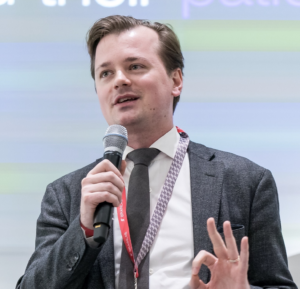
Dr. Várkuti is the founder and CEO of CereGate, a pioneering company developing brain-computer interface technologies.
#64: Balint Varkuti – Making Use of Side-Effects: Redefining Brain Computer Interfaces with Ceregate
Today, we have the pleasure of speaking with Dr. Bálint Várkuti, a distinguished expert in the field of neuromodulation. Dr. Várkuti is the founder and CEO of CereGate, a pioneering company developing brain-computer interface technologies—referred to as computer-brain interface technologies—that aim to enhance neuromodulation therapies.
Before founding CereGate, Dr. Várkuti made significant contributions to image-guided DBS programming solutions at Brainlab. With over a decade of experience in neurotechnology and the medical device industry, his work focuses on designing innovative interfaces between technology and the human brain to improve patient outcomes.
For those familiar with DBS, you’ll understand the nuances here: when stimulation of the super-dynamic nucleus in DBS is set too high, patients often experience a tingling or irritating sensation due to overstimulation of sensory fibers. Typically, this side effect is avoided. However, Dr. Várkuti had a groundbreaking insight: This sensation represented a channel of information with the brain – and one could make use of it!
In a nutshell, CereGate leverages these overlooked pathways, using them in a patterned and complex way to transmit information that the brain can decode. This approach opens up new possibilities for interfacing with the brain, which we find truly fascinating: This concept that CereGate is exploring might just be the start of a much larger field of innovation.
Balint Varkuti 00:00Like, what could I do that really changes something? And can I birth ideas out of my head into reality? And academia had its limits. So I think that was one factor. For example, the brain segmentation, which finds, you know, or segments the basal ganglia in the images, that is part of a product that does the same for cranial surgery or radial surgery. So again, this is basically where this galaxy of modules works together. But I'm super happy about this. I'm smiling every time I see another ad on LinkedIn or I go to a conference and I see people using it. If we could build basically a sensory substitution interface through the recruitment of afferent white metafibers, we could build basically a white meta-CBI. So a system that operates in areas of the body where you don't have usually large blood vessels or, you know, a lot of risk of creating damage, which is... which is different, obviously, if you approach the cortex. 01:00But you could recruit the fibers that you could utilize to encode information and basically you create a wiretap.
Andreas Horn Basically you hack your way into the afferents and send information along. Welcome to Stimulating Brains. Hello, and welcome to another episode of Stimulating Brains. Today, we have the pleasure of speaking with Dr. Balint Varkuti, who is a distinguished figure in the field of neuromodulation. Balint is the founder and CEO of CereGate, a company developing brain-computer interface technologies, which are aimed at enhancing neuromodulation therapies. 02:03Before founding CereGate, he contributed significantly to image-guided deep brain stimulation programming solutions at BrainLab. With over a decade of experience in neurotechnology and the medical device industry, Balint's work focuses on creating innovative interfaces between technology and the human brain to improve patient outcomes. If DBS neurologists listened to this, they would know what I'm talking about. If you switch on the stimulation of subthalamic nucleus DBS too high, you would often get a tingling, nuisance, side effect. It is a sensation that the patient would have because there's too much reaching sensory fibers that would feel irritative to the patient. So normally you would turn away from that and say that is to be avoided. But Balint had the great insight that this is actually a channel of information into the brain. So I think in a nutshell, that's what CereGate stands for. So to essentially use these channels of information to communicate with the brain that most of us have ignored and use them in a patterned way and in a complex way to transmit information that can then be decoded 03:06by the brain. So I find that very fascinating. I think it might even be just the beginning of a much bigger field. And I learned a lot when talking to Balint. I hope you enjoy the conversation as much as I did. And thank you for tuning into Stimulating Brains. Okay, Balint, thank you so much for joining us here on the show and taking some time on your busy day. Thank you for the invitation. Yeah, thanks. Thanks for joining. How are you doing? How are things today? You're in Munich, right? I'm in Munich, exactly. I'm here in the office behind me. On a good day, you can actually see the Alps and the Dolomites from here. It's a great view. It's really nice. Sun is out. So very good day. Fantastic.
Balint Varkuti As you know, I will have likely introduced, I will have introduced you by now. And so we can 04:01start directly with questions. And I often start with an icebreaker. That is what you do in your
Andreas Horn free time. So when you're not immersed in advancing neuromodulation technologies, how do you spend it? Yeah, so there's not that much free time, to be honest. So first of all, with a startup, that's
Balint Varkuti quite time demanding. But I have two small girls who are three and six years old. So I try to spend as much time as I can. And I'm actually with them. And outside of that, to be honest, I have all kinds of like little tinkering creative projects that I do. I do cooking, I do gaming, I work out, I always have something else that I'm working on. So it's really depends. Tomorrow is a reading day at my child's kindergarten. So I made with Generative AI a picture book, where she's the star. So that's, that's the latest. That's the latest project. So it really depends.
Andreas Horn Oh, fantastic. That sounds lovely. Okay, so I'm going into the work life. Could you share the journey that led you to specialize in neuromodulation and BCIs? And were there like any pivotal moments of influence that shaped your career and brought you where you're now? 05:12Yeah, happy to. So I started quite far away, actually. So when after my high school Abitur, I went to Budapest and started to study literature theory and aesthetics.
Balint Varkuti Because I thought I was going to become a famous writer. And then after like, one semester, I realized I'm going to starve to death, and stopped that and came back. And then I started studying psychology in Freiburg. And there I also did a stint. Towards the end, I think we had basically like a practical internship, where I was at the Charité Westend and did some time, I think it was three months in the affective module. So thank you very much.
Andreas Horn And I started doing some therapy, resistant depression, and ECT and psychotherapy. And that's really where I realized, I'm not going to become a therapist. So I saw clearly, psychology was super interesting. It was a great school for methods. So to learn basically about statistical thinking, and what is an experiment, what is a hypothesis, all of that stuff, but like that therapeutic part didn't really resonate with me.
Balint Varkuti 06:21So I started specializing in neurodivergences. And I started doing some therapy, resistant depression, and ECT and psychotherapy. And there I also did some therapy, resistant depression, and ECT and psychotherapy. And that's really where I realized, I'm not going to become a therapist. So to learn basically about statistical thinking, and what is an experiment, what is a hypothesis, all of that stuff, but like that therapeutic part didn't really resonate with me. And it was hilarious, because you could really do everything. So they had an MEG. They had one of the two fetal MEGs in the world. The other was, I think, in Arkansas. 07:01They had everything you could do with the MRI. So we were connected to the Max Planck Institute for cybernetics. They had a high field MRI, we could do neurofeedback, fMRI, BCI. We did a lot of DTI work, everything. We had an ethnius. So in other words, it was like a really, really cool place to learn about everything.
Andreas Horn Yeah.
Balint Varkuti And that is like neuroscientific methodology. And in that time, then I went to Singapore and did a time there at the Institute for, I think it was called I2R, which I go on. He's now at NTU and worked on BCI rehabilitation and stroke. So there we worked on functional connectivity correlates of stroke rehabilitation, and with EGBCI and the Manus robot and these types of things. And then when I was done with the BCI work, I did one year of postdoc. And then I started at BrainLab. So I was actually already on the way to a career in academia. I had a Jackson fellowship to join the NIH. But then I had a nice phone call with BrainLab. And they said, they are doing stuff with DTI. And that was like my thing. So I thought, awesome, let's do that.
Andreas Horn 08:17And yeah, at BrainLab, we did. I started as a project engineer in working on elastic image fusion, and these types of validations. And then I became a product manager for general neurosurgery. So everything that's cranial neurosurgery, AVMs, tumor surgery. Yeah, literally everything basically that is part of the cranial navigation portfolio.
Balint Varkuti And then I was lucky to be discovered by some colleagues. In the team, I was in one office with my friend Stefan Mittermeier, who later then also became part of this functional neurosurgery work and the team on the C level Stefan Hall and Joseph Doyle, who were part of the team who negotiated the Boston Scientific and BrainLab partnership. 09:07And so that was super exciting. I got to see basically from the inside how all of that was done. And then someone also had to do the work. So that's how I became then the unit director for the new business. That's how I got to do this unit, functional and stereotactic neurosurgery. And that was super cool. So that was a lot of fun to do. Learn about how people do this. So as you can imagine, you see a lot of different styles of how the neurosurgery is done. You see then also a lot of things on the neurological side. So we developed the Guidex T and lead localization and stereotaxis elements and these types of things. And so that meant branching out of the neurosurgical domain to do this. That's so cool. That's so cool. That's so cool. That's so cool. That's so cool. That's so cool. neurological domain, which was not something we did before. So that was a complete change of like the people and the culture and everything to talk to. And yes, I did that until 2018.
Andreas Horn 10:04And then at the end of 2018, 2019, I started surrogate. And that's basically when we were looking at the field of BCI and brain stimulation and wondering like, what is probably an interesting thing to do? And it was also the year when Elon Musk and Neuralink, they came with the pigs.
Balint Varkuti That was the time when they had this big presentation with the animals. And so you saw that a lot of money was flowing into BCI around that time, I think half a billion dollars
Andreas Horn or something in those years that were raised. So we looked at this and said, well, what's probably really interesting, what no one is actually working on is not reading from the brain, but writing to the brain. So basically, how can we send information in? And as brain stimulation was obviously what I had like worked on in the years before,
Balint Varkuti that was, I think, a really, really good starting point. And then we went from there, exactly.
Andreas Horn 11:02So before we go, we, of course, talk a lot about surrogate here, but maybe can you also talk a bit about mentors that shaped you, how you thought, likely, you know, in academia or at Brain Lab? And then what did you take? What did you take from your, you know, experience in a bigger company like Brain Lab to the startup world and surrogate?
Balint Varkuti Yeah, so I think in the academic time, it was Ranganathasitaram, who was one of my, I don't know the English term, but it's Dr. Fata. So one of the people who were part of my PhD committee. And it was like, I think, generally excitement about science and like an openness of mind to apply different methods and also play.
Andreas Horn Fullness to a certain extent. So we did a lot of stuff that was just possible and interesting.
Balint Varkuti I did, I worked on fMRI based lie detection. We did a seminar with students where we had them 12:01play poker in the scanner and then detect who was bluffing. So it was like a lot of stuff where you
Andreas Horn were just playing with the methods where you were looking like, what could you do? And you get a
Balint Varkuti really good feeling of what the methods can and cannot do. And I think that was something that was so super influential. And, yeah, and I think then from then at BrainLab, it was mostly that people, you know, gave me a chance to come out of this R&D corner. So often in academia, you then probably transition into industry, you breathe a sigh of relief, because the rate of people in the university who are probably not as, you know, business capable, is much less and much smaller in the industry, naturally. So yeah. And so suddenly, you're in a more competitive environment. And it's then sometimes tricky to make that leap. And many people just stay in R&D, because that's basically what you knew you were doing science before. Now you're doing engineering, you do documentation, and that's what you do forever. So the fact that some people, you know,
Andreas Horn 13:03saw that I had also other talents, so to speak, that was really very, very positive. And yeah,
Balint Varkuti so Joseph and Stefan, who were part of that team, that was really those people who, Great. gave me a leap forward.
Andreas Horn Can you even a step back, briefly talk about what brought you to go to industry? Because you said you had the fellowship for the NIH and all that. Why industry? And did you ever regret it?
Balint Varkuti To be honest, I never regretted it. So I rather, I told many people who worked with me who then went off and started PhDs, I rather told them, don't do that. Because I think if you are if you are someone who doesn't plan on becoming a professor, so if you're not planning on the long run in academia, then sometimes those years that you spend in the PhD domain are actually quite valuable. And you could try other things,
Andreas Horn 14:05you could go to a startup, you could really learn stuff that is interesting in the industry domain. And instead of that,
Balint Varkuti sometimes, as you know, many academic works go into a shelf, and they're published, and it's great. But sometimes, as you know, many academic works go into a shelf, and they're published, and it's great. But then don't always help people, or they don't always change the real world. So I think what I was really looking for always is traction, like, what could I do that really changes something? And can I birth ideas out of my head into reality, and academia had its limits. So I think that was one factor. The other factor is I had just gotten married in Singapore, and we were like looking at Washington, but also it was
Andreas Horn suddenly really attractive, probably just to stay in Munich and try something else. And so with BrainLab, I really I gave it a spin, probably it works, probably it doesn't. But in the end, it was exactly the right thing. So I was very lucky to be in an environment that where we could also learn a lot of different things. BrainLab also does everything from
Balint Varkuti 15:08radiosurgery, orthopedics, cranio-maxillofacial reconstruction, scanners, robots, so you could, again, immerse yourself in an entirely new stimulating environment. And then we had the idea of having a really cool, really exciting field. And many people there are young and ambitious, and often it's the first job in industry. So people are really burning to do something cool. And that's a rare thing. And that was really a fun environment to be in and to evolve in, so to speak. Super cool. And, and it's, it's, I can say this, what you just said about that, you know, if you don't spend, if you don't plan for a long term academia career, I kind of, it meshes with the idea of, you know, if you're not going to do something cool, you're not going to do something cool.
Andreas Horn Yeah. 17:47company that was doing interesting fiber tracking stuff just you know close to close to where we
Balint Varkuti were living and that's the other thing like not everything that you do in this academic sphere 18:00is obviously useful or already being applied in the industry sphere so some people have an easy time to switch because they are very much in demand because let's say they do vta modeling or they do you know these types of things that are big in the dbs world but if you take a few steps back outside of that niche they're not that big right so you have to like really find the right
Andreas Horn slot uh for yourself and for your talents and that's that's tricky yeah makes sense okay and
Balint Varkuti then you you did like after fun years at brain lab uh i still remember you giving a talk back in the day about um a new product you guys had at the time um so you were really rocking that i think and people knew you and you know you you um had had a great like also built cool products really um but then you still chose to transition to a startup motivations of that do you want to
Andreas Horn share any of the insights of why you did that no absolutely so we we had uh that really cool 19:04time and then with a really fantastic team but at some point you know you wonder what's next for me
Balint Varkuti right so so i've done that and i i very much enjoyed uh also these things like learning about all the different styles how this is done talking to all the people in this community and and also building that that relationship building that network but uh then after a few years basically this business unit was uh very well working and it is still uh very well working today so it was basically a little bit like a startup inside of the company yeah because you had integrated r&d marketing sales operations like you had everything uh connected and that was a cool experience to build but i realized also like uh i thought probably i can do more like i can probably do this myself and uh and that also that i wanted to see could i like go into a different direction and i didn't start 20:05another imaging company or another uh neurosurgical planning company or something in that domain but i went into an entirely different direction and so i wanted to basically see uh could i go along with that challenge so i think that was part of it and also i think the curiosity to wanting to do something new because uh it is it is super
Andreas Horn interesting to work on stereo taxi and work on these things but then also as it's often the case
Balint Varkuti with marketing you repeat the same message you go to the the castles every month you go to the conferences and you see the same group of 30 40 key opinion leaders every month right and this is cool it is like a little bit like a family but it can also become a little bit repetitive and and I wanted to really do something that was that was entirely novel and and that was what would drove 21:03me then to do the big jump and uh yeah today obviously I look at this differently so now with two kids uh it's a different perspective you say by God that was a big jump and uh yeah uh today obviously I look at this differently so uh now with two kids uh it's a different perspective you say by God that was insane I had the I had a a good job and I had a fun people around me and then I made this big leap and then in 2020 covet came not the best time to have a company that relies
Andreas Horn on clinical data and and you know many other interesting things but uh I still uh yeah I
Balint Varkuti still like it I'm still very proud of it and I still wouldn't do it differently what were some of the things that you were able to do in the in the early days of the startup I guess raising money is a stressful time but you know other things that you want to share that were challenging oh everything so I think you know 20 to 30 percent is building and creativity and then 60 to 70 percent 22:01is putting out fires managing things uh trying to move things forward and that's that's tricky and um so for us for example we needed to then obtain all of the approvals to do the clinical work that we were doing we needed
Andreas Horn to form the partnerships that we were relying on which was also very interesting because then it
Balint Varkuti was a entirely different dynamic also when the market is looking different so as you can imagine during covet and then the years after the whole DBS and SCS markets changed quite significantly so it was a time where I think in 2019 everybody was incredibly bullish and optimistic on your 23:09! I think the determining factor often, and I think that's what I would also say to other people who are thinking about starting a company, is determination to basically keep going. Because then if you do, and if you're lucky, then you make it through. And I think that's something that is a big factor.
Andreas Horn Yeah, yeah, I can imagine that.
Balint Varkuti So one could probably say you were both at the right time, right, at 2019, probably comparably easy to raise money then, but then also at the wrong time with COVID. So, you know, we're lucky, but then also unlucky.
Andreas Horn Exactly. Yeah.
Balint Varkuti But we made it. So we raised around in 2020. Actually, you know, pitching and fundraising from the tail, from the navel up in a suit.
Andreas Horn 24:04And we lost. We loaded in the jogging pants from the basement on Zoom, right? And doing these things. So it was hilarious, but in the end, we made it and it worked. But that's one aspect. So basically, that's our own continuation. The other aspect is, you know, how does the entire market change?
Balint Varkuti Like patients don't like to go into the hospital as much in that time. Obviously, there were not that many elective procedures for a while. Elective procedures were completely halted. So there were these macroeconomics.
Andreas Horn There were these macroeconomic or macro factors, basically, that were influencing a lot of what was happening.
Balint Varkuti And so before we go into all the fun and cool stuff Syrigate does, just to very briefly mention, because I think we skipped that, what you built at BrainLab. I don't know how many people know that, but I think it is like your team that you led back then has built these like a foundation of BrainLab elements, but also GuideXT, which is this image, 25:03like what people now think of as.
Andreas Horn So you have a lot of image guided programming at Boston Scientific and BrainLab, right? Do you want to briefly summarize that and maybe before we skip to Syrigate?
Balint Varkuti No, absolutely. So basically, there was when I started, BrainLab was still on iPlan Stereotaxy, which was the legacy product that actually was used in many centers around the world, which was done for stereotactic planning. And we say sometimes in this domain that functional neurosurgery, neurosurgery is a special discipline because many surgeons can do cranial neurosurgery or do it with navigation. But sometimes they don't plan as much because from the imaging, you see where the tumor is, you know, your routine, you do these things and you basically augment a little bit what you do with navigation. But it is not for some people as critical. For the best, it is always critical because they know it has tremendous value. 26:01But it is different than in functional neurosurgery or stereotactic. So you can do the surgery if you didn't plan. So the requirements basically for this are entirely different and you need to support many different things. Image fusion or image core registration, segmentation of the images. You need to support various stereotactic frames or robotic interfaces.
Andreas Horn So basically all the instruments that people choose to execute the plan and then postoperatively, ideally, you also know what's happening. Did you do it well? Is the lead actually where you want it? Or is it not where you want it? And what is the reality that the neurological team will have to deal with the days after the surgery?
Balint Varkuti So that was around the time when it was part of the more general strategy to move towards this new ecosystem that was called Elements, which was a more modular approach to have different components that can do different parts. And for example, in the radiosurgical workflow, you also need to coregister images.
Andreas Horn 27:00So it makes sense to have one image fusion that can do this.
Balint Varkuti But then you also need to have a coregister.
Andreas Horn So it makes sense to have one image fusion that can do this.
Balint Varkuti But then you also need to have a coregister.
Andreas Horn So it makes sense to have one image fusion that can do this.
Balint Varkuti But that can serve multiple product lines and multiple workflows, such as, for example, spinal surgery, radiosurgery, but as well, cranial and functional surgery.
Andreas Horn So that was a really interesting change because it meant that you could go deeper with the single modules, for example, develop elastic fusion or semi-elastic fusion, where you only, for example, in spine, you align the vertebra and then you bring CT and MRI imaging into one alignment, which is never in the same position. And basically, try also to support workflows that can probably even bring the field forward. 28:07So in that sense, can we probably make good recommendations in terms of what you should do for the preoperative imaging? Can we make good recommendations like how you should co-register this stuff? Can we help with this to elevate the quality towards the direction where you can, for example, do more surgeries asleep?
Balint Varkuti And if you can do more surgeries asleep, probably you can actually do more surgeries overall because you don't need that much time in the operating room. So there are many motivating factors that basically go in this. And the stereotaxy product line has to support DBS, but it also has to support SEG. So you have to support the epilepsy products, but also other things that not that many people know about. Simpler stuff like shunt placement, but also more advanced stuff like convection-enhanced drug delivery, where you actually implant. And catheters that are used for direct infusion of drugs into tumors. And so with that, you have to build an application that can support all of these different workflows 29:05while still aiming to deliver something very attractive and very simple to understand and use for the neurosurgeon who does the stereotactic surgery.
Andreas Horn And it's interesting because we know the few key opinion leaders who are the surgeons we see on stage a lot.
Balint Varkuti But there is something that you could almost call like a dark matter of functional neurosurgery, which is many people who don't publish that much, who don't, you know, are not on stage that much, but who do a lot of the work. And so this, whatever you build, has to work not only in the hands of the superstars, but it has to work very reliably and intuitively in everybody's hands.
Andreas Horn And that's quite interesting because then you have to cater to different, you know, styles that are different in Europe.
Balint Varkuti In the US, in Asia, within Europe, different in different countries, within the US, different in different centers.
Andreas Horn 30:00So you have to like do a lot of like legwork research to understand what is needed and what can move it forward. So that's basically everything preoperative and then the actual surgery. And then as we were then connecting to the postoperative world, like how do we do the DBS programming?
Balint Varkuti That's where it then came in.
Andreas Horn We first need to see where did the electrode end up?
Balint Varkuti So we developed the lead localization element that detected the electrode. So we developed the lead localization element that detected the electrode. And then in the next version, it also detected the orientation of the directional electrode so that you could then actually do real one-stop programming, so to speak. And then you export all of this into GuideXT. And then you can utilize that information to simulate the fields, to do the programming, and then do many, many other things in that sphere.
Andreas Horn And interestingly, all of this now happens or back then it happened in DICOM.
Balint Varkuti So. So basically, it also went away from a closed image format that was proprietary to an open format.
Andreas Horn 31:00And that's actually also quite interesting for interoperability.
Balint Varkuti So now more of these data pieces become loadable in open source software. And all of a sudden, many people can use this in NIFTY, in other formats to utilize, to do research. So that's basically the other side of this. You're on the one hand, want to do a good workflow. On the other hand, you want to also. Stimulate that people also use it in the research context.
Andreas Horn Yeah.
Balint Varkuti Because that's what drives a lot of the, a lot of the excellence, so to speak. Super cool.
Andreas Horn Yeah. And I, I really think you build a fantastic project, product there, product line there.
Balint Varkuti I've used BrainLab Elements for planning a lot with the surgeon in Berlin when I was still there. Typically attended the planning sessions. And of course you also have, you know, tinkered with GuideXT. So the, the legacy, legacy.
Andreas Horn Lives on and it's really fantastic stuff.
Balint Varkuti But I think your current. It was a team effort. 32:00So I don't want to take, take all the credit. No, no. It was, it was a team effort of really great people. And you have things like for example, the brain segmentation, which finds, you know, or segments the basal ganglia in the images.
Andreas Horn Yeah.
Balint Varkuti That is part of a product that does the same for cranial surgery or a radio surgery. So again, this is basically where this galaxy of modules works together. But I'm super happy about this and I'm, I'm smiling. Every time I see another ad on LinkedIn or I go to a conference and I see people using it.
Andreas Horn So yeah, I'm very happy.
Balint Varkuti It's still there.
Andreas Horn Yeah. Yeah. No, fantastic.
Balint Varkuti But I guess you're probably currently more excited or most excited about Surrogate. And you've already like briefly summarized it in the, in the, in the beginning that the aim was to read right into the brain. Right.
Andreas Horn Can you summarize what Surrogate's mission is, what you do?
Balint Varkuti I think it's soft and hardware now.
Andreas Horn Exactly.
Balint Varkuti So the whole thing really started with the observation that that many people were doing reading. 33:01So implantable or non implantable and that the field of companies was getting super hot. So that was around the time where Paradromics, Precision Neuroscience, Synchron, Neuralink and many, many others that were operating this field. InBrain recently also with Graphene. So many, many other companies that were operating.
Andreas Horn Yeah.
Balint Varkuti And they were also working with the
Andreas Horn And this is super interesting, but it obviously has certain limitations.
Balint Varkuti First of all, you only cater to one domain where it is this specific indication of motor loss, which is, which is, as we know, not all the patients. 34:04It is, it is a very specific group. And second of all, the whole approach requires you to be in the vicinity of a structure where there is neuronal activity, where there is gray matter, because that's what creates whatever electrical signal you're recording. And that's often a good place to record. But it's not always a good place to record. But it's not always a good place to write.
Andreas Horn And so this observation that that the cortical surface is an interesting part, for example, to do the recordings, but it's probably quite limiting part to do the sending or the writing.
Balint Varkuti And as we know, in DBS, it is often actually white metastimulation. That is what is driving a lot of the results. So we see that the, that the. Side effects that we were observing, like phosphenes, like prestigious, like other effects are driven by core recruitment of fibers, afferent fibers in these cases that are unwanted in classical DBS therapy. 35:07But that's really what started to get me thinking, well, it might be unwanted, but it means we're doing it all the time. We don't see serious adverse events. We don't see really lasting negative side effects from this.
Andreas Horn So what if we could do something with that in order to turn this into an information carrier? Yeah.
Balint Varkuti And that's where we then started thinking about what we then call computer brain interface. So in BCI brain computer interface, the information flows from the brain to the computer and moves the robot. But in CBI, the computer sends information into the brain and ideally creates. Perception. Ideally, it creates something where the, where the patient has a conscious sensation and can integrate it and do something with that. And this was also inspired a little bit by the works on sensory substitution that I had actually learned about in my psychology degree. 36:04So Paul Bachirita is one of the most eminent figures in this, in this domain. He did a lot of work in the seventies and in the eighties. And one of his first works was. For example, someone sits on a chair. It was a modified dental chair and they had little actuator motors in the back. And you probably know this party game where someone draws something on your back and you have to draw in front of you, whatever they're drawing. So they basically made a version of that for, for blind patients. And all of a sudden the people could say, okay, this is a letter X, or this is a letter A, or this is a cross. This is a rectangle, et cetera. And they developed it from there further towards the tongue. So later they developed an electrical system. And they developed a signal stimulator that would sit on the tongue. And blind people were walking around with a camera mounted to their forehead. And the signals were translated into, I think it was 64 by 64 pixels. The tongue was stimulated and lo and behold, the brain decoded the signal. 37:03So it didn't just say, well, this is useless noise. All of a sudden it was reliable. It was behaviorally useful. And the brain decoded it very reliably. And people could utilize this. So if we could build basically a sensory substitution interface through the recruitment of afferent white matter fibers, we could build basically a white matter CBI. So a system that operates in areas of the body where you don't have usually large blood vessels or, you know, a lot of risk of creating damage, which is different obviously if you approach the cortex. But you could recruit the fibers that you could utilize to encode information. And basically you create a wiretap. Basically you hack your way into the afferents and send information along.
Andreas Horn So a simple idea could be you have a tingling artifact in STN-DBS for Parkinson's disease as a side effect, right?
Balint Varkuti 38:00Most people ignore it.
Andreas Horn But you said this could be a channel in, right? Exactly. And not only do most people ignore it, in most people it goes away, right?
Balint Varkuti So everybody knows on the table or later. Later, if you have this, often disappears in 30 seconds to a minute.
Andreas Horn Why? I mean, like, you know, doctors ignored it. They didn't see the possibility here, right?
Balint Varkuti They didn't see what you saw in a way.
Andreas Horn They thought, oh, that's a nuisance, right?
Balint Varkuti But you said, oh, no, this could be a channel in. But you're right. It attenuates over time most of the time.
Andreas Horn Exactly.
Balint Varkuti So if you look also for literature, there's actually not that much systematic literature on exploring these.
Andreas Horn Exactly. Because exactly, it was a nuisance.
Balint Varkuti It was something that if you saw it, you did it wrong. So you moved away from it. But this was the original idea. This was basically the original hypothesis. And then we went to the ethics boards and basically asked for a permit to work with externalized TBS patients. 39:02We started this in Budapest with the group of Professor Erich Lohrand, which is now the Semmelweis University's Department of Neurosurgery and Neurosurgery. And in 2019, we did the first patient was a tremor implant TBS patient. And in the externalized leads, we created these sensations. And that was absolutely fascinating because we saw that they could interpret it. So basically, the nuisance became an information carrier. And we were so this we still have this recording and show it quite frequently. Because it was a total aha moment. So we went to do this trial and we had three experiments that we wanted to do. It was about the perception of speed and the perception of a joint angle.
Andreas Horn So basically for prosthetics, whether a hand is open or hand is closed or it holds an object. 40:00And the third one was literally ABC. So we were transmitting letters and we were wondering, would they be able to decode?
Balint Varkuti And we thought, well, if this works at all, we're lucky if it works in one of these three. And it worked in all of them. And that was incredible.
Andreas Horn And what was even more incredible is that the patient needed like 10, 15 minutes to understand what we want.
Balint Varkuti So the training time and if you're familiar with the BCI training times of the other devices like the first Neuralink patient needed, I think, if I recall correctly, 10 or 12 days of eight hour training to use the Neuralink device. As intuitively as you see it in the videos. Here, 10, 15 minutes after we had established the interface, the patient could actually use it and very casually. So these people are not these are people in their 60s. They are not gamers. These are not science fiction fans. These are not people who, you know, completely anticipated that experience. 41:03Right. Which is an experience probably no one has ever had before. But they felt something. And then they learned. They learned what this information is supposed to mean. And the tingles, the ants, the white noise image that we can imagine the typical paresthesia to be was suddenly transformed into something that has texture, that has depth, that has meaning. And yeah. And so basically with this initial experience, we then extended. We started also a trial with Professor Koenen and his team in the University of Freiburg. And so we did the first cohort in patients with tremor and pain. So we had DBS electrodes, which were either close to the thalamus or basically close to the sensory nucleus. But we knew, OK, from here, the typical areas that are sensory medial and these are quite reachable. So that worked quite well. But then we made the observation that you could actually also elicit cues and input that you could use to structure gait. 42:04And that's really where the idea came from. Then to focus on freezing of gait. Because we have a very rich literature in cueing, which is often done with the laser cane, which projects stuff on the floor or with shoes that vibrate or sounds like a metronome. So we thought, well, if we can do something similar and probably even extend on this idea and not only tell patients when to move, but how to move. And they can use this like rungs on a ladder, like a structure that helps them basically to slowly, slowly, completely. Anticipate this regularity and then free themselves from freezing or probably not even fall into freezing in the first place. And then we expanded into the Parkinson population and with great worry initially because we were not sure that we can actually establish sensory cues that are stable. We thought probably you have to come from actually a transventricular approach where you have the lead that is long enough that reaches the relevant fiber structures. 43:06But that's not the case. So to our very positive amazement, you can elicit these structures from a completely conventionally implanted STN implanted electrode. And that means that you can all of a sudden do this with people who have had the electrodes for years.
Andreas Horn And as many patients develop freezing of gait actually years after the initial implantation, that is super interesting.
Balint Varkuti So suddenly when they get, for example, an IPG change or they get a firmware error. And then they get a firmware upgrade, so to speak, on their system. Now you can do something that can actually help potentially with freezing.
Andreas Horn So you have a population of potential, you know, a population to essentially sell this to where the implant is already in there. But a new problem arises, right? So, yeah, that makes a lot of sense. And in the STN, would it be, do you think this comes from then, you know, capsular side effects or sensory structures going up? 44:05Why are the medial limniscus or is there a different, like, is it the typical tingling that people report or? Yeah. So you don't want it to be capsular because if it's capsular, then dysarthria and other things can come. And that's like not something you want. And also it wouldn't be pleasant, right?
Balint Varkuti So patients would describe it as something that is not good. But there are enough sensory tributary fibers basically that come out of the STN. The typical medial limniscus is actually quite simple.
Andreas Horn It's not like the VTA, right?
Balint Varkuti So if you would build that, you would have to turn up the VTA like crazy and all kinds of insane things would happen. But actually you can reach far enough to do some useful stimulation. But it's not only tingles, but we can actually move the sensation around. And it's like that's one of the special capabilities basically that we can shape stimulation parameters to wonder the location of the cue from your feet, 45:03your calves, your soles, to your hands or other places in the body. And all of a sudden that means you can, for example, create like a push sensation where a patient feels in their calves something that says probably you should make a step.
Andreas Horn And that's where it becomes really interesting for the freezing population.
Balint Varkuti That's really intuitive then.
Andreas Horn Exactly.
Balint Varkuti Training is zero.
Andreas Horn Do you use imaging for this?
Balint Varkuti So is it based on... No. No. Do you use sensing to know where the lead is roughly or is it just... No.
Andreas Horn Okay.
Balint Varkuti No. So we've done both basically. But simply to be hardware agnostic, we didn't want to have a waveform that, for example, would rely on MICC. So it works with MICC, but it also works with single source. It works also with interleaved style stimulation. We didn't want to be relying only on sensing. It would obviously be very cool if you can detect the precursor. 46:02If you can detect the precursor of a freezing event or if you can detect the freezing event happening and then react. But it is not required. And it is also not required to have high quality imaging because as we also learned, not every center will have it. So I've spent years trying to get people to do very high quality imaging to make the postoperative life easier. But it's not always going to happen. We share that experience.
Andreas Horn Exactly.
Balint Varkuti So that's something where it's quite tricky. But anyway, so we wanted to have it robust and therefore we really only rely on basically a huge corpus of data now where we have done a stimulation. We know where the sensation was and we actually know was it pleasant, was it unpleasant, did it have all the qualities. And so in a certain sense, what we did is basically psychophysics. It's a psychophysics of side effects that people have ignored, rightfully so. 47:00For decades. But where we know that the side effect is safe. Where the regulatory body, when they ask us, well, what you're doing there, then we can say, well, we have 30 years of safety data. And if it would ever be uncomfortable, we turn it off and it's gone. It doesn't have any lasting risk. And that's basically when we did a cohort of Parkinson's patients in Budapest and in Freiburg. And this is the data we then used.
Andreas Horn And this is the data we then used to submit to the FDA and one FDA breakthrough device designation where the FDA also looked at this and recognized that this is actually quite interesting to treat specifically freezing of gait.
Balint Varkuti And then we went on and started the FOGLIDES trial that we are now doing with Boston Scientific where we are doing a large trial at seven sites in the United States where we are recruiting patients who are already implanted. So no one is newly implanted. We are not implanted here. 48:00These are patients who have had the device for years, are actually on stable DBS, but still have persistent freezing symptoms.
Andreas Horn And here we are currently evaluating whether this new waveform can basically do something for them. And that would require replaced devices or just, you know, different firmware on an existing device? Exactly.
Balint Varkuti So these people are wirelessly implanted. Right. So the program is basically added wirelessly. And that makes it obviously very attractive. So if you would have to do surgery, that would be then really more tricky. But whether it will later be something where you have to swap the IPG or not, that depends. That's in the future. But at least for the trial, it's very easy. It's basically we connect wirelessly and the patients then go home with the program for, I think at the moment it's two months.
Andreas Horn And they are using this system. 49:01And then we check them initially at the baseline. And then we check them again later at repeated times and basically assess whether the freezing has reduced. And this is done by our U.S. daughter company and my colleague Brian Blishak, who's leading this effort in the States. And we had fantastic input from many great researchers, including Helen Bronte-Stewart, who helped us a little bit to understand how do we measure freezing?
Balint Varkuti Because it's notoriously tricky to trigger. It's notoriously tricky to measure reliably on the lab conditions.
Andreas Horn So there was quite some engineering and thought work involved to get to the point. Yeah, that's super fantastic. And like fingers crossed for this to work. And, you know, it sounds like such a really thing. The beauty of it is you don't need new hardware, right? And you don't need a new implant and all that. So that's really fantastic. So I love it. And it doesn't have any stigma, right? So a patient who has a loud beeping thing or, you know, who has a laser cane is probably not going to use it when they go to the supermarket. 50:06And so it turns out that patients have a very good understanding of which situations are risky for them. Where is the narrow opening of the garage door where they always get it or which supermarket aisle is where this happens to them. And they can anticipate this quite well. And this is a great tool. This is a hidden thing, right?
Balint Varkuti This is something that they can have and the one from the outside can see. It comes on board, so to speak.
Andreas Horn And that makes it very elegant. And so we talked about GATE. But from the early days or rumors or whatever, I also heard that you looked at also, you know, the position in space, right?
Balint Varkuti That people would see when they lean maybe and, you know, might fall.
Andreas Horn Exactly.
Balint Varkuti And I'm sure there are also other. Applications you're exploring.
Andreas Horn Do you want to share a bit about the portfolio you're currently looking into? Yes. Yes.
Balint Varkuti 51:00So basically today our work is two thirds spinal cord stimulation and about one third DBS. We have by now worked with more than 87 patients across the states, across Europe. And that is a huge data set. So we have literally tens of thousands of annotated trials where we know basically what patients are. And we were able to feed this into machine learning approaches. We are now starting to publish some of that work, which means that we can in some cases anticipate before we press the button what sensation is going to occur where. And that is basically giving you a library. And this library is something that you can use as an encoder. So like a video codec, you can then encode pretty much anything you want through that. And this is then where bitrate becomes relevant. There are some. There are some effects that make this interface very different in the brain versus in the spinal cord. And the reason for that is that the afferent fibers in the dorsal column are obviously tuned to very fast conduction. 52:06They're tuned for reflexes. They're tuned in a different way than those parts in the brain are after many polysynaptic steps and probably carry more of an abstraction of the signal or operate in different time scales. So in other words, we can actually transmit. Much more information through the spinal interface per second. And then the brain. And that means that all of a sudden you approach a point where people can receive information fast enough to catch themselves. Because if I give you the signal that you are about to fall and you get it two seconds later, then it hasn't helped you because you're already on the floor.
Andreas Horn Yeah.
Balint Varkuti So now all of a sudden we can transmit multiple times per second. And in one trial, we. Went actually above 40 Hertz. So this means that the patient received 40 sensations per second and was acting on them absolutely fluently. 53:00And this is obviously the crossing the boundary where someone is. So they can consciously describe that something is happening, but it is not a conscious act to deal with every single bit.
Andreas Horn Yeah.
Balint Varkuti But the brain has learned this skill. It has learned that this is a reliable source of whatever information and and class. And so we can utilize it. And so we did.
Andreas Horn Yeah, exactly.
Balint Varkuti A new sense. So we did things for communication. We did Morse code. We did hearing. So we did basically an artificial sense of hearing. We did. Let us. We did many different forms of that. We did different aspects for balance, which is the gate and posture thing where you want to, for example, give live feedback, whether someone is falling or is about to fall or can utilize this sense to actually communicate.
Andreas Horn Yeah.
Balint Varkuti So. So. So. So. So how do you sort of sort 54:17And if you want to do that in a product, in an implant, you can imagine that not every IPG is made for that. And that is basically where the engineering effort to also have our own system comes in. But the nice thing about this is you can leave all the electrodes identical to the ones you have. You can leave all the surgical locations identical to the ones everybody knows. And this is an enormous advantage. So if you look at the Synchron BCI, for example, they use the stent or the procedure of neurointerventional placement of these catheter as the entryway where you have thousands of hospitals that know how to do this, which means you have thousands of hospitals that could theoretically implant the stent electrode tomorrow if they had access. 55:04And literally the same is true for us. So we have a thousand plus hospitals worldwide that know how to do DBS and SCS. The location for the surgery. The surgery is unaltered. We have actually never had anyone implanted into a new location for a better information interface or something. So that means people can, with a very low barrier to doing it, utilize this. But now, for example, expand to indications, people with postural instability, people with balance disorders, people with hearing disorders who, for example, don't have an auditory nerve or don't have a cochlea. Or don't have due to.
Andreas Horn Yeah.
Balint Varkuti 56:00that part because that's also the recently published paper um in a second but just just clarify so the hardware you're developing is gonna be a spinal cord um device or yes so basically at the moment that's our main focus i don't want to say we're never gonna also visit the brain again but uh but the spinal interface has the enormous advantage that you can work with a percutaneous implant and a percutaneous implant in the initial trial phases which is very common around the world is being kept for three weeks and then the patient decides whether they want to keep it in which then the ipg is internalized or whether they don't and then it's just being pulled out and you can imagine there's no cochlear implant on the planet that you can just try out low risk for three weeks and say you don't want it of course so this is an enormous advantage of having a low barrier to a market entry good patient acceptance and giving the patient agency to actually test it
Andreas Horn and then decide does this help me and if it does fantastic if it does not then it can be taken out 57:04and that's that's that's why we're driving strongly towards spine at the moment super cool
Balint Varkuti and so to talk about this recent paper and the the sensory um substitution idea right so you you stimulate the spine to um to give back hearing which is you know uh creative in it in
Andreas Horn itself you did that together with the seminal vice university um what was the concept
Balint Varkuti how does it feel for people like how does the hearing feel or you know how how do they report about this how does it work yeah yeah so uh this was really uh motivated by the observation that we can actually transmit at these much faster time scales so that we really have a frame rate of multiple transmissions per second that is intelligible so that can be utilized and then all of a sudden you start thinking okay then probably we could do something like a cochlear implant does which is basically transposing the like a cochlear implant does which is basically transposing like a cochlear implant does which is basically transposing the real audio into an expression that is electrical. 58:02And this idea was originally coming from my colleague Saman Hagui, who is our VP of neural interface. He's basically the man who knows everything about hardware and how we have to do these things. And following this idea, we built something which we call a vocoder, which is basically a piece of software that translates sound into these interface library selections, where the certain stimulation has been played as part, for example, of a frequency spectrum or as part of a sound property. And so patients are receiving these stimulations, and they feel them initially in the areas where they would feel the paresthesias, which are different parts of the dermatomes below the implantation. But quite quickly, basically, it becomes transparent, it becomes intuitive. Quite quickly, they not only feel the rhythmicity of it, for example, an alarm is repeating, 59:02but they also feel aspects of the tonal color. So, for example, we do something where we have a confusion pair, we play two fire alarms, and if you would only say da-do-da-da, da-do-da-da, so you would only go after the repeating factor, you wouldn't be able to tell them apart, because they're both repeating at the same cycle. But people can tell them apart. And that's... That tells us that they're hearing, or hearing or feeling or sensing a component of this quality that is not only its rhythmicity. And the patients have,
Andreas Horn and this is very interesting,
Balint Varkuti because we conducted a number of interviews with them, they have descriptions of this which are completely unanticipated. So, for example, we did one where we slowly went from simple sounds, baby crying, car alarm, these things, which are rather... the low scale of sound perception, and we went towards language. Because also for a cochlear implant, 01:00:00the top test is where you can hold a phone conversation
Andreas Horn where you don't see the other one's mouth. Right? So that's the end goal.
Balint Varkuti So we went to Hungarian number words, which are actually, for a non-Hungarian speaker, sound quite difficult, but it's basically multi-syllabic words. And when we play these, and when the patients learn them, one lady said, well, the number one feels to me like a friend is calling up to me from the bottom of the street and I'm in the window. And the number two feels to me like someone is in the room with me and speaks directly to me. And then number three feels to me like someone's on the other roof and yells it over. And like, when you sit there, we had no idea what to do with this. Like, it is so unanticipated in its qualitative nature. And I think that's super interesting because people will fill it with whatever connotation space you have, 01:01:00whatever context you have. And that's also the other aspect of the sensory substitution is not unnatural. So if you think about it, you know, if you read a book, you stare at, you know, a page of scribbles and then you wildly hallucinate.
Andreas Horn And we think this is completely normal, right?
Balint Varkuti So it's basically something where this is where, you know, it's dark, and you are trying to find the light switch. It's totally normal for you to feel with your hands to get there. It's not unnatural for us basically to use the different sensory modalities in an interchangeable fashion. And some people describe synesthesia where they are naturally connected. A color has a certain smell or a number has a certain color. So in other words, people will fill this with whatever fertile ground it falls on in terms of their own associations.
Andreas Horn And it's actually completely different for, for everyone. What's common is that after an initial period where this is like, what is this?
Balint Varkuti It becomes rather natural. 01:02:01And then basically as they are using it, they don't think about it. And that's the other key thing. So we have a number of recordings where we hold conversations with the patients while they're doing these tasks and they can talk to us and still complete the task in parallel, which tells you that they do not need to exclusively concentrate on this.
Andreas Horn Yeah.
Balint Varkuti In order to, to basically know how it works.
Andreas Horn And, and that is very interesting because it tells us it's not only attention.
Balint Varkuti It is, it is something that's basically working in the background. And in a certain sense, it's like a new perceptual stream that's layered under your normal perceptual stream. And if you think about it, actually, that's anyway, how everything works. So we don't usually consciously think about our senses unless they are out of touch or unless they're doing something. They're not supposed to do. So that's a long-winded way of basically saying it's, it's from the qualitative side. We are still learning basically how it is interpreted. 01:03:02It's interpreted rather differently, but it has slow or short training times. So it's, it's not unintuitive and people can then solve these, these association problems relatively easily to assign the relevant sounds after just some short training times.
Andreas Horn Would you anticipate that if this were, you know, to happen permanently, let's say over two years and people get really used to it, you know, even more than they already were in your trials, would they describe it as just hearing and feel the same as hearing? And would you maybe going back to your fMRI studies, would you anticipate A1 activity when, when they do that?
Balint Varkuti Like that the plasticity in the brain actually maps it to the...
Andreas Horn Yeah. So, so the, the, the Bacherito work actually showed exactly that.
Balint Varkuti So they showed that some...
Andreas Horn Yes. So the, the, the Bacherito work actually showed exactly that.
Balint Varkuti So they showed that some...
Andreas Horn Yes. So the, the, the Bacherito work actually showed exactly that. So the, the, the Bacherito work actually showed exactly that. So the, the, the Bacherito work actually showed exactly that. So the, the, the Bacherito work actually showed exactly that. So the, the, the Bacherito work actually showed exactly that. So the, the, the Bacherito work actually showed exactly that. So the, the, the Bacherito work actually showed exactly that. So the, the, the Bacherito work actually showed exactly that. So the, the, the Bacherito work actually showed exactly that.
Balint Varkuti visual cortex was all of a sudden in some way using it. I don't want to go that far.
Andreas Horn 01:04:00So we don't know and we have not done these fMRI studies. But I would anticipate that absolutely, yes, that is what's going to happen. Because where else would they process it, right?
Balint Varkuti So it's basically in terms of like neural workspace aspects, you're going to allocate computational resources to this where they are most suited to complete this task. And to a certain extent, where the information is coming from, for which sensory end organ is irrelevant. And so that's really what Paul Bachirita, I think it was him who said this famous word is, we're seeing with the brain, we're not seeing with our eyes. And here, this is a very similar way.
Andreas Horn The reason, by the way, why we're doing this with these invasive systems is not because
Balint Varkuti we can, it is because you cannot reach the frame rates that we are reaching or the bit rates that we are reaching. If you stimulate the skin, because, for example, stimulating the skin, you can only do, let's say, five, 10 times per second in a way that the brain can tell them apart. You can do this much more fast and much more frequently if you are in the relevant fiber 01:05:04systems. But yeah, so essentially, I think this is one way to look at it, is that they will integrate this relatively quickly into these systems.
Andreas Horn How they will use it in every day is exactly...
Balint Varkuti What we are now gearing up to do. So we're now preparing for actually clinical trials where patients will receive these implants and they will receive basically one of these new sensors. The first one is going to be for an artificial sense of balance. And then we will see how they utilize them, when they walk about with it, when they have it for multiple weeks. But we are, we have seen no reason to suspect that it would not be very quickly integrated into the body or into the... Mental image and simply use, like you use any other sense that you learn how to use.
Andreas Horn Yeah, I mean, it's so interesting how adaptable the brain is there.
Balint Varkuti 01:06:01I think there are also these early experiments where you like turn around the vision.
Andreas Horn Yeah, the glasses.
Balint Varkuti And you would just like after a day or so, you would just, you know, not recognize it anymore.
Andreas Horn And if you take them off again, then you're confused again, right?
Balint Varkuti So, yeah.
Andreas Horn Exactly.
Balint Varkuti So I think what we do is very natural. In that sense, we are really working in partnership with the brain because the brain is doing this as its main job. It is decoding stuff. It is deciding what is useless noise that I have to suppress and what is probably a reliable information carrier that I have to probably even attenuate to, that I have to really look at more closely because there's something to get out of that input stream. And I think that's like an interesting aspect. So I think when I grew up and...
Andreas Horn All the science fiction stuff that I was watching, I thought like, yeah, one day we're going to have
Balint Varkuti like, you know, like things in our vision that tell us the time or, you know, like a Google Maps thing where it shows me an arrow. 01:07:01And I don't believe that at all anymore. I think that it is something that often we consciously don't have words for because it is not a normal experience in the sense that we would have any reference. But we know.
Andreas Horn Yeah.
Balint Varkuti So it's like the sixth sense, the proverbial sixth sense. We know how to use it. We know how to do it. And we know how to utilize the input without necessarily having a correlate that is easy to describe.
Andreas Horn And that's really why this is so exciting, because it's new territory. Yeah.
Balint Varkuti Super cool.
Andreas Horn Do you see opportunities for artificial vision through the spinal cord as well or with the bit where it's not? Yeah. Okay.
Balint Varkuti We are also looking into that. And then if you look around, there are actually multiple companies that are building LiDAR based systems. So they are, for example, having glasses that the patients are wearing and that are scanning the environment with high speed LiDAR and then translating them either into tactile or auditory interfaces. 01:08:02So that is already that is already being developed. I don't think it's on the market, but you can see it on YouTube and many other places. So this is so the sensors are there. But what is not there is how you get this in basically at a high frame rate fast enough that you can catch a ball. Or that you can see a fast approaching car or these aspects. And obviously, if you do it this way, then you can also reduce the size of the device. Potentially one day it's as easy as a meta AR glasses that you see there.
Andreas Horn And that's where it becomes interesting.
Balint Varkuti The consumer tech that we see in augmented reality glasses is becoming good enough. And that's really where we see our position. So we don't want to develop sensors for vision. We don't want to develop sensors for balance.
Andreas Horn What we want to do is we want to get the information. Where it's supposed to go. So be the intermediary, so to speak, that enables the input. Why LiDAR and not just cameras? 01:09:01Is there an advantage?
Balint Varkuti That you have to ask someone who is in this field. So I think the LiDAR point cloud is simpler to calculate than stereoscopic vision. Because they do the processing on device. They don't do cloud play.
Andreas Horn Yeah.
Balint Varkuti I once heard that Tesla changed from LiDAR. To all just cameras in their cars for now. So they started with LiDAR. But things changed to just vision. Just optical cameras.
Andreas Horn But so it makes sense that maybe it's easier to represent.
Balint Varkuti And you wouldn't need a lot of computer vision. I don't know. So that might also just be a patent reason. It might also be IP that Waymo and the others have something where.
Andreas Horn Makes sense. And that's the reason why they don't use it. Yeah. Yeah.
Balint Varkuti So I don't know.
Andreas Horn Yeah.
Balint Varkuti But sure. It is definitely a question of what can you solve computationally on board. And the time scales that are physiologically relevant.
Andreas Horn 01:10:00Yeah. Yeah. That's where these artificial senses start to become interesting.
Balint Varkuti This may be an maybe a bit odd question that I also like. You know spontaneous question that I have right now while talking. But what you said about the sixth sense idea of you know. Just. Just new ways to interact with the brain. There's also reminded me that there's also this body hacking scene that you know where people do things where for example I once heard that somebody put magnets in their fingertips and then now all of a sudden they could sense metal or so right. And by. Electrical magnetic fields.
Andreas Horn Yeah. Exactly.
Balint Varkuti For that.
Andreas Horn Yeah.
Balint Varkuti So. So do you guys at all interact with such a crowd or. Or do you. Inspiration. Inspiration from. No. No. So I know about it because I also you know just generally read all kinds of stuff so those there's this guy who has a I think an artificial color sensor was usually color blind and then gets basically the color sensations through that camera. 01:11:04There are people who implant RFID chips on the desk in. But so we are far away basically from this scene. For obvious reasons.
Andreas Horn Yeah.
Balint Varkuti So there are there are real clinical problems that we're trying to solve. And and no one I think today would get DBS surgery or SCS surgery for fun. So.
Andreas Horn Yeah.
Balint Varkuti Of course. At the moment it is not yet the boutique experience that is being advertised by certain people who talk a lot about PCS and as long as that's not the case I don't.
Andreas Horn Yeah.
Balint Varkuti There's there's much connection.
Andreas Horn Makes sense.
Balint Varkuti So future directions of surrogate. We have heard about the FDA trial the trial that's running in the US for. For gauge. And that's STN DBS. I think. But and I you also mentioned that you have spinal cord studies or gearing up to do trials that are longer. Where do you see the maybe midterm and long term future of where you're going. 01:12:01What are the milestones you want to achieve. We are working on these devices for these new indications. The roadmap is literally starting I think with balance but vision and hearing are also on it. And I think so. Balance is important. I think. I think that's going to be the most likely the first one that is going to come. Simply because it's a little bit easier to do in terms of what you need to do computationally on board.
Andreas Horn But the hearing is very interesting.
Balint Varkuti And obviously with hearing you can open it up to any type of communication. So once you basically have solved the transmission of language you can also exchange the speaker. Right. It can be someone in the room. It can also be someone who's not in the room. It can also be an artificial intelligence who knows you know the memories that you would like to retain.
Andreas Horn So all of a sudden you get into an area where also memory becomes interesting because you can actually supplement information that probably might not be available at the moment when you need it.
Balint Varkuti 01:13:05So I think in general the direction is our key performance indicator is bit rate. So we are driving up the amount of bits we can transmit per second. We have not yet encountered any biological boundary. So we have not yet seen anything where it says oh you can't do more because then you run into problems. So we think there is much more space upwards actually to go more. Whether you will have 4K Netflix vision so to speak I don't think so. And I also don't think that's like necessarily what we're going for. But there is a lot of space between where the field is now and where we could go. And if you look for example there are.
Andreas Horn Yeah.
Balint Varkuti There are many areas where there's simply no implant or there's no clinical solution on the market today. And that that's where we can come with something that's entirely novel but already very well known to the surgeons already has some acceptance in the neurological community. And I think that's an interesting angle of approaching this. 01:14:03Super cool. Is is the name surrogate is that is that a word play with surrogate so a surrogate sense or is that just yeah okay. That was a little bit. Both like the gate to the brain but also the surrogate so it plays in multiple multiple layers of meaning. Love it. Okay moving on to a bit more general questions before we close up. So just industry perspectives right. The neuromodulation field is rapidly evolving. You mentioned the you know bullish times. We have recently also heard a bit more bearish times except maybe Elon Musk. So I just wanted to ask what emerging trends on our technologies do you find most promising for the future. How do you currently see the field evolving as a whole. So I think for us it's it's it's actually artificial intelligence that is that is really one of the one of the key drivers that's going to drive change. 01:15:03And what I mean with that is we we recognize quite early that. These products cannot scale. They don't become smart in terms of programming themselves or reprogramming themselves. So we started looking into this because we want the the the experience basically to be as seamless as possible. And naturally there are many things that you can do with these types of capabilities in classical DBS and classical SES in classical other stimulation domains. So we're looking into one project that we're doing with Jens Volkmann and Parkinson Foundation and the Wurzburg team. Where we are building. An AI that is actually augmented with specific knowledge about Parkinson's disease and can be patient facing. So that is basically more of a educational offering where patients can interact with a system that has some know how that might be specific to their to their indication or where they might ask some specific questions. 01:16:03And the other side of this is agentic. So basically AI that can do things. And I think that's. And I think that is definitely going to be a very, very interesting field because as we know, programming the devices is not something that that is well reimbursed or short.
Andreas Horn So many more patients could be treated if the devices were a little bit smarter. And a lot of the groundwork has already been done with remote programming. So you have already certain failsafe protocols in place to basically do some of this.
Balint Varkuti And so I think these are going to be incredible drivers.
Andreas Horn So in short, hardware is cool, but a lot of the value creation is actually now going to happen in software. And this is going to be the only way how in the future it is going to be manageable. Because if you think in five years, will the average neurologist or the average neurosurgeon have 15 different DBS implants on the table with 15 different programmers and 16 SCS devices and five BCIs? 01:17:06And who is going to do this?
Balint Varkuti So the only way basically is, I think, expert systems and software that's going to drive this forward.
Andreas Horn Yeah. So an app store on the IPG essentially, right?
Balint Varkuti You could load up new software or these things. That would be really cool. But yeah, so I think in general, a lot of the stuff that we see in consumer tech is becoming something that we just have to think through. And you have already cardiac rhythm management devices that connect to your home Wi-Fi and get you to the right device.
Andreas Horn Yeah.
Balint Varkuti And you have to connect to your home Wi-Fi and give a report to your doctor. You have a Tesla car that can do a wireless software update and then drive, which is a highly regulated product. So naturally, these highly regulated devices will be slower in adapting these things. But the technological capabilities are there. So I think it's undoubted that we will live to see something like that becoming a reality. 01:18:02And I think that's super exciting.
Andreas Horn Yeah.
Balint Varkuti So I think around the time when you start to think about it, it's going to be a lot of fun.
Andreas Horn Yeah.
Balint Varkuti I think around the time when you started, also, there was the time where there was not that many, for example, SPM or these toolboxes. Not many people were doing DTI. Not many people were doing even looking at imaging in a common language where they could exchange ideas, where they could talk about that. And then that came. And now I think another wave is coming. And that wave is going to be this side of the equation. That is going to be another major value driver in optimizing the process.
Andreas Horn Yeah.
Balint Varkuti Cool. Collaboration is key to innovation.
Andreas Horn So how does Seragate engage with academic institutions like Semmelweis and other hospitals?
Balint Varkuti Is that a very complicated process or to legally get the…
Andreas Horn Yeah.
Balint Varkuti It depends on the hospital. So basically, some hospitals are easier in terms of like the technology transfer office or legal departments or how hungry they are for collaboration and partnership. Others are much easier.
Andreas Horn Yeah.
Balint Varkuti So I think that's a very good point.
Andreas Horn Yeah.
Balint Varkuti I think that's a very good point.
Andreas Horn Yeah.
Balint Varkuti 01:19:00I think that's a very good point.
Andreas Horn Yeah.
Balint Varkuti I think that's a very good point.
Andreas Horn Yeah.
Balint Varkuti I think that's a very good point.
Andreas Horn Yeah.
Balint Varkuti I think that's a very good point.
Andreas Horn Yeah.
Balint Varkuti I think that's a very good point.
Andreas Horn Yeah.
Balint Varkuti I think that's a very good point.
Andreas Horn Yeah.
Balint Varkuti I think that's a very good point.
Andreas Horn Yeah.
Balint Varkuti I think that's a very good point.
Andreas Horn Yeah.
Balint Varkuti I think that's a very good point.
Andreas Horn Yeah.
Balint Varkuti I think that's a very good point.
Andreas Horn Yeah.
Balint Varkuti I think that's a very good point.
Andreas Horn Yeah.
Balint Varkuti I think that's a very good point.
Andreas Horn Yeah.
Balint Varkuti regulatory approval is also critical to get stuff really into patients long term um you talked about the fda breakthrough designation you you have what what advice would you give in general or what challenges do you do you maybe face yourself in in that landscape yeah so we are currently developing most of our things for the fda market first um which is uh probably not something that you would have said a few years ago when the notion was ce first so many people were bringing 01:20:05new indications on new products first to the european market the regulatory environment here is more tricky with this new mdr so some innovation and some investment has left europe or is leaving europe because of over regulation and that is definitely a challenge so i think it would be great to have it a little bit simpler in some aspects but at the same time the system is evolved and has evolved like this for a reason so it's tricky to say at the moment we are we are we are doing okay so to speak but the regulatory environment is tricky so many people say who probably started a medical device company 20 years ago they say i would never do it today because the hurdles are much higher than they have been before which also means you have a higher capital need so you need longer runways you need more capital to actually get to the finish line and these are really big sums so if you heard recently there was a big fundraising round for um for the amber therapeutics device it was a series around 01:21:06100 million and that will you know get them some place but so these are large large sums right if you think the whole dbs market is probably 1.2 billion dollars the whole scs market around 3.6 uh neuralink is being traded at 8 billion in secondary valuation is the rumor so how can that be real right these are industries that have developed over 30 years and they're not going to be able to do that in the next 30 years so in other words this is going to go through a major shake-up and in order to make it more fluent in order to make it more permissible in order to have more good competitive products the regulatory environment has to change and i don't yet know when or how i also don't see a country that i could point to and say this is how it's done
Andreas Horn perfectly yeah it's part of the business okay makes sense i i want to be mindful of your time
Balint Varkuti so let's move to a few last rapid fire questions i mean feel free to answer short or long as you want but how do you think 01:22:05about the future of neuromodulation so that how does the field look like in 10 or 20 years so i think uh the so on the side of the of the programming ai is going to play a huge role and and i think also wearables and devices that give us pre-intervention context of what what was the baseline like of the life and then post-intervention context like how is movement at home how is mood how are like many other things that we can already track in the health space i think all of that is going to play a much bigger role when it's really contextualized with programming with adaptation all of that so i think this is an area of the technology that is definitely going to come i would also think that that we're going to again we're going to have more indications because although there has been a little bit of a bearish phase overall i still don't see pharma really bring out blockbusters that completely change the field 01:23:07so you you see things that are being done for alzheimer's so you see things that are being done in other domains but you still don't for example especially in the psychiatric indications you still don't have at least my knowledge something that is such an incredible game changer on the horizon where you say yeah in 10 years we just give you a pill and there is no major depressive disorder so i think these are definitely going to come it will require probably some investment probably some um some found again bullishness by the big players to say this was the right bet and strategically this is the right direction i think this is going to be one aspect the other aspect on the surgery side so you have many converging trends that are pushing functional neurosurgery forward dbs and bci is one of them but also the the convection and instruct delivery that i mentioned is another one so once one of these compounds that can treat 01:24:05brain tumors gets approval you have a very good reason to have a highly evolved minimally invasive stereotactic high precision neurosurgical suite that all day every day seven days a week does
Andreas Horn these surgeries and and that is not a reality today but you have many reasons basically why you will
Balint Varkuti need certain sort of
Andreas Horn why you will need these types of highly evolved, functionally relevant intervention rooms,
Balint Varkuti but also these probably for drug delivery. So I think in five, 10 years, you will have more separate departments of minimally invasive stereotactic surgery that probably have as much business, so to speak, as the general neurosurgery, which is often not the case today. But all the indicators that I see point to a very bright future in that direction. So I think that's going to be it. You're going to have more volume. 01:25:02You're going to have more intelligent devices and hopefully a broader spectrum of offerings for the patients. You've mentioned one Eureka moment before.
Andreas Horn What were others that you may have had in your work?
Balint Varkuti Oh, so I think, yeah, there were a few. So I think at Brain Lab, it was really when I think I was at the first surgery that was done with the new software we made. And that's like, you know, now it's on. Like, it's real. So that was a very profound experience. And yeah, with Surrogate, I think it was these moments where whenever we did something new, we realized, wow, this is actually probably a good step or a step in the right direction. And we see positive feedback. It's working. The first time we saw good effects, I think, in the field. And freezing was phenomenal. So I remember we were driving back and we couldn't believe it. 01:26:03Like, we were on a high, basically, for four hours in the car because it was so unexpected and so positive. And these moments drive you forward.
Andreas Horn Yeah, also through more complicated times
Balint Varkuti because you feel you are a witness to something that's a pretty cool moment. And to people who think about doing something in neurotech, I think everybody, that's what they're looking for. You're not only looking. You're not only looking to build a cool chip or you're looking to, you know, I don't know, but you're definitely looking to push the envelope a little bit and see a positive resonance in reality. And then it's all of a sudden really, really exciting. Sounds great. And then also to, you know, sometimes speak about the failures as well and not just the positive things. So any time where you felt like this didn't go well, this was a waste of my time. Hundreds and thousands. So the majority of stuff is, you know, obviously,
Andreas Horn not just this cool fantastic stuff,
Balint Varkuti but things that are more difficult than you anticipate 01:27:03or it's more of an uphill battle. Sometimes it has to do with regulatory, where you just have bad luck. Sometimes it has to do with finance. So where it's a tricky environment because of the recession or, you know, sometimes it's just stuff that is not even your fault, but it basically happens around you and you have to deal with it. So it's hard to point out. It's hard to point at a specific moment, I think. But in general, I think if you go into startups, if you can't deal well with frustration and with getting 90 no's before you get 10 yeses, then it's probably not the right path.
Andreas Horn Yeah. So that's definitely a part of it. That makes sense. What advice would you give to new people that want to go entrepreneurs, like become entrepreneurs in the neurotech field?
Balint Varkuti I mean, if you have a lot of experience in the field, I think you would give a lot of advice to people who are just starting out. 01:28:02I think if you're just coming out of university and you think this is what you want to do, then I would suggest go to a startup and do a few years there where you will just see basically how this is done, how it's from the inside, what are the limitations, what are you good at, what are you not good at. And if those few years are wasted, no problem. You're still young. So that's totally fine.
Andreas Horn Yeah.
Balint Varkuti You will have a much more grounded idea of what this really means, what this really means to go out, to do these things, to try. And as usual, it's all about network and connections and like who do you talk to, how do you do these talks. So you have to become a more rounded person if you are a technical founder. Then you have to become a more rounded person in all of the aspects of you that are non-technical. If you're a non-technical founder, you have to become either more smart about the topic
Andreas Horn or you have to find fantastic technical people to work with.
Balint Varkuti And if you're not, then you have to do it well. So my advice would be go out and just try 01:29:00and don't be afraid to fail or to probably not immediately found a billion dollar unicorn company in the first go. It's unrealistic. For most of us, that's not going to happen. But there's really no shame in trying this out and just getting a really good sense of what this is like. And probably it's for you, probably it's not for you. But that would be my advice. If you could collaborate with any real tech, if you could collaborate with any researcher or company,
Andreas Horn who would it be and why?
Balint Varkuti I don't have a really good answer to that. So I think we have the partnerships we would like to have. Also on the company side, I couldn't now pinpoint one specific one who is in the clouds and would never open that door. So fortunately, we have good interactions with most people that are relevant for us. So you get replies to your emails or your phone calls. Not always, but I know where to find them at the parties 01:30:03and then I corner them. So it works. Sounds good.
Andreas Horn Is there a particular book or resource that has significantly influenced your professional approach or your life?
Balint Varkuti Kandel, in your sense, encyclopedia. No. It's hard to say. There was a lot of different things that I had to learn, also in a quite autodidactic fashion. It's hard to pinpoint one specific resource. So I do a lot of like, I consume a lot of these things that are in the self-improvement domain. Today there's a lot of podcasts of how you pull more out of your time and how do you get up even more early, etc. But then that gives you something, probably, in your mind, that you're in your 20s or your 30s and then you turn 40 and you have two kids and it's okay to sleep a little longer. So it changes. It's life phase dependent.
Andreas Horn 01:31:02Any favorite movie?
Balint Varkuti Just to give us something like on the popular. Oh, favorite movie. So many. It's really hard to say. I think one of the favorites ones is probably Her, like this movie about the AI companions.
Andreas Horn Yeah. I find that super interesting. Yeah.
Balint Varkuti There's this movie where, yeah, I think probably Her is one of my favorites. That's good.
Andreas Horn What do you envision as the next major breakthrough in BCI technology? So not thinking in 20 years, but what is really the thing that will come next?
Balint Varkuti Next one of the BCI companies will get approval soon. So next year, two years, definitely.
Andreas Horn And then there's going to be a very interesting, there's going to be a very interesting phase change
Balint Varkuti because people are going to realize that, for example, ALS is an indication that's not as big as Parkinson's or as pain. 01:32:03So the economic pressure is going to mount to then grow out into different niches and to serve more people basically with the same BCI.
Andreas Horn And that's going to be a very interesting differentiation moment.
Balint Varkuti Not every device is going to be able to do that. So I think the field is going to constrict again in like a few years, and then it's going to expand again on the back of a few devices that are well positioned to actually cater to multiple indications.
Andreas Horn And that's going to be super interesting. Valiant, did I miss anything? Any question that I should have asked?
Balint Varkuti I know I asked a lot, but anything you would have loved to talk about, but I just didn't. I feel also I talked a lot, so I think I was exhaustive on every chapter.
Andreas Horn Yeah.
Balint Varkuti No, I think this was fantastic. Thank you very much.
Andreas Horn Thanks so much for participating one more time. Yeah, that was really fantastic.
Balint Varkuti 01:33:20Thank you.
Click any highlighted text passage to jump the Spotify player to that point. The transcript text is present directly in the page HTML for search engines and accessibility.
Some media content Balint shared with us