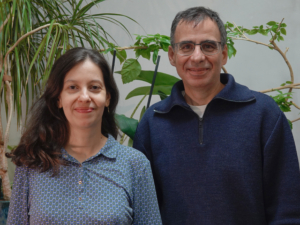
Dr. Daniela Popa (left), a Principal Investigator at the Neurophysiology of Brain Circuits Team at the Institut de Biologie of the École Normale Supérieure in Paris, and Dr. Clément Léna (right), Professor of Neuroscience at the same institute.
#62: Daniela Popa & Clement Lena – Unlocking the Cerebellum: From Dyskinesia to Fear Extinction
In today’s episode, we dive deep into two groundbreaking studies led by Daniela and Clément. We explore their 2022 Nature Communications paper on using cerebellar stimulation to alleviate levodopa-induced dyskinesias in Parkinson’s disease and discuss their 2023 paper uncovering the cerebellum’s role in regulating fear extinction through its connections with the thalamo-prefrontal cortex pathway. Along the way, we discuss how these discoveries may open up exciting new possibilities for treating both motor and emotional disorders. Tune in for an insightful conversation packed with cutting-edge science and exciting future perspectives!
Daniela Popa & Clement Lena 00:00The cerebellum has this ability to correct an error using almost any information that is available in the brain. That stimulation of the cerebellum for less than two minutes a day stops dyskinesia and corrects activity in the whole motor circuit. The very first time when you look at it, you don't really see it, but then in a few days it's really there and then it stays even if we don't see the stimulation anymore. So in fact with those stimulations, the idea that we have is that those stimulations, they just change something in the way neurons react to the continuous flow of activity. And instead of building up some crates... ...and then doing some crazy activity, it just on the contrary downscales things that otherwise would be building up down to producing a completely random movement. 01:03So the idea is that would be related to motor learning at length.
Andreas Horn Welcome to Stimulating Brains. Welcome to another episode of Stimulating Brains. Today I have the great pleasure of hosting two exceptional scientists. Dr. Daniela Popa, a principal investigator at the neurophysiology of brain circuits team at the Institute of Biology of the École Normale-Surveillance Institute. Welcome to Stimulating Brains. Dr. Daniela Popa, a principal investigator at the École Normale-Surveillance Institute. Dr. Daniela Popa, a principal investigator at the École Normale-Surveillance Institute. And Dr. Clément Lénard, who is professor of neuroscience at the same institute. Both are leading experts in the fields of cerebellar circuits and their involvement in motor and emotional regulation. 02:03In today's episode, we dive deep into two groundbreaking studies led by Daniela and Clément. We explore their 2022 Nature Communications paper on using cerebellar stimulation to alleviate levodopa-induced dyskinesias in Parkinson's disease. We explore their 2022 Nature Communications paper on using cerebellar stimulation to alleviate levodopa-induced dyskinesias in Parkinson's disease. We also discuss their 2023 paper on covering the cerebellum's role in regulating fear extinction through its connections with the thalamoprefrontal cortex pathway, published in the same journal. We also discuss their 2023 paper on covering the cerebellum's role in regulating fear extinction through its connections with the thalamoprefrontal cortex pathway, published in the same journal. Along the way, we discuss how these discoveries may open up exciting new possibilities for treating both motor and emotional disorders, potentially one day in humans. Stay tuned for an insightful conversation packed with cutting-edge science and exciting future perspectives. Thank you for tuning in, Stimulating Brains. It's a big honor to speak with the two of you. And you are really one of the world experts in the cerebellum, 03:01but also in brain stimulation of the cerebellum and of related circuits. And I'm super excited to have you here. Thanks for taking the time. Before we dive into scientific work, we often have one question dedicated for, as an icebreaker, what you do in your free time. So maybe we can start with Daniela. What do you do? So first, hello, Andy, and thank you for inviting us for this podcast. So, yeah, hobbies outside the lab. Well, recently I started running and I like it. But most of my free time is really family time. So I have the chance to have a great son, the best. I'm very proud of him and I'm very happy spending time together.
Daniela Popa & Clement Lena Great.
Andreas Horn You, Clement? Yeah, same.
Daniela Popa & Clement Lena Hello, Andy, and thanks for having us. 04:01It's really great. So I combine my commuting with a hobby. So I live like 20 kilometers from the lab and I have a 20 kilometer bike ride every day. So it's a very nice workout twice a day. It's along the river. It's outside. And that's really the thing that brings balance in my life. So stressful days are followed by a very nice and pleasant ride. I have all the skies and lights in the evening or in the morning.
Andreas Horn That's absolutely fantastic.
Daniela Popa & Clement Lena So the best thing out of the lab is actually moving around. And I know you're in Paris, but I don't know where. Paris is big.
Andreas Horn Is it in the center, the Institute? Or is it where you're located?
Daniela Popa & Clement Lena We're located in the center. And the Institute, it's really in the center. It's a great place. So we are very lucky.
Andreas Horn Yeah.
Daniela Popa & Clement Lena We're in the Panthéon, which is on the hill in Paris, where actually in the Middle Age part of the city was located. 05:05We're very close to this. So Daniela lives in the center of Paris and I live far from the center. That's a very different life.
Andreas Horn Yeah.
Daniela Popa & Clement Lena That's a very different life experience, actually.
Andreas Horn Okay.
Daniela Popa & Clement Lena But I mean, it sounds a bit stressful to drive through with your bike, bicycle, to drive through the entire, let's say, rim like from the outside into Paris.
Andreas Horn But are you saying it's fun? It's along the river? It's along the Seine then?
Daniela Popa & Clement Lena It's along the Seine and the Marne. And it turns out that they've arranged the – I've been always biking since my earliest time in research. But now there's a lot of installation now for – or a bike instead of bikes. So it's pretty safe, actually. Great. And enjoyable. Not so many problems. That's great.
Andreas Horn Okay.
Daniela Popa & Clement Lena So you both have had impressive careers. Moving on to the work time,
Andreas Horn 06:00who have been some of your key mentors and what were some of the turning points along your career to get where you're now?
Daniela Popa & Clement Lena Maybe there was even, you know, joint, I don't know much about your history,
Andreas Horn but have you been like co-workers for a long time? Or, you know, how did that work?
Daniela Popa & Clement Lena Well, I can start. So my first contact with neuroscience was during my medical studies in Bucharest in Romania in the lab of Professor Leon Zagran. So it was almost the only neuroscience lab in Romania at that time. And I was very lucky to discover the world of neuroscience research. And it made me want, to continue. So then I did my PhD in France, in the Michel Amon laboratory. And it was a very big lab studying the serotonin under very different facets from receptors, pharmacology to physiology. And I worked more on the very exciting topic 07:02on the link between the serotonin sleep and depression. So this was in animal models with Joëlle Adrien. And she was extremely methodical. And she was a very good and independent woman and was a role model for me. And it made me want to continue with the postdoc. And then for the postdoc, I was also very lucky. And I worked in Rutgers, New Jersey with Denis Paré, where I studied electrophysiology in emotional and attentional circuits. So Denis was a key mentor for me also, and he was very organized and extremely knowledgeable. And he organized his research by combining experiments that were safe with others that were really very ambitious. And this was very reassuring actually to work with him for everybody in the lab, because you had the impression that nothing negative, 08:02you know, could happen. So yeah. So overall, well, since the very beginning in the laboratory, in Romania with Leon Zagran, I always studied the brain as a network with lots of interacting regions. And when I came back to France after my postdoc, I talked with Clement, and who was working on the cerebellum already, but thought that the future would be to look at the cerebellum's interaction with the brain. And we identified that our scientific collaboration could be very fruitful. And then moving to the motor circuit, which was also great for me, as I did emotional, intentional, and serotonin in the past. And I'm very happy to have that touch to many scientific fields before starting as a PI working with Clement.
Andreas Horn Was motor system easier all of a sudden 09:00because you could study it better than emotions or?
Daniela Popa & Clement Lena No, not really, because I was really in love with emotions actually, when we started with Clement, I was very excited. I really wanted to do cerebellum and emotions actually. So it was my first time.
Andreas Horn Which you are doing, yeah, yeah.
Daniela Popa & Clement Lena Sounds good.
Andreas Horn Yeah, okay.
Daniela Popa & Clement Lena And Clement said, it's maybe too early because so far already in motor, we don't know everything. So maybe start with something that is more clear and then your dream will come. And then he was right.
Andreas Horn Yeah, it was time to get grants basically. Yeah, yeah, because we needed grants to do this, yeah.
Daniela Popa & Clement Lena Okay, Moa.
Andreas Horn Yeah, my curriculum is kind of all over the place
Daniela Popa & Clement Lena because I started in quantum physics, then shifted completely. I mean, spending days running, writing equations was not my thing. So I moved to biology and I was lucky because Jean-Pierre Changeux, a very prominent neuroscientist, 10:02was ready to take people he somehow picked.
Andreas Horn I don't know exactly why I got picked,
Daniela Popa & Clement Lena but I went into his lab. So I did a PhD in neurophysiology, so cellular and molecular neurophysiology. And Changeux was not properly a neurophysiologist,
Andreas Horn but he had a fantastic lab
Daniela Popa & Clement Lena where I met a number of very, very nice people like Marina Picciotto, who got a nice career in France and Jolie in Italy, Descaux in France. So really nice scientists. And this, what I enjoyed most, I think in this lab, beyond the fact that I was working with very, very smart, helpful people, was that I was very free. I could do pretty much anything provided the only requirement is having nicotinic receptors somewhere in my research. That's the only thing. And as a PhD, that was really a degree of freedom that I was granted. That was great. But I really wanted to go on an upper scale. 11:02So I moved to MIT to get trained and in vivo in neurophysiology. And I did this with Matt Wilson. And Matt Wilson is just an incredibly inspirational person, as well. He's a great guy. He's a very, very visionary, I would say. And from him, I learned a number of things, particularly a very, there's something about data mining that I didn't know of, that I really learned there and the craftsmanship of this, that is really looking at data. And there are really deep ways to look into data and also to build tools to look into data. And I think that's what I really enjoyed. And I think that's what I really enjoyed. Thank you. And that was, and I worked on some kind of emotional limbic circuit stuff there. It was just a short stay. So, and I came back to France and started working on cerebellum, which is an entirely new topic, the nicotinic receptor limbic circuit. And at that time, it turned out that I had the collaboration. I had started the collaboration with the Joëlle Adrien 12:02that Daniela mentioned. So that's the first time that we started collaborating with Daniela because she was in the lab where she was doing her PhD. I kind of tried to prove her. I tried to push up and follow up the things I started before leaving for my postdoc. So that's the first time that we found that we were working very well together. That is, ideas were just moving around very easily and it was very constructive. And even the way we could resolve all the antagonism, that disagreements on data or experiments, there was always a way out, which was not a simple position, but just to make it creative. So that's where we started. And of course, when that happened, I was like, oh, I'm going to do this. I'm going to do this. I'm going to do this. I'm going to do this. And then Daniela said that she wanted to be back in France. And I wasn't sure because she was Romanian and then moving to the US. I just said, look, if you want some exciting topics, I was purely CERB-LR researcher at that time. But I knew that the way was to look at brain-wide. So Daniela was just the perfect partner to really start, really, 13:04a neurophysiology CERB-LR brain team. And I think we've been probably one of the first, I think, teams around to identify itself as a CERB-LOR forebrain group. That's cool. So she was your cerebrum in a way, if you were the cerebellum. That would be it. Sorry, I interrupted you. Go ahead. No, that's kind of the excitement is still there. And I think for a, I think, for a lot of people, I think for us, I don't think we're mutual mentors, but I think the, so we run a joint team and that's really something that we believe in, let's say, to find that complementarity of our backgrounds and is really operating, basically.
Andreas Horn 14:03Yeah.
Daniela Popa & Clement Lena That's super fascinating would be the next question. But before we move into that, it seems like, Clément, you were the first one to say, I'm not sure if I'm right or wrong, but I'm not sure if I'm right or wrong.
Andreas Horn But you were the one to pick the cerebellum in a way, right? So you were already studying the cerebellum before. Why, why cerebellum? Why not something else?
Daniela Popa & Clement Lena Could have been something else. So I think it's incidental. It happened so. And it was based on, when I came back to France, I actually wanted to work on hippocampal prefrontal work and it didn't work out. So I basically looked for other places to work in. And at the Ecole Normale Supérieure in Paris was a big centre of cerebellum physiology. That's very bright specialist there. There was people who are still working here like Stéphane Diodonné, Boris Barbo were excellent. Mariano Cassado, outstanding neurophysiologists of the cellular network of the cerebellum. 15:04And at that time they figured that looking in vivo was really the thing. So when they. knew that I was around on the market basically. They just say we want you that's that's there's a whole thing about multi-cellular recordings in vivo. This is a lot of recordings the things I had learned in the US. This has to be done this hasn't been done in the 7-11. So that's how basically it started. But since I really wanted to do very innovative things I that's that's how I came to want in fact to do something that would be a little bit external to the CERBELOM itself. Which was kind of also I must say at that time was kind of closed community. So not having done your thesis and PhD in the field felt like you was a you was a foreigner. So if I was to be a friend you know I would be just a you know connect side worker in the CERBELOM field. 16:06And so you have both been you mentioned the collaboration and Daniela you're an MD. I understand you're not seeing patients but you have that medical background and then Clément you have studied physics originally. How is that complementary role working out for you and then also maybe as a follow-up question is being in France with
Andreas Horn often you know permanent salaries and so on is that a component of why this works so well
Daniela Popa & Clement Lena maybe or yeah can you talk a bit about that. That would be interesting because I think you had like three nature communications papers for example as shared last author right. So you really work together it's not like just a part yeah maybe yeah we okay yeah we really work together yeah yeah so Clément said already a little bit that we really have complementary backgrounds and skills uh so we really work together. Yeah we really work together. Yeah so Clément said already a little bit that we really have complementary backgrounds and skills. Clément says already a little bit that we really have complementary backgrounds and skills. 17:01I'm a medical doctor and this means that we can cover together all the projects in the group and so that we could direct some students on a common axis so how we organize the lab so we have this physiology to the Cerebellum Forebrain pathways and this is something that we we try to co-direct students on this and then we each take more in charge of specific axes with specific dedicated grants. So Clément is more on projects focusing on neural dynamics and advanced signal processing and analysis of electrophysiological data of neural network activity and me more on the pathophysiological projects addressed with chemogenetics and optogenetics in different circuits but we interact a lot and as you said the studies that we do they have a lot of techniques and they have a lot of techniques and so then it's really great to be able to collaborate to do such 18:04complete studies let's say around a subject and we share the same office as we showed you before so this is really easy because we can exchange information very easily and as Clément said we met a long time ago we already worked together on very different topics so we know each other for a very long time more than 20 years and I think this is really important because we try to create a trust each other and well it's more easier to move for our together.
Andreas Horn Yeah, it's a part of what makes it work is we know how to disagree
Daniela Popa & Clement Lena and that's actually I think quite central in collaboration and long-term collaboration is that you have to find ways to resolve disagreements other other ways than just capitulation and I think we managed to make our disagreements very productive and I think that's that's part of the story. In the case of France I think yes we've been helped to some degree because 19:04we're both INSEM researchers and INSEB is one of the three main structures so in France you have universities CNRS and INSEM and INSEM is really the basic science preclinical clinical institute that's really they want these ways of doing science and questions and ambitions to be assembled together so that's for us we really fit into that program and I think it's tighter in the and smaller than than the NIH in the US for example in the way of bringing this together and you're right the fact that there's we have those permanent position it's also allowing us to take risks and I think in our case we really exploited that fully so one of the recent work of Daniela on
Andreas Horn the research of the research system was the one that was really interesting and it's just the
Daniela Popa & Clement Lena 20:03example this was completely crazy it was extremely far-fetched chances that it would fail were pretty high actually turned out not to it was it was very very risky and I think our research system one of the good things not everything is good but that one is good is we can take risks and that's and we did and we definitely approach this as a as a yeah an adventure.
Andreas Horn Great okay yeah really interesting so so so maybe for the foreign listeners including myself
Daniela Popa & Clement Lena I think in France you often have these different like a set of PI like multiple PI's are working together in the IN for our institute at École Normale. 21:00It's mostly American type teams. Most of the teams are just one PI. There may be a few researchers that would be close to, what is it, research associates, I think, in the American system. But otherwise, yes, there's a bunch of laboratories which are indeed with like five or seven researchers and just in a team. But here, the space constraint is really high, so it's very hard to, and the number of teams has to be sufficient for the institute.
Andreas Horn So, yeah, all teams are kind of constrained.
Daniela Popa & Clement Lena And also, I think that for INSERM, this is more the case in hospitals, because it's very hard for medical doctors that see patients to really have also a lab, 100% as only one or two PIs. So usually in hospitals, you can see more often big labs with many PIs on separate projects, 22:02but still working together, they're a big idea. Great. Okay, so going into science, Clément, if you had to tell us what the cerebellum does
Andreas Horn in a few words to a novice like me, what would you say? Yeah, it's a pretty,
Daniela Popa & Clement Lena it's always a challenging question. I think there are a few things that we can say and that somehow matter and are telling in the case of the cerebellum. So the first thing is that even if it's quite small, so it's like 10% of the brain mass, it's really packed with neurons, and there's more neurons in the cerebellum than in the rest of the brain. So it has, so the first thing is that it has a lot of computational power. It doesn't mean that it does everything, but it's in the position to do a very wide number of things. 23:05And then if I had to define the cerebellum in terms of functionally what it is good for, it's good for accuracy. That's a brain device that is very good at making things accurate, precise. And and of course we have a very good picture of that just by looking at what the cerebellum does in the motor domain, where we know that the, the cerebral patients, patients with cerebral lesions have the same defects and suffer from the same things as if they were drunk and ethanol intoxication actually shuts down the cerebral. So we just need to see drunk people to see how, how the cerebral lung, when you remove it is influenced. is influencing and of course we see that it's reducing the accuracy of actions like you can't touch your nose consistently if you try several times in a row, the problem of 24:04balance, fixation of the eye is not functioning anymore. So all these things we know involve the Cephalon and having a good fixation point in the sight is really something that requires a very accurate and very finely tuned movement, particularly because your head is moving so you need to compensate constantly what your head is doing and so forth. So precision is the key word for the Cephalon. And if there is one challenge is that we know that the Cephalon does more than just this motor control, so the motor is just one of the dimensions where the Cephalon does, but then it does a number of other things in cognition that are still, that are very well established and I think Jeremy Schmaman did a fantastic job of proving that and making that acceptable to the universe. But it's still very hard and very challenging to understand. So that's for the definition of the function of the 25:03Cephalon. Now if we want to look at the function of the Cephalon, there's, I think there are three things that we want to keep in mind. The first thing is that the Cephalon as any brain region learns and it learns in a very specific way which is supervised learning.
Andreas Horn So what does it mean supervised learning? It's error driven learning. So it means that
Daniela Popa & Clement Lena somehow you have to say this is wrong. You can only say this is wrong if there is an idea of what is right. So you need a plan, you need an expectation. So the first thing is that the Cephalon only operates or virtually only operates when there is something that is already identified as right or there are things that you can immediately understand they are wrong. And of course, if you bump yourself into a world, you know it's wrong because you're not paying for it. But in the higher cognitive domain, what is the definition of wrong is more challenging. And I think that 26:01makes the understanding of what Cephalon does in cognition more difficult. So supervised learning is the first thing. The second thing is that because of its circuitry, which I'm not going to explain here, but can easily be of course revised from any textbook, the Cephalon has this ability. The ability to correct an error using almost any information that is available in the brain. That is, it's such a mixer of information that if you can correct anything that goes wrong with something that is in the brain, you will, the Cephalon will connect this thing together. And that's exemplified, for example, with the bike. I like riding my bike. With bike riding. So in bike riding, you can correct an error. And you can correct an error in the brain. And you can correct an error in the brain. And you can correct an error in the brain. And you can correct an error in the brain. And you can correct an error in the brain. And you can correct an error in the brain. And you can correct an error in the brain. And you can correct an error in the brain. And you can correct an error in the brain. And you can correct an error in the brain. And you can correct an error in the brain. And you can correct an error in the brain. And you can correct an error in the brain. And you can correct an error in the brain. And you can correct an error in the brain. And you can correct an error in the brain. And you can correct an error in the brain. And you can correct an error in the brain. 27:00And you can correct an error in the brain. And you can correct an error in the brain. And you can correct an error in the brain. And you can correct an error in the brain. fall, actually, you need to turn the handlebars. This is not natural. So there's no reason evolution would have connected your hand movements to your vestibular organ. There's no way this could have been anticipated and designed for. So it's not only the cerebellum that does the correspondence between the vestibular signal and the handlebar. Of course, there's plenty of brain around, but the cerebellum is really the thing that is going to tune. So whenever you're going to turn the handlebar by the wrong amount, the cerebellum will try to find whether it was too little or too much. And at some point it will match, in fact, some vestibular, maybe visual information and determine how much change in your head tilt has to be converted in how much rotation of your handlebar. And this requires very fine tuning. And once it's automated, you can ride your bike in very difficult terrain. If you do want to take a bike, for example. But there is so what the cerebellum is, is that in all 28:05the flux that you can have, the sensory flux that you can have when you're on your bike, it finds the specific element that is going to be driving your hand movements so that you actually stay on it. And it's very likely that the cerebellum, because it's inscribed in its connectivity, the cerebellum does that for everything. That is, whenever there's an error, it will find something in the brain that says, oh, you could have anticipated that. So if you play, you play tennis, you feel some wind at the moment you're going to strike the ball, the cerebellum will be able, if that happens regularly, capture that information, just change a little bit your movement so that actually it gets in, even if the wind just came at the very moment you was hitting. So the last element we need to keep in mind in describing the cerebellum is just the temporal aspect. So cerebellum is very good at finding those correspondence of what could be helped to use to prevent the error and using that for correcting the error. But it does this in a very narrow window. So it's a second window. 29:04And if the thing that can prevent your problem is located in time very far away, the cerebellum is not going to help. So the cerebellum requires the solution to be at hand in the second that precedes the problem. And if it's not the case, you will, the brain will rely on many more complicated circuits to fix the solution. So how does translate in cognition, now is a big challenge. If I was just to add one word, I'm speaking too much. Just adding that, so the last element on cerebellum is just to bring an evolutionary perspective. So probably if we look at evolution, the cerebellum was invented when the vestibular system became complicated. So the earliest vertebrates had already an embryo of the vestibular system, but it was not three semicircular canals. Le 30:29and this has been then reused in the motor system and then reused in the cognition domain. So in fact the cerebellum has always the same circuit but this circuit has been recycled for very very different functions. So we believe that the computations in the cerebellum are always the same but in fact that system is plugged to very different functions and probably very different circuitry with very different requirements and the big challenge of course is figuring how these two things work together. So that was my crash course. Super helpful really. Daniela, anything
Andreas Horn 31:07you would add to this? Yeah, so what can I add? Maybe to continue. So as Clément explained, how the
Daniela Popa & Clement Lena cerebellum controls the muscles is really understandable but the effects on cognition are harder to measure than a muscle construction and moreover the circuit that connects the cerebellum to the brain is very difficult to measure. So the circuit that connects the cerebellum to the brain is very difficult to measure. So the circuit that connects the cerebellum to the muscles is generally relatively simple. In contrast, the circuits that connects the cerebellum to the forebrain is much less known. And what can I add is that the way for us to approach this question in our lab is to study the neurobiology of the circuits in addition to the study of the behavior. Super cool. I had James McShine on the podcast once. He's from Australia. Maybe you know him. He does great theoretical work but often very much grounded on basic science 32:04findings. And he told the story of his son, even mentioned the name Tyler, when he was still young. You know, everybody knows this that has kids, had big trouble even standing up as every kid,
Andreas Horn right? So it was a very normal kid but it was a very cognitive effort to, let's say, stand up and
Daniela Popa & Clement Lena then walk and all that. And then just half a year later or so he was, of course, running around like normal. And he talked to his dad who's, I think, a biologist and not even a neuroscientist, and they wrote a paper together about trying to figure this out, how this, you know, making these more conscious efforts more automatic. So delivering automaticity for these processes. And they essentially nailed this to the cerebellum, which I think you might agree on. I think a lot you said, Clément, meshed with that. For example, also that it seems to be an online thing. It has to be in the moment. It cannot be for something, you know, computing 33:03things for the future. But it seems like really an online computer that's like a graphics board
Andreas Horn or so that is helpful to figure out the details essentially, right? And make continuous movements
Daniela Popa & Clement Lena smooth and all these things. Would you agree that maybe, you know, next to precision, there's also this automaticity as one function that... Does that mesh with the... Yeah, I think that's a good question. I think that's a good question. I think that's a good question.
Andreas Horn Do you agree with your thoughts?
Daniela Popa & Clement Lena Not entirely because I think... So if I was to say yes, I think I would have the whole community of basal ganglia researchers coming after me, which I'm not ready for because they're quite numerous. And automatization is definitely something that goes in the basic ganglia. So I think... Sorry to interrupt. Sorry to interrupt. So, you know, Mac is very much aware of that. And he, I think he was okay with 34:03having the entire field of basal ganglia against, like at him, because he said the striatum is really too capacity limited for it. And I think that made a lot of sense to me. So there's just not enough neurons to do this in the striatum. So in a way, you know, I agree, it was kind of revolutionary that he would, you know, put this to the cerebellum. But he said it needs to start, you know, the whole thing. And I think that's a very interesting question. And I think that's a very interesting question. And I think that's a very interesting question. But again, I'm not an expert. And I'm putting you on the spot here. So we can also move on to
Andreas Horn another topic. I just when you talked about it, I felt like this is a very interesting question.
Daniela Popa & Clement Lena Yeah, I think. So I think that's your question, I suppose, exactly in line with the aspects that we are scientifically struggling with, in fact. Mm-hmm. Mm-hmm. Mm-hmm. Mm-hmm. Mm-hmm. Mm-hmm. Mm-hmm. Mm-hmm. Mm-hmm. Mm-hmm. Mm-hmm. Mm-hmm. Mm-hmm. Mm-hmm. 35:27fields and different fields and and but in each field we've met people who say everything happens there i worked with hippocampal people and i said hippocampal is the thing then i worked with the amygdala people saying amygdala is the thing and um i've worked with nicotinic receptors people saying that nicotinic receptor was pretty much anything you needed to know yeah they are all right they're all right oh great yeah yeah so i think our uh we i think we're quite resolute in taking a holistic approach and i think we it is um i think it's very important to understand what 36:05sort of computing power is and and i think you're completely right in the in stating that very likely a lot of the details of motor execution are stored in the several our secretary but um but i i'm very um skeptical that we could describe something like the automated storage is entirely there and in fact we have ongoing work in the team that really indicates in some simple motor skills or not so simple motor skills in mice that shows that in fact when we put an animal learning something complicated we find that we get rather tight collaboration between cortex basal ganglia and cerebellum and they start really we were were were were were were were were were were were were were were were were start really we have cell assemblies that really start co-varying and and have a very specific dynamical trajectory that are of their own so my take on that aspect is really that the sevalum is 37:01is very much bound and a lot more bound to the forebrain motor circuits than they're listed as part of it but they actually become they develop very very tight links that are essential to obtain you know the full repertoire of skills like you know buttoning and we were at the meeting where one of the colleague was saying one of the undervalued skills of humans is just buttoning a shirt a shirt yeah yeah that's a good point and and just for the record because mack shine is not here to defend himself he would 100% agree that it's not just the cerebellum right so he has as beautiful papers on on exactly this this whole you know interactions between i think he's one of the proponents to think of the you know um of the brain in an integrated way and you know does a lot on on other um points as well basically ganglia cortex and so on so so he's he's all over the place um and he he would um he would very much agree with what you just said just just so the listeners know 38:01this and uh um you know mack if you hear this uh let us know if i represented you well if not we can do a follow-up can i can i add something some thoughts on this yeah please of course i think that is a lot also about uh development and development is really fascinating since we really look at uh in others so it's it's a little different and and i do think that the circuits are really very important for functions it's what we look at but also what is fascinating in development is that we can uh we can really see it like for working like like you said that um um there is a need for a function and to work and then uh this will really help constructing a circuit and then uh making the right plasticities to be to be able to work uh so but this is really a great uh i mean very impressive for at least for me uh the development uh area because it's something that we 39:03we don't really touch uh in the lab and i think it's fascinating to be able to see how this comes actually and this is something that we we don't really touch uh in the lab and i think it's something that comes also for i mean we can maybe say a word about autism or where cerebellum looks like it can be involved but it's really very developmental so it's very hard for us to to touch into this uh subjects but i think that from a developmental point of view it's it's really i mean i understand the the point of view that that you said and i i really think that um um sure it's it's really it's hard to have a clear position but um for sure you i mean the plasticities that are there at the beginning they can really be moved and then these are physiological plasticities to learn a function yeah and uh yeah so that's a frontier yeah definitely yeah that's a great so so i helped a little bit you know yeah no no absolutely 40:00let let us move into dyskinesia now so this is um you're like i've mainly two papers singled out that that you know i want to um ask you some questions on and the first both were published in nature communications in two consecutive ways so the first one um was in 2022 and it it focuses on cerebellar stimulation as a treatment for levodopa induced dyskinesia in parkinson's disease this of course is you know to many of our listeners that are more
Andreas Horn into the brain simulation clinical field very interesting right because it seemed like you had fantastic effects um there um dyskinesias are a real problem in the brain and they're not just
Daniela Popa & Clement Lena 41:05sort of sort major structures in the motor circuits, so the cortex, the basal ganglia, and the cerebellum. And what we know from dyskinesia is that dysfunction comes from the basal ganglia. And we have observed in our experiments in animals that stimulation of the cerebellum for less than two minutes a day stops dyskinesia and corrects activity in the whole motor circuit. But first,
Andreas Horn why we started investigating
Daniela Popa & Clement Lena this. There are clinical studies, so the group of Giacomo Koch has tested transcranial magnetic stimulation of the cerebellum, known as theta burst, and known to induce elasticity on patients suffering from various pathologies. And the effect on dyskinesia 42:00was modest in patients, but intrigued us, and we decided to understand the mechanism of this effect and improve it by reproducing it in animals. So what transcranial magnetic stimulation stimulates is not well known in humans, but we made the bet that the effect goes through the porcineal cells in the cerebellum that are the output of the cortex of the cerebellum. And as we had generated L7 channelrhodopsin transgenic mice with colleagues in France, so in this mice, we are enabled, we can enable porcineal cells to be selectively stimulated by light that are applied on the surface of the cerebellum. And we had in this way an ideal tool for testing the effects of the cerebellar stimulation in dyskinesia. So super cool. So essentially, I love a lot of things of this. One is also that it was, 43:01you know, inspired by human work, which, you know, sometimes it's not even happens that often. So that's really cool.
Andreas Horn It's really fantastic.
Daniela Popa & Clement Lena And as you described from Giacomo, Giacomo Koch's study, it was even a minor effect. And maybe this was what Clément said, that it was a bit of, you know, doomed to failure to
Andreas Horn try this even, right?
Daniela Popa & Clement Lena It might have been, let's say, false positive. But then you said, OK, there's theta bursts that seem to have a good effect on dyskinesia in humans. Let's try to simulate, like find out what happens there or if something is there. And then you and that's the other big point here that I want to emphasize one more time. You really only simulated two minutes a day, but then it had long lasting effects. And these were these were these mice with levodopa induced. So they had levodopa intake orally
Andreas Horn or yeah, and then had dyskinesias.
Daniela Popa & Clement Lena So this mice. So this is a model that we induce with a toxin in the basal 44:01ganglia. So first they are Parkinsonian mice like. And then we. Treated them with levodopa and we give a progressive increase doses so then we can have dyskinesia in these mice.
Andreas Horn And. So it's IP, right?
Daniela Popa & Clement Lena So it's IP, but we know that if this is injected directly in the striatum, this this can work. So this is really a striatal pathology.
Andreas Horn Yeah, but we did this
Daniela Popa & Clement Lena systemically as is observing humans where it's demonstrated chronically, but systemically by oral treatment. And then you said it's two minutes a day.
Andreas Horn How did you stimulate this? That with optogenetics? Is it is there frequencies or intensity or something to discuss?
Daniela Popa & Clement Lena So we really got inspired by the by the clinical studies and we took
Andreas Horn 45:00exactly the same protocol as they did.
Daniela Popa & Clement Lena So then to be sure that we can really really get the clinical studies. And we have this in our animals. And so this is called the Teta burst, which is thought to induce plasticity.
Andreas Horn And we still don't know exactly how,
Daniela Popa & Clement Lena but we are and how this is working. But we are working on this in the lab and they did it less than two minutes a day also during two weeks only. Also in humans.
Andreas Horn And we wanted to do exactly the same
Daniela Popa & Clement Lena to first to be sure that it's really working yourselves and what we could do in more in in the future. So we did this in the lab. And what we could do in more in in in mice is that we could be very specific. And we stimulated in our dyskinetic mice the oral fascial region of the cerebellum since dyskinesia there are more type of dyskinesia, but one is all facial. And we have access to the cerebellum because the post or lingual zone is is actually that we can really put light on this zone specifically in mice with optogenetics. And we were amazed that we could get this to be a very specific 46:00and we can really put light on this zone specifically in mice with optogenetics. And we did that we totally suppressed all facial dyskinesia. So it was really almost down to zero. So a very impressive effect. That's the other point we didn't say so far right but you told me before so that that that it was almost you know gone right and that's very important it wasn't a mild effect as in the TMS work but it was really essentially gone. Wow yeah. And more than that the effect continued for two weeks post end of the stimulation. So during which we continue to to measure dyskinesia. So this is really a long term effect. So even without these two minutes every day of the stimulations we could see that the effect was there for another two weeks. We only look at two weeks later so maybe it's there after we don't know. But in the weeks where we look at it was still there. So this is a long term so probably 47:00because there are plasticities induced in the system that allows the effects to stay for a longer time.
Andreas Horn And so it was how often did you say two minutes a day for one week or how?
Daniela Popa & Clement Lena It was two minutes a day for two weeks. For two weeks okay and then it lasted two weeks later. And then we looked more two weeks. But you had an effect already after one week. It's very fast but it's not
Andreas Horn exactly when we start because if we
Daniela Popa & Clement Lena looked just before the third hour burst the two minutes that are worse and just after there is no at that point the moment when it stops. So it's really something that builds and needs more time to build. So it's not an acute effect. So the very first time when you look at you don't really see it but then on a few days it's really there and then it stays even if we don't keep the stimulations anymore. Fascinating and Clément how are you feeling about the 48:00results of the !
Andreas Horn How do you think of this maybe
Daniela Popa & Clement Lena on a circuits level? I think there's the cerebellar thalamus triadal pathway as a key player in this but or maybe there's also you know you mentioned the FosB and Delta FosB expression and so on. So can you talk a bit about how you make sense of this on a pathomechanistic
Andreas Horn level maybe?
Daniela Popa & Clement Lena Whoa difficult pathomechanistic is hard for me. I think just to so you mentioned the FosB Delta FosB that was in this paper and so what Daniela and her students showed was really the expression of this early gene was changing. So this is very this gene is very peculiar so it's an early gene meaning that it's not the gene that is encoding first one protein that does something on the membrane for example it's really a controller of a whole genetic program 49:00that or a number of genetic programs that are downstream. So just changing the state of the cell basically it's changing something deep in the cell and so the so we don't know so if you overexpress the FosB for example in animals you will trigger dyskinesia. So it's really creating something that favors dyskinesia and so I think so in the paper there's a collaborative work with the team of Laurent Venance in Paris who was very expert in striatal plasticity and what he found is that when he ran the slices from Daniela's animals there was he was running some protocol to induce LTP in direct pathway dopamine medium spiny neurons sorry of the striatal and he was trying to 50:00induce LTP and when he was taking animals who got the LTP he was getting LTP. So somehow part of the program that is changed in the cell and probably but we're not sure of this that's part of what we put in grants currently but probably these programs are going to change the plasticity rules or affecting the plasticity rules in the striatal. So we know that in dyskinesia there's a trend to have an overactive D1 neurons or overactive prokinetic pathway out of the basal brain. So we're seeing one option is that in fact those stimulations probably running through the CBLO thalamus striatal pathway are changing this plasticity or targeting this plasticity and instead of having a build-up of potentiation of this prokinetic pathway because this program has changed now we have a downscaling that is happening. So in fact with those stimulation the the idea that we have is that those stimulation they just change something 51:00in the way neurons react to the flow the continuous flow of the activity and instead of building up some crazy activity it's just on the contrary downscales things that otherwise would be would be building up down to up to producing a completely random movements. And that so the idea is that would be related to motor learning aspects. So maybe I can add something on the CBLO thalamus striatal pathway. Please yeah. So because the discovery of this circuit connecting the cerebellum with the basal ganglia is is really very recent and what we have also shown in this story is that when this circuit is inhibited specifically the therapeutic effect of prokinetic cell stimulation is lost. So well thanks in particular to your work Andy we can see that we can really target a bundle within the brain rather 52:02than one bundle than another bundle and so we can really hope that with the guidance of the tractography we can find the kind of sweet spot for therapeutic stimulation on this specific cerebellum thalamus striatal pathway.
Andreas Horn Interesting so so you said you you were
Daniela Popa & Clement Lena able to shut down the circuit and then in that case the prokinia cell treatment would not have any effect anymore and so it must must have something to do with that and and so this this
Andreas Horn this is a very interesting question
Daniela Popa & Clement Lena because I think it's very interesting because I think it's very interesting because I think it's very interesting because I think it's very interesting um can I ask so it's a cerebellum projection to where to thalamus specific sites and then thalamic that projects to this triatom and then we inhibited this projection with chemogenetics while stimulating prokinia cells with the theta burst this two minutes stimulation every day and normally when we relate if we 53:00stimulate every day well then we we see the decrease of this kinetics and then we see the decrease of this kinetics but if we stimulate but the circuit between the cerebellar these nuclei in the thalamus to the striatum with optogenetics then that effect is lost so cmpf is of course i think very familiar to the community of deep brain stimulation
Andreas Horn yeah one of the interesting aspects that is related to that so there are two things that
Daniela Popa & Clement Lena come on top of that is that if you look at the patterns of cerebellar terminals in the parapsicular so in rodents it's only pf parapsicular so the terminology doesn't fit 54:07entirely but it's the same in the rodents the equivalent of cmpf in the rodent is only partly targeted by the cerebellum and recently there was a very nice paper showing that there are multiple output pathways from the parapsicular in the rodents and some are going to the stn some are going to the striatum and some is going to the zedamigula and depending on which pathway you stimulate you may have very different outcomes so we believe that in fact the cerebellum might target one specific combination of these output pathways of the pf so it may be that the cerebellum pf stimulation has a selectivity or could offer a selectivity that you wouldn't get with direct pf pathway because the pf stimulation is not going to be able to get the direct pf pathway because the cerebellum is only going to drive a subset and it seems that this subset is powerful so that's why
Andreas Horn 55:08that's why we've on both sides we think it fits with the existing knowledge that is known on
Daniela Popa & Clement Lena stimulation of that circuitry and it's potentially adding something into it because we would have and this is is is this coming in via dentato thalamic or or like from the fastigial like which nucleus projects to the cm or to these midline so we we we did look at that in in in our mice and by injecting retrograde viruses in the parafascicular and then looking at the cerebellar nuclei and all of them are they have massive projections to the parafascicular okay so all of them fastigio
Andreas Horn interposed dentate they they project massively to the parafascicular interesting lots of potential
Daniela Popa & Clement Lena implications here for clinical work right including the for clinical work right including the 56:00even you know tourette's or um potentially dystonia so so um uh of course i know i'm brushing over things here uh wildly but but um certainly for dyskinesia of course in pd so so do you see any you know translational uh work coming like going into humans at some point or other plans even to collaborate or anything in that end yeah yeah well so clearly the field of deep cerebellar stimulation is it's in its uh early stages so um and transcranial magnetic stimulation is probably not effective enough to modify cerebellar activity um so there are challenges some very exciting things are happening for example there is this transcranial alternating current stimulation tax technique that maybe would enable us to target deep structures in the brain non-invasively so um so this as far as i know has not been done on the on the cerebellum 57:07but there is maybe some potential there and uh yeah so anyway it's really clear that we need to reinforce the interactions between basic and and preclinical research and clinical scientists to to uh yeah to see if this can work if i was to add something one of the very striking uh uh state currency what is striking in the current situation sorry is that um we know so much about the organization of the circuitry in rodents and we actually so know so little of the even primate not not talking about human organization of the of the secretary of cerebellar output and and there are attack textbooks in uh stl printed textbook on the several output which are probably wrong they're probably just an over 58:05over oversimplification so um one of the limitations and one of the the problems we're facing when we want to stop thinking about the translation is really that we lack a lot of anatomical work in uh in um in humans and i think again i concur with daniela the trachography uh is is going and the high resolution tractography is something that should help even if it has its own limitations and some of the output projections in the CERB-LM that we see with the fluorescent tracing are not going to show up in tractography because they're quite discrete and still we have found with the manipulations that they are operant but this I know that anatomy has faded away as a very important base for understanding the organization of circuit 59:00and I regret that because I think that's often the missing link before saying okay we should do this in humans based on what we see in yeah I couldn't agree more I had Susan Haber on the show once and I'm big fan of her work of course and it was I think the episode was even entitled something like endangered species of human anatomists I feel like it's coming back but it will take a long time right and and she mentioned that you know they're not even so many labs to train people anymore and because there was yeah we kind of with maybe the rise of imaging we felt like we know anatomy now we don't need this anymore but it's you know we're it's very very this is very very much not true so we we have in in our you know big struggles to even define manually define these tracks that that based on you know often very old papers to look at you know what is the ground truth there and to come up with a bit more detailed circuit models that then DTI allows you know we we followed Cameron McIntyre's 01:00:05footsteps there a lot with you know trying to manually define tracks based on ground truth data which I think is is the way to go in in humans but then when you do that you really realize as
Andreas Horn you say there's a lot of lack of knowledge of where exactly do these tracks go where exactly do they kind of Traverse and do they send accent collaterals to exactly you know nuclear like
Daniela Popa & Clement Lena the cmpf and so on or not um so you know for example the answer linticularis does send collaterals but that is also not so well known or you know often ignored and so you're totally right um and I'm sure there's much more knowledge in the rodent but then we can never be 100 sure that it's the same so yeah a lot a lot to be done um now we'll we'll focus on your second paper a bit and that's now twice being on like uh on thin ice with my own knowledge I don't know much about the
Andreas Horn 01:01:00cerebellum but I also even know no less on fear extinction but it's still a very interesting
Daniela Popa & Clement Lena paper so I'd love to talk about it but mind me if I if I ask some um you know wrong questions so that was one year later same Journal and it explored the role of the cerebellum in fear extinction through interactions between the thalamus and prefrontal cortex um again I would love for you to summarize the findings and daniela maybe uh you also this is this is now you went back to emotions with the cerebellum right that was and and I think it's based on the 2020 paper in the same journal or at least as you had one more um before um so we can of course also talk about that one yeah yeah so maybe I can say a word about the 2020 which was the yeah the first one coming back to the fear conditioning and an anxiety feel and so um and we looked in that paper we look at the neurons linking the fastidium nucleus of the cerebellum with a peri-adductor gray matter and um we um we use the fear conditioning classical one 01:02:06when we um just spare a sound with uh with a shock so this is the learning of the fear conditioning for the fear conditioning and uh and then with the next day we look at the recall of the memory of the fear and then we we do extinction and uh um and we found that uh the neurons in the fastidial neurons uh the procedure nuclear that are projecting to the peri-adductor gray matter um they did not change the the um response to the fear uh in the day of the learning so the learning was the same if we activate this neuron specifically with edo genetics but then the following day during the recall we saw that the memory has been changed so something uh while we are activating this pathway during the fear conditioning during the learning of the fear of memory uh something changed uh in this pathway probably in the 01:03:03period of the gray matter that makes the memory to be memorized differently and then this pathway determines the intensity of the association of the cube with this aversive stimulus um while um uh then in memory um next uh in the next paper we looked more at uh at the extinction yes so yeah the whole idea I think so that I was very uh very uh uh uh keen to use the this Pavlovian fear conditioning which is extremely simple right uh a cue aversive shock is extremely simple but she was very keen at defending this as a as an ideal pattern to start looking in the emotional component of the sebellum and um but she was quite certain about how she was 01:04:17described, we actually, so Daniela's postdoc had been tracing the connections between the cerebellum and these components, that prefrontal cortex, amygdala, and peri-agdical gray. So the first, the 2020 paper was very surprising because the first experiments were targeting the amygdala, which is supposed to be the center where you, where things happen. And this didn't show any effect in field learning, but in fact, the effect came from the peri-agdical gray, which was unexpected. And then we figured that this, the effect we are observing are related to what you expect for fear prediction error. So the idea is in fear learning, you use the characteristic of this learning is that you 01:05:04don't learn simply something bad happens. You learn as a function of how new the impression, the bad impression is. And if it's already very familiar, you don't learn. And it's.
Andreas Horn Yeah. Yeah.
Daniela Popa & Clement Lena Not simply the intensity is the surprise of the intensity. So this first story was saying that there was a first computation in how much surprise you are when there's a cue and a shock and the several on states how much you should be surprised. So fine tuning there. So that was the first element. And then key extinction is another story because fear extinction isn't so the principle of extinction is once the animal has learned the association, you just play the cue alone. And the fear response goes away. So it doesn't go away because the animal forgets it's an extra learning that is on top of the other one. And what the brain learns is to suppress the previous learning. 01:06:00So the previous learning is still there. It's just on top of it's an inhibitory system that says, no, we don't, we know that it's, you feel it's bad, but we don't show it basically. And this, this is where the prefrontal cortex comes in. And what we found in fact, is that after the animal had learned, if we suppress the pathway that goes to the prefrontal cortex, the animal don't show the decrease in expression of their, of their, their fear. So it would stay always, always in fear, like no matter what. As long as we maintain. So actually it's a little bit more subtle than that because it was really clear when the level of expression was pretty high. But there are specificity in the second that probably underlined that. Sure. you know related to the nature of the effect but yeah so so then essentially shutting down that
Andreas Horn route and you could do that with optogenetics too um would would lead to that okay interesting and
Daniela Popa & Clement Lena then i think there was also there were these um four hertz oscillations in the prefrontal cortex 01:07:04can you talk about those a bit yeah um so these four hertz oscillation are not purely let's say four hertz oscillation uh actually it's four hertz because the breathing of the mice is four hertz and in fact we use that because they're the signature of a state where a number of brain structures are coordinated and there's a prefrontal cortex that oscillates at this rhythm but the amygdala oscillates at the same rhythm and olfactory regions oscillate at the same region and these olfactory regions turns out they they're oscillating at the frequency of breathing because they're driven by the olfactory epithelium right so in fact it turns out that these structures oscillate together when the animal is in the state is one of the fear states which is uh freezing like complete 01:08:01immobility so it's a very familiar response emotional response for rodents because that's a defensive mechanism they if they are completely immobile we leave as a human being we are not able to stop the movement of the body because the humans are rarely experienced that degree of fear that will completely freeze us but for for mice it's very common so when the animal is when the animals are in this state they exhibit these oscillations and when we sorry what we found is that when the cerebellum talamo prefrontal cortex network is inhibited the animal gets stuck in that uh oscillatory mode which is not simply the network that has prefrontal cortex amygdala and other structures that really talk to another continuously and so what this shows is that in normal condition during flea extinction somehow the sebalam helps these regions to get out of that state so you know there and and then 01:09:00you know prefrontal cortex will interact more with the hippocampus in the the next state so the sebalam is seem to be instrumental in it's not the only partner but it seems instrumental in kicking the network out of one configuration where a number of structure interact to let another set of structure to interact and that's that's the key underlying mechanism that is at play so if we were to think at a translational value of this observation i think that's where it would stand it's more about having a set of structure that is at play that work and the sebalam helping this set of structure to cease being locked into a given oscillatory here state and allow another combination of structure to take over and and allow the behavior to reach other um yeah so so as the md in the team daniela how do you think about this maybe in towards treatments with ptsd or or um similar conditions going forward 01:10:06uh
Andreas Horn yes so uh so this is really the basic that can explain uh um why targeting the cerebellum
Daniela Popa & Clement Lena can uh can maybe help for uh anxiety and and ptsd and and so so we we still have to be very uh careful with uh with translational statements since we only did this in in rodent and our paradigm it's it's a really a simple one sure the most simple for this field conditioning learning, and it only addresses physiological and behavior responses and does not allow to address the cognitive aspects of the negative emotions. And yet there are indeed plenty of physiological and behavior components in PTSD, for example. So there should be some relevance 01:11:00for this pathology also in humans. And there is a whole field to explore from non-invasive cerebellar simulations in patients to research on PTSD following head trauma as found in war veterans, for example, who were exposed to blast and show cerebellar anomalies. Super cool. All right, moving on to more like broader scientific questions. There's one, so we met at the Raynor Cerebellum Big Ideas, Raynor Cerebellum Project, Big Ideas Summit in Arizona, and was super fun to talk on, you know, brainstorm on things, learn from you guys. And one idea that Clément brought up there that really meshed with me, and I also felt like could have clinical impact, but as far as I understand, it's more an idea currently, is this idea that Purkinje cells would project to the cerebellar nuclei and essentially have to produce 01:12:03some sort of blanket there,
Andreas Horn and that, you know, if that breaks down, could lead to ataxia or dystonia. So do you want to briefly outline that concept? Is any of that published, or is it really more currently an idea? So it's actually, yeah, it's published in some way,
Daniela Popa & Clement Lena in many papers. I'm just putting a couple of things together in there. So the idea, so I think the core observation is that when the output of the cerebellum, which is provided by the cerebellar nuclei neuron, when the neurons in the cerebellar nuclei start firing irregularly, it seems to have very, very detrimental motor function. And so there's, for example, 01:13:00some work in Kaman Kodaka's lab showing that there's, you know, there's a very high correlation between the degree of irregularity of cerebellar nuclei neurons and the degree of motor impairments observed in the animals. So in fact, cerebellar nuclei neurons normally are tonically active and relatively regular. And when they stop behaving erratically, they seem to be inducing some, probably some plasticity mechanisms, a bit like the Daniela Stetaverse, downstream and they just bring the system down and promote dystonia, which are a number of potentially some symptoms of attacks as well. So the idea is what, the question is what can make the cerebellar nuclei irregular
Andreas Horn and how can we fix that?
Daniela Popa & Clement Lena So I think one aspect is that if you, so if you start losing pecunia cells, you may not have enough pecunia cells at each moment to maintain a certain degree of tonic inhibition 01:14:00on the cerebellar nuclei neurons. So these cerebellar nuclei neurons, they're constantly receiving from about a hundred pecunia cell and these fly at high frequency, but they inhibit only for a very short time. So you need really, all the pecunia cells need to be somehow active to maintain a steady level of inhibition. And there's excitation and features that allow the neuron to fly their own life, but this is kind of balanced. You lose pecunia cells, you lose some of the inhibition, and then at some moment you don't have enough inhibition. So you get lots of excitation, that go through, or maybe you can have at random moment, a little bit more inhibition, then cell stops firing. So you get, you end up having neurons that instead of being relatively continuously firing, they're just erratically firing. And downstream that has consequences. So if we think in terms of what can happen, what can go wrong, particularly in the perspective of stimulating the cerebellar nuclei, so the stimulation is going to, 01:15:02have to play on two aspects. The first thing is if you change the excitation inhibition balance in the cerebellar nuclei, your tonic activity coming out of the cerebellar nuclei, so they have to fire certain 20, 40, 70 Hertz firing, continuous firing with fluctuations of course, but if you don't have enough, you are going to need to compensate for that. So stimulation are probably needed to compensate that. But if you have some irregularities, then that's a harder problem. So stimulation are able to feel the holes when the cells are stopped firing while they could be, they should be continuously firing, but you also have mountains. So there are peaks of activity where intense activity, and ideally you would like also the stimulation to be able to smooth this out. And I'm not sure we've identified, we know enough about several nuclei function to optimize it, but I think this makes the problem, 01:16:01the problem of designing the stimulation of seven on okay. I quite complicated because instead of having a system that, you know, for example, has to fight rarely and you say, okay, I just need to provide a little bit more excitation here. We need to have that system with a correct degree of average firing and then not so much fluctuation around this average firing to come closer to the actual physiological property.
Andreas Horn Yeah.
Daniela Popa & Clement Lena So. need more basic or clinical research, but I think now we know that several stimulations are coming into the game. There's a big world effort into starting these. This is going to be a challenge we anticipate into the design of the stimulation protocols.
Andreas Horn Yeah, super interesting.
Daniela Popa & Clement Lena So you would also say that if, let's say, for any neurodegenerative process or atrophy in the cortex, if the Purkinje cells die or if they lose their function or whatever, then 01:17:01that will, just because they essentially come from all angles, project to one of the nuclei neurons, you say it's around 100 Purkinje cells projecting there. If there's not enough, it will be more irregular, and that is shown to lead to ataxia and other symptoms.
Andreas Horn So now if we were to apply, let's say, 130 hertz or high-frequency stimulation onto the nuclei, it would at least smoothen everything, right?
Daniela Popa & Clement Lena It would probably, but then we might also lose function, of course, if it's nonsensical.
Andreas Horn So I get the point that it has to be smart, but it can't be very, let's say, it has to be smooth as well, right?
Daniela Popa & Clement Lena It has to, it can't be very erratic and go up and down all the time, because that's not the physiological.
Andreas Horn Yeah. Okay.
Daniela Popa & Clement Lena Super, super exciting concept, and to me, that was really revealing. 01:18:06Your work also highlights, as we talked about, the multifaceted role of the cerebellum, you know, as we said, from motor control to emotion regulation.
Andreas Horn Do you think future research will continue to uncover even more non-motor functions in the cerebellum? What is next in the field? And maybe... What do you see as the steps to go into the more emotional or so directions? Yeah.
Daniela Popa & Clement Lena So, yes, we do think that future research will continue to uncover new function where the cerebellum is involved. And maybe I can say a few words about what some work from the lab and what we are doing now, that it's a little more different from what we discussed earlier, but just to give a flavor on that. Sure. Sure. Sure. 01:19:14! Sure. Sure. same place in the cerebellum as the motor cortex. So this was for the descending pathway. And on another side, in another work that we did in the past, in 2013, we recorded simultaneously the whisker part in the sensory and in the motor cortex during exploration in freely moving animals. And we observed that the transit inactivation of the cerebellum suppressed the synchrony of the gamma oscillation between this motor and sensory cortices, but without disrupting the gamma oscillation in each area. So for us, this was really very exciting because it revealed a new 01:20:00unexpected contribution of the cerebellum to the coordinated activities of distant cortical areas. And now we are preparing a new story, knowing that we saw that the descending pathway sensory motor goes to the same place in the cerebellum, and that if we inactivate the cerebellum, we can really change the coordinated activities in between the motor and the sensory cortex. And we ask, well,
Andreas Horn how the cerebellum regulates the interactions between these cortical areas, because what was
Daniela Popa & Clement Lena more shown, in the literature, is that the cerebellum goes to the motor thalamus, that goes to the cortex, and in this way, it can have an effect on motor adaptation. And then what we identified is that cerebellum, there are several projections to high order thalamic nuclei, such as posterior median 01:21:01thalamus, so POM. And this projects to the somatosensory and the motor cortices in the same
Andreas Horn place. And then we have a very interesting study, which is called the
Daniela Popa & Clement Lena ! POM. And we showed that these projections are important for the cortical coordination in exploratory behavior. So this is something that we, I mean, we need to finish this to send it. So this is quite exciting. So that's for your next question. What's new still next to come in the
Andreas Horn field? So we really think that it's very important to know how the cerebellum works. So we're going
Daniela Popa & Clement Lena to do a little bit of a study on how the cerebellum controls the cerebellum thalamic plasticity and what are the sites of this plasticity. We so know that the cerebellum goes to the motor thalamus, but also to the intralaminar thalamus, now to the high order thalamus. So there are really very different ways to interact with the thalamus. And we really need to know what are the sites of the plasticity 01:22:03and the mode of recruitment of these plasticities. From human work, because we really love getting inspired by human work, we know that the clinical experience with the VIM nucleus, that is really very effective target for tremor. And VIM receives many projections from the cerebellum. So clearly the thalamus is a critical site and we need to characterize its sub regions to better understand it and understand how the cerebellum interacts with these sub regions.
Andreas Horn And yeah, so just to, yeah, overall, I don't know if this is saying that really the cerebellum
Daniela Popa & Clement Lena has many different targets in the brain, as we already discussed. And for sure there will be
Andreas Horn more to come in the field on its role on the motor and non-motor functions. You want to add something?
Daniela Popa & Clement Lena Yeah, I think, so I think the Schwamman syndrome is very 01:23:05very strong argument to say that there are many compartments of cognition that are under several influence. And I think the central problem that we're facing is not necessarily creating a list of creating in animal models, a matching list, which always will be, should be shorter because it's cognition in mice is always difficult to assess. But I think that's the key. So, but the big challenge is figuring the modalities of these interactions. And there was a very nice paper. Oops.
Andreas Horn Which one?
Daniela Popa & Clement Lena From Jan Didrichsen. Okay, this one. So there's a very nice paper from Jan Didrichsen, published in Jeroen recently, where he showed, 01:24:04he was discussing, he was not showing, he was discussing the fact that maybe the cerebellum is doing different things on different sub-circuitry. So I think the biggest challenge is not simply creating a list of what sort of non-motor functions. There's plenty of exciting work, for example, in social interactions that are under the influence of the cerebellum. So
Andreas Horn it's interesting to know and find good paradigms. But the modality of this influence is really a very,
Daniela Popa & Clement Lena very central question. The, these ideas that Daniela was exposing, where the cerebellum is not simply scaling the activity in the cortex, but in fact, gating the interactions between cortical areas. That's where this idea might be, might be conceptually helpful to figure things out. And so we believe that this layer between, you know, symptomatology in the semiology in patients and neurophysiology and organization 01:25:03of circuit, this interaction between all these elements is the way to go to, to figure new things and, and real understanding of what's, what could be going on. Yeah. Yeah. I, I sometimes, to young trainees in the lab, I sometimes, you know, to make a point, I sometimes say something like, for example, the subthalamic nucleus is involved in everything the brain does, or the ansa 11-tucularis is involved in everything the brain does, which is obviously not a hundred percent true, but I want to make that point that these, you know, components of, let's say,
Andreas Horn basal ganglia are involved in almost any function somehow, right? Probably a similar thing is true
Daniela Popa & Clement Lena for the cerebellum, but if I, if you had to come up with maybe a brain function where, where you're
Andreas Horn sure the cerebellum is not involved, is that possible? Is there anything where you'd say,
Daniela Popa & Clement Lena okay, here we have to stop. That's not for the cerebellum. Is there something the brain does without it? Yeah. Visual processing. I think it does very little into converting 01:26:03retina pixels into recognizing an object. I think that's where...
Andreas Horn Did you know though that V1 projects to the caudate? So, so, so the basal ganglia are still
Daniela Popa & Clement Lena involved in that too, I think, but you would say it's not... But you, the base, so when you try to identify a visual setting, you need to, you're, you're going to use, you need to make a decision and you're going to use any, any element that is needed for that. So I think the cerebellum received from V1 as well. Yeah. But I think it projects back very little toward V1.
Andreas Horn Okay. I see. Okay. Interesting. Okay. So the processing itself. Okay. All right.
Daniela Popa & Clement Lena The cerebellum is aware of everything that happens in the brain, but it doesn't project to, through a few synapses to any place. So the cerebellum is really projecting in the oligosynaptic aspect only to the executive regions and very little to the purely sensory regions.
Andreas Horn 01:27:03That's super helpful. Okay. Yeah, that makes sense. Great. Great. All right. So let's,
Daniela Popa & Clement Lena I want to be mindful of your time too. Let's close with some rapid fire questions. Feel free to
Andreas Horn answer as long, as short as you want. How does the lab of the future look like to you? Maybe
Daniela Popa & Clement Lena the cerebellum lab, but also more in general, the neuroscience lab of the future. Okay. That's for me then. So I think the, I think we are going to continue to have in the future labs that combine wet and dry science. And I think there is a big, there are big advantages to big data, pure big data approach. That is someone is just running the same experiment over and over and producing tons of data. And then there's a bunch of people mining it. That's not what I, that's not what we feel in the 01:28:03way for the way to go. We think that the dialogue between observations and, and deep mining into the data is essential as I think for preclinical and clinical research, you can't just make it the, your pre preclinical research without really having as much discussion as you can with, with clinicians, because that's, that's where you, you will get inspiration and also, find things that could make sense in the clinical situations and not in purely rodent model that is so far from humans that it doesn't make sense. So a lab, I think should be the combination of all these aspects and not necessarily cover all the aspects, but there's,
Andreas Horn there's fantastic technology. So you want some of the technologies, but the diversity of
Daniela Popa & Clement Lena 01:29:00type of, Dr. ! ! type of sites, type of way of looking at it, I think is essential for creating new neuroscience, basically, new knowledge in neuroscience. Oh, sorry. Go ahead. So if I can add that animal models for preclinical researchers, I think they are very important also in the future in the labs. And so far, there are still many studies on anesthetized or awake but head-fixed animals. And this is really important for some questions. But I really hope that in the future, there will be more and more studies on freely moving animals in natural paradigms, which may turn out to be more relevant and to increase the translational value.
Andreas Horn Great. Yeah, that's a good point. We talked about, I'm sure, some eureka moments already in the cool stuff we discussed, but maybe are there eureka moments that you can think of? 01:30:00In your career?
Daniela Popa & Clement Lena I think the latest one for me and for us, actually, is the moment we realized how conditioned we were by textbook and, let's say, standard paper introduction reading. And that made us think that the CERB-ELAM was learning some stuff and the basal ganglia had reinforced, reinforcement learning and Cortex had non-supervised learning. And all these were just exchanging information on the way so that they keep informing other, like sharing the load of data treatment between structures with their own computing power. And this was probably lacking a very, very central property of what happens at least in the motor network. We know that in, you 01:31:00know, we know from the literature that in CERB-ELAM research, CERB-ELAM is essential for motor adaptation. You change contingencies, you attach heavy weight to the hand and then you try to make the movement. It's going to be wrong. You can correct it. Help to the CERB-ELAM motor adaptation. Right. We know also from the literature that if you, if you perturb the movements, that CERB-ELAM helps you figure out how to adjust it. That's right. And then you. That's right. That's right. That's right. That's right. end of session, you come back the next day, you stop without perturbation, you put the perturbation in, and rapidly, much more rapidly than the day before you correct it. But if you do that, so if you try to see what happens in several patients, they can't correct the first day. They will never get it right with the perturbation. They will always need to adjust after they figured it was wrong. They can't anticipate the problem. If you do that in Parkinsonian patients, you find that the next day, actually, so the 01:32:01first day when you induce a perturbation, they correct it because they have perfect CERB-LM. And the next day, it's as if it was the first day. They didn't consolidate any knowledge. So this shows that the CERB-LM, which is a fast learner, able to figure things quite fast in a few trials. The CERB-LM is going to need, even if it has... It has long-term storage. But if you want to make a new motor plan, that is the modified, the new motor plan based on modification, not simply adapted, but modified, you're going to need the full brain circuitry. And in fact, when you learn a complex motor skill, it's likely that you need a quick fix, and the CERB-LM will provide. And then if you figure a new configuration of the way to address the motor challenge, you store this in a very wide circuit, which is not purely CERB-LM. It also involves cortex and basal ganglia.
Andreas Horn 01:33:01So this means that when the CERB-LM figures out something early, it needs to inform the other structures so that they start learning, right?
Daniela Popa & Clement Lena So it means that CERB-LM plasticity is, by construction of the motor system, is absolutely connected to the plasticity of the full brain. So in fact, you don't have a pure... You can... You can... You can... You can... You can... You can... You can... You can... You can... You can... You can have a pure CERB-LM learning. But whenever you have something that repeats in time, then your purely CERB-LM learning is not going to remain purely. You're going to have to work hard the conditions to make sure that the other structures don't
Andreas Horn stop thinking that they should be part of it, right?
Daniela Popa & Clement Lena So in fact, motor learning, because it has to operate on many timescales, because it has to operate on different cues, then you can have rewards that are mostly encoded in the cortico-basal ganglia system. This makes the plasticities all over the place interdependent. And if we take the... At some point, we looked at the data we've had on dyskinesia, on dystonia, on motor learning, 01:34:05and we figured that everywhere, we find that there's an interdependence in the plasticity. So this was a eureka moment, because we figured that this is the nature of those circuits. They're made to teach another, to indicate something another. And now if we think in terms of therapeutic aspects, whenever you have something that goes wrong, of course, the system can't compute things correctly, but you will have adaptive or maladaptive plasticities. If you stimulate an intact part, in fact, you might fix or help fix or direct the plasticities in the network in the right way. And in fact, the cerebellum holds a very strong handle on the forebrain plasticity. And this is a very, it's not incidental. It's really rooted in the nature of the system. So I think the moment we looked at our data and say, okay, this is as simple as that. 01:35:01It's just plasticity is interdependent. And you break the basal ganglia, you find plasticity in the cerebellum. And you break the cerebellum, and in fact, corticosteroidal plasticity will change. All these are just continuously adapting to another, meaning that you can't really address one point. If you take our holistic approach, you can't address one point. You're going to need anything you do somewhere, which is not the accurate version where you look like pre-post of your learning. The moment you really look at what an organism and what the brain is supposed to do, in fact, you're going to need to look at the whole motor circuit that works at the same time.
Andreas Horn And that's for the motor part. So that was the big Eureka thing. Yeah, they did not develop independently, right?
Daniela Popa & Clement Lena They were always together, all these components.
Andreas Horn So they have to, of course. Yeah, but I get it. Yeah, very cool. Have you ever felt that something was a waste of your time or something really didn't work out or so?
Daniela Popa & Clement Lena 01:36:03Well, meetings are a waste of time in general. At least creative meetings.
Andreas Horn Yeah.
Daniela Popa & Clement Lena We don't remember. We only remember the good moments. Okay, love it. Love it. Okay, we can go with that. I think it's very hard to have utilitarian values. I think if you do not have the right view of what you try in science, and I think even your failures may end up... So we have, I have a number of, you have fewer. I have a number of failed ideas. They are templates for something else. So spending time building up an idea or even trying experiments is something that, my experience is you reuse constantly. So I think the being completely efficient, or the idea that you can do something, if you do not do something, then you do not do anything. So the idea that you can be an extremely efficient scientist expose you to the, you to be not a very creative, creative scientist. So I think part of the creative process is wasting time. 01:37:02So you don't want to waste too much, but that's part of it. That is helpful though.
Andreas Horn Yeah.
Daniela Popa & Clement Lena It's just important for the, also for the young listeners to talk about, you know, that failures are normal, I think. And I probably agree. And you said it so nicely that they are, failed ideas become templates for new ones. I love that. That's a great way of thinking.
Andreas Horn Yeah. What advice would you give young researchers that are entering the field of neuroscience today?
Daniela Popa & Clement Lena Well, I'd say any researcher I know is unique. So I would say whatever you do, don't copy, get inspired.
Andreas Horn Inspiration is good, but copying, copying can bring you fantastic. Yeah.
Daniela Popa & Clement Lena Short-lived success, but it will not build into something that lasts and it's unlikely that it build into something that lasts. And if you want to be a good scientist, you have to be unique and you have to follow your hunch, your intuition, which will be based on all the things that you've done and tried. 01:38:08And that's the best way to go. So don't over-compute it. Just get passionate about what you do and just, this will come together at some point. So if I can add something to this. I think for the young researchers, there is really enough room for everybody. And so keep pushing and remain confident. Okay, great.
Andreas Horn And Daniele any advice to women in the field? Yes.
Daniela Popa & Clement Lena So I don't think there is any obligation for women. That's okay. That's okay. That's okay. That's okay. That's okay. That's okay. That's okay. woman to have a scientific career or to have children. But if a woman decides to do both, I think that this is more than normal. So please don't think you have to choose between the two. 01:39:02And also there are men who sometimes impose themselves on everything, but sometimes there are also women that impose themselves and can block other women. So I do think that to achieve parity for us, we really need to work together with our male colleagues and to build this equal scientific world for men and women together. So sure, in some universities, I mean, in universities, not all places are equal. So I know it's not always easy, not for everybody, but you've got to learn not to let it get to you. Okay, love it. Yeah. If you could, either of you, if you could change one thing about how research is done today,
Andreas Horn what would it be? Maybe missed opportunities or yeah.
Daniela Popa & Clement Lena Oh, funding system. Let's fix it. I think funding system, the whole funding system is based on
Andreas Horn 01:40:04grants that where you explain what you should be finding. And this is not discovery, right?
Daniela Popa & Clement Lena Discovery is the thing that you're not supposed to find. And it doesn't mean that you, you don't want to fund anything randomly necessarily, but I think the funding system is putting too much emphasis on what you should find or actually what you already found and for which you have enough preliminary data that you could write a paper and you write a grant before you write the paper. So fixing that would make an immense difference, I think, for the research and for the quality of things that we can undertake.
Andreas Horn How would that work, though? Would it be more? Funding people instead of projects or more wild ideas or how would it work?
Daniela Popa & Clement Lena Yeah, I think funding people is an adjusted based on what comes out. 01:41:00And I think we currently the system is asking everyone to provide the proof that whatever interesting idea we have in mind is going to come out. I think early in the career, there's no way around them asking, particularly because when you start, you're in your own lab, you're learning a number of things. But I think later you can see what comes out of the brain of people and their hands. And I'm not sure I would be the one that would be most funded there. It's not what I mean, but I think it would save everybody's time.
Andreas Horn We spend a lot of time viewing grants, right?
Daniela Popa & Clement Lena And sometimes I feel like, you know, I don't want to have people I respect and admire. I don't want to spend so much time writing and putting together things. And I would better have them be funded and read their papers rather than, you know, they're promising preliminary findings with a number of weeks. So I think we could have a system that is more asking projects and something more calibrated early in the career and later in the career. 01:42:07Just find ways to evaluate how well it went and say it's really good. So we want to help. It's not so good. So maybe you will get a little. Bit less money and you will have to make something that is more convincing so that you say, okay, it was just a bad spot and it's getting better. So I think it could move a little bit more toward that.
Andreas Horn Yeah. Yeah.
Daniela Popa & Clement Lena I once heard the idea that, that, you know, if every scientist essentially gets a base funding and then from that they would give something like 10% to others and they can distribute it to whoever they want. And that, you know, just, you know, people that they believe do good stuff and that. There. There have been calculations that such a system would likely bring out the same distribution roughly than we currently have. But nobody has to write grants. So, so much less, you know, nobody has to read grants and so on. So, so. 01:43:01That was the first system like 25 years ago, up to 25 years ago. That's how the French system was working. More or less.
Andreas Horn Really? Oh, interesting.
Daniela Popa & Clement Lena So, so you would, you would, you would be able as a researcher to distribute some of the funds to others. Essentially.
Andreas Horn But that was so not exactly, but the, it was coming to laboratories and laboratories funded not equally, but so there was a certain dynamic wrench, but it was kind of, uh, if a lab was, uh, agreed to be started over a period of five or six years, there were some evaluation and then the money was split based on these evaluations.
Daniela Popa & Clement Lena And then within the lab, typically the head of the lab would start all the committee.
Andreas Horn Yeah. Yeah.
Daniela Popa & Clement Lena ! And then within the lab, typically the head of the lab would decide on how to balance things and whether, you know, they should be. The community would give some of the money to someone who's really on something hot or young people that need some extra impulse to, to start over. 01:44:01And we, we let it go.
Andreas Horn Interesting.
Daniela Popa & Clement Lena And I, I remember that during my PhD in France, uh, I never had this question. So for me, uh, doing research was just a question of ideas and working because there was a lot of money. for this in France. And then I went to the U.S. And when I came back and now that we really have the team and we need to make it run, we realized that we spent so many months per year to write and read other grants. So, yeah, unfortunately, I think it was a good system, but no, yeah, we are not on this anymore. No big mess. No, no, no, it's okay. Okay, yeah. Any other missed opportunities you would see then? No, I think that is this funding. this is, I'm totally with Clemenceau, I think this is really something that is hard. I think one thing that is missing and falling on this missed opportunity thing is, 01:45:01I think that there is still a gap between basic and preclinical research and clinical research. And you know, there are very outstanding scientists that the Saint-Petriere, which is like three kilometers from here, two kilometers from here, and we've had meetings over over 15 years where we discuss things and we share results and that's very inspirational. And it's so difficult for a number of reasons, but I think even at INSEAM, partly because INSEAM is not directly funding research, it's mostly salaries and encouragement. We're still having a hard time doing this, and it feels like there are probably missed opportunities there, and every time we talk with people who work with patients, every time that happens, it's a lot of excitement, and say, oh, there's so much to do, and we achieve so little compared to what comes from this conversation, and I think that's, for us, for both of us, it's a frustration every time we come out energized 01:46:04and, you know, we were having a hard time to make the, you know, create, the objects out of that i i couldn't agree more and i i shamelessly used this as a plug for the opto dbs conference that i'm also organizing together with um christian lucia which has that in mind and and we had an episode on the podcast on it too so the idea there is really that um we invite both optogenetics folks and dbs people that of course mainly in in in in human um and uh the the idea is really for the spark to jump across the fields right and even pair speakers across the two fields because it it is true i'm not going to optogenetics conferences and then the optogenetics folks would not often have um you know listen to talks from clinicians so i would say so far it has kind of worked there have been really some success stories but it's also hard to make the spark jump right because sometimes the basic science talks are too 01:47:04detailed people don't understand you know some things and then the other way around and and so it's been challenging but but it's been a exactly with that in mind so um you know i i think more of these endeavors like that would be helpful totally agree so anything i should have said but did not anything you would have wanted to talk about that i missed i know i've covered a lot and took a lot of your time but was there any final thing you would have wanted to share thank you thank you a lot i really had a great time great okay then then this has been great i think there's there's uh definitely i think exactly what you were saying uh is the thing that uh is needed and and making connections and i think for us it means a lot that uh you're working with a lot with human with people uh could find some interest to have us in your post podcast that's 01:48:03a good point that's that's very very meaningful so i hope listener will get something out of it
Andreas Horn i'm sure i'm sure they will so thank you so much one more time for your time
Daniela Popa & Clement Lena for your time um this is always a two-hour slot for people so it's always hard to block that from our busy schedule so so thank you for doing that both of you and um i learned a lot and
Andreas Horn thanks for sharing your work yeah nicely thanks so much andy
Daniela Popa & Clement Lena thanks for sharing your time. Closing cross-talk omitted from transcript. Closing cross-talk omitted from transcript. Closing cross-talk omitted from transcript. Closing cross-talk omitted from transcript. Closing cross-talk omitted from transcript. Closing cross-talk omitted from transcript. Closing cross-talk omitted from transcript. Closing cross-talk omitted from transcript. Closing cross-talk omitted from transcript. Closing cross-talk omitted from transcript. Thank you.
Click any highlighted text passage to jump the Spotify player to that point. The transcript text is present directly in the page HTML for search engines and accessibility.