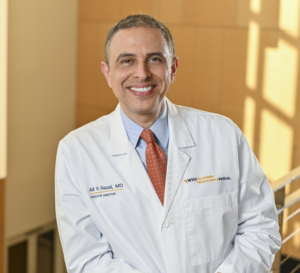
Dr. Ali Rezai is the Associate Dean of Neuroscience at West Virginia University (WVU) and Executive Chair and Director of its Rockefeller Neuroscience Institute (RNI).
#58: Ali Rezai – Long lasting Effects of Focused Ultrasound for Addiction
In this episode, we have an insightful conversation with Dr. Ali Rezai, who is the Associate Dean of Neuroscience at West Virginia University (WVU) and Executive Chair and Director of its Rockefeller Neuroscience Institute (RNI). We take a deeper dive into Dr. Rezai’s career, which features his notable achievement of performing 900 neurostimulator implants by 2006.
We highlight Dr. Rezai’s involvement in deep brain stimulation (DBS) and focused ultrasound (FUS), particularly in treating severe traumatic brain injury and addiction. This episode features interesting findings on the sustained effects of low-intensity FUS in addiction, as well as the possibilities of opening the blood-brain barrier for the treatment of Alzheimer’s disease.
Dr. Rezai shares more about RNI’s core mission and his leadership experiences in various medical societies, namely CNS, NANS, and ASSFN. We also discuss anecdotes from his presentations to various politicians, including President George W. Bush.
We cover a lot of ground in this episode, and it truly offers a comprehensive look into Dr. Rezai’s remarkable contributions to neuroscience and the broader medical field.
Ali Rezai 00:00I lost count after 2,500. So, you know, I really don't know how many who have done, but, you know, you're talking about 25 years plus of doing EVP stimulation as a very routine specialty for me and the teams that are working. My point is that without further characterizing the disease and understanding the connections and targeting those connections in a personalized way related to the deficit of the patient, we're not going to make a major advance. Interesting, which was even more of a surprise, is that our goal was to acutely reduce it because, as you said, this is neuromodulation. It's not geared towards long-term changes. But we also noticed that after the procedure, there was even a more profound reduction in the cravings for the drugs, and it seemed like it has a durability effect beyond the... short-term neuromodulation that we did. 01:07Welcome to Stimulating Brains.
Andreas Horn Stimulating Brains In this episode, Stimulating Brains Stimulating Brains We have an insightful conversation with Dr. Ali Rezaei, who is the Associate Dean of Neuroscience at West Virginia University and the Executive Chair and Director of its Rockefeller Neuroscience Institute, short for R&I. We take a deeper dive into Dr. Rezaei's career, which features his notable achievement of performing more than 900 neurostimulator implants by 2006. We highlight Dr. Rezaei's involvement in deep brain stimulation and focused ultrasound, particularly in treating severe traumatic brain injury and addiction. 02:02This episode features interesting findings of the sustained effects of low-intensity focused ultrasound in addiction, as well as the possibilities of opening the blood-brain barrier for the treatment of Alzheimer's disease. Dr. Rezaei shares more about R&I's core mission and about his leadership experiences in various medical societies, namely CNS, NANS, and the ASSFN. We also discuss anecdotes from his presentations to various politicians, including President George Bush. We cover a lot of ground in this episode, and it is truly a remarkable view into Dr. Rezaei's contributions to neuroscience and the broader medical field. I hope that you enjoyed this episode as much as I did, and thank you for tuning in to Stimulating Brains. Okay, so Ali, thank you so much for taking time to do this in your very busy schedule. And this time I will have introduced you more formally already. So to break the ice, we often ask about hobbies and what you do when not working with your surgery or research, anything you can talk about there. You know, so hobbies are tough to come by. We are very busy at work with so many things. 03:27So I like to spend a lot of time with family and friends whenever I can do it, exercise, whatever exercise possible. So really, I think the biggest thing outside family or friends is keeping up with neuroscience and keeping up with the latest advances and the work that's being done that's so rapidly growing. So it's fun for me to learn about neuroscience and how we can advance our field. So really outside of family and friends and exercise, there's not many hobbies.
Ali Rezai Yeah, yeah, I can relate to that, makes sense. And then, you know, going into how you came who you are today, you grew up in Tehran, Iran, based on Wikipedia, as the oldest of three brothers, and then moved to California at the age of 12-ish. Do you get to visit Iran often? Do you miss it? How was adjusting to the U.S. culture as a child like? No, I have not been around in 45 years, and I have great memories, and it's a 04:27Thank you. years and still have family there but have not been there 45 years and adjusting was difficult so he came here didn't speak english so i had to learn english oh and really it was a significant change in culture but as a child you adapt the younger you are the more quickly you adapt so of course oh and uh it's been a fun journey and uh but um i've not been back during 45 years and what 05:02were the next steps um moving to your career as a neuroscience as neurosurgeon and neuroscientist who were key mentors in your career um turning points that led you to where you're now i mean all of us at every stage of our lives you know we have mentors of different kinds that we learn from um and that shape your experience and your life so for me when i was at early in my undergraduate education at ucla i became interested in neuroscience and the brain i was involved in immunology research at that time but then got very interested in the brain subsequently and then in medical school it got further amplified that interest in the brain and neurosciences and i was fortunate that university of southern california medical school being exposed to key neurosurgery leaders dr michael appuzzo marty weiss giannata um at that time usc was one of the most amazing places for growth and innovation in neurosurgery 06:32when I moved to New York University. Fred Epstein, a pioneering pediatric neurosurgeon, Paul Cooper, and then Patrick Kelly became the chair at NYU. So I've been very fortunate in my education at medical school and in residency to be exposed to some of the biggest thought leaders in neurosurgery. I was also fortunate to learn more about neurosciences with Adolfo Linas, who was a chair of physiology at New York University and learned about brain imaging 07:05and magnetoencephalography. And that really sparked my interest, along with Patrick Kelly coming in to becoming the chair at New York University. It sparked my interest in being a functional neurosurgeon that really works in collaboration with neuroscientists and neuroradiologists and neurophysiologists, neurologists, and neurosurgeons. And it was really a combination of working with Patrick Kelly and Adolfo Linas that sparked my interest. And then my fellowship when I went to the University of Toronto, Ron Tasker, as at that time there, Andres Lozano was also just joined the University of Toronto. So it was really an amazing time at the University of Toronto, a functional neurosurgery being exposed to the master, Ron Tasker. His last few years of practice, I learned about pain neurosurgery, functional neurosurgery, stereotactic neurosurgery. 08:04At that time, deep brain stimulation was just starting out and was becoming popularized. This is in the 90s, mid to late 90s. So once again, I was been very fortunate in my career to be exposed to some of the key innovators at the times when the technology was emerging rapidly from every stage of my career. And I think you learn from each person's experience, from each person's experience, and you realize what the opportunities are to help more and more people and how as a neurosurgeon, you can be involved in more therapies, like for example, Parkinson's disease or chronic pain, these areas. And then I was also very fortunate to spend some time at the Karolinska Institute, Bjorn Meyerson, Bengt Linderoth, who are also pioneers in functional neurosurgery and gamma knife and pain psychosurgery. I learned a lot from them. And then Professor Benebit, who was also Alin Benebit, who was really, I would say, one of the 09:05fathers of deep brain stimulation, that really popularized deep brain stimulation in the late 80s
Andreas Horn and 90s. So those were really critical experiences of mentors. Where did you meet Benebit? In Sweden, or were you in Grenoble?
Ali Rezai Grenoble, I went to Grenoble for a short time, and he was also a consultant. When I was at Cleveland Clinic, he also came to me, and I was like, how can I And he was also a consultant when I was at the Cleveland Clinic. He also came to the Cleveland Clinic. He was an advisor to us to help build our functional neurosurgery program. So in the late 90s and the 2000s, we had tremendous connectivity with Professor Benebit. And he is a legendary visionary leader in the field. So really, you learn different elements from different individuals. Individuals, the art of neurosurgery, science of it, the practice, philosophy. So I've been very fortunate to have worked with some of the masters in the field that have really shaped the way I tackle neurosurgery and collaborations with different environments. 10:08I think that's a big aspect of functional neurosurgery.
Andreas Horn Fantastic. Yeah, it seems like also based on this short executive summary, you've been to places.
Ali Rezai You've really come around. And I think also based on Wikipedia. In 2006, you were still at the Cleveland Clinic. It says you had already performed 900 neurostimulator implants, which really is a big number. I think Heige Beckmann once told me that he did 700 or 800 in his life.
Andreas Horn So it's really a large number. So do you still count them?
Ali Rezai Because this was 2006.
Andreas Horn And how would the count be today? Do you know? Yeah, no, I don't count them.
Ali Rezai I mean, I think not anymore. I mean, just for counting. I mean, I think surgeries that we did before, but I lost count after 2500. So I really don't know how many who have done. But you're talking about 25 years plus of doing stimulation as a very routine specialty for me and the teams that I've worked with.
Andreas Horn 11:08Yeah, fantastic. Okay.
Ali Rezai And so then moving ahead to your many domains that you've pioneered things, I think one, two that we have to briefly mention, or
Andreas Horn maybe two. Maybe not briefly, but is in 2007, you were the last author on the Schiff et al article in Nature in which you showed behavioral improvements after thalamic stimulation in severe traumatic brain injury. Can you maybe broadly talk about that study, but also maybe the future of deep brain stimulation in disorders of consciousness a bit? Yeah, that's an area.
Ali Rezai I mean, disorders of consciousness or traumatic brain injury is a very active area for all neurosurgeons and neuroscientists. And the studies that we did at that time in collaboration with colleagues across various specialties, neurology, neurosurgery, neuropsychology, brain injury, rehabilitation, computational neuroscience, really showed that you can improve function, alertness, consciousness, and connectivity and function with patients. 12:17But the studies need to continue. The funding. The funding was limited. The studies never were scaled. And I think it's an area that we need to really understand better. One of the fundamental elements is the characterization of the brain injury. And these disorders of consciousness can have vegetative state or minimally conscious state or a combination of many deficits that result in motor deficits, sensory deficits, consciousness, cognitive behavioral deficits. And really, I think from the consciousness of the spectrum, in my opinion, it will not, neuromodulation will not help people on the vegetative state. 13:00I would say minimally conscious state needs to be explored further and people that are less severe than the minimally conscious state can potentially benefit from neuromodulation and deep brain stimulation. And also others, for example, the Japanese and others have done spinal cord stimulation, neuromodulation for traumatic brain injury.
Andreas Horn Yeah.
Ali Rezai disease characterization and classification is critical, as is with everything else we do in functional neurosurgery, whether it's Parkinson's disease or traumatic brain injury or depression, obsessive compulsive disorder, and everything we do in functional neurosurgery. If you don't have the right disease classification that the procedure can potentially help, you're not 14:00going to get benefits. So that classification, characterization, and inclusion, exclusion is very important, and that's where some of the work that you're doing is really important with connectomics and personalized connectomics, looking at tracts and how different parts of the brain are connected. Really, we need to move beyond looking at generalized anatomy, black and white, if you will, MRI, into more move from black and white to color TV, to high definition and technicolor, and all. This is how evolution is going. So my point, is that without further characterizing the disease and understanding the connections and targeting those connections in a personalized way related to the deficit of the patient, we're not going to make a major advance. So I think there's a great opportunity with neuromodulation, DBS, even focused ultrasound has been done. The groups at UCLA have done focused ultrasound neuromodulation, and they've shown some preliminary really encouraging results. 15:05Modulation, activation of these thalamic nodes and other deep nodes in the brain involved in consciousness can potentially benefit people with consciousness disorders and brain injuries. But you've got to look at everything. There's motor, sensory, cognitive, behavioral deficits. So we need to look at different components of brain injury and how we can help them. And you mentioned it, that funding was limited. And I think funding is a big problem here because it's also, you know, you'd have to pay for DBS device. If it's with DBS. So I know you are currently more engaged in other topics that we'll cover.
Andreas Horn But if you had to, you know, put your nickel down on what to do next in this field, what would the best next step study look like? What do you think?
Ali Rezai Really, what we need to do is to... Characterization. Yeah. I think the key thing is looking at the disease classification is very important. 16:04Really, technologically... Technological innovations, you have to partner and have the industry support you. So like you said, having us to have to pay for the devices, but the industry needs to provide the devices, needs to provide the engineers, the software developers and others to work with you. So really need the collaboration of different specialists, imaging, connectomics, looking at deep brain stimulation, the settings of deep brain stimulation, the physics. How are you modulating the nervous
Andreas Horn system? So that's a big part of it. And then the other thing is, you know, you have to have a lot of
Ali Rezai circuitry. All these things are really critical to advance in the future. I think without that, we're not going to make an advance. It's going to be very challenging. So, you know, we need to really fundamentally facilitate these personalized, minimally invasive therapeutics. In my opinion, that's where the field is going. And every once in a while, you have these disruptive technologies 17:01that potentially can be game changers. EBS was one in the 90s. And now it's the first one. And so, we need to have a more personalized approach to disease therapeutics and classification of the disease. And the most important thing is to have a more personalized approach to disease therapeutics and classification of the disease. And the most important thing is to have a more personalized approach to disease therapeutics and classification of the disease. And the classified better, we can treat it better, in my opinion, by tailoring the therapy for that specific deficit versus just doing a general neuromodulation. Yeah, great. So, I think a current hot topic in your lab and in your center is also addiction. And I heard from Pierre Dehaize that currently you've essentially moved away from deep brain stimulation and focused on ultrasound surgery. But 18:00maybe before we go into that, can you talk a bit about your experience with DBS for addiction that I think you've done
Andreas Horn before? Yeah. So, you know, the addiction, as you know, is a big problem in the United States. And more than 40 million people in the U.S.
Ali Rezai have a diagnosis of a substance use disorder, or SUD. And that includes alcohol, drug use, includes opioids, cocaine, methamphetamine, heroin, many other drugs. Outside the U.S., it's different. It's more cocaine or alcohol. So, it depends on what region of the world you're in. But in the U.S., opioids are a big problem in North America. And so, we know from years of research, decades of research, that there are networks in the brain that are involved in the reward circuitry, the behavioral regulation, the reward circuitry involved in the cravings and the reward drives. And that results in a lot of 19:05obsessive behavior that can result in OCD, but also can result in addictions. And some of these key notes in the brain that have been explored with decades of animal research and human imaging and other research include the nucleus accumbens, eventual striatum, the insula, some of the prefrontal cortical areas, prefrontal, medial prefrontal cortex. So, what's important, and dorsal lateral prefrontal cortex. So, what's important is that neuroscience and imaging advances and animal research has identified nodes or regions in the brain that are implicated in the circuitry of addiction. And it's the same whether you have addiction to nicotine or you have addiction to drugs or alcohol, and even behavioral addictions, gambling addictions, binge eating, for example, some of the eating disorders, binge eating being the most 20:04common eating disorder. And sports gambling, which is becoming a big problem in this country. All of those fundamentally involve the same networks in the brain. So, in 2018, in collaboration with the National Institute of Drug Abuse, we were able to obtain a U01 grant. And what we said is, can we, we have had decades of experience, we did the studies initially in early 2000s with deep brain stimulation of the accumbens and ventral striatum and ventral capsule for OCD and depression. We published those with a lot of interest. So, we did a lot of research on that. So, we did a lot of research on that. And we were able to gather a lot of 21:05a big problem in the U.S. So we were successful in obtaining a grant from the National Institute of Drug Abuse to do a pilot safety and feasibility study of the nucleus accumbens of DBS for people with severe end-stage opioid and other substance use. And these are people who've had multiple overdoses and 20, 30 years of drug use and treatment resistant, whether it's inpatient or outpatient, residential programs, really severe patients that have a high chance of overdosing, and they have overdosed and potentially dying from their overdose. So that was really the genesis, the background research from a scientific rationale, the safety with DBS in that region for many years. So we said, let's try this for DBS for addiction. And so it started in 2018. And also, Andy, there's been 22:03Other people across the groups in Germany have done great work looking at alcohol addiction. The groups in China have looked at opioid addiction. The groups in Portugal. So there's been a lot of attempts at looking at addiction and deep brain stimulation fundamentally in the community's accumbance. So with that background, we started this study for safety and feasibility. And we were able to enroll four patients in this first phase of the safety and feasibility.
Andreas Horn And the results showed that it was interesting that we can very acutely, like a tremor being turned on and off.
Ali Rezai When we were in surgery during the procedures, when you have a DBS in the accumbance, when you turn the DBS on, we had an acute reduction in the cravings of the individuals for heroin, opioids, and benzos, and cannabis, and nicotine, which was really profound.
Andreas Horn And we're saying, wow, that's really interesting.
Ali Rezai 23:02We're seeing an acute change, like I see a tremor stop.
Andreas Horn Yeah.
Ali Rezai And that really gave us a pause. And we said, okay, seems like you can acutely reduce cravings in people with severe addiction. And we were doing a craving test where we're trying to trigger the cravings by showing visual cues. You can show visual, tactile, other sensory cues that can further activate somebody with an addiction and their cravings.
Andreas Horn So DBS acutely resulted in craving reduction, which was really interesting to us immediately.
Ali Rezai And then subsequently when we did chronic stimulation. And the study showed that the DBS was safe and we're able to have two people that were abstinent completely. And we published this in the Journal of Neurosurgery and in the Experimental and Clinical Psychopharmacology. One patient we discontinued because he was noncompliant with the study protocol. And the protocol made it really difficult to have follow-ups and connectivity. 24:02These are very difficult patients with significant psychological, bio, social elements. So what we came to the conclusion in collaboration with NIDA is that DBS is safe and can be effective. But it is very challenging. It's an invasive brain procedure. And it's a very intense protocol demands for patients that are often we can't get a hold of them.
Andreas Horn Yeah.
Ali Rezai They're out in natural environments. They don't respond. They get off the grid. So recruitment and compliance was a big challenge. And scaling, in our opinion, scaling of this for a large study. You should always look at scaling. Doing one or two patients, in my opinion, is fine. But you should look at how you can change the field. So we said that scaling is limited.
Andreas Horn And that's why we started exploring ultrasound for addiction. Yeah.
Ali Rezai And I think exactly that. If I'm informed correctly, the thing that is published is currently a case report. 25:06And that was in biological psychiatry, which showed long lasting improvements in one patient with addiction.
Andreas Horn And that was after low intensity focused ultrasound in the neck, which is very interesting.
Ali Rezai So maybe for the listeners, just to clarify, this is not lesional. This is not burning a lesion into the neck and nucleus accumbens. But low intensity neuromodulation.
Andreas Horn Yeah.
Ali Rezai So it's not burning a lesion. And I had conversations with people of your team, Pierre Dehaize and also Manish Ranjan. They essentially said that similar successes have been made in additional patients already. And I think your team was understandably surprised by the long lasting effects of this treatment. Because you would typically think low intensity FAS would be reversible. So maybe you can talk a bit about this study. And this endeavor.
Andreas Horn Yes.
Ali Rezai 26:00I think for your listeners, I mean, ultrasound, focused ultrasound, I think has come of age. And there's now 20 plus companies. So this area is rapidly growing very quickly. I see it as where DBS was in the late 90s and 2000s. So you're going to see a rapid increase in focused ultrasound applications, which is exciting. But the other thing I would say is that, you know, I think that's a very important thing.
Andreas Horn Yeah.
Ali Rezai So there's three applications for the readers that may not know focused ultrasound well. I'm sorry, the listeners rather. One is a high intensity where we deliver increasing energy and you make it a thermal energy with a higher and higher and higher dose of ultrasound to make a small thermal lesion. And that's used for tremors or Parkinson's, FDA approved with the company Cytek. But there's also exploration going on for FAS. So there's a lot of exploration going on for epilepsy, lesioning and neuropathic pain. 27:01And the groups in Korea, South Korea, Jinwoo Chang's group have done tremendous work with lesioning with ultrasound for obsessive compulsive disorder. The Toronto group is looking at depression. So really, lesioning is one of the most significant applications for neurosurgeons for focused ultrasound. The second application is blood brain barrier opening. Where you, in conjunction with micro bubbles, you open the blood brain barrier. And what you're doing, you're delivering therapeutics like chemotherapy or antibodies. Or you can do what's called the brain liquid biopsy. Where when you open the blood brain barrier, you can have more targeted therapies going from the blood vessel to the brain. But also you can sample the milieu that you opened the blood brain barrier in the vessels to sample for biomarkers. So it's really exciting what we call liquid biopsy. And then the third application, which is rapid. Very rapidly growing is neuromodulation, as you said. 28:00And that uses a different frequency of ultrasound. That's not a thermal lesion. It's a lower intensity. So roughly, if you speak about it, it's probably 10% or less of the energy that you do for a lesion. A thermal lesion.
Andreas Horn Which is, that's why you're not getting a lesion.
Ali Rezai But what we saw. The same target that comes is what we saw. We initially did a dosing and safety study that we published. Because there was no experience in this in the world. As we're trying to titrate to find out the right dose, we noticed that in the same way that you can acutely reduce cravings that we saw in DBS in 2018 and 19. In 2020, 2021 and 2022 with the studies that we did. In. Safety and feasibility. We saw similar findings, which was really surprising to us.
Andreas Horn And what was interesting, which was even more of a surprise is that.
Ali Rezai 29:03Our goal was to acutely reduce it because as you said, this is neuromodulation. It's not geared towards long term changes. But we also noticed that. That the, after the procedure, there was even a more profound reduction in the cravings. And for the drugs. And it seemed like it has a. Durability effect beyond the short term neuromodulation that we did. So that's been a study that we've done 20 patients as part of this study. That's being submitted publication now. And then now we're doing a placebo controlled randomized control trial sponsored by the National Institute of Drug Abuse for people with severe addiction. And I'm sure you can talk about the study results yet. But that single case, I think that's published. You can maybe walk us through.
Andreas Horn There was three months effects of this or yeah, maybe it's better if you just. Yes. 30:00Yeah.
Ali Rezai You present the results at the American Society of Stratagic and Functional Neurosurgery in Nashville recently. And so basically the we were we have eight patients now. We looked at long term follow up. And what we saw is that one session of focus ultrasound. Targeted. To the. To the nucleus accumbens. Is resulting. In sustained reduction. In cravings. Across various substances, whether it's. Methamphetamine cocaine benzos. Opioid cannabis and alcohol. And across the board. These individuals who have poly substance use disorder. Primarily opioid. We saw sustained craving. During the procedure immediately with the ultrasound. And then it was sustained to 90 days plus. And. We're still getting approximately 90% reduction in cravings in the long term.
Andreas Horn And we're following these individuals. 31:00And. The next question after that is what's happening with urine talks?
Ali Rezai Because if the cravings are reduced. Are we also. Impacting people's actually taking drugs when they're out in their natural environment. So as part of the study. We're also show showed that. Five of the eight. Participants for the long term. They were abstinent. And these are people that. Immediately. When they were outside of the program or discharge from the residential program. Within a week, they were using multiple drugs. So. We thought that that was a significant benefit that we're seeing. Not only the craving, but concomitant abstinence or a very dramatic. Production drug use. And these individuals are going back. To work. Re-engagement in their life. And one of the most critical things that people need to know. It's not a cure. But what it is, we believe that this mechanism needs to be determined at this point. But we believe that. 32:00Along with animal research and others that. We're the nucleus accumbens with persistent drug use. It gets more super sensitized and dysregulated. You're not born an addict. But you become an addict. And you're not. You're not. You're not. You're not. You're not. You're not. You're not. You're not. You're not. You're not. You're not. You're not. You're not. You're not. You're not. You're not. You're not. You're not. You're not. You're not. You're not. You're not. You're not. You're not. You're not. You're not. You're not. You're not. You're not. You're not. or breaks the cycle, if you will. But same thing that DBS does, but DBS, you need sort of a continuous stimulation that we sell. So everything we see in ultrasound, we sell in the DBS as well, and the same findings. But ultrasound, the difference is that it's one treatment 33:01is resulting long-term. And the mechanisms are unclear at this point, so there are several hypotheses. So definitely ultrasound is causing a mechanical disruption of the cell membranes without increasing the temperature. So there's no temperature increase. The safety is extremely robust and good at the doses that we're using and the durations and the duty cycles. But there's a perturbation of the membranes causing several mechanisms. Activation of the mechanosensitive ion channels in the neurons or glial cells membranes. That's causing calcium signal transduction and others. And there's also thoughts that you're creating physical pores, sauna poration, the lipid layers of the membrane. And also you're inducing electrical changes across the membrane like DBS does. So we think the effects are like DBS but additive because you're also causing mechanosensitive ion channel changes. 34:02And so all of those is good because you're probably resetting the nucleus. But DBS is good. The target that we have is not just the accumbens. The accumbens are part of the internal capsule with tractography. So you want to basically help reset the nucleus but also facilitate the connectivity with the prefrontal medial cortex to facilitate behavioral self-regulation. That's our hypothesis. And it's not a one-shot cure. But what it does is resets the brain in these individuals so they're not having cravings anymore or significant reduction. And that's important because now we're talking about a new technology. Now the therapists, the peer recovery counselors, and the psychiatrists, psychologists, they can now have a better chance of working people with addiction and helping them. They're retraining their brain because imagine people that are driven by addiction and the focus to get their next fix for 20, 30 years 35:01and they have not known any other way of functioning. Addiction has governed their life.
Andreas Horn Hence why there are such severe people with severe addiction.
Ali Rezai And treatment is resistant. Now that craving is not driving them anymore. It's disconnected in some ways. And so the concomitant behavioral therapy is extremely important. So it's not a magic cure, but I think it causes a reset and now it enables the therapist to be more effective with these individuals that retrain them about dealing with their anxieties and stresses and other variables that are contributing to them taking drugs. This is really such a fascinating topic. It's a fascinating story. If it holds the test of time and it looks like it will, this is really a huge breakthrough because, I mean, as you said, compliance, if it's a one-shot treatment, that's so much better for such a population than DBS where lots of programming visits and so on need to happen and it's much more invasive and so on.
Andreas Horn 36:00And then, you know, very interesting
Ali Rezai that it's a non-lesional approach here. And, you know, when I first... heard of it, I thought it might be even some sort of resetting of microcircuits in the nucleus. So where it's, you know, there is some... I'm sure there's sonic waves that do something.
Andreas Horn So maybe if some of the excellent and right connections get cut off, that could be another thing, right?
Ali Rezai So that would be a bit more disruptive, but it would still reset, as you say, the nucleus. So it's a super interesting breakthrough, I think. And so we'll be... very exciting to watch you guys, how this unfolds. We need collaborators. We want this to be done in other sites and we need other collaborators like yourself and others to work with so we can understand the mechanisms, as you said, because it's like DBS. The results when it happened initially are very profound, but we've got to understand the mechanism. So we were surprised to see this, 37:01but we saw the same reduction in cravings with the DBS patients. So their DBS has an effect, but if you turn it... off, the craving goes back up again. So it's not... you need long-term treatment. Ultrasound is different. That's why I think this changes at the cellular level and this mechanosensitive because the vibrations ultrasound is doing is changing the membrane potentials and causing... it's been shown with animal studies that you get signal transduction and activation of these mechanoreceptors, calcium channel single transduction, and you're seeing... you can't... you can't just get a long-term effects with just a short-term stimulation. So you're probably causing some genetics and epigenetic changes that needs to be studied with animal studies. So I think it's very important for the field to get involved with this neuromodulation. Again, it requires dosing and timing and duty cycles, but I think it's an important time for us to collaborate and other groups to get involved 38:03because this needs to be replicated and we need others to do this and also learn more because when we target this area, we target the nucleus accumbens, but also we use tractography and looking at tractography and functional MRI to see what's going on. So we need to understand what is this clinical response that we're seeing, what's happening in the brain. Really cool.
Andreas Horn Have you ever had a patient relapse and then could perform a second application?
Ali Rezai Great question. Of the 20 patients, indeed, we've had a couple of patients that over time, they have had a, they don't get full relapse, but they're using and they're engaged more. And it's because if you let them go back in their environment, so it's like looking at the heart, for example. You can cardiovert the heart or change the function of the heart, but then you can go back into atrial fibrillation. So I think the environment is very profound.
Andreas Horn That's why working with experts in addiction to really help these people start being in charge of their,
Ali Rezai 39:06of their, their, their, their go, no go or their behavior regulation. But I think by reducing cravings, you're taking out that craving driver in terms of how they're seeking drugs. And now they're able to think better. But we have had situations where we've had to retreat. And again, the dosing, we're still trying to figure out the right dose. So the dosing is not optimal yet. But we think we're now doing this for over almost three years that the dosing, at least in our experience, is not optimal yet. So we're still trying to figure out the right dose. But we think we're now doing this for over almost three years that the dosing, at least in our experience, for addiction, we think that the dosing is becoming more standardized. So again, this is a, we're learning with every patient, but we've done 20 patients in an open label. And we're now conducting the placebo control randomized trial. Super cool.
Andreas Horn Do you see application of a similar approach in other disorders, depression or similar? 40:02Yeah, I do. Like a neuromodulation approach?
Ali Rezai I do. And I think it's already being done by others. So for example, you know, you're expert looking at connectomics and connectivity, which is really personalized way of how networks are connected. And you can target those networks in a personalized fashion. You know, you just don't want to go on an MRI and X marks the target. You want to take that target, refine it in a personalized fashion with connectomics and tractography. So there's already evidence coming out with published studies from different centers for depression, the subgenital singular target. That's now a target for DBS studies. Already people are working in that, showing some promising results with ultrasound. There's work being done for post-traumatic stress disorder. People are looking at different behavioral OCD and others. So I think it's a very fertile area for investigations because fundamentally, 41:01the non-invasiveness or minimally invasiveness of this and the outpatient nature of this, really makes it an important area for adoption.
Andreas Horn And people want it because that's why we have to stop the DBS surgery for this, for addiction,
Ali Rezai because we cannot justify doing a brain surgery and opening the skull, putting an implant eight centimeters deep in the brain, in the accumbens with its associated risks and chronic programming needs and maintenance and management, if potentially a non-invasive, one-hour procedure as an outpatient procedure can give you similar results.
Andreas Horn So that's why we actually, we had a grant and study to do this as a randomized control trial for DBS,
Ali Rezai as a UGUH grant that we obtained from the National Institute of Drug Abuse. Well, we had to retool and say, it's not, ethically, we cannot be doing DBS surgery 42:00if the ultrasound surgery, if the ultrasound procedure is showing similar benefits. Whether that, the answer remains to be determined still, we're doing the trial, but if the results are consistent, then there's no reason to do DBS, in my opinion. Sounds good.
Andreas Horn Yeah.
Ali Rezai And then you've mentioned, of course, and we talked about the long sustained effects here. We have essentially a test simulation, low frequency,
Andreas Horn and that has an effect over three months or more in drug abuse. And in the VIM, if we do it for tremor, where we typically lesion, we don't see that, right?
Ali Rezai Tremor stops for a while. But then relapses after minutes, I think.
Andreas Horn How do you think of this mechanistically? Why is it different for tremor versus addiction?
Ali Rezai I think we're using a different dose. And also for tremor, the duration, we're looking at thermal effect for tremor, and the duration of the energy is causing a thermal increase. 43:00So it's a short duration, high energy of one focus. Here, the focus is a bit larger. Then the tremor focus. And it's not a thermal energy. It's not an energy that's causing a thermal increase. So I think there's a fundamental difference. Also, the frequency is different. We use a 650 kilohertz, although the group in France have shown nicely that 650 kilohertz high intensity ultrasound can reduce tremor and can be sustained for a while. But it comes back. So I think it has to do with the dose. I think it has to do with the duration. And really the duty cycle. And I do believe potentially you can see some effects also for tremor, but it needs to be studied. Certainly the French group is showing that you can reduce tremor, not permanently or long term as we do the lesion, but you are having the impact. So you just got to understand how often you may need to treat and then or maybe the dose is not optimized. A lot of research needs to be done, but fundamentally that's thermal. 44:03And this is a different energy. And the dose is different. We do in neuromodulation. The doses do a longer term and is roughly 10% of the dose that we're giving.
Andreas Horn Yeah.
Ali Rezai It will be high intensity. But keep in mind for your listeners that the ultrasound can be one transducer like they've done for people with brain injuries and consciousness, or you can have two transducers, phaser rays. You can have the helmet like the incite like helmet. There are many, many different. Number of ultrasound transducers, frequencies of duty cycles, all phase corrections, skull correction algorithms. So skull density, there's a lot of variables that contribute to how much actual dose is being given to particular region, including the nucleus itself. You may have a nucleus that or target region that sensitize and excited, excited, and you 45:00want to shift that to a less excitable nucleus, or you may want to activate a different nucleus. That's not as active. So it really depends, as you know, and the listeners on the location that you're modulating and how you're modulating.
Andreas Horn Yeah.
Ali Rezai Very good points. And I mean, the maybe an additional explanation could also be that that it's, you know, sometimes I feel that in tremor, VAM surgery is really effective, but it sometimes feels like putting a cap onto something and the real site might potentially be in the cerebellum or, you know, more network effect or so. And it sometimes comes back and it's almost as if the cap is being broken up by the water coming in, you know, somehow. And so it could also be that in tremor, we're not at the causal site, if that even exists. And it's always, you know, a network effect, but maybe the knack for addiction is more the central hub.
Andreas Horn And that's why it might have, you know, more sustained effects.
Ali Rezai 46:02Just another idea or concept.
Andreas Horn Yeah.
Ali Rezai You're 100% correct. It's fundamentally about the network effects. And there are other networks that may need to be targeted. I mean, we went to the VIM and best routine and the results are good. There's a, I would say about 10% recurrence rate, at least in our experience over time. And as we get better and better, we're able to lesion more effectively, but you're right, different parts of the network take over.
Andreas Horn And we've got patients even with DBS, fantastic tremor control and good location, and then
Ali Rezai a certain number of patients. The tremor comes back despite us being in perfect location, good tremor. So the network overcomes that, as you said. And I think that needs to be studied further. And look at the phenotype of patients, certain patients tremor, it's very, very heterogeneous condition. It's not just essential tremor. That's it. There are different types. There's distal tremor, proximal tremor, intention tremor, so many different components. For us, we do tractography with the DRT and we do corticospinal tract. 47:04That helps facilitate better. But I think this tractography and circuitry localization, this personalized fashion, it is going to govern everything we're doing in neurosurgery in the future. I have no doubt about that. We once met in person already, and that was in Boston at, I think, a FAS event organized by Reece Cosgrove at the Harvard Club. And I briefly mentioned, I think, remember, you briefly mentioned that focused ultrasound will be the future. Here you said similar things. And I've had some questions. I think I've heard from Dr. Kulavu Hyneinen on the podcast as well, who is one of the key pioneers in the MR guidance and of the method. And he even, I think, went further in his, like in the last minutes of the podcast episode, he said that in the future, everybody will have a device at home and use it for various things and so on. So I think they're also developing, as I'm sure you know, these more personalized, you know, head cast based systems that might have even, you know, more direct ways of monitoring. 48:04And I think it's sort of like using low-intensity FAS. And in 2024, you published a New England Journal of Medicine article on doing that to remove or increase the removal of amyloid beta plaques in Alzheimer's disease. Patients that underwent antibody treatment. That's a complex concept.
Andreas Horn So could you break it down for us and maybe talk a bit about that study?
Ali Rezai Yes. And, you know, Colervo is the visionary leader. So he has trained so many generations of people. He is amazing. So I'm glad you had him on your podcast.
Andreas Horn That's fantastic. He's a visionary leader.
Ali Rezai People need to listen to him carefully. And I agree with him. 49:00The future, right now, there are probably 20 different companies out there. So it's going to evolve. The technology always will evolve. And I think us, fundamentally, at Focus Ultrasound, it's changed the game. In my opinion, it's a disruptive technology in neurosurgery because patients want it. They're asking for it because it's effectively minimally invasive. And it's an outpatient procedure. You're not doing surgery. So that, by itself, lends itself to huge application. Neurosurgeons need to be staying involved in ultrasound because potentially, as time goes on, as it gets along, you'll have non-neurosurgeons doing it as well. So you're going to get practitioners, like neuromodulation, being done in neurostimulation, not only by neurosurgeon, but by others. So there'll be a large group of people being ultrasound practitioners. Whether it's, I think, the domain of lesioning is at the domain of the neurosurgeon. Block brain barrier opening, I think, is still neurosurgeon. The neuromodulation, it will be non-neurosurgeons, in my opinion, who will be involved more and more 50:01because the systems are getting less and less invasive. And like you said, at or at home in the clinic can be done like a TMS. The difference is with ultrasound, a big difference as compared to TMS, is that it can get deep in the brain. TMS cannot get deep in the brain, transcranial magnetic deletion. So it's a fundamental, of key fundamental importance for ultrasound, is getting these deep targets. Regarding block brain barrier opening, I think is another very important technology, and I would call it disruptive in our field because it allows us to now, for the first time, overcome the block brain barrier, which has been an area in neurosciences of significant importance that prevents 98% plus of medications to get across the block brain barrier into the brain. As a result, you need high doses, high frequencies, and sometimes systemic side effects because you have to give higher dose of drugs. But if we can now open it non-invasively, in the past we did, we do direct catheters going inside the brain 51:01to deliver it locally, or you did intra-arterial therapy and others to open the block brain barrier. Those can be effective, but this is, in my opinion, the ultrasound-guided approach is non-invasive or minimally invasive, and it is a game changer if it's developed appropriately in the future. So what we do is we basically inject micro-bubbles, and these are micro-bubbles or lipid-soluble spheres that go through your system after injection in a short time, but is used for cardiac imaging. It's routine, FDA-approved for cardiac imaging. So we inject it. We inject micro-bubbles, and they're circulating in your entire system and bloodstream from head to toe. And then the area that you deliver ultrasound, you give a dose that causes the micro-bubbles to oscillate and expand and contract. And you've got to be careful because if you give too much, the micro-bubbles can burst and get problems, and it can burst the capillaries. 52:01So there's a dose-response curve that's critical for safety. But what you can do is anywhere the ultrasound beam is being directed to, where the bubbles are circulating, they can oscillate and contract and expand, and that mechanically and with other mechanisms opens the blood-brain barrier temporarily with the safe doses that are determined. And for 24 to 48 hours, you're getting blood-brain barrier opening as determined by gadolinium contrast getting into the interstitium of the brain. So this is very, very important because now the blood-brain barrier is open. So gadolinium gets in, blood-brain barrier is open, that's a biomarker for it, but it may be open longer, but we don't know. But typically we say after 48 hours it reseals because we don't get no more gadolinium going in. Forty hours. But what's really exciting is now you can deliver chemotherapy for brain tumors. You can deliver antibodies that have been published for brain tumors. 53:04Any part of the brain, cortical, subcortical, brain stem, doesn't matter. You can deliver medications, antibodies, and others to different parts of the brain. So we've been involved in the studies for brain tumors, but one of the things we want to do along with other groups is look at Alzheimer's disease, which is a big problem. And one of the important things, Andy, for neurosurgeons and others is we need to expand the domain of therapeutics and go beyond brain tumors or vascular disease to diseases that before could not be treated optimally. And I think looking at Alzheimer's or addiction, these are areas that there's more opportunities. Ultrasound, I think, is providing that. So with regard to brain tumors, I'm sorry, with regards to Alzheimer's, we started in 2018, six years ago, looking at the safety and the dosing. 54:01First you've got to figure out the dose and safety. Same thing with addiction. Blood-brain barrier opening, we've got to figure out how to do it by itself so we can be comfortable with the dosing. And this was done in collaboration with Insight Tech, the manufacturer, and University of Toronto, Neil Lipsman's group are doing a great job with that as well. They were the pioneers in this. They published in 2018 in Nature Medicine. And so our group and Jin Woo Chang's group in Seoul, South Korea, French groups, they all have been investigating Alzheimer's. And seeing if we can open the blood-brain barrier using different approaches.
Andreas Horn And what was shown is that just the opening of the blood-brain by itself
Ali Rezai caused a clearance of these beta-amyloid plaques. And we think the mechanism is probably activation of microglia in the brain because now they're exposed to antigens that they're not normally exposed to because of the blood-brain barrier. And serum gets in there. But also we think we're activating glymphatics. 55:01You see perivenous permeability and all that. So complex mechanisms. But the fundamentals of how to safely open the blood-brain barrier in Alzheimer's disease has been worked out to a large extent. Still ongoing, but worked out. Sorry to interrupt.
Andreas Horn How do you show that it leads to clearance? Is that with PET? Yes.
Ali Rezai We do beta-amyloid PET scans. That's done. And for the listeners, beta-amyloid accumulation is an element. And tau accumulation that you see in the brain of individuals with Alzheimer's disease. And roughly for 20 years, your brain is accumulating beta-amyloid. And you're not aware of it until it reaches a tipping point of accumulation, at which time you get the clinical symptoms. But by that time, it's often too late. And so the field is moving towards earlier diagnosis, sort of in the preclinical diagnosis 56:01by looking at the blood-brain barrier. And the first thing that we did was we looked at the blood-based biomarkers, PET scans and other biomarkers, even optical coherence tomography, OCT, that looks at behind the eyes at the seven layers of retina. You can see changes going on in retina in conjunction with early Alzheimer's. So now, more than ever before, we are in an exciting time where we can now be able to detect Alzheimer's or Parkinson's earlier. So the question was, now we can open the blood-brain barrier in Alzheimer's, and you're getting some reduction in beta-amyloid as detected by PET. And we think that's due to maybe a facilitation of the clearance of the PET because the lymphatics are activated
Andreas Horn or the microfilia are coming in and clearing it there. So we said, okay, how about doing a next step?
Ali Rezai There are now this category of drugs called disease-modifying agents, which really change the world of Alzheimer's. And the drugs are aducanumab, which was FDA-approved first, 57:01and then there's lacanumab, myobionogen and ISAI, FDA-approved, and most recently, two weeks ago, the FDA-approved donanumab, the Eli Lilly drug. And this category is really exciting for people with Alzheimer's. It's no longer a death sentence for the brain. I think there's a lot of great potential for Alzheimer's because now these drugs have shown that infusion with these antibodies against beta-amyloid, over 18 to 24 months, the beta-amyloid in the brain is clear. And more importantly, patients' clinical progressions are reduced. So by roughly 30% or a bit more, the disease progression is slowed down, which is remarkable in people with Alzheimer's. So what we said is, okay, these disruptive technologies of disease-modifying therapeutics that now is available, routinely being performed. People come in once a month or twice a month and get an IV, like a chemo, but instead of a chemo, 58:00they get a vaccine. They get the antibody. And then they keep on getting it every other week for two years. And then the plaques are reduced. One of the problems with this is that you get these REIs, AMALOID-related imaging abnormalities in the brain, which are a problem. You can get a hemorrhage or swelling in the brain, and that's a limitation of these drugs. So we said, what if we can now combine, give the people the drugs, but also open the blood-brain barrier in selective parts of the brain
Andreas Horn that have a very high density of beta-AMALOID plaques?
Ali Rezai So target those areas, specifically the signature areas in Alzheimer's, the frontal areas, the temple, the hippocampus areas, some of the parietal areas, which are important in the deficits of Alzheimer's. So we targeted areas with high SUVR. It's the unit that's used for PET scan for beta-AMALOID. And we said, okay, let's treat the individuals with FDA-approved antibody. They get it in the morning. We wait two hours to make sure 59:01that there's no side effects to the antibody. And then heard this FDA study, again, it's a safety study. We opened the blood-brain barrier in areas where there's a large density of beta-AMALOID. So that was the study design. And what we said is that if we can clear the plaques in a few months versus two years, then maybe this is a potential for future scaling. So that was the hypothesis. And we showed in the first two years, the first three patients that was published in the England Journal of Medicine earlier this year, that we've had a, with blood-brain barrier opening in the hemisphere that we had the blood-brain barrier opening, we compared the contralateral hemisphere of homologous areas with no blood-brain barrier opening. So the whole brain is getting the antibody, but selective blood-brain barrier opening in specific parts of one hemisphere. And we compared to the other hemisphere. And we showed that by just, again, small numbers, so I want to be cautious about generalizing this. But we showed that the blood-brain barrier opening, 01:00:01in the areas that blood-brain barrier was open, there was a 50% plus more reduction in beta-AMALOID at each treatment time up to six months, and a much more significant reduction. So we're now continuing that. And our goal is to see if we can reduce the beta-AMALOID plaques in the brain within three months versus waiting two years. So that was a feasibility and safety study that was published in the England Journal of Medicine in the United States.
Andreas Horn Fantastic work. Yeah, this really shows combining from all angles,
Ali Rezai using FUS, but also very modern therapeutics.
Andreas Horn And so, yeah, very fascinating.
Ali Rezai Thanks for walking us through that. You serve as West Virginia University's Associate Dean of Neuroscience, as well as Executive Chair of the Rockefeller Neuroscience Institute. And if I understood correctly, the institution was founded with backing of U.S. Senator Jay Rockefeller. You're a fellow of the Rockefeller family,
Andreas Horn 01:01:00and you were recruited as founding director of the institute. What is the core mission of the institute? What has it brought you? How do you use this opportunity to make progress in the field?
Ali Rezai Thank you. In 2018, about six years ago, we formed the institute as a new concept. We wanted to model this after a comprehensive patient care research and education institute like Memorial Slate, or Sloan Kettering, or MD Anderson, or these are large comprehensive cancer programs. And they're limited in the neuroscience world. We don't have a comprehensive institute. Not many of them that have... Some are research institutes, some are patient care. But in this case, we said, okay, let's take all the neuro departments, neurology and neurosurgery and psychiatry and neuroradiology and basic neuroscience, and then PMNR and others, all come together into one unit 01:02:00that is break down the silos, the chairs manage the department, but there's institute multidisciplinary programs. So we created this new concept of breaking the silos and create this institute as a new experiment. And really, it was supported by the... by Senator Rockefeller and our institution, West Virginia University, to form this. And our goal really is to improve patient care, health and wellness, and educate the next generation of individuals involved in neuroscience, stakeholders, and also to tackle large public health challenges. And that is institutes, one of the core missions is rapid cycle innovation by collaborating with different specialists. And this includes the public, private sector, industry, government. So we're very, very much about rapidly accelerating 01:03:02the collaboration, breaking down the silos and breaking down the barriers so we can rapidly get outcomes. And we've grown significantly, and we have 250 full-time faculty institute right now. And our team manages about 280,000 patients in the past year with neurological and mental health conditions, across rural America. So it's a new model, and we're looking at population health, longitudinal health, because all the patients are connected with EMRs, so we have access to data with patients, psychosocial and clinical and medications and other histories. And we follow individuals longitudinally to look at disease across rural America and other areas to see how we can help advance population health. So that's the genesis of the institute. Super cool. You are past president of CNS, NANCE and ASSFN.
Andreas Horn 01:04:00Can you talk a bit about leadership in medical societies, what you learned in these experiences, what you could achieve as a president and how it may have helped your career and your network? Yeah, I was really,
Ali Rezai it was a great privilege and honor in my career to contribute to organized neurosurgery. And I encourage those who are interested to participate. It's about volunteering and meritocracy and basically you volunteer in committees that are involved. A lot of it fundamentally is about education, innovation, advocacy, teaching the next generation of leaders, teaching neurosurgeons about the different aspects of their craft and arts and also advocacy to make sure that neurosurgery, with our Washington committee, we are able to make sure that the future is protected and supported for people about neurosurgical procedures. And collaboration with neurologists and neuroradiologists and others. So for me, it was a great privilege working with so many neurosurgeons 01:05:01in different aspects of their career and really helped facilitate growth of neurosurgery in regional practices, community practices, academic, work with industry partners. And it was about education, advocacy, innovation and training the next generation of leaders. So those people are interested in participating in organized neurosurgery. You need to volunteer and spend time and be involved in determining the scientific program. You'd be there as volunteers during the meetings, be involved in development of guidelines, be involved in so many committees and learn the committee structures, management, really making compromises and partnering. So I think it provides a lot of valuable elements for people that are interested in getting involved in organized neurosurgery, organized neural modulation and others. So it was a very important 01:06:00and very enjoyable aspect of my career.
Andreas Horn Fantastic.
Ali Rezai And then you've also served the government by giving scientific presentations to politicians in the past. So for instance, in I think 2007, you presented about brain pacemakers in front of George W. Bush. And I think you mentioned that you had similar presentations as well. Can you share some anecdotes maybe or experience you've made in these interactions
Andreas Horn and how they came about or what you learned there?
Ali Rezai Yes, I mean, it's also a privileged opportunity to be able to present to U.S. senators or the House of Representatives, governors and others. I think what it does allows us and also working with NIH and other government agency leaders, it allows us to be able to give them the opportunity to have the opportunity to educate them and raise their awareness about what can be done to help people with neurological and mental health conditions. 01:07:01And I think the more there's awareness from them and educating them, the more opportunities for collaborations, for government funding, NIH funding, industry funding. So I think the more you educate and raise awareness, the more they understand that, yes, there are things that can potentially be done to treat people with aneurysms, the brain better or managing stroke better than ever before or having systems that are managing stroke or being able to treat Parkinson's or even Alzheimer's and addiction. We need government support without funding from the government, whether it's state or federal government, NIH, without funding from the industry, we cannot advance. It cannot be done by one person. We need teams that are collaborating, that are collaborating to make an impact. And the more you raise awareness, even with industry, raising awareness with leaders about the potential of what can be done and engaging them is important because they have to support the concepts 01:08:01and support their research. We're not going to always succeed. The vast majority of time we fail, but the times that there's some progress or some inclination of benefit, we need to seize that opportunity and jump on it quickly and accelerate.
Andreas Horn Yeah, yeah, makes a lot of sense.
Ali Rezai You also led key endeavors in the translation and innovation field. So at Ohio State, you served as scientific lead for the medical device company Neuro Technology Innovators, Innovations Translator. And I think you hold 60 US patents.
Andreas Horn Is that right? Yes.
Ali Rezai Do you want to talk a bit about that side of your... You know, all of us as neurosurgeons, neurologists, neuroscientists, the neuro stakeholders, and all of us have opportunities where we say, okay, there may be... I see a potential of this technology or this method helping people. So it's our responsibility to do responsible research 01:09:00and collaborations to advance the field. But also if there's an opportunity to develop patents, this is not just me, it's teams that are working together. The patents are not me alone, many teams. But what allows is to really have... really tap into the creativity and the opportunity to help advance the fields. And when you create patents, it allows industry to really leverage those to accelerate discoveries. So I think it becomes an enabling mechanism that allows the field to move forward. And so I think it's an enabler. And all of us have ideas and it comes to your mind. I think all the time, different people, you need to really listen to that and put a structure around it, engage the technology commercialization leaders in your university and others say,
Andreas Horn I have this idea, what do you think about this? And then you have to demonstrate, is your idea helping improve a diagnosis? 01:10:00Is it here to improve the technology?
Ali Rezai Is it a better treatment, a better detection, a better cure potentially,
Andreas Horn a better way that we can be safer for the existing way?
Ali Rezai And I think always it has to be fundamentally driven about the need to help people. So if you always focus on that, I think the rest will fall into place about the potential for helping people. So I've had the opportunity and the privilege to be parts of different teams that really value translational research impact and patents can be a further enablers for that translational research.
Andreas Horn Yeah, because I mean, it wasn't clear to me when I was younger, but like without patents, there's no investment, right?
Ali Rezai So essentially, you need the IP for investors to take the risk and put money into something. And then that's the only way to actually make progress in translating things into clinical practice. So that makes a lot of sense. And so I think also back in the day, that's more in my domain, 01:11:00you founded Intellect Medical, which as I heard, was originally intended to become some sort of an academic version of Medtronic or a small Medtronic with hardware and software components. And then it was ultimately sold to Boston Scientific, I think for 78 million in 2011. We had Cameron McIntyre on the show as well,
Andreas Horn who was part of this endeavor. Is it possible to summarize this fantastic success story somehow? What you learned from it?
Ali Rezai What, you know, yeah. It is so many people involved with this. I mean, dozens, very large number of people involved with different backgrounds, neurologists, neuroradiologists, engineers, computer scientists, neuroscientists, neurosurgeons, many, many people involved. And, you know, there was a sort of creative energy at that time in the early 2000s in Cleveland Clinic. And that creative energy about helping the field, and at that time a lot was related to neurostimulation. 01:12:02I see the same creative energy for ultrasound now. It's very similar as I see it now, as it was in early 2000s. So at that time, people said, hey, how can we improve people's,
Andreas Horn how can we improve people with pain or Parkinson's?
Ali Rezai Or look at autonomic nervous system neuromodulation, or look at this phenopalatine ganglion which is an important parasympathetic node in your pterygo-pelvin fossa that's implicated in cluster and migraine headaches. So let's see how we can leverage neurostimulation in the brain and outside the brain. Look at different programming elements. DBS leads that were directional at that time. That's where the technology came out. Concepts of directional leads multi-dimensional leads versus a standard cylinder. Those concepts came in the late 90s and early 2000s. So it was really a very exciting time of so many people involved. Not everything worked. And so as with everything else normal, you know, many things don't work, don't pan out. 01:13:00But some elements were successful. And it really, it's the creative partnership and collaboration with so many people, dozens and dozens of people involved.
Andreas Horn And in that effort, and really the fundamental driver is to how to accelerate translational impact. Fantastic. Yeah, really cool.
Ali Rezai And I think just to mention, you founded a few other companies.
Andreas Horn Any other points you want to share before we wrap up with some concluding questions?
Ali Rezai On the more innovative and commercial side of things. Yeah, I think, you know, everybody should just seek partners. And as you said, intellectual property can be enabling and companies want that. So I think you're not going to make progress without bringing the companies in. That's where they bring resources and capabilities and infrastructure that academia does not have. So it really is academia or non-academics, physicians and other scientists 01:14:02who collaborate with industry and government to really come together. And I think if there's an opportunity to form companies, it's important. But I've seen many times, if you're forming a company, in my opinion, you have to be the clinical or scientific or technical sort of a vision behind it. But you have to let the experts manage it. In my opinion, when neurosurgeons or neuroscientists or others want to manage everything, and let's say, okay, you're a founder, fine, that came with your concept, your thought. But you have to let the professionals manage it. You have to let the professionals in the technical aspects, professionals in the technical aspects, financial aspects, management, CEOs. It's rare, in my opinion, to have somebody be a clinical or scientific lead and manage all aspects of the company. You've got to let the experts do it because I'm not an expert in business, but I can try to contribute to science and neuroscience and neurosurgery. 01:15:00So a very important point is you have to give up the control and the management to others. Let the professionals run with it and focus on your area of expertise because we cannot boil down to a single company. We have to stop boiling the ocean and be experts in everything.
Andreas Horn Dr. Yeah, I mean, that in part already answers what I had just thought about. How do you manage time with all these many projects?
Ali Rezai And I think one part of it has to be to delegate as well, right? And to have big teams and all that. Dr. It's all about teamwork. In my career, I've been privileged and lucky to really be in areas when I was at Cleveland Clinic or NYU before that, Ohio State and now at West Virginia University, Dr. be with teams. Dr. Yeah. with teams that have a common passion and purpose to make a difference. That's unique, and it doesn't come often in people's careers. And when that team and that environment comes, you've got to jump on it because it doesn't happen often. The opportunity doesn't knock like that. But it's really about being parts of teams with a passion and purpose to make a difference and teams that are centered on helping the patients. 01:16:03That's important. The motivations and the passion and purpose is about helping people that are impacted by neurological and behavioral conditions. When that motivation, that centering is there, the rest falls into place if people have a purpose and passion to make an impact.
Andreas Horn Fantastic.
Ali Rezai I want to be mindful of your time, so maybe let's wrap up with some rapid-fire questions. Feel free to answer short or long as you want. From the many neuromodulation indications you've worked with so far,
Andreas Horn so OCD, Alzheimer's, addiction, consciousness, but of course also the more general things, which ones have you worked with? Which is your favorite and why, if you had to pick one?
Ali Rezai I think all areas are going to evolve. I mean, movement disorder is the most mature for functional neurosurgery, and I think that's going to become more of a personalized therapeutics driven by connectomics and driven by personalized targeting and really classification of the disease. 01:17:00The disease is very heterogeneous. There's many elements of Parkinsonism, but there's only one idiopathic Parkinsonism. We're learning or developing. We're and, and refined targets for depression, I think is exciting to come. I think the neurobehavioral conditions are big areas, in my opinion, that have not typically, we have not had benefits, or we have not come of age in the understanding of all the elements. But I do think we're coming to a unique time where using ultrasound neuromodulation, or using sophisticated, personalized 01:18:03deep brain stimulation, and leveraging a minimally invasive therapeutics or personalized programming that's guided of the DBS is guided by imaging and science versus just turn it on and see what you do. It's really, we've evolved. So I think is exciting right now, we're going from a general to a more personalized approach from let's say, black and white to color to high definition. And restorative therapeutics are really important. Now we're talking, about Alzheimer's, that's domain is coming other frontal temporal degeneration, other dementias, these are really big impact conditions that we can now potentially have an impact. And really, the goal is to go from neurosurgery, it needs to go into more restoration. And that's an important area. And that advances imaging, I think is really important. That's fundamentally shifted things. So I believe it's an exciting time coming up, because it's technological innovations are 01:19:02really, really important. And I think that's what I'm going to focus on today. really spearheading teams that are making advances. So I believe it's an exciting time for the future. How does the future of functional neurosurgery really look like, and maybe how does the OR look like of a future? I think the OR of the future is going to be image guidance. That's important. Precision image guidance is important. Precision medicine is a general term everybody uses, but it's actually coming into much more focus about targeting the brain, using tractography and connectomics. This is critical to do that functional imaging. The closed-loop feedback is exciting. We're using physiological closed-loop feedback, looking at beta and gamma bands and see how we can use that physiologically to have a smart DBS programming versus a standard program that would be used for 30 years. So I think the future of functional neurosurgery is exciting, but again, it's the convergence of imaging, technological innovations. 01:20:00I believe ultrasound will have a major impact in the future because you're able to get to deep nodes in the brain like DBS does, but non-invasively. Modulate, opening the blood-brain barrier is exciting, in my opinion, not only for therapeutic delivery, but also for liquid biopsy. We can biopsy the brain non-invasively by opening the blood-brain barrier and the antigens coming to the brain. It's bidirectional. Open the blood-brain barrier, you get things in and come inside, and then you do a small venipuncture and get a sample. You can characterize brain tumors with antigens that normally don't get into the blood or neurodegenerative conditions or, for example, chronic traumatic encephalopathy and all those conditions. These are post-mortem conditions, and you're able to potentially now have a new era where, as neurosurgeons, you're able to be able to detect these biomarkers by leveraging blood-brain barrier opening as a diagnostic modality
Andreas Horn and also as a modality that's secretive. 01:21:00So, you can see how you're responding to medications, right?
Ali Rezai A lot of times, we don't know how we're responding, but by biopsying it non-invasively, we can get a better sense of that pathological agent is reduced or not with your therapy.
Andreas Horn So, it's a very unique and exciting time that's coming, so we've got to work harder and faster in that context. Did you have key eureka moments in all these many fantastic studies where you thought, oh, now I understand something, or this was a great success that you vividly remember?
Ali Rezai I mean, we all... We all have moments where you say, wow, you know, I mean, in my training, I think the integration of imaging in neurosurgery and computers and targeting precision with Pat Kelly and others, that was really a key time for my learning during residency. And then, in my opinion, when I watched the impact of the DBS in the late 90s, it was profound. You can see the timer stop, life-changing in people with Parkinson's. So, those are key moments where you say, okay, this is going to have a major impact in the field. 01:22:02And it did, and it still has, and will continue to do. Another area is when we see, for example, in people with DBS and addiction,
Andreas Horn where you turn the DBS on, the craving goes down. That's a moment where we're saying, wow, what's going on here?
Ali Rezai And you're able to modulate the craving like this in somebody who has severe craving-guided addiction. Or do the ultrasound, and you say, okay, you can reduce cravings, great. We can replicate DBS, but wow, what's going... The effects are even more pronounced that night and the next day.
Andreas Horn What's going on?
Ali Rezai So, I think when you see these observations, you've got to say, what's going on? You need to understand the mechanisms and learn more from... These are some of the things that have been, in my career, observations that I made that have been, I think, fundamental game changers. And as using imaging and computers in neurosurgery, my training, and then DBS evolution, now we're seeing personalized targeting the brain. Closed-loop feedback and then ultrasound, those are key moments, I think, 01:23:04that are going to continue to evolve in different stages.
Andreas Horn Did you ever think this was a big waste of my time?
Ali Rezai I don't think anything is a waste of time because I call things challenges because you learn from things, from every experience and interaction. So, in my opinion, there is no waste of time. You just have to understand the lesson from it and need to pay attention and not repeat it. The waste of time is if you keep on repeating the same thing over and over again, in my opinion.
Andreas Horn Yeah.
Ali Rezai I include this question to also not only talk about the successes, but maybe also for the listeners about failures or just to see you are human too. Is there anything you can share where you think, I don't know, this didn't go as well as planned or... But also totally fine too. All the time. I think actually, of course, I have had many more failures than successes. Failures are routine and people expect it. 01:24:04And that's life. And I think in neuroscience and failures are some things that are expected because if you don't embrace it, you have to embrace the failures because you can become better. And so, in our experience, sometimes where I wouldn't call failures, but challenges like, for example, lack of funding to really pursue an observation that was really exciting or lack of industry. The industry says, okay, we're not going to invest in this area because the financial aspects of reimbursement is a challenge. So, I would say missed challenges, missed opportunities are things in life. In my career has to be when the industry did not come on board or lack of collaboration, lack of funding. At times, you have very stringent FDA regulatory restrictions that are there in place for safety. And I understand that. But it can have excessive bureaucracy.
Andreas Horn Yeah.
Ali Rezai And I think that's one of the things that can make it really challenging for people to get involved. 01:25:03If you have to spend a lot of time working on an FDA application, and again, neurosurgeons or scientists or academicians, we're not big multi-billion dollar companies. So, we don't have all the infrastructure and resources. So, I think one of the challenges that you as an individual might make an impact, if you don't have the infrastructure of a big company, but your health is similar standards, so it's really difficult to get the regulatory and compliance. And I think that's one of the things that I would say is that you have to have a lot of time and energy and time commitment in teams. And often, people just say, I just can't do it. It's too much to do. And so, those are important things that you need to leverage your institution, leverage teams together to do it because you as an individual cannot do it all. And it's not one person. It's teams. You cannot get anything done without teams. And they have to be aligned and have good chemistry and good passion and purpose. And most of the times, you will not achieve, in my opinion. But you have to keep at it. 01:26:00Sounds good.
Andreas Horn Any advice for researchers, young researchers entering the field or neurosurgeons entering the field?
Ali Rezai Well, they're the future. So, the advice is keep at it. And I think one of the key things is you've got to stay very curious. That creativity and curiosity is critical, guided by the need to find a solution to help people. If you're looking at it for the wrong reasons, I think you're going to have to do it. If you're looking at it for the wrong reasons, I think that's not good from my point of view. It has to be always centered on the patient. And I think be resilient, you know, and just be resilient, be passionate, and don't give up because, you know, it can be – and surround yourself or be like a sponge around leaders. Learn from them and understand how they have navigated the challenges and with the thought process. I think the more you can understand that and integrate that into your functioning, the more successful you can become. And just collaboration is very important. It's not one person. So, in my opinion, without collaborating, you will not get anything significant achieved. 01:27:02Sounds good.
Andreas Horn Do you see any missed opportunities that we are not doing as a field?
Ali Rezai So, things we should be doing but somehow not. I would say missed opportunities, I would say collaborations. And really, when we can come together in collaborations, great things can happen. Like, for example, the COVID vaccine. You can make it happen so quickly if put the teams together and say, do it. So, this can happen, in my opinion, for other areas by bringing the government, the industry, the patient advocacy groups, the academia, public-private partnerships. Great things can happen when they come together. COVID vaccine is one example. That was a necessity and happened fast. Same thing can happen in neurosciences. So, I think, really, the collaborations is a thing that I think is critical. And collaboration is critical. And great things can be done as evidenced by other elements in life. But you got to get together and you got to be focused. And you need partners who want to be willing to make a difference. 01:28:01You cannot just do an academia by itself. You will get far. You make progress, of course. But that progress can be exponential now if you have government, industry, and other partners coming in.
Andreas Horn Thank you so much.
Ali Rezai We covered a lot.
Andreas Horn Is there anything final that you would have loved to cover but I didn't ask about?
Ali Rezai No. I appreciate the opportunity.
Andreas Horn And thank you for what you're doing and also for doing this podcast because you're able to get people like Jalervo and others.
Ali Rezai You're providing the perspective of different people. So, I'm going to go listen to your podcast now. Thank you. Thanks again for taking the time in your very busy schedule. So, it's a big honor. And I think you have to run anyways. But thanks again. And it's great to talk to you. Thank you.
Click any highlighted text passage to jump the Spotify player to that point. The transcript text is present directly in the page HTML for search engines and accessibility.