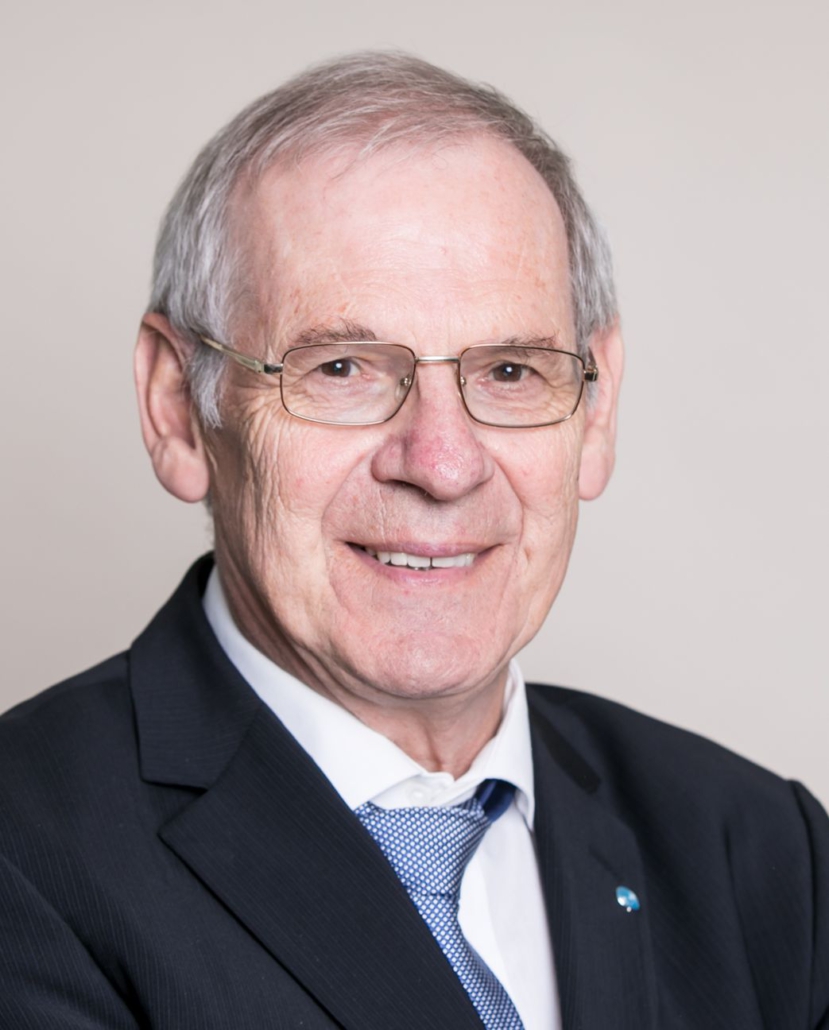
#5: Günther Deuschl – On the importance of transforming Deep Brain Stimulation to evidence based medicine
Günther Deuschl 00:00In Germany it was a failure because you probably know that in the early 70s there were all these publications about psychosurgery which led to an article in the Spiegel and that article influenced the whole field in Germany to collapse because everybody said well this is something we should not do this is unethical more or less and so at least my personal intention was I believe in that but I learned from these events that the only chance we have is really to have a strong scientific foundation for all of this. Welcome to Stimulating Brains Hello and welcome back to Stimulating Brains. I'm really excited that I was able to talk to Günther Deuschl
Andreas Horn 01:14in this episode. Günther needs no introduction and has been extremely important for transforming deep brain stimulation into evidence-based medicine. He has been involved in a series of very large-scale trials that provided class one evidence for the efficacy of deep brain stimulation for movement disorders. We talk about his life in this field, the beginnings and how deep brain stimulation became established and we then of course also talk a bit about the future. So thank you so much for tuning in and I hope you enjoy this episode with Günther Deuschl. So Professor Deuschl, first of all thank you so much for taking part in this and I would like to 02:05open the episode with a mini surprise which also leads to the first question because upon my research to prepare I noticed that we were in fact born in the same small city in southern Germany in Lahr/Schwarzwald and we may even have been to the same school. And that leads me to the beginnings of your professional life. Lahr/Schwarzwald is exciting to me and I would like to talk about it but it's not exciting for the rest of the world and you went on after that to study mathematics, geography, philosophy and history in Munich for five years before switching to medicine. Why did you switch to medicine? Well, you know, in the beginning it was the time of the late 60s. My intention was to become a teacher 03:02and I wanted to be broad and I wanted to do more than my main interest which was mathematics. So I studied very different things and did very different, and took very different, different approaches. But then when I went to school and went to work as a teacher I recognized that this is not what I can do my whole life. And I went back to what I wanted initially to do which was medicine and so I turned this pretty tough corner. Yeah. Did still studying something like mathematics help you later on?
Günther Deuschl Oh yes, absolutely. I mean that has been a companion through all my scientific career. 04:06And still nowadays I have people working with me who are mathematicians and I'm still interested in that field and I admire this type of science because it's just so pure. So, [inaudible] I can totally understand that, yeah.
Andreas Horn And then you started your medical training in Munich where, as I've been told, Professor Struppler was one of the few remaining surgical neurologists, right?
Günther Deuschl Right. So he was a neurologist but did his own surgery. Yes. He was never trained as a neurosurgeon but he learned functional neurosurgery from neurosurgeons through all his life. He worked with Narabayashi and with many different people all around the world. And, um, and in these days, um, I, I went to him because he was an excellent neurologist and I wanted to learn from him, 05:03um, but was very skeptical with functional neurosurgery because, you know, in, in these days it, it was always the, the idea that touching the brain is something you shouldn't do and that could influence your personality and things like this. So, so this has never been something which I thought I would do. And then all of a sudden I saw these tremor patients, getting more or less cured by this intervention, which totally convinced me, and that was the start of my personal career with functional neurosurgery.
Andreas Horn So it never itched your fingers to do surgery yourself?
Günther Deuschl No, no, no. No. I mean, even in these days, it was a little bit old-fashioned that a neurologist does the work that he has never learned. Sure. And he does it every four weeks. I mean, that was nothing which I considered to be the right way. 06:03I think a bit later, you moved with Professor Lücking to Freiburg.
Andreas Horn And as we've previously discussed in this podcast with Christian Moll, Freiburg had been a mecca for brain stimulation, maybe even worldwide, a bit before that time with Traugott Riechert, Fritz Mundinger, Rolf Hassler, later Wilhelm Umbach. So that leads me to the next question. So who were the mentors during that time? And also later on, when you moved maybe to Freiburg and started your clinical and research career, who were the mentors? Who really stuck out and maybe changed how you approached the brain? Or also, what were the key events that really mattered?
Günther Deuschl Well, that starts a little bit earlier because during my studies, I worked in experimental neurophysiology and did cat experiments with a person that is called Michael Illert. He is the one who worked with Lundberg and who did all this spinal neurophysiology where I learned a lot. 07:06And that is... That made my first entry into movement disorders. And then when I came to Freiburg, it was not only my mentoring these days, Lücking, it was also Richard Jung, who still was alive and still was very active in these days. And you may probably know that he wrote one of the most influential works on tremor in 1939. He published it. That was his habilitation.
Andreas Horn Still a very interesting study.
Günther Deuschl And so that was my start in the field of movement disorders. So that was my start in the field of movement disorders. And then there was another person, which was Eduard Schenk. Eduard Schenk is probably not as known. He is a pupil of Paul Hoffman. 08:00And he was also very much interested in reflexes, electrophysiology of reflexes and movement disorders. And with him, he was an excellent clinician. He showed me all the features he learned from Hassler and all these people in Freiburg in these days, which really led me to better understand this particular field.
Andreas Horn Interestingly, the connection between neurology and neurosurgery, functional neurosurgery, was not as strong as it seems because it was just a few kilometers away from each other.
Günther Deuschl It was just a few kilometers away from each other. But in these days, the neurosurgeons were very much on their own. And they did their own job, particularly Mundinger, with whom I share some friendship. And later, Ostertag. Ostertag was the one who was the head of the department in the late 80s and early 90s. 09:06And with him. I had the pleasure to attend several of his surgeries. But the scientific connection between the both departments were not as strong. And therefore, it was only these two persons with whom I had relations. It was not like this that the neurologists sent their patients to the neurosurgeons. They have their own physicians doing that. And by the way, Mundinger was very often doing surgeries in Rome. So he was out for several days. And his co-workers did the interventions in these days.
Andreas Horn Okay.
Günther Deuschl So I guess despite the pioneering efforts that we just talked about that had been happening worldwide, DBS for movement disorders had not really been established in a way it is now. 10:06At that time, it was not established. It was not established. It was not established. And I think it's fair to say that you have personally contributed a lot to this establishment. Of course, with a lot of help from other people.
Andreas Horn But how was the early time before the large New England trials like? How did society form maybe? How did people connect and then exchange their experience during that time?
Günther Deuschl Maybe 1990 to 2000. So before the big trials. Oh, that's already pretty late. I mean, in effect, it started even earlier. There was this saying that Benabid, whom I visited in these early days, Benabid did this DBS for tremor in '87. Sure. And that went around the movement disorder community very quickly. And everybody was waiting for something that could cure all these negative effects of levodopa. 11:04That was pretty early seen. That was even in the late 70s. In the late 70s, it became clear that levodopa is not the only solution to the problem of Parkinson's disease. And in these days, it was really that everybody waited that something new should happen to have a definite cure for these dyskinesias. And then came the problem. And then came the paper of Mahlon DeLong and Bergmann.
Andreas Horn Yeah, 1990.
Günther Deuschl In 1990, 1991. So that was all of a sudden, you know, everybody said, well, this may be the solution.
Andreas Horn Yeah.
Günther Deuschl And we were only waiting that somebody, and Benabid was certainly the person doing that first, that somebody put an electrode into the STN. 12:05Mm-hmm. And when that transpired. I mean, Alim is not a very fast publisher. So we heard about his surgical success already long before this was really published. And certainly, he showed videos on conferences. And then it became clear that this may be the solution. That was a time when the classical functional neurosurgeons, like Ostertag and Sturm, they were still pretty reluctant to this new thing. I mean, having radiofrequency lesions was still the state of the art, despite it was almost abandoned in Germany due to events that we can probably discuss later. But there were only few departments who remained with functional neurosurgery, and they were very reluctant to take these new electrodes on. 13:07the first paper came out, certainly everybody said, okay, we want to have such an electrode and put it into a patient's brain.
Andreas Horn Okay.
Günther Deuschl And then by that, so for me, there's a gap from that time to maybe when the big trials, so let's name a few. So most of them are in the New England Journal. One is first authored by yourself about STN-DBS in 2006. There's one about dystonia the same year by Andreas Kupsch.
Andreas Horn And I mean, you've still been leading that one. And then, of course, later, 2013, the Earlystim trial by Michael Schuepbach. So what happened in between? Or how did these trials then form? Well, that is an interesting story.
Günther Deuschl You know, as I said, the classical neurosurgeons were a little bit reluctant. 14:03To take over DBS. They finally did. And a number of colleagues and myself were really influenced by this failure of functional neurosurgery with regard to radiofrequency lesions. In Germany, it was a failure because you probably know that in the early 70s, there were... All these publications about psychosurgery,
Andreas Horn which led to an article in the Spiegel. And that article influenced the whole field in Germany. And so... To collapse, right?
Günther Deuschl To collapse, yeah. Because everybody said, well, this is something we should not do. This is unethical, more or less. And so, at least my personal intention, 15:03was I believe in that. But I learned from these events that the only chance we have is really to have a strong scientific foundation for all of this. And then we had in the late 90s... Then I went to Kiel in 95. And it was very clear. When I presented myself there, I said, I want to do DBS. There was no functional neurosurgery. There was no neurosurgery in Kiel at that time. But the surgeon, which was Maximilian Mehdorn, he said, okay, I'm going to do it with you. And then it was very clear that I want to have this scientific foundation. Then we had a grant proposal to the BMBF, which was in this time a pretty big proposal. And then I said, this is our chance. 16:01And we submitted. We submitted that proposal and got funded finally. And that was the start of that. But the intention behind was really, let's have a solid foundation
Andreas Horn and not fall again in that trap, which is probably specific to Germany. Do you think that that is the reason why these large trials... One reason why these large trials happened in Europe and maybe not in the US?
Günther Deuschl Or was there...
Andreas Horn Yeah, I mean, that is one of the reasons.
Günther Deuschl But there are other reasons as well, because in these days it was very difficult to start with a new treatment in the US. And we had just better conditions here in Europe. And, you know, I mean, we were the first ones in Germany, that's true. But then look at France. 17:03So they also... They also did huge trials regarding dystonia. And they were not much later than we were. So Paris was always a place where excellent DBS research was done.
Andreas Horn Yeah.
Günther Deuschl So I would guess due to these efforts, though, we now live in a world, and us young people can be happy to live in a world in which DBS for movement disorders is fairly established.
Andreas Horn Yeah. And what about other diseases now? Do you think similar large-scale efforts should be performed by the psychiatric world? Are we not there yet?
Günther Deuschl Well, this is... I can only speak about Germany, and we always tried to come into close connection with the psychiatrists. And we asked them to do it together with us 18:01to really develop scientifically a scientific program for that. But again, I mean, this is the same problem that we discussed before. Don't touch the brain with neurosurgical approaches for functional neurosurgery. That was considered always something which is evil, which probably bears too many ethical problems. And so it was very difficult to establish that. Even in Kiel, the psychiatrist, with whom I was working, was very reluctant to do this. Although, personally, I very much believe that there must be a way to improve depression, and that's for sure the largest disease in the field, and where really major studies should be done. It's not as easy as we have it in movement disorders, 19:00where we know much more about the brain. So they are in a... in a worse condition. But nevertheless, I mean, there are good hypotheses on the table, and I really hope that this will be the next great breakthrough when it comes to DBS. Yeah. Great. You've been president of the International Movement Disorders Society from 2011 until 2013, and of course have played a major role after that and probably before that. So maybe particularly, for the neuromodulation and DBS field,
Andreas Horn what do you think... like, what is the role of the society?
Günther Deuschl Well, I mean, the Movement Disorders Society has always been the place where really new developments were... sucked up very, very quickly. And there were many of my friends which were active in the Movement Disorders Society 20:00doing DBS in other countries. The Movement Disorders Society was always the marketplace, you know, where you met friends, where you could start collaborations. And this society really had a major role. Probably not something that you can definitely prove. But the Movement Disorders Society was the place where people came together and where they really made their collaborations and developed their ideas. And the outcome was basically this international community that is now standing and that is working together in different ways. Super. And I mean, one of your main fields, as you've already mentioned, of course, or field of interest has always been Tremor. And I think the second most cited paper that you've published is 21:00the initial consensus statement of the Movement Disorders Society on Tremor. You also lead or led the study group. You still lead it, I think. And of course, the revised version, you've been instrumental there as well.
Andreas Horn So why Tremor? What is so fascinating about it for you?
Günther Deuschl Well, I have two roots. It's not only movement disorders. It's also electrophysiology. And when you're doing electrophysiology and you look at movement and you see this awkward movement tremor, movement disorder tremor, you always say, it is so easy to measure. It must be easy to understand. And start with the thing that is really, that has the big chance to come to a breakthrough. That was a mistake. I learned through my career that it's much more difficult 22:01to understand a condition like tremor compared, for example, to akinesia and all the basal ganglia loops for akinesia are pretty settled, meanwhile. This is not so for tremor. But when you do that, and I did this really from the early 80s on, I worked on tremor, it becomes your passion. And that is still like this now. I still work on tremor. I still work on measuring and doing analysis, mathematical analysis of tremor. I like to, I think, what we really need in movement disorders is to keep the connection with electrophysiology. This is so important. I mean, the function of the brain is best reflected in electrophysiology. 23:01Certainly, your field, imaging, is equally important and has grown dramatically. Of course. I totally agree with you. In fMRI, we see the very slow fluctuations. Yes, that's... Certainly, you see something from tremor. You see a lot from tremor. And many people have proven, I mean, David Brooks and Heidelberg and many, many people and many, many really big imagers have really moved the field forward. But electrophysiology and EMG is still something where we can learn a lot from. And we need to keep that relation. And basically, this relation is, for me, still up until now, is of great interest. Great. Speaking of technology, I know and I think you've told me 24:01and you see it in your life's work that you've always been really interested in new technology and the further development of maybe the interface between medical technology and clinical practice, which I also find the most fascinating thing about deep brain stimulation. So, also today, I think, you hold a guest professorship in Zurich where you are working with MR-guided focused ultrasound.
Andreas Horn So, how do you think, how does technology shape our field or how has it shaped our field? And what were the major technological breakthroughs?
Günther Deuschl Well, I'm not sure that it's technology that's fascinating me most. What fascinates me is success. Therapeutic success. And this was like this for botulinum toxin. I mean, that was for many years. I was doing a lot of Botox treatment. That was for DBS. 25:02And now we have the new kid on the block and that's focused ultrasound. And fortunately, after I retired in 2016, I had a follower, which was Daniela Berg, which is Daniela Berg, and she's very much interested also in therapeutic success. And I'm very happy that she's managed to have now a focused ultrasound also in Kiel. Because I think this is back to the roots. It's back to functional neurosurgery in a new way. We do have some testing possibility for what we do by heating the tissue and looking at the functional consequences of that. But personally, I think for tremor, it's really, it opens a new field. It opens a field to all these patients which are currently untreated, 26:01tremor patients which are untreated and which really suffer a lot. And who cannot be treated with DBS because that's a full-blown surgery. And the other thing is for the patient in the MRI, it's a two-hour thing.
Andreas Horn Yeah.
Günther Deuschl And that's... They go home afterwards.
Andreas Horn Yeah.
Günther Deuschl And they can go home the next day or the day after. So this is really something very different. And certainly, I mean, we will see what the future brings. We will certainly, we have the first trial now for Parkinson's disease with an STN lesion. This is still very preliminary and we... Most of the work remains to be done. But I think that this will really increase our possibilities to treat our patients 27:01in a way that is equally dramatic like DBS is. Great. And therefore, I think it's a big success and it's a big... It promises big progress in the field. If you were a PD patient, would you do DBS or... Well, I mean, that's... I mean, that depends on the situation. On the situation.
Andreas Horn Yeah.
Günther Deuschl Currently, I would say a DBS patient that is not severely demented
Andreas Horn can have a much longer and much more profound improvement by DBS. But an elderly tremor patient with Parkinson's disease, why not improving his tremor?
Günther Deuschl Then you don't need as much drugs and it may be the right solution for him. So that depends on the particular patient. Currently, focused ultrasound is really for tremor and everything else is investigation.
Andreas Horn 28:02Okay. And if DBS, would you prefer awake or asleep DBS?
Günther Deuschl Well, here I'm very old-fashioned. I mean, seeing the result of stimulation and recording gives me confidence that I'm doing the right thing. I know that particularly neurosurgeons are very much in favor of using imaging. And, you know, I mean, for you it may be different because... No, I would do the same. I would do the same. Your hammer is the MRI and the imaging. And my hammer is really the clinical approach. And therefore I would not be in favor of doing sleep surgery. Me too. I agree.
Andreas Horn So maybe to already wrap up, 29:01would you maybe like to share with us a true milestone or a scientific success or maybe a eureka moment or big surprise?
Günther Deuschl I'm sure there have been many, but some anecdote of your... Well, I mean, we talked about... I think about all of this during our conversation now. My first real breakthrough was really seeing a blepharospasm patient coming in and giving him two shots of botulinum toxin. And after... I mean, these early days, the patients were hospitalized. And I saw him the next day, and he looked already a little bit better. And after three days, he went out with open eyes. Which he couldn't do before. So that was really a big breakthrough. The second breakthrough was certainly DBS. Seeing DBS in a Parkinson patient is something that you can't believe. 30:05If you shut off the stimulator and turn it on again. I mean, this is just something that's unbelievable. And the same thing happens also... with FUS. I mean, that's a similarly really dramatic change of the patient's condition. But there were many other things. I mean, seeing in my career, thrombectomies and the success of thrombectomies in patients whom you know when you're an experienced clinician and have seen a lot of stroke patients, when a patient comes in and you see the imaging result and you see a complete block of the media, you know this patient will go out in a wheelchair at best. And that's it. And seeing these patients, 31:00and after thrombectomy they went out on their feet without almost any really, really problem. I think that's the kind of success that we need in neurology. Or, I mean... autoantibody diseases.
Andreas Horn There are so many aspects in our interesting discipline
Günther Deuschl that have changed completely during my time as an active neurologist. We have talked a lot about the successes.
Andreas Horn Was there also an episode where you thought something went wrong or that was a complete waste of my time?
Günther Deuschl I mean, I'm sure that... That is much more difficult. That's much more difficult. There were many of these instances where you really, you know, I mean, where you really thought that was really 32:00the contrary of a success. But there's nothing which is... which comes to my mind immediately. And I mean, you know, the whole scientific work. You certainly know these evenings when you work all day long and at the end, in the evening at 9 o'clock, you recognize, well, this was the wrong way.
Andreas Horn Yes.
Günther Deuschl And then you do it again and it was the second wrong way. And again, and the second time. And so on. So this is always... But over time, you get accustomed to it. Over time, you get accustomed to that feeling and you consider it part of your professional life. Yes, I guess you have to get accustomed to that in science. Probably not so much in medicine, but in science. Yes, I agree. And this makes these big successes even more outstanding. 33:04True. That's true. You go through many valleys to come to the hill.
Andreas Horn Yes, that makes sense.
Günther Deuschl That's a good thing. So is there a message you would like to share with a young generation of scientists and doctors
Andreas Horn in the field of DBS? What is crucial for us younger people to know or not to forget? And then maybe also where will our field head?
Günther Deuschl Two questions. Well, I think there are content aspects. Personally, I think that the next big breakthrough regarding DBS will not be mainly movement disorders. It may be depression. It may be Alzheimer's. 34:02It may be other diseases that at least have a strong network component that could be influenced by smart DBS devices. Certainly, there are very many aspects in DBS that can improve the life of our patients. And technology plays a major role here and will really help us to improve that very much. But probably the most important aspect and the big breakthroughs will cover other diseases. The second aspect that I learned from my career is that there's one thing in neurology, movement disorders, and very generally in science, is to have collaborations. I'm proud to say that I have had through my life 35:04collaborations with very many people. You are one of the most recent examples. I mean, I'm proud that I learned from you about Lead-DBS and about all the developments in the field because it is the collaboration that is not only bringing science forward, it's also making all this fun that we have in our field. And therefore, you know, sometimes when I talk to young people, they are shy to approach other people. They are somehow even thinking that they could worsen their chances for moving forward if they share their knowledge with others. I think the contrary is the case. You learn from others and you give your knowledge to others, 36:00and that makes the progress so big. And that, on the other hand, also makes a lot of fun. I think that is the important thing. You have to know what you want to study. But once you know that and once you are sure that this is your way, then you should really seek for collaborators. Great. That sounds great. Maybe a very last question to wrap up. So how did your professional, but also maybe private life, if you want to talk about it,
Andreas Horn change after retirement? Is it more fun now?
Günther Deuschl Well, I would say it's much more fun. Just because I don't have the administration. The administration in a German university hospital becomes more and more boring because of the cutting down of resources. I'm not speaking about funding. Funding is still something 37:00I mean, you know, if you don't get something funded, then you have to ask yourself what is wrong. But in the hospital, there are really that is more and more privatized. And it's not always the patient that is first line. It's very often the money that makes decisions about, very important decisions about the way how we practice. It's medicine and so on. And giving that to young and talented and even better people was for me something which I did with great pleasure. And certainly I'm always open to help. But having young and energetic people in doing that and defending good medicine against the money is probably something which I very much like 38:08and I very much agree that this should be done. And it's like this in the German system that you usually cannot continue then working scientifically. I have the privilege to have a senior professor position and I have Daniela Berg, my follower, who really supports me in every respect and allows me to do all the things as before. So in essence, my scientific activity has grown instead of decreasing. And you can do just the fun part.
Andreas Horn Yeah, just the fun part.
Günther Deuschl Super. I can go to the lab. It's well-deserved, I think.
Andreas Horn Yeah. Thank you so much, Günther, for this interview.
Günther Deuschl Thank you, Andreas. It was a great pleasure to speak to you.
Click any highlighted text passage to jump the Spotify player to that point. The transcript text is present directly in the page HTML for search engines and accessibility.
In this episode, Günther Deuschl shares insights about his life in neurology and the endeavors to transform deep brain stimulation for movement disorders as established treatment options supported by class one evidence. He has been instrumental in multiple major clinical trials, such as the randomized double-blind clinical trial for DBS to the subthalamic nucleus in Parkinson’s Disease (Deuschl et al. 2006), a similar study for modulation of the internal pallidum in dystonia (Kupsch et al. 2006) and later the Earlystim trial (Schuepbach et al. 2013) – all published in the New England Journal of Medicine. He was president of the International Movement Disorders Society (MDS) from 2011-2013, Editor in Chief of the journal Movement Disorders and has been awarded numerous high-class awards in our field. He is an international capacity in the field of tremor and leads the study group for tremor in the MDS.
Günther Deuschl takes us on a fascinating journey into the past – where DBS was not as established as it is today – the present and the future – with emerging technologies such as MR-guided focused ultrasound and neuromodulation for psychiatric diseases.
References we talked about in the episode
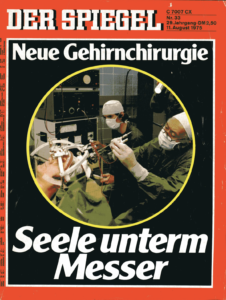
Article by “Der Spiegel” that according to Deuschl heralded the decline of psychosurgery in Germany
Colleagues mentioned in this episode include:
- Michael Illert (Physiologist in Kiel)
- Nils Lundberg (Neurosurgeon in Lund)
- Richard Jung (Neurologist in Freiburg)
- Fritz Mundinger (Neurosurgeon in Freiburg)
- Traugott Riechert (Ophthalmologist and neurosurgeon in Freiburg)
- Wilhelm Umbach (Neurologist in Freiburg)
- Rolf Hassler (Anatomist in Freiburg, later in Frankfurt)
- Christian Moll (Neurophysiologist in Hamburg)
- Carl Hermann Lücking (with whom Deuschl moved from Munich to Freiburg)
- Albrecht Struppler (surgical Neurologist in Munich)
- Eduard Schenk (Neurologist/Neurophysiologist in Freiburg)
- Paul Hoffmann (Physiologist in Freiburg)
- Mahlon DeLong (Neurologist at Emory, in 1990 published a seminal paper paving the way to STN-DBS together with Bergmann)
- Hagai Bergmann (Neurophysiologist in Israel who in 1990 published a seminal paper paving the way to STN-DBS together with DeLong)
- Alim Louis Benabid (Neurosurgeon in Grenoble)
- Christoph Ostertag (Neurosurgeon in Freiburg)
- Volker Sturm (Neurosurgeon in Cologne)
- Andreas Kupsch (Neurologist in Berlin, First-author in a large dystonia DBS trial)
- Michael Schuepbach (Neurologist in Bern, First-author in the Earlystim study)
- Maximilian Mehdorn (Neurosurgeon in Kiel)
- Daniela Berg (Neurologist in Kiel, Deuschl’s successor as head of the Neurology Department in Kiel)