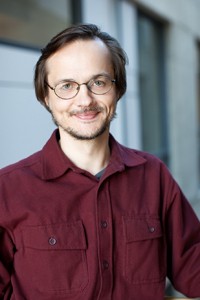
Paul Cisek PhD – Associate Professor of the Department of Neuroscience, University of Montreal

Mac Shine PhD – Associate Professor at the University of Sydney
#45: Mac Shine and Paul Cisek – Exploring the evolution, integration and complexities of the brain: basal ganglia, dopamine, and beyond.
In this special episode of Stimulating Brains, we dive deep into the intricacies of the human brain with two esteemed guests, Mac Shine from Sydney University and Paul Cisek from the University of Montreal. Building upon our earlier conversation with Mac in episode 9, this episode sees these brilliant minds sharing their insights on the basal ganglia, the role of dopamine, and the fascinating interplay between various brain regions. In addition, we explore the modulation of the thalamus by the basal ganglia, discussing its impact on both the cortex and the brainstem. Moreover, the conversation takes us on a journey through the evolution of the brain, examining the concept of the phylogenetic refinement approach. Join us in this intellectually stimulating episode as we explore groundbreaking concepts that could significantly impact both systems and clinical neuroscience.
Mac Shine and Paul Cisek 00:00The basal ganglia really isn't the only subcortical structure that is modulating the thalamus. It receives inputs from... ...is that there's a kind of a paleostriatopalatal circuit that is sort of the... There's these fascinating, deep stories about stimulating these diffusely projecting filament nuclei in primates that are anesthetized, and they wake up from anesthesia. It's there in mammals, and it's there in birds, but it's unclear to what extent it's there in other animals, and to what extent it's ancestral. So that closed-loop action of the basal ganglia... Welcome to Stimulating Brains. 01:00Hello, and welcome back to Stimulating Brains.
Andreas Horn So this episode is a bit special, and I had the great honor to talk to two heroes of mine in the same go. One is Associate Professor Max Schein from Sydney University that we already heard in episode number nine. The other one is... ...is Associate Professor Paul Ciesek from University in Montreal, who together bring so much knowledge and insight into the human brain to the table that essentially all I had to do is to lean back and let them exchange their thoughts of their brilliant minds. So we cover a lot of ground. What brought me into inviting Paul and Mac is that both have great thoughts about the basal ganglia, also about dopamine and how they interact. How the basal ganglia... ...how the basal ganglia would modulate the thalamus to then speak back to the cortex 02:03and also, of course, to the brainstem. And we essentially delve across a lot of topics, even to some degree cover AI at some point as a mistake of mine. But then also we go back 750 million years ago into evolution and talk of what Paul calls the phylogenetic refinement approach and how we can use that to better understand how the brain is made up by correlating the behavior that early brain development has been doing to the brain. So we talk about how the brain is made up by correlating the behavior that early brain development has been doing to the brain. And how we can sort of sort of sort of sort of sort of systems may have had an impact of these new behaviors developing. We also talk about how almost the entire forebrain, meaning the cerebral cortex and basal ganglia, 03:01mushroomed out of a part of the hypothalamus. And then we also go into Max's ideas of how the thalamus integrates with the cortex and the basal ganglia and how they interplay. And if you're more interested in a deep dive of these ideas, you can give a listen to episode nine again as a preparation to this episode. We'll try my best to add a few of the papers that were mentioned into the show notes on the website too. And we even have a guest quote from Haggai Bergman, another hero of mine in here. Thanks for that, Haggai. And so I think a lot to look forward to, and I hope you like that. And I want to thank you wholeheartedly for tuning in. Spread the word about our little podcast. I think this episode could be more interesting to the neuroscience field. And yeah, thanks again and have fun listening to Paul Ciesek and Max Schein.
Mac Shine and Paul Cisek 04:05Thanks, Paul and Max for joining. Maybe we can add that it is evening for us on the East Coast. So in Montreal and Boston, it is morning for Max. And so we're here to talk about various issues that we're going to be talking about. And I think it's going to be a lot of very exciting things today. And since Max has been on the show before, I would pass the first two icebreaker questions to Paul. Because usually before we get into science, I always ask about
Andreas Horn free time. So Paul, what do you do when not involved in science? Any hobbies?
Mac Shine and Paul Cisek Well, I don't have a lot of free time, frankly. I mean, what non-science time I have is sort of spent treading water. And trying to keep myself afloat and help out around with the family and everything. But my wife is also a neuroscientist. So between the two of us, we're busy all the time and just scrambling. 05:00So essentially, the free time is spent hanging out with our son, doing stuff with him. That's become sort of the hobby. My hobbies are his hobbies. So things like reading Harry Potter or playing Uno or Pokemon.
Andreas Horn Yeah.
Mac Shine and Paul Cisek These are now my hobbies. It used to be things like playing the piano, which I still love to do. And he's doing it. So again, so it's kind of... Andrea also plays. So there's those things. But I have to say that when you asked me this question, I thought to myself, you know,
Andreas Horn it's disturbing that I can't really think of anything because it's free time. But yeah,
Mac Shine and Paul Cisek I mean, as a kid, it keeps you busy, as you know. Exactly. Yes. So I think that changed for me too. And it does. It might still be, there might be, a part of this being a disease under scientists, the longer you're in, it's just hard to maintain
Andreas Horn other things sometimes because, yeah, I... So, but a kid is, of course, a great thing to spend the
Mac Shine and Paul Cisek time. Yeah. Essentially, I get to be a kid again, which is the main thing. I get to play with Lego, which 06:06otherwise would be kind of strange if I was playing with Lego. But now I can do it and it's totally acceptable. That's great. Who have been key mentors in your career and turning points that brought you to where
Andreas Horn you are now?
Mac Shine and Paul Cisek Well, I mean, obviously, my supervisors were a big deal. So I started as a computer science student. And I was all set essentially to become a computer programmer. I had, as an undergrad, a number of jobs. And then I was at Microsoft for about a year. And if I had stayed, I would have been quite wealthy. But I did not. So I just decided I wanted to get into science. I was always drawn to science.
Andreas Horn Do you regret it with Microsoft? Sorry to ask. What's that? Do you regret it not staying at Microsoft?
Mac Shine and Paul Cisek I regret not having the money. Certainly. But because when I calculate out how much my stock options would have been 07:02worth now, it's depressing. But no, actually, I don't. Actually, I think this suits me a lot more. I don't think it's for everybody. I don't think scientific research is, you know, there's so many sacrifices and aggravations. But actually, it suits me very well. It's kind of a dream.
Andreas Horn Yeah.
Mac Shine and Paul Cisek and a couple of other professors there, Ennio Mingola, who sort of exposed me to ecological psychology and all of those ideas. So a lot of the groundwork was laid there. I think that's true for a lot of people that go to grad school. A lot of your worldview is set up by the people that you train with. But then I went to Montreal to work with John Kalaska, 08:01who had kind of become a hero of mine because everything I read by him was great. He was always doing the experiment that somebody should do, in my opinion. And so then he was actually Steve Scott, who was here at the time, and John, who were my co-supervisors, they kind of taught me experimental neuroscience and kind of got me hooked on it. I didn't think that I would actually be running an experimental lab doing neural recordings in monkeys, but I... I really got excited about the quality of the data, just what you can do with that kind of data, which is not possible with other things, I think. Although, of course, there's some techniques that are even more impressive in mice and lamprey and such. But I got sort of hooked on the idea of having data, in part because I think it made me a better computational modeler. 09:01In Boston, I was just a computational modeler. But if you... I was just a computational modeler. I was just a computational modeler. If you have data, then you can be a computational modeler
Andreas Horn who is not so deeply attached to the models, because if they're wrong, you still have the data, right? So you're not like... Your whole meaning in life is not tied up to some theory, right?
Mac Shine and Paul Cisek The theory can be wrong, but then, you know, maybe you'll come up with another thing. You've got data. You're making a... You're still making a meaningful contribution. So... But in addition to that, having access to a lab actually makes it...
Andreas Horn makes it possible for me to do the experiments that I want to do, right?
Mac Shine and Paul Cisek Of course. And it's harder to convince somebody else, you know, to invest five years of their life doing some experiment to test my idea. But if it's me, then it's easier. So I kind of got hooked on that. And so you're really those ways of thinking. I mean, the very heavily dynamical systems-oriented way of thinking that Steve Grossberg pushed, you know, for decades, 10:01that became my way of thinking. And then ecological psychology became a sort of more philosophical grounding to all of it. A lot of the evolutionary stuff actually came from Dan Bullock and Steve Grossberg as well. And then actually doing experiments and actually delving into the brain and, you know, getting some humility about how complicated it really is. That came from John Scott.
Andreas Horn And I assume running a monkey laboratory is a big deal, right?
Mac Shine and Paul Cisek It's... There's a lot of fresh... There's a lot of fresh material that you need in terms of funding, in terms of facilities.
Andreas Horn Yeah.
Mac Shine and Paul Cisek Well, the group here has a good critical mass. So there's sort of, you know, because we have, you know, we've always had about five people doing this kind of work, plus, you know, others doing work with other animals. But there's enough critical mass that you're not really on your own. I think it'd be really hard to do it by yourself. 11:00But yes, yes. I mean, I have to have a full-time technician or I wouldn't be able to do it.
Andreas Horn Yeah.
Mac Shine and Paul Cisek I have to have, you know, good people always in my lab. And then I have to get grants to support all that. I mean, in the end, salaries are still the biggest part. But there's all kinds of... There's just all kinds of stuff, you know, all kinds of complications.
Andreas Horn And you have to just sort of be on call, kind of, right?
Mac Shine and Paul Cisek Because people need you. Now, again, once you get good people, like right now, I've, you know, one student just graduated, but my other project, I was led by a postdoc. He knows everything. He knows how to do everything. He could run the whole lab. So I don't really need to deal with every problem. But still, you know, it's still, it's a daunting task. That's great.
Andreas Horn Yeah.
Mac Shine and Paul Cisek Really cool.
Andreas Horn So we will talk about broader things, I guess, right?
Mac Shine and Paul Cisek Zooming out, not so much about the hardcore electrophysiology data that you acquire. And Mac, I think next question to you. 12:00Many people have talked about this, including, I think, Bujaki and yourself. And Paul. So, but just to set the stage for what we want to talk about, if you currently open a modern textbook of psychology, and even sometimes of neuroscience, you will find terms such as perception, cognition, action, and subheadings such as attention, memory, thinking, and decision-making in it. And these terms actually read remarkably similar. I learned that from you guys. Two terms used by early pioneers, such as William James, or even, I think, by the ancient Greeks sometimes. And then a lot of these terms have not been created with the brain in mind, because at the time we didn't think so much about the brain.
Andreas Horn And so only later neuropsychology tried to match these terms with brain activity. How did that go? How did that, was that successful? What are the challenges there? Can you talk a bit about that? Yeah, it's a really fun question to think about and to really kind of marinate on just how it's going to be.
Mac Shine and Paul Cisek 13:00I think it's a really fun question to think about and to really kind of marinate on just how it's going to be. Just how difficult of a problem it is to understand how our kind of inner mental lives and our interactions with the world are related to brain structure and how you'd go about interrogating it. And we were actually just talking about this. I just got back from my lab's retreat for a few days.
Andreas Horn And in amongst them being me at various sporting events and board games, we were talking about some of these problems, about how, in some ways, neuropsychology and cognitive neuropathy, neuroscience has really this difficult challenge on its hands, right?
Mac Shine and Paul Cisek If you want to understand a behavior, let's say you care about something like an animal's ability to do some particular skill, an act of particular skill, grab something. To understand that in a laboratory, you need lots and lots of recordings of that particular thing. You can't just take one off and hope that you can somehow look in the sort of mass of all of their neural activity and understand what's going on. You need reproducibility. 14:00And so in order to do that, you need to design experiments that bring out that particular thing.
Andreas Horn Yeah. And that's a really popular feature again and again and again. But without being too hard about it, you're essentially kind of paying yourself into a bit of a behavioral corner in that way, right?
Mac Shine and Paul Cisek You're forcing this really precise behavior on this sort of almost equipotential nervous system. And if you're not careful about it, in fact, I really learned this from watching some of Paul's early talks on YouTube when I was learning about his work, if we're not careful about the fact that we're building in this seriality into the kinds of things that we're doing, then we're not going to be able to do it. sort of sort of sort of sort of sort of go into a lab, if you've looked at a cognitive neuroscience experiment, oftentimes the challenge will be something like the following. There's a crosshair on a screen. You're then presented with 15:02some form of stimulus, which means that the first part of the brain that receives anything at all that's different from the crosshair is going to be the sensory system. You're then going to have to do some work to figure out what that sensory stimulus meant in the context of the experiment you're doing. And then you typically have to do some form of response. A motor response could be touching a button or moving your eyes to the side, saccading left or right. And so there's this sort of seriality baked into the way that we interrogate the nervous system. And for very good reason, but out in the world, it's much, much harder to find this kind of seriality. In fact, the world is much more parallel. While I'm driving my kids to school in the morning, I've got to take in visual information about what's on the road, what the cars are in front of me, whether there's a red light or an orange light or a green light. I've also got to be hearing my kids talk about their problem at school.
Andreas Horn That day, oh no, did they forget their lunch? Or what can I do about getting back to that?
Mac Shine and Paul Cisek It's this massively parallel problem solving challenge that I have. And it's really, really difficult to kind of imagine how you would investigate that in an experimental setting. So I 16:03think in a way, this is a really, really deep problem that we've got to figure out how to deal with. And I don't really have a great solution to it. Because most of the behaviors that we really deeply care about are these much more idiosyncratic, one-off, type of problems, at least in the lab at the moment. Paul, I'm really curious to hear your thoughts on how you tackle this as an experimentalist. I'm much more of a theoretician nowadays, I think. Well, I have to admit that my experiments are actually still like that. So my theories are all trying to address how we actually behave in the world, like driving the car and listening to your kids, and just how you deal with the constant changing flow of sensory information. And one of the most important things, I think, that people have recognized, of course,
Andreas Horn for a long time is that it's actually closed loop, right? Your actions themselves are determining the
Mac Shine and Paul Cisek 17:01next time series of sensory stimulation. And it's that actually, that is the whole point of behavior,
Andreas Horn right? It's how to not crash the car and get it in the right direction, right? So that control aspect, is part of it, right? But then the problem is that to understand it, you kind of want to do
Mac Shine and Paul Cisek something a bit like engineering system identification, where you just sort of poke the system and see how it responds. And you poke it again, and you see how it responds. And so that's the kind of stimulus response empirical method that we use. And, you know, I must admit that my experiments in the lab are extremely unnatural. They are these trial-based things where animals are the sacred animals. And I think that's the kind of thing that I'm trying to do.
Andreas Horn Right? Animals or humans are the same thing 100 times. And then we do a stimulus, and we do a response, and then we repeat, you know, an inter-trial interval, and then we repeat, right? And now, it's, but it's not, it's not necessary that the empirical approach becomes the theory, right?
Mac Shine and Paul Cisek 18:07The theory can still be about feedback control and parallel systems. And it can still make predictions of what might happen if you were there to take that.
Andreas Horn Sure, exactly.
Mac Shine and Paul Cisek And then you can sort of sort of over and over again? And what are some of the predictions? And so I think it still can be done. And there's a study that I found very inspiring to me. And it was a study by Anders Ledberg and others who put LFP recoding electrodes all over the brains of monkeys. And they showed them
Andreas Horn 19:05stimuli that they had to either let go at a level or not according to some rule, right? So they had
Mac Shine and Paul Cisek a stimulus configuration, they had some rule in effect, and they had some response. So it's extremely impoverished, you know, simplified task. But the cool thing about it is that the result
Andreas Horn is actually very pertinent to theories of how the brain works in parallel. Because what they found is that there's this sort of fast, very fast feedforward sweep of sensory-like information, which discriminates things like categories. And it gets to, almost the whole brain within like 50 milliseconds, right? But then the entire brain suddenly,
Mac Shine and Paul Cisek almost simultaneously, about 100 milliseconds after that, discriminates and makes the decision,
Andreas Horn right? And you see that in parietal cortex and premotor cortex, and you see it in visual regions,
Mac Shine and Paul Cisek 20:03actually some of the visual regions later than in premotor and parietal and such. So there's this kind of... you know, this kind of sweep of information, and then it gets colored by how the decision unfolds across a very highly distributed network. And I was excited about this because this was very, fit very much in the kind of theories that I was working on with John Kalaska, about this kind of system for specifying the potential actions and then selecting between
Andreas Horn them, right? Now, in the context of the brain, there's a lot of information that's being put into the brain,
Mac Shine and Paul Cisek and it's like, you know, you have a system that's sort of a feedback system. It's appreciating the possibilities of actions while it's engaged in executing one of them. But at the same time, it's still sort of monitoring what other possibilities might be out there and sometimes switching. And that's kind of how we were describing this behavior. This is, of course, very much based on Gibson and others who came much earlier. But then you imagine if you took that 21:04system and you stuck it in lab and you gave it this task that they gave it, well, that's what you get. Dr. Andy Roark Dr. Andy Roark Dr. Andy Roark Dr. Andy Roark Dr. Andy Roark Dr. Andy Roark Dr. Andy Roark Dr. Andy Roark Dr. Andy Roark Well, that's what you'd expect. You would expect this large feedforward sweep because the information does have to travel in there. And then the whole thing sort of gets biased one way or the other. So I think you can do it. I think you can ask questions about natural behavior in a classical kind of experiment if you have a theory that actually makes a prediction, an interesting prediction for that kind of experiment. But, you know, not to go on forever, but I do think what's exciting now is that people are starting to do closed-loop experiments.
Andreas Horn A lot of interesting VR work done.
Mac Shine and Paul Cisek A little bit in monkeys. A lot in humans, of course. But some of the best stuff is, you know, with mice on track balls running through virtual environments or zebrafish with stimuli projected into the tank, swimming freely, and actually being able to... 22:05Sort of quantify the behavior, but still allow the animal to control the stimuli. So it's control its full closed-loop of interactions and actually really do justice to the richness of it.
Andreas Horn I actually just heard an interesting experiment along these lines that you might find interesting, Paul. Yeah.
Mac Shine and Paul Cisek A guy that I know at Macquarie University, Andrew Barron, is working with David Kaplan. They're kind of... Kind of embodied neuroscientists and evolutionary neuroscience bent. And they've done one of these VR experiments, but they've done it in Drosophila, in flies. And so they have the flies that can, you know, flap their wings either side. And then they have a virtual display that then dictates how the fly would move. So if it flapped its wings to the right, it should move to the left and left to the right. And then they can switch it so that the animal, when it flaps its wings to the right, now moves to the right. 23:00And this is a little bit like this really, really fun video online of this. It's I think it's called Smarter Every Day, where this engineer in Alabama gets his friend to change his bicycle. Oh, yes.
Andreas Horn So the way he sets it to the right, it goes to the left, the left to the right. And he can't do it, right?
Mac Shine and Paul Cisek It's absolutely impossible for this man to do this thing. It takes him months and months and months of deliberate practice to learn how to do this thing. Really, really difficult. It turns out that... And then he can't ride a normal bike afterwards. Then he can't ride a normal bike.
Andreas Horn Exactly, right?
Mac Shine and Paul Cisek So it's deeply, deeply problematic for him. It turns out that when they do this to the fly... The fly couldn't care less.
Andreas Horn Oh, really?
Mac Shine and Paul Cisek The fly flaps to the right and moves to the right.
Andreas Horn It's like, so what?
Mac Shine and Paul Cisek The world changed when I moved. Okay, big deal. Flaps to the left, moves to the left.
Andreas Horn It learned?
Mac Shine and Paul Cisek It learned. It just didn't care.
Andreas Horn Yeah.
Mac Shine and Paul Cisek And so their prediction is that because the fly has a much less developed cerebellum, there's less that's causing the problem for it that would be a problem for a vertebrate. But wait, it never adapts. It can never steer itself.
Andreas Horn Yeah, exactly. It's used to being more pelagic, right?
Mac Shine and Paul Cisek 24:01The wind whipped up and something moved. And it just kind of... Figured out the movement it needed to do in the moment. I just think that's a deeply fascinating example of sort of the benefits and costs of having this big complicated nervous system. But it also, you know, the kinds of things you can bring out with these closed loop type experiments. So I think we'll... You know, to put a wrapper on your question, Andy, I think that if we can take very seriously the fact that the kinds of labels we've had in the past, maybe we're a little bit premature and we start to look at the brain anew, kind of the Yorubizhaki inside out idea.
Andreas Horn Yeah.
Mac Shine and Paul Cisek Maybe some new labels will come up. Maybe some of them will be more about coupling with the world than about this particular function that you could put into a vat, like attention or cognition. And more about multitasking, the coupling at multiple different timescales or something. And we'll come up with a richer language, I think, of the kinds of capacities that we have that differentiate us from different species. Some ways more beneficial, some ways worse. I'd actually like to add to this topic because there's a kind of a historical... 25:04Historical point to be made here.
Andreas Horn And I guess you both have heard it, but just to say it. So, you know, psychology, the study of the human mind had been separate from studies of physiology for a really long time, in part because there was this kind of idea that we're different, right?
Mac Shine and Paul Cisek That we are special. We have some, you know, non-physical mind that is perhaps only humans have for hundreds of years, thousands of years.
Andreas Horn And we have a sort of some, you know, non-physical mind that is perhaps only humans have. And for hundreds of years and thousands of years. People have been thinking this way, right?
Mac Shine and Paul Cisek And so psychology was actually defined. Psychology actually means the study of the non-physical mind. But nevertheless, even though it was assumed that this is non-physical, people were still said, well, we can still study it scientifically and systematically and very carefully.
Andreas Horn And people like, you know, I'm blocking on the name, which is kind of embarrassing, but Wunden Titchener. 26:03Yeah, Titchener I'm thinking of. You know, they did these studies very carefully, very systematic studies of how the mind works, right? And it was just a different topic, right?
Mac Shine and Paul Cisek So at the same time, this was like in the late 1800s. At the same time, people were studying animal behavior. They're all talking about closed loop control, like people like Von Exkuhl and others. And then later Tinbergen and Lorenz and all these people. Lots of people have been studying animals behaving in the wild.
Andreas Horn And all of that. And all of that was really about closed loop control, right? Von Holst and Middlestead very famously did exactly this kind of thing with the fly, except with much lower tech, right?
Mac Shine and Paul Cisek They actually flipped the stimulus around.
Andreas Horn And all these kinds of interesting ideas had been there in the ethology and in the biology world,
Mac Shine and Paul Cisek very much centered on this kind of ideas of interaction. But it was just not the same in psychology. 27:00And I think it's because of this idea.
Andreas Horn Yeah.
Mac Shine and Paul Cisek There's some kind of interface between it and the world.
Andreas Horn So how it perceives and how it acts, right?
Mac Shine and Paul Cisek And so I think what happens is that you have this assumption that forces these additional
Andreas Horn assumptions, right? And then the whole field, ideas like attention and memory and such, were all framed within the context of all this, right? And they got sort of solidified into very specific concepts that everybody knows what that is, what attention is, right? And memory is. But then at some point, this idea of the non-physical mind just fell out of fashion, right? Largely because it was just not compatible with the laws of physics, right?
Mac Shine and Paul Cisek It just didn't...
Andreas Horn At one point, people gave up on it, right? And it was behaviorists that really pushed that, sort of killed that idea, right? 28:01But then it needed to be replaced.
Mac Shine and Paul Cisek And I think what happened is that the structure that was forced by that idea just stayed,
Andreas Horn right?
Mac Shine and Paul Cisek Because we already had the... In terms of perception and attention and memory and such, and these ideas were already embedded in it just the way we talk about it. But, you know, the whole time that psychologists were doing this, I think all of the ethologists
Andreas Horn and animal behavior people were going like, what is all that about? I mean, why are they insisting on these things?
Mac Shine and Paul Cisek People try to find the correlate, the anatomical or functional implementation of these concepts
Andreas Horn in the brain, right?
Mac Shine and Paul Cisek But they didn't fit, I guess, because... Well, I mean, we're still looking. And they fit a little bit. Sure. There are some things like that, but I don't think they fit in the way one would expect.
Andreas Horn They don't fit in the way that maybe Titchener would have expected, right?
Mac Shine and Paul Cisek 29:00Now, he was a dualist, so maybe he wouldn't care.
Andreas Horn But, you know, I just don't think that the ideas, sort of the questions that we ask about how does X work?
Mac Shine and Paul Cisek It has a definition of this thing called X that predates our study of the brain. As you said, these ideas predate the study of the brain. And so, but if we had gone around about it very differently, we would have had different theories. I think we would have had much more focus on interaction, you know. And, you know, James Gibson said all this, and many have said this. Piaget said all this, too. So, I just think they were always sort of, you know, the kind of maverick outsiders. They weren't really mainstream psychology. So, people didn't listen. Plus, Piaget was incomprehensible. That was also a problem. I heard that in your podcast episode with Paul Middlebrooks that you apparently tried 30:04to read original and it's hard to understand. I was actually reading in Polish, which was even harder. So, I don't know why. I should read some original Piaget, but I think I'd probably do better just reading somebody else's sort of concise, you know, translated version of it. Because he had his own terminology. It's not easy. So, we mentioned Yuri Gorzaki, but with his idea of, you know, starting from maybe the brain signals or from inside out to then come up with terms. I think another really promising concept and not competing. I think another really promising concept that you've come up with, Paul, is to go back in evolution, right? So, the human brain is the most complex object in the known universe. The three of us embarked on this impossible, maybe stupid mission to try to understand a bit of it. But one key strategy to maybe do so would be to study simpler brains. 31:01And of course, we can do that in animals, but we can also, I'm sorry, we can go back in embryology. We might come to that, but we can also go back to animals in simpler forms and model. Organisms and, you know, could use mice, but also could go back in evolution. And then if we thoroughly understand the brain of a model organism, such as the lamprey or the shark, which might be easier to understand, not as futile as a mission, we might then, of course, extrapolate some of these functions to our brain. And so, based on this, or, you know, not a new idea, of course, but you developed, I think, a really cool new framework, which you called it. Phylogenetic.
Andreas Horn And then you also called it the phylogenetic refinement approach, which adds the additional layer of behavior to this concept, essentially looking at which behavior was possible in these early animals and then which behavior came with new structures that formed.
Mac Shine and Paul Cisek And I think by doing so, you came up with a preliminary, but maybe more grounded tree of behavior in your papers that starts with simple things that simple animals could do already and then adds on to new things. 32:11And I think by doing so, you came up with a preliminary, but maybe more grounded tree of behavior in your papers that starts with simple things that simple animals could do already and then adds on to new structures that formed. And I think by doing so, you came up with a preliminary, but maybe more grounded tree of behavior in your papers that starts with simple things that simple animals could do already and then adds on to new structures that formed.
Andreas Horn Could you maybe give us an executive summary of the approach, how you came up with it and what you learned so far? Well, so for me, it's just kind of been, I don't know, to me, evolution is kind of the grand unifying theory of biology, right?
Mac Shine and Paul Cisek So it seems that we should use it. And the idea really came from a number of sources. I mean, lots of people have said this. And actually, my supervisor, Dan Bullock and Steve Grossberg, developed a nice model of spinal cord essentially using this kind of approach. But people have said this very nicely before. The basic idea is just we know that the thing was created by evolution. And evolution is actually quite conservative in terms of not throwing away old solutions because you can't. 33:06You know, if you have an escape circuit and you're living in a hostile world. World full of predators. You're not going to get rid of that escape circuit. There will never be a generation that doesn't have an escape circuit like that. It's just not going to happen. Well, I guess it could happen if you take a different strategy, like hide in the sand your whole life and just filter feed what tunicates have done, essentially devour your own nervous system and just build a hard shell. But in general, mobile animals and such are going to have a lot of potential. And I think that's a good point. And I think that's a good point. And I think that's a good point. And I think that's a good point. And I think that's a good point. And I think that's a good point. And I think that's a good point. There are certain constraints and how they're going to change at every particular stage. And so the point is this. If that's the case, then there should be a kind of a historical sequence of how those changes came about. And then the proposal is just, well, let's see if we can actually reconstruct what that sequence was. 34:08And people do, you know, throughout biology, people do this. And it's just a comparative approach. And it's just a comparative approach. Sure. Sure. Sure. Sure. Sure. Sure. Sure. Sure. Sure. Sure. Sure. Sure. Sure. Sure. Sure. Sure. Sure. Sure. Sure. Sure. Sure. Sure. Sure. Sure. Sure. Sure. Sure. Sure. Sure. Sure. Sure. Sure. Sure. Sure. you infer whether things are homologous, and then you know something about the common ancestor. I'm just saying, you know, I have a term, phylogenetic refinement, but it's really the same thing that people have been doing in all fields of biology, except, you know, sort of, you know, cognitive neuroscience. So the idea is just to add a constraint on yourself. Um, when you think about mechanisms, to make it necessary that whatever mechanism, whatever hypothesis you have about something works, has to be compatible with a stepwise process of how it could have come about. Now, the tricky thing there is if you're going from the, from, from humans backwards, then it's very hard to, to know, because, you know, if I want to go back 35:06from humans and make, make my theory of humans humans consistent with a theory of monkeys, well, then I still first need a theory of monkeys. And for that, I need a theory of some, you know, tree shrew-like creature, and then some, some common ancestor of mammals. So going backwards is very hard. Going forwards and doing sort of
Andreas Horn chronologically is also hard, because we don't have those animals anymore, right? All the,
Mac Shine and Paul Cisek all the animals except the current ones are dead. So, so the best we can do is try to infer what those, those various ancestors were like. And for that, it's useful to look at specific species
Andreas Horn that, so you don't want to just look across all species, right? I mean, you, you can, but then you, you're still stuck with that, that first problem that I mentioned, right? If you look at Drosophila and octopi and birds and humans, good luck. You know, they all are very, very, very complex, 36:04right? But if you instead, let's say, compare mice to lamprey, then the reason why lamprey are really good is because they diverged from us,
Mac Shine and Paul Cisek you know, half a billion years ago, but then didn't really change that much, at least according to what we can see. From the fossil record, we can see something that looks like a modern lamprey, 350, 350 million years ago, and probably earlier. The Amphioxus is another good example. It's a creature that's, it's a chordate that diverged from us about 650 million years ago, and didn't really change. It's not really changed as far as we can tell because it's, you know, it's, you want to look at animals that didn't travel through too many different niches. They diverged. So Amphioxus and lamprey are great. Octopus, not really. Octopus diverged from us like, I don't know, 800 or more, more million years ago. But the common answer was nothing like an octopus.
Andreas Horn 37:03Yeah.
Mac Shine and Paul Cisek I mean, it was nothing like an octopus or a human. You know, they went through a crazy, convoluted path.
Andreas Horn Yeah. That's super interesting, but it's not going to tell us as much about what our common answer was. Flatworms will probably tell us a lot more, right? Because they didn't change
Mac Shine and Paul Cisek as much as octopi did. So birds, birds are all, you know, helpful, but confusing, you know, and so on. So, so lamprey are good. Amphioxus is good. Sharks are pretty good. You know, because they diverged, they became apex predators. And when you're apex predator, you don't really want to change too much. Sure. Sure. a variety of other species along the way. And so I think by looking at those, you get an idea of what the various stages are. And then you can do what I'm essentially trying to do. It's kind of try to constrain the problem from both ends. You have some idea of what the common ancestor was like by looking at these specific species to give you that.
Andreas Horn And how they behave, right? 38:00Which behaviors did they have in their repertoire? Yeah, and of course, that's a tough thing because behavior doesn't directly fossilize, right?
Mac Shine and Paul Cisek Sure. But traces of behavior do. You can get a lot of ideas from looking at the bodies of what animals were capable of and where they're found and things like that. And people do that. And that's actually the other thing I would say that when I embarked on this, I was very encouraged by just how much people have done, how much there is out there that's been done,
Andreas Horn really good science on exactly these kinds of questions.
Mac Shine and Paul Cisek So then you try to constrain it from both ends. So I think that's a really good question. You try to constrain knowing what the later creature is and knowing what the earlier creature might have been. If you have sort of an amphioxus and a lamprey that sort of bracket that particular stage
Andreas Horn and you can say, all right, well, what happened? What might have changed? I can tell you there, the telencephalon emerged, right?
Mac Shine and Paul Cisek 39:00There was something like a hypothalamus and then there was something that grew into a telencephalon.
Andreas Horn And that is interesting.
Mac Shine and Paul Cisek And there's basal ganglia. And all that kind of stuff in lamprey. So there was a big change there that happened. And another big change that happened is they became kind of predatory. I mean, they're parasites, but they seek their prey and they chase it down and stuff. Whereas the amphioxus is a filter feeder. So there's things that we can sort of surround with these convenient species.
Andreas Horn So new types of behavior together with new brain regions. Exactly. And what is it? Yeah, exactly.
Mac Shine and Paul Cisek Like the amphioxus doesn't really have an eye.
Andreas Horn It has a photosensitive patch that can't even make an image, right?
Mac Shine and Paul Cisek But all it does is it sort of synchronizes its behavior to diurnal cycles, circadian cycles, and hides from things.
Andreas Horn Every once in a while, it runs away from stuff, right?
Mac Shine and Paul Cisek 40:00So it doesn't really have much of a visual system. Whereas the lamprey has image-forming eyes on the sides of its head, you know, that allow it to be able to see. It's able to guide itself through the world. And it has the circuitry that then supports that kind of behavior, including the telencephalon and such, and basal ganglia,
Andreas Horn and all these kinds of things.
Mac Shine and Paul Cisek So I think it gives us both, right? Because there's so many studies of the amphioxus, and there's so many studies of the lamprey,
Andreas Horn that now you have a really good handle on some interesting events
Mac Shine and Paul Cisek that happen along this path. And then you just try to find that for every little segment. And again, I'm encouraged by when I read this stuff, and I see just how much people have done. There's experts along the way that represent knowledge about each of those segments. Some of the segments are trickier than others, but there are people working on all of it. And, you know, I just, essentially what I'm doing is just reading their stuff. 41:01Really cool.
Andreas Horn And you write a book, right?
Mac Shine and Paul Cisek I'm really looking forward to that. I think at this point,
Andreas Horn probably many listeners will think, of this podcast,
Mac Shine and Paul Cisek will think, hmm, this is a bit of an odd episode, you know, talking about amphioxus and sharks and so on. But we'll get to what made me so interested in this work right now, essentially, because I think if you even go back more in time, 750 million years ago, the conceptual clade of eumetazones roamed our oceans, and these were multicellular organisms already in the matter of nervous system. And I think you based this on work by Thomas Hills. They already used dopamine to switch between explore and exploit behaviors. And I felt, you know, this is so cool that, first of all, I did not know dopamine already was in play at that time. And then, you know, with your phylogenetic refinement approach, 42:00the idea of studying the behavior that was apparent at that in these smaller organisms already, could we potentially make the big, make the big leap through evolution to us humans
Andreas Horn and learn, you know, about the role of dopamine better by doing so? And then maybe also we'll get to the basal ganglia in a bit. So maybe to ask Mac, do you have a clear understanding of what dopamine does in the brain? How would you summarize it?
Mac Shine and Paul Cisek It's not an easy question, but.
Andreas Horn Yeah. Yeah.
Mac Shine and Paul Cisek I was just going to say, thanks for the hospital pass, Andy.
Andreas Horn So, yeah, the history of dopamine is fascinating.
Mac Shine and Paul Cisek And, yeah. And I think it's also, you know, it's worth while we're thinking about phylogeny, kind of admitting to ourselves that dopamine has sort of shown up and disappeared and then shown up again, you know, a few times across phylogeny. In fact, it kind of fits really nicely into this idea of a sort of spare part that was sort of lying around from our diet. And if we need to, you know, turn the volume up or down on this circuit in this 43:02particular context, or if there's adapted benefit for that, well, the dopamine is one of these kinds of chemicals that's lying around and can be, can be used to, to kind of take advantage of that. So in terms of, you know, the, the broader question of how to think about it, you know, we, we placed dopamine into this class of what we would call kind of neuromodulatory neurotransmitters. Their main mechanism of action cellularly is via G protein coupled receptors that have a different kind of an action than the kinds of neurotransmitters that affect ion channels directly. So if you're a neurotransmitter that opens an ion channel, you can enact a really, really quick change. You can cause, you know things like glutamate. Um, can cause the, a channel to open that causes sodium potassium to fall in and out of a, of a cell change in action potential. You can also, um, cause chloride, um, and you can kind of make a cell much more hyperpolarized or depolarized. Um, this other class has a much slower effect, um, but it can be much more modulatory as well. So, um, there are sort of two main classes of the G protein coupled 44:00receptors, ones that liberate calcium. One of my favorite chemicals in the nervous system, uh, and then another class that's. changed things like voltage-gated ion channels, and you can think of it sort of a little bit like the excitability of the cell or the ability of the cell to respond to and enact change when it receives a spike. There's also a lot of other fascinating stuff that happens on much longer time scales with plasticity with these different G-protein coupled receptors that you don't find as obviously with the ionotropic receptors. In terms of kind of putting a wrapper on what dopamine does in the vertebrate brain, it's a really tough one because I think a lot of it changes on context. I'm inspired a lot by the work of Joshua Burke. He has a really nice way of framing this, where he thinks about dopamine as important for helping you elaborate decisions into an action selection, but also has this really important effect of causing plasticity such that the things that you've done that worked well for you or the things that you'd like to 45:03avoid, you can reinforce those in the nervous system such that the next time that you come back to that same context, you know how to act in the future. It's got this dual nature to it, where it's helping you navigate the world in an adaptive way, but also helping you figure out how to do it better next time in this longer timescale. That's my first protocol for dopamine. You often hear people talk about it as the seeking system as well, which I like as well. I don't like to think of it as... Pleasure chemical, which sometimes comes up in the broader non-scientific literature, just because that's such a much more complicated term that I think imbues a lot of other parts of the nervous system. The seeking system and reinforcing system is probably the best way for me to start off there. It's funny because I just read that paper. Sorry, I just read that paper by Josh Burke yesterday. I'm rereading it because I thought maybe this would come up. 46:03Yeah. That's the good thing about Josh's work as well, just to put a tap on that, is that he really is an empirical neurobiologist that does really beautiful work with rodents, where they'll go in with the tools of optogenetics and really brilliant recordings to place animals into scenarios that really challenge some of our preconceived notions of these systems. One of his works that I was really inspired by, Arif Amit, who's the first author. This is going back some years now. I met them at a Gordon conference at the Basil Ganglia. What they were doing was placing these rodents in situations where they had to wait for a particular time for different levels of reward. The way that they demonstrated how motivated they were for that reward was by leaving their nose in a little part of the system. I had to stick their nose into a little hole in this apparatus. The longer they left it, the more motivated they were for that reward. They could actually show that the levels of dopamine in parts of their stride were actually 47:03covarying with their amount of time that they would wait for this reward. Then what they also showed, which I think was really, really cool, was that if they then dropped the reward, if they then all of a sudden said, no, no, you don't get that trial on a set of catch trials, the amount of dopamine in the stride would drop down. Then if they looked at the difference in dopamine over time, if they took the step-by-step change in dopamine, it actually mimicked the old reward prediction error story that was really popular back in the late 90s from Motegi and colleagues. Have this idea of dopamine as this system controlling your motivation, the amount in which you're willing to engage resources to get a particular thing. Then if things changed quickly, either you got a big reward or a big drop in a big punishment, now all of a sudden that was telling you about a prediction error that would then help you update your behavior next time. I think the idea of finding these kinds of empirically driven descriptions of how a system could work can actually really reinforce how we think of the system as a whole. I think it's a nice example 48:03of what you were mentioning before. There's super hard evidence for everything you said. I totally agree with the reward system, reinforcement learning, also learning in that end. One very
Andreas Horn big topic as well is Parkinson's disease. Why do people with Parkinson's not get depressed? They do sometimes, of course, but why is that not the predominant system? What's the role in dopamine for movement?
Mac Shine and Paul Cisek The best way that I've been able to square this away with myself relates to the kind of differentiation that you see in the basal ganglia across the neuraxis. The traditional story in Parkinson's, particularly for akinetic rigid Parkinson's, is that you lose the dopaminergic innovation of the putamen, which is a more predominantly motor structure, before you would lose dopaminergic innovation of something like the ventral tegmental area to the nucleus accumbens. 49:00The idea would be that you could actually reframe, one of the issues that people with Parkinson's deal with, as a lack of motivation for movement early on. They're less willing to engage resources in the detailed control of their movements over time. It's more effortful for them to create basic movements. Then over time, you start to see impairments as the pathological damage spreads to more anterior and ventral parts of the basal ganglia. You can have really difficult challenges with endodontics. Sure. Later, I think things align very much with what you said before. In the earlier stages in the motor system, though, it's a great analogy to think of it as motivation for movement. Is there also a
Andreas Horn component of the reinforcement part of things in motor, do you think? How do we bring the two things 50:01together? Also a question to both of you.
Mac Shine and Paul Cisek also a question to both of you. Well, I think the motivational aspect is always there during the performance aspect. So there's experiments and phenomena that sort of are pertinent to the performance of an action in the here and now. But that's potentially different than what you learn from the here and now, right? So what you learn for future movements. So I think dopamine has this motivating role, but it also has this learning, as Mac was saying. So I think those are kind of different things. Now, I don't know whether the ability to learn from rewards or errors in Parkinson's appears at the same time as the thing spreads to these more anterior parts. Maybe that's the case. The butane is probably more involved in learning action, action patterns and such. So I think the sort of 51:13deficit of motivation is a pretty good explanation actually for a lot of Parkinson's. It's the
Andreas Horn inability to sort of volitionally decide to go and do something, right? I mean, of course, we all know
Mac Shine and Paul Cisek how excellent Parkinson's patients are in reacting to things that are really strong. If you draw a line on the ground, they can step over it. But if you tell them to just take a step forward, they have a hard time with it. If you throw them a ball, they'll catch it just fine.
Andreas Horn So there's a certain sense of it. It has to be sort of the internally generated thing. That's where the problems are more, right? I mean, there's even symptoms like
Mac Shine and Paul Cisek rigidity. There's even symptoms like rigidity. There's even symptoms like rigidity. There's even symptoms like rigidity, which make, you know, it's hard to draw the line for motivation for 52:04rigid, you know, tonus of the muscles. Yeah. So we actually, we're actually developing a model of this. And in the model, we suggest that the basal ganglia is sort of helping
Andreas Horn you commit, right? And so it's sort of taking information from the cortex and sort of helping
Mac Shine and Paul Cisek the cortex choose one action. And so it's sort of helping the cortex choose one action. And so it's sort of helping the cortex choose one action among others. And if the actions are really clear,
Andreas Horn like you throw somebody a ball, then the cortex does not need basal ganglia to help out, right?
Mac Shine and Paul Cisek But if things are ambiguous, and you're not really sure what to do, then you kind of need the basal ganglia to help you select out from among all the things you can do, the one thing that you're going to do. And without that, it's almost like the classic ideas, the ideas of mink, that it's, it's the inability to suppress all the other things that just, 53:04you're kind of a deer caught in the headlights, you just can't go one way or the other way. And you, you, you're rigid in that sense. So I mean, it's actually, it's actually kind of the old idea about basal ganglia. But I actually think it's, you know, so in our model, we're essentially describing it in that way. And I think it explains certain kinds of data quite well. But one of the, one of the things that I always, say about basal ganglia is that whatever theory you have, somebody has a piece of data out there, that's going to, you know, whatever theory, the basal ganglia you have, somebody else has got a piece of data there, it's going to kind of cause trouble for your theory.
Andreas Horn Yeah, I love that quote. That, that, yeah.
Mac Shine and Paul Cisek You know, and the thing is, you know, I realized that one of the problems that we have is, as neuroscientists, is we always want the, the neural function of some structure to be sort of
Andreas Horn externally interpretable, right? But if the function of the basal ganglia, is to change the balance of activity in the thalamus, I mean, this is something Mac has 54:02emphasized, right? The function of the basal ganglia is to deal with the dynamics of, of the
Mac Shine and Paul Cisek rest of the system. Then until you know the dynamics of the rest of the system, you don't even have the language to describe the function of basal ganglia. And, and there's no guarantee that
Andreas Horn any particular one part of the brain can be sort of understood outside of the context of all the things that, that project to it and that it received from it, right? I mean, this is one of
Mac Shine and Paul Cisek the things that's kind of daunting
Andreas Horn that, you know, we know what every neuron does, right? It contributes to the activity of the next neuron, right? But then, you know, you've got to study the next
Mac Shine and Paul Cisek neuron, right? And so that this is kind of, I think it's one of the problem, problems. And I, and I think the basal ganglia for me, at least, is one of these regions that I feel like, you know, any, any theory that I have that sort of externally interpretable is probably wrong. I have to think about all the other pieces of the system,
Andreas Horn that it's modulated. You know? I mean, it is also, you know, 55:03probably involved in almost everything the brain does, right? So the striatum gets an
Mac Shine and Paul Cisek afferent copy of almost anything that's going on in the cortex. So must have some major modulatory
Andreas Horn role. And then what always confuses me too, is that most things work without the cortex, right? When there was no cortex, most of the behaviors we, we often study were, were already present. So then would the cortex just be an extra layer of compute there? You know, would, would the basal ganglia alone do the same job, but poorer, you know, less, less elaborate and so on? Well, this is where looking at evolution is actually quite interesting. So one of the
Mac Shine and Paul Cisek things I've learned is that, you know, and, and, you know, many people study the basal ganglia, know this, that, you know, for a long time, the basal ganglia was the major output of the whole
Andreas Horn forebrain, right? It was not just the basal ganglia, but the sort of the extended Swanson-like basal ganglia, right? All those, all those sort of striatal and paddle-like subcortical. Yeah. That
Mac Shine and Paul Cisek 56:03was really the out, the, the, the whole output and the, and the pallium of which the cerebral cortex is one, one sub region, is kind of the front ends to the striatum, essentially. It's kind of the front end of the striatum and the striatum then projects downstream. And in non-mammals, most of that is going down to the midbrain. And so it's modulating these midbrain circuits, and the, the, and, and again, the, the striatum and pallidum are sort of the output, but it's modulatory as, as, as Mac noted, you know, it's, it's, it's not driving so much as modulating the activity in the midbrain that, that actually governed a lot of behavior for a long time. And, and the, the input of the striatum is just that, it's just sort of the, the front end,
Andreas Horn right? And, and even in, even the thalamic input,
Mac Shine and Paul Cisek sensory input in, in things like fish and amphibians is, is a lot of it's going just to 57:03the striatum. It's not even going through the, the pallium or, you know, the sort of cortical-like
Andreas Horn structures. So, you know, it's, it's kind of like, you know, it's not sub cortex, right? It's, the cortex is the, is the thin layer on top of that thing, right? It's not, you know, it's,
Mac Shine and Paul Cisek I think we're, when we study humans, we're very impressed with the cortex because so much, you know, that front end has become really elaborate. Yeah. but, and, and of course, in mammals now, of course, in mammals, things change because the cortex does have its own projections out downstream and actually governing actual, directly controlling things. But so a lot of motor systems, essentially a new thing came with mammals. It's a bit of a debate. So a lot of people would say that, yeah, that's a new thing that mammals and birds came up with independently. That's what Striedter and Northcutt say, and they're real experts. 58:00But then again, Grillner studying lamprey shows that, well, there's descending output from the pallium in lamprey. So either lamprey came up on their own, or it's as Grillner suggests, that that is actually there. It hasn't really become so massive until you get to mammals.
Andreas Horn Makes sense.
Mac Shine and Paul Cisek So maybe we can also mention in these very early cortical animals that had a first cortex, I think the first regions that came up were S1, V1, and A1. So the primary sensory organs. I've recently read that M1 was not really present in the beginning, but was essentially still taken over by S1, like a sensory region.
Andreas Horn Yeah, that's still the case in marsupials.
Mac Shine and Paul Cisek It's not really separate.
Andreas Horn And then? In between regions grew, right?
Mac Shine and Paul Cisek So, but these, and in these animals, if you look at them, obviously the cortex is super 59:00small. It's just like another, you're right, like, looks like the brain looks very different
Andreas Horn and then you have the small cap on top, right?
Mac Shine and Paul Cisek That will become a big hemisphere, but it is not massive.
Andreas Horn It is not impressive yet, right?
Mac Shine and Paul Cisek And it's still neocortex, I guess.
Andreas Horn Yeah. Yeah.
Mac Shine and Paul Cisek And so I think one of the, of course, key points you often bring up is, I think you refer to the work of Pueblo. And I've stated before that the entire neocortex and basal ganglia, so the pallium grew out of the peduncular hypothalamus.
Andreas Horn And why is that?
Mac Shine and Paul Cisek I think you have a theory of why that part had to grow and mushroom out so big versus the other part of the hypothalamus remained more or less as it was.
Andreas Horn Yeah.
Mac Shine and Paul Cisek So, so, I mean, I, I am very, very strongly influenced by Pueblo because I think his work is just so solid. And, and so he essentially lays down the anatomical foundations by looking at fate maps during 01:00:04development that cut across vertebrate species very nicely, even to the amphioxus actually. So, so he provides a kind of, he and the people that work, that do that kind of work, provide the kind of fundamental topology of the nervous system. But he himself doesn't like to speculate too much. He's not interested in the function, at least not in articles. And so. He does in person, Paul, out of interest. I went to a four-day masterclass of his and it was just poetry. Like you go from this little detailed drawing with a bunch of black dots on a screen and then he'd start talking about how you could play the piano while also having a conversation with your wife. And it was just so much fun to even imagine along with him what he was seeing because he really is a brilliant, brilliant scientist.
Andreas Horn Yeah.
Mac Shine and Paul Cisek I got to know him because we did that book club on the.
Andreas Horn Yeah, of course.
Mac Shine and Paul Cisek Of course. You know, and that was a lot of fun. 01:01:02So, so, so I mean, my stuff is kind of like, so a lot of my stuff is kind of, you know, speculating on Puelas' stuff in ways that he might not want to do himself or might disagree with. Right. But, but my take on this thing. So he suggests that there's this terminal hypothalamus that's sort of the top of the hierarchy kind of. It's sort of the front end of the neural. Tube. And that includes things like the anterior pituitary and, and, and many structures involved in basic nutrient balance and things like that. And, and a lot of internal hormonal control. Um, whereas the peduncular hypothalamus, uh, is the thing that the telencephalon grew out of. And my take on it is simply that the peduncular hypothalamus is, so there's two kinds of sort of physiological control. There's the, there's the physiological control inside the body, which is things like temperature regulation and, and, and, you know, food resource allocation, et cetera, energy, energy dealing. 01:02:01And then there's the peduncular hypothalamus that does the same thing, except that it's extending through the world. Right. So temperature regulation involving things like going and walking and finding a shady spot, um, and food resource allocation in terms of finding food. Um, and so that part of the peduncular of the hypothalamus expanded so much because that problem is such a.
Andreas Horn Such a complex problem, right?
Mac Shine and Paul Cisek Once you deal with the external world, you have to sort of keep up with the complexity of that world.
Andreas Horn And it, and it's just an eternally expanding problem, right?
Mac Shine and Paul Cisek Because you can continue doing more and more sophisticated things in that complex world. So I think that's why that peduncular hypothalamus expanded into this whole thing that includes the cerebral cortex, hippocampus, basal ganglia, et cetera, et cetera. Amygdala. Um, you know. Everything's short of everything on top outside of the midbrain really. And, um, and I think it's because of that, because that problem is just so demanding. 01:03:05Um, and, and again, there's, there's always a value of ex of expanding it further. It's, you know, we're. Never, never ending problem. You, you get better at modeling the world, but then you, you know, at some point you, you could maybe want to model the weather and you know, the, the, the, the problems keep up. Right. With, with. Well, because. Your, your, your competitors are also doing that. Right. Sure.
Andreas Horn Yeah.
Mac Shine and Paul Cisek And, and your conspecifics are doing that too. And, and their, their complex behavior gives you a whole new domain of complex behavior to exploit and, and, and deal with. Right. And you have to, you have to, you have to deal, you have to keep up with, with all of them. And they're keeping up with you. And of course that applies to completely different nervous systems too, like insects and, and mollusks and such, but, but the point is that. Um.
Andreas Horn The external world is just really demanding, you know? Yeah.
Mac Shine and Paul Cisek And I think you also mentioned. And, and, and it can expand to things like, like, like language and culture and civilization even. 01:04:03I mean.
Andreas Horn Yeah. Yeah.
Mac Shine and Paul Cisek To get ever better at controlling, right. And.
Andreas Horn Yeah.
Mac Shine and Paul Cisek Controlling the environment. I think you also mentioned that the move to land, um, added a lot of complexity to life, right? All of this.
Andreas Horn Yeah.
Mac Shine and Paul Cisek I mean.
Andreas Horn Yeah.
Mac Shine and Paul Cisek It, it, it was a very big challenge, but at first it didn't really add that much complexity to the brains. I mean, a lot of amphibian brains, even now are not really much more sophisticated fish brains. True. But, but there are certain things that happen when you get out on land. And one big one, which, uh, Malcolm McIver emphasizes nicely and Barbara Finlay is that vision becomes really useful once you get out of the water. Cause, cause water doesn't really, you know, you've got like a thousand fold increase in, in visual, uh, range.
Andreas Horn Yeah.
Mac Shine and Paul Cisek Immediately, uh, especially with larger eyeballs and small adaptations that.
Andreas Horn Yeah.
Mac Shine and Paul Cisek And so that now things become really sophisticated and there's, and there's, and there's a great value in actually planning ahead. 01:05:01If you can only see, you know, one body length ahead of you, you can't really plan that much ahead of you anyway. But if you can see, you know, uh, 600 meters away, that that's a big deal. Um, but there's a lot of challenges too, because I mean, obviously the bodies had to deal with, you know, I mean, the locomotion is different. Breathing is different. I mean, you name it. So there was a lot of challenges. Um, but then I think what, what happened at first is the brains didn't really get that sophisticated. I mean, the visual system became more important. Amphibians became very good at navigating with distant landmarks because now they were there. Um, but, uh, but they didn't get really too sophisticated, except some of them of course did became sort of fully terrestrial animals, amniotes, and, and then really took off into that world. But now it's a, it's a different world. Right. It's, it's kind of constraining in some ways more than the aquatic world, because it's, it's really two dimensional. 01:06:01Um, things are now obstacles, you know, and, and so there's, there's complexity that, that happens. Um, you know, so in addition to the increased visual range, there's just a, a, a new diverse world of, of opportunities to, to deal with and dangers to deal with.
Andreas Horn Um, so yeah, a lot happened out there, a lot of modifications.
Mac Shine and Paul Cisek And. They seem to mostly have involved, um, the forebrain. I mean, the mid brain circuits still became very sophisticated, certainly in reptiles and birds. Um, but then the forebrain, um, became much more diverse and, uh, kind of complex. Right. So amphibians don't even have amphibians. Don't really have more metallic specific ceramic projections as far as I know.
Andreas Horn Um, so it's kind of a multimodal, you know?
Mac Shine and Paul Cisek Mix of signals that goes to the forebrain. Um, but once you get to amniotes, you start getting vision specific regions and audition specific regions and such.
Andreas Horn 01:07:04Can I ask a question here, Andy?
Mac Shine and Paul Cisek Of course. My father as a, as an evolutionary biologist, and he, he loves to tease me as someone who studies the human nervous system a lot, that humans aren't particularly good at much if you compare them to the rest of the biomass on earth. You know, we, we can't jump as high as a frog can relative to its body weight. We're not as strong as an ant is. We can't fly at all. Our vision's pretty bad compared to an Eagle. You know, you can kind of like come up with all these different examples of things where humans are pretty, pretty bad. Um, but one thing we are quite good at is, is being flexible. And I think that's kind of what you were pointing towards before Paul, that if things change, we have this big gigantic nervous system with so much complexity in it that we can kind of adapt to the changing niche.
Andreas Horn And one of the things that I've heard quite compellingly kind of brought to bear on. Why? That adaptation is sort of allowed to occur in our brains development is that we were not nice, right?
Mac Shine and Paul Cisek We have such a long time in utero, much more relatively than a lot of other species. 01:08:03And so we're born much less developed, much less, um, useful as it were. We kind of rely on our parents, but you know, uh, uh, in Australia, it's kind of probably about 25 years or so after birth before we can kind of shit on our own.
Andreas Horn And so my curiosity is to you, Paul, are there other species that have kind of relative? Stretched, um, neonatal periods and, and does that confer to behavioral flexibility?
Mac Shine and Paul Cisek Like does the new Caledonian crow, you know, sit longer in, in an egg than another bird that maybe isn't as flexible. I'm just saying. That's great. That's a great question.
Andreas Horn Yeah.
Mac Shine and Paul Cisek That's a great question. I don't know. Actually, I, it would be probably pretty easy to look it up. We could probably Google in Google scholar it.
Andreas Horn Yeah. I mean, that's, that's an interesting, very interesting question because I agree that is a big part of our.
Mac Shine and Paul Cisek This. You know, our specialty is this flexibility. Mm-hmm uh, and social interactions and language and such. Right. But, but all of that requires this great flexibility. 01:09:01Um, and, and being sort of born early and sort of helpless is, is part of, I, I don't know. That's a, that's a really good question. Actually. As a, as a tangent, I also think we have in, in, especially the newer parts of our cortex, we have less, um, myelin than for example, primates. And it, it might be a stretch, but I think there's, there's people that have thought that.
Andreas Horn This might be because, because more myelin is less flexible, right?
Mac Shine and Paul Cisek More insulation between things. I don't know if that directly translates, but I've heard that, um, I think, uh, Bob Turner once said that in, in, in a workshop that maybe that's an idea where these newer regions have to be more flexible than let's say M1. And so there's less myelin because less insulation and more flexibility.
Andreas Horn Yeah. I mean, we, we keep getting myelination into our teens, right?
Mac Shine and Paul Cisek I mean, we're not really fully wired up until we're in our teens. Right.
Andreas Horn Yeah.
Mac Shine and Paul Cisek I don't have a great understanding of myelination at least. Um, but I mean, of course we have, um, we have a number of very particular expansion. 01:10:05If we want to talk about the transition from sort of basal primates to humans, you know, it's a lot of expansion of cortex and the cerebellar, um, regions that project to those expanding parts of cortex. So it's those and, and the basal.
Andreas Horn Okay. Yeah.
Mac Shine and Paul Cisek So. So I think there is this kind of certain circuitry that expands dramatically.
Andreas Horn Uh, what I find interesting though, is the topology is quite the same.
Mac Shine and Paul Cisek I mean, if you actually look at the pattern of connections, um, it's actually quite similar, you know, um, just added in between.
Andreas Horn Yeah.
Mac Shine and Paul Cisek Just kind of like take the thing and just expand it, expand it forward. The whole idea of the prefrontal cortex sort of expanding out of premotor is, is pretty consistent with, with the. Um, and if you look at different species like gorillas and, um, gibbons and macaques and sort of try to get, so actually chimpanzees, I guess would be better. 01:11:02Um, you, you, you see this. So, so some people do these kinds of, you know, DTI studies and, and, uh, of different species and they find, you know, they find essentially what, what one would expect if it really did expand in this way and the cerebellum. In parallel. Right. And, and, and, and in fact.
Andreas Horn Uh, exactly in parallel with the expanding neocortical regions.
Mac Shine and Paul Cisek But that idea that, that you brought up that the hypothalamus, you know, that, that one part of the brain that dealt with the external world just kept growing, right. Because you could ever get better at controlling the environment. It's such a powerful one. At least for me, it was a really, really enlightening one. And I should, I should correct it. I should correct it to say though, that, you know, all this time though, it was for a lot of that time, it was actually the midbrain that was actually controlling momentarily.
Andreas Horn Yeah.
Mac Shine and Paul Cisek 01:12:22system, the part that mushroomed is the part that this sort of modulated that system about when to
Andreas Horn approach. Are you pointing at a good direction or are you pointing at a bad direction? And that is
Mac Shine and Paul Cisek the problem actually. It's almost like the guidance, the sort of visual motor, spatial motor guidance was actually relatively well established, very, very early vertebrates. And then it's just the deciding what to do in what context and learning from cues and all those kinds of things. That's where the forebrain really took off. So making these decisions in a way, 01:13:02adding much more compute to it, adding more data, adding experience and so on.
Andreas Horn So one parallel that I find striking is with chat GPT and large language models, the task we give them, it's very simple, right? It's really just predict the next word. But in order to become
Mac Shine and Paul Cisek more precise, you have to be able to predict the next word. And that's what we're trying to do. And if you want to become really good at that, you have to learn a lot about even the entire world. So I think the first time we all heard about this, we just predict the next word. We didn't think this could, or I didn't think this could become anything sophisticated, but in order to become sophisticated, you had to essentially build a model of the world, right? And I think that's what these systems did too. So maybe as one question, if you really want to be really good at predicting the next word or the next thing that happens, in the brain, in the world, do you essentially have to grow a brain or do you have to grow
Andreas Horn something like that, that can model things? And so, what I like, what I find interesting in both
Mac Shine and Paul Cisek 01:14:04domains is that the task is quite simple. The definition of the task is really simple. Control
Andreas Horn your environment, right? It's a simple recipe, but then to actually do it, you need a lot of stuff.
Mac Shine and Paul Cisek But I would say, I would say that the task is quite simple. The definition of the task is really simple. I would disagree with that though, actually, because I don't think chat GPT is
Andreas Horn actually doing that problem, right? Chat GPT is not actually trying to control its environment.
Mac Shine and Paul Cisek It's trying to predict the next word based on having passively absorbed a sort of a hierarchy
Andreas Horn of patterns of how words are structured in human communications, right? It doesn't have any access
Mac Shine and Paul Cisek to the actual meaning. And this is why I think, I do not believe that chat GPT has anything like our type of intelligence.
Andreas Horn 01:15:01And I very much agree. Sorry, just to clarify. It's essentially ELISA, right?
Mac Shine and Paul Cisek It's a very different question. One is controlling the world, the other one is predicting the next word. But the analogy I see is that it is a very complex task. And if you just add at it, and try to ever come better, come better at that task, you need to develop a complex
Andreas Horn system. It's a very different complex system, I totally agree. It's not a brain, right? It's not,
Mac Shine and Paul Cisek it doesn't have consciousness, and so on. So but, but it still had to, you could easily, you know, create a system that predicts the next word, just based on some rough statistics, and it would be better than chance. But I sometimes feel like it has, it has to have a model of some understanding, if you will so, to be as good as it is. Maybe you disagree. But it is a joke.
Andreas Horn Okay.
Mac Shine and Paul Cisek But, you know, it's very easy. It's very easy to have chat GPTs say really, really stupid things.
Andreas Horn 01:16:01I mean, it's, right?
Mac Shine and Paul Cisek I mean, I think what it is doing is what you said, that it could be just picking up the statistics of the actual language that's out there. And I think, yeah, that's exactly what it's doing. And I think once you start testing whether it's doing that or true understanding, then it shows its limitations. You know, it's this kind of out of distribution thing and problem. And it's really, I think, fundamentally limited by this, the fact that it's actually just being trained. It's just being trained to reproduce the structure of human conversations.
Andreas Horn But it has no access. Are we more than being trained? Absolutely. Absolutely.
Mac Shine and Paul Cisek Because when you learn the meaning of, because, and here, you know,
Andreas Horn I'm going to describe the Piaget view, right?
Mac Shine and Paul Cisek When a child is there in that crib and he doesn't know what on earth is going on, 01:17:01he's going to, through trial and error, try a bunch of different things. And some of the things will work really well. And one of the things that works really well is if your parent happens to be in the room, then just making some noise will solve whatever problem you have. You don't have to communicate to your parent, my diaper needs changing. You just need to make some noise.
Andreas Horn The parent's going to figure it out, right?
Mac Shine and Paul Cisek Essentially, think about it this way, is that babies have at their disposal this incredibly complicated and sophisticated animal that's incredibly easy to control. It's like this, you know, hopeless, helpless slave that will do whatever you want, whether it requires... just, you know, bringing some milk or, you know, driving to the hospital in a high-speed vehicle, you know, and not getting into a car crash.
Andreas Horn So the thing is babies have this incredible resource, right? 01:18:02This parent, right? And they first learn to control the world through the parent, through a variety of different noises, right?
Mac Shine and Paul Cisek But as a certain time, and the parent will happily do all that. And then at some point, the baby can... And the parent... The parent will actually help the baby to utter... to make some distinctions between the noises it makes and the actions that happen.
Andreas Horn So that if you really want food, you make one type of noise. And if you really want water, you make a different type of noise. And the parent will actually help the child make these distinctions through its own actions, right? And then you gradually learn how to control your parent better and better and better.
Mac Shine and Paul Cisek And, you know, and that's, I think, the essence of communication.
Andreas Horn So in other words, the meaningful interaction of satisfying your hungry tummy via the parent, that's the fundamental thing, right?
Mac Shine and Paul Cisek And along the way, there's this very brief little... 01:19:02And that's a very complicated interaction. It's a very complicated dynamical system that involves the parent going to the refrigerator and all that kind of stuff. But along the way, within that control loop, there's one little thing, which is this utterance that's being made.
Andreas Horn And that works because... Because the parent does the rest of the work, right?
Mac Shine and Paul Cisek And so those little snippets of cues that we send to our parents to get what we need, to help them, you know, to sort of... That's, I think, the essence of communications, this persuasion aspect of communication, right?
Andreas Horn And then it just explodes from that, right?
Mac Shine and Paul Cisek Because the parents are willing and helpful to teach you all kinds of more sophisticated layers and layers about... And I don't want to belittle the complexity, but I don't think at any stage it really becomes anything other than this kind of extension of control into more and more complex domains. 01:20:01Like, you know, then it becomes a question of establishing your social status by interacting with people in ways that benefit you in the long term, because then they're your allies in case things go certain ways.
Andreas Horn And so...
Mac Shine and Paul Cisek And I think...
Andreas Horn And again...
Mac Shine and Paul Cisek And I think... And I think... And I think those interactions are fundamental.
Andreas Horn And the actual noises made between the agents are just little cues we send to ourselves. And they're structured in a certain way because the interactions are structured, right?
Mac Shine and Paul Cisek But chat GPT and all these kinds of things are never given access to the actual meaningful things. They're just...
Andreas Horn It's like, you know, you could have a model of an airplane that predicts the noise made by the airplane, right?
Mac Shine and Paul Cisek You could... From it, you could probably decode what... You could make a model that predicts the altitude it's flying at or whether it's landing or whether the gears are down. You could make a model that predicts the sound of the airplane and does it extremely well
Andreas Horn to every level of detail that you'd want, right?
Mac Shine and Paul Cisek 01:21:03But it's not the airplane. It's just the sounds the airplane makes. So I think what we have... You could also do terribly if you tried to fly the airplane underwater somewhere you'd never recorded something.
Andreas Horn Yeah, that's true.
Mac Shine and Paul Cisek If you go out of distribution, if you go out of distribution... Well, it extrapolates beautifully. Sorry, guys.
Andreas Horn It does, right?
Mac Shine and Paul Cisek So, I mean, there are even... If you... I think there was this great example that I saw on Twitter where somebody asked, okay, if you put a thread of wire through a loop and then go back the same way out, is the wire now connected to the loop?
Andreas Horn And then the answer was no and was correct. And the other way would be if you go through the loop and then around the loop and then back, is it now connected? And it got that, right? So... But is it extrapolating or is that out there?
Mac Shine and Paul Cisek Are those... It's hard to imagine that.
Andreas Horn I mean, somebody just read that somewhere, right?
Mac Shine and Paul Cisek It's not just repeating what the internet says. It forms... It has to form a model, some sort of model. And it's not a human brain. I totally agree. But there has to be a model of creating some sort of understanding, quote, unquote. 01:22:05I'm looking at this. I think there's... Me neither. I've done this. There's too many other examples. I've asked it to stack blocks. I've asked it to stack blocks. And it's, you know, it's very impressive. Don't get me wrong.
Andreas Horn But it makes mistakes that humans would never, ever, ever make, right? Which humans, right?
Mac Shine and Paul Cisek Also, think of... I would say humans make tons of stupid mistakes, too. Oh, yeah.
Andreas Horn Yeah, of course.
Mac Shine and Paul Cisek Look at the entire population. And even, you know, us, of course. So I very much agree. It's not like the human brain. I guess the point I wanted to make, and this conversation is not even about JGPT, of course, is just the idea that if you just hammer a single... problem long enough and hard enough and give it as much resources as you want with, you know, essentially being able to grow a brain,
Andreas Horn will it potentially lead to some sort of model of the world, right?
Mac Shine and Paul Cisek 01:23:00And with the idea, if you would ask it, you know, let's say you ask JGPT version 6, that will come up, and it knows you, Paul. It knows you, Mac.
Andreas Horn What is meaning for Paul?
Mac Shine and Paul Cisek It would probably give a good answer. And it might... I've asked... I've asked it actually about... I've asked it questions that are pretty good on research, just as a thing. And no, it didn't get it right. My research is not out there enough. I think, you know, if I asked it... Actually, what it did is it ascribed it all to James Gibson,
Andreas Horn which is actually probably pretty fair, right?
Mac Shine and Paul Cisek But... It's better than most humans would answer it.
Andreas Horn Yeah.
Mac Shine and Paul Cisek Well, anyway, I actually wanted to say that Alison Gopnik had a nice summary of this. She sees chat... She sees chat, JGPT, and a lot of these things.
Andreas Horn Essentially, more akin to a library than to a human, right?
Mac Shine and Paul Cisek It has an enormous repository of knowledge
Andreas Horn and a way of sorting through that knowledge that lets you get at it quickly. 01:24:02But... And, of course, it's very different because it's creative in a certain sense, right?
Mac Shine and Paul Cisek But it's not doing the same thing. It's a little bit more like, you know, like a search engine that gives you responses, in a textual form that, you know, combines information very nicely. But I really think... And, again, I think that it's not because you can't do it, but I think what we've asked it to do is very far from what we're doing. I think you mentioned that control...
Andreas Horn Like, meaning is lacking, right, for these systems? Yeah.
Mac Shine and Paul Cisek I think that's the thing. I think meaning is lacking because meaning comes from sort of... I think it comes from the... You know, this is, again, very Gibsonian. It comes from closing the loop and understanding how things along the loop are actually purposeful in very basic things, like, you know, that terminal hypothalamus.
Andreas Horn 01:25:02It's all about keeping the terminal hypothalamus happy, right?
Mac Shine and Paul Cisek That's the hierarchy. That's the part that says, I'm well-fed, I'm not, you know, I'm not being eaten, and I'm comfy, and everything else is just... Keeping that thing happy and, you know, essentially maintaining your structure.
Andreas Horn It's autopoiesis, right?
Mac Shine and Paul Cisek Materana and Varela. Those are the foundations of living systems.
Andreas Horn And then the point is that along the way, we come up with very convoluted control systems, and within that, the elements of those control systems have meaning because they are actually coupled to that outcome, that desirable outcome, right?
Mac Shine and Paul Cisek The thing that's tricky is how those things become explicit and communicatable, you know, where we actually have... Because you can imagine, you know, a control system spinning around and driving a, you know, a self-driving car through the world or whatever,
Andreas Horn and it's very sort of pragmatically, dynamically coupled. 01:26:01But then the question is how we can then sort of come up with a more detached understanding. So Giovanni Pizzulo calls this a symbol detachment problem.
Mac Shine and Paul Cisek And I think that's the right way of asking the question.
Andreas Horn So there's this question of symbol grounding, which maybe you've heard from Stephen Harnad. How do our symbols get attached to the meaning?
Mac Shine and Paul Cisek The symbols being like words. But I think I agree with Giovanni that the problem goes the other way. We have interacting systems, and the question is how do symbols arise within those systems
Andreas Horn and become sort of detached from that dynamical context?
Mac Shine and Paul Cisek And I think in the case of language, it's because...
Andreas Horn Again, the interaction between parent and child has inherently in it a symbolic step, right?
Mac Shine and Paul Cisek The noise that the baby makes that says, I want food or I want water is symbolic because you don't have to tell the parent where the food is 01:27:04or how to place the feet and how to hold the bottle. The parent takes care of all of that. And all you have to do is just send a little sort of a, you know, very symbolic and compact cue. But it's enough. And I think our language becomes symbolic because our behavior is so... Because the behavior of the units in the world that you're sort of controlling through
Andreas Horn is so sophisticated and categorical in some sense, right?
Mac Shine and Paul Cisek You either approach or, you know, you can tell somebody to back off.
Andreas Horn You don't have to tell them exactly how to, again, place their feet.
Mac Shine and Paul Cisek The control system is... The control is accomplished. Simply by making the utterance. And so... My grad students have the same strategy, Paul, when trying to go to international conferences.
Andreas Horn With that?
Mac Shine and Paul Cisek My grad students have the same response, the same strategy, when they try to go to international conferences. 01:28:01I want to go. They don't know how hard it is to get the funding to go. Oh, I see.
Andreas Horn Yeah.
Mac Shine and Paul Cisek Well, if you're a good parent, you should take care of all that for them. Oh, I do. I do. The details about that. You should book their flights for them and find them a nice hotel.
Andreas Horn Yeah.
Mac Shine and Paul Cisek So there's a nice analogy that we talk about a bit with the students here that might be kind of helpful, which is this notion that I think kind of comes back to the idea of control that you've been thinking a lot about, Paul, which is just how different a control architecture would be if you had more elaborate sort of control to kind of enact on that control process. So if you think back to, you know, like a simple worm, you can think about the control that it has over its environment as something a little bit like a joystick. It can kind of like move forward and backwards or left and right. It could kind of copulate or defecate or something like that. And if you can imagine that as a simple joystick. Now, if you sort of elaborate a nervous system, now you've got much more connections between the input and output structures. 01:29:00Now, all of a sudden, you've got a little bit more like a sort of car where you can kind of imagine putting indicators on. I intend to move to the right so that anyone behind me can now see that I'll move to the right before I actually do the movement. This is very, very useful if you're trying to have social communication. And you have it more and more. Elaborate architecture. Now, it's a little bit like being in a sort of advanced cockpit of a plane. Now, you've got all these different gauges and dials you can move around. I can tweak the, you know, pressure here. I can kind of change the system. I can move this engine to that engine. I can pull full force or less force on the engine. And you can imagine that having more and more elaborate control systems can give you more and more elaborate kinds of ways of responding, some of which will be social like you're talking about, and other ones will be more that multitasking we were talking about, about driving in the car and listening to the... the children at the same time. So I think this is a kind of a nice way to think about one of the things that's sort of a benefit of a more elaborate nervous system over phylogeny is this kind of more elaborate control architecture. Anyway, this is an analogy.
Andreas Horn Yeah, do you know Tony Prescott's work? 01:30:00He's done a lot of interesting theoretical work on layered control architectures.
Mac Shine and Paul Cisek But Bill Powers did this too in his classic book. And Ashby and they... a lot of them are actually using... they were using actually these metaphors, you know,
Andreas Horn how does the pilot fly the plane like in dense fog?
Mac Shine and Paul Cisek And again, it's the control of the setting of the dials that he's doing, you know, he or she is doing, keeping it within particular things, like for example, the altitude being above zero, you know,
Andreas Horn but also other things, right?
Mac Shine and Paul Cisek And so it's, again, it's the idea of a controlled variable that you want to keep within a certain range. And then you have various ways of affecting it.
Andreas Horn Yeah.
Mac Shine and Paul Cisek You're not just setting it with all kinds of complicated dials and switches, but then you layer on top of that a thing that now is going to set the range that the lower level system deals with and enact control through the dynamics
Andreas Horn 01:31:00of the lower level system by knowing its controlled variables, right? And this is almost certainly what happened, right?
Mac Shine and Paul Cisek I mean, you know, you have a spinal cord that you can steer by, you know, sort of differential activation of the mesencephalic locomotor region, which then generates oscillatory activity in your fish-like swimming thing. And now you can steer by this, and now you can have another system built on top of that, et cetera, et cetera. And that's almost certainly what happened. But one of the things that's hard for us, for neuroscientists, of course, is that, again, you don't, it's hard to, you know, interpret the stuff that's built on top of old stuff until you know
Andreas Horn the dynamics of the old stuff, right? And its particular intrinsic properties that might not be easily, you know, describable even, right?
Mac Shine and Paul Cisek 01:32:00You need to have a really good computational model before you even know what the control signals should look like.
Andreas Horn Yeah, totally agree. Yeah.
Mac Shine and Paul Cisek And we talked basically a bit more. So I talked to, I told Hagar Bergman about our conversation, and he's another. Hero of mine, beyond the two of you. And he has a guest question to you guys and asks, and he's, by the way, I think both a fan of your works, Paul, but also your recent thalamus work that you've published, Progress Neurobiology, that we talked about last episode, Mac as well.
Andreas Horn And so he asks, why are the basal ganglia the only subcortical structures that modulate the thalamus?
Mac Shine and Paul Cisek And I think he himself, I know that. From his conversation with him has shifted a bit, you know, being one of the typical basal ganglia model people to since recently believing that they mainly modulate the thalamus and the cortex. So I think he's been recording in the thalamus a bit.
Andreas Horn 01:33:02So, so that's why he's so curious about this modulation aspect there. Yeah.
Mac Shine and Paul Cisek I mean, it's a good one for Mac.
Andreas Horn Yeah.
Mac Shine and Paul Cisek Well, I want to also reflect here just a little bit of meta, Hagar is an absolute hero of mine and I remember reading his reinforcement and dimensionality reduction model back in my PhD and just being blown away by how wide ranging and thoughtful that, that work was. It was hugely inspirational to me and, and making sense of some of the really difficult clinical problems like freezing of gait that we were trying to think about at the time. So to, to be asked a question by a guy is, is a, is a, a deeply warming moment in my career.
Andreas Horn Yeah. Yeah.
Mac Shine and Paul Cisek So the question I think is, is, is a great one. I think we think a lot about the thalamus as a, as a really useful kind of starting place. If you're going to try to kind of grapple with some of those nice questions that Paul was asking me for about how to think about different parts of the nervous system as this 01:34:02big interconnected network, the thalamus is a pretty decent place to start. The hypothalamus is also a really excellent place, but the thalamus itself is interconnected with pretty much every other major system we can think about in, in, in the brain. And it has this really fascinating architecture that kind of sits in all of them. But I think it's really important to note that the basal ganglia really isn't the only subcortical structure that is modulating the thalamus. It receives inputs from the cerebellum and often different parts of the thalamus will receive inputs in cerebellum. The superior colliculus can impact the thalamus. In fact, superficial superior colliculus projects to different parts of the thalamus than the deep superior superior colliculus. Same with the inferior colliculus. There's a massive modulatory input from the brainstem, the adrenergic system, the cholinergic system, the serotonergic system all impact the thalamus deeply histamine. And so I really think of it more rather than being as kind of the sort of downstream gated 01:35:06sort of system of the basal ganglia, rather think of it as kind of a central processing hub that receives lots of different kinds of inputs and then has a way of helping to coordinate, and then also sort of orientate them. Now, I don't really love this analogy of the conductor because I don't like to think of homunculi and a kind of infinite regress in the nervous system. But it's kind of conductor-y in the sense that anything that goes on in the rest of the brain is going to have a
Andreas Horn little bit of an impact on this system, which then has this really interesting kind of inhibitory global
Mac Shine and Paul Cisek modulation from the reticular nucleus. It's going to kind of shape and constrain what else can be active. And so we think about kind of as this kind of really crucial processing hub in the sense that this kind of instincts can be formed. That's kind of how we operate. That's kind of how we operate. That's kind of how we operate. in the center of the brain. Paul, I don't know if you have thoughts or anything you'd add to that. Well, I would have, yeah. I mean, I think, I'm glad you answered first, because there's not much more for me to add. I mean, I guess I didn't quite, maybe I didn't quite understand what 01:36:03the question was getting at. But I mean, I guess I would add that the basal ganglia projections to the thalamus are what I focus on, etc. But of course, they're not the only ones. I mean, the basal ganglia is actually modulating many other things as well. And so, you know, I think, I don't know if the answer is the same for the other things that it modulates.
Andreas Horn To go back to the cortex, the main root is the thalamus, right? Yes. To get back to the cortex, yeah, it's the thalamus. But there's a lot of downstream stuff. Yeah.
Mac Shine and Paul Cisek And here's, you know, here's something that Mac and I have actually talked and scratched their heads on about a bunch of times, is that the, that closed loop through the thalamus back to the cortex is, it's there in mammals, and it's there in birds, but it's unclear to what extent it's there in other animals and to what extent it's ancestral. So that might, that closed loop action 01:37:03of the basal ganglia projecting through the thalamus, essentially modulating the thalamocortical system. That may be rather mammal specific. Now, I don't actually know what, which way the balance of evidence goes. But if that's the case, then that's really a big deal. That's a really big change in the mammalian circuitry. Whereas in most other vertebrate species, the projections
Andreas Horn are mostly downstream, like the substantia nigra reticulata, right? So the GPI and the substantia
Mac Shine and Paul Cisek nigra reticulata are not similar structures. And maybe they're not. But I think that's a big deal.
Andreas Horn Yeah.
Mac Shine and Paul Cisek In many ways, they're, in Puellis' model, they're completely different segments of the nervous system. And I sort of think of the substantia nigra to be sort of the output in, in sort of the basal ganglia target of the midbrain, whereas the GPI is kind of, kind of the same thing, but for
Andreas Horn 01:38:01the forebrain, right? And so sort of like that, through that loop to the thalamus, it's coming
Mac Shine and Paul Cisek back and controlling and modulating.
Andreas Horn Yeah. And so, you know, the activity in the forebrain, but the projections from straight and down to, and GPE to SNR are actually quite different, and they're modulating those midbrain systems. That's very interesting. And that's very old. So, and is that one reason why there's not really a homologous region of the GPI? There's a homologous
Mac Shine and Paul Cisek region of the GPI in mice, but it's not called GPI yet. So is that the reason that these things,
Andreas Horn these things were new and came in like this loop back?
Mac Shine and Paul Cisek I think, I don't know, again, this is one of those things that I'd really like to get some, some expert to tell me what just the truth is, but I think maybe there's no agreement yet. But I know Ann Butler said this, and I think to Mac directly, correct me if I'm wrong.
Andreas Horn Yeah, that's right. We had a chat running it.
Mac Shine and Paul Cisek 01:39:02He believes that's a mammalian innovation. And that's a kind of a big deal. Because, because before then,
Andreas Horn And to me, it's interesting that we don't know whether these things happen hand in hand, but in mammals, what you get is a lot more descending control from the cerebral cortex. And at the same time, you get this loop. And that's the same case for birds. Birds have very strong projections from the forebrain downstream, and they also have this loop.
Mac Shine and Paul Cisek Whereas in reptiles, it's kind of debated. Now, I don't know. I sort of go with the Grilner story that's actually ancestral. But even Grilner, I don't believe he's identified the loop back through thalamus up to pallium and in the lamprey. So that loop might be a new thing. And that's kind of important, I think.
Andreas Horn Very interesting.
Mac Shine and Paul Cisek And picking in collaborators that work on zebrafish, the thalamus. 01:40:01Thalamic architecture and tactile kind of interactions with thalamus is completely different than the kinds of things that you read about in rodents and primates. So I think there's kind of good reason to think that there's quite a lot of important variability in this kind of topology that could be really important, as you say, Paul, to really kind of focus our attention on if we're trying to understand interspecies differences.
Andreas Horn Yeah, I always get very excited about topological differences, right?
Mac Shine and Paul Cisek But because regional size differences, it's less, I think.
Andreas Horn Less telling, right?
Mac Shine and Paul Cisek It's, you know, topological differences can really eliminate certain theories, favor others. And then that loop back up from GPI to thalamus back to the cortex. I think in your work, Mac, you based this on Ted Jones' work to think that the basal ganglia of mainly projectomatrix thalamus neurons, and they would rather project diffusely through the apical layers.
Andreas Horn 01:41:01Right? And the diffused term is really important here to me, right?
Mac Shine and Paul Cisek Because I think we often learn that it goes back to the same site where it originated, and hence it's a loop.
Andreas Horn But it seems to be much diffuser.
Mac Shine and Paul Cisek And I think when you talk in Montreal, Paul mentioned it's even in streaks.
Andreas Horn So can you talk about that, both of you?
Mac Shine and Paul Cisek So I was actually recently, actually after our conversation, I went back and reread a paper, another paper I loved in my grad studies by Nambu.
Andreas Horn Yeah.
Mac Shine and Paul Cisek The Six Problems on the Basal Ganglia. I don't know if either of you have read this, but it's this really lovely paper that kind of talks about where the field is at in the basal ganglia and kind of, you know, what we need to figure out as a group. And in fact, in that paper, Nambu brings up the fact that the diffusely projecting thalamic nuclei were actually discovered back when I was about four years old in 1986, but were placed in this kind of oddities basket. Like, ah, you know, we don't quite know. 01:42:01We don't quite know what this is. We know that if you look at the palatal projections down, we stain these particular cells from the grievous pallidus, the cells in the ventral tier of the thalamus, you know, particularly I think in this case, they were looking at ventral anterior thalamus, project back up in this really diffuse fashion, often to super granular layers, often hitting multiple different sort of functional regions of the cortex. But it was the sort of functional importance of this was, I think, really, really difficult to really pin your finger on.
Andreas Horn Yeah.
Mac Shine and Paul Cisek that more global perspective and think what is it that this circuit could do in the context of the rest of the of the system i think it becomes a little bit more more clear at least i don't think we know for sure right now and i think that the modeling work suggests that there's a benefit to this kind of a structure but um the empirical work is still being done but one of the benefits you could imagine is that if a cortical region is currently projecting down to the stratum 01:43:00doing something a little bit like what paul was suggesting before kind of determining whether or not one of two options is the better one to go let's say you're in a two alternative force choice deciding whether to reach right or left you're currently um arbitrating between whether or not you should do one of those two different things the extent to which you can liberate some of the diffusely projecting thalamus to come back up to the cortex innovate the super granular regions what you're allowing now is the feedback projections from higher cortical areas to have an influence maybe the context reminds you of something that you saw before or you think oh i've got a super granular region and i've got a super granular region and i've got a super granular scene four less in a row maybe it'll be left again or you remember that last time when this didn't work we had to switch you're getting these higher order kind of more meta level concepts coming in that can then shift the balance of your decision so that you can change that action and like i said this is very theoretical but you can imagine now that having that variability baked into the decision making process is incredibly important for adaptive behavior you don't just want to do the same thing every single time you don't want to become stereotyped you want to be able to use the rich context that you have and all the 01:44:00information at hand to make an adaptive decision and so in our work we've been trying to think carefully about the benefits of that and you know the reason that we're so excited by it is that if you go looking in the literature there's this fascinating deep uh stories about um you know stimulating these diffusely projecting filament nuclei in primates that are anesthetized and they wake up from anesthesia i mean this is a deeply important set of structures these diffusely projecting filament nuclei that are linked to phenomenal consciousness in a really fascinating way and so we're trying to think about how we can model them how we can think of the computational benefits and costs of this kind of a system and it's really early days though um i don't think so but what you're saying is that this one mechanism that you hypothesized about would be that if a cortical region is essentially in the process of deciding it could by this loop recruit more more other cortex diffusely to propagate back is that did i understand that correctly so essentially yeah so the way we're 01:45:00the way we're thinking about it now if you if you dive in and have a look at some of the dopamine receptors that um that are expressed heavily on the um direct and indirect pathway in the basal ganglion striatum the classic story is something like d1 receptors are expressed on the on the on the um spiny projection neurons that represent the go pathway this is something like projecting down to globus pallidus internus which is then getting the thalamus um these are excitatory modulatory receptors they're called gs so they're going to um basically make it a little bit easier for that cell to fire um on the indirect pathway you have gi receptors these are um on the d2 type cells uh so these are um the the chemical here will now cause a decrease in excitability they're going to hyperpolarize the cell make it harder for it to spike it turns out if you track up into the cortex and look at the um pyramidal neurons that project down to these different populations it turns out that the paramount neurons that project to each of these two different populations also express these different receptors as well and so the layer 5 it 01:46:00cells that project to the um the go pathway are expressing dopamine 1 receptors they're going to be excited by the presence of dopamine and pyramidal tract neurons these are layer 5b neurons that typically project to the indirect pathway actually expressing predominantly d2 so now you've got this now more elaborate role for dopamine to play where this arbitration process can be gated by the presence or absence of this motivating chemical so now rather than just wondering about whether i should open up the channel in the cortex i'm also wondering about whether i should vote for a different process let's say in the cortex and then i'm also wondering about whether i should say of the different options in the cortex and here the thalamus can now open up the different options that you could be arbitrating so we think about it as a really big emergent process shaped and constrained by dopamine that's playing out over the neuraxis right not just focused down in one population but rather across an elaborate kind of set of neural circuits and here the the diffuse projections can essentially buy you that variability you need in order to arbitrate correctly in a really complex situation you might find yourself 01:47:17looking at these earlier developed brains where you see specific folds that would essentially divide the cortex from the striatum from the pallidum. And then we've talked about it briefly, some of these palatal sites would become the actual pallidum, but they would also become other brain nuclei. So I think in this Swansonian way of thinking, almost every single brain nucleus would be either a striatum or a pallidum.
Andreas Horn And so first of all, do you agree with that? And then second, how would that fold into the general concept of the basal ganglia? So is his canonical circuit still valid in humans?
Mac Shine and Paul Cisek 01:48:03Sorry, yeah.
Andreas Horn Well, it agrees very nicely with what Puelles is doing and the fate mapping studies, right?
Mac Shine and Paul Cisek So there's a... Essentially, it's a... Actually, Puelles' model has the same subdivision that Swanson does for the forebrain. Now I should make a caveat that these two groups actually argue a lot against each other. So there's a lot of disagreement. And I can get into that. It just has to do with the sort of the organization of the two. I favor Puelles' view. But what happens in the forebrain... In Puelles' model, that peduncular hypothalamus expands into a telencephalon, which has those three segments, as you said, a pallial segment, which includes things like the supracortex, a striatal segment, which includes things like the striatum plus other things like parts 01:49:02of the amygdala that are actually striatal, and a pallidal segment that includes the globus pallidus, but also other things like, again, parts of the amygdala. Actually... The nucleus of the stria terminalis is sort of the pallidum for the amygdala circuit. And so in Puelles' model, and this is, I think, fairly well established now from multiple labs is that there's a kind of a palio striatal pallidal circuit that is sort of the basic organization of the forebrain. And then there's multiple circuits. So we all know the basal ganglia circuit.
Andreas Horn Yeah.
Mac Shine and Paul Cisek The limbic, the motor, et cetera. But that can be extended into a hippocampal circuit, which includes the hippocampus and other parts of what's called the medial pallium. That's the pallial part. Then there's the striatal part, which is the lateral septum, and a pallidal part, which 01:50:01is the medial septum. And then they're organized sort of topologically, kind of like the basal ganglia. And then there's the amygdala that has basolateral amygdala, sort of pallial. Then there's the central amygdala, which is sort of striatal. And then the... nucleus of the stria terminosus or palatal. And so there's this kind of beautiful conserved architecture in parallel through all these systems.
Andreas Horn And the basal ganglia is one of them, and it's a very big one. But it's actually one of multiple corticostriatal palatal loops. Would they all go back to the thalamus, by the way? Do you know that?
Mac Shine and Paul Cisek No. As far as I know, no. I think the dorsal striatum one does, the ventral striatum one does too. The amygdala, I believe so, but I'd have to track down the references for that. And there's a lot of essential amygdala projections. If I were to default, my default assumption would be yes, actually they do all go through the thalamus, 01:51:01but I wouldn't be very confident about it. I mean, obviously the basal ganglia one does. Well, if what we said is true or what we thought is true, that the… This invention is a new one where the palatum was actually projected back to the thalamus. It could be that that was an invention just of that system and not of the other ones. That particular part, yes. I don't know, to tell you the truth. I believe Loretta Medina… I mean, I heard somebody else say… Someone else told me that she said, and she would know a lot about this stuff, that the ventral does project back. I can tell you that Steve Wise and Betsy Murray in their books, suggest that they all do, that that structure is conserved. There's a thalamic, there's a palatal part, palatal part, and a thalamic part, and all of them go back. And again, these are people that know a lot about this stuff. Sure.
Andreas Horn But I don't know exactly because there seems to be some disagreement
Mac Shine and Paul Cisek to what degree it's all there or not there. 01:52:01But the organization of these domains from a developmental standpoint seems to be very well… Well established in all vertebrates, actually. So there's a medial pallium in fish, which happens to wind up on the lateral side of the brain that has that same topology as ours, our hippocampal circuit. So again, I'm simplifying this a lot, of course, but there is… I do think, I do agree with what you said, that Swanson's basic framework, I think, is fairly well supported. Well. That part of it's very well supported by Puelas' work, even though they disagree vehemently on a bunch of things, as well as by other studies based on connections. When you read these things, you really get maybe there is some basic power plan and some grand unifying principle that we might at some point really understand and understand.
Andreas Horn 01:53:01How much of that is just our wishful thinking? Yeah, I know, I know.
Mac Shine and Paul Cisek And I think a lot of exceptions develop along the way.
Andreas Horn Yes.
Mac Shine and Paul Cisek That's the other point where… I think, again, it is not as simple anymore as in the lamprey. It is not as simple anymore as in a baby or features that develop.
Andreas Horn So, yeah, there's a…
Mac Shine and Paul Cisek You know, but there's a few people that have managed to unravel it a bit. I mean, I think Swanson's work for me was also very important. And Puelas', he combined that. But another one I would add is Helen Barbas, right, who has the structural model that you may be familiar with. The basic idea that there's this concentric ring organization, to the forebrain, which many people have said for a long time, but she suggests how that maps to the actual projection patterns that you get from primary sensory regions, which are the central island of that concentric ring, and how they project outward in both feedforward and feedback ways. And I describe that as kind of an antidote, a very welcome antidote to the Van Essen and Felleman diagrams, which are just like, here's the brain. 01:54:09Here's the brain, look, and it's just like this incredible plate of spaghetti.
Andreas Horn It's like, oh my God, we're never going to make sense out of this, right? But in Helen Barbas's hands, it actually unfolds into something which has a very beautiful and relatively simple structure. Now, I don't know, maybe it's just her wishful thinking and my wishful thinking, but I find it quite compelling, right?
Mac Shine and Paul Cisek And then the nice thing about that is it agrees, I think, conveniently with a lot of very theoretical ideas like predictive processing ideas of Friston. Lisa Feldman Barrett, I think, has summarized this link very nicely, sort of combining Friston's predictive coding and Barbas's structural model into a nice architecture. 01:55:02That's great. That might be common across many species of mammals, certainly. And then, you know, actually kind of a very good overview of the anatomy and function of these systems. I'll certainly check that out. Thanks for pointing that out. Well, I mean, I just find it nice.
Andreas Horn Yeah.
Mac Shine and Paul Cisek Because I get really depressed when I look at the real anatomy. When people show me the connectome.
Andreas Horn Yes.
Mac Shine and Paul Cisek That's usually my email. I have emails with Haggai Beckman, too, where I feel like I might have understood a small thing.
Andreas Horn And then he sends me a paper that crushes it and has tons of, you know, exceptions to the rule and so on. Yeah, but, you know, but if there is a rule, then I can handle the exceptions, right? Yeah, you're right.
Mac Shine and Paul Cisek If it's just exceptions, then I just can't assimilate. And then I just, you know, give up and do something else for a living. So I kind of feel like we need that. I think I want to be mindful of your time. 01:56:01We promised. I promised two. Hours only. And I don't want to go over time without asking first. So usually we have wrap up questions with rapid fire questions. But maybe just one for each of you. Same question.
Andreas Horn What's the future of neuroscience going to look like?
Mac Shine and Paul Cisek An easy one. So I just recently was quite lucky to be able to work on a paper with Emily Finn and Russ Poldrack about what we kind of saw the future of human neuroimaging. What role it could play in neuroscience. And we were it was funny. We our discussions kind of were quite polarizing. They were either deeply pessimistic or extremely optimistic. And the pessimistic version is so far we haven't done a particularly good job of connecting together as a field. Neuroscience is really young in a lot of ways and deep insights in the cellular world or the rodent literature or the cerebellum. 01:57:02The literature or the human cognitive neuroscience literature often just completely at odds with one another. But I think there's actually a reason for optimism in the sense that we're now at the place where we've got so much data and these amazing tools, things like dynamical systems, computational modeling that we can start to try to figure out whether we can knit them together. And so I, you know, writing this this article, we had the students in mind. We thought, you know, if you're a student coming along and you want to help out, the trick to me is trying to. Learn from a few different fields and try to see if you can figure out ways to knit things together. Go read some really old people like the Steve Grossbergs of the world and try to see if you can map it up with the kinds of neuroimaging you can do nowadays. And it's a hard problem and it's going to, I think, have a lot of false starts in it because of how difficult it is to talk across communities or to, as Paul was saying before, to take these ideas of dualism, which were based on this old idea of psychology being separable from neuroscience and then find a way back to those beautiful concepts. 01:58:00But from the neurobiology. But we've got an opportunity to do that. And so to me, that's an aspirationally exciting and optimistic viewpoint, which is that we are separated as a field, but we can integrate and we should be thinking very, very long and hard about how to do that better. If we can neuroscience will start to be viewed, I think, like other really, really tight and trusted medical fields, cardiology and and renal physiology and things of that nature where we can really make some inroads into disorders.
Andreas Horn So I'm optimistic for the future. Paul, what do you think?
Mac Shine and Paul Cisek I'm fairly optimistic about some things, but I find some things very frustrating. I mean, I think one of the wonderful things we have to look forward to is new data and new techniques and just the size of the data. But one of the things that I find very frustrating is that, you know, I'll be kind of crude about this. You know, it seems to me that there's some kind of a. 01:59:01There. There's some kind of a limited resource in in in science in general, where the bigger the data, the smaller the theory. Right. It's almost like when we have more data, we have less of we're less prepared to do something with it that's actually hypothesis driven. Right. And so a lot of a lot of research becomes very descriptive because it just has so much data.
Andreas Horn It's so far beyond any particular thing.
Mac Shine and Paul Cisek The theory is just like a lot of people are doing very wide recordings. And then and then what they do with that data is they decode something. Right. And because there's tools for doing that, it's easy to say I can decode this from that. Right.
Andreas Horn But what is the theory that motivates that that process? Why? Why would you want to decode some variable? 02:00:02X from some, you know, large data set. And I find, you know, what is actually the theory?
Mac Shine and Paul Cisek It's not really a theory in terms of, you know, mechanisms. It's just kind of the presence of information. And I think, you know, almost every theory that you could conceive would suggest that
Andreas Horn there's the presence of information, there's correlations there, right? And I don't think
Mac Shine and Paul Cisek those analysis help us distinguish between those different mechanisms. You know, I mean, I really like dynamical systems that are actually structured, sort of, to actually express a hypothesis, such as, you know, there's on-center-offs around interactions in the visual system that creates edge enhancement or certain kinds of things. And then that does something.
Andreas Horn And then we can look for and we can make predictions very specific, right? But if you just
Mac Shine and Paul Cisek decode the information is there, then the only hypothesis you're testing, really,
Andreas Horn is that the brain is responsible for behavior, which, you know, kind of obvious, right?
Mac Shine and Paul Cisek 02:01:01And so what I'm seeing is that as the data gets bigger, I'm not, I don't know. And I think the
Andreas Horn limited resource that I mentioned is just time, right? That a researcher really only has so many
Mac Shine and Paul Cisek hours in the day, no matter how hard you work. And if you spend all of your time dealing with the massive data, you just don't, you know, you get overwhelmed by it. And I think I see this happening to me as well. But my data is not that big yet. So, you know, I think that's a good way to look at it.
Andreas Horn So, I feel there's a bit of a, right now, a kind of a frustrating trend away from really hypothesis-driven research, right? Just because you have more data doesn't mean you can actually
Mac Shine and Paul Cisek test hypotheses better. You know, an example I really like is the sort of the test of the
Andreas Horn Newtonian versus Einsteinian model of the universe, you know? It doesn't matter how many
Mac Shine and Paul Cisek observations you make. 02:02:01Most of them are not going to distinguish between those two models. There's really only a couple of observations that are actually even pertinent to testing between those hypotheses. So, if you collect more and more and more and more data, astronomical data, it's not necessarily going to help you. You really have to focus on the particular things where the models make different
Andreas Horn predictions, right? And, you know, again, massive amounts of, if I had, if I recorded from every
Mac Shine and Paul Cisek neuron in the brain at high resolution, I wouldn't know what to do with it. I just wouldn't know what to do with it. But if I have a hypothesis about what some region will do in some behavioral context, then I don't need the whole brain. I just need really good data, not big data, but good data from those particular conditions that tell me about different mechanisms and from the particular structures that my hypothesis says I should be looking at. And so, I think this kind of more targeted approach, you know, I think it's 02:03:05There's an old article by John Platt called Strong Inference, which says certain fields of science make really good progress. And it has to do with how much they are really hypothesis driven, you know, call me old fashioned.
Andreas Horn No, but I mean, we just had Marcel Meselam visiting the Brigham here, and he said exactly the same thing. We need more theory, right? Yeah.
Mac Shine and Paul Cisek We have a quote from John Platt on my desk, Paul. Oh, yeah. Yeah. Yeah. It's a great paper. And and, you know, and. And I think one of the problems we have is is that we we we love the techniques. You know, I would actually like to have recordings from every neuron in the brain. Could be great. I would not know what to do with it. We'd figure it out. Come on. Well, no. But I think what happens is people are taking the first step. Yes. 02:04:00No one has time to take the second step because because the first step is just so gigantic. You know, maybe what I would do is I would throw away ninety nine percent of the data and just ignore it, not let it distract me.
Andreas Horn But but then I feel like that's stupid. Why? You know, why? Why throw away all this stuff that's potentially insightful?
Mac Shine and Paul Cisek So I think there's a I think there's a I don't know. Maybe it's just because the data has grown so fast. Right. The theory is not keeping up with it. But I think there's ways of again, I think I think the key really is, you know, have a hypothesis and maybe express the hypothesis actually as a computational model. And it doesn't have to be precise. You know, the good quote from from John Tukey is, you know, far better to have a vague answer to the right question than a precise answer to the wrong one. Right. And I think if we make models that are. Trying to capture principles and make distinguishable predictions, we're much better off than making models that describe every single neurons firing very precisely, but don't actually. 02:05:10You know, you know, we can't even interpret the model because it's just a gigantic neural network that just fits the data. Right. I think that's. I find it frustrating that a lot of a lot of I see a lot of great data and then I'm kind of like, well. tell me what it means. You know, don't just describe it with a decoding analysis or a representational similarity analysis. I mean, there's something to be learned there, but that next step has to be taken, in my opinion. And we'll see what happens to me when I get more data. Well, the answer is, I think we'll end up being deeply multidisciplinary as well. I think we keep coming back to this idea that if we want to be really good theoretical neuroscientists in my group, what really matters is that we collaborate with an extensive group of people with different backgrounds and different insights so that 02:06:02they can say hey you're looking at the fmri data like this but the electrophysiology data doesn't look like that at all or you're taking this dynamical systems approach what if you took a cognitive neuroscience approach you'd be missing this entire thing that we've been spending all this time clarifying so to us the real key is finding ways to communicate to a broad group of people from a different set of backgrounds to try to find those lingua franca's like those little examples that they can all connect to and then you can understand one another and that's hard work but if we can get that then i think we'll be way ahead of where we are now yeah i agree and i think that's actually some reason for optimism because there's a lot more of that now that there's a lot more actually collaboration between people with different uh expertise and and actually managing sometimes to understand each other um yeah i think that's good and that that's the other thing that i think that is important is actually have a few people that speak that that actually know enough about both fields to sort of provide that glue right that's tricky that's tricky but but you if you have enough of them
Andreas Horn 02:07:03then yeah then we can all make some progress yeah yeah i agree thanks so much for for for your time
Mac Shine and Paul Cisek and this was super cool, so thanks a lot. thanks
Click any highlighted text passage to jump the Spotify player to that point. The transcript text is present directly in the page HTML for search engines and accessibility.
Additional Resources
- Tony Prescott work on layered control architecture – (1408) Lecture 8.3: Tony Prescott – Control Architecture in Mammals and Robots – YouTube
- Elisabeth Murray, Steven Wise book – The Evolution of Memory Systems – Paperback – Elisabeth Murray; Steven Wise; Kim Graham – Oxford University Press (oup.com)
- Bill Powers book review – Behavior: The Control of Perception — LessWrong
- The seven problems of the basal ganglia – Seven problems on the basal ganglia – PubMed (nih.gov)
- Functional neuroimaging as a catalyst for integrated neuroscience – Functional neuroimaging as a catalyst for integrated neuroscience – PubMed (nih.gov)
- Strong inference by John Platt – Strong Inference | Science
- Josh Berke – (1408) Josh Berke – Dopamine firing versus dopamine release during motivated behavior – ViDA 2020 – YouTube