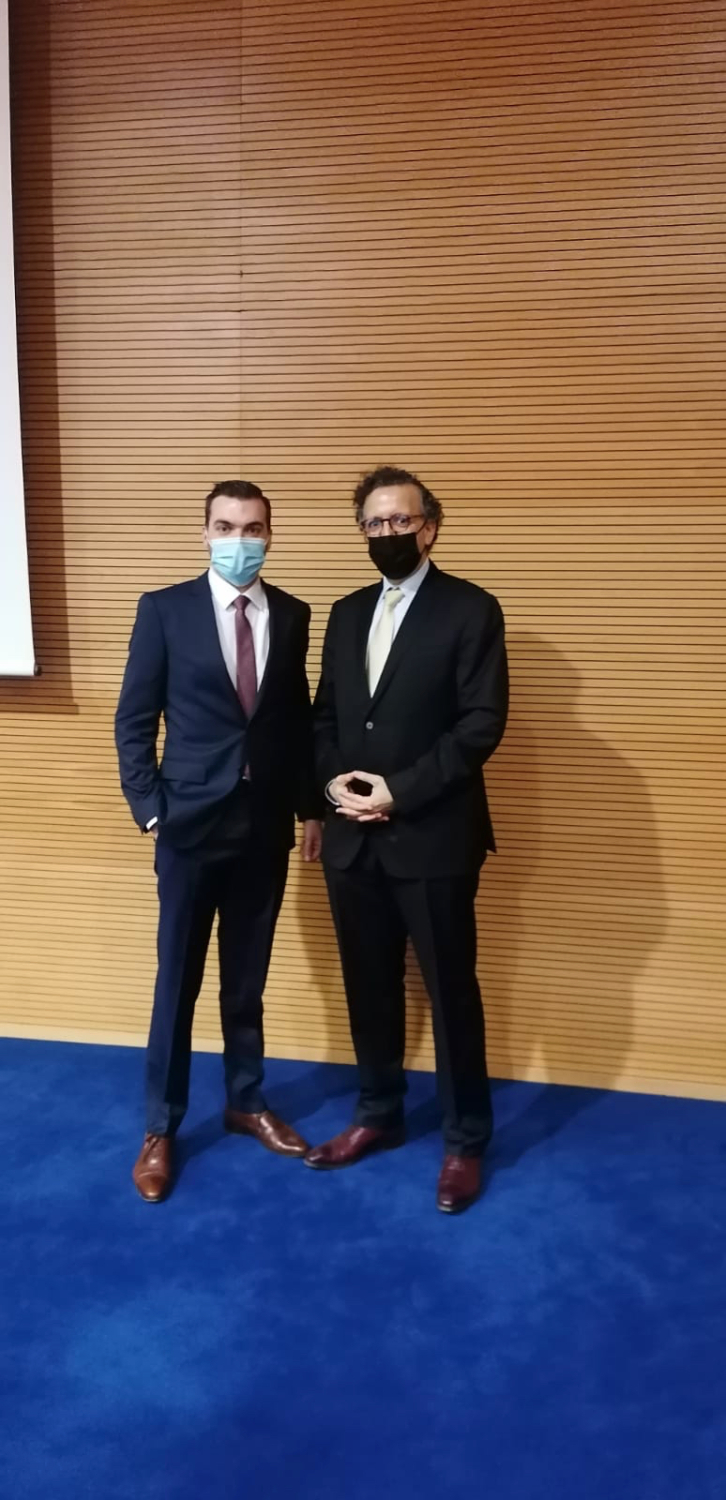
Dr. Béchir Jarraya (MD-PhD) is a neurosurgeaon and a professor of therapeutics (PU-PH) at the medical school of UVSQ (Université Paris-Saclay, France) and a principal investigator at NeuroSpin neuroimaging center.
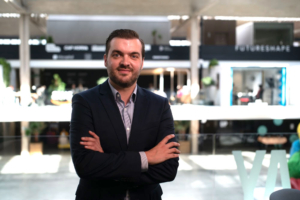
Dr. Jordy Tasserie is a neuroscientist and entrepreneur expert in DBS and MRI. His studies combine both disciplines to develop new biomarkers of optimal neuro-stimulation to treat chronic neurological diseases.
#36: Béchir Jarraya & Jordy Tasserie – Unlocking Consciousness: Neuromodulation, Neurofeedback, and the Future of Brain Science
In this episode, we delve into the groundbreaking work of the Neuromodulation Lab at the NeuroSpin center, led by Dr. Béchir Jarraya. The lab’s mission is to evaluate brain modulation using pharmacological agents and electrical neurostimulation. Combining functional MRI with new neuromodulation techniques, they train awake macaques, with a unique mock-MRI process, to study consciousness-related domains. Their activities encompass MRI, electrophysiology, and 3-photon imaging to unlock the mysteries of consciousness.
Join us as we explore the lab’s recent study published in Science Advances, spearheaded by Dr. Jordy Tasserie, which sheds light on the potential use of DBS for consciousness disorders like unresponsive wakefulness syndrome and minimally conscious states. We also explore the value of DBS in epilepsy and other indications, discussing potential targets for treatment.
Discover how neurofeedback for DBS is teaching self-control of brain functions to patients implanted with DBS, and its potential for closed-loop stimulation. Moreover, learn about the transformative Iseult, an 11.72T MRI at NeuroSpin, and the novel discoveries and biomarker applications it promises for neurological diseases.
As the discussion progresses, we gain insight into the co-invention of a gene therapy for Parkinson’s disease, and explore the future of gene/cell therapy in comparison to electrical stimulation stemming from Dr. Jarraya’s interest and expertise.
Béchir Jarraya & Jordy Tasserie 00:00If you restore arousal, how can you see if there is also an awareness restoration on them? And this we really believe since the beginning that... And the first thing we show is that if you perform deep brain stimulation on the Sanctuary on Thalamus, when the monkey is completely anesthetized, you will restore... We all know this paper by Nicholas Schiff and Ali Reza in Nature 2007. I remember I was doing my postdoc at MGH at that time and I was amazed by this paper. Less known is a paper by Coadon, which is a neurosurgeon in Bordeaux. And I think there's also other works in Germany, previous works in Germany with acute stimulation in the ovary showing the capability of really... Yeah.
Andreas Horn 01:27Hello everyone, this is Andy. Thanks so much for tuning in. Before we get started with announcing today's guest, I wanted to bring up two small things. First, I wanted to express my sincere thanks to Alaa Taha, who is a PhD student in biomedical engineering at Western University in Canada. Alaa has reached out to me to offer help editing the recordings and has done a phenomenal job to produce the last few episodes. 02:02This is super helpful and allows me to keep interviewing experts in the field and to run this podcast, which of course is entirely non-profit, and hence essentially a hobby of mine. Alaa, thank you. In case you are listening to this and want to become a part of the project in a similar fashion, please let me know. We are always looking for help and to connect the young brains of the upcoming generations. with this podcast. Second, I wanted to mention that since a while, a new framework has been born as a sister project to this podcast. Namely, three trainees from my lab, Barbara Holunder, Garance Meyer, and Patricia Zvarova, have started to organize a talk series under the same name. The talks are organized on Zoom and for free and feature two speakers each month. They have had tremendous talks already by experts, such as the Professor of Biomedical Engineering at the University of New York, Professor of Biomedical Engineering at the University of New York, Professor of Biomedical Engineering at the University of New York, Professor of Biomedical Engineering at the University of New York, Professor of Biomedical Engineering at the University of New York, Phil Starr, Professor of Biomedical Engineering at the University of New York, Ludwig Srinzo, Mike Fox, Shantz-Ediki, Hagei Bergman, 03:00Kara Johnson, Roxanne Lofridi, Marie Kruger, and others. All recordings are available online at stimulatingbrains.org. To make this talk series special, Barbara Garance and Patricia have come up with a new concept. Each month, they pair a senior speaker with a junior speaker to give talks on a similar topic, followed by a joint discussion. Also, the senior speaker will be a member of the group, and the senior speakers devote 10 minutes of their time to talk about how they got where they are now. So if you ever wondered why Mark Richardson ultimately moved full circle from a swamp on a hill to a swamp in Massachusetts, who were the mentors that influenced Phil Starr most, and why or which was Mike Fox's path to brain circuit therapeutics, tune in and take a look at this talk series. Barbara and Patricia are bright PhD students in my lab in Berlin,
Béchir Jarraya & Jordy Tasserie and you can follow them on Twitter under B underscore Hollander and Trissie's VAR. Allah Taha is also on Twitter under Allah underscore T underscore. 04:03Gharoz Maya, who is a postdoc in my lab in Boston, is not on Twitter, but certainly also open for contact. But now to today's episode. I think we have a tremendous topic in front of us. Wait for it. Consciousness. Recently, Jordi Tassery joined my lab here in Boston after doing a tour de force five-year PhD at Neurospin in Paris, and after a quick stop in Andres Lozano's lab in Toronto. He did his PhD under the supervision of Bahir Jarayar, who is a functional neurosurgeon at Foch Hospital in Paris, a professor of medicine at Paris-Saclay-Versailles-Saint-Quay University, and a principal investigator at Neurospin in Paris. Together, they recently published a paper in Science Advances in which they awoke non-human primates that were under anesthesia using DBS. Their study is a work of fiction, but he has it all. Invasive neuromodulation, an animal model, fMRI, EEG, and dynamic resting state fMRI analysis. 05:03Together with their joint mentor, Stanislas Dehaene, who leads Neurospin and is famous for his global workspace theory, they could demonstrate that it is not only possible to increase arousal, but also consciousness using DBS. I think this is a truly outstanding effort and a Hackelanian PhD thesis and paper. I hope you enjoy the conversation, as much as I did. And thanks for tuning in. Again, stimulating brains. So, Behir, it's a great honor to have you on the podcast. At this point, I already will have introduced you formally, so we can start right off with questions. And to break, the ice, usually before we get into the science, I always ask about your free time.
Andreas Horn So what do you do when not involved in science? 06:01Any hobbies or things you like to do?
Béchir Jarraya & Jordy Tasserie Well, I actually love opera. So I love not singing myself. But when I was young, I discovered opera really accidentally. I was a teenager listening to the French TV broadcasting, and there was a magic flute, which is really very good even for kids and teenagers. Great. The famous Mozart opera. And it was a revelation. I mean, I remember, I have other friends coming here, and I stopped playing with the other friends and went listening to this opera. So it was odd for them, but still. And later on, again, accidentally, I discovered Rheingold, Rheingold, the first opera of the, the famous trilogy of Wagner. And I became a big fan of Wagner's opera, 07:00I must say. So again, completely by chance. Of course, I appreciate also other forms of art, paintings, impressionists, Vardian sculptures, seeing ballet from Tchaikovsky, and of course, musicals. I, when I was in the US, I loved, I loved to go to Broadway. Broadway musical is maybe the modern form of opera, let's say. So I enjoyed it much. And I would add now that parenting is also a new hobby. Of course. Yeah, I think that takes a lot of time.
Andreas Horn So I was about to ask, how often do you get to go to the opera? Is it multiple times a year or every month even? Or?
Béchir Jarraya & Jordy Tasserie Well, it used to be at least, every month.
Andreas Horn Yeah.
Béchir Jarraya & Jordy Tasserie But I must say that recently, a parenting activity took over. So not to mention the COVID, 08:02of course. Sure. But well, I keep hope that it will go later on back to the previous one. Sounds great. And you live in the perfect city for art, I would say with Paris. So that's, that's amazing.
Andreas Horn So what sparked your interest to get into functional neurosurgery? Why that field?
Béchir Jarraya & Jordy Tasserie Well,
Andreas Horn I must say Andy that even I could even question myself why I went to medicine,
Béchir Jarraya & Jordy Tasserie basically, because at high school I was, I really loved mathematics. It was really my favorite, my favorite class, my favorite theme, but also biology. And I had some hesitation between medical school and engineering school somehow. So for me, the ideal scheme was to combine both basically to do, to do something related to medicine, to, to help also people suffering or discover new avenues in the disease field. 09:06And I found that functional neurosurgery was very well suited for that. I remember very precisely my first year of the medical school. I started medical school in Lyon, 1992. And I read a, a paper at that time about the, you know, the Swedish team at Klund, Björklund, Lindvall who pioneered the graft, actually the grafting in Parkinson's disease. And for me, it was really, really amazing to, to, to hear the, the, what the possibility of neurografting dopaminergic cells coming from fetal tissues into the brain of Parkinson's patients. And somehow it was like,
Andreas Horn yeah,
Béchir Jarraya & Jordy Tasserie I want to do that. Like the idea of rewiring the brain was so fascinating for me. 10:03And well, I must say that a few, few domains in medicine also are so transversal interdisciplinary. I love that I can function or surgery. It's well, we call it functional surgery, but it's not, I mean, you're directly working with colleagues, surgeon, neurologist or scientist or physiologist, MDs, PhDs, the PD nurse. That's for me. I love that actually, for me, it's, I hope it's the future of medicine, you know, the transdisciplinary, do you mean to work together with,
Andreas Horn yeah,
Béchir Jarraya & Jordy Tasserie maybe even a field of neuromodernism, you know, of neuromodulation that, that involves many specialties,
Andreas Horn right? Yeah.
Béchir Jarraya & Jordy Tasserie That's, that's great. So, 11:00so we heard a bit already this, you know, grafting fascination. And I love it when, when, when you sometimes have this aha moment and think this is what I want to do. I think I had that when I saw the first tractography image as well, myself at some point in small, but it didn't put my entire career in there, but, but I really loved this idea too. And I remember this image. And so, so maybe going into that, then in your career, who were key mentors or like turning points where you think this was an amazing experience, or this was, you know,
Andreas Horn the best mentor or the most important person in your professional career? Yeah,
Béchir Jarraya & Jordy Tasserie there were some several key people, actually. My first great mentor, ah, for sure was Michel Jouvet. Michel Jouvet was really one of the greatest neuroscientists of his time, at least in France and Europe. 12:02Probably now that in the 50s, 60s, he really was the first to link REM sleep to dreams. And he, he could destroy selectively locust cellulose in, in cats and, and see the cats dreaming basically, because they were, he interpreted that as looking after a mouse.
Andreas Horn So could the cat dream of that?
Béchir Jarraya & Jordy Tasserie Maybe. And actually he was a professor at Lyon, a professor of what we call experimental medicine. Today we say maybe translational medicine. And it was his last year before he retired, basically. I was really very fortunate to be in his class. And, and I discovered that Michel Jouvet first was, started his career as a neurosurgeon.
Andreas Horn Yes.
Béchir Jarraya & Jordy Tasserie Nobody knows about it, but in, maybe he was not in the right time for neurosurgery because at 13:02that time neurosurgery was still not really not on the, as today has developed as even today, or even 20 years ago. However, he, he really gives you very, with his big charisma, the love of neuroscience. Obviously, and, and he also talked about this grafting in the Luna team, etc. And, he refers also to Claude Bernan, so the inventor of experimental medicine. So this is, this influenced me a lot when I was a undergrad, or was the first years of medicine in Lyon. Then I started my residency in Paris, I moved to Paris, about this grafting in the LUN team, etc. And he refers also to Claude Bernard, the inventor of experimental medicine. So this is this influenced me a lot when I was an undergrad, or the first years of medicine in Lyon. Then I started my residency in Paris. I moved to Paris from Lyon for the residency. And I was very happy and fortunate to meet with Stéphane Palfi. He's a functional neurosurgeon and neuroscientist at Henri Mondeur Hospital. 14:03For sure, he played an important role in my career because he was the first to show me a concrete way of conducting both neurosurgery and neuroscience. I'm going from the bed to the bench. And he was, of course, doing functional surgery. He also gave me the opportunity to go to the lab to do a master and then a PhD under his supervision in the laboratory of Philippe Entrey at CEA. So he initiated me to non-human primate models as well of neurodegenerative diseases. So we did a lot of MPTP modeling, monkeys. And we developed together with a UK biotech called OxoBioMedica a gene therapy for Parkinson's disease that eventually later on went for clinical trials. 15:03So that was for me really an important moment in my life. I must also acknowledge that people like Yves Agide, a famous neurologist at Saint-Pierre.
Andreas Horn Yeah.
Béchir Jarraya & Jordy Tasserie I did a rotation in his department. Because I knew that I will do my career in neuromodulation. And for me it was important as a neurosurgeon to also spend at least a rotation where you're away from the OR but really having the opportunity to understand what is this disease, this fascinating disease. And with Yves Agide, I think he gives you, again, with his charisma and his sense of leadership. I mean, anybody that will meet with him. Anybody that will meet with him will fall in love with Parkinson's disease for sure. That's great. I've been trying to get him on the podcast actually because Marwan Hariz mentioned I should try but didn't get a reply. 16:02So haven't managed yet. No, please, yes. That must have been a great fellowship.
Andreas Horn So that was a rotation only or did you spend multiple years with him?
Béchir Jarraya & Jordy Tasserie Yes, I did a rotation in his department. And then among also my mentors, I would add Wim van Daffel. Wim van Daffel is a neuroscientist, not necessarily very known in the neuromodulation field, but he's a pioneer in cognitive neuroscience and in fMRI especially.
Andreas Horn And that was in Boston, right?
Béchir Jarraya & Jordy Tasserie That was when you went to the Martino Center. So maybe we can highlight that. There was not Paris anymore.
Andreas Horn But how long were you in Boston?
Béchir Jarraya & Jordy Tasserie So I spent one year in Boston, but it was a year of days and nights, basically. So two years. Sometimes I joke a bit because in Wim van Daffel's lab, actually, we had the opportunity to scan overnight and use the scanner. 17:04So it's really the efficiency of the US system where the scanners are turning almost 24 hours a day. I tried to do this with colleagues here at NeuroSpeech. It's hard to do. And it was really amazing because I, well, it was a switch for me. Like he was not doing any Parkinson's or stuff like that.
Andreas Horn But he developed techniques and technology that eventually later on influenced me a lot in my career when I was back to France, basically. So let's speak about that.
Béchir Jarraya & Jordy Tasserie I think after coming back from Martino Center, so from Boston to Paris, as I understood you from, you know, the beginning of your career, what was it like? I think after coming back from Boston to Paris, as I understood you founded the neuromodulation lab at NeuroSpin. And NeuroSpin, you know, is very famous, needs an introduction, but it's, I think, the center with the most MRIs in France, I could probably imagine. 18:01So a bit like the Martino Center in the US or Leipzig in Germany or so with the mission to evaluate brain modulation by. So your lab's mission was to evaluate brain modulation by a pharmacologist.
Andreas Horn Yes.
Béchir Jarraya & Jordy Tasserie And then you had a lot of research on the So this is a lab I had really the opportunity to mount back from Martino Center in Boston. In fact, I was fortunate to be a candidate and laureate of a French program for young investigators in the field of neuroplasticity. And I was lucky to be able to do that. And I was lucky to be able to do that. And I was lucky to be able to do that. And I was lucky to be able to do that. And I was lucky to be able to do that. And I was lucky to be able to do that. And I was lucky to be able to do that. And I was lucky to be able to do that. And I was lucky to be able to do that. And I was lucky to be able to do that. And I was lucky to be able to do that. And I was lucky to be able to do that. And I was lucky to be able to do that. And I was lucky to be able to do that. And I was lucky to be able to do that. And I was lucky to be able to do that. And I was lucky to be able to do that. 19:00And I was lucky to be able to do that. And I was lucky to be able to do that. And I was lucky to be able to do that. also teaches. I think it's important, especially when you are young, you have this opportunity to
Andreas Horn do that. So for me, it was something I learned in Boston from Wim van der Vroegel's lab. How can we do fMRI in non-human primates away or anesthetized? And the idea was to
Béchir Jarraya & Jordy Tasserie first to study consciousness, because when I was back to NeuroSpin, I made an amazing, actually, amazing collaboration with somebody who's very famous in the cognitive neuroscience field, Stanislas Doan. And that was the beginning of one of the most fruitful collaboration I had in my life over the last 10 years. And I hope it will be also the case for the upcoming years. So with Stanislas, we really decided that these models unique in primates and the ability of 20:10doing neuromodulation combined with functional MRI eventually could reveal some new secrets about
Andreas Horn consciousness. So how can the brain produce the consciousness phenomena? This is a fascinating
Béchir Jarraya & Jordy Tasserie field, in my opinion. Very hot topic. In neuroscience now, of course. Yeah. And even in the neuromodulation field, many teams are interested in applying neuromodulation for people, patients with chronic disorders of consciousness. So we really, the focus of the lab now is to study consciousness, to dissect consciousness mechanism, and to apply advanced functional MRI technologies with tasks for the resting state and advanced most technologies and analysis techniques to dissect the neural mechanism of consciousness.
Andreas Horn 21:03And this gives you not only a theoretical dissection of how the brain produces consciousness and modulates consciousness, but also why anesthesia does suppress your consciousness. Why? By binding to GABA receptors or glutamate packed in case of ketamine or mixed receptor bindings. Why do you produce this phenomena? I mean, it's when you think about it, it's incredible. It's a very recent discovery in
Béchir Jarraya & Jordy Tasserie the whole history of the humanity in a reversible manner, of course. So that we could actually have some new insights into how anesthesia affects the brain. And starting from that, we use this model that was developed by Eileen Uryk, actually she's an anesthesiologist 22:02herself. And she's also my wife, I should say. Became my wife after finishing her PhD. And we went to ask the question, could we reverse anesthesia effects once we studied a lot how anesthesia could
Andreas Horn suppress your consciousness? And we said, no, we don't have the tools. We don't have the tools. We
Béchir Jarraya & Jordy Tasserie don't have the tools. We don't have the tools. We don't have the tools. We don't have the tools. We don't have the tools.
Andreas Horn Could we reverse this phenomenon? And that was the opportunity to make a PhD for Jean-Yves Tasserine,
Béchir Jarraya & Jordy Tasserie who was my grad student. And it was an amazing adventure, several years adventure, to really reverse that by modulating specific nuclei of the brain of the thalamus, for example.
Andreas Horn And by doing so, are we reversing all the aspects of consciousness? Because consciousness is a very
Béchir Jarraya & Jordy Tasserie 23:07very polysemic word, so we can apply it for the arousal, we can apply it for the higher level of consciousness, the awareness. The perception or even the metacognition. It's very difficult actually to do in that field, either with patients and even more with animals. If you restore arousal, how can you see
Andreas Horn if there is also an awareness restoration on that? And this, we really believe since
Béchir Jarraya & Jordy Tasserie the beginning that imaging could be a key tool for that. Amazing. And I think this is of course the main topic also we wanted to talk about, which culminated in Jordi Tasserine's and like your Science Advances publication recently, where I think it's really a tour de force. It 24:00also, as you said, took around five years at least, I think, this work or at least his PhD. Jordi is with us today as well, so we can maybe also ask him to summarize a bit how, you know, what the effort was. And then we can also ask him to summarize a bit how, you know, what the effort was. You know, what the project involved. I think in, you know, just to excite the listeners already, so in a way you guys managed to restore consciousness with deep brain stimulation to the thalamus in monkeys and macaques. So, and you used, you know, multiple MRI techniques and invasive neuromodulation. So I think this is really a, and these were anesthetized monkeys, so it was not a like it was not a lesion based. So I think this is really a, and these were anesthetized monkeys, so it was not a like it was not a lesion based. So I think this is really a, and these were anesthetized monkeys, so it was not a lesion based. This order of consciousness, but anesthesia, so under anesthesia with DBS, monkeys woke up again, which I think is very, very helpful and very interesting as a, as a concept. So maybe Jordi, you want to briefly mention your activities like in during your PhD with Bahir, 25:04and then together we can talk more about the study. Sure. Thank you very much for having me. It's a pleasure. So we lead a comprehensive study in non-human primates when we monitor the brain. And then we can also talk about the brain when we basically study behavior of the animals, EEG result, and then we move to fMRI. So we had two group of monkeys. The first one was completely awake as a reference. And the second group was deeply anesthetized with propofol, is a model developed by Linearing. So finelitude anesthesia at a deep level. And we perform on a deep brain stimulation with a different control, both on the amplitude, so low or high amplitude, but also on time of localization. In the central talamus, which is a natural laminar nuclei, or in the lateral talamus, which is not. And the first thing we show is that if you perform deep brain stimulation on the central talamus, when the monkey is completely anesthetized, you will restore
Andreas Horn 26:01arousal. So what does it mean? It means that the monkey literally woke up,
Béchir Jarraya & Jordy Tasserie he will have spontaneous movement, he will have self-breathing, he will open his eyes, which is actually not the case when you are stimulating at lower amplitude, on the same contact or if you are stimulating the ventral lateral thalamus. But it just gave us an understanding of how deep brain stimulation can restore arousal but still not awareness. So we also perform EEG during this same condition and what we show is that the normal delta power significantly decreases under the same conditions that restore arousal in the monkey. And in the opposite normalised delta and alpha power increase when you perform deep brain stimulation. So overall the spectral distribution of frequency and entropy increase during high amplitude central million thalamus. But again we still have no idea about the content of consciousness, so the 27:00awareness. So we then moved to fMRI this time and the first idea was just to look at the DBS and juice activity. So when you simply switch on and off the state of the brain, you can see that the DBS and juice activity are not the same. So you can see that the DBS and juice activity are not
Andreas Horn the same. So we then moved on to the stimulation. What kind of brain activity would you have? So we
Béchir Jarraya & Jordy Tasserie map the whole brain fMRI response and what we saw is that with low amplitude stimulation center on the central thalamus, you will activate localised sectors of prefrontal, parietal and anterior circulate cortex for instance, as well as the midbrain and the cerebellum. Now if you perform the same stimulation but in the control in the ventral lateral thalamus, the activation will be much more restricted to the occipital and the parietal. So if you do the same stimulation but in the control in the ventral lateral thalamus, you will activate the occipital cortex. Now if you look at the only conditions that awake the monkey, so the high amplitude central brain stimulation, we saw an amazing broadcast effect in prefrontal, parietal, anterior and posterior circulate cortex, but also insular cortex, triatom, hypothalamus or even midbrain and cerebellum. 28:02And if you do the same stimulation at high amplitude but now in the control in the ventral lateral thalamus, it leads to more restricted activation only in the prefrontal, parietal and posterior thalamus. And if you do the same stimulation at high amplitude but now in the control in the ventral lateral thalamus, it leads to more restricted activation only in the prefrontal, parietal, anterior and posterior circulate cortex. So among all the different DBS targets and levels, only high amplitude stimulation center on central brain thalamus activates this broad cortical and subcortical networks, which include especially the circulate cortex. Wow, this is really amazing. So you controlled for frequency or like amplitude and you controlled for the target. You did this, I think, in two monkeys, is that true? Absolutely. So we had three monkeys for the awake pattern. And two monkey was implanted with deep brain stimulation.
Andreas Horn Interesting. So we then moved to resting states. And we look at how the spontaneous fluctuation of
Béchir Jarraya & Jordy Tasserie the brain will look like when you perform against this stimulation. And what we saw is that when you are under anesthesia, all the long wedge cortical correlation will be vanished compared to awake.
Andreas Horn 29:05So the question was to say, can we restore this long wedge bilateral connection? And the question was to say, can we restore this long wedge bilateral connection?
Béchir Jarraya & Jordy Tasserie And during low amplitude stimulation, both on central median and ventral thalamus, we barely restore some part of it, especially in the prefrontal cortex, but not the long wedge cortical connection from prefrontal to circulate cortex, for instance.
Andreas Horn But interestingly, when we perform high amplitude stimulation on central median thalamus, again, the same that restore arousal, the same that increase the mean spectral entropy awareness.
Béchir Jarraya & Jordy Tasserie We saw that we restore an awake pattern in the global neuronal workspace key node. So the global neuronal workspace is a theory of consciousness developed by Jean-Pierre Chandler and Stanislav Dohan. And we identified key areas in the cortex that are probably responsible for consciousness. And we performed this analysis of functional correlation. 30:03We showed that only this kind of stimulation in the central median thalamus restores the long wedge cortical function. And we found that the long wedge cortical function is the most effective way to restore functional connectivity. Super cool. So this even ties in the global workspace theory that, as Bahir mentioned, Stanislav Dohan, among others, developed at the center of NeuroSpIN. You were not done. You wanted to...
Andreas Horn Sorry, did I interrupt you?
Béchir Jarraya & Jordy Tasserie Sure. Because I think what we demonstrate here is just the mechanism of deep brain stimulation, sometimes functional thalamus. But... From all the experiments, we still have no idea about the content of consciousness, what is really the awareness. And to that, it has been demonstrated that there is two biomarkers of consciousness when you use neuroimaging. And the first one is the dynamic resting state. So if you use an unsupervised algorithm to segregate your fMRI scenario into different patterns, you will be able to identify, let's say, seven brain patterns that OK. 31:09In your brain and how your brain is moving from one to another during 10 minutes of resting states. And what have been demonstrated both in non-human primates and in patients with chronic disorders of consciousness is that when you are completely conscious, you have a rich set of brain states completely independent to the structure. So if you order this brain state, going to the similarity with the anatomy, you will see that there is absolutely no correlation. And what we've done here is that we... Performed the exact same experimental condition. So awake, anesthetized and anesthetized plus deep brain stimulation. And we saw that only central telomere deep brain stimulation at high amplitude was able to completely restore a rich repertoire of brain states, which was not just the case when you are completely anesthetized. 32:00So when you are anesthetized, your brain is shaped to brain state number seven, which is the one which is really tied by the anatomy. So your brain is not flexible enough to jump from one state to another, but you will remain in one specific pattern.
Andreas Horn And interestingly, it was absolutely not the case with your other deep brain stimulation conditions.
Béchir Jarraya & Jordy Tasserie So again, the same condition restore a rich and dependent of the anatomy pattern in dynamic resting state. And just to finish, I know some of you could be a bit annoyed by resting state and how we can denote this kind of data. So we move forward. OK. So we move to another paradigm, which is an event related task. A notable paradigm we call local global. And again, it has been demonstrated both in patient and animals models that the first level of deviance, so just the tone would break the rule. You can process that even if you are non-conscious, which is what we call the local deviance. So you will have something like tb, bb, bap. 33:01But now if you make something much more complex, which would be the global deviance. The sequence violates the rule. So you will have bb, bb, bb, bap, bb, bb, bb, bap, bb, bb, bb. This is much more complex to process. And only if you are conscious, you will be able to have this ability to detect these global deviance. And what we show is that if you perform again the same centurion thalamus deep brain stimulation, you will restore the broadcasting effects in prefrontal, parietal, and cingulate cortex when the global deviance occur. This is not the case when you are anesthetized because all these effects are completely vanished. And so far it was really two different orthogonal ways of demonstrating a signature of consciousness that is restored by deviance stimulation, sometimes the centurion thalamus, which is not the case when you perform the control side of the frontal lateral thalamus. Amazing. So really, like two of the four PhDs and paper, all in one paper. 34:03They hear, they hear. They hear. Thanks for the summary, Jordi.
Andreas Horn But here, did Jordi miss anything? Or would you, what would you add?
Béchir Jarraya & Jordy Tasserie No, just to give more context, I think Jordi explained very well the paper and the experiment there. And everybody in the normidation field knows that the idea of stimulating the thalamus to restore consciousness is not completely new, actually. Sure. We all know that. We all know this paper by Nicolas Schiff and Ali Reza in Nature 2007. I remember I was doing my postdoc at MGH at that time. I was amazed by this paper. Less known is a paper by Coadon, which is a neurosurgeon in Bordeaux. And I think there's also other works in Germany, previous work in Germany with acute stimulation, the OVAR, showing the capability of, of, of, of the thalamus. 35:02The ability of, of, of really inducing consciousness or shifting consciousness states. What is, what is new, I think, here is the, I would say two, two, two aspects. First, so far, and also in the monkeys, the awakening monkeys with thalamic stimulation was also reported by Yairi Salman Group, Red Inbow Paper Neuron. And also the group of Emery Brown and Dr. the MIT group, Ern Miller and Henry Brown. I think the novelty here is to measure consciousness precisely and not to look only on arousal effects, the awakening effects. This was really difficult to say.
Andreas Horn How could we really measure 36:01awareness in these animals?
Béchir Jarraya & Jordy Tasserie It's very hard to interact with. This explains very well the signature that we spent already a while on developing them with Stanislas, with Yonet Nakash, and sometimes first in patient then in the monkey, sometimes first in the monkey then in patient. That's the virtue of translational medicine, the back and forth. I think this is
Andreas Horn something very interesting that
Béchir Jarraya & Jordy Tasserie in my opinion, even for future clinical trials involving neuromodulation, whatever the technique of neuromodulation in disorders
Andreas Horn of consciousness, or why not even
Béchir Jarraya & Jordy Tasserie in acute consciousness disorder and coma, should really involve these measures, these biomarkers of consciousness, because it's the only way to move on and to prove how much are you inducing in terms of which level of consciousness. The second aspect, 37:00I think, which can be generalized even more, is that functional imaging can be a key tool to distinguish your settings, your electrical parameters. What I personally think is that eventually, functional imaging, it could be also HDG, etc., could probably play an increasing role in the neuromodulation field. Like the, this publication we had in Science Advances, clearly, you could see that the fMRI maps vary a lot according not only to the location of stimulation within the thalamus, but also to the setting and the cortical aspect of it. We know now very well that cortical modulation is very important. It's deep, but a lot of cortical effects there. Functional imaging could 38:00eventually be a way to better understand the mechanisms of DBS and Parkinson's. Well, this Andres Lozano and his group and also Robert Jesch also pioneering that. But we should probably profit from the advancements in technologies of fMRI and in analysis, of course, of fMRI. Both resting state and task.
Andreas Horn And why not guiding even better
Béchir Jarraya & Jordy Tasserie neuro modulation, neuro modulation settings in our already current applications, movement disorders, maybe even more critical for psychiatric disorders, of course. You know very well, I would not convince you about the importance of imaging in the neuro modulation field. You're a pioneer in that. Thank you again also for your time. Thank you. 39:00And also for the collaboration we had so far on lead DBS and adapting lead DBS first as a first time to preclinical models.
Andreas Horn Yeah, I should maybe mention that,
Béchir Jarraya & Jordy Tasserie that you guys did, you were the first to use lead DBS in a non-human. So, Jordi, you visited us in 2016 at Charity when we gave the first lead DBS workshop and you were interested in applying that into like localizing electrodes in macaques.
Andreas Horn Yeah, absolutely.
Béchir Jarraya & Jordy Tasserie So we discovered this amazing tool lead DBS that you guys developed and we were a bit annoyed to say that it was not yet working for non-human primates. So the idea was to extend that for macaques monkey. And so thanks to this collaboration efforts, we bring this extension when we have now the atlases from non-human primates. And thanks to that, we were able to localize electrodes that we implanted in this monkey 40:00for quaternary disorders. That's really great. And it is now, I think, openly available. People can use lead DBS for primates thanks to you guys and first publication there. I think just as a side note, there was one group that used it in a swine model without any of my interaction. I didn't even, you know, I just saw the paper. So, and we ourselves published rats, you know, a rat version of lead DBS and used it in rodents. But that was all after your primate model. So you were certainly the pioneers of adapting lead DBS to other animal models, which is amazing. And was it, you know, great. Thanks to you. Thanks to you. Thanks again. I didn't do much. No, no, no. Really great.
Andreas Horn Yeah.
Béchir Jarraya & Jordy Tasserie I think you played an important role in this. So I guess for the second point, 41:00what you're saying, and I totally agree, you know, we have a causal, you know, impact with the stimulation on the brain. We can now measure that with fMRI beautifully because we really know we induce some stimulus
Andreas Horn and then we see the response, right?
Béchir Jarraya & Jordy Tasserie We can contrast location. We can contrast different simulation frequencies and so on. So I totally agree with you there. For the first point that you mentioned, which was that, I think, I guess it was quite obvious to you guys
Andreas Horn that the monkeys would be more aroused, right?
Béchir Jarraya & Jordy Tasserie They would move, they would open their eyes and so on. That's easy to diagnose,
Andreas Horn but sounds like you guys were really into consciousness, right?
Béchir Jarraya & Jordy Tasserie About, you know,
Andreas Horn are they conscious or not?
Béchir Jarraya & Jordy Tasserie That was the key or the most important thing for you. So, and then you think there, that's where imaging really helped because you essentially can't talk to them. You know,
Andreas Horn it's hard to measure consciousness, right?
Béchir Jarraya & Jordy Tasserie You can't measure consciousness there. I would maybe love to dive into that a little bit more, 42:00but even starting with arousal. So like when you put the stimulation on at the right frequency at the central median nucleus, I think, Jordi, I asked you before, the monkeys would eventually would have left their cage
Andreas Horn or like they would have gone away if you wouldn't like stop them, right?
Béchir Jarraya & Jordy Tasserie They were so awake in a way or aroused that they would move and, you know, look around. And then you sort of sort of sort of copied how were like how wild were like wild were like wild were like wild were like wild were like wild were like wild were like wild were like wild were like wild were like wild were like wild were like wild were like wild were like wild were like wild were like wild were like wild were like wild were like wild were like wild were like wild were like wild were like wild were a monkey that tried to escape was completely sleeping and then all of a sudden he opened 43:00his eye he have their reflexes and he will try to understand the surrounding world has continuous movement and even on the physiology of the animal you can see that when you anesthetize the mean heart rate will decrease or the body temperature will decrease and it regain normal values so if you're not turning out the stimulation or if the monkey is not paralyzed it could definitely turn to something potentially dangerous if you are just next to him um so yeah definitely i could picture someone that woke up and and restore complain ability to interact uh with the surrounding world and i think that is so important because you know i think many of you know you could imagine that the dbs effect had something that you could measure in the signal or so but no you really saw it right the monkey would essentially wake up now i guess for the lay person like me i'm not you know i'm familiar with with um consciousness that well it would would could it be let's say like sleepwalking like um you know sometimes we do 44:04move during sleep but we're not awake we're not conscious so was it a bit like that could it have been like that and then for that you needed to prove in different forms for example with the stimuli bit bit bit bup bup bup bup bup bup bup prove in different forms for example with the stimuli the bit bit bit bop idea and with imaging that no it was really consciousness or like at least the measures of consciousness were heightened under dbs is that a bit how we could picture it it's it's a good uh that to use the sleepwalking so it is a way maybe a metaphor to dissociate the two dimensions of consciousness meaning the the arousal the vigilance which is very easy to see uh like uh if you you look after an accident and you see some somebody in his car you say well is he conscious it mean is he waking is he uh opening his eyes spontaneously for example uh but then that's not enough i mean 45:03arousal you can have arousal or vigilance without any perception of external world that's yeah that's something important to uh that that now we we we have very good examples of it if you take chronic disorders of consciousness for example so these are patients we see a lot in neurosurgery after severe head injury for example or severe stroke and some of these patients thanks to the current medicine and icu can survive actually but some of them will even open their eyes for example you know like you know like you know like you know like you know like you know like you know 10 days, two weeks, when sedation is not there and spontaneously eyes are opened. But we know very well that it doesn't mean they are conscious because they may be vegetative. They open eyes in the morning, they have a cycle. But actually, it's really impossible to have any communication between the external world and those patients. 46:05And we know that some of them actually have more than that and start to communicate, to perceive the external world. And we call them minimal conscious state, MCS. And the difference is important because it's not easy to make clinically. Well, colleagues from Liège like Steve Lorais or Adrien Owen was in Cambridge, quantified that... and found that with clinical examination, we are mistaken in 40% of patients because of the limitation of the clinical examination for consciousness. When you go to the department of neurosurgery or people know very well the Glasgow Coma Scale, for example. This is the universal scale for, let's say, loss of consciousness. 47:01It's a very good scale for the acute management. Of course. But it's very bad scale for the chronic disorders of consciousness. And what we should now teach more and more to our residents and etc. who are young colleagues is that after the acute period of a coma, the Glasgow Coma Scale has not, don't have any sense anymore. You need to move to specific scales called, for example, CRSR. So, coma recovery scale revised. There are other scales, but CRSR is one of the most translated in all languages. These are scales that will take you more time to realize. You need almost between half an hour and one hour, whereas Glasgow Coma Scale in two minutes, you can easily do it. But they are much more appropriate to try to better evaluate the recovery from coma. 48:02But even CRSR is not enough. And there are... Patients who are in between, between vegetative also now, although now we say more and more UWS, so unresponsive weight from the central, versus minimal calcified state. And this difference can be important. It may be, maybe it's important to select the patients for neuromodulation eventually. Maybe in terms of prognosis eventually. So, so there are different, different conditions. Different sequences. But this again, gives you clear from the clinical experience, clear difference between arousal vigilance. So the first level of consciousness, which is clinically diagnosed by open eyes or not, basically. And going more than that, perceive the external world and eventually communicate with the external world. 49:01So having some kind of awareness, even if it's an intermediate. So that's sort of part of the awareness. And clearly, it's important for neuromodulation to restore both aspects of consciousness, especially awareness. So we call it also conscious access, or conscious content of consciousness. So it's a more cognitive aspect of the consciousness. It's very important to look at the potential restoration of the second level of consciousness, in my opinion. Because this is more clinically relevant and useful for patients with disorders of consciousness. So this again, sorry, yes, this again, can be tricky to measure. And more and more, it's tools like imaging with tasks like global global is not the only one, many people are working on tasks. But as you mentioned, also more and more within the resting state also, by 50:34thing to do with your model as well, where you have a single DBS stimulus or something, and then look at the complexity, I think, of the response? And the propagation of the complexity, actually, across the brain. This is an amazing idea, developed by Massimini and Tonini, when they compute a specific index for PCI, perturbational complexity index. 51:01PCI is a very good measure, for sure.
Andreas Horn Actually, the interesting thing with PCI is that the stimulation is potentially pretty
Béchir Jarraya & Jordy Tasserie homogeneous across patients, and is not relying on the preservation of sensory inputs. Because by the end, in event-related paradigms, this is also what you do. But instead of doing electrical zap. You will make an auditory paradigm or a visual paradigm. However, you need, in these patients with head trauma also, to check for the integrity of the sensory input, visual input, hearing, auditory input, etc., etc. I think, somehow, I mean, I would say there are two... 52:04two aspects. First, that it's good to have different biomarkers, because probably we will converge to this idea of personalized medicine. And you know how much brain trauma patients are heterogeneous. They are much more heterogeneous than Parkinson's patients, which already are heterogeneous. So probably, probably you need to multiply the biomarkers. And there is also a strong, strong efforts to do all of that.
Andreas Horn Yeah.
Béchir Jarraya & Jordy Tasserie To bring these biomarkers to the everyday clinical settings. And that's really... That's really something we need to work on. And I know, for example, the team of Jacques Hussite and Yolaine Nakache and Pitié-Saint-Petrière and ICM, they are actually developing embarkable devices that can eventually run this with EG. So some tasks with online analysis. 53:02it's it's a general question now when you have a hot topic in neuroscience message only very few coming to the patient sure no absolutely i mean going towards that next steps on the way to a clinical trial of this like developing this into patients but also if you had done in theory the same thing with humans instead of monkeys i know not ethically possible but if you had and they would be away like aroused you could try to talk to them right so you have different means of accessing their consciousness um just by interacting with them maybe um that go beyond the monkey and um could an intermediate set because we do implant cm in epilepsy patients right we put electrodes into the central median nucleus and the thalamus in epilepsy patients sometimes under and and the and the ! could that be an intermediate step where one could say okay we try to of course with ethical approval and everything, but we try to replicate patients sometimes under anesthesia, 54:03potentially awaking or arousing patients during surgery that go in for epilepsy. I don't know if that is an idea that is feasible or thinkable? Well, no, you are absolutely right. It depends on what is the idea behind, because clearly the development of neuromodulation for conscious restoration is very clearly not only for chronic disorders of consciousness. You're absolutely right. I mean, Blumenfeld showed that in many papers and then he's driving several preclinical and I think also clinical trials to perform 55:01neuromodulation DBS to restore consciousness in epilepsy patients and I think he's absolutely right because some of epileptic patients have so we're talking of course of drug resistant epilepsy and drug resistant epilepsy with consciousness alteration so this is a strong handicap and it's I found it a clever way to address also the question by taking it and on the consciousness side more than on the epilepsy side although fixing the two problems is of course the holy grail but still it could be that you're ameliorating the everyday life of patients enormously already by going in the direction of consciousness restoration and again I would personally I would try to apply neuroimaging in these patients and 56:05to guide the way we conduct but we personalize maybe the settings well you know very well Andy I mean in the movement disorders field who is probably the most mature application of neuromodulation today and we know how much it's key to get the right patient the right spot the right setting at the right moment so go extremely toward personalized medicine and we can we can guess that this should be even more important in cognitive disorders psychiatric disorders disorders of consciousness these are also network a network disease consciousness is not related to one center there is no center of consciousness within the brain and especially the second level of consciousness we're talking about the awareness of the conscious access 57:03if we take whatever the theory actually yeah but it's true that at NeuroSpain we're taking the GNW theory framework let's say to explain also our results in the theory ! Because this visual input that started in V1, V2, went until your prefrontal cortex to parietal cortex, realizing kind of ignition. This progressing phenomena, this is what makes an information become available globally 58:00and becoming conscious. So this is something, it's much easier to assess with the functional imaging, for example. Sure. Because you may, of course, you're very right to say that with patients, we can have the communication aspect, which can make it easier sometimes, but you can eventually also go into intermediate steps and eventually functional imaging could be very helpful. Are there concrete steps towards clinical translation of your findings
Andreas Horn at the hospital or at the NeuroSpin?
Béchir Jarraya & Jordy Tasserie Well, only if you can talk about it, of course. Sure, sure, sure, sure. Well, you know, currently there's a big national debate about end of life and dignity of end of life and the right of patients to terminate their life if they consider that they're extremely handicapped.
Andreas Horn 59:00So is it really the best period for these patients?
Béchir Jarraya & Jordy Tasserie I don't know. I must say that it's true that there are ethical limitations. I mean, there are ethical limitations. I mean, we see it already that today it's not easy to take part of this patient into the fMRI. It's heavy. It's not really realized routinely, apart from very few centers in the world.
Andreas Horn So what about patients with chronic disorders of consciousness?
Béchir Jarraya & Jordy Tasserie Much more challenging ethically to do such studies. I think we need to keep that in mind. I mean, it's, it's not, it's not quite straightforward to do in these patients, but we are do in the lab settings with either preclinical models or even healthy volunteers that are generally young students, very willing to spend hours in the lab jumping from fMRI to MEG, 01:00:00from to EEG to HDEG, no matter what happens. That's clear. So, I think, I think, I think, I think it's a big challenge. So there is an ethical limitation and there is also, I think a big, big challenge about the selection of patients. It, I mean, it took almost 10, 15 years since the early, early days of Grenoble with the SDN DBS, really achieve the current international standard of selecting patients based on L-dopa response, neuropsychological testing, MRI. et cetera, et cetera, even psychiatric evaluation. It took a while. And this is a disease supposedly more simple than chronic disorder of consciousness, although we know now that it's not that simple with alpha-synucleopathy theory. So this, I think today we're lacking that.
Andreas Horn 01:01:01How would we select these patients?
Béchir Jarraya & Jordy Tasserie Because it's not very supportable, in my opinion, to just go again and implant Leeds centrotalamic because probably it will not work in all patients, for sure. Sure.
Andreas Horn So maybe to tie into that, one big limitation of your model or like for translation is that these were again anesthetized, but then most of your patients, that's not, or all of your patients, that's not what they suffer from, right?
Béchir Jarraya & Jordy Tasserie So that's probably one- It's a big difference.
Andreas Horn Yeah, it's a big difference.
Béchir Jarraya & Jordy Tasserie You have- Normal structure in these monkeys, completely massively altered structure and connectos in the patient. That's very clear. And we're very explicit about it, even in our discussions, et cetera. I know, but I just wanted to open it up again for the listeners because this is the big difference here, of course, between the model and the reality.
Andreas Horn 01:02:00Yeah, yeah.
Béchir Jarraya & Jordy Tasserie You're right. So for me, I hope that, well, I think approaches with the connectome analysis with DTI should, of course, be very important in the selection of patients. But still, for me, an ideal world, we should have a way to predict the effect of DBS before implanting the electrode.
Andreas Horn Yeah. Would it be possible?
Béchir Jarraya & Jordy Tasserie Well, you know, now more and more in neuroscience, you have this emerging technique, which is called focused ultrasound.
Andreas Horn Yeah.
Béchir Jarraya & Jordy Tasserie That can allow us eventually to do that. So many of the listeners know focused ultrasounds through the realization of thalamotomies because of the last years, Insight Tech company make it more and more popular to perform thalamotomies with high intensity, 01:03:04high density focused ultrasound. And to perform, you know, high intensity, high density focused ultrasound. And to perform a much more proper thalamotomy than done 40 years ago, of course, with MRI control, et cetera, chest x-rays. But I'm not talking about this at all. You probably know that focused ultrasound now allow many other things, allow to open brain-blank barrier, for example, but allow also to perform neuromodulation, actually reversible neuromodulation. So for me,
Andreas Horn it is a very interesting pathway potentially
Béchir Jarraya & Jordy Tasserie that we need probably to first study in the lab setting
Andreas Horn and even in preclinical models eventually. How could we really predict the effect of DBS with completely deeper focus ultrasound neuromodulation? 01:04:05Yeah.
Béchir Jarraya & Jordy Tasserie So I think that would be fantastic because that could save a lot of patients from useless implementations, which for ethical situation like this one would be, in my opinion, very important. So you're saying with one or two transducers, low intensity focused ultrasound tries to also, you know, mimic the DBS effect by going deep and inducing action potentials or modulating the activity deep there. So, and you would say, this is a great idea to probe,
Andreas Horn will this have an effect?
Béchir Jarraya & Jordy Tasserie And then if it does, you could have a temporary, a permanent effect with the DBS electrode. That's the model you're proposing. I really like that. That's a great idea. And I mean, even with the Insight Tech machine, I think you can also with, you know, lower the intensity and modulate and then have really good precision in the MRI to do it. 01:05:00So it's a great proposal there.
Andreas Horn Yeah.
Béchir Jarraya & Jordy Tasserie Even also for,
Andreas Horn anything we do in DBS, right?
Béchir Jarraya & Jordy Tasserie Even in, you know, psychiatric disorders
Andreas Horn and to probe it before we do the actual surgeries is a really important avenue for the field. But I mean, for that, we have to show that we can predict the effect first, right?
Béchir Jarraya & Jordy Tasserie So maybe even something like tremor could be a good model where you could really, you know, see it first. And there we already, I think we already know that we can test modulator. I know. Some groups already started doing that with tremor. So studying more thoroughly the effect of non-relation with the Insight Tech machine at sub-threshold level of focus ultrasound. So there will be papers in the upcoming.
Andreas Horn Yeah. Yeah. Absolutely.
Béchir Jarraya & Jordy Tasserie And I mean, we routinely do it in like before burning the hole. I think also here in the hospital, of course, 01:06:01we would always have a, you know, test sonication. I sometimes wonder though,
Andreas Horn because we rarely stop then, right?
Béchir Jarraya & Jordy Tasserie We would usually then burn the hole.
Andreas Horn So I sometimes wonder, is the first sonication really just a test? Is no neuron really dying there?
Béchir Jarraya & Jordy Tasserie Or is it already, you know, finding that threshold is also going to be important, of course. But that's really, really helpful. So we touched upon epilepsy and we can maybe go into that again a little bit more, but maybe before that, we can go into that a little bit more. So I think that's an odd question, but I'm sure people have asked you this before. If we think of your model modulating the connectome somehow with the global workspace and everything, you could do maybe at some point the same with a multifocal non-invasive idea from outside, and you could maybe even reverse it and, you know, do the opposite. 01:07:01And with that, maybe have a form of anesthesia, I mean, we are working on consciousness and its reversal and its induction with anesthetic ages, its reversal, DBS, etc. And very clearly, I mean, you can say, will anesthesia be the same in
Andreas Horn 10, 20 years than today? Not sure. Because when you think about it, I always joke with
Béchir Jarraya & Jordy Tasserie my very good friends and colleagues, anesthesiologists, they say, well, anesthesiology 01:08:01have this very unique particularity is that most of the training during residency is about combating fighting against the side effects of the drug. So most of the training is about how to handle with the circulation effect, the heart effect, the lung effect, the respiratory effects. And of course, this is very technically sometimes challenging, and it's very important. It's very, for the safety of patients, it's incredible. I mean, the safety of anesthesia increased a lot over the last decades. But by the end of the day, anesthesia is about suppressing consciousness. So
Andreas Horn the ultimate goal should be how can I induce loss of consciousness without these side effects?
Béchir Jarraya & Jordy Tasserie And cancer, 01:09:17much more than the disorders of consciousness in terms of number of people. But for sure, I really hope that one day we can go to that direction, that neuromodulation, non-invasive, of course, neuromodulation, could even do the opposite and go for a safe loss of consciousness, safe and reversible loss of consciousness, maybe, hopefully, without the side effects of the cardiac, the lung side effects and the circulatory side effects. Absolutely. And the beauty could be the closed loop component of it where you can measure and induce and 01:10:02really titrate the exact level one day, maybe in the future, of consciousness. And that brings me to you. And that, you know, maybe moving a bit to your medical practice as a neurosurgeon, specialized in DBS for movement disorders. You're also involved, I think, in the Neuropedist project led by David Linden with other European centers, as well as Toronto and Turkey. And there, I think, neurofeedback plays a big role in the way you do DBS. Could you give us an
Andreas Horn overview about that? Yes, sure. This is a fantastic project,
Béchir Jarraya & Jordy Tasserie Linden. And this is also funded by an incredible person, David Linden, who is really amazing in the neurofeedback field. The idea is that neurofeedback is the way to project to the patient his own brain activity somehow and try to let him to influence that so that he could, for example, reduce beta 01:11:08oscillation eventually. Or reduce the propagation of beta oscillation. of beta-oscillation in the basal ganglia and the cortex, et cetera, et cetera. And the idea of David is that neurofeedback who is more and more providing evidence in diseases, psychiatric diseases of efficiency actually, could eventually enhance condition of Parkinson's in patients with or without DBS, but including with DBS.
Andreas Horn I found it very interesting. I find it also very interesting because it enhance
Béchir Jarraya & Jordy Tasserie and regroup many groups that are interested in combining imaging and DBS. So it's also a way to promote that field, which is evolving slowly by the way, for different reasons. So of course, ultimately, fMRI-based DBS 01:12:03is not very easy to, neurofeedback is not very easy to perform unless manufacturers would help to add applications within their schedule.
Andreas Horn Why not? Another application could come also eventually from the fact that we are more and more now with the new technologies, for example, the percept neurostimulator electronic and others probably in the future, read the activity and eventually project it to patients and to try to have them influencing that activity. Yeah, would that really improve the effect of DBS? Why not? But it's pretty fascinating, actually. Really cool. So you think there is a role for neurofeedback in these closed loop stimulation techniques? Could you draw a picture of how that could work in the future?
Béchir Jarraya & Jordy Tasserie 01:13:01So, again, I think during the research development. Currently, it's based on fMRI. So patients could go to the scanner.
Andreas Horn fMRI needs to say, what will we project? What kind of brain activity will we project?
Béchir Jarraya & Jordy Tasserie So that's one of the unsolved questions that we try to solve during this project, by the way. Probably not the STN activity because already the artifact of the electrode is not helping. And again, I think it's a very interesting question.
Andreas Horn Yeah.
Béchir Jarraya & Jordy Tasserie I believe many, many evidence now show that cortical effects are so strong in DBS that they can be per se the target of neurofeedback.
Andreas Horn Yeah. So could it be just projecting the activity of one of these premature areas to the patient, asking him to reduce it and having even a carryover effect?
Béchir Jarraya & Jordy Tasserie 01:14:02Or could we... I'm actually trying to push to DBS.
Andreas Horn Yeah. So if we use the methods we use in our consciousness studies, so these dynamic resting state analysis, which is seducing somehow, could it be also a way to perform neurofeedback?
Béchir Jarraya & Jordy Tasserie This will still take some few years. But again, I believe it can only help. And in the study we have also representative patients. Sure.
Andreas Horn I find it more and more interesting in clinical trials to involve representative of patients so they can attend even scientific meetings we had.
Béchir Jarraya & Jordy Tasserie And I must say that it's really very, very good experience.
Andreas Horn Absolutely. Yeah. It's a very interesting experience.
Béchir Jarraya & Jordy Tasserie I mean, they are the experts, right, in many ways. So I totally agree with you. 01:15:00Involving patients, even as co-authors on papers or, you know, is really important. Of course, not every patient would be interested, I think, but some would be, and they are really valuable as partners in science. I couldn't agree more.
Andreas Horn So new large instruments like the telescope have advanced science.
Béchir Jarraya & Jordy Tasserie And the NeuroSpin Center has now this new MRI scanner at the Easyult, I think, an 11.72 Tesla MRI.
Andreas Horn Which novel discoveries do you expect to discover? Which novel discoveries do you expect there? And also, is there any application for your work in DBS, maybe even clinical cases or better targeting? Any thoughts on that end? Yeah, thank you for bringing that, Andy.
Béchir Jarraya & Jordy Tasserie So Easyult is a fascinating project. It's a European project. It was built between Germany and France. It was even co-signed by Chirac and Schroeder. 01:16:03Wow. A while ago.
Andreas Horn Yes. And it took a while and it came in. And of course, when I heard for the first time Easyult, I said, where is Tristan?
Béchir Jarraya & Jordy Tasserie I thought it was very, very well chosen. Tristan Easyult is an amazing opera Wagner, by the way. And Easyult was a very, very well chosen nickname for this Franco-German European project. So the magnet is here. It's running. There were images from post-mortem brain. Some preclinical images. I can't say more because it's still ongoing. And I must say that it's we are very lucky because the regulation agency very recently approved the fact that human beings could go into this magnet. We were afraid that it would have taken more time. 01:17:02But the evidence of safety was enough. It was accepted. So probably next fall, the very first humans will go to this very first time. Such a high field. But then again, it's big science.
Andreas Horn It's interesting.
Béchir Jarraya & Jordy Tasserie It's also for the physicists. It's amazing. You know, like between both Germany and France, they already released. I don't know how many patents already.
Andreas Horn How many? How many discoveries in physics just by building up this magnet? So that's already great. Now, what about neuroscience? And what about even clinical neuroscience? This we need to see because I would ask you how many, for example, examples where the 70 bring something that the 30 doesn't make?
Béchir Jarraya & Jordy Tasserie Actually, today on the clinical side. 01:18:01There's only one recommendation for drug-resistant epilepsy for the 7-Tesla as a clinical routine examination. It doesn't mean that I don't believe in ultra-high field. Otherwise, I wouldn't have been in NeuroSpin, of course.
Andreas Horn You mean the central vein sign?
Béchir Jarraya & Jordy Tasserie You were talking about the, sorry, that was MS.
Andreas Horn So what's the recommendation, the clinical recommendation for epilepsy?
Béchir Jarraya & Jordy Tasserie I think that to evaluate patients before going for neurosurgery for drug-resistant epilepsy now, if you don't see any abnormality within the image at 3-Tesla, then there's a clear recommendation to make 7-Tesla scan, because you can still see lesions that are not seen at 3-Tesla. But I think it's the unique example so far when you have clear recommendation for 7-Tesla.
Andreas Horn What would come with 11.2?
Béchir Jarraya & Jordy Tasserie 11.7-Tesla. One of my personal guess, I hope at least, is Parkinson's biomarkers 01:19:01to be able to directly see the neurodegeneration, the nigrodegeneration with imaging. You know that at 3-T, we don't see nigrodegeneration. At 7-T, there are already significant work in South Korea and Italy with Mitko Positini, some other groups in the world. That starts to see abnormality within the nigra, disappearance of nigrosome 1 signal, etc. But we really would like to go and have clear evaluation. See, for example, Parkinson's in its very, very early stages. Because for me, the future for Parkinson's disease, I would be provocative. It's not DBS, it's not HIFU. It's really curing the disease. That's what we should go for. So I hope one day my daughters would say, 01:20:02well, my father implanted leads in any patient. That was history. Now this disease disappeared.
Andreas Horn What a crude measure to do that, right?
Béchir Jarraya & Jordy Tasserie To put electrodes in the brain.
Andreas Horn Exactly.
Béchir Jarraya & Jordy Tasserie I hope that too. And I think for Parkinson's, there's great hope. I could imagine for some, you know, they will potentially, even if we... I mean, I think it could cure Parkinson's or, you know, a large proportion of it or so.
Andreas Horn There could probably still be indications that come up, right?
Béchir Jarraya & Jordy Tasserie Like epilepsy, like psychiatric disorders. So you will probably, until you retire, have a job, I hope. We'll see. Depending on age of retirement, which is increasingly important. Sure. I heard about that.
Andreas Horn Makes sense.
Béchir Jarraya & Jordy Tasserie But since we're talking about cure and we mentioned the better, the better resolution with the nigrosome, one story, I think that's a really fascinating story as well, 01:21:01you know, detecting Parkinson's better. You also, and you mentioned it in the beginning, you co-invented a specific gene therapy for Parkinson's disease,
Andreas Horn which also went into clinical trials or practice. Can you tell us a bit more about that?
Béchir Jarraya & Jordy Tasserie I'm absolutely not an expert on it, but would love to hear more. Well, so this is, this actually was the work of my PhD under the supervision of Dr. Stephen Palfi and in an amazing collaboration with Oxford Biomedica, Biotech in UK. Actually, the idea there was to administer, to restore dopaminergic stimulation in a continuous way, not in pulsatile way. And we know that levodopa is still the main treatment of Parkinson's disease with agonists, of course, but the pulsatile stimulation, is really not the best way to administer, to restore dopaminergic tone. 01:22:00And you end up having fluctuation, dyskinesia. So the hypothesis was there, was to administer continuously dopamine. And second, to do it also locally, because we know that psychological side effects or psychiatric side effects emerge sometimes from the stimulation of dopaminergic receptors. The, that are for example, in limbic part within striatum or, or other dopaminergic receptors. So being local and continuous was really the aim there. And gene therapy is very well suited for that. So, so, so this was a really very nice period of my life. When you go to completely new, new thing where DBS was already the main innovation in Parkinson's. So, so again, and it worked pretty well in BTP models and human primates. 01:23:02And then I was fortunate enough to participate also in the Phase 1-2 clinical trial as a young neurosurgeon, chef de clinique. And I remember very well the first patient who just came in after two months with this picture. I play golf again. Oh, wow.
Andreas Horn Yes.
Béchir Jarraya & Jordy Tasserie You know, I call him our Neil Armstrong. He's the first guy. He was brave enough to accept to be the first to have a gene-modifying vector, which makes you a GM forever, basically. It's not reversible like DBS. And these are really rare moments. We never forget, basically. Now. Other formulations of the vector were performed by Oxford Bay Medica. So then again, it goes to Phase 1-2 clinical trial. 01:24:04I think it's really a very important and very interesting area of research for the future because eventually it could even be combined with DBS. So there's no contradiction there. And contrary. to cell therapy, you don't rely on reconnections. Cell therapy is really very challenging because first, it's not just about grafting cells. You need also to make the connection, the connectivity. And connectivity is very hard to do. And second, we know that cells that are grafted can still be receiving the alpha-synucleopathy. And several cases published showed that grafted cells could die from the remaining alpha-synucleopathy phenomena. 01:25:00We know very well now that Parkinson's disease is an alpha-synucleopathy with this prion-like propagation of misfolded alpha-synuclein. So the disease is there.
Andreas Horn So I found it very interesting and I hope that in the future, gene therapy will go all the way to the next phase.
Béchir Jarraya & Jordy Tasserie And I hope that in the future, gene therapy will go all the way to the next phase. Also to combat alpha-synuclein. So to achieve real neuroprotection and not only symptomatic treatment. But this requires also the very early diagnosis. For me, neuroprotection is something that goes on two legs. First, very early diagnosis and simultaneous administration of neuroprotective agents. And one without the other, it doesn't work, basically. Because at the time of diagnosis, it's already,
Andreas Horn clinical diagnosis, it's usually already too late, you say?
Béchir Jarraya & Jordy Tasserie 01:26:01It is. It is. It has been demonstrated. Like Jeffrey Cordova from Chicago, who spent all his career on developing neuroprotection with his famous paper, the science paper on GDNF in MPTP macaques. He wrote several papers on it.
Andreas Horn I mean, all clinical translation of this fantastic work failed, unfortunately.
Béchir Jarraya & Jordy Tasserie Growth factors never work, even with gene therapy. And one strong reason is that we are still diagnosing too late the disease. And he shows that even two, three years after diagnosis, most of the nigra almost is gone. It's always very late. Now there are hopes. There are hopes on two sides. There are hopes from, because two very recent papers showed that we can really screen, and test alpha-synucleic neuropathy, either in CSF and even last week, another paper in the Serum, Serra, the actual medicine paper from the Japanese and Luxembourg group. 01:27:04This is a tremendous hope to have a biological biomarker. And I believe that imaging at ultra-high field would complete that very nicely, to really show the connectome variation. It might be that one day, we will screen in the Serra, because it's easier than CSF, of course, for alpha-synucleopathy, and select those who will go to ultra-high field imaging. And then you could intervene before even any symptoms happen there. While today, this situation is only possible when you are in a family with a genetic dominant disease. And then we can start hoping that in a decade or so, we may treat Parkinson's before any symptom appears. That's for me, the next big thing.
Andreas Horn It's a very interesting point.
Béchir Jarraya & Jordy Tasserie I just finished a collaboration with David Charles and Mallory Hacker 01:28:03on this very early DBS. They had a study, I think, a while back, that you're probably familiar with, where they implanted the DBS electrodes at the time of diagnosis, essentially. So with very early onset, on the DBS, it was still, of course, diagnosed. So later than what you dream of. But I talked to David Charles, and he said the same thing, that he would, at some point, even if we can show DBS as a potentially disease-modifying or slowing the motor progression effect, to potentially at some point implant before symptoms start, if we can screen for it better. So same idea. He also mentioned that usually it's too late for any DBS, because it's not a disease-modifying thing.
Andreas Horn So do you see future of DBS to people that haven't even have motor symptoms yet? 01:29:00Or would you say that's too invasive, and we would need other agents to modify the disease?
Béchir Jarraya & Jordy Tasserie I really believe in, I mean, I'm data-driven, so I believe in what science would bring. really prove any disease modifying aspect or therapy and the most effective one would be then the one that I would adopt and I'm participating in this effort. Sounds good and in general future of we have talked a bit about the future of gene therapy that you were talking about in high field but future of neuromodulation as a whole what do you see as next steps that we could pursue? So I think the future of neuromodulation we will 01:30:01I think we would benefit more and more from all what is developed in the labs basically so massively imaging recordings translating what is what already exists actually you know what is already there and what is already there and what is already there and what is already there and what is already there and what is already there and what is already there. So let me tell you for example a paper I liked much nature medicine paper about depression
Andreas Horn by the the team of Eddie Chong and Philip Starr. Yeah exactly showing that we are treating a network
Béchir Jarraya & Jordy Tasserie disease so we should record everywhere in the network and do personalized medicine and we ended up implanting this gene. So I think the future of neuromodulation is going to be in the next few years. So I think the future of neuromodulation is going to be in that nucleus or campus or in that I mean there's no single target for sure. Then the challenge with that is that it's not it's it's pretty invasive and we cannot imagine 01:31:02to generalize this approach to all patients. It's a beautiful paper. I think it's showing
Andreas Horn the pathway but we need to do it in a non-invasive way. Can we replace the recording with fMRI? Can we replace the stimulation by focused ultrasound? If we can achieve that then we do
Béchir Jarraya & Jordy Tasserie the same approach non-invasively then you win and it may be if in the meanwhile we achieve to cure Parkinson's it may be that the field will be dominated by cognitive and psychiatric diseases with this kind of highly predictive approaches. Including of course AI because AI will probably play a big role in the selection of these targets with these massive parallel data that will be recorded. 01:32:00Sounds great. I love the avenue. It's a clear path we just have to follow it and do our best. So to wrap up I want to be mindful of your time but some rapid fire questions that I usually include in the end. How... does... does... does...the... does...the...
Andreas Horn does...the...surgical theater look like in the future?
Béchir Jarraya & Jordy Tasserie Would you like... If you could design one for let's say your son or your daughter's... becoming neurosurgeons...
Andreas Horn what would they have? Does it look the same or which equipment would you want?
Béchir Jarraya & Jordy Tasserie there will be less and less differences between the OR and the lab, let's say. By saying so, I'm not saying that ethically we can do whatever we want in the OR, of course, but I mean that all this strong development, the technological development, the analysis tools 01:33:02that are already existing in the lab and are going even faster and faster, goes very, very translationally fast to the OR and instead of taking 10, 20 years delay. And that's our responsibility, Andy, I think. I mean, we have a foot here and a foot here. It's somehow our responsibility to try to push for this quick translation from the two worlds. I just interviewed Mike Richardson and he mentioned that his mentor, Phil Starr, had taught him lucky neurosurgery. And I think that's a very good example of how the surgeons are the ones that made the OR the lab. And so he tried that as well. So I agree that there's so much that can be done in the OR to do science, but the other way around, of course, as well, to translate scientific tools into clinical practice and to help be better and so on. 01:34:00Great. Any eureka moments that you had in your life where you thought, oh, this is, now I understand this. So this was a great success.
Andreas Horn Yeah.
Béchir Jarraya & Jordy Tasserie Good question. I remember very well, actually, when I was working on gene therapy during my PhD, the very first animal in which we injected the new viral vector and I was following him directly myself. And I remember it was like two weeks after coming back from the weekend and wow, is he the
Andreas Horn animal?
Béchir Jarraya & Jordy Tasserie He was the animal that I saw two weeks ago. He was completely transformed. He was getting and jumping everywhere, looking much more healthy and not Parkinsonian anymore. And that's really something you feel, wow, something amazing here. Then I would say also, later on, when we could do all these experiments, the Jordi with lean combining 01:35:06the fMRI, the 01:34:41!
Andreas Horn Yeah.
Béchir Jarraya & Jordy Tasserie 01:35:01do all these experiments with Jordi, with Lynn combining the fMRI then even the DPS on top of it and seeing everything working and have these fMRI maps going out of it yes I felt
Andreas Horn happy because it was exactly
Béchir Jarraya & Jordy Tasserie what I was looking after when I was in Martino's and saying I will be back to France and I would like to do this and this and this so yes great and it really sounds like a Eureka story when you know especially just the monkey waking up and being aroused and everything you put together there amazing how it all came together it's really a very unique paper just in terms of the depth you have put on both of you and any time like I'm sure but did you ever think this was a waste of my time never okay that's why 01:36:00yes yes because it's always worth it any experiment you do yeah yeah I think so we learn from everything we do yes I wouldn't say that I just want to include also let's say the failures a bit because we always speak about success in these podcasts so any time where you thought that this was didn't go well that you would be happy to share oh many times many times but I I I ! 01:37:01I didn't know how to how do I how do I how do I how do I how do I how do I how do I how do I how do I how do I how do I how do I how do I how do I how do I how do I how do I how do I how do I how do I I cannot. Love it.
Andreas Horn Yeah, that makes sense. Yeah.
Béchir Jarraya & Jordy Tasserie Okay, great. Advice for young researchers entering the field, either neuroscience or also neurosurgery.
Andreas Horn Any tips you would give? Yeah.
Béchir Jarraya & Jordy Tasserie I would give the same advice. I would say this is your century. 01:38:01This is your century. This is your time. I mean, we are in a momentum in neuroscience. Profit from this extraordinary development of neuroscience. I would say be transversal, really. Be transversal. Take risks. Don't stay, move from your comfort zone. I mean, you are too young to have a comfort zone. Maybe there's never a comfort zone. So, take risks and believe in your ideas. So, yes, I would say that. I would say that. The brain is a multi-scale, complex object or product of evolution. So,
Andreas Horn yes.
Béchir Jarraya & Jordy Tasserie Great time. If you are in one scale, sometimes, you can move to another scale. You can study single cells and then you want to do fMRI 01:39:01and then you go to clinics and you are happy with preclinical models. But yes, do that. Do that and share with other people. Sounds great. We did talk about the future of the field,
Andreas Horn but right now, what do you think we have missed opportunities?
Béchir Jarraya & Jordy Tasserie Like things we should be doing,
Andreas Horn but the field is somehow not doing right?
Béchir Jarraya & Jordy Tasserie Ooh.
Andreas Horn Yeah.
Béchir Jarraya & Jordy Tasserie I have the impression, I'm biased, that we are underusing imaging and MRI. I mean, you know that very well. I would even say fMRI also.
Andreas Horn Yeah.
Béchir Jarraya & Jordy Tasserie So, I have the, I mean, I feel bad sometimes when I jump from NeuroSpin to the hospital. I say, it's incredible. I mean, you have all this here in the research. I mean, I think it's a very good setting. And the clinic, we are still looking by the eye 01:40:01on this structure and this structure and fMRI is not obvious to perform in radiology departments. I think we gain to have more PhDs and engineers in the clinical departments. Something I saw in Martinez Center, I mean, the US radiology department, there are more PhDs and engineers. At least in France, I can generalize to, to Europe, but radiology departments and clinical departments are 100% about caregivers, radiologists, technicians, which limits a lot, completely, the expansion of advanced technology, advanced analysis. So, either the manufacturers like Siemens, Philips, Toshiba, et cetera, I have no, no conflict of interest. I'm just citing some firms. Either they, you know, they end up developing a ready-to-use device, 01:41:01like, for example, roughly language area so that the neurosurgeon will be very attentive when he's removing his tumor or nothing happens. Or, or sometimes you have an impressive radiologist who is really interested in this and this, et cetera, et cetera, but generally feels isolated if there's a lack of environment. So, yes, for me, for me, I think we're missing something because of that. So, moving more PhDs into the hospitals. I really agree with you. In Germany, it's the same thing. Big missed opportunity if you compare it to the US because here we have a lot of PhD PIs even in the medical system. And I think, especially on the PI level, I think in Germany, we, of course, have some PhD students there, but they are not the drivers that lead to actual change. You need to find positions for long-term for people in the medical system. That are not MDs sometimes just to, you know, add in some creativity 01:42:02and technology from the outside. I totally agree. Despite being a big proponent of the clinician researcher model, I think it's great to do both. I currently don't, but I still think it's a great idea. But I also think it's a great idea to include non-medical personnel long-term, give them long-term perspectives in close to the hospitals or in the medical system. The US does a great job in doing that.
Andreas Horn Exactly.
Béchir Jarraya & Jordy Tasserie With real careers, they can become professors, et cetera. I totally agree.
Andreas Horn Yeah. Okay.
Béchir Jarraya & Jordy Tasserie Great.
Andreas Horn Interesting.
Béchir Jarraya & Jordy Tasserie Is there anything we should have talked about that I didn't ask,
Andreas Horn but that you would have liked to cover?
Béchir Jarraya & Jordy Tasserie I know this was long, but wow.
Andreas Horn Did we cover everything?
Béchir Jarraya & Jordy Tasserie So then with that, I want to thank you one more time very much for your time. I promised we would go one and a half hours. We're a bit over time. I'm sorry about that. 01:43:00But thank you for your time. This was really an amazing conversation.
Andreas Horn Thank you so much.
Béchir Jarraya & Jordy Tasserie Thank you.
Click any highlighted text passage to jump the Spotify player to that point. The transcript text is present directly in the page HTML for search engines and accessibility.