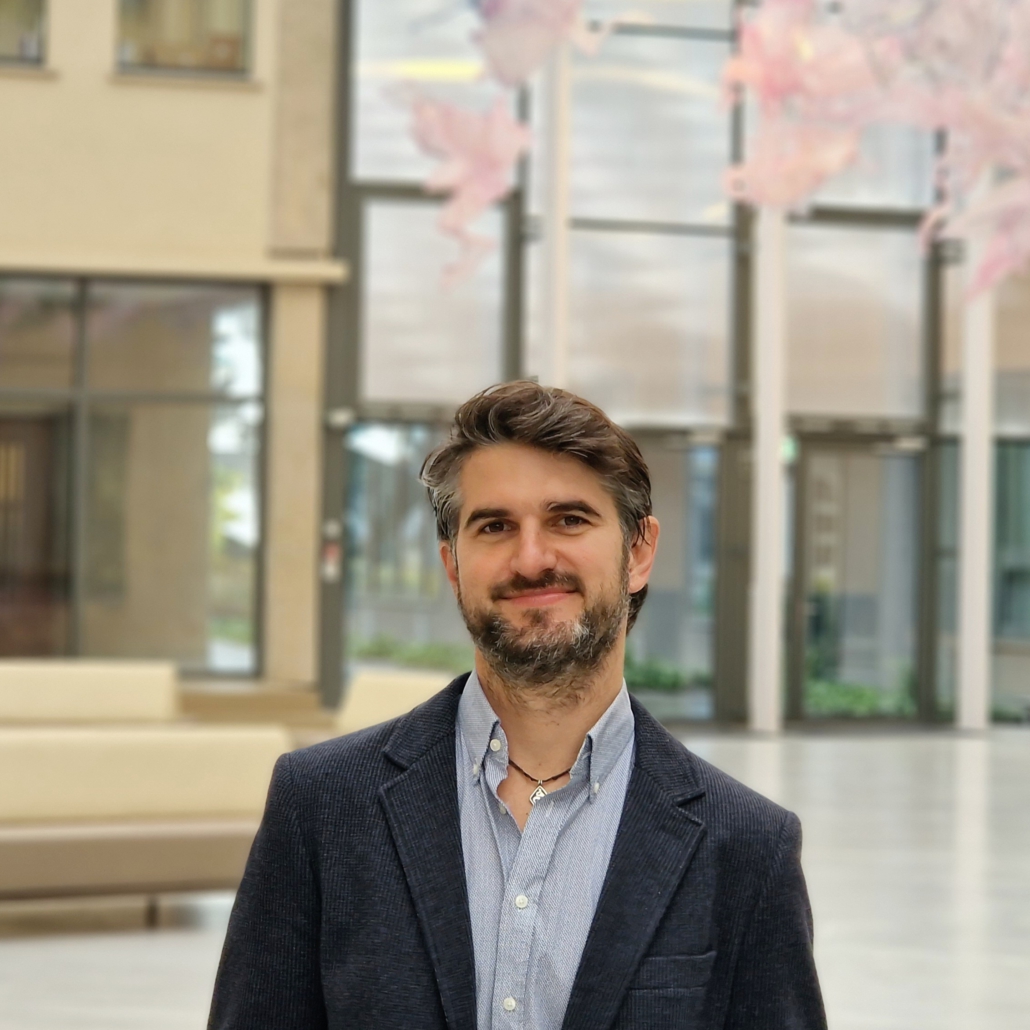
Eduardo Moraud is a neural engineer and assistant professor at EPFL’s Neuro-X Institute. His research combines control engineering, human neurophysiology and adaptive neuromodulation to address gait and balance impairments in Parkinson’s disease, including approaches involving deep brain and spinal cord stimulation.
#83: Eduardo Moraud – Making DBS Respond to Everyday Movement
Eduardo Moraud, neural engineer and assistant professor at EPFL’s Neuro-X Institute, joins Andreas Horn to explore how deep brain stimulation can adapt to what a person is doing—and why walking may require different settings from those used to control tremor or rigidity.
At the center of our conversation is his team’s recent Nature Medicine paper on activity-dependent adaptive DBS for Parkinson’s disease. Combining physiological recordings in 35 people with a separate four-person feasibility study, the work investigates how brain signals can guide personalized stimulation during walking. Some participants benefited from more stimulation, while others needed less. We discuss these differences, how medication and stimulation change the signals used for control, and what remains to be demonstrated beyond brief, supervised testing.
Building on our previous episode with Doris Wang, we compare recognizing walking with following the rhythm of individual steps. Eduardo also shares his journey through robotics, artificial intelligence, and spinal stimulation, reflecting on mentorship, patient encounters, and why simplicity and reliability matter when bringing neurotechnology into everyday care.
Eduardo Moraud 00:00If you walk at a normal speed, you're actually sort of falling continuously forwards, right? And that patient would manually change his stimulation to have, in his case, higher amplitude because he reported walking better and he would do it by hand. What we do in the lab is only partially true, and it's only partially reflecting what happens in the real life of these patients.
Show jingle Welcome to Stimulating Brains.
Andreas Horn Today on Stimulating Brains, I'm delighted to welcome Eduardo Moraud, a neural engineer and assistant professor at EPFL's Neuro-X Institute, whose work brings together control engineering, human neurophysiology, and neuromodulation to improve walking in Parkinson's disease. In our last episode, Doris Wang 01:19described a system that adjusts deep brain stimulation to the rhythm of individual steps. Today, we'll explore a complementary question. What if the stimulation that helps someone while sitting is different from the stimulation they need when they stand up and walk? Eduardo's new paper in Nature Medicine led by Stefano Scafa and Valeria de Seta with Jocelyne Bloch and Eduardo as senior authors addresses exactly this problem. Published on the same day as Doris' study, it investigates how the subthalamic nucleus represents everyday movement, how medication and stimulation change those signals, and how they can guide activity-dependent DBS. A four-person feasibility study then tests whether switching to individually chosen walking settings can improve gait while retaining treatment for other motor symptoms. Eduardo has approached movement from several directions. Robotics and AI, spinal cord stimulation after 02:18spinal cord injury, neuronal recordings in Parkinson's disease, and a spinal neuroprosthesis for severe walking difficulties. Across this work runs a practical question. How should stimulation respond to what a person is trying to do? We will talk about that journey, the new study, its connection to our conversation with Doris and what it will take to bring these ideas into everyday care. As always, thank you so much for tuning in, Stimulating Brains. Eduardo, thank you so much for joining. I normally start with an icebreaker, but I have a special one for you. I just learned you completed your Swiss naturalization. Is that true?
Eduardo Moraud 03:07That's correct, yes. So
Andreas Horn you're Swiss now. That's fantastic.
Eduardo Moraud Yeah, it's a new step. What
Andreas Horn questions did they ask you?
Eduardo Moraud Oh, yeah, they actually make you study about history, geography, culture. And because Switzerland has a bit of a funny organization, you have three different languages and a bit of a federal organization in which every single canton has its own control and politics. So you have all these questions about history, geography and culture at the federal level for the country, for the canton, for the city. And so, yeah, you sort of need to know a little bit about how the country got to be and more local questions about the city you live in, etc. Somebody told me once that they would ask about how you make a fondue, which is one of the typical dishes in Switzerland. And I was lucky not to receive that question. 04:05but I mean it can get quite uh simple questions about everyday life just to see how well integrated you are and and and stuff but but it was good I learned a few things through the and then
Andreas Horn I normally start the first question with hobbies what do you do when not doing research or oh oh
Eduardo Moraud actually um well I mean well first of all I I I often try to spend time with friends and family. Family is not in Switzerland, so this forces me to travel quite a bit. And it does take a bit of time going back and forth. But this is clearly the first thing I try to do is definitely devote time for friends and family. I try to have a break from work. I try to stay active. I try to do sports. I go running. I go swimming. I try to play football. And, you know, whenever possible, I used to paint. I really like painting. And so whenever possible, I mean, I mean, I must admit nowadays, 05:01not so much anymore, but I try to get a bit of cultural exposure whenever I manage. So, you know, museums and theater and things like this. Yeah.
Andreas Horn We'd love to see some of your art, even if it's
Eduardo Moraud dated
Andreas Horn stuff. So that's fantastic. You studied electrical and control engineering, I think, then artificial intelligence and worked in robotics as well before moving into neuroscience. What um originally drew you to machines that uh sense learn and act and um
Eduardo Moraud well I mean it was interesting I mean there was a part of motivation and sort of personal interest and a part of luck I think so I started studying electrically to be honest when I was younger I wanted to be an architect
Andreas Horn okay because
Eduardo Moraud I loved drawing and I liked the link between between art and math. And so I thought, well, architecture is probably going to be the most suitable sort of at the interface between these two fields. Then a friend of my parents told me that, you know, it's really hard to make a career out of that. So then I decided to be an 06:06engineer instead. And so I thought, OK, maybe I'll be a civil engineer, which would have been the closest kind of engineer to architecture. Of
Andreas Horn course. But
Eduardo Moraud then it happened. My mom was working in civil engineering and she said, oh, no, you know, it's difficult to work out of that. So I ended up doing electrical engineering, which at the time, you know, at the 2000s, telecommunications was like a big boom. And one of the applications of telecommunications was biomedical engineering. So I ended up doing a stage, an internship in Japan, actually, in a lab that were doing robotics with an inspiration with neuroscience. And
Andreas Horn so
Eduardo Moraud this was my first introduction to how machines can be linked to neuroscience, to reproducing movement, movement, to better understand human behavior, etc. And so that was my first steps in the field of, you know, intelligent machines and the link to neuroscience, neuroscientific inspiration to develop machines, etc.
Andreas Horn 07:03Great. And then you've also been in multiple countries. I know you're from Madrid, right? Or at least from Spain.
Eduardo Moraud Yeah.
Andreas Horn Where else have you been?
Eduardo Moraud Yeah. So, yes, I'm Spanish. My mom is French. So I did part of my studies in Paris and then I worked for a couple of years in France, again, in robotics and intelligent robotics. Then I actually went to the UK, to Scotland, to study AI. So this was after the experience, after the internship I told you about. So I wanted to specialize in AI and the link between AI and neuroscience. So this was back in 2007. It's interesting because at the time people would say, what is AI? Why do you even want to do AI?" Which obviously now, looking back, I wonder whether I should have continued more in the AI field. And then after that, I worked for a year in Holland, in the Netherlands. So this was more at the space agency. I explored the link of AI and human behavior applied to space exploration. I mean, there's a lot of research in how human behavior 08:14and motor control changes in microgravity and stuff and somehow after that I ended up starting my PhD in switzerland on motor control uh yeah so it's it's been a it's been a quite of an a funny funny evolution I would say great
Andreas Horn who were key mentors and or turning points we had a few already but maybe the mentors more um yeah
Eduardo Moraud um well I mean for me the probably the biggest mentor was uh Grégoire Courtine is the person with whom I did my PhD.
Andreas Horn He's a
Eduardo Moraud person who is brilliant at many levels. And he's been somebody, I mean, obviously, now I know him for more than 15 years. And he's shaped a lot of things in how I think, how I think of research, how I think that research should be linked to, you know, an application, have an impact in real life, in patients, etc. How 09:06you even sell your research, right it's important that research is understandable to everybody not just scientists it's important to make the link even to companies and make sure that whatever developments we do end up having an impact and a benefit for society so he's definitely being a big mentor for me uh the second well I still work with both of them is a Jocelyne Bloch so she's a head of neurosurgery in Lausanne so she helped me back in 2007 2007, a lot to get closer to working with patients, which with Parkinson's. So this is what I've been doing since. But for me, that step was very, very important. It's something that I really wanted to do. And somehow I had a bit of trouble managing to get to that point. And she made it possible. She trusted me from the beginning. And she sort of introduced me to the whole field of clinical neuroscience, neurosurgery. And it's been a learning curve for me, thanks to her. So I would say these are the two biggest people I would say that have shaped a little bit who I am scientifically and how I evolved. 10:11Obviously over the course of all this time, there's been many others that you meet and who became then friends and stuff, but it's true that them two have been quite important, I would say.
Andreas Horn Great. And you did work in their lab, as you mentioned, with PhD, very prominent lab, of course, in the field, where I'm sure you can learn a lot and you did and so that also meant your early work included closed-loop spinal stimulation primarily I think after spinal cord injury what did that teach you about the importance maybe of timing sensory feedback and also about gait and walking yeah
Eduardo Moraud that's an excellent question yeah and it's it's even something I regularly try to put forward whenever I present what we do how we think of all the problems that we try to address about gait deficits in people that have Parkinson's disease. So coming from a different field, so my PhD was on 11:10spinal cord injury, and I got to learn everything about the importance of sensory feedback, sensorimotor reflex loops, how they help coordinate locomotion, how much of leg motor control is encoded in the spinal cord. And so automatically this makes you wonder how much is the brain controlling every single time you think of... I always say that even in classes that I have to teach is that when you and I are walking on a treadmill and we go to the gym, most of the walking comes from spinal cord controlling the coordination of leg muscles. And so the involvement of the brain automatically is something that you think about, right? How much is the brain doing? And automatically I remember even when I was in the UK, I did mention this when I arrived. And it's maybe something that not everybody necessarily will think about, especially if you work in Parkinson's disease. I think we tend to be very focused on the basal ganglia, on cortical 12:04structures and stuff. But obviously, there's all the brainstem, there's all the spinal cord, which are really important. And so this shaped a lot how I started working in this field when I started doing recordings of LFPs, for example, in the STN. I really wanted to see, right, what's the link between what we see in the STN and how this correlates with what we might see in the spinal cord. So we kept recording leg muscle activity, looking at what we call muscle synergies, right? Which is this idea that you're going to have neural circuits in the spinal cord, which automatically control the coordination and contraction of specific muscles to generate a flexion. For example, you never need the contraction of many muscles to generate an extension. You need the contraction of many muscles. All of that is encoded in the spinal cord. And so from that perspective, then how much is the basal ganglia going to be involved? So we try to make links to these leg muscle synergies, etc. So from that perspective, it had a very strong influence. The second I would say is the concept of rehabilitation. So, you know, in spinal cord injury, gait training and rehabilitation is something that is very well established. It is known for decades how important it is to train and to do physical therapy 13:15after an injury. It is something that is, you know, developed everywhere in the world. It is part of the normal clinical practice after a spinal cord injury. Whereas in movement disorders, it's something that has been a bit disregarded. I think it's something that over the past years has been gaining momentum. It's extremely important. We know nowadays that when a person with Parkinson's disease develops gait problems, the first thing he should do is really start, you know, doing physiotherapy and gait training. But, you know, we sometimes think of it a bit of, okay, well, it's a bit of physical exercise. It's like going to the gym. And yes, I mean, there's a part of it, which is true. But I mean, there's the whole, you know, training of neural networks in the spinal cord so that they keep this organization of controlling leg muscles and coordination between right and left movement, etc. So rehabilitation is extremely important. And so, again, bringing all of 14:06that information and all of that knowledge from one field, spinal cord injury, into Parkinson's has also been quite interesting for me. So there's many things I learned in the past which we could gradually sort of leverage and integrate into our current work. Was
Andreas Horn there anything that was misleading that you carried over, but maybe was different in PD in Parkinson's?
Eduardo Moraud I mean, misleading, I wouldn't necessarily say misleading, but things that we have been adapting over time. So if I think of, for example, trying to develop spinal cord stimulation therapies, right? So this idea that you might want to go and target through stimulation directly the circuits in the spinal cord to try and alleviate some of the gait deficits that patients can have. We obviously started with Grégoire and Jocelyne by sort of translating almost one-to-one what was done in spinal cord injury to Parkinson's disease.
Andreas Horn 15:02And
Eduardo Moraud gradually realized that, you know, Parkinson's has its own specificities in terms of perception. First of all, patients can feel the stimulation very strongly. It's not the same to treat somebody who cannot walk than to treat somebody who can walk, but in an abnormal way. So, you know, people who would have a spinal cord injury would often be holding themselves to crutches or to a walker or to some other structure, whereas a person with Parkinson's disease is often not holding to anything. So balance is very important. And so, yes, I mean, I wouldn't necessarily use the word misleading, but definitely things that perhaps initially we thought would be translated from one
Andreas Horn disorder
Eduardo Moraud to the next in a almost one-to-one form and we've had to adapt over time this is definitely something that happened yes
Andreas Horn circling back to the you know what controls what just because it's so interesting if if you do if you did a single step very very slowly very consciously would 16:00that still I think the synergies would still happen in the spinal cord, right? There's still kind of the interface of the muscles, but maybe more would happen in the, maybe even cortex or striatum.
Eduardo Moraud Sure, sure. What do you think? Yeah, yeah. I mean, also it's not, this is also, I mean, you know, gait is complicated in the sense that normal gait, if you walk at a normal speed, you're actually sort of falling continuously forwards, right? You're letting yourself fall. And as you do that, some muscles are going to stretch. and by stretching you're going to generate a certain reflex, others are going to flex. So the conscious and sort of volitional aspect of normal gait is, you could say, a bit reduced. A lot of it is sort of automatic. Whereas if you're standing and you sort of artificially lift your leg to do a very slow step, as you said, this is completely voluntary control with cortical activity for sure right there's no reflex no it's not much reflex pathways there so that's why the study of gait when when I've seen people studying gait for example um I don't know for example stepping in place is it really gait I mean it 17:09has some components of gait but not all of them so you're not falling forwards for one yeah um uh so so yeah that's that's that's why the real natural study of gait is complicated because you really need to put people in that context and you can try to come up with simpler ways of decomposing certain aspects of gait and for sure that is extremely valid but we need to be aware of the limitations of those methods right and so yes if you ask somebody to lift their leg they will need to put all the balance in the other leg first of all then you lift one leg you go very slowly in that movement all of that is uh completely cortical control I guess or
Andreas Horn a
Eduardo Moraud big part of it not exactly the same as just walking naturally I think.
Andreas Horn Yeah, that's good. And then I, my limited experience, my limited clinical experience on assessing gait is that it can be very variable too, right? So sometimes patients that had a lot of freezing, they sit down for a second, you change something, let's say in the DBS setting, then you assess them again, and it's much, much 18:09better. And you see these videos that are fantastic, but then maybe you reproduce it a few times blindedly, and then you realize, that's not even that clear, right? Is that a challenge when building a gait lab and doing these experiments? Do you have to repeat things multiple times or do it blindly? Or how do you
Eduardo Moraud measure a gait?
Andreas Horn That's
Eduardo Moraud an excellent, excellent question. And it is even something that I don't think I have a full response because it's something we're still trying to understand, especially the variability you mentioned about freezing of gait. I think it's well-known and we still don't know why. but in views of how you study gait yes absolutely actually I have this I still remember it was like probably I just came back from to Switzerland from the UK and I remember we were in this very you know sophisticated gait lab that we have in the hospital and we were assessing a patient and this one day actually the the the wife of the participant stayed for the session 19:04and she was sitting next to me when we were doing the assessments and she was a bit sort of surprised and puzzled. And I asked her, you know, what's, what's happening? And she said, well, you know, my husband never walks like this at home. So, you know, she was surprised to see how well the husband was walking in a context of a lab in which, you know, he was, he knew that he was observed. He was very focused. He knew that there were cameras pointing at him. He had a physiotherapist next to him. And, and clearly, I don't know, for me, it was quite, quite funny to hear that. And And it was a realization that what we do in the lab is only partially true. And it's only partially reflecting what happens in the real life of these patients.
Andreas Horn And
Eduardo Moraud we really need to combine it with technologies and behavioral tasks in more real-world situations. And in our case, it's really something we're trying to push for because it's something you cannot avoid. I mean, definitely, it's really hard to reproduce everything in a well-controlled lab environment. Again, freezing 20:02of gait is another very good example. And it's the only way actually to capture all the variability that you will have over the course of the day. Many of these patients can tell you, well, in the afternoon, I'm a bit less well than in the morning. Sometimes if I sleep well, then I walk better. But if I don't sleep well, the next day I'm not so well. And so there's sleep affects a lot. Attention stress affects a lot. And the only way you can capture this is by really sort of transposing everything to the home and to the real life of these patients. And so this variability and all these cognitive and attentional aspects that affect gait are still not fully understood, I think. And it's one of the big challenges we have in trying to address gait deficits in Parkinson's.
Andreas Horn You've now worked both in brain and spinal stimulation. How would you decide in general where in the movement system and interventions most likely to help? Did you consider spinal stim and PD? You probably do, right? I think at least a bigger lab does investigate spinal stim in 21:04Parkinson's as well.
Eduardo Moraud Did you ask if we consider stopping?
Andreas Horn No. Whether you, and with you in this case, I mean also Grégoire and Jocelyne, somebody in the bigger network does spinal cord stimulation in Parkinson's as well, or
Eduardo Moraud at
Andreas Horn least plans to. And yeah, how do you decide where to intervene?
Eduardo Moraud Yeah, it's one of the big clinical trials that we have here at NeuroRestore in Lausanne and Geneva, trying to optimize spinal cord stimulation therapies for Parkinson's. I mean, it's true that we are at the stage of understanding, let's say, what are the better profiles for this kind of therapy. The results we've had so far, we had patients who responded. We did six patients overall so far. We had patients who responded extremely well. Well, these were patients who already had a DBS and reached a stage where DBS alone is not enough. They then combined again DBS with quite some substantial amounts of medication. 22:06And even then, they still experienced quite a lot of gait deficits, asymmetry, tiredness, imbalance, sometimes freezing of gait, etc. So there was really no alternative, I would say. And so they were courageous enough, I could say, to try this, to be part of this clinical trial. And we had quite some positive results. Some other patients responded, but more moderately, I could say. So we had a patient with a lot of freezing of gait and his freezing of gait responded a bit less well. So we're trying to understand why. And so I think it will be a question, first of all, for that therapy to properly define either the type of profile that better responds to that or the good timing to go and stimulate these patients. I also found it interesting. We had a patient who did not have a DBS. And it's true that our neurology team here at the hospital in Lausanne suggested maybe DBS would be the first step before considering a spinal cord stim therapy. And the patient said, no, I do not want to have a DBS. It's something that I don't want.
Andreas Horn 23:11And
Eduardo Moraud so for me, it was also a discovery thinking, well, true, some patients might not want to undergo a brain surgery. Whereas for some reason, they seem a bit more comfortable with having other kinds of surgery. And so for those patients, maybe this is again an option that would bring them a benefit. And so at the end of the day, I really see it like our hope is it will be one day part of the toolbox that doctors have to address these deficits. Hopefully, we will better pinpoint what are the patient profiles and, you know, the let's say the stages where this therapy works the best. what kind of symptoms can we address the best and then um I would just hope that this is again part of the toolbox that the doctors will have to yeah but I don't think it's it's competing with DBS at all right I mean now we've had patients who have both we've had patients who only have spinal cord stim um yeah it's a complement do you
Andreas Horn 24:04see value in them communicating probably right the the spinal cord and DBS
Eduardo Moraud one
Andreas Horn day yeah absolutely
Eduardo Moraud I mean honestly this was even one of the first um ideas even that I remember discussing with Grégoire more than 10 years ago. I mean, Grégoire and Jocelyne have been pushing this concept of brain-spine interface, as you probably know, for spinal cord injury. So combining spinal cord stimulation in people with spinal cord injury with brain decoding from the cortex as a way to have voluntary control of the stimulation. And they've shown that this works really, really well. And it's extremely impressive to see that. and I remember that we talked about it. I think I was still in the UK. I remember sending a message to Grégoire saying we should, you know, I remember Simon Little was there and people were trying to do their original adaptive DBS trials in the UK and thinking we should use these signals in the STN to control spinal cord stimulation. This could be a good, hopefully a good origin, right? To have a neural biomarker that could one day control spinal cord stimulation. And it's definitely a goal 25:09in the future. This has also been one of the motivations for me and everybody in NeuroRestore, I think, to go and look at the STN, what's encoded in the STN when it comes to gait, what kind of functions can we decode, what kind of dysfunction can we decode, how fast can we predict these things, obviously because you might want to optimize DBS, but potentially other targets. And spinal cord stimulation is one of them. Since
Andreas Horn you mentioned your time in Oxford, I did not know that you overlapped with Simon. So that's a little bit here because the two of you and I guess Julian Neumann are my current heroes, right? As I told you before, in
Eduardo Moraud really
Andreas Horn shaping the field with very cool new approaches. So how did your time at Oxford change your thinking in general about neural biomarkers and what a DBS controller should control.
Eduardo Moraud 26:02Well, I mean, for me, it was a bit the discovery, let's say, of neural biomarkers in the STN. I had not done any STN recordings before. And so it was through that time and all the people who were working with Peter Brown and then Rafal Bogacz, who was there at the time, I read a lot about how much the STN might be encoding certain motor symptoms. We started using those. It was a bit the beginning also of the decoder. So I remember with Rafal and Peter trying to develop decoding algorithms. I mean, Gerd Tinkhauser was there,
Andreas Horn trying
Eduardo Moraud to develop decoders at the time for bursting activity, which was a bit the beginning of these things. And there were two people also doing gait. So there was Huiling Tan and Petra Fischer. They were also doing recordings during gait, which as far as I know, were the first ones to have assessed STN encoding during gait, because it's really hard, actually. You tend to have a lot of artifacts. nowadays we have you know this cool wireless technology that allows you to do brain recordings as people walk and do whatever activities but at the time everything was done with externalized leads yeah wireless yeah with wires and it was complicated 27:08and so I mean for me it was a a discovery time I would say and um and I'm very grateful to all these people who allowed me to learn all these things with them great
Andreas Horn so going to the main topic which is of of course, your recent Nature Medicine study. We came out the same day in the same journal as Doris Wang's came out, but we already learned from her that there was no back-to-back kind of agreement. It was maybe you
Eduardo Moraud both knew about the studies, but it was
Andreas Horn probably an editorial decision too, or just good timing to put them out together. That certainly made a splash, was I think even great for the field as a whole in DBS to have such prominent papers come out. and, you know, so thank you for that. And we learned from Doris, and many listeners know anyways, that gait is one of the core symptoms that
Eduardo Moraud 28:02is
Andreas Horn currently a big problem, right? You can control many symptoms in Parkinson's, but not so much gait. And gait is probably the most cumbersome one of the ones that you can't control over, at least in the later stages of the disorder. So So what was the clinical observation for you to study gait? And then, you know, your concept is different than Doris's, where I think hers was maybe in very brief summary to alternate stimulation while stepping. So essentially decoding, stepping. Yours, the idea, at least equally great, was that there might be two settings. One is better for gait, one is better for sitting or other activities, and then to alternate between the two, right? Is that correct? Great. So how did you get to that? And then, you know, what were the challenges or the concept? How did you develop the concept?
Eduardo Moraud Yeah. So actually, like many other things, I think this actually came from interaction with a patient. Because, I mean, I knew and I have read and discussed it with our neurology teams here in the hospital with Julien Bally, who is the head of movement disorders,
Andreas Horn 29:05that
Eduardo Moraud often when patients start developing gait problems, they will try to start changing parameters, you know, maybe lower frequencies. There's been a few papers in the past saying that maybe lower frequencies can be better for gait,
Andreas Horn which
Eduardo Moraud is also something we tried at some point. Maybe you start using more ventral contacts, etc. So there's a bunch of hypotheses on this. And this is something that I think when patients start developing severe mobility problems that are non-responsive to dopamine or to their standard DBS, then doctors will try to start playing with the parameters to at least try something. And so this is something I knew. And I remember this one patient that we were assessing a couple of years ago. And, you know, he was in the lab and we did a bunch of recordings and stuff. And, yeah, you try to understand a bit their problems. So you always ask all these questions. You know, when is it that you have most problems? Is it in the morning? Is it in the afternoon? Is it when you go to a shop? And he said, you know, that, yeah, no, well, I go walking. I do this, I do that. And then in the afternoons, I do a walk in the forest. But, you know, when I go to my long walk in the forest, 30:08I increase the amplitude of stim because actually this helps me walk. And I don't know, it was a bit of a moment of what I thought, OK, so actually you can. Yeah, I mean, maybe depending on the activity that you're doing, if you just go for a walk, maybe you like you don't need to have the same setting giving answer to everything at the same time. Maybe you could prioritize what you're going to be trying to give answer to depending on the needs of each moment. and that patient would manually change his stimulation to have in his case higher amplitude because he reported walking better and he would do it by hand but it's true right at the end of the day maybe you have a configuration let's assume with a lower frequency or with I don't know maybe some directionality or something to better target specific tracts which you might want to use specifically when you go for a long walk for example or when you I don't know if you you have a therapy for freezing maybe you want to target specifically when you're in a shop surrounded by people or in a very stressful situation so this concept that in the end stimulation could be seen as you know being delivered in an activity-dependent manner depending on
Andreas Horn 31:13what
Eduardo Moraud the specific activity that you're doing needs um and so yeah that was a little bit so again the concept is very simple I don't think it's it's a very complicated uh or elaborate concept. And so it came from that. And so in the end, we just tried to see, is it true, first of all, that in patients who have gait problems, we can find a better configuration? Obviously, if we do that, that's probably going to be at the expense of something else, right? So if you increase the stimulation, the reason they don't have a continuously increased stimulation is probably because then you induce some kind of maybe dyskinetic movement on some arm or maybe you affect speech or you know you're gonna have a side effect elsewhere but would a patient be sort of okay to let's say prioritize gait when they walk at the expense of maybe a slight dyskinesia on the right arm for example I'm inventing um knowing that as soon as they sit down you will go back to their normal 32:11stim and okay gait will worsen again but it doesn't matter because they're sitting down and then you're prioritizing something else and so it's really a question of prior prior prior anyway prioritizing yeah uh what you try to target uh so that's that's a bit the concept yeah and
Andreas Horn you said it's a simple concept uh which may be true but it's very complicated to get it to work right and we'll get to that in a second just so the listeners know we're not talking about simple things here I mean the concept may be simple but um yeah adaptive DBS is is even simpler and took 15 years right to get to development and maybe it's still being developed of course um if I remember correctly that participant you just talked about that increased
Eduardo Moraud their
Andreas Horn voltage when walking they were already on adaptive DBS right so actually
Eduardo Moraud 33:01the person who told me this was a couple of years ago so that was somebody else uh the person we did include in the study was actually a bit the same actually yes so he would benefit from increasing the the stimulation and actually in some cases he would also do it manually. I think more than one person does this actually, when they realize that they have some control over stimulation and they're cognitively well enough to do it themselves. Some of them do, like they modulate it themselves, which is quite interesting. And so, yes, so that person was actually under adaptive DBS, yes. And for us in Lausanne and Geneva, it's been probably a year now that with Jocelyne and with Julien Bally, we've been trying to explore a little bit how to integrate adaptive DBS into the everyday clinic. So we follow that patient quite closely. We optimize his adaptive DBS and we tried to improve, you know, setting up the thresholds. It took us, you know, six, seven, eight weeks, eight sessions to get to something stable. He was actually very happy with it. His sleep got better, but he was still complaining about gait. And that's actually when we thought, well, listen, okay, so now you're under adaptive DBS, how about we try to enroll you in the study and we see whether this new approach, which 34:12is going to be much, let's say the increases are going to be much faster, much more aggressive, and really aligned to your activity, are they going to bring you something else? And they did. So this was even interesting for us because we realized that the two approaches, which have very different dynamics, right? One is relatively slow, the other is very fast, could even be combined one day. So it's like two different ways of seeing the delivery. They're addressing different things, but they're not mutually exclusive. So hopefully one day you will be able to combine the two. Yes,
Andreas Horn yes, yes. Sounds good. When I was in Boston, Mike Fox often said that, you know, maybe one reason why gait is so intractable with DBS is that we really just don't program for it enough because it's so hard to program for it, right? So at least in the average case, in the beginning, you start by optimizing tremor. It's an 35:07acute symptom. You can have a great readout, you know. And then now if the hypothesis were that, let's say, the tremor setting is almost always very different than the gait setting, right? So they don't overlap circuit-wise. Then that would lead to just having many, many people that benefit very well from tremor, but not for gait, just because we are not optimizing for it, right? For sure. Do you agree to that or do you think it is more than that? I mean, I
Eduardo Moraud think, first of all, I think that's completely true. I think, obviously, when a person, well, the initial programming will obviously tend to prioritize the symptoms at the early stages, right? Right after surgery, which I would say are probably more, primarily, you will have more upper limb symptoms, usually more than gait. also because when you have very severe gait deficits probably patients are not even eligible for DBS so I guess the first programming configurations will be more targeting uh the other symptoms but it's true that when patients develop gait problems over time then clinicians will actually try to address 36:13them but if you have a continuous stimulation you have a trade-off to make and if that trade-off involves worsening a lot the other symptoms I don't think any clinician will actually go for something that is even if he finds something amazing for gait You will never put a configuration that is perfect for gait at the expense of a terrible tremor, for example. And so I think that's where also adaptive DBS and this whole concept of closed-loop DBS opens new possibilities, right? Because then, yes, you can hopefully exploit much more optimized therapies for each symptom. And I allow even myself to make the link to your very nice perspective article that you wrote with Julian, right? So this obviously goes hand in hand with targeting specific circuits, probably, right? And I think gait and other more upper limb symptoms like tremor or some rigidity that you might have in the arms. These are good examples, I think, of, let's say, functions that are probably 37:08separatable enough that you might find configurations for one or another right so you have circuits more for maybe upper limb rigidity and then you will see that those configurations maybe do not alleviate fully lower limb rigidity or something but and and so that's uh I think those are functions that I want to believe are separate separate enough so that you could apply as a first step this concept of you know circuit targeting for one or another yeah in a relatively straightforward way and this would be so beautiful because then yeah you know exactly what you need to target and you do that in real time based on what the patient needs and and I think it's also simple enough to be robust as well in everyday life right it's something that in the end we we can go to the implementation afterwards if you want because as you mentioned earlier we are still at a stage where the implementation is quite complicated but yeah I I think the concept is simple enough 38:00that you could one day hope that this is uh implementable in almost everybody so it even
Andreas Horn in a out out of the box fashion I think right? So I agree with you. There's hints that these decoding algorithms don't have to be retrained if they're well done these days, right? And then maybe the circuit definitions may also not be learned again, hopefully. Yeah. So great, great future options there. So
Eduardo Moraud last
Andreas Horn question before we go into the nitty gritty of the paper itself. To summarize, right, You had two settings per patient and one is maybe good for gait, gait optimized. The other one is the standard or normal setting. Did you ever try to just activate both, essentially sum them up that you would, let's say one is the first contact, the other one is the second contact. Why not? If you switched on both, would that have a good effect on both things or not?
Eduardo Moraud Unfortunately, we were very limited by the technical possibilities that we had. 39:04I don't want it to sound like a criticism because I'm very grateful to the interactions that we had over the years with Medtronic who gave us access to some of these features. And it's thanks to their interactions and their support that we could do this. But it's true that we were a bit limited in some of the functions we could do. So we could only change the amplitude. We could not do different contacts in real time. We could not do directionality in real time. Obviously, it's what we would have hoped. and it's something that we are trying to push forward. But in the study, we could only do up-regulation or down-regulation of amplitude, et cetera. So it was limited to the amplitude. We could not do both at the same time, to
Andreas Horn answer
Eduardo Moraud your question here. Sounds
Andreas Horn good. Great. Okay, so there's multiple parts of the study. Maybe you want to give us a high-level overview. There's first the decoding piece, right? So the physiological part, and then you also had the active part of it. Maybe it's better if you summarize
Eduardo Moraud roughly
Andreas Horn what you did in that paper. Yeah.
Eduardo Moraud 40:01So we tried actually to organize the paper in three parts, actually. So the first part was really all the encoding. The second was more the decoding, right? How do we develop the algorithms to decode this? And the third was more the therapy. So how do we leverage the first part, the understanding of the encoding, as well as the second part, the development of the algorithms to then implement this as a therapy into an implantable device? And so the first part encoding was mostly trying to understand how what we had already observed previously about encoding in the STN changes with therapies, because we know that from the moment we start changing DBS amplitude, DBS contact, patients are tested therapeutically over the course of the day, dopamine plays a role, etc. So we need to really have a very good understanding of what different functions are encoded and how they change with different DBS amplitudes, with different dopamine dosages, etc. So we characterized all of that. Then all the decoding part, which was the second part, was trying to have decoders that are able to address the changes induced by the therapies. So
Andreas Horn 41:07the
Eduardo Moraud encoding that you'll have in the STN of gait, for example, will change dramatically under dopamine, not surprisingly. It will also change quite dramatically with DBS amplitude. And so we needed to have decoders that can be robust enough to keep decoding across these changes. And for the listener,
Andreas Horn you mean the decoding piece has to be robust. Decoding here means what is the patient doing right now? Oh, right. Exactly.
Eduardo Moraud Sorry,
Andreas Horn walking and sitting and rest? Or it was two conditions?
Eduardo Moraud No. So in the decoding, we actually had three. So we did sit, stand and walk. We also tested, for example, decoding turning, or you can even try to decode if somebody goes upstairs or avoids an obstacle. I mean, what we showed in the past is that the amplitude of the modulations in the STN, whether it's a beta-desynchronization or a gamma-synchronization, correlate really well with the amount of leg muscle activity that's going to be produced. Sorry. So if you avoid an obstacle, the, let's say, increased leg muscle activity that you're going to have to produce to avoid the obstacle is going to be that muscle activation, that increase 42:15is going to be translated by some neural modulation, right? So you can very easily decode whether somebody is avoiding an obstacle or turning, et cetera. But the decoding, we restricted it to three states because initially that's a bit what we wanted to sort of do. Unfortunately then the implementation as a therapy was restricted to two. So only sit and walk because we were limited by the fact that you have a threshold, right? So a threshold only allows you to have like two states. And so we went to the two most extreme states. But honestly, if you have a better decoder or even if you use other source of decoding, you could even consider having standing, going upstairs, turning, etc. So you could have many more states, I think. So this was the second part. And for the decoding, the way we addressed the difficulty of changes induced by therapies, meaning dopamine changes my encoding completely so my decoder doesn't work, or DBS changes my encoding dramatically 43:08so my decoder doesn't work. There's many ways to address this. You could have relatively complicated decoders, I think. We tried to address it in a modular way. We thought, well, rather than having a very complicated decoder in which you need a lot of data to train, et cetera, let's try to keep it very simple but make it modular. So you're going to have a module that decodes gait when the person is very low dopamine. So we know the kind of encoding we expect in the STN when the person sits, when the person stands, when the person walks, when the person turns.
Andreas Horn Then we
Eduardo Moraud do the same on dopamine. So you have another module, which is only decoding sit, stand, walk, turn, et cetera, when the person is on dopamine. And those two can be trained separately. And then you're going to have another sort of logic, which is going to be telling you, is my patient on dopamine or is my patient off dopamine?
Andreas Horn and
Eduardo Moraud for that I mean you're going to have to train your algorithms with a much slower dynamics because dopamine affects you know it's more over minutes whereas gait is over seconds so you can play with the dynamics of the encoding and the appearance of either movement versus dopamine the dynamics are so different 44:12that you can actually exploit this so if for gait we have a window of about a second second and a half which more or less corresponds to one gait cycle whereas for dopamine, you take a window of 20, 30, 40 seconds.
Andreas Horn And
Eduardo Moraud so because your windows for decoding are so different, you can actually filter out mobility when you decode dopamine or filter out. So, you know, from the same signal, you can extract multiple things just by playing with the dynamics of the underlying manifestation, let's say. And it was
Andreas Horn typically under DBS, right? Because you didn't really have off DBS. That didn't happen in a way. I know you did encode it and decode it, but I think for the active part, it was always under DBS.
Eduardo Moraud Exactly. Then we would have low DBS, high DBS. And then our decoders were trained across the two conditions. But it's basically the same concept, right? For example, you see that on very high, if you need to increase DBS very strongly when the person walks, and this is going to induce a new biomarker, for example, you know, 45:14this narrow band gamma that you see in some patients, which you might not see when the DBS is very low for example in some patients then this needs to be taken into account in your decoders too and this modularity allows you to do that so it's it's a it was I think a simple way of addressing the fact that therapies are going to change the encoding so much and while keeping very simple decoders which are very easy to interpret like honestly very easy to train you don't need a lot of data and and even I always sort of explained that what I like about this concept is you could even consider adding modules, right? If one day we want to decode something else or you want to have another input, like we spoke about this with Julian once, that maybe you want to have now an ECoG signal. Well, why not have a module which is going to enter into this decoder? And it creates a very simple structure that can be even controlled by a clinician. And maybe you say, well, on 46:08one patient, this is not working. I just turn it off and I'm going to rely on the other module, for example. So this concept of modularity, I really like it. I think it makes things very simple to interpret and to control.
Andreas Horn But
Eduardo Moraud again, it's not to say that you could not consider more elaborate algorithms. And potentially, as the power computation capabilities increase, maybe it'll be better even to have some much more complicated models in the future. But this is the way we addressed it. And then the last part of the paper was the therapy, which was more to say, OK, we've understood the encoding and these changes with therapy. We've shown we can decode it. now let's implement this in um in an implantable device and that step obviously required us to make sacrifices because we could not decode all these different states we could not do everything because we could not we have limitation from a technical perspective so we we did our best at translating what we had been able to do offline or you know uh to to to the capabilities of the device but but that's where I see the most uh possible uh expected benefits in the 47:11future, as the possibilities of these devices increase, I think we'll be able to really start addressing many, much, much better and many other options in the future. There we had to do many, many sacrifices. And so
Andreas Horn this part, certainly the most ambitious one, maybe not even the most complicated one, but very ambitious. which is it had to stream data, process things offline, right, in a computer, and then send the decision system back? Or how much happened on chip, so on the IPG, and how much on a computer?
Eduardo Moraud Yeah, well, as you know, we currently, the current Medtronic systems don't allow to stream data out of the tablet, let's say. So we were able to see, the real-time component was restricted to what we could see on the tablet.
Andreas Horn 48:00Okay. Right.
Eduardo Moraud And so basically all the setting up was basically done in a sort of pseudo-online, meaning that we would ask the patient to do a certain number of tasks. We would take that data, take it out of the tablet. So take it out of the system. Run it in pseudo-online in our separate computer. And from there, find what are the biomarkers we need to implement, meaning what is the best biomarker when the person is on DOPA, when the person is off DOPA. which is the biomarker in each dopaminergic state that is best capturing sitting versus walking. And in some patients it was beta, in other patients it was gamma, in others it was maybe narrowband gamma. Then we would implement this in the device. We would test the real-time robustness. We would change whatever parameters had to be done, like the windows within which you compute the signal in real time, the blanking periods, all these things were sort of optimized manually, let's say. Now we're doing actually simulations as well to optimize this automatically. But yeah, a lot of it was done sort of pseudo-online. And the same for knowing when the patient was on DOPA or not, right? So meaning we would, you know, every half an hour extract the JSON file, put it on the computer, run the DOPA decoder and tell, the patient 49:17based on our decoder is entering to Dopa, we're going to change the parameters. So there were a lot of things that unfortunately had to be sort of manually translated from our computer to the tablet. Again, it's a proof of concept that this works, but hopefully one day you can actually fully close the loop and show that it's stable, right? Makes
Andreas Horn sense.
Eduardo Moraud And
Andreas Horn then maybe in the second, so in the decoding stage, we talked about decoders a lot. What are the features that they use? Is it power in frequency bands or is it
Eduardo Moraud more
Andreas Horn the raw signal even?
Eduardo Moraud It's mostly power in the frequency band, yeah. So the combination
Andreas Horn of these, and you have pretty figures, as always, coming from that lab as well, or you learned it, I guess, there, showing exactly how the configurations change for both treatment level but also the state level. of uh yeah yeah so 50:16so it was it was essentially that right distribution in bands yes
Eduardo Moraud for the I must add that you know that with the same goal of having these sort of modular decoders as simple as possible there were a bunch of hyperparameters which were trained beforehand on all the we had 35 patients that we had recorded for the first and second part of the paper so across all those patients we optimized all the different aspects so for example the window within which you're to be decoding the overlap between the sort of moving window. So all these things, we optimized it for each. So either to detect different locomotor states, either to detect dopaminergic modulations, or either to detect DBS changes, we optimized it offline, and then they were hard coded. And so that way, the only parameters that had to be changed were the frequencies, the power in the frequencies. You could consider having all these other hyperparameters as part of the optimization too.
Andreas Horn 51:13It
Eduardo Moraud was a choice basically to make it simple. But again, for example, I've heard the presentations by Julian recently using decoders from cortical signals, and he uses quite interesting features as well about the raw signals, et cetera. So there's clearly more aspects of the signal that we could try to exploit as well.
Andreas Horn I
Eduardo Moraud think always the question of of accuracy in decoding needs to go hand in hand with the therapeutic precision that you have, right? I mean, I don't think it makes a lot of sense to try and make super complicated decoders to have 100% decoding accuracy if at the end of the day, you cannot follow up with the stimulation behind, right? So if your stimulation is not going to be able to deliver the stimulation faster than a certain speed, then that's actually the speed that is limiting your whole closed-loop system. And so in the end, that's your... And so we were a bit aware of 52:12this and we tried to sort of match this. But as the systems evolve in the future, I think, yes, it'll be super interesting to explore a bit the decoding algorithms that Julian has been doing and integrating those features. I think this will be very useful too.
Andreas Horn Cool. And I guess, you know, simplicity often means robustness, right? So there's a, especially in medical therapies, it can be very, very powerful if you decode on comparably simple features, right? So I think it makes maximum sense to start with those. And most people do. I think also Julian has done
Eduardo Moraud that. Absolutely. Absolutely. Yeah.
Andreas Horn So what is interesting as maybe to thinking buzzwords, personalizing care, right? I think four people you had in your trial and it wasn't always the same recipe that they needed, right? right? Two benefited or eight benefited from higher amplitudes, two from lower amplitudes, for example. Can 53:08you talk a bit about this heterogeneity? Did you learn something from that? Or do you think it's really the solution to just personalized care for everybody? Yeah, thoughts on that?
Eduardo Moraud So I'll answer in two steps. I think first of all, I would say that yes, you absolutely need to personalize because you depend a lot on the symptoms that the patients have and how they respond to stimulation. I think there's no other way. You have patients for whom, you know, I don't know, they will be maybe stimulated with a specific configuration, which is going to be working great for some of their symptoms. But these great configurations might be inducing some kind of side effects. And those side effects could be, you know, a dystonic movement of the right leg. It could be whatever. And this will be different from patient two. It will be different from patient three. I mean, all these patients, one patient will have freezing of gait and another will have, I don't know, fatigue. And so I think it's just impossible to have a general recipe for everybody. You might be able to cluster patients into subgroups according to some kind of phenotype or something. 54:13And this is obviously, I think, the hope that we all have that one day this might help simplify this process, but the personalization will always be needed. it um that being said you know hopefully we might be able to do cross-patient uh learning as well and I know julian is trying to do this on the decoding side but it could also be applied on the stimulation side so what have we learned maybe on you know if you have three four five hundred patients one day and can you directly predict how you might want to stimulate so that that the complicated process of personalization sort of is automatic, automatized. And then therefore, this becomes, you know, like a black box to a clinician. He doesn't have to handle this. And, you know, it becomes sort of automatic. So whatever patient you have, then the system will be able to address the variability. A very nice example is what you guys have been doing with Lead-DBS. Right now, you're able to know automatically 55:09from the reconstructions where the expected beta hotspot is going to be. And we personally use that all the time, too. So that's giving a really good indication based on models that you guys have on how we should start probably tune the stimulation to start with. And this is something that we integrated. And so you might have something similar in the future for the other symptoms, for gait, for balance and other stuff. So that's, yeah.
Andreas Horn So you use the beta hotspot or Lead-DBS or both?
Eduardo Moraud Both. Yes. Wow. I
Andreas Horn didn't know that. The beta hotspot paper is pretty old. I hope that's still true. But I mean, roughly, roughly just based on basic assumptions, probably not completely wrong, but yeah, interesting. Great. So which result meant the most to you maybe personally, right. Or was most gratifying a change in the movement measurements and observed reduction in freezing, or maybe even something a participant told you.
Eduardo Moraud 56:12I mean I would actually say you know one of the things that I really like about my work is actually an interaction with the with the patients I really like that that social aspect I love learning from them and I love yeah I mean what it means to to to work with them and have these interactions with the patients with their families and so any feedback when when we receive this feedback that anything we did brings them something, sometimes it's not a miracle, right? Sometimes you just improve by, I don't know, five or 10% something in their everyday life. But just that is, I think, enough to keep you motivated and keep moving forward. So it's not necessarily something that one person said at a specific time. I think it's a global feeling, right? And I mean, actually, even last Friday, I need to call afterwards a patient. And he told me last Friday that we implemented something on him and he told me, oh yeah, my quality of life went from 4 out of 10 to 7 57:08out of 10. And honestly, I shared that with the whole team and he was just super happy and it's great. I mean, what else do you want, right? This is such a... Yeah, I don't know. I went on my weekend very happy after this. And so, again, it's a very general response to your answer. I cannot really find one specific thing to we have had specific patients with whom indeed we spent a lot of time and those obviously not only they became good friends but they gave us specific feedback which at the time meant a lot to us but it's not been the only one we had also the same important feedback from other patients that maybe we got to know a bit better so I don't want to you know restrict myself to one I think I think all of them have carried some meaningful importance in themselves. So, yeah.
Andreas Horn Absolutely.
Eduardo Moraud 58:00And
Andreas Horn then the, you know, since you mentioned you changed the quality of life, that might have been a different study because or maybe it was because the settings you did were just in the lab, right? Unfortunately, you weren't able to kind of make this a permanent change. And that leads me to the next question. So is, I would say, a feasibility study, a very important one, published very prominently, deservedly so. What does it establish, which claims about maybe sustained benefits or falls or so can we make from it or so? And then what is needed next, probably together with the companies to even do it. But yeah, what are your thoughts on next steps? Absolutely.
Eduardo Moraud You're touching on a very important topic. I mean, the first thing is that the four, now five participants who have participated in the study, all of them would have liked to maintain that configuration or that activity-dependent DBS at home. They all wanted it. Unfortunately, we could not give them 59:07the stimulation at home yet. So we tested it as much as we could outside on the streets. And we walked around the hospital. And, you know, they stayed overnight several days for the study. So they would be able to keep the stimulation, et cetera. But it was always in a relatively well-controlled environment. We were with them. We asked them to wear some wearables to be able to assess the impact, etc. So it was never in a fully uncontrolled condition. We were lucky enough that the Michael J. Fox agreed to support us for the next step of the trial. Congratulations.
Andreas Horn Great.
Eduardo Moraud Very thankful for their support. And so the goal there is really to try and bring this at home, right? As you say, the goal that we all have is that these therapies will eventually be used in daily life and actually make a real impact in the patient's lives. And so we are in the process of starting this. So we already adapted all the clinical protocol. This is now accepted. We are trying to get all the technology needed to go home. We already planned, and this is even something I discussed with Simon when he came to Geneva in June for OptoDBS, is how difficult that step from sort of controlled environment, even if patient is walking on the 01:00:19street or something, but surrounded by people who can always in real time change something versus completely at home. So we already planned multiple stages in how we will be proceeding to this home phase, the technologies that we will be using to monitor the patients at home, understand if something doesn't work, why it doesn't work, how we quickly adapt things, etc. And so going so this is definitely something that's happening now. Ethics are already changed and adapted. And so we are starting this now. And I think we will be learning a lot over the next six months on limitations, limitations, potential benefits, potential next steps that are needed. It is true that the most difficult part nowadays comes from the technological limitations because, as we said, right, if you go to an uncontrolled environment at home, you need the therapy to be robustly delivered. And you don't have feedback all the time about whether it 01:01:16works or not, whether it's delivered properly or not, whether you should change something or not, etc. And so that step would very highly benefit from having a more flexible system that could allow us, for example, to use multiple frequency bands to make sure the decoding is more stable, to make sure that the stimulation can be more rapidly changed, etc. So there's a bunch of things that we already discussed with Medtronic. and yeah I mean for now we are going to try and do the best we can with the current system that we have and as I said I'm very grateful that we have that system and we are in discussions to try and improve it as much as we can and I'm sure there will be limitations in what can be done with the current system we'll document it and then we'll try to improve it but we are pushing forward that direction it's it's definitely the yeah it's definitely the step to yeah yeah Yeah.
Andreas Horn 01:02:10Doris's study didn't use the Percept device, but
Eduardo Moraud the
Andreas Horn RC plus S Summit, I think it's called, right? So the one that never was introduced in Europe and is also gone in the US, I think not manufactured anymore. It widely was a research device. It was quite interesting to also hear her about that, right? She was a bit sad about that, right? Because there's probably that exact line of research is hard to continue. And she even mentioned that you guys have to use the Percept and that you could of course directly go forward. And I'm sure Doris will use the Percept too, right? But I think the advantage of the RC plus S was that you could stream out multiple bands. And I think in Percept it's only one band that you can live stream. I told Doris
Eduardo Moraud and Simon for that matter many times that I'm very jealous of their capacity to use. I mean, it's amazing the kind of results they've been having over the past years with that system. I think they've been pioneering a lot of things that we are all then building on afterwards. And one of the, I guess, reasons is that they 01:03:18have this system. It's true. They've been using it in an impressive way. And they show the capacities. Even I think the paper of Doris is extremely impressive, not only in the therapy that she delivers, which I think is pretty, pretty interesting, the concept, but also in the technical side, right? how she manages to decode even every single step in real time and to change the stimulation at a gait cycle level. It's so complicated to do that. And I told her, I mean, it's impressive that she manages to do that. And she's been showing and really leading the development, thanks also to that technology. And so I hope one day, yeah, in Europe and also in the US, we'll be able to achieve similar stuff with something commercially available like the Percept, because clearly there's a good reason to try and go in that direction. She showed it and I think Simon has been showing it too. And so hopefully one day we'll manage. It might have
Andreas Horn 01:04:08been even the fastest acting closed-loop system that she built there, right? Absolutely. Because it's every step, right? Super impressive. Yeah. But I mean, it leads me to the question if you could dream now, right? And ask what should the IPG of your dreams do? Would you, for example, take ECoG signals in or not? Would you have multiple bands? what else would you need uh should it be able to to you know um execute neural networks on the chip or what are the key things that industry and this show is being listened to by industry by the way quite a bit I I get uh people approaching me at conferences so so maybe somebody will listen to your dreams if you talk now um
Eduardo Moraud well I mean there's I think there's okay I'll I will allow myself to dream out loud very not to say that this is something to be implemented tomorrow but I mean definitely you always have these two directions in parallel one is the purely research proof of testing for which I 01:05:13guess ideally you stream all the data into an external computer I think
Andreas Horn allowing
Eduardo Moraud people to stream everything into a computer even if it's in extremely well-controlled the environments for security for confidence confidentiality etc
Andreas Horn this
Eduardo Moraud opens the door to people testing things in all possible directions and that's often how you end up coming up with ideas that maybe other people would not would have never thought about this is how you even randomly come up with things or discover things that make so opening that door I understand that this is a complicated step to be taken by a company I understand that this is something that they need to control and there's many reasons why they they currently this is not on the table but that that possibility uh in a research environment opens many doors and
Andreas Horn then
Eduardo Moraud in parallel the capacity to implement some more advanced features on the device um that are research oriented right is really makes it sort of clinically relevant uh in the sense that you start really testing these these things at home, et cetera. And also for the company, this involves a development 01:06:17that is very complicated. So once again, I understand why this is not something that they enable for just everybody, right? You cannot just upload whatever neural network into a system because I could assume that either you have a Medtronic engineer involved in the clinical team all the time, but for example, I can give you the example of how we did at the time for spinal cord stimulation. I remember that the first testing that was done of spinal cord stimulation in spinal cord injury. This was through an agreement with Medtronic who had a graphical interface to interact in real time with their device.
Andreas Horn And
Eduardo Moraud we could establish, from a different computer, right? So in collaboration with Medtronic, we could establish this closed-loop system, which would constantly allowing us to update the parameters within a hundred millisecond range range as the animals and then humans were walking, etc. And so, you know, I told 01:07:15this to Medtronic a couple of years ago. I said, you know, for the spinal cord, I remember that you guys had a graphical interface. You gave us full access to the device in real time from an external computer. Is this something that could be conceivable for DBS? And it's true that, boy, it's a different device. It's a different system. At the time, there was no neural recording. It was mostly stimulation. It's not exactly the same framework, but I do remember that just having access to that real-time capability allowed us to test millions of things of what spinal cord stimulation can do. We did it in animal models and we tested it in humans. And this has been at the base of any development that was then generated on spatiotemporal closed-loop spinal cord stimulation in humans, right? So it was extremely important. And so the same could be thought for DBS. And then whether you would need signals from other 01:08:09sources, yes. I mean, I think you, Julian, all the groups from UCSF have shown the immense potential of having cortical signals on top of LFPs. It's definitely not something that we have done in Switzerland, but I think all the amazing work that you guys have been publishing show the potential of that. But something as well could be, especially for gait, is obviously movement sensors, wearables, accelerometers, either on the device or elsewhere. So we try nowadays to integrate wearables into our therapies as much as we can. As you know, probably for spinal cord stimulation, we work not with Medtronic, but with another company here in Switzerland called ONWARD, who develops spinal cord stimulators for gait. they we have a very special collaboration with them thanks to this interaction they have with NeuroRestore with Grégoire Courtine and Jocelyne Bloch and this is a good example also of interactions in which we test a lot of things in research we 01:09:05get back to them very quickly they integrate very quickly this feedback into their devices and the speed at which these therapies have been evolving is quite impressive and one of them has been for example to link wearables in shoes so this is a company called NUSHU, who is in Zurich, directly with spinal cord stimulation. So now you can have spinal cord stimulation controlled by wearables in real time, and this is working great. And so the same, it would be so awesome if you could do the same for DBS, for example, right? So yeah, I mean, I am very much aware of the limitations from a company perspective of, you know, how much control you need to have on these developments. But yeah, Yeah, when you dream, as you asked me, I think these are things that you would love to have. No, and it's
Andreas Horn important. I mean, I think you had almost some fear of being unrealistic, but the future is long, hopefully, right? So things will happen eventually. So it's great to think and project. Yeah,
Eduardo Moraud 01:10:02yeah. I mean, one thing that I think is always very important is also to keep in mind that all of these things need to be used by patients and used by clinicians, right? And so in the end, having extremely highly fancy stuff is not necessarily always the best option either.
Andreas Horn I
Eduardo Moraud think, like we said earlier, I think robustness and sometimes simplicity needs to be at the core of everything we develop.
Andreas Horn And
Eduardo Moraud so I'm always, the realism comes, I think, from that side. That, you know, of course you could dream of putting 20 electrodes everywhere on the cortex and then you will be able to decode absolutely everything. Sure. I mean, but that's unrealistic. That's never going to happen. At least not in my lifetime. lifetime well I don't know maybe Elon Musk but um it's uh it's um yeah I think remembering that at the end of the days these things need to be deployed hopefully in as many places in the world as possible including centers who might not have access to all the fancy Technologies or fancy options and and training centers that we have and 01:11:00so simplicity and robustness needs to remain at the core of what we do so yeah
Andreas Horn zooming out a little bit this is about state state-dependent DBS, right? So activity-dependent DBS, but with activity more meant not so much the brain activity, but the actual activity of the patient, which is then expressed as brain activity.
Eduardo Moraud Do
Andreas Horn you think such state-dependent DBS could be, I mean, I'm sure the answer is yes, can be used for other things, but then which other symptoms would you think are the lowest hanging fruits? Cognition, rehabilitation, other symptoms in Parkinson's, what would be next probably your lab is gait focused but yeah
Eduardo Moraud if that
Andreas Horn weren't the case what would you go next after
Eduardo Moraud um I mean obviously yeah we're exploring all the possible ramifications around gait obviously and and as you know I think gait is an interesting um let's say function in that it covers many things right I think there's many many symptoms actually when we talk about gait as if it was a single thing and actually it covers many
Andreas Horn 01:12:08posture
Eduardo Moraud balance uh symmetry I mean there's many things and so already being able to address those would be quite amazing um I mean cognition is I I am personally more and more as well interested in cognition because of things like freezing of gait as you know and
Andreas Horn many
Eduardo Moraud of the listeners know that freezing of gait is very much involved you know affected by attentional components components, cognitive components, cognitive decline, stress, sleep. And so clearly having a better knowledge about that and potentially therapies that start targeting those aspects and integrating those aspects are pretty relevant. I don't think it's only symptoms about Parkinson's disease. I think, well, you guys have been doing amazing work in other applications for other disorders, right? OCD, of course you have tremor, but then there's groups doing, I don't know, Alzheimer's or
Andreas Horn 01:13:04depression. Yeah, sure. That's right.
Eduardo Moraud So I think that's also where you have, I wouldn't go as far as to say that these are low-hanging fruits, but I mean, these are definitely things that some groups around the world have been showing amazing results and very, very promising directions to go into and the same sort of, let's say, elaborate therapies that we're trying to discuss here might benefit those applications too, right? For OCD, for dystonia, for Tourette, why not considering adaptive approaches, probably the timescales that you're going to be having your closed-loop operate on are going to be different. Maybe there are slower sort of timescales for dystonia maybe or for other symptoms that are more related to plasticity, et cetera. But the same concept would apply. And it's true that adaptive DBS now seems to be very focused on Parkinson's, but I think this is going to change very quickly. And it'll be exciting to see groups working on other applications then start joining forces also in these developments and leveraging maybe decoding and leveraging you know then you start sensing elsewhere because that's probably the relevant region and you start stimulating elsewhere uh yeah and
Andreas Horn 01:14:10it's funny how different concepts seem to bring to light uh sorry different disorders or different problems by that of the brain bring to light very different concepts I'm just thinking about Nicole Provenza's
Eduardo Moraud you
Andreas Horn know um complexity work which is something that unfolds over days right and she's recording long, long, long time. And then, and then it's like something like obsessive compulsive symptoms may be just much, much slower, right? They don't come in an instant and go away in an instant, at least not normally. And it might be more driven by these, these things where then you need entropy and these, you know, different information theory, things to encode them or decode them. So that's, that could be, as you say, maybe a crosstalk could then also be really interesting. Yeah. You did join EPFL's Neuro-X Institute, 01:15:02I think this year. What kind of team do you want to build around these questions? Do you have a fancy gait lab or how does it look like? And maybe to advertise your lab a bit. Yeah. How is that going?
Eduardo Moraud So it's, yeah, it's, I mean, EPFL definitely brings a pretty amazing environment to also also dream and try to create a pretty unique environment. I think the collaborations in terms of colleagues that you have, in terms of support that they give you and the capabilities that they allow you to have is quite a unique environment. All the collaborations, even with other clinical centers around, I mean, it's a pretty good environment to work with. So in terms of rooms, I mean, it's so far, I was before joining EPFL, I was at the hospital hospital in Lausanne at NeuroRestore, which is in itself a pretty amazing environment to work in. And there's a pretty, in terms of infrastructure, first of all, in terms of rooms, but also in terms of people, in terms of expertise, and everybody works together and helps each other. And it's a pretty unique environment. And, you know, the developments we're considering obviously fall within that 01:16:14umbrella. I think it's a model that is pretty unique and pretty really amazing. And so I think it's definitely how science should work, I think, this idea of having interdisciplinary, but really interdisciplinary and cross-disease even interactions. And so we are trying to develop the lab in a similar direction. We do not have yet here in Geneva a very highly sophisticated gait lab yet. There is an empty space,
Andreas Horn which
Eduardo Moraud hopefully one day will become highly sophisticated. We had a two-hour meeting this morning about it and uh you know it is it is in the process of and it's very exciting to be able to do that of course and in that process we're having many interactions with colleagues with friends um people from different fields and it's 01:17:01it's a it's a pretty uh cool process for me I'm getting to learn many things and it allows you that definitely to you know you ask yourself questions that maybe things you took for granted before you assume oh you know this is how a gait lab should be but actually well what if you wanted to integrate something you go and talk to a a neurologist you go to talk to a physiotherapist you go to talk to you know and and you know how would you imagine the therapy in 10 years and what does that mean and what kind of technology do we expect and what kind of tasks are you going to be developing and what kind of and and so you try to integrate all those things yeah so we we are in that process those things are expensive by the way so it's not as if we're going to be able to to develop and integrate all those things in the new rooms and the new spaces that we have. But even, I will say it also again, I mean, we have the chance that Julian Neumann is also now in this environment and I love the interactions with him. And I think the Wyss Center will also play a role in interactions that we can have in building all these different spaces together, joining forces, you know, between the Wyss, within EPFL, 01:18:03NeuroRestore. I mean, it's a quite unique environment. I really put it forward because, you know, it's important in this kind of field. and it's in the process of being built. Let's put it that way. And so I hope that maybe next time I talk to you, we'll be able to give you an update on how this evolved. Yeah,
Andreas Horn and I envy you and Julian being two really fantastic people, I think in the same building even, right? Or at least very close. And then it's a fantastic building. It's all around this one lake, Lausanne and Geneva. So it must be a great place to do these things.
Eduardo Moraud if
Andreas Horn we revisited this conversation in 10 years what would you want people with Parkinson's be able to do then that they cannot do today reliably oh
Eduardo Moraud I mean the most obvious answer would be I I would hope that the main gait and balance problems that we tend to see in these patients and sometimes get frustrated about not being able to address are addressed in a robust like this is not even something we you know if if if one of the things that shocked 01:19:12me over the years that I spent in in Lausanne with all the interactions I had with the with the clinical teams was I I always remember uh Julien Bally who's the head of the movement disorders telling me you know when I have a patient in front of me and he you know he starts developing gait problems and falling especially falling
Andreas Horn it's
Eduardo Moraud it's it's it's that's that's you you don't know what to do anymore I mean that's when you start trying all these kind of things hoping that you find something that works.
Andreas Horn And
Eduardo Moraud it was so enlightening to realize this, right? It's true. This is a moment where nowadays I allow myself to say that's when real problems start. This is when that person's going to start falling. That's when he's going to start having comorbidities. And when that's when the family is going to start. I mean, it's not the only symptom, gait. I mean, you have orthostatic hypertension. That's a huge problem as well. Obviously, swallowing problems are huge also as well. But these symptoms for which we don't have very clear therapies are something that nowadays change the way we we see the patients and I would hope that in 10 years that's not 01:20:10the case anymore that would be
Andreas Horn great so I'll close with a few rapid fire questions I've taken a lot of your time already um did you ever have a true eureka moment in your career
Eduardo Moraud um in in terms of um where
Andreas Horn you saw something realized something and said oh now I I understand this or this coolest result ever, or didn't think this would work. Yeah. Sorry.
Eduardo Moraud I would say my, my, I wouldn't necessarily think of one, but I think the ones that I've had come usually from interactions with patients. So
Andreas Horn having
Eduardo Moraud that, that wife of the, of one of the participants telling me this patient, you know, this, my husband never walks like this at home made me realize, wait a second, this, what we're doing here is a bit artificial. Or when that other patient told me like, oh yeah, you know, when I go walk in the forest, I increase my amplitude myself. I was like, oh, wait a second. So you do that manually. So these are things that, so often these things come from comments that patients would have randomly without really thinking that's going to be, and in your head, you're like, oh, wait, that actually makes sense. And so why don't we exploit it, right? So, yeah, 01:21:16I couldn't necessarily say one, but there's a few, a handful of those, you know, like that. Any
Andreas Horn failed experiments? You know, we often talk about the positive things, but it's for the listeners also.
Eduardo Moraud anything
Andreas Horn you want to share or anything where you felt like this was a waste of your time or
Eduardo Moraud uh honestly I'll say that I I I don't think well I I'm gonna try to be philosophical and I think I'm getting older enough that I can allow myself to make these comments now um I I many of the The experiments and analysis and figures and even things you write do not even make it to anything.
Andreas Horn 01:22:02But
Eduardo Moraud one thing I came to realize is that they are not failed. It's through that process of doing that experiment, talking to that patient, doing that figure, doing that assessment, doing that analysis that you eventually come up with an idea. And so there's millions of hours, I think, that I've spent doing stuff that never made it out of the closet. Yeah. But I do not think it was wasted. And so, you know, sometimes I think of that if it's I don't know if I'm working on a Saturday or it's a Sunday and I, you know, I'm like, do I really want to be doing this? And first of all, I will always ask myself, am I enjoying what I'm doing? So I need to at least have some pleasure in doing those steps. And second of all, I tell myself, you know, I don't know if this is really going to make a difference, but at least I will be learning something through the process. And so my sort of philosophical answer will be, yes, many, many hours, but not lost or not wasted. Great. My
Andreas Horn signature question is, which person has most stimulated your brain? Could be other people, not your mentors, right? We've covered those. 01:23:05Celebrities, Mickey Mouse, father. that.
Eduardo Moraud Well, I mean, yeah, since you mentioned that, I'll maybe talk about it. So yes, I mean, probably stimulation, probably yes. So the reason I do work on this, I mean, I didn't talk about this for a long time because it took me a while to sort of accept what this meant. But I mean, the reason I work in this field is because my father developed this disease. And I think this is, there's been many Eureka moments with him. You know, I got to realize, to understand what what this disease means day to day, weeks, months, disease evolution, interactions with neurologists over many years, and then mobility problems. I got to really understand what they mean once somebody that you are very close to exhibits those problems every single time they leave the house. You wonder, is he going to come back home? Is he going to fall on the street? Are we going to get a call from the hospital? I mean, you come to realize the reality of these things through these experiences. 01:24:02and I think the way I approach what I do every day and what motivates me and what motivates me even in terms of interacting with patients with families to participate in events with families to try and teach even people my experience and things I learned comes from what I learned from him so I don't know if it's necessarily the one that this experience the one that stimulated my brain the most but definitely the one that affected and and and sort of uh drove my motivation to do what I do every single day and to you know try and be realistic in what's possible and to always keep the humane side also in in sight and um yeah so I would say probably my father yes
Andreas Horn which idea from robotics or control theory should more neuroscientists know about
Eduardo Moraud probably what a closed-loop system means so um in the end you know um 01:25:07the brain and obviously any biological system is a dynamical system meaning it changes over time and when you start changing an input which can be a stimulation but it can also be a contextual environment or whatever you are disturbing that system and this affects the output and it will affect how you then change again your input right so
Andreas Horn and
Eduardo Moraud and and there's a there's a lot of there's a lot of uh engineering concepts and and developments that uh are should be probably more integrated into how we reason about these developments um I remember if I can share this with you, you know, when I did my PhD, I was actually enrolled in a control engineering department. And so every single
Andreas Horn week
Eduardo Moraud I would go to a lab meeting or to a seminar and everybody would be putting like very complicated equations on the screen. And I remember I was, you know, I went to see one of my supervisors saying, well, I don't have any complicated equations, you know, am I doing something wrong? Because, and I remember his answer, it 01:26:08was like, well, you know, he was a very wise person. And he said, you know, you're dealing with a biological system. We don't have good equations for these biological systems. And so don't be afraid of not having complicated equations, just having something that works robustly is probably the most difficult aspect of it. That being said, make sure to learn and leverage from all the theory that's been developed and apply it to that biological system. And that step is complicated, but it's definitely something that we should keep in mind. So this is, I would say that, I mean, it's a bit abstract, but I don't know if it fully answers your
Andreas Horn question. It does. It's perfect. And I think the next question is even related. What is one thing engineers underestimate about working with patients?
Eduardo Moraud Or
Andreas Horn maybe biology, since you brought it up. The question was patients, but biology is also complex.
Eduardo Moraud Simplicity. Simplicity. I don't know how many times I've been to engineering conferences and half of the posters I see are great engineering developments, but so complicated that I think this is just useless. This is so complicated. This is never going to make it. This is like, and it's probably a good step. Like it's a 01:27:17good first step. You need to start by dreaming big and you need to, but, but, you know, I mean, the realism of, you know, once you start interacting with the patients and you realize, you know, what it means to use something every single day and they need to understand what it means, they need to be able to use it. They need to be able to change it themselves, even at a certain age, even if they have some kind of level of cognitive decline even if so you need it to be super simple and um and I think many engineers don't understand that I mean you know
Andreas Horn the answer makes a lot of sense
Eduardo Moraud makes a lot
Andreas Horn of sense the answer but but it's also surprising to me because biology is much more too complex right sometimes to to comprehend as you mentioned we don't have good equations for it likely because it's not as deterministic and all that right but then simplicity being the answer is is yeah but But honestly,
Eduardo Moraud 01:28:05if you think of control engineering, right? So I remember, like I said, in my PhD, all these complicated equations, people doing what we call model predictive control. So you need equations of the model, right? And you're going to have a model that's going to predict how the plant or the system is going to be evolving. And you use that to then control your system. That's like 5% of dynamical systems that are controlled with very slow dynamics. 95% of what's controlled in the world is a PID controller.
Andreas Horn And
Eduardo Moraud that's the simplest control system that you could have, right? Right. I mean, at the end of the day. So I think this applies also to to biological systems. It's full. Yeah, it's it's I'm not saying that we should not aim at having sophisticated systems, but they still need to remain realistically simple. And this is something that as engineers, I mean, we try to want to make we try to believe that complicated, complicating things makes it better. And it's not really always the case.
Andreas Horn 01:29:02Absolutely agree with you. Couldn't agree more even.
Eduardo Moraud What
Andreas Horn advice would you give a young engineer or clinician who wants to work in this field, neuroscience in general or restoring movement in particular?
Eduardo Moraud Actually, well, I mean, you asked what I would tell an engineer or a clinician. I mean, if you ask me for both, I would say spend more time with the other. Okay. Okay. Definitely, that's something I always tell students that I have, which are usually engineers, is spend more time with the clinicians, spend more time with the physiotherapist, spend more time with the patients. You will understand what you need to develop by spending time. And as I said, all my eureka moments came from interactions with patients or neurologists or neurosurgeons. That's how you understand the real needs, right? And an engineer ends up developing solutions to a need. and often we invent the need and develop complicated stuff for needs that are not even there. So spend more time, especially even for the interaction between them. One of the things I think we've managed quite well, at least in our environment in Switzerland here, is to have a good interaction between all these 01:30:08different actors, neuroscientists, physiotherapists, neurosurgeons, neurologists, engineers, and the flow in the discussions works quite well. And this is unique. I think it's often, we have different priorities, We have different ways of conceiving the problems or different interests. And the interactions are not always so simple. And so facilitating the interaction is, I think, the first step. You need to be able to talk to each other.
Andreas Horn Great. Last question. What is a missed opportunity in the field? So something we as a field should be doing more, but are not doing enough.
Eduardo Moraud That's a really good question. Is this one of the usual questions you ask?
Andreas Horn it's fine I mean you could also say maybe we are doing many things correct already right um but maybe anything where you always felt like how we should be not paying all these dollars to Nature probably everybody agrees oh all right no but I mean no this is this is not a good example I think the better examples are really 01:31:12the more about what we do in terms of research or as a field anything you always thought we should improve this we should fix this we should do it differently
Eduardo Moraud I mean on my day-to-day like I said it's often been most on the interaction side this is things that are have been so obvious for me to say we you know how come we don't reinforce the interaction or even at the teaching level right if you're studying biomedical engineering or anybody who wants to go in this direction you need from the beginning again I'm more thinking of engineers because those are the students that I teach to but to to teach them to think of the other side and the other sides because there's multiple of them so this is the one thing that I could say that is it's so obvious I mean 01:32:03it's not a grandiose response to your answer but it doesn't have
Andreas Horn to be maybe we should be doing more two hour long conversations with people yeah I genuinely think this is true by the way right I ever since starting the podcast I in the beginning I thought I would not have time for this but I think I learned at least for me this is so great to go in and and have it be over an hour right because if it's half an hour you don't get into the nitty gritty but I and it doesn't have to be of course a podcast format it could just be sitting down together and talking but actually talking about neuroscience yeah um no
Eduardo Moraud it's true I mean I I would would expand this to like I said for me I I try to participate in as many events that I can related to outreach right with patients to with families I love it I love the interaction I I love you know I I hate the feeling that for a lot of families and and people who have the disease or or or children who have parents who have the disease this is like an obscure mystery and and and they're so afraid and and they don't understand the symptoms and suddenly the person might develop develop something new and they don't know what it is and and so so this this aspect is something that I I maybe because I experienced it myself
Andreas Horn 01:33:15is
Eduardo Moraud very important I really enjoy it but it's it's not only that I enjoy it is that this is how you get ideas this is even how it's it's necessary even for my own research and every day sort of you know thinking of
Andreas Horn course
Eduardo Moraud and and and so it's a bit the same maybe for you it's a podcast and for me it's something else but but this idea that you allow yourself the time to talk about something because you enjoy it. And actually, you can find the time for it. And actually, it turns out that these are the moments where you have often the best ideas and the best. Yeah, this is what makes the difference even. Any
Andreas Horn question I should have asked that I didn't? I know we covered a lot.
Eduardo Moraud Not that I can think of, honestly. I think you did a great job at covering everything.
Andreas Horn 01:34:02So thanks again so much, Eduardo, for joining. This was a huge honor. Great to talk to you. And yeah, thanks for sharing your time with us.
Eduardo Moraud Likewise. It was an honor to be able to be on this podcast. I know very important people who have participated in it. And I feel like it's great that you took the time for this. And I really want to thank you. And everybody who listens to this, they're welcome to obviously contact me or anybody in the team if they're interested by what we do. And yeah, thank you again for the time.
Andreas Horn Thank you.
Click any highlighted text passage to jump the Spotify player to that point. The transcript text is present directly in the page HTML for search engines and accessibility.
From the lab
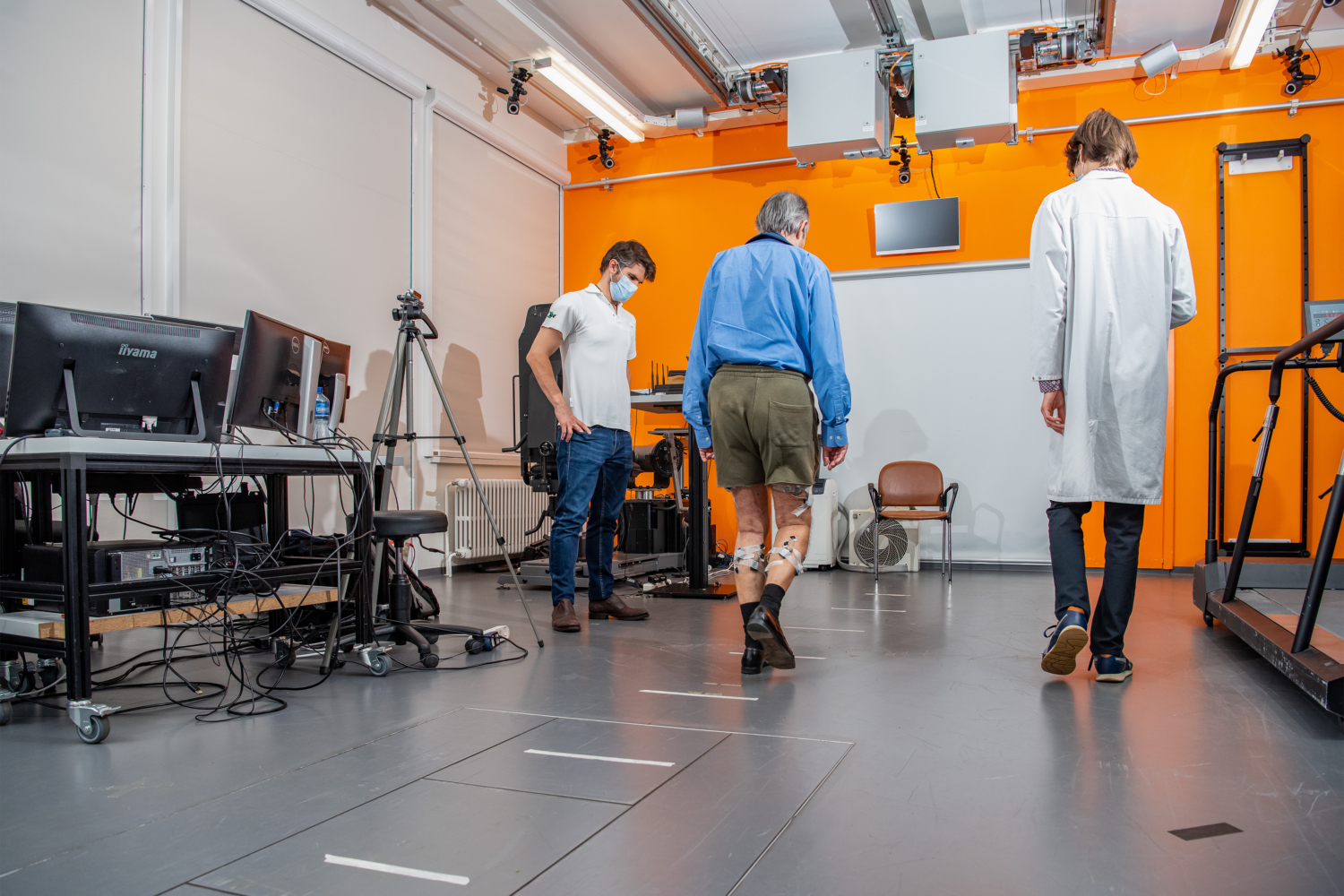
During a session in the lab.

