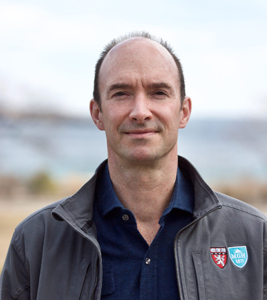
Dr. Mark Richardson is the Director of Functional Neurosurgery at MGH and also founder of the Brain Modulation Lab
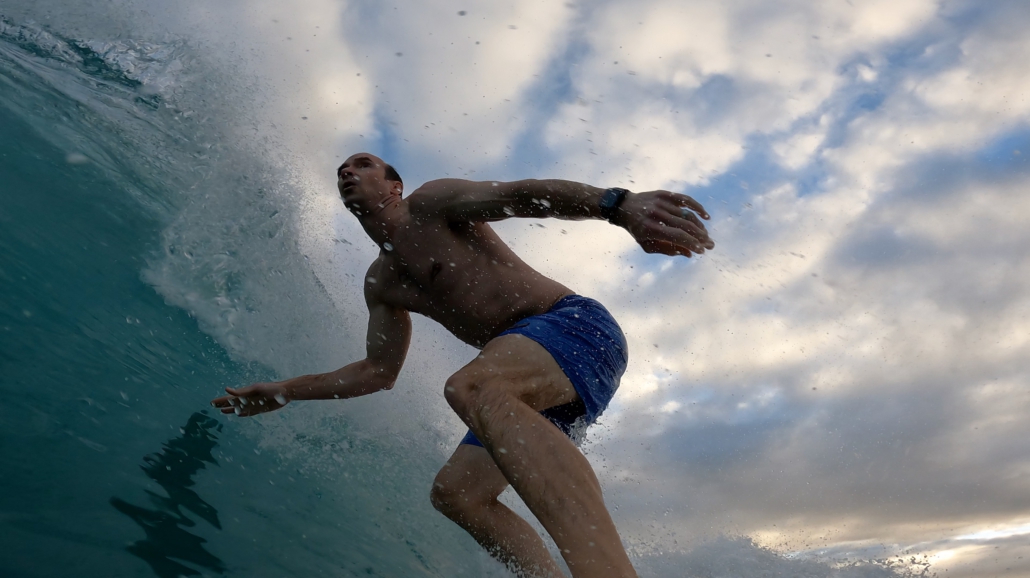
Dominican Republic, 2022

Costa Rica, 2004
#35: Mark Richardson – Surfing the Frontiers of Functional Neurosurgery: From Brain Modulation to Patient Engagement
In this captivating episode, we had the privilege of interviewing Dr. Mark Richardson, an esteemed expert in the field of functional neurosurgery and the Director of the Brain Modulation Lab at MGH Neurosurgery. With a remarkable career path that spans from his upbringing in Poquoson, Virginia, to his medical and graduate education at UVA and VCU, Dr. Richardson brings a wealth of expertise and experience to the forefront of neuroscience.
Having served as the Director of Epilepsy and Movement Disorders Surgery at the University of Pittsburgh, Dr. Richardson’s leadership and pioneering spirit led to the establishment of the Brain Modulation Lab. Since joining MGH in 2019, Dr. Richardson and his lab have been at the forefront of applying a systems neuroscience approach to enhance surgical treatments for epilepsy, movement disorders, and psychiatric diseases. Through collaborations with esteemed colleagues at MGH, MIT, Harvard, and Boston University, the lab aims to improve outcomes for patients undergoing functional neurosurgery.
During our conversation, Dr. Richardson shared fascinating insights into his journey, from his early education to his residency at UCSF and his subsequent leadership roles. We explored the mission and activities of the Brain Modulation Lab, delving into their innovative approaches to improving surgical treatments for various neurological conditions. From epilepsy and movement disorders to psychiatric diseases, Dr. Richardson’s lab employs cutting-edge techniques and leverages interdisciplinary collaborations to drive advancements in the field.
We also discussed the exciting prospects of closed-loop deep brain stimulation (DBS) in epilepsy and its potential applications in focal epilepsy. Furthermore, we explored the efficacy and implications of incision-less approaches like FUS and LITT. Dr. Richardson offered valuable insights and shared his thoughts on the selection between CM-Pf and ANT in generalized epilepsy, shedding light on the role of these nuclei in the broader context.
Shifting our focus to speech and language research, we explored the overarching goals of Dr. Richardson’s work in decoding speech and the potential of the basal ganglia in this context. Additionally, we examined the therapeutic applications of DBS in improving speech, considering its value in addressing other indications such as stuttering and apraxia of speech.
Intriguingly, Dr. Richardson’s lab also investigates the realm of olfaction through invasive neurosurgery. We delved into their activities in this domain, gaining valuable insights into the importance of understanding olfactory processes and potential therapeutic applications.
Finally, we explored Dr. Richardson’s commitment to patient engagement in research trials. We gained deeper insights into the lab’s initiatives and approaches to involving patients in the research process, highlighting the significance of their contributions and the impact of patient-centered research on advancing treatments.
Join us for this engaging and enlightening conversation with Dr. Mark Richardson as we dive into the frontiers of neurosurgery and the groundbreaking work of the Brain Modulation Lab, paving the way for novel advancements in surgical treatments for epilepsy, movement disorders, and psychiatric diseases.
Mark Richardson 00:00I remember Peter Strick running into him in the hallway once and him telling me, you know, the happiest neurosurgeons I know are the ones who... Anyone who's trained with Mitch Berger at UCSF for awake surgeries knows that the operating room should be completely quiet during any awake surgery. And so I have that ingrained into my brain and I, in a, you know, pretty polite way, would keep the OR pretty quiet. But still, I remember hearing someone talking and whipping around and saying, you know, who's talking to you? We're doing a micro lecture recording portion. Welcome to Stimulating Brains.
Andreas Horn 01:17Hello and welcome to Stimulating Brains. Today it is my tremendous pleasure to share the conversation with you that I had with Mark Richardson. Who is the director of the Functional Neurosurgery Program at Massachusetts General Hospital and the Charles A. Pappas Associate Professor of Neurosciences at Harvard Medical School. Mark is also a Visiting Associate Professor of Brain and Cognitive Sciences at the MIT. He completed the MD-PhD program at Virginia Commonwealth University's Medical College of Virginia and neurosurgical residency at the University of California, San Francisco. His clinical expertise includes awake brain mapping during epilepsy and DBS surgery. Robotic-assisted stereotactic surgery and network surgery approaches to epilepsy, including responsive neurostimulation. 02:02I think Mark's surgical work, but even more so his research work, is truly unique since he uses data from a broad array of invasive techniques that includes DBS, ECOG, RNS, IEEG mapping for epilepsy, but also ablative procedures that include conventional radiofrequency ablations and LID. Beyond that, he has expertise with gene therapy, closed-loop stimulation, and connectology. He also works with the National Institute of Neuroscience and Neuroscience. We talk about invasive procedures for epilepsy, the role of the basal ganglia in speech and language, the potential role of surgery to create an olfactory prosthesis, but also patient engagement in research trials and incision-less ablative approaches. I should probably disclose that Mark was one key driving factor besides Mike Fox in my own recruitment to the Master General Brigham system, and I work closely with him on a weekly basis. I have learned a lot from Mark in the past and also in this conversation. So I hope you enjoy it as much as I did. Thank you so much for tuning into Stimulating Brains, episode number 35. 03:14I will have formally introduced you already by now, so we can directly jump into it. And to break the ice, before we get into science... Science. I always ask about hobbies and things you would do if not involved in neuroscience or neurosurgery. Any hobbies? Yes. I've whittled down to one main hobby outside of my family after neurosurgical training, which is surfing. So that's just something I love to do, and I try to make as much extra time for it as I can. And it turns out that you can surf in the wind, which I didn't know before I considered coming to MGH. Did you surf in Pittsburgh before as well?
Mark Richardson You can't surf in Pittsburgh. It just has three rivers. You can fly to some surf destinations. It's the best you can do. 04:02I learned to surf on the Outer Banks in North Carolina as a kid on vacation. I grew up on the Chesapeake Bay, the small town in the southern suburbs of Virginia. We could drive to Virginia Beach where you can surf. And the height of my surfing was probably in residency in San Francisco at Ocean Beach, which is a great place to surf.
Andreas Horn Yeah, it is. Yeah.
Mark Richardson It's amazing.
Andreas Horn And you live at the sea right now, right?
Mark Richardson Beautiful location. We do. We live very close, and you can surf a few minutes from the house on either side. That is great.
Andreas Horn How often would you find time to do it?
Mark Richardson I get out there once every couple of months probably for interviews. Sounds good. Cool.
Andreas Horn So who were key mentors in your career or also turning points that were important?
Mark Richardson I've had a number of key mentors. The first was... the person who directed me into neuroscience. So when I was in college, I was not serious enough about student, even though I was committed to going to med school. 05:04I didn't really understand what that meant. And so I did a master's in physiology at VCU, Virginia Commonwealth University.
Andreas Horn And there is a particular professor there, Linda Casanzo, who many people in the U.S. know from her authorship of the primary physiology book that she used for a board review. And long story short, her husband is also a physiology professor, and she directed me into his lab. And that's when I fell in love with neuroscience, doing olfactory nerve regeneration experiments. So that was my first brain surgery is separating the olfactory nerve when we watch how the spree grew into the olfactory bone. And that was in mice, I assume?
Mark Richardson That was in mice.
Andreas Horn Yes.
Mark Richardson So that was someone named Rich Costanzo that we actually collaborate with now. After 20 years. 20 years plus after having been in his lab, we collaborate again on the project. So that he was my original mentor in neuroscience. 06:01And then the time I went through med school at VCU, it was because of that experience that I switched into the Ph.D. program once I finally got into med school. And then I had three great mentors in the neurosurgery department who brought us, who was a tumor surgeon, but allowed me to come into his lab and study neurogenesis and culture, neurospheres. From epilepsy surgeries that Cap Holloway did, who was my first mentor in stereotactic and functional neurosurgery. He was the DBS and epilepsy surgeon at VCU. And then Ross Bullock, who was the neurotrauma surgeon there. Really well known in the neurotrauma field at MCV, Medical College of Virginia, which is what they used to call VCU. Long-standing history in neurotrauma. So I was interested in emerging functional and neurogenesis. And then I did a PhD in functional and trauma. And it's Ross Bullock who suggested that I do a sub-I at UCSF. Or at least encourage me to do that. 07:02And then of course there I went on to have very important mentors in Phil Starr and Paul Larson and DBS. And Nick Barrow is a person who taught me how to do epilepsy surgery. And I give a large portion of credit for my accomplishments. And I also give a lot of credit for my competence at operating to Mike Lawton, who is a vascular surgeon at UCSF for a number of years. And we spent a lot of time learning from him. That was really critical for me. Because I didn't do an external fellowship after residency. And so I was really lucky to have that training at UCSF at that time. And then after UCSF, you went to Pittsburgh. Then I went to Pittsburgh. So that was, I think, in 2011.
Andreas Horn And then you also founded the brain modulation lab there. And the mission still is to apply a systems neuroscience approach to improving surgical treatments for epilepsy and movement disorders.
Mark Richardson So I think a lot has changed since 2011.
Andreas Horn 08:02But can you give us an overview in a nutshell? Yeah, sure.
Mark Richardson The basic principles are still the same. And I think one of the reasons why I didn't start out calling it the Richardson Lab is because I knew the things I wanted to do. I wasn't capable of doing them. I wasn't capable of directing those. I didn't have the expertise to do all the things that I wanted to do but that I thought a functional neurosurgery could facilitate.
Andreas Horn And that's why the mission of the lab has really been to do something or things that eventually can affect the way that we do neurosurgical therapies for patients.
Mark Richardson So if you look across our projects, some of which are pretty close to pure basic science. But you can see a pathway for each of these, how it can eventually help a patient. And that's something that's been really critically important to me.
Andreas Horn And it's one of the reasons why our projects span things that are a little more bread and butter, surgical development related and outcomes related, down to what's the role of nasal ganglion speech.
Mark Richardson 09:10And that collaboration has been really important, part of that. We've had a lot of collaborators. They've probably enabled each project that we have. So yeah, I think although I didn't have, you know, my PhD was in physiology and obviously got exposed to neurophysiology. The lab is now about 90% computational neuroscience, which is not my background. But I just, I got hooked early on the idea of restorative and functional neurosurgery. And then it just became very apparent that. So. Signal processing and access to intracranial data was a big deal. And it's just, it's fascinating that the number of human behaviors that we can look at is access to the brain. So. It's really in Pittsburgh. 10:01A couple fundamental things happened. One, I remember Peter Strick running into him in the hallway once and him telling me, you know, the happiest neurosurgeons I know are the ones who make the operating room their laboratory. And at that time, I was just transitioning to doing all the DBS there. Doug Konziolka had been there when I arrived doing DBS and left about a year, year and a half after I got there. And we had started doing some intracranial neurophysiology work in the epilepsy monitoring unit. And then we had also started with some intraoperative neurophysiology studies based on what I learned with Phil Starr. And of course, when Peter made that comment, I thought the happiest neurosurgeon I know, Phil. And that was just really obvious advice, but that stuck with me. And I've followed that, you know, almost to the T. So we don't do a whole lot that maybe we don't do anything that isn't based on data from our patients.
Andreas Horn 11:01Yeah. Yeah.
Mark Richardson Or potential patients. It's mainly, I would say that the main focus is electrophysiology. Of course, you do a lot of imaging now too, but I think a lot is intracranial recordings, right? That you do.
Andreas Horn Yeah. Yeah.
Mark Richardson And I think that's a really good point. I think that in movement disorders and epilepsy and language is a key topic.
Andreas Horn Are there other ways to summarize the lab?
Mark Richardson It can be hard to summarize what our lab does.
Andreas Horn Yeah. Yeah.
Mark Richardson But so maybe I'll just, I'll tell you the story of how these things evolved.
Andreas Horn Yeah.
Mark Richardson When I left UCSF, I'd had exposure to electrophysiology and to the work that Eddie was starting to do at the time. Eddie Chang was a year ahead of me in residency. So he was a big influence for sure. Watching, you know, his work. But my postdoctoral work was in gene therapy delivery. So these are two disparate things, but they're linked by the patient population. And that's the thing that I think is so wonderful about functional neurosurgery. At least the flavor that I've been lucky enough to practice, which is what I observed, cap Holloway practice back in med school. 12:01So my idea of functional neurosurgeon was someone who did epilepsy and DBS.
Andreas Horn Yeah.
Mark Richardson And I was lucky enough to have that be my job at Pittsburgh and have that be my job in Pittsburgh. And have that be my job here. And that's important because it is the link across all these projects. And now, of course, at MGH, we have the opportunity to do work with psychiatric patients who have undergone DBS and even some relation therapies. So the unifying link there is access to brain physiology. It's not the same in each case.
Andreas Horn Okay.
Mark Richardson So given that. When I was in Pittsburgh, I was lucky enough at the same time to have Avnil Gumon start as director of the MEG program, actually clinical MEG program.
Andreas Horn Now Avnil turns out didn't have a lot of interesting clinical use of MEG, but a ton
Mark Richardson of interest in cognitive neuroscience use and ECOG. 13:01And he was the real partner who helped mentor people in my lab for doing signal processing. And so we started in the epilepsy monitoring unit. And then when we had the opportunity to really expand into all the DBS patients in Pitt, he and other mentors, Rob Turner was a huge mentor in Pittsburgh. And Rob is primarily responsible for helping us design the behavioral task and the analytic methods for the DBS work at Pitt. So maybe to quickly dive into that part. Because there's so many things that I think your lab makes your lab so special.
Andreas Horn But one would be the ECOG recordings that you do together with DBS, right? Yeah.
Mark Richardson A few people do that. I think Phil Starr does it, but not many people do it.
Andreas Horn So how did that develop? Yeah.
Mark Richardson Still a few people I think do this. I can't tell if this is still slowly increasing. I think it is. 14:04So the way that evolved was I had done those cases with Phil. I've been a technician in those cases. And I had been exposed to some of the scientific questions. And Phil was, at the time I started as faculty in Pittsburgh, was moving into the how does DBS work, you know, beginnings of his current close, quite mature closed loop simulation work. And I saw opportunities for basic science, you know, basal ganglia cortical interactions. And that's what we started doing.
Andreas Horn Yeah.
Mark Richardson That's what we started doing with basic hand grip movements. And then thankfully for the BRAIN Initiative, which was the first time a mechanism was created, specifically to fund projects for intracranial recording simulation. 15:04At the same time when we realized that with a new microelectrode that AlphaMega was making that had greatly reduced feedback, we could study speech.
Andreas Horn Yeah.
Mark Richardson And having been exposed to this, I went to Julie Fiez, you know, another mentor who was chair in the psychology department at Pittsburgh and a reading and language expert, and reappropriated a task that she had used for another study and started running that in DBS patients. And that's how we got the preliminary data for our first U01. So in your speech work, I could imagine since you mentioned Eddie Chang, it might have been motivated also by his work of decoding speech on the cortex. I know you have currently a project where you try to decode subcortically as well.
Andreas Horn Is that the main idea or is it also just generally finding out how language works in the brain?
Mark Richardson 16:03It was really just finding out, trying to figure out what's the role of basal ganglia in speech production. It's really not about decoding. If my impression of Eddie's pathway is that he really evolved along the way, but at some point early on saw the potential for decoding and speech prosthesis. Our lab has not been BCI oriented, even though I think it's more and more of the work we do may be applicable to design new DBS systems and particular to these decoding problems. But the primary goal, initial goal was to decode speech. And I think that's what we're trying to do. We're trying to do this.
Andreas Horn Really, what's the basal ganglia doing?
Mark Richardson And I think this is still, from basic science perspective, open for debate and discussion. Speech is just a really rich way to look at things that the basal ganglia can be participating in.
Andreas Horn Makes sense. 17:00Makes sense. So I would say in general, deep brain stimulation has mostly been associated with firstly affecting language and speech, right?
Mark Richardson At least for Parkinson's disease, subthalamic and non-subthalamic DBS.
Andreas Horn Do you see potential in therapeutic applications of DBS to improve speech?
Mark Richardson Yes, definitely. And I think, I won't say it's a myth, but I feel like the effects of DBS on speech get a bad rap because they're not always bad. This is the perception. And I think of this like head tremor and patients with essential tremor. There's a bias. And this is a preventative.
Andreas Horn Yeah.
Mark Richardson And I think it's a basic myth in my experience that head tremor doesn't improve or voice tremor doesn't improve with DBS. And of course it does. It does. I've never had it not improve. It's just a question of how much is it going to improve and maybe it doesn't improve as much as the limb tremor. And so I think it's a similar thing with speech, although obviously the issues with speech, 18:01if you get a side effect, it's obvious. And the patients will complain about it or sometimes they don't. One, I remember after we started doing this work, I paid a lot more attention to the patient's speech. And I do remember seeing someone for a battery change who I could not understand because of his dysarthria. The family and the patient for all intents and purposes were as happy as they could be with the effects of DBS.
Andreas Horn And I said, well, what about the speech?
Mark Richardson And they said, oh, well, you know, it just, it is what it is. And sometimes it's hard to dissociate this from the depression disease. Sure. But clearly there is something different about speech that's not the same as the limb motor improvement. And so I think that is an important potential contribution of our work is if we could shed
Andreas Horn some light on why that is. And obviously some of these pathways are exactly the same. 19:02But there's a different aspect. And is it because there's some different cognitive overlap with speech production?
Mark Richardson Which of course is language.
Andreas Horn This is the other very interesting thing about speech and language.
Mark Richardson If you're a cognitive neuroscientist, you understand maybe more clearly than I do what the, where the boundary is between those two. But this is something that our lab has had to think about and deal with in terms of how we think about designing our experience and questions of the language.
Andreas Horn Absolutely.
Mark Richardson And it makes so much sense that, you know, the basal ganglia are of course very much involved in all motor. So they must at least be, you know, in the, in the, in the, in the, in the, in the, in the, in the, in the, in the, in the, in the, in the, in the, in the, in the, in the, in the, in the, in the, in the, in the, in the, in the, in the, in the, in the, in the, in the, in the, in the, in the, in the, in the, in the, in the, in the, in the, in the, in the, in the, in the, in the, in the, in the, in the, in the, in the, in the, in the, in the, in the, in the, in the, in the, in the, in the, in the, in the, in the, in the, in the, in the, in the, in the, in the, in the, in the, in the, in the, in the, in the, in the, in the, in the, in the, in the, in the, in the, in the, in the, in the, in the, in you're doing right i mean i'm sure it has been studied but maybe it wasn't in the focus of the attention of basic anglia research it hasn't i would say yes it hasn't landed maybe it wasn't so squarely in the realm of basal ganglia research in terms of is you know what's the basal ganglia 20:04process here that's being modulated or disrupted even though there's definitely a literature there another big arm of your lab of course is epilepsy and then maybe before we go into that it's it's just a curiosity question for myself that landing here do you in the us myself i feel like a lot of functional neurosurgeons do both dbs and epilepsy in europe that was very rare but also because i think in europe there is not so much functional um at least not so much sedg epilepsy um research and and therapy is that even is that my bias is it is it a common thing here that dbs and epilepsy is often done by the same person in the us or is that especially casey in boston with john and you and yeah no it is um you have the right impression okay that's every functional neurosurgeon 21:00doesn't have that practice i'd say you know in the us there are people who do functional who do dbs and spying there are people who do dbs and pain there are people who do dbs and epilepsy there are people who do epilepsy and tumors yeah okay don't do dbs that's a slightly different genre and you can have someone who does all those things even uh and then they're a subset of functional people who they primarily are are generalists and and do as much dbs as they can they have good training but they end up in a system where they're the volume maybe just as high um so but in your case um i mean it seems such a natural um thing it both involves implanting electrodes into to the brain so how how how do you think the two complement each other and then maybe if you want to talk about the epilepsy research a bit sure and actually i'll swing back to one thing you said about the basal ganglia which is it controls all motor function but it also modulates probably 22:03everything else all of our cognitive functions too yes which um is
Andreas Horn obviously very interesting the way that relates to epilepsy is in thinking about that and you
Mark Richardson think about how the dbs skills evolved and the need to understand functional anatomy and the physiology of these circuits the same things happen in epilepsy where you there's been a transition from thinking about a seizure focus as one thing that you can potentially resect or else the surgeon doesn't have any role there, or even then, what, we can't treat that effectively, really there's not much else we can do, to thinking about how different regions in the brain participate in a circuit that drives clinical seizure generation. So that's one way that there's overlap. The other is on the research side. So we can use each of these patient populations, not as exact controls, but we try not to miss 23:10an opportunity to, for instance, run a task in a patient in the EMU who's implanted in speech production areas, even though they don't have a movement disorder and we don't have electro-library vasocanglia. But there's some useful information there that can be used as control against the movement disorder data. There are all the techniques that cross. Here, we're still on the research side. You know, the lab has now more than one person focused on a machine learning-based project. And a lot of these techniques can cross between the research problems.
Andreas Horn On the clinical side, the, yeah, so I said I feel like I've been really lucky to have
Mark Richardson this as my practice. The reason is these are chronic disorders that are underutilized. The surgeries are quality of life improving. 24:02They're really intellectually engaging. And they're a puzzle. I mean, each of these patients. This is a puzzle. Sometimes the epilepsy side more so than the movement disorder side on a case by case basis. But if you still look at the puzzles that need to be solved to prove DBS for Parkinson's disease, let alone for neuropsychiatric indications, there's still a lot of fun problems to work on.
Andreas Horn And both are very rewarding, right?
Mark Richardson I find both very rewarding and more and more of my, and I will talk to you. Ask me more questions. I'm going to ask you about the epilepsy research more and more.
Andreas Horn You know, I've been thinking about the underutilization problem and you know, what's the role, what's my role going to be? What's the labs role? What should NGH's role be in increasing access or utilization of these surgeries that we know help so many people that are grossly underutilized? Can we maybe even before we go into the research, can I ask the simple question or it's not simple, I guess, but if I were an epilepsy patient with, let's say, 25:08you know, complex seizures, there are certain options for me if surgery is an option, right?
Mark Richardson It would be, I think, SEG monitoring and then resection or based on that also DBS with, I think, two targets, CM and N nucleus of the thalamus.
Andreas Horn And then there's RNS probably to the same targets most of the time. Is that accurate? And how would the decision process usually work?
Mark Richardson Aha. So that's a pretty good overview.
Andreas Horn Okay. Yeah.
Mark Richardson Let me start by saying anyone who has, you know, drug resistant epilepsy now is a surgical candidate.
Andreas Horn Yeah.
Mark Richardson That would be quite controversial in some neurology circles, but it is a fact, you know, based on empirical data we have, even with generalized epilepsy, assuming what we've seen over the past few years using RNS off label and what others have shown with DBS off label is enough fluke, which I don't think it is. 26:03So to answer your question, it's a complex process.
Andreas Horn Yeah.
Mark Richardson It's a complex process still to get the full epilepsy surgery evaluation to determine which of these treatment strategies may be the best. And we really need to evolve on the pre-surgical workup side. And I think surgeons are going to have to have a role in this in some way to figure out which patients really don't need this whole workup. Generalized epilepsy patients, I think are one of them because that is relatively straightforward to diagnose on the EEG at least when it's straightforward, it's straightforward.
Andreas Horn Yeah.
Mark Richardson And frankly, you don't need a neurologist to do that. You don't need a neurologist to program the device. And you might be able to implant these same day. So that would be, usually you'd go for CM, DBS, or CM. We've picked CM, which there's, I think, still a lot of target refinement to do. There may be subtypes of generalized epilepsy and certainly subtypes of symptomatic generalized epilepsy, 27:05which is not, let's say, a pure generalized epilepsy where there may be another target in the thalamus or somewhere else that's a good target. But the current, we're very biased towards the use of RNS for a simple reason, which is you get very valuable data off the device. It is not perfect, but it's better than duty cycle stimulation, in my opinion, duty cycle stimulation. And it used to be no. Information now, of course, with the Percept device, you can get feedback on tracking some electrophysiological signals. And we've done that. We have a project, Matteo Bassani in the lab has a nice paper on a putative biomarker discovered on the Percept recordings in OCD patients. But we don't have enough, maybe a couple DBS patients, because just from the start, we've really wanted to have the data. 28:05And I think this is important for the future of epilepsy surgery in a number of ways. This data over time is going to be very, very instructive to the field. It's going to be instructive to individual patients. I think these devices are going to become more like consumer electronics products. You're going to be able to interact with them on your phone or your watch.
Andreas Horn You may be able to do other interesting things with your own data.
Mark Richardson You may have seizure warning or at least be able to track your own seizure rhythms. You can use the data. The neurologist or whoever is prescribing the medication can use the data to determine whether brain activity is worsening in the epileptogenic sense. If the medication is reduced, this could be really valuable. It requires more work on the side of the epileptologist or better clinical tools, better analytic tools. That's really valuable.
Andreas Horn 29:00So my bias has been why, given the opportunity to collect this data, why?
Mark Richardson Because I can't plant a DBS in someone.
Andreas Horn So I get the point between RNS and DBS, but maybe before that, resection versus DBS, how is that?
Mark Richardson Resection, we still want to resect if we can because it's the only way to get a surgical cure. But you need a seizure focus. If you don't have one, then you go for DBS. You need a seizure focus or enough of the seizure network that can be taken out or ablated with a high enough chance of producing seizure freedom or something really close to that. Now, in experienced hands, the risk of open traditional epilepsy surgery is low. So it's not that we don't want to do these procedures because they're not safe. Complication rates high, person's going to be changed forever if they have resective surgery. That's not the reason that in the surgeon's bias opinion, that's not the reason we would avoid those surgeries. 30:03It's we would avoid those when we don't want to do them. We would avoid those when we don't have high confidence about the durability, which is based on the understanding of the seizure network. And can you know something about the seizure network without SCEG probes or do you always do need that to determine whether there's a... You don't always need it. This is one of the holy grails of epilepsy surgery.
Andreas Horn It would be that how can we ever get around having to put electrodes in the brain? Yeah. Can we just develop enough? Yeah.
Mark Richardson So, I think that's the way that we should be able to do it. So, I think that's the way that we should be able to do it.
Andreas Horn Yeah.
Mark Richardson But I think that pathway is through SCEG.
Andreas Horn Yeah.
Mark Richardson So, usually it's SCEG, then decision... No, I mean as a field. As a field.
Andreas Horn Okay.
Mark Richardson Like the idea that, oh, well, don't worry about studying SCEG because non-invasive stuff, we're eventually going to have that. That is an incorrect assessment in my opinion.
Andreas Horn Yeah.
Mark Richardson I think we need to use the SCEG data and work in conjunction with the SCEG data.
Andreas Horn Yeah.
Mark Richardson So, I think that's the way that we should be able to do it.
Andreas Horn Yeah.
Mark Richardson So, I think that's the way that we should be able to do it.
Andreas Horn Yeah.
Mark Richardson Like the idea that, oh, well, don't worry about studying SCEG because non-invasive stuff, we're eventually going to have that. That is an incorrect assessment in my opinion.
Andreas Horn 31:00Yeah.
Mark Richardson and work in conjunction with MegData and with the ScoutBG and with Connectomics and figure out what cases we no longer need to do SEG in. So I'd say now our current practice, it feels like more than half the cases go to SEG.
Andreas Horn Yeah.
Mark Richardson It definitely feels that way. But we're also seeing more complex cases, and we're also seeing more borderline cases that would never have made it to an epilepsy conference and still many epilepsy centers might not make it to a conference. So with multifocal epilepsy where maybe they're a candidate for resection or ablation, but probably they're a candidate for RNS, then we're going to do SEG to, one, see if there's part of the circuit we can take out or ablate, and two, see what's the best place to record and stimulate. And that way, RNS has really changed the way that we do SEG. It's my opinion that it should have changed. It should change it. 32:00So you mentioned the evaluation. So you mentioned the advantages of RNS in the recording, and that even for the European listeners, it's not approved there. So NeuroPace is new. So I think it was the first approved closed-loop device. It's first, and it's still. It's the first bidirectional brain-computer interface. Good point. You're right.
Andreas Horn Yeah, still.
Mark Richardson It still is. Even with Percept, that's not closed-loop yet. That's right.
Andreas Horn So you're right. So it is, and it's a single electrode, right?
Mark Richardson Single lead. It's two leads. There are four contacts on each, so you get two channels per lead, two bipolar pairs, so you get four channels per lead.
Andreas Horn And you stimulate two sides, or one side only?
Mark Richardson You can simulate on any. I see. You can record and simulate on any. That's great. And you are involved, I think, in the Nautilus trial, the responsive, that's from NeuroPace. 33:00The Nautilus trial is NeuroPace's trial, which they are funding for bilateral centromedian RNS for idiopathic generalized epilepsy. Got it.
Andreas Horn That would sense in the same spot?
Mark Richardson Sense and simulate in the thalamus. In the CN, okay.
Andreas Horn Yeah. What's the marker look like? Is that comparable to movement disorders, like a beta signature? Is it in the frequency?
Mark Richardson It's even better. It's the seizure. It's the seizure. So generalized epilepsy is defined, at least in ITG, by generalized spike in wave discharges.
Andreas Horn Yeah. Yeah.
Mark Richardson Low frequency. And you see those in the thalamus. And this is, it was known from the literature, from the work of Mexico City Group, you know, externalizing DBS leads implanted in CM and reporting from them, reporting during seizures in patients with generalized epilepsy. There's been data in the literature, at least since the 80s, that shows that you can see those, 34:00the simultaneous cortical onset.
Andreas Horn Yeah.
Mark Richardson And this goes back to the centroencephalic theories of seizure generation. And it really... And there's data from other groups, like the groups at King's College, that show that there's some seizure types where the thalamus is involved very early. They're from where I started to show this too, in generalized epilepsy. And the idea is that the thalamus is required to have this broad cortical synchronization.
Andreas Horn Yeah.
Mark Richardson So, we've known for a while that you could see the seizure in the thalamus, and it's the field that's known, even though this really wasn't widely, I think, appreciated. At the time we started doing it, there was really a question of, well, are you going
Andreas Horn to see the seizure in the thalamus?
Mark Richardson There is not a case where you're not going to see a thalamus. That's not UNFS, I'm questioning that.
Andreas Horn Is there enough patients implanted with the RNS in the thalamus with this type of epilepsy?
Mark Richardson 35:00The other trial that's an NIH-sponsored trial that involves the RNS device is in Lennox-Gastaut syndrome, which is a symptomatic generalized epilepsy. It's a lot more heterogeneous patient population. There, there are two devices using thalamocortical simulation. So, there the strategy is different, where the detection could happen in either, but the idea is that that's a cortical-based problem that quickly goes through the thalamus, and it's widespread enough in terms of the cortical seizure.
Andreas Horn So, it's a very interesting approach. And then, so very interesting, you probably can't say much about the trial yet.
Mark Richardson It's ongoing, but maybe just based on your prior experience with RNS and DBS and the
Andreas Horn thalamus, it is probably going to be fruitful, or at least interesting to learn bilateral
Mark Richardson CM-DBS responsive stimulation. It has a high probability of success based on your experience. 36:00Sure.
Andreas Horn I mean, I can tell you why I was enthusiastic about it before the trial started, which is
Mark Richardson we've seen robust clinical effects literally in every patient with primary generalized epilepsy that we've tried this in. There is variability in terms of the timing, and we have, I think, at least one patient with a lead that's not optimally placed, who took longer to respond, and I really think I should reposition his lead. So, you know, there, there is a lot of variation. It's still an early stage, but anecdotally, it does seem to work well. And the, and I think it must be working well in other centers because when NeuroBase wanted to initiate that trial, there's a lot more demand and requests to be involved than there were spaces for clinical sites. Got it. And there are 20-some surgical sites involved. So there's a real enthusiasm for this.
Andreas Horn Yeah.
Mark Richardson Which speaks to maybe a couple of things. One is the clinical need. 37:00It turns out there are a lot of patients with primary generalized epilepsy. Many of them are, you know, otherwise normal people in their 20s or 30s who are just trying to, you know, hold their jobs and are medically refractory, for whom this may be a great option. So I think there's an understanding that that population is out there. And then two, in centers who have tried, haven't heard of a center that's been able to do that, have heard of a center trying this and saying, ah, we just, we don't believe in that, we just don't do it.
Andreas Horn Makes sense. Okay. And can you speak about the general concept between CM versus ANT DBS? Yeah.
Mark Richardson I could imagine CM is midline thalamus.
Andreas Horn That's why widespread cortical projections, also projections to the striatum, maybe that is more for the generalized and then ANT more for temporal? Yeah.
Mark Richardson This is speculative at this point for sure.
Andreas Horn Yeah. Yeah. Okay. Yeah. Okay. Okay. Okay. Okay. Okay. Okay. Okay. Okay. Okay. Okay. Okay. Okay. Okay. Okay. Okay. Okay. Okay. Okay. Okay. Okay. Okay. Okay. Okay. Okay. Okay. Okay. Okay. Okay. 38:00Okay. Okay. Okay. Okay. Okay. Okay. Okay. Okay. Okay. Okay. Okay. Okay. Okay. Okay. Okay. Okay. Okay. Okay. Okay. Okay. Okay. Okay. Okay. Okay. Okay. Okay. Okay. Okay. Okay. Okay. Okay.
Mark Richardson Myoclonic components of their generalized epilepsy may be best responders or quickest responders. And there the supposition would be because of the denser connectivity to motor sensory areas. And maybe some central connections, you know, like you suggested, for primarily generalized epilepsy.
Andreas Horn The A&T data is interesting because people have the idea that because the SANTE trial was pretty good
Mark Richardson and, again, I'm biased. I think the RNS clinical trial data is a little better, but the SANTE data is pretty good. And people have the idea that this works across all types of epilepsy. But if you look at, there's a registry paper that came out recently. I can't remember the first author, I would tell you. But it's very interesting because there the responder rate drops into, I think, the 30s. 39:00And I... My... Interpretation is that part of the reason is maybe use, greater use of A&T DBS outside of temporal lobe epilepsy, which was the majority of cases that were in the SANTE trial, even though there was extratemporal epilepsy, maybe more frontal lobe cases. And this is one thing we've learned from collaborating with you and using the tools in VDBS and VConnectome. Again, Pranav has... Reparcelated the thalamus and... The A&T is just a third of, just covered a third of the brain. Pulvinar has got the back third and centromedian is kind of in the middle. And then there's overlap. But this... This is really a fascinating area. Especially if you think about the pulvinar.
Andreas Horn If you want another interesting, you want a new, interesting...
Mark Richardson Well, it's not new. It's new for... It's new for neurosurgeons. Usually I think about the pulvinar. Something new to think about. 40:00Because it's connectivity. So it's broadly connected to the temporal lobe. And you can look in the European SCEG data. And... I mean, they're doing bedside, essentially responsive neurostimulation. One of the French groups. Stimulating the pulvinar with detecting a seizure in the thalamus. So it's not just an anterior to posterior gradient. And we've even had some patients who are implanted in the pulvinar. And other thalamic areas. And you have seizure onset in the orophrontal cortex. And it's picked up first in the pulvinar before other parts of the thalamus.
Andreas Horn Interesting.
Mark Richardson So there's still, you know... We have a little ways to go in our understanding of this connectivity.
Andreas Horn Yeah. Would any of the DBS patients ever get completely seizure-free? Probably not, right?
Mark Richardson Is that... Some of the work that they do, electrographically... Now that you mean the RNS patients. So we have...
Andreas Horn Yeah.
Mark Richardson At least my experience is with the RNS patients. Either way. 41:00We have patients that will say, I've been seizure-free. I haven't had a seizure in eight months. And if you look at the data, and that's another good thing about that system. I can log in right now. I can show you patients' data if they've been uploading it. You'll still see electrographic seizures.
Andreas Horn Okay.
Mark Richardson So it's not that the device has completely shut down the network. But it's shut it down from clinical significance. Which is a really big deal, of course. So that does seem to be one thing that pops. And I think that's a big thing. And I think that's a big thing that pops out in a lot of the RNS outcome literature so far. Is patients will get these long breaks between seizures that they did not have before.
Andreas Horn Yeah.
Mark Richardson Some of these patients are so refractory. They're in the emergency room several times a year before something like this. Or losing consciousness all the time. No longer losing consciousness. So have periods of six months or a year. Sometimes longer no seizures.
Andreas Horn But they usually still have medication on board?
Mark Richardson Often they do. I don't think we're...
Andreas Horn Yeah.
Mark Richardson I don't think the field's aggressive enough. 42:00But I think this is changing.
Andreas Horn Yeah.
Mark Richardson Especially with the forward-thinking neurologists who are really engaged with the data. They understand the ideas.
Andreas Horn Makes sense.
Mark Richardson And they're really focused on the patient. They want to get the medications on. Of course.
Andreas Horn Do you see potential applications in focal epilepsy for DBS or RNS?
Mark Richardson You know, state-of-the-art is resection.
Andreas Horn But then also with maybe less invasive methods like FUS or LIT. Any ideas on that? Yeah.
Mark Richardson I mean, LIT... LIT can work very well if the focus is small enough and you can conform the ablation to it.
Andreas Horn Yeah.
Mark Richardson I think it can work great. Focused ultrasound, yes. When the technology catches up to the point where you... Or let's say surpasses the ability of LIT to conform the lesion to the seizure onset zone. Great. Mm-hmm. RNS works really well in things like focal length.
Andreas Horn Yeah. Yeah. Yeah.
Mark Richardson Focal motor seizures though directly in motor cortex. 43:00I see.
Andreas Horn Yeah.
Mark Richardson Sure. So there's also that. So you've been doing that.
Andreas Horn Yeah.
Mark Richardson We do that too.
Andreas Horn Okay.
Mark Richardson So that's a target you cannot ablate. Sure.
Andreas Horn Yeah. Makes sense. Okay.
Mark Richardson Great. All right. Moving on to speech. I think that's one other big topic of your lab. We did cover a bit of that.
Andreas Horn What are maybe the future ideas of speech? Yeah.
Mark Richardson Speech and language.
Andreas Horn Yeah.
Mark Richardson Well, we would love to be able to contribute to a type of DBS therapy that could differentially modulate speech.
Andreas Horn Yeah.
Mark Richardson Versus other motor symptoms.
Andreas Horn So having a talking mode or walking mode in tremor patients or something like that? Yeah.
Mark Richardson Or maybe novel, whether it's anatomic or physiologic delivery.
Andreas Horn Yeah.
Mark Richardson Or maybe a surgical delivery where you don't have to sacrifice one or the other.
Andreas Horn Yeah.
Mark Richardson 44:00So that would be the ultimate goal.
Andreas Horn So we can understand the circuitry well enough to understand why in some patients if you
Mark Richardson turn a DBS lead on in one location. And by the way, I don't know if I said in response to one of your first questions, DBS, it can improve speech.
Andreas Horn Yeah.
Mark Richardson So if you think that it can, it can. And it can improve hypophonia and it can improve articulation. When those things I think are basically a symptom of the baratokinesia. And that's where it's easier to understand.
Andreas Horn Yeah.
Mark Richardson Think about the circuit problem.
Andreas Horn But what's going on with the speech when it's not the same thing as the patient getting bradykinetic?
Mark Richardson Hmm.
Andreas Horn Okay.
Mark Richardson That we don't know. And I think, I hope that if we have a better understanding of the circuit and our physiology that maybe we could modulate both at the same time.
Andreas Horn Any indication for stuttering or apraxia?
Mark Richardson I love this idea.
Andreas Horn Yeah. Yeah. And the apraxia is interesting because then you might think more about cerebellum. Yeah.
Mark Richardson Stuttering is potentially a basal ganglia problem. 45:04Hmm. And this is where I'm hopeful one of our current collaborations eventually leads. And that's with Frank Hunter at Boston University. And so Frank and his lab have developed the leading computational models of, or a leading computational model of speech production. And they're interested in studying stuttering.
Andreas Horn Yeah.
Mark Richardson And I think that's a good way to start. So I'm hoping that we can get some information out there for other groups, obviously, that are interested in this. But I do, I think if we are thoughtful about this, we could potentially get to a clinical trial sooner rather than later. Right.
Andreas Horn Yeah.
Mark Richardson You have mentioned the OCD paper by Matteo Visani and also maybe your ongoing work on that is responsive DBS, or at least reporting from DBS and OCD.
Andreas Horn Can you give an executive summary of that? Yes.
Mark Richardson We've had two interesting things happen, I think, simultaneously in looking at data 46:07from the OCD patients. So one are the recordings from the percept device. And we happened, it happened to be that our first patient who was implanted with the percept device was a great responder. Now, she did fluctuate, which provided us with a lot of information.
Andreas Horn Yeah.
Mark Richardson Which provided some opportunities to see if that tracked with the frequency band that we were tracking on the first set.
Andreas Horn Yeah.
Mark Richardson And it did. And so that, I mean, that's a pretty crude method of just taking the peak, you know, in the power spectrum and tracking it and seeing if changes in the amplitude of that signal vary over time and vary with medication with responsive therapy.
Andreas Horn Yeah.
Mark Richardson So that patient, they did. And since we have switched other patients who've gotten a battery change or used this more actively to drive therapy changes to using the tracked signal, we've seen other 47:06improvements. I mean, we're not ready to publish that data, but it looks like that's a real thing. You know, Mateo's, the basic principle that Mateo described.
Andreas Horn The other thing that we're doing where it's really an interesting question about how to
Mark Richardson merge the two is...
Andreas Horn Yeah.
Mark Richardson Of course, using the connectomics and looking at the positive track that your group identified that runs through the ALEC. And this is not...actually, I couldn't tell you the extent to which we're recording signal from the same areas that we're stimulating because it's a little difficult on the first set device. So, for instance, you can't...the way the recording's set up, it would be really hard to record, actually impossible to record around the same areas.
Andreas Horn Yeah.
Mark Richardson The same areas that you stimulate. At least there's some caveats to that. So, these were ALEC DBS patients and I think you did at least five, six by now, right? 48:04Since you've moved to the MGH. Yep.
Andreas Horn Can you...like, just your gut feeling, is this, you know, working or not? Yes.
Mark Richardson In each patient where we've moved the stimulation contacts towards this positive track, it's worked. No, I mean...
Andreas Horn Yeah. I mean, just DBS for OCD. So, it would say... Oh, does it work? Yes.
Mark Richardson Is it... Oh, definitely.
Andreas Horn Yeah. Okay.
Mark Richardson It definitely works.
Andreas Horn Okay.
Mark Richardson Great. I don't think there's any...in my mind, there is no question about this because these patients are so refractory that I don't think that you can placebo the type of responses. And they don't...you know, remember, we're not doing this in clinical trial. So, they get a little more attention with their DBS. Sure. But...well, I think DBS for OCD is a real thing. Sure. Great. Any potential anecdotes you could tell about, like, maybe symptoms that did improve or
Andreas Horn 49:04you were aware of?
Mark Richardson We have had...we've had patients who have been liberated. They've been liberated enough from some of their compulsive behavior that they can function. For instance, go back to holding a job.
Andreas Horn Okay.
Mark Richardson But some of their...some of their compulsions or their obsessions manifest in unhealthy ways like being on dating apps.
Andreas Horn Okay.
Mark Richardson Too much. We have one case of that. But for the most part, I think what we've seen are people... who have been on the borderline of responding or frankly not responding well and kind of moving the location away from the accumbens, trying to force as much current into the accumbens 50:05and really pulling it up into the white matter that that's made significant, you know, through blood. Great.
Andreas Horn Yeah.
Mark Richardson Super. And then I think last topic before some wrap-up questions. The olfaction work.
Andreas Horn Okay.
Mark Richardson So, you did mention your first mentor that...and that is now a collaboration with him again, I think.
Andreas Horn Yeah. So, what is going on there? Yeah.
Mark Richardson So, that's a project with Rich Casanto, whose lab I worked in as a master's student. And Rich, now, a couple of years ago, it was maybe right after I moved...oh, no. Let me think about this. I was still in Pittsburgh at the time and he was getting ready to move. And Rich got in touch with me and he said, hey, we have this project to build an olfactory prosthesis and we're interested in collaborating potentially with a neurosurgeon on this. And my ENT colleague was Googling people and he came across you and asked me if I'd ever 51:05heard of you because you went to VCU. So, long story short, we started a conversation again. And then my first resident mentor, meaning someone who was in a residency and helped me in research, was an ENT surgeon that's now at Mass Eye and Ear named Eric Holbrook. And so, Rich Casanto and Dan Coelho, another ENT surgeon from VCU, came to MGH. I had now moved. And Eric came over from Mass Eye and Ear and we brainstormed about how we could potentially restore smell in patients who are anastomic. Because of brain trauma or, you know, another illness like COVID. That group had been very much focused on how to deliver an electrode to the olfactory bone. There are a number of technical issues related to that that probably are solvable at the end of the day. 52:00But we realized that based on our experience in other disorders, it might be possible to understand the circuit. And so, we decided to go with the olfactory bone. And we found that the olfactory bone is a very good way to stimulate and produce a percept.
Andreas Horn When stimulating the percept?
Mark Richardson Well, we're not sure what to stimulate. So the general idea is a pathway we've taken with some of our other work where we want to map the circuit, understand what's happening, and then use stimulation to disrupt or augment the behavior. So, in this case, we've built an olfactometer, a very sophisticated setup for delivering odors.
Andreas Horn And what's very interesting about olfaction is it is a once-in-a-term modality that comes
Mark Richardson into the brain, into primary cortical areas, and actually all the primary areas in parallel. So, it does not take a relay, you know, through the thalamus and then one spot in the cortex and then disperse. It comes in bilaterally and it goes to multiple subcortical spots at the same time. 53:04So, it's a very challenging computational neuroscience problem. There seems to be some gamma involved.
Andreas Horn Can we say that?
Mark Richardson Or like in the... We take exception to one paper that has shown this, where it's not clear to us how rigorous that was. But after spending a lot of time on this, we do think that one can track olfactory percept with gamma oscillations. Like, you can track other task-related behavior.
Andreas Horn So, yeah, that's been the focus.
Mark Richardson One particular highlight about your lab that I find special is that you also pursue to foster patient engagement in research.
Andreas Horn Yes. Can you talk about that?
Mark Richardson Sure. Well, I'd say one of the hallmarks of the progress of this lab has been taking advantage of different opportunities that present themselves. And this opportunity to get into neuroethics was essentially a mandate through the BRAIN 54:03Initiative, at least through the mechanism where you had to, or you're supposed to be thoughtful about this and create a neuroethics component of your application. And in thinking about this, this is what we settled on this idea of patient engagement. And this really resonates with me for a number of reasons. I am very interested in the idea of whether participation in intracranial research, I mean, of course, this could be any research, but I think specifically intracranial research, because it's something... It's very personal. Patients are giving up more time in the OR that they don't have to give up. Not going to help them at all.
Andreas Horn Can we make this a two-way street so we're not just taking the data from them and thanking them and they're just going on and never hearing about it again? Is it possible that we could turn this into an educational experience for them in some 55:02way, allow them to really get something out of the experience?
Mark Richardson So that's the initial goal of the patient engagement project is to figure out how we can do that. Probably can't do that for every patient, but they're probably solid where that could be significant. So essentially, we want to move the research experience from one that just benefits the researchers to one that benefits the patients too, even if it's not going to affect their disease. This has reciprocal benefit if patients can then go back and contribute to increased neuroscience literacy. Which I think is an opportunity that we should not miss. So I think we've got to get better at providing patients with the knowledge to talk about their experience in a way that demystifies DBS or demystifies brain surgery, demystifies the brain, period. One of my main motivations for being in neuroscience is to make a contribution to society. 56:01And I think we all should think about that. How to get this sort of thinking across to the average person who knows nothing about neuroscience.
Andreas Horn And maybe that would help us solve a lot of the problems we have. That's a very interesting point to phrase it that you mentioned before, most research would, the researchers benefit, the patients don't, but you could always say they do in a way as society benefit, right?
Mark Richardson If things, they contribute to progress. But I think your initiative would make that more transparent. It would make it more transparent. I think that's a very good way to describe it. Well, I would add a word to that, which is that it would make it intentionally transparent. We basically identify an opportunity and then bring attention to it and intentionally engage in the transparency. And that's the value. And I think in general, this has been an approach. 57:01I'm not a big fan of the idea of transparency. I'm not a big fan of the idea of transparency. I'm not a big fan of the idea of transparency. I'm using more and more. It's always been the approach of the lab, but there is so much value in total transparency and really stating what the problem is or what the goal is of your specific therapy or a new clinical initiative or a certain way that you do anything, whether it's in the research or clinical practice, is to be intentionally transparent and focus on the fundamental issue at hand. And in that sense, I think that's a very good way to do it.
Andreas Horn Yeah.
Mark Richardson And I think that's the key. And in this case, it's the fact that we bring people in for this phenomenal experience for everyone else. We're talking about how great it is and the patients leave the hospital and they couldn't tell you a whole lot about it.
Andreas Horn Yeah. So is there an example that I know it's also in development how exactly you do this, but example of how you implemented these?
Mark Richardson 58:00We have started by interviewing. We have started by interviewing. We have started by interviewing the patients and talking to them about their experience. Other people have done this and published all that and you've learned from what they published too. And I think now we're understanding that where we might want to put our effort now is identifying patient ambassadors and we don't need to go through a stage of interviewing everyone and
Andreas Horn then figuring out exactly what to do.
Mark Richardson We just need to group identify the people that want to help and then bring them together in a group and have a working group of patients that advise us on what to do next and really start just getting the advice from the patient. We also want to, to the extent they're willing and able, that's not too much of a sacrifice of their time to have them contribute to patient materials that describe the research experience. So this is important to note that, again, we haven't really started developing, but this is 59:00the goal.
Andreas Horn Could you foresee, you know, individual patients at some point even becoming co-authors on papers? Sure. Sure. And the other thing is, of course, patient investors. So we already have informal programs for someone who's a new DBS patient and wants to talk to a DBS patient, and we have a list of patients that we can call. I'd like to do the same thing on the research side, but formalize it. So to wrap up some rapid-fire questions. How does the functional neurosurgery operation roof of the future look like? Stand-alone hospital. Stand-alone hospital? Okay. Stand-alone surgical centers with service line type setup that are their own entities and they're not part of neurosurgery neurology departments. They're functional neurosurgery centers. So also standardized pipelines then? What's the benefit of standard level?
Mark Richardson 01:00:06To at least in the US system, it's to break them out so that they can be financially viable and they don't suffer from the constraints of a system that does not recognize their inherent and actual value. I really think that functional could work better if if you pull it out from the traditional structure.
Andreas Horn Future of gene therapy or DBS therapy or function?
Mark Richardson Will be used in combination.
Andreas Horn Okay.
Mark Richardson Eureka moments in your career. Anytime where you thought, wow, this is, now I understand it. Or great experiences.
Andreas Horn Yeah, so I'll give you two examples that are just related to kind of career development.
Mark Richardson I remember, I remember being at Ivermectin. I was at the UCB and the chair there. 01:01:02I remember telling him, I'm not sure I'm smart enough to go there and surgery.
Andreas Horn And he said, that's not what's most important. He said, how hard can you work?
Mark Richardson I thought, okay, I can understand that concept.
Andreas Horn And then at a similar time or Ross Bullock, who's one of the mentors I mentioned, I said, yeah, I'm not sure.
Mark Richardson I could go to go to UCSF.
Andreas Horn And he's basically said, like, why not?
Mark Richardson I just want to just do it. And that was the last. That was probably not the last time. It was one of the last times where I let the idea that something being, you know, to grant stop me from moving forward. That's great. So I'd say those are my personal eureka moments. The other fun eureka moment is, this is definitely the one I think of for, I'm going to go to, you know, the research side. And they're related to the projects we talked about. One was the first time we were recording with the electrode in an awake DBS case in Pittsburgh that had been modified so that there wasn't vibration. 01:02:07There wasn't artifact speech artifact.
Andreas Horn And anyone who's trained with Mitch Berger at UCSF for awake surgeries knows that the operating room should be completely quiet during any awake surgery. And so I have that ingrained into my brain. And I, in a, you know, pretty polite way, would keep the OR pretty quiet.
Mark Richardson But still, I remember hearing someone talking and whipping around and saying, who's talking to you? We're doing the micro electrode recording portion. And it was a patient. And I hadn't realized that because we had been looking at the MER recording and it was unperturbed. And so that was a eureka moment. I thought, oh, holy. The patient can talk and we can still record the MER. Well, I guess we can do some speech work. 01:03:01Amazing. And then the other was just the decision to approach the first patient we approached to do bilateral thalamic RNS and that generalized epilepsy. And just the, that was a patient who was young, didn't want to try other medication. You know, bad reaction to. Valpromate, which is a standard medication you can use to generalize epilepsy. And didn't want a VNS, which would have been the kind of standard thing if you wanted to throw some nerve modulation into the problem. And having been thinking about that at the same time and thinking, okay, I'm going to offer this patient, you know, RNS. Great.
Andreas Horn Did you ever think this was a big waste of my time?
Mark Richardson No.
Andreas Horn Never? Okay.
Mark Richardson No.
Andreas Horn But this comes down to my fundamental philosophy on life, which is, like, what's the purpose of any of us being here? 01:04:06Who knows?
Mark Richardson The only thing I've ever thought to do about it is contribute to something that helps other people in a meaningful way. Obviously, you can't do that unless you're really interested in something. And I can't think of neuroscience, can't think of anything better than neuroscience.
Andreas Horn Yeah.
Mark Richardson Or maybe to rephrase something where you thought this didn't go well. I'm sure there were surgical cases, but maybe more in research.
Andreas Horn Oh, you want an example of something that went badly?
Mark Richardson Maybe not surgical, but whatever you want to talk about, but you feel comfortable to talk about. Since we talk about the successes, I think it makes sense to. Oh, yeah. No. I can remember all of my, probably all of my bad complications, which fortunately haven't been that many. I mean, I can remember the, if you ask me the person that I had, you know, hurt in the operating room from a surgery. 01:05:03And that's a, and in Pittsburgh, I did a fair amount of two-year surgery into a bunch of big meningiomas. But I can remember, you know, earlier on, resecting a big meningioma and not appreciating the risk for edema with dysregulation. And I remember, you know, I had a big edema with disrupting blood supply just by taking out the meningioma and not having appreciated the amount of venous return that was going through the meningioma. And the brain swelled. And that lady had a, you know, carminate motor deficit, was, you know, severely hemiparetic for a while to the water. She was super appreciative.
Andreas Horn Very nice.
Mark Richardson That one comes to mind. Sure.
Andreas Horn Yeah.
Mark Richardson You know, there are things like that. You know, every surgeon has certain things like that.
Andreas Horn Yeah.
Mark Richardson And they show up.
Andreas Horn Yeah.
Mark Richardson On the research side, when I think of things that haven't gone well, it's a few, we've had a few experiences with hiring people, you know, as everyone does who starts a lab, runs a lab. 01:06:10And this is, of course, one of the things that we don't talk about a lot, which is all the responsibilities involved in having a lab and everything that goes into that. And there's no training for that. There's no training for hiring people. And what I can talk about is one of the people that we brought in for a data science position at Pittsburgh who we didn't realize until after he was in the lab that he thought that the government might be implanting stimulation devices in people. And he was very interested in whether extraterrestrials might also have a role in this process. Oh, wow. So that was one that I missed. We lost a lot of money on that. We lost a lot of money on that deal to get rid of him. And, you know, we've had some other experiences like that. But for the most part, gosh, we have been so lucky with great people to have in the lab. 01:07:02We wouldn't be doing anything if we were doing that. You have an amazing team. I totally agree.
Andreas Horn Yeah. Do you have advice for young researchers entering the field or even medicine, like neurosurgery? Yeah.
Mark Richardson I've had a lot of good experiences.
Andreas Horn Yeah. Yeah.
Mark Richardson I've had pretty good luck with identifying what I want to do and just trying to stick with it. So that's the general advice I give people is that it's certainly fine to be undifferentiated at different periods. But it's important to figure out how to take the time if you don't have it or don't have a plan for that to really figure out what it is that you like to do.
Andreas Horn Yeah.
Mark Richardson And then just stick with it. And the field does not change fast enough to pick what you want to do based on what other people are doing or where you feel there's an opening.
Andreas Horn You should go with what you want to do and what you think is interesting.
Mark Richardson 01:08:01And based on my experience, that will be there when you finish your training. And the motivation is the key. You have to be doing something that you're happy with. Sounds great. We have talked about the future of the OR, but the future of the field of neuroscience.
Andreas Horn Is there anything you think will be the next big thing, maybe in the next 10 years?
Mark Richardson I think there...
Andreas Horn Well, it's interesting.
Mark Richardson So I just... Before we started talking, I met with an old friend who is a neurosurgeon from Japan, and we were talking about ways to collaborate. And he told me the culture in Japan is one where there's a real reluctance to have an implanted brain device. Because... Seeing that this affects, you know, the spirit in a different way. There's just a different cultural appreciation of that. And the reason I bring that up is because otherwise, my general thought on this is that we're going to see the brain implantation for various reasons is going to become more commonplace. 01:09:05It's just going to become... Number one, it's medically indicated for so many patients who don't have, for instance, DBS or don't have their DBS or DBS. Right. Right. Or RNS for epilepsy. So just based on clinical need, we should see a lot more. Combined with the fact that these devices hopefully get easier to use and easier to get the information in patients' hands. And I think the idea just seems to me naturally comes from a commonplace that if you have a certain disorder, yeah, you're probably going to have a brain stimulation device. It's not that big a deal. And then there are a lot of repercussions. So that...
Andreas Horn Yeah.
Mark Richardson There are a lot of repercussions to that happening.
Andreas Horn Yeah.
Mark Richardson But having said that, you know, they're the most, you know, probably the majority of people in the world would say that's probably not right because you're so biased.
Andreas Horn 01:10:02Almost everyone else really wants to focus on what can you do non-invasive. Yeah.
Mark Richardson And I'm okay with that. I just... These two don't seem like they evolve. Evolve. Evolve that fast.
Andreas Horn Yes.
Mark Richardson That we would really bypass all the potential utility of implanted devices.
Andreas Horn Yeah.
Mark Richardson You know.
Andreas Horn Yeah.
Mark Richardson Because it just takes too long. And in the period where we're figuring out non-invasive, I think that's just... I do think that's going to be a major change in the next 10 years. I think utilization, we're finally going to see a real inflection point. And it could also, you know, become less invasive or at least less effective.
Andreas Horn Yeah.
Mark Richardson It could be less invasive or at least less, you know, if we get better at everything,
Andreas Horn which already we do, it's going to be less scary to do it. Right?
Mark Richardson Definitely. I think some of these procedures can go the same day. Some of the tools that you and others have been developing can be applied in this way for targeting and for programming. And I do think the whole thing is good. It should be easier. Are there missed opportunities that the field should be taking that it's not taking right
Andreas Horn 01:11:06now?
Mark Richardson I think the major missed opportunities.
Andreas Horn Yeah.
Mark Richardson Are there missed opportunities that the field should be taking that it's not taking right
Andreas Horn now?
Mark Richardson I think the major missed opportunity is from the healthcare perspective, like the medical center perspective. Again, I'm very biased, but based on the utilization rates of these surgeries, which we know improve quality of life, we know that they produce overall medical costs for the patients. This is a missed opportunity for healthcare systems.
Andreas Horn Yeah. So, could you make the example? Yeah. Could you make the example that you could probably save on a Parkinsonian patient after DBS?
Mark Richardson Is that what you... That literature, I don't know. I'd be willing to bet it's out there or it's... Let's assume it's a break even. Let's say it's the same.
Andreas Horn Yeah.
Mark Richardson Versus polypilepsy. 01:12:00Sure. The epilepsy, there are publications definitely that it reduces overall costs, converts someone from uncontrolled epilepsy to controlled epilepsy.
Andreas Horn Yeah. Yeah.
Mark Richardson So, the example of the epilepsy, they're safe. Again, they're out of the savings. That's great. I want to be in control of your time.
Andreas Horn Any topic we did not cover that you would have liked to talk about before we stop?
Mark Richardson No. No. No. No.
Andreas Horn So thank you so much for your time.
Mark Richardson This was amazing. Thanks Mark. Thank you.
Andreas Horn Yeah.
Mark Richardson Thank you. 01:13:02Bye.
Click any highlighted text passage to jump the Spotify player to that point. The transcript text is present directly in the page HTML for search engines and accessibility.
Dr. Donald Crammond, a distinguished clinical neurophysiologist, merits special recognition for his outstanding contributions and leaving an indelible mark on Dr. Richardson’s professional and personal growth. Dr. Donald’s expertise stems from a rich background in motor control neuroscience at NIH (via Glasgow and Montréal). His arrival in Pittsburgh in 1997 brought a wealth of knowledge and a deep commitment to patients.
Notably, Dr. Crammond is also an expert in scotch whisky. Below is a picture from the scotch tasting workshop that he conducted, serving as the final Brain Modulation Lab meeting in Pittsburgh in June 2019.
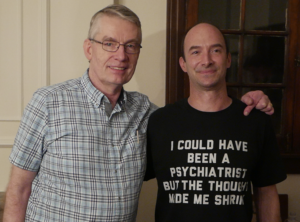
Dr. Richardson wearing a t-shirt received as a gift from Dr. Ian Kratter, a former lab member and psychiatrist at Stanford.
References and Links:
Speech and electrophysiology during DBS surgery:
Chrabaszcz, A. et al. Simultaneously recorded subthalamic and cortical LFPs reveal different lexicality effects during reading aloud. J. Neurolinguistics 60, (2021)
Dastolfo-Hromack, C. et al. Articulatory Gain Predicts Motor Cortex and Subthalamic Nucleus Activity During Speech. Cereb. Cortex 32, 1337–1349 (2022)
Employing ECoG during DBS surgery:
Sisterson, N. D. et al. Electrocorticography During Deep Brain Stimulation Surgery: Safety Experience From 4 Centers Within the National Institute of Neurological Disorders and Stroke Research Opportunities in Human Consortium. Neurosurgery 88, E420–E426 (2021)
Brain Modulation Lab:
Lab logo: “brain on holiday” designed by Italian illustrator Alberto Ruggieri.

The ‘surfing brain’ as we fondly call it here on Stimulating Brains not only represents Dr. Richardson’s personal connection to the sport but we also think serves as a symbol of the lab’s innovative and dynamic approach.